Home Blog Page 9640

IP authorities warn of widespread PPE counterfeiting during crisis

THE National Committee on Intellectual Property Rights (NCIPR) is warning against the counterfeiting of masks and other goods needed to contain the spread of coronavirus disease 2019 (COVID-19) after a surge in complaints during the enhanced community quarantine.

The Intellectual Property Office of the Philippines (IPOPHL) said in a statement Saturday that its enforcement office received 21 counterfeiting and piracy complaints in March, surpassing the 14 complaints for 2019. IPOPHL is the vice-chair of the NCIPR.

IPOPHL said that products likely to attract significant counterfeiting include masks, personal protective equipment, pharmaceuticals, hygiene products, food, and beverages.

“Counterfeiters will likely ride on the wave of the public’s spending behavior, as observed historically in both local and global markets,” IPOPHL Director General Rowel S. Barba said.

“The gaping hole between supply and demand all over the world is also an easy entry point for counterfeiters. We saw this week that amid the continuing global mask shortage, mask maker 3M Co. filed its first COVID-related lawsuit for alleged trademark infringement, among others,” he said, adding that products that bypass quality control checks for food and medicine can damage health.

IPOPHL said that among March reports, 19% involved piracy or the illegal streaming or downloading of movies.

“The findings are expected given that many are scrambling to find various sources of entertainment during the quarantine period,” Mr. Barba said.

“We have taken action by informing the rights holders, associations, and involved platforms and coordinating with them for the successful removal of the offending posts or offers.”

The office said that seizure operations and case filings are suspended while trial courts are shut, but that the NCIPR is hoping that the Philippine National Police and the Bureau of Customs could help contain counterfeiting at checkpoints.

“We were assured by the PNP and Customs that their inspection efforts will be thorough enough to capture counterfeits, arrest their movement, and prevent them from exacerbating our present burdens,” IPOPHL Deputy Director General Teodoro C. Pascua said.

Mr. Barba asked the public to report products they suspect are counterfeit, including those from online sellers. — Jenina P. Ibañez

SEC adjusts grace period for loans falling due within ECQ

THE Securities and Exchange Commission (SEC) is requiring financing and lending companies and microfinance non-government organizations to extend the 30-day grace period for loans due within the enhanced community quarantine (ECQ) period, covering those payments due when ECQ was extended to April 30.

In a notice on its website, the corporate regulator said the extension of the ECQ over Luzon until the end of the month should be considered by lenders in adjusting debt collection schedules.

“[T]he initial 30-day grace period for the payment of loans… shall apply to all loans with principal and/or interest falling due within the extended ECQ period, from March 17 to April 30,” it said.

Republic Act No. 11469 or the Bayanihan to Heal as One Act calls for a minimum 30-day grace period for loan payments during quarantine as assistance to the public during the coronavirus disease 2019 (COVID-19) outbreak.

The SEC issued a notice on April 2 ordering lenders to observe the law for all loans due from March 17 to April 12 — the initial period of the ECQ.

On April 7, the government decided to extend the ECQ period until midnight of April 30 after deciding that the lockdown had yet to contain the outbreak.

The extended ECQ prompted the SEC to call on lenders to likewise adjust their implementation of the 30-day grace period for borrowers.

In a separate advisory, the SEC said it has been receiving reports that some lenders refused to comply with the policy.

“The commission advises the public that it takes every report and complaint seriously. Accordingly, a number of (financing and lending companies) are already being investigated for possible violation of the law…,” it said.

Several lending and financing companies have previously announced extended loan payment deadlines in view of the quarantine: BDO Unibank, Inc.; Metropolitan Bank & Trust Co.; Bank of the Philippine Islands; Rizal Commercial Banking Corp.; Union Bank of the Philippines; East West Banking Corp.; China Banking Corp.; CIMB Bank Philippines; and Philippine Savings Bank. — Denise A. Valdez

DoE asks LGUs to provide grace period on energy firms’ tax payments

THE Department of Energy (DoE) asked local government units (LGUs) to extend the deadline for the payments of taxes, dues, and other obligations by energy facilities in their jurisdictions.

In a statement over the weekend, the DoE said it has ordered the energy industry, LGUs and power consumers to observe the current guidelines on the deferment of payments within the sector following the extension of the enhanced community quarantine (ECQ) to April 30.

“Having access to power services is extremely critical during this national public health emergency, so we hope that these guidelines will allay at least some of the worries of the members of the energy family,” DoE Secretary Alfonso G. Cusi said.

The Energy Regulatory Commission (ERC) released an advisory on Wednesday allowing power consumers to pay their deferred bills in installments starting mid-May until September.

The deferred amounts, it said, will appear as separate items in their bills in the succeeding months.

The ERC also advised consumers that the collection of the feed-in-tariff allowance (FiT-All), which they also pay as part of their electricity bills, is still suspended for the next billing period.

Aside from power consumers, all public and private power corporations were also granted a similar grace period on paying their dues, universal charges, total trading amounts, and other relevant charges falling within the ECQ period.

This includes payments due to the National Power Corp., the National Transmission Corp., the National Grid Corp. of the Philippines, the Power Sector and Liabilities Management Corp., the Independent Electricity Market Operator of the Philippines, as well as the fuel or resource suppliers of generating facilities and independent power producers. — Adam J. Ang

Testing your capital agenda amid COVID-19

We are currently in an unprecedented global crisis, and every country is struggling to deal with outbreaks of COVID-19 in their respective jurisdictions. Luzon is still in the midst of an enhanced community quarantine with other parts of the country rapidly following suit. We are faced with rising COVID-19-positive cases with our frontliners and health care system being pushed to the limits.

The pandemic has brought massive disruption to our daily lives and livelihoods; businesses are being shaken all around the world. The pandemic-related disruption presents different and more complex challenges compared to typical business disruptions in the dimensions of scale, velocity, duration, workforce shortage, external coordination and infrastructure availability.

As private companies continue to grapple with the evolving situation, they have to be proactive and predictive in their decision-making to preserve continuity and build resilience. It is more imperative now to test the companies’ commitment to their Capital Agenda. Our EY Capital Agenda framework presents COVID-19 considerations for companies to consider in today’s current business predicament.

INVESTING — BUY AND INTEGRATE
1. If you are in the middle of an acquisition:

a. Consider the impact on the closure process — should you close early or postpone the acquisition?

b. Ask for further scenarios that stress test the original assumptions underlying the maintainable earnings, cash flows and cost implications.

c. Revisit the robustness of your supply chain set up, working capital and short-term liquidity risks.

d. Reconsider the overall synergies and your other exposures.

2. If you are in the middle of a major capital program:

a. Revisit the feasibility of the entire project;

b. Revisit the revenue, cost estimates, and project timelines;

c. Review any delay exposures, liquidity damages and mitigation options.

3. Look for new business models and emerging investment opportunities.

DIVESTING — SELL AND SEPARATE
1. If you are in the middle of a divestment:

a. Assess the impact on the forecast cash flows, working capital, profitability and balance sheet of the business to be sold.

b. Assess the robustness of the supply chain set-up.

c. Assess the timing of the sale, the impact on the potential buyers, and pricing expectations.

d. Increase the frequency of reporting the overall results, risks and mitigating factors through data and smart analytics to the potential buyers.

2. If you are in the middle of a fund-raising exercise:

a. Reconsider the pricing and timing of the transaction, especially if it is through public markets.

b. Reconsider the purpose, timing and deal terms.

c. Explore alternative options.

3. If the business is significantly impacted, then management will need to assess the company’s short-term liquidity needs and funding options.

OPTIMIZING — CORPORATE FINANCE
1. Review the supply chain resilience:

a. Consider inventory levels for critical components.

b. Anticipate possible supplier disruptions and consider alternatives.

c. If multi-sourced, optimize production and logistics locations from impacted cities to alternative locations.

2. Scenario plan for short-term and medium-term recovery cycles.

3. Explore synergies across your business portfolio by leveraging common customers, suppliers and financing sources.

4. Explore restructuring options for the capital base — e.g. share buybacks, debt restructuring.

5. Explore cost/financing mitigation options embedded in existing contracts, insurance arrangements and government incentive programs.

PRESERVING — RESHAPING AND RESTRUCTURING
1. Consider employee well-being, communication and continuous engagement.

2. Prepare for multiple scenarios with staged action plans for prolonged employee and customer commitment, and supply chain disruptions.

3. Set up short-term cash flow monitoring; scenario plan for short and medium-term disruptions to the business and assess your cash flow needs.

4. Assess working capital management measures; proactively plan and intervene to prevent inventory build-up and collection challenges for receivables.

5. Immediate implementation of cost savings and profit improvement plans.

6. Review the impairment risk of assets; anticipate any potential breach of financial covenants.

7. Undertake deep supply chain risk assessments.

Anticipating, planning and forecasting for business disruptions are already complex and difficult exercises, but companies traditionally have past experience, conventional wisdom and corporate finance tools to guide them. However, in this unprecedented crisis, it may prove impossible to some.

Despite the challenges, however, companies need to take stock of their current business models, plan for recovery, and prepare for a new normal once the pandemic has been contained and, eventually beaten. After this crisis is over, those who will emerge are those companies that are resilient and agile enough to reshape their business models as they prepare for a post-COVID 19 world.

This article is for general information only and is not a substitute for professional advice where the facts and circumstances warrant. The views reflected in this article are the views of the author and do not necessarily reflect the views of SGV, the global EY organization or its member firms.


Marie Stephanie C. Tan-Hamed is a Transaction Advisory Partner of SGV & Co.

President weighs lockdown; lawmaker seeks 2 more weeks

PRESIDENT Rodrigo R. Duterte is expected to decide whether to lift or extend a Luzon-wide lockdown that has brought the Philippine economy to a standstill amid the coronavirus disease pandemic, and will probably continue to mandate social distancing protocols in the absence of any cure.

The National Economic and Development Authority (NEDA) will present to an inter-agency task force made up of Cabinet officials its recommendations once the lockdown that started on March 17 expires on April 30, NEDA Undersecretary Rosemarie G. Edillon said in a mobile-phone message on Sunday.

“The matter will still be presented before the Inter-Agency Task Force (IATF), the parameters to be used and the decision,” she said. “We just know that social distancing will still be observed.”

Albay Rep. Jose Maria Clemente S. Salceda yesterday said the Luzon lockdown should be extended by two more weeks.

“The risk of a resurgence of infection remains significant and the total economic cost of a resurgence in infection is triple the cost,” he told CNN Philippines.

The congressman said 130,000 people will have been tested by the end of April, which is “too small for a country of 110 million.”

NEDA heads the IATF technical working group that will recommend measures and policies in the battle against the COVID-19 virus.

Ms. Edillon said their recommendations would be used in Mr. Duterte’s decision on the lockdown.

Mr. Duterte can either lift, extend or modify lockdown protocols meant to contain the pandemic that has sickened 6,259 and killed 409 people in the Philippines.

The President will meet with health experts today including, former Health secretaries, to discuss options, Senator Christopher Lawrence T. Go, his former aide, told DZBB radio yesterday.

Mr. Duterte locked down the entire Luzon island on March 17, suspending work, classes and public transportation to contain the pandemic. He later extended it by two more weeks until April 30.

Justice Secretary Menardo I. Guevarra, a task force member, said it was not practical to wait for zero human transmission of the virus before lifting the lockdown.

“It may not be advisable to wait until the entire country reaches a zero level of human transmission,” he told reporters in a group message. “By then, we may have hit the tipping point where it would be extremely difficult to recover from the economic and social devastation.”

Senator Christopher T. Go in a radio interview said the president is meeting with health experts to consult on the extension or modification of the ECQ after April 30.

Experts from the University of the Philippines reported despite the ECQ appearing successful, its expansion “may not be sustainable over the long run,” and extending restrictions on movement of goods and services might “unnecessarily paralyze the economy.”

Resigned Socioeconomic Planning Secretary Ernesto M. Pernia last week said extending the lockdown beyond April 30 would be difficult, and should be gradually lifted instead.

In an interview with the ABS-CBN News Channel yesterday, he reiterated his proposal for selective quarantine after April 30, adding that this should be accompanied by mass testing.

Joey Concepcion, Mr. Duterte’s adviser for entrepreneurship, wants selective lockdown or village-based strategies to avoid penalizing areas that remain COVID-19-free. — Beatrice M. Laforga, Genshen L. Espedido, Vann Marlo M. Villegas and Charmaine A. Tadalan

QC COVID-19 cases top 1,000 as national tally reaches 6,259

QUEZON City will strictly enforce monitoring and surveillance in coronavirus hotspots after infections rose to more than a thousand, according to the local government.

The city in a social media post at the weekend said cases have reached 1,042 with 90 deaths.

The villages of North Fairview, Novaliches Proper and New Era were placed under “extreme enhanced community quarantine,” bringing the number of villages under the reinforced quarantine protocol to 34, the local government said.

“There will be strict monitoring and surveillance in these areas,” it said. “Expect quarantine checkpoints manned by police, village law enforcers and health authorities.

The village of Batasan Hills posted the biggest number of cases with 30, followed by Culiat with 19 and Pasong Tamo with 16.

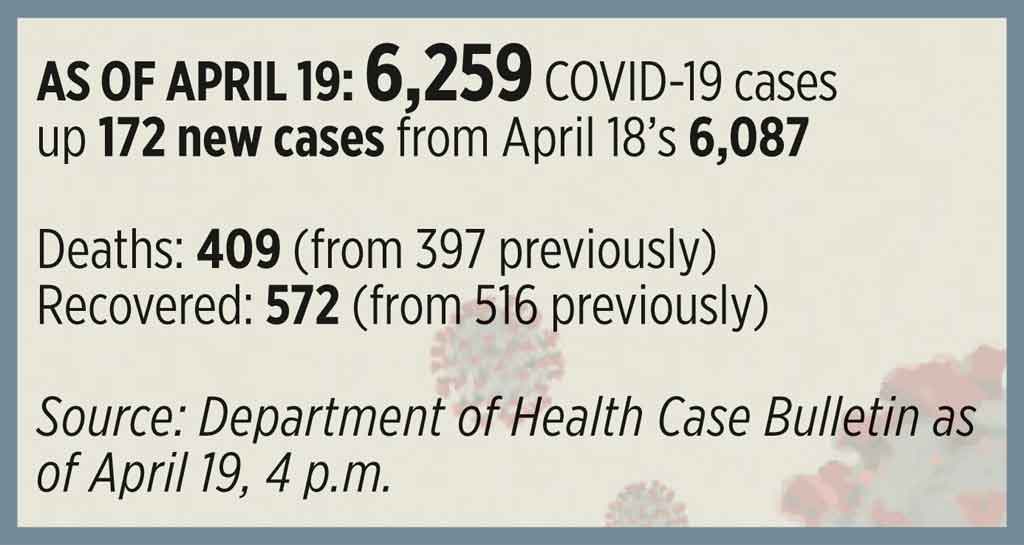
DoH reported 172 new infections on Sunday, bringing the national tally to 6,259.

Twelve more patients died, raising the death toll to 409, it said in a bulletin. Fifty-six more patients have gotten well, bringing total recoveries to 572, it added. — Vann Marlo M. Villegas

Cash remittances may fall by $3B

CASH remittances from Filipinos overseas will probably fall by $3 billion from a year earlier to $27 billion this year as the world grapples with the coronavirus disease 2019 pandemic, ACTS-OFW Coalition of Organizations said in a statement on Sunday.

The estimate assumes the “best possible outcome,” ACTS-OFW chairman Aniceto D. Bertiz III said.

The group said the pandemic would probably trigger joblessness among Filipino workers overseas, he said.

“The foreign labor markets for Filipino workers — except for medical professionals and technicians — will shrink considerably this year as the global economy declines,” he added.

Filipino workers in the shipping, aviation, travel, hotel and restaurant, gaming, oil, gas and energy sectors would likely be the most hit by the global health crisis, Mr. Bertiz said.

The collapse of crude oil prices to $20 to $25 per barrel is expected to ease the demand for Filipino workers — from engineers to construction workers — in the Middle East, he said.

The kingdoms in the region heavily dependent on oil and gas income would probably spend less aggressively on new public infrastructure, according to Mr. Bertiz.

“The global economic recession will also reduce the demand for Filipinos sailor as shipping traffic sinks,” he added.

The Philippines is the world’s second-largest supplier of licensed ship officers and the top provider of unlicensed ship ratings or non-officer crew.

About 450,000 Filipino sailors serve on ocean-going bulk carriers, container ships, oil, gas, chemical and other product tankers, general cargo ships, pure car carriers and tugboats around the world.

Mr. Bertiz said ACTS-OFW is counting on the government to provide financial aid to Filipino workers overseas who have lost income under the “no work, no pay policy” of their employers.

The Overseas Workers Welfare Administration last week started accepting online applications for the $200 (P10,000) cash aid for Filipino workers abroad. — G.M. Cortez

#COVID-19 Regional Updates

VISAYAS

Bus terminals in Cebu to serve as temporary wholesale markets for agri goods

CEBU province’s local officials continue to find new measures to minimize convergence sites which serve as transmission opportunities for the coronavirus disease 2019 (COVID-19) as the number of cases in Cebu City, the central area, has shot up to 163 as of April 18. In a meeting last week, the province’s mayors agreed to designate two major bus terminals as temporary wholesale markets for agricultural produce. Fresh catch from the northern parts of Cebu will be traded at the North Bus Terminal instead of the Pasil Fish Market while farm produce from the south will be sold at the Cebu South Bus Terminal instead of the Carbon Public Market. The Pasil and Carbon markets within Cebu City will remain as retail centers. “As a new normal practice, wholesalers are to converge at the said terminals in a bid to continue their enterprise while avoiding exposure to possible COVID-19 carriers,” the Cebu provincial government said in a statement. Of the 187 COVID-19 cases in the entire Central Visayas, there are 10 in Lapu-Lapu City, six in Mandaue City, and three in towns under Cebu province. Cebu City’s high number of patients is due largely to an outbreak in one village, Barangay Luz, where there are 137 as Friday. The village has been put on strict lockdown with all residents considered as COVID-19 suspected cases. Cebu Governor Gwendolyn F. Garcia has handed over the province-owned evacuation center in Barangay Busay to Cebu City to serve as additional isolation facility for positive patients with mild illnesses. — Marifi S. Jara

MINDANAO

MICE conference, Ironman moved to 2021 as Davao City bans big events until end-2020

ALL major events in Davao City — including its Kadayawan Festival; the Philippine Meetings, Incentive Travel, Conventions and Exhibitions (MICE) Conference; and the 3rd Alveo 70.3 Ironman, among others — have been cancelled or moved to next year. Mayor Sara Duterte-Carpio, in an executive order issued Friday, banned all big celebrations for the rest of this year with the declaration of a “Period of Mourning and Vigilance.” In her executive order, Ms. Carpio said the period of mourning is intended to emphasize the value of sympathy for the families of frontliners who died in the fight against the coronavirus disease 2019 (COVID-19) as well as all those suffering from the impact of the crisis. The commemoration of important dates and legal holidays will also be kept short. Family and other private gatherings must be kept “low key.” She said, “As a guide, low key can mean a celebration in a public place with no more than 25 guests.” Private firms, meanwhile, are advised to consider food distribution, feeding program, or providing financial assistance to their employees instead of grand celebrations to mark important events. For the MICECON scheduled in September, Seda Abreeza General Manager Kennedy V. Kapulong, chair of the Davao MICE executive committee, said they will send a letter of recommendation to the Tourism Promotions Board for the postponement to 2021. The 3rd Alveo 70.3 Ironman, supposed to be held in May, will also be moved next year. — Maya M. Padillo

Nationwide round-up

Barangay-level lockdown to continue after ECQ lifting

SELECTIVE lockdowns at the barangay level should remain in place after the enhanced community quarantine (ECQ) measures against the spread of the coronavirus disease 2019 (COVID-19) are lifted, Presidential Adviser for Entrepreneurship Jose Ma. A. Concepcion III said. “(For) areas that still have high level of infection, I think they will continue (the lockdown), and I would agree with that because we cannot let our guards down,” Mr. Concepcion said in a television interview on Sunday. Secretary Carlito G. Galvez Jr., chief implementer of the COVID-19 National Action Plan, earlier said selective quarantine is possible as a means to isolate and treat COVID-19 patients. “We start from the barangay… if it’s very hard for the government to monitor, then you can look at the municipality and elevate it to the city and so forth to the province. Those are our recommendations,” Mr. Concepcion said. He also announced that the private sector recently launched Project ARK (antibody rapid test kits) to test all employees for the virus. The project will later be expanded to sample sizes in barangays, he said, adding that the data collected by the private sector will be shared with the Health department. — Jenina P. Ibañez

Lawmaker seeks detailed report on quarantine facilities

A LAWMAKER called on the government to provide detailed reporting and accountability on temporary quarantine facilities (TQFs) for coronavirus disease 2019 patients around the country. “There is an IATF (Inter-Agency Task Force on Emerging Infectious Disease) directive enjoining LGUs (local government units) to set up their temporary quarantine facilities. Where are the daily and weekly reports on these TQFs?” Ako Bicol Party-list Rep. Alfredo A. Garbin, Jr. said in a statement Sunday. He recommended that the government post status reports on TQFs and identify the accountable individuals in charge of the day-to-day operations. — Genshen L. Espedido

Gov’t yet to decide on ceasefire extension

THE GOVERNMENT has yet to discuss whether to extend the unilateral ceasefire with communist rebels, Palace Spokesperson Harry L. Roque said in a statement on Sunday. “(T)his matter is something the National Task Force on Ending Local Armed Conflict can discuss with the President,” he said. The ceasefire was first ordered by President Rodrigo R. Duterte at the beginning of the enhanced community quarantine (ECQ) last month as the country deals with the coronavirus disease 2019 (COVID-19) crisis. The National Democratic Front of the Philippines-Communist Party of the Philippines reciprocated after the United Nations called for a global armistice amid the COVID-19 pandemic. The communist movement has announced a ceasefire extension to April 30, which coincides with the lifting of the ECQ. “The call for peace is everyone’s desire and it has become more urgent in the present state of calamity and public health emergency,” Mr. Roque said. — Gillian M. Cortez

Palace wants more proof of alleged human rights violations by LGUs

THE Palace on Sunday said they will need more proof before taking action on alleged human rights violations by local government units (LGUs) in the implementation of community quarantine guidelines. Palace Spokesperson Harry L. Roque, in a statement, said, “As we are not fully aware of the details of such violations, we will appreciate receipt of detailed information of the same for proper action by the appropriate agencies.” He added, “Under the current circumstances we are in, the LGUs enforce the law as reasonably strict as possible for the full protection of our people.” The national government has imposed a lockdown in Luzon and quarantine guidelines for LGUs nationwide. There have been allegations made on social media of punishments for violators such as carrying a gallon of water for hours, push-ups, and other physically demanding activities. Mr. Roque told the public to simply follow the quarantine rules, saying, “This entails everyone’s cooperation. We need to fight this pandemic together.” — Gillian M. Cortez

Too early to worry COVID-19 will further delay Tokyo Games

TORONTO — It is premature to think the coronavirus disease 2019 (COVID-19) pandemic will further delay the Tokyo Olympics, which have already been postponed a year, Brian McCloskey, an expert on global health security and outbreak prevention told Reuters.

Under increasing pressure from athletes, the International Olympic Committee (IOC) and Tokyo Games organizers last month postponed the 2020 Games for one year as the COVID-19 spread, shutting down global sport.

Yet as countries try to beat back the pandemic, with experts predicting a vaccine is still 12-18 months away, questions have begun to surface as to whether a year’s delay is sufficient time to stage the Games in a safe environment.

“I think that’s probably a little bit premature in the sense that we’ve got 15 months more of planning and preparing for the Olympics in 2021,” McCloskey said. “So, I think it’s premature to say it’s unrealistic (that the Olympics cannot be held in 2021).

“Clearly, having a vaccine would be extremely helpful, not just for the Olympics, but for all of us. But even without a vaccine I think there are other mitigation measures we will look at to make sure we can run the Games safely.

“So, it’s a challenge, but I’d say it’s too soon to say it can’t happen.”

The number of confirmed coronavirus disease 2019 cases in Japan rose to 10,000 on Saturday, public broadcaster NHK said, just days after a state of emergency was extended to the entire nation in an attempt to slow the spread of the virus.

WAIT-AND-SEE APPROACH
Just over 200 people have died from the virus in Japan.

“This year for Tokyo, it got to the point where the amount of mitigation that would have been needed was more than we could ask the Japanese government to do when the Japanese government needed to be focusing on looking after its population,” said McCloskey, a member of the World Health Organization Novel Coronavirus-19 Mass Gatherings Expert Group.

“But that could well have changed by next year. So, it’s quite possible that the outbreak will be at a level where it’s manageable without any particular risk.

“Or it may be that the vaccine arrives, it may be there’s treatment available. So, we just need to think through the options and not jump to too many conclusions too quickly.”

McCloskey’s wait-and-see approach sounds similar to the one taken by the IOC before it decided to postpone the Games amid mounting criticism.

Athletes were angry at being left in a state of limbo by the IOC and Tokyo organizers and while the postponement has provided a cushion, the clock is once again ticking.

Sports leagues and federations around the world are preparing to emerge from the outbreak and return to action with most seemingly resigned to the fact they will be played in empty arenas and stadiums until it is safe for fans to come back.

“So, we can run through to this time next year,” said McCloskey, looking ahead to a 2021 Summer Games. “After that it gets more problematic because people have spent a lot of money, athletes have to make up their mind whether they can come or not.

“So, it gets more and more difficult the closer you get. But I’d say there’s a willingness and an enthusiasm to make sure it happens properly.

“So, people will try hard and I think they’ll hang on to the last minute to see whether it’s safe to go.” — Reuters

PhilSports Arena ready to serve as coronavirus facility

THE multipurpose arena at the PhilSports Complex in Pasig City is now ready to be used as a facility to accommodate people infected by the coronavirus disease 2019 (COVID-19).

Repurposed to accommodate one hundred plus patients, the arena, popularly known as ULTRA, was set to start accepting patients yesterday with the end view of treating them as well as isolating them from the community to mitigate the spread of the highly contagious respiratory disease.

A task force under the Department of Public Works and Highways led the conversion of the arena, which served as home of the volleyball competition in the 30th Southeast Asian Games in December, to a facility for COVID-19.

The PhilSports Arena is another one of the facilities under the supervision of the Philippine Sports Commission repurposed to help in the government push to fight COVID-19.

It follows those of the Ninoy Aquino Stadium and the Rizal Memorial Coliseum in Manila.

The PSC has expressed readiness to open its other facilities for use if the need arises.

“These times call for unselfish patriotism. Let us step up to the plate. This is us as a sporting community stepping up to bat,” said PSC Chairman William Ramirez.

As of this writing, confirmed COVID-19 cases in the country were at 6,259, with 572 recoveries and 409 deaths. — Michael Angelo S. Murillo

NBA Players to receive 25% less pay from May 15

LOS ANGELES — The NBA has reached an agreement with the National Basketball Players Association to withhold 25% of each player’s salary from May 15 due to the shutdown of the sport because of the coronavirus pandemic.

The deal would provide a gradual reduction in player salaries in case a “force majeure” event, such as the pandemic, wipes out the rest of the regular season.

The money will be placed in escrow and paid back to players if all of the remaining regular season games are played, ESPN reported.

If only part of the season can be played, the amount paid out would be on a pro rata basis based on the number of games completed.

The salary reductions will continue through the first two months of the 2020–21 NBA season, ESPN said.

The NBA has not held a game since March 11 and it is unclear when it might return to action. — Reuters