PHILIPPINE SHARES continued to fall on Tuesday as investors reacted to the historic drop in oil prices to new lows overnight.
The 30-member Philippine Stock Exchange index (PSEi) lost 141.40 points or 2.46% to close at 5,592.25 on Tuesday. The broader all shares index fell 84.16 points or 2.42% to 3,389.74.
“Market is down…due to the downward spiral of oil price which may cause bankruptcy of highly-leveraged oil producing nations wherein their economies mainly rely on oil,” Diversified Securities, Inc. Equity Trader Aniceto K. Pangan said in a text message yesterday.
United States oil prices crashed to negative territory on Monday as the global demand dropped sharply due to limitations on mobility caused by the coronavirus disease 2019 (COVID-19) pandemic.
Mr. Pangan said oil’s negative effect on the equities markets may continue for the rest of the week if Russia and Saudi Arabia will also keep flooding the global oil supply.
US stocks declined on Monday: the Dow Jones Industrial Average, S&P 500 and Nasdaq Composite indices fell 2.44%, 1.79% and 1.03%, respectively. Asian markets were also sour on Tuesday: Japan’s Nikkei 225 and Topix indices dropped 1.97% and 1.15%, respectively, South Korea’s Kospi index fell 1.00%, and China’s Shanghai Shenzhen CSI 300 index slipped 1.18%.
For Timson Securities, Inc. Trader Darren T. Pangan, the drop in the local bourse is also still attributable to worries of the COVID-19 pandemic. “[P]rofit taking may have ensued as investors take a breather to assess the COVID-19 pandemic situation in the country,” he said.
As of Monday afternoon, COVID-19 cases in the Philippines reached 6,259 people. Deaths hit 428 individuals while 613 have recovered.
“The PSEi broke down from the 5,600… If it continues to trade lower than 5,500 [today], then next support is at 5,300. Otherwise, resistance remains at the 6,000 area,” Timson Securities’ Mr. Pangan said.
Sectoral indices at the PSE all closed in red territory on Tuesday. Mining and oil led with 138.30 points or 2.89% erased to 4,642.80. Industrials lost 190.26 points or 2.55% to 7,255.41; services let go 32.26 points or 2.48% to 1,266.97; property shaved off 71.25 points or 2.43% to 2,860.92; holding firms trimmed 134.22 points or 2.36% to 5,551.84; and financials dropped 27.22 points or 2.22% to 1,195.34.
Some 764.34 issues valued at P5.66 billion switched hands yesterday, higher from Monday’s 703.70 million issues worth P4.76 billion.
Decliners led advancers, 140 against 49, while 44 names ended unchanged.
Offshore investors fled the Philippine stock market, recording a net foreign selling of P763.35 million from Monday’s P628.75 million. — Denise A. Valdez
AT least 19 inmates and a worker at a correction facility for women near the Philippine capital have been infected with the coronavirus, raising fears of outbreaks in hundreds of the country’s cramped jails.
In a Facebook post, the Bureau of Corrections (BuCor) on Tuesday said 18 prisoners and a staff member at the Correctional Institute for Women in Mandaluyong City have tested positive for the virus.
They were exposed to a 72-year-old inmate who has since been hospitalized, according to the social media post.
“Those who tested positive were reported to have mild symptoms and some were asymptomatic,” the bureau said.
“They are now being monitored and given vitamins, medicines and food supplements to strengthen their immune system, it added.
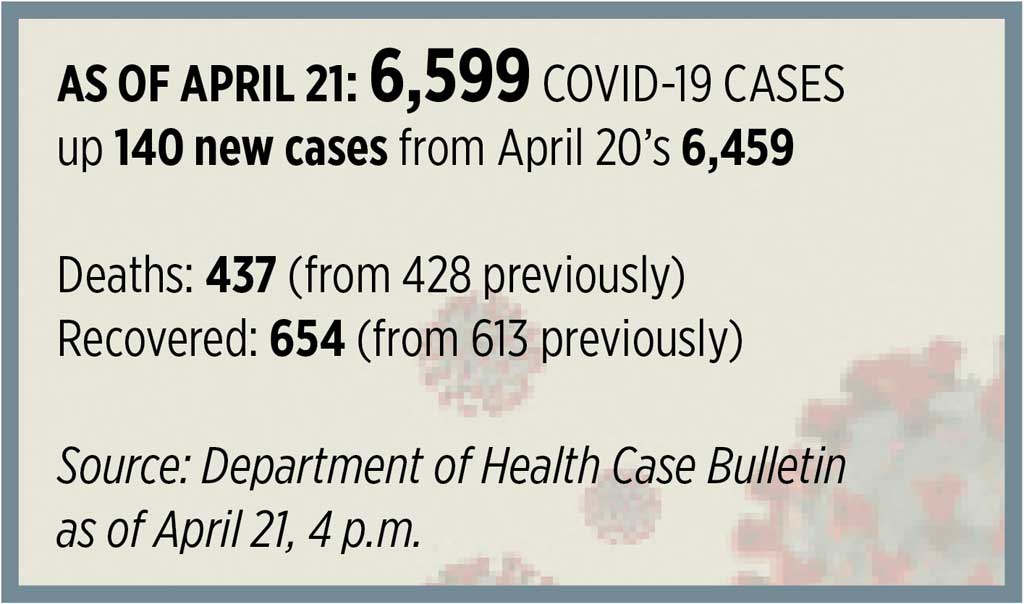
The Department of Health reported 140 new infections yesterday, bringing the total to 6,599.
Nine more patients have died, raising the death toll to 437, it said in a bulletin. Forty-one more patients have gotten well, bringing the total recoveries to 654, it added.
BuCor said officers at the female prison were conducting contract tracing so these people can be isolated in quarantine areas. They will also be tested for the coronavirus disease 2019.
Prison management will boost partnerships with government hospitals for the admission of COVID-19-positive inmates as well as with donors, partners and stakeholders to fight the disease. Philippine prisons need beds, big tents and medicines.
The prison bureau on Saturday said the 72-year-old inmate who had tested positive for the virus was confined at the Sta. Ana Hospital in Manila.
She has a history of diabetes and had been diagnosed with pneumonia at the prison’s infirmary.
More than 20 prisoners who claimed to be vulnerable to COVID-19 earlier asked the Supreme Court to allow their release through bail on humanitarian grounds.
Several groups have also urged the tribunal to allow the release of those who are elderly, sick and pregnant, citing congestion in jails.
The tribunal’s court administrator this week asked trial judges to enforce a six-year-old rule allowing the release of detainees who have been jailed for a time equal to the minimum of the penalty charged.
Those whose hearings had been postponed at least twice in the absence of witnesses should also be freed.
Meanwhile, Health Undersecretary Maria Rosario S. Vergeire said they have conducted 58,072 tests.
The rate of infections have slowed and most cases remained in Metro Manila, she said at a news briefing. There were about 30 provinces with zero or minimal cases of the virus, she added.
Mr. Vergeire warned that cases could still spike if preventive measures were not followed.
She said the Philippine International Convention Center has been turned into a quarantine facility with 294 beds. The New Clark City National Government Administration Center in Pampanga province also started admitting COVID-19 patients with 688 beds.
In separate advisory, DoH said the Research Institute for Tropical Medicine scaled down its operations from April 16 to 24 after 43 of its personnel tested positive for the novel coronavirus.
Testing and contact tracing would continue, Ms. Vergeire said, adding that this would not affect the release of results.
She also said 75 people at the National Center for Mental Health — 62 employees and 13 psychiatric patients had tested positive for the virus. Five of them have recovered.
HEALTH experts on Monday advised President Rodrigo R. Duterte to limit the lockdown to certain areas and industries, while expanding the government’s testing capacity to contain the coronavirus disease 2019 pandemic.
“The more we expand our testing capacity, the more we have confidence in modifying the quarantine,” Cabinet Secretary Karlo Alexei B. Nograles said at a briefing on Tuesday.
Mr. Nograles, who also speaks for an inter-agency task force against the virus, said the President needed more time before deciding on the lockdown that started on March 17. It was supposed to end on April 13 but he extended it by two more weeks until April 30.
“It’s not an easy decision,” Mr. Nograles said, adding that Mr. Duterte has until the end of the week to make up his mind.
The President needs more data before deciding on the so-called enhanced community quarantine, his spokesman Harry L. Roque said at a separate news briefing.
He said the experts had told Mr. Duterte to either relax or lift the Luzon-wide lockdown in areas where there are not too many COVID-19 cases.
The task force will keep in mind the guidelines of the World Health Organization, which had warned of a spike in cases worldwide if the lockdowns were lifted too soon.
Also yesterday, Party-list Rep. Virgilio S. Lacson said the lockdown should be relaxed in some areas to allow micro, small and medium enterprises and informal entrepreneurs to resume business.
The relaxed quarantine should be enforced by villages because they know the needs of their communities, the congressman said in a committee report.
Small business should be allowed to operate while the local governments monitor them for compliance with social distancing and disinfection measures to contain the pandemic, he said. — Gillian M. CortezandGenshen L. Espedido
CORONAVIRUS infections in the Philippines may hit 12,000 once a Luzon-wide lockdown is lifted on April 30, assuming the capacity of the country’s health system will have improved by then, according to an academic expert.
Cases will have reached two million by June without the so-called enhanced community quarantine, Ateneo de Manila University professor Ma. Regina Justina E. Estuar told a news briefing on Tuesday.
President Rodrigo R. Duterte locked down the entire Luzon island on March 17 until mid-April, which cut confirmed cases by half a million and slowed the peak, she said. The President later extended the home quarantine by two more weeks until April 30.
“Cases went down because the capacity of our health system went up after people’s movements were limited under the enhanced community quarantine,” Ms. Estuar said in Filipino.
Ms. Estuar, project leader of a tool funded by the Department of Science and Technology in projecting cases for epidemic or pandemic such as dengue, typhoid fever and measles, said the government must expand its testing capacity.
It can do so by buying more COVID-19 test kits, setting up more test centers and training more health workers, she said. — Vann Marlo M. Villegas
THE National Water Resources Board (NWRB) vowed to maintain its increased water allocation to the two concessionaires in Metro Manila, the area in the country with the highest number of coronavirus disease 2019 (COVID-19) cases. In a radio interview Tuesday, NWRB Executive Director Dr. Sevillo D. David Jr. said the water allocation to the nation’s capital has been raised to 46 cubic meters per second (cms) since the national government declared a state of public health emergency. On Monday, President Rodrigo R. Duterte reported to Congress that the NWRB has increased the water allocation in accordance with the call for the observance of frequent hand washing and baths as preventive measures to combat the virus causing COVID-19. As of Tuesday morning, the water level of Angat Dam, Metro Manila’s main source, was at 192.25 meters, lower by 0.20 meters from Monday, according to data from the Philippine Atmospheric, Geophysical, and Astronomical Services Administration (PAGASA). Angat Dam’s normal water level is 212 meters. — Revin Mikhael D. Ochave
Iloilo City prepares post-quarantine plan; UP Visayas submits exit guide
ILOILO City Mayor Jerry P. Treñas has formed a multi-sector committee that will draw up protocols for the gradual lifting of restrictions after the enhanced community quarantine (ECQ) policy ends on April 30. The committee, chaired by Roland Jay Fortuna, the city’s focal person for the coronavirus disease 2019 (COVID-19) response, includes city hall department heads, councilors, police officers, and business sector leaders. “We really have to move forward. We will slowly lift the ECQ,” Mr. Treñas said in a press conference on Monday. Meanwhile, a group of professors and experts from the University of the Philippines Visayas submitted to the mayor a quarantine exit plan that will be used as one of the guides for allowing businesses to resume operations while maintaining safety measures against COVID-19. Professors Maria Elisa Baliao Rhodella Ibabao, Hanny John Mediodia, Cristabel Parcon, Juhn Cris Espia, and Vicente Balinas recommended steps based on the experiences of countries that have started their gradual exit from a lockdown or have adopted general community quarantine measures. The proposed measures are also based on online reports and informal consultations with sector representatives. “Once the lockdown policy is lifted after April 30, Iloilo City should consider prepping for a phased reopening and scaling back of LGU’s (local government unit’s) support for the economy. The phased reopening is a strategy that will protect the people from the virus allowing life to progressively return to normal, albeit a ‘new normal,’” reads part of the exit plan. — Emme Rose S. Santiagudo
FOREST rangers in the Bangsamoro Autonomous Region in Muslim Mindanao (BARMM), among them former Moro Islamic Liberation Front combatants, have started cultivating “survival gardens” of vegetables and short-term crops in forestlands as part of food security measures amid the coronavirus disease 2019 (COVID-19) outbreak. “They have already begun implementing the initiative in their respective communities early this month,” BARMM-Minister of Environment, Natural Resources and Energy Abdulraof A. Macacua said in a statement on Monday. The gardens, he said, “will serve as another source of food for the region’s constituents, helping them ease the shortage of food supply” during and after the health crisis. Provincial Environment, Natural Resources and Energy (PENRE) officers continue to identify suitable planting areas around the region, considering those that are near forest-dependent communities and where water is accessible. Mr. Macacua said in Filipino, “We are hopeful that this vegetable gardening will continue not just while there is a pandemic, but in days ahead because this is beneficial to families.” The BARMM ministry, similar to several local governments and agricultural regional offices around the country, has also been promoting and providing seeds for backyard gardening. — Carmelito Q. Francisco
THE NEW school year will likely open in August instead of the usual June start, Education Secretary Leonor M. Briones said on Tuesday. In a briefing, Ms. Briones said consultations with teachers and other stakeholders indicate that it will be hard to push for the normal academic calendar for school year 2020-2021 given the coronavirus disease 2019 (COVID-19) situation. “Right now, ang lumabas sa ating mga consultations, karamihan nagsasabi, para may panahon tayo na maghanda sa pagbabago ng edukasyon, pagbabago ng pamamaraan ng pagtuturo at saka kailangang masigurado natin na malinis at safe iyong ating kabataan, karamihan sa nag-re-respond ay para sa August (what came from these consultations, many say that we need time to prepare, revise the way we teach, and ensure that our children are secure and safe, many are for an August opening),” Ms. Briones said. On the other hand, experts from the University of the Philippines recommend that classes be kept suspended until the end of the year to curb the transmission of COVID-19. Alfredo Mahar A. Lagmay, an academician of the National Academy of Science and Technology, said in a Palace briefing on Tuesday that based on their study, extending the suspension of classes in all levels until December will help prevent a massive spread of the virus. He cited that students interact with vulnerable age groups such as the elderly. The government is currently assessing the policies that will be implemented after the enhanced community quarantine expires on April 30. — Gillian M. Cortez
Duterte administration vows ‘substantial grant’ for COVID-19 vaccine research
PRESIDENT Rodrigo R. Duterte will be providing a “substantial grant” to researchers at the University of the Philippines (UP) to help develop a vaccine for the coronavirus disease 2019 (COVID-19). In a briefing on Tuesday, Presidential Spokesperson Harry L. Roque said Mr. Duterte will give a “substantial grant sa UP at sa (and to) UP-PGH (UP-Philippine General Hospital) para po maka-develop nga ng bakuna laban dito sa (to develop a vaccine to fight) COVID-19.” UP scientists have developed a COVID-19 test kit, which was approved by the Food and Drug administration earlier this month. Researchers from UP have also created a COVID-19 dashboard tracker, which monitors the spread of the virus by classifying data of cases. Mr. Roque also said that the President has offered a P10 million reward to anyone who will develop a vaccine for the virus.
‘LAB CZAR’
Meanwhile, Iloilo Representative Janette L. Garin, a former Health secretary, has urged the Department of Health (DoH) to assign a “COVID lab czar” who will oversee and coordinate all laboratory testing centers in the country. “The laboratory testing centers, they are all acting individually… If we had a COVID lab czar who directly coordinates with each laboratories, ‘yung mga maliliit na kailangan…lahat po kaya (all the small details required… everything can be addressed),” Ms. Garin told DzBB radio on Tuesday. She also stressed that quarantine facilities should be established to house suspected COVID-19 cases and do away with the home quarantine practice. “Matagal ko na itong pinaglalaban na talagang meron dapat tayong quarantine centers hindi lang po sa Metro Manila (I have been pushing for this for a long while, that we should have quarantine centers)… because I don’t personally believe that home quarantine will work,” she said. — Gillian M. CortezandGenshen L. Espedido
MAP calls for ‘demand-driven’ transport system during post-lockdown transition; lawmaker bats for construction resumption
THE Management Association of the Philippines (MAP) has proposed to the Department of Transportation (DoTr) the implementation of a “demand-driven” transport system in Metro Manila so that employees can “gradually” return to work, and avoid business closures and layoffs as the country battles the coronavirus disease 2019 (COVID-19) pandemic. MAP said it submitted its proposal entitled “Transition Towards the Normalization of the Public Transport System in NCR (National Capital Region) with Initial Focus on Buses, LRT/MRT/PNR” to DoTr Secretary Arthur P. Tugade on Monday. Under the proposed system, “the number of transport vehicles, to be authorized, will be determined by the size of the requirements for transport service.” MAP noted that the country had a total workforce of 42.925 million as of July 2019, of which 5.4 million were employees in the NCR. The group said the government could allow public transport in the NCR “on a graduated and phase-by-phase basis for more or less 245,000 people (estimate for a skeletal force), with the number increasing gradually as the COVID-19 curve flattens.” MAP said the goal is to allow more businesses, workers and daily-wage earners to work while following and enforcing the COVID-19 protection protocols. Also, as part of the proposal, the Land Transportation Franchising and Regulatory Board (LTFRB) will identify the buses and rail systems — including the Manila Metro Rail Transit System, the Manila Light Rail Transit System and the Philippine National Railways — that will be authorized to ply specific routes based on a set of criteria that it will develop jointly with bus operators, LRT/MRT/PNR management, and Philippine National Police. Travels will also be limited to “absolutely necessary” trips, such as going to and from work, buying medicines and food, and other emergencies. MAP said that if DoTr and LTFRB find its proposal feasible, “they can begin by experimenting it on a limited basis (such as starting with EDSA) and expand it gradually to other routes.”
CONSTRUCTION
At the House of Representatives, Deputy Speaker Luis Raymund F. Villafuerte is proposing the inclusion of construction activities as an essential service exempted from containment measures that will remain in place beyond April 30, the supposed end of the enhanced community quarantine measures. “Rebooting ‘Build, Build, Build’ projects even during the lockdown will spearhead the recovery of our economy and thus mitigate the adverse effects of what the International Monetary Fund expects to be the worst global recession in almost a century since the Great Depression of the 1930s,” said the Camarines Sur representative in a statement on Tuesday. Mr. Villafuerte said that the administration’s Build, Build, Build program must be put back on track “as infrastructure investments offer the highest multiplier effects, including job generation, on the economy” and could stimulate high growth despite the COVID-19 crisis. He said regular construction work can resume on major infrastructure projects “for so long as social distancing measures and other health protocols are strictly imposed in job sites.” The Inter-Agency Task Force for the Management of Emerging Infectious Diseases earlier approved the request of the Department of Transportation to allow the resumption of utility relocation and other works on 13 rail projects. — Arjay L. BalinbinandGenshen L. Espedido
Over P240B pooled so far from gov’t sources for COVID-19 response
OVER P200 billion has been pooled so far by the Duterte administration from internal sources for response measures relating to the coronavirus disease 2019, based on the President’s 4th weekly report to Congress submitted Monday. A total of P246.28 billion worth of savings has been gathered from various sources as of April 16, according to the report. A majority of these savings have already been distributed by the Department of Budget and Management to other government agencies. “P148.933 billion has already been downloaded by the DBM to relevant national government agencies (NGAs) in connection with the government’s COVID-19 responses.” Additional allotments worth P5.690 billion and P7.789 cash allocations that were released are from programs under the 2020 budgets of the NGAs. Unlike the third report which detailed how the funds released for that week worth P132 billion were allocated, the fourth report did not indicate the specific government agencies that received what amount from the pooled savings. Under the Bayanihan to Heal As One Act, President Rodrigo R. Duterte has the power to realign the 2019 and 2020 national budgets towards COVID-19 measures.
CONTRACTUALS
Meanwhile, Cagayan de Oro Representative Rufus B. Rodriguez urged Mr. Duterte to extend the service of contractual government workers to the end of the year. “With the current COVID-19 situation, the enhanced community quarantine in Luzon and lockdowns happening all over the country, it is becoming clear that there is a very strong possibility that the contracts of these employees might not be renewed or extended,” Mr. Rodriguez said in a letter to the President obtained by BusinessWorld. He cited that there are about 700,000 government personnel on job-order or contract-of-service arrangements. He also pointed out that government agencies have funds in their budgets for contractual personnel. He informed the President that the Workers of Government Movement in Cagayan de Oro City sought his help in having their services retained. “As such, may I endorse their request for the contracts of these workers to be securely extended until Dec. 31, 2020. This will provide security to them in these uncertain times,” Mr. Rodriguez said. — Gillian M. CortezandGenshen L. Espedido
More Filipinos return from NZ, Singapore, Malawi; LANDBANK to offer ‘study now, pay later’ program for OFWs
ALMOST 100 more Filipinos from New Zealand, Singapore and Malawi have been repatriated amid the coronavirus disease 2019 (COVID-19) pandemic that has sickened 2.4 million and killed over 170,000 people worldwide, the Department of Foreign Affairs (DFA) reported on Tuesday. Sixty overseas Filipino workers (OFWs) arrived on Monday evening from Auckland, New Zealand, 14 from Singapore, and 19 from Malawi. This brings the total number of repatriates to nearly 18,000 out of the DFA’s 20,000 target beneficiaries.
The most recent repatriations were facilitated by the Philippine Embassies in New Zealand, Nigeria and South Africa. “The OFWs from Malawi transited through Zambia, Zimbabwe, Ethiopia, Germany, and Qatar, before finally returning to the Philippines,” the DFA said in a statement. All the repatriates will undergo the mandatory 14-day quarantine after being subjected to the Bureau of Quarantine’s medical checkup upon arrival. The DFA, as of April 20, is monitoring 584 patients abroad undergoing treatment. Another 263 have recovered, while 143 have died.
LOAN
In another development, Finance Secretary Carlos G. Dominguez III said the Land Bank of the Philippines (LANDBANK) will offer a “study now, pay later” loan program for displaced OFWs. “If private schools provide a study now, pay later program, and get a promissory note from the student… LANDBANK can lend the private school against that promissory note, probably up to 70% to 75% of the value of the promissory note,” he said during the House Defeat COVID-19 committee virtual hearing on Tuesday. Mr. Dominguez also said the state-owned bank will launch a digital bank by the “middle of this year,” which will mainly serve OFWs. Meanwhile, Bangko Sentral ng Pilipinas Governor Benjamin E. Diokno said in the same hearing that they plan to make borrowing for small and medium enterprises (SMEs) “as user-friendly” as possible. “We try to be creative, gusto namin mapupunta ‘yun sa (we want loans to go to) small and medium scale industries,” Mr. Diokno said. LANDBANK President and Chief Executive Officer Cecilia C. Borromeo recommended to the House panel that the bank, along with fellow state-run Development Bank of the Philippines, be the implementing agencies for the government’s lending programs. — Charmaine A. TadalanandGenshen L. Espedido
Trump offers more assistance to PHL’s COVID-19 response
UNITED States President Donald J. Trump has offered additional assistance to the Philippines in its coronavirus disease 2019 (COVID-19) response, the US Embassy in the Philippines said on Tuesday. The embassy confirmed that Mr. Trump had spoken to President Rodrigo R. Duterte last Sunday. “President Trump expressed his solidarity and offered additional assistance to the Philippines as it continues to battle the COVID-19 pandemic,” the Embassy said in a statement. The Philippines has so far received $4 million or over P203 million worth of assistance from the US government. The financial aid is intended to support the Philippine government in expanding its testing capacity, among other response measures. “The two leaders also discussed how the United States and the Philippines can continue building upon the strong and enduring economic, cultural, and security ties binding the two nations,” the embassy said. Mr. Trump also expressed his condolences over the death of 11 Philippine soldiers in an encounter with Abu Sayyaf terrorists in Sulu last Friday. — Charmaine A. Tadalan
THE HIGHLY ANTICIPATED premiere of the 10-part ESPN documentary The Last Dance drew in the numbers, averaging 6.1 million viewers for its first two episodes to become the most-viewed documentary content ever of the network.
The series, which debuted on Monday (Manila time), spotlights National Basketball Association legend Michael Jordan and his Chicago Bulls in the 1990s as they went for their sixth title in eight years in 1998, and a repeat three-peat.
It touches on the many issues that hounded the team as it went for one last run at the NBA title.
Episode 1 of The Last Dance averaged 6.3 million viewers and Episode 2 averaged 5.8 million viewers across ESPN and ESPN2, according to numbers shared by the network.
On ESPN alone, the two hours averaged 5.3 million viewers, with Episode 1 delivering 5.6 million viewers and Episode 2 delivering five million.
The premiere episodes rank as the two most-viewed original content broadcasts on ESPN Networks since 2004, surpassing You Don’t Know Bo (3.6 million).
It is also the most-viewed telecast on ESPN since the CFP National Championship Game.
Additionally, ranks as the most-watched telecast among adults 18–34 and 18–49 since sports halted across broadcast and cable networks.
On social media, the documentary also dominated, with The Last Dance the #1 trending topic on the premiere date on Twitter and at one point, 25 of the 30 trending topics were all related to the show.
On Facebook, Instagram, and Twitter, Last Dance posts from ESPN accounted for a combined nine million engagements.
The documentary was originally set to be released in June but ESPN moved up the release date as a form of temporary relief from the many concerns surrounding the coronavirus disease 2019 (COVID-19) pandemic.
“As society navigates this time without live sports, viewers are still looking to the sports world to escape and enjoy a collective experience. We’ve heard the calls from fans asking us to move up the release date for this series, and we’re happy to announce that we’ve been able to accelerate the production schedule to do just that,” said ESPN in a statement as it announced the early release of The Last Dance.
“This project celebrates one of the greatest players and dynasties ever, and we hope it can serve as a unifying entertainment experience to fill the role that sports often play in our lives, telling a story that will captivate everyone, not just sports fans,” it added.
To reach more people, the documentary series has been made available outside of the United States as well by way of Netflix. — Michael Angelo S. Murillo
SIX-TIME Super Bowl-winning quarterback Tom Brady was told to leave a Tampa park that had been closed as part of measures to curb the spread of the coronavirus disease 2019, the city’s mayor said on Monday.
Brady was traded to the Tampa Bay Buccaneers last month after 20 years of unparalleled success with the New England Patriots.
Tampa Mayor Jane Castor told her St. Petersburg counterpart Rick Kriseman during a video briefing: “I always tell people, ‘Now I’m not one to gossip so you didn’t hear this from me.’
“But you know our parks are closed down and so a lot of our parks staff, they patrol around just to make sure people aren’t doing contact sports and things and saw an individual working out in one of our downtown parks.
“And she went over to tell him that it was closed and it was Tom Brady.”
The Buccaneers have not yet responded to a request for comment.
NFL offseason programs have been altered significantly this year as all team facilities, where players would normally gather to prepare for the upcoming season, have been closed due to the COVID-19 pandemic.
Brady, who is staying at a Tampa Bay mansion he is renting from Baseball Hall of Famer Derek Jeter, said last month he could not prepare for the 2020 campaign as he would like since offseason programs have been delayed indefinitely.
The NFL’s 2020 season is scheduled to kick off in September. — Reuters
THE SPORTING WORLD may be at a standstill right now as the coronavirus disease 2019 (COVID-19) pandemic takes hold but work continues for para swimmer Ernie Gawilan, determined to make good use of the lull people are forced to have under the enhanced community quarantine (ECQ).
Mr. Gawilan, a bemedalled paralympic swimmer and who is also an ambassador of Toyota Motor Philippines, said the current setup under ECQ is tough for athletes like him.
He, however, is not allowing it to weigh on him by staying active and maintaining his focus so that when the time comes that they will be allowed to return to normal training and compete he would not lose much step.
“Despite the situation, I’m not losing hope and the training continues for me so I will be ready for future competitions. We just have to continue fighting. Fight COVID-19!” said Mr. Gawilan.
One of the competitions the swimmer is preparing for is the Paralympic Games in Tokyo where he already secured a spot after an impressive showing in the 2018 Asian Para Games in Indonesia.
Winning gold medals in the men’s 400-meter freestyle (S7 class), men’s 100m backstroke (S7) and 200m individual medley events (SM7) in the ASEAN meet for the differently abled, Mr. Gawilan earned valuable points for qualification for the Paralympics.
He also won silver medals in the men’s 50m freestyle (S7) and men’s 100m backstroke freestyle (S7).
Unfortunately the Tokyo Games has been pushed for next year because of the COVID-19 but he remains committed to doing well as he makes his second straight Paralympics appearance.
“Since right now I cannot for the pool, I’m doing land training. I just do what is possible to do,” said Davao native Gawilan, who was born with no legs and an underdeveloped left limb, as he talked about the kind of training he is having at the moment.
As he deals with the ECQ, Toyota is relying behind Mr. Gawilan, fully supporting his quest to excel in his craft and continue to inspire, something the group said they are relating to.
“Through our local Toyota Ambassador Mr. Ernie Gawilan, we hope to inspire everyone even though we are facing challenging times,” said Cristina Arevalo, TMP’s First Vice President for Brand & Product Planning. — Michael Angelo S. Murillo
In baseball, when one incurs three strikes at bat it means you are out.
The same could well be said for the 10th ASEAN Para Games which the country is hosting and is in danger of being stricken off for a third time this year.
Originally set to take place in January, supposedly off the heels of the country’s hosting of the 30th Southeast Asian Games in December, the sporting event for the differently abled was pushed back to March after the Philippine Sports Commission, the agency tasked to fund the Para Games, acknowledged that it did not have enough funding to bankroll its successful staging.
It was hoped that by moving the competition to March, enough funding would be raised to get the Games going as seamlessly as possible.
Then came the coronavirus disease 2019 (COVID-19) pandemic which practically threw a monkey wrench into all sporting events not only here but globally.
With the highly contagious respiratory disease still a growing concern in the country, organizers deemed it fit to postpone the Games for a second time to October, hoping that by that time some normalcy has already been established and the effects of COVID-19 mitigated.
This week, however, reports (not in this paper) have it that the ASEAN Para Games could be scrapped altogether as the PSC is set for possible budget reduction as the government readjusts its finances in light of the ongoing battle against the COVID-19 pandemic.
Under the General Appropriations Act this year, the PSC stands to get P900 million to cover the agency’s affairs, including salaries of its employees and payment for utilities.
However, realignment of the government budget is said to be made as money is to be poured into the COVID-19 battle, with that allocated for the PSC set to be slashed considerably by as much as P700 million, leaving the agency with just P200 million to work with.
PSC officials said in such a setup the sporting body will be really hard-pressed, leaving them with no choice but to move to cancel some of their scheduled events like the Philippine National Games and Batang Pinoy, and possibly the ASEAN Para Games, which the Philippine Paralympic Committee said would need at least P450 million to be staged.
As I have said in the past, for the Para Games to be dealt such blows is really unfortunate.
Nothing is official yet as to its postponement, worse cancellation, but with the tone of the words of our sports officials such is highly likely to happen.
I am not completely privy to what is happening in the country’s preparation of the Para Games but having talked to officials of the PPC and other local sports executives as well as some para athletes much effort has been put into its successful staging.
Officials are really trying to cover all the bases despite the many challenges while the athletes are training hard to give three stars and a sun a good showing and something to be proud of.
One could just imagine the frustration and disappointment they are experiencing with all these setbacks.
But some things in life are just really beyond one’s control like the COVID-19 episode that everybody is made to experience right now.
We just have to roll with the punches no matter how stinging they are until such time we get our swing back and gain better footing.
At this point the fate of the 10th ASEAN Para Games is anybody’s guess but I encourage the paralympic community to just continue fighting and moving forward.
The current fight may be tough and seemingly insurmountable but there are still other battles to take on and mountains to conquer. Stay strong and driven.
Michael Angelo S. Murillo has been a columnist since 2003. He is a BusinessWorld Senior reporter covering the Sports beat.
Most everyone who loves basketball — and a fair share who have, at best, a casual interest in the sport — will have already watched the first two episodes of The Last Dance. Compelled to stay home because of quarantine measures to mitigate the spread of the coronavirus disease 2019, they will have been intrigued by the prospect of seeing living legend Michael Jordan behind the curtains as he led the Bulls through the 1997–98 season and to its sixth and final National Basketball Association championship. And they will have come away equally impressed and perturbed at the unabashedly candid look the documentary series afforded them.
Indeed, the Bulls’ march to success was marred by shocking instances of disconnect. As The Last Dance showed time and again, their status as two-time reigning titleholders spearheaded by the otherworldly Jordan did not translate to a blissful pursuit of a collective objective. Far from it, in fact; they were slated for destruction, with general manager Jerry Krause determined to break them apart at the end of their campaign, hence the title of ESPN’s 10-part opus. And, in between, they had to deal with a disillusioned All-Star in Scottie Pippen, a distracted vital cog in Dennis Rodman, and a lame-duck head coach in Phil Jackson.
Needless to say, Jordan’s utter refusal to accept losing kept the Bulls focused on their ultimate goal. He was relentless and determined; if this was their final run, he argued, they would go out in a blaze of glory. And they did, but not before leaving a trail of bitterness and recrimination on which The Last Dance shines an illuminating light. Responsible for building the team following Jordan’s arrival, Krause delivered the goods. Unfortunately, the latter was likewise too prideful to bask in the returns sans the clearly desired public acknowledgement. No one front-office type in the proper frame of mind would have wished to rebuild while at the top.
Certainly, the Bulls were at the pinnacle when they let Jackson and Jordan (fresh off a fifth Most Valuable Player and sixth Finals MVP award) walk away, and then traded Pippen prior to the start of the lockout-truncated 1999 campaign. Krause made a mistake, and it would cement his role as the villain of the Dynasty. That said, he also deserved due recognition as its principal architect. He wanted it, only to get it too late; his inclusion in the 2017 class of the Naismith Basketball Memorial Hall of Fame came 10 days after his death.
Life is never just black or white. People are complicated. And if there’s anything The Last Dance has shown so far, it’s that even seemingly inevitable achievements cannot but be frayed at the edges; lost in the enveloping facade of good vibes are deep-seated emotions that tend to carry well past the celebrations and through new challenges. Little wonder, then, that it took so long for Jordan to green light, and, once out, that it took so little for the world to embrace.
Anthony L. Cuaycong has been writing Courtside since BusinessWorld introduced a Sports section in 1994.
By Michaela Tangan Features Writer, The Philippine STAR
STAR’s CG Live presents ‘Mental Health Check During Lockdown’
The coronavirus disease 2019 (COVID-19) has been taking a toll on everybody — from innocent children, adults trying to make ends meet, to frontliners working round the clock to serve and save lives. While the end of the pandemic is not yet in sight, we hope for the best but continue to ask questions and feel scared and anxious.
In CareerGuide’s online forum titled “Mental Health Check During the Lockdown,” psychiatrist Dr. Rene Samaniego and Jean Goulbourn of IASP Philippines noted: “It is okay not to be okay.”
The Inter-agency Standing Committee (IASC) said that frontline workers might feel stressed and overwhelmed, and this feeling may keep them from going to their jobs and provide a sense of purpose. Some might also experience ostracization or exclusion from the community due to stigma.
Moreover, chronic stress might also affect their well-being and work, even after the COVID-19 situation begins to improve.
If you are or have a loved one who’s a frontliner, Ms. Goulbourn said that utilizing warm water, practicing deep breathing, and making a game plan may help ease feelings of anxiousness. Meanwhile, the World Health Organization (WHO) and IASC shared the following tips:
– Show different form of support and acknowledge the role they play to save lives and keep our loved ones alive.
– Take care of your physical health and practice a healthy lifestyle by eating sufficient healthy food and engaging in physical activity.
– Use wireless forms of communication to stay connected with friends, family and other loved ones.
– Talk and open up about how you feel with your colleagues, managers and other trusted persons in your workplace — they might be feeling the same.
– Try and use helpful coping strategies such as ensuring sufficient rest and respite during work or between shifts.
– Avoid vices such as tobacco, alcohol or other drugs to cope with the stress.