Home Blog Page 9565

BUSINESSWORLD INSIGHTS: The ‘new normal’ businesses should brace for

By Adrian Paul B. Conoza
Special Features Writer, BusinessWorld

A ‘new normal’ is anticipated to take place once the coronavirus disease 2019 (COVID-19) crisis ends and the enhanced community quarantine (ECQ) is relaxed. As businesses brace for this, understanding what it means for them is worth considering before they welcome such transitions.

The second leg of the Phase 1 of BUSINESSWORLD INSIGHTS has further shed light on this ‘new normal’ that the Philippines is set to encounter.

Moderated by BusinessWorld‘s digital platform editor Santiago Arnaiz, the online forum held last May 6 gathered interesting thoughts from Anthony Oundjian, managing director and senior partner of Boston Consulting Group (BCG); Dr. Raul Destura, deputy executive director of Philippine Genome Center (PGC) at University of the Philippines (System); Dr. Nicole Curato, associate professor of Centre for Deliberative Democracy and Global Governance at University of Canberra; and Shailesh Baidwan, president of Voyager Innovations and PayMaya Philippines.

Preparedness for future pandemics

Dr. Destura sees the ‘new normal’ upon the lifting of the ECQ to be challenging, as he found that it absolutely will not be the same as before while the virus is still present in the country.

“Until we are actually able to develop the vaccine [and] control or improve the herd immunity, then the new normal will be a little bit different than what we used to enjoy,” Dr. Destura said.

He pointed out factors he deems very important and crucial for the control of the coronavirus infection, namely identifying active cases for effective contact tracing and continuous awareness of practicing social distancing.

“[Identifying cases] would include more testings going on all around the country, allowing individuals to be identified at the early stages of disease so that their transmission dynamics will be shortened — as opposed to persons undiagnosed spreading the virus with transmission rates of two is to one. This particular intervention is very necessary and very important,” PGC’s deputy executive director said.

Moreover, Dr. Destura highlighted the importance of preparedness in responding to global infectious disease emergencies. For the infectious disease specialist, pandemic preparedness is a very serious area that needs to be addressed on a national and global level.

“In terms of pandemics, there will always be a new version, whether more powerful than what’s happening right now or less. But, what’s necessary is the ability for us to prepare for these particular problems that will arise again in the future,” he said.

He saw the level of preparedness of healthcare workers as the major difference of COVID-19 from past epidemics, adding that even with healthcare systems becoming more advanced than before, the transmission of the virus is very high, given the immense growth in the country’s population size.

The PGC official also noted the significance of modeling during this period, lest that “the number of cases outnumbers our capacity to absorb cases”.

“The purpose of modeling is to actually give us an estimate on how much impact [COVID-19 is] going to get at certain stages of our intervention,” he said. “It will also allow us to determine whether the current intervention is going to help decrease the number of insufficient rates or not.”

For Mr. Destura, the academic community has a vital role during the crisis in providing scientific bases for certain decision-making and providing tools for decision-makers to have better implementation guidelines on relaxing the ECQ in the next couple of weeks.

Hearing out vulnerable communities

The exacerbation of existing inequalities and the inclusion of most vulnerable communities are important in going to a ‘new normal’ according to Ms. Curato.

The sociologist noted that the ‘new normal’ is not new at all since it further deepens the disparity between certain groups in the society.

“For example, if the new normal means there should be physical distancing in public spaces, then this experience is different for people with cars and those waiting for the MRT, which [will take fewer] passengers per train car and consequently making the queues even longer,” she explained.

This ‘new normal’ will thus reveal the “unfortunate obvious truth that the poor will bear the brunt of the new normal”, she added.

Ms. Curato also noted the new normal experience becoming ‘gendered’, especially in terms of working from home.

“Working from home may be the new norm but… working from home is not always safe. We know that homes are sites of domestic inequalities. Recently, the United Nations called for urgent action as reports of domestic violence escalated,” she said.

The associate professor also emphasized the importance of listening to the reasons of communities whom she finds are not often paid attention to. She finds the lack of “listening to the reasons of the most vulnerable Filipinos” as one of the failures in the country’s response to the pandemic.

“I think it’s good that the government tells us what’s ideal but we have to recognize that many Filipinos live in the least ideal of circumstances,” she stressed.

She suggests that stakeholders should create a communication strategy that brings in the most vulnerable communities in the conversation, rather than excluding them.

“The best way to move forward from this pandemic is to just not have an exclusive conversation about opportunities available just for government and business, but putting the most vulnerable communities at the center of this conversation,” she added.

Digital financial services becoming essential
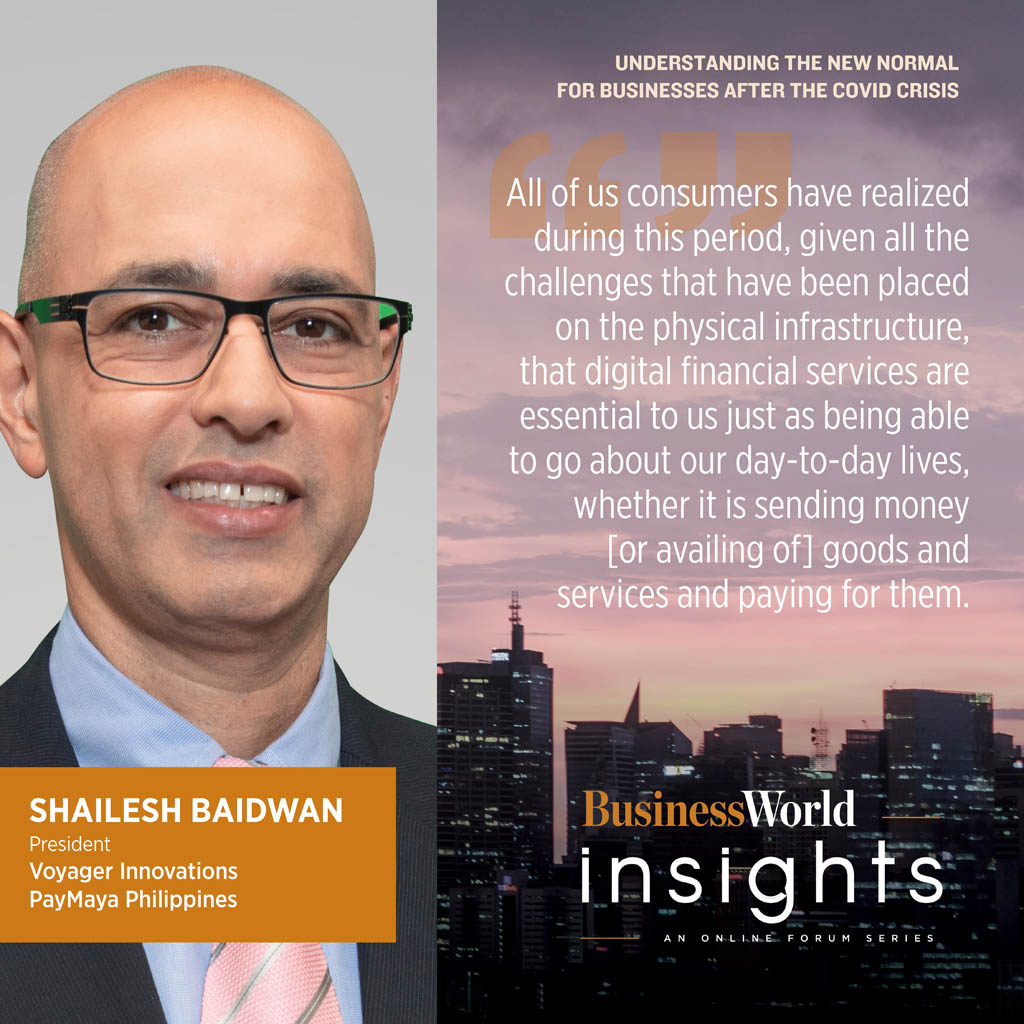
For Mr. Baidwan of Voyager and PayMaya, digital financial services will be an inevitable part of the new normal, and these services are no longer an option.

He observes an acceleration of such services on both consumer and enterprise levels.

Among enterprises, Mr. Baidwan sees businesses pushing their digital strategies from being a part of their long-term roadmap into a top priority to be delivered in the next few months.

Consumers, meanwhile, are realizing the advantages of digital payments.

“All of us consumers have realized during this period, given all the challenges that have been placed on the physical infrastructure, that digital financial services are essential to us just as being able to go about our day-to-day lives whether it is sending money [or availing of] goods and services and paying for them,” he said.

He shared that over the last few weeks, they have observed a significant increase in the number of people who are downloading the PayMaya app and using it to send money to continue supporting their loved ones in the provinces, as well as to buy mobile load and data.

Expanding financial inclusion in the Philippines, he said, is one of the big ways to counter the issues brought about by the present crisis.

Accelerating financial inclusion and ensuring wider access to payment, credit, insurance, and all kinds of other services, he added, will greatly help digital financial services to include “a large segment of the society that is today very vulnerable”.

“This is a time we really need to accelerate financial inclusion across the country because that to me will be one of the key factors that can help in the overall lift [of the ECQ], and to help to cushion some of the negative impacts that we will see over the coming months,” he said.

Mr. Baidwan also expounded on the significant roles digital financial services are playing during this crisis, such as enabling consumers and businesses to transact safely as well as helping needy communities access funds from the government and helping the government receive payments.

Adapting to ‘meaningful changes’

BCG’s Mr. Oundjian, meanwhile, shared that just like in previous major crises in history, meaningful changes will be imminent when the dust of the present crisis settles.

He sees two stages taking place specifically in the COVID-19 crisis. The first stage, he explained, happens for the next few quarters when people still live with a set of constraints related to COVID-19. The following stage will usher in “a more structurally different world once this is behind us”.

The managing director and senior partner of BCG sees digitalization ushering in a significant transition.

“The digitalization of our life, through the shopping, through the way we buy, through the way we interact, I think that will be a fundamental trend,” he said.

He sees the shift to home-based activities as the main change that is taking place among consumers, aside from a “major sustained shift” to digital services.

“We are not just talking about the work from home. We are talking about entertainment at home, consume at home, communicate socially from home,” he said. “For now, it’s by necessity; but we see that a lot of people start to realize actually that it’s quite convenient and it works well, and some of these will stay.”

As the new normal witnesses these significant changes, Mr. Oundjian considers the crisis as a wake-up call for businesses and communities to make their transition to the new normal a meaningful one as well.

“I’m hoping and I believe that this event is an opportunity to step back and realign our model to something which is much more sustainable for the planet but also for communities and something that we give like a fair share to provide the community,” he emphasized.

The next legs of BUSINESSWORLD INSIGHTS will tackle “COVID-19 and The Philippine Stock Market: Uncertainties and Opportunities” on May 13, and can be viewed on the Facebook pages of BusinessWorld and The Philippine STAR.


BUSINESSWORLD INSIGHTS is made possible by sponsors SM, Megaworld Corporation, Globe Telecom, and PayMaya; eLearning platfrom partner Olern; partner organizations Management Association of the Philippines, Philippine Chamber of Commerce and Industry, Philippine Association of National Advertisers, and Bank Marketing Association of the Philippines; and media partner The Philippine STAR.


Career insights during lockdown

By Hannah Mallorca
Features Writer, The Philippine STAR

Experts weigh in on how employees can better tackle important career decisions in the face of uncertainties brought by the pandemic

The coronavirus disease 2019 (COVID-19) has caused a looming global recession. It has posed an uncertain future in the economy and employment with various industries walking on a thin line. As a result, employees are faced with decisions — should they stay in their current jobs or move on to the next phase of their careers?

To help Filipino workers determine their next career move, The Philippine STAR’s CareerGuide shared insights on important job decisions during the pandemic.

The online discussion featured TalentView chief executive officer Anj Vera, Inspire Leadership Consultancy Inc. general manager and leadership consultant Jeff Manhilot, and TaskUs human resources leader Atty. Bianca Bacani.

Ensuring stability among employees

One of the major factors that determines an employee’s career decision is how their employers maintain stability during crises such as the COVID-19 pandemic. According to Ms. Vera, employers should establish effective communication with their employees.

“It doesn’t matter if you’re a small company or a big company, whether you see it or not — you have an employer brand. Especially in this crisis, it’s vital that you protect it, communicate well with your organization and just showcase who you are because it always comes out. Your true self comes out in a crisis like this,” she stated.

Ms. Vera also urged companies to provide sufficient assistance and strengthen their leadership skills for their employees’ sake.

“Pour out your resources for your organization: show them that you’re present, that you have strong leadership capabilities and that you’re at the forefront of this crisis,” Ms. Vera said.

 Working hand in hand during the crisis

Because of the pandemic, many companies experienced drastic changes in business operations. This includes the work-from-home setup, which goes beyond the traditional working relationship. Mr. Manhilot stated that employees and employers should preserve a stable working relationship.

“It will all play down with the combination of the two things. One is how the leaders are doing it and at the same time, how employees should be taking it,” he added. “We need to put into perspective that leaders have to play a huge role in making sure that the organizations they’re leading are really taken care of in all aspects.”

In making wise career decisions, Mr. Manhilot and Atty. Bacani encouraged employees to understand that various sectors are also affected because of the pandemic.

“As an individual, we all have to understand that our leaders are also encountering the same thing. The virus is a great equalizer, regardless kung nandito ka sa sitwasyon na ito or itoyung position mo sa organization. The amount of fear or risk is the same,” he said.

“Inevitably, our employees will feel uncertain, they will feel sad that there are so many changes around. Here’s the challenge for our employees, we want you to step up in this crisis as well. Once your employee steps up and tries to help you, you will also need to step up,” Ms. Bacani added.

Despite this, Ms. Vera advised employers to be transparent with their employees. “We really need to see our leaders communicating well enough, sometimes even as simple as being transparent is appreciated by your organization. It cannot be that the leaders are the ones who are silent,” she said. 

Making life-changing career decisions

Employees are faced with decisions on whether they should stay or move on with their careers as a result of the pandemic. With this, Ms. Bacani advised workers to consider important factors such as employment opportunities, salaries, and more.

“Every career move, it has to be a deliberate act. Whether or not there is a global pandemic or crisis, we have to take a pragmatic stance with regards to our career choices,” she added.

Since career transitions is a life-changing move for employees, Ms. Bacani stated that it’s a personal decision that one needs to make.

“Do you want to make a career change now? It depends. It’s a ‘no’ if you don’t have a plan, if you’re not pursuing your passion and you’re not doing anything productive. But on the other side, it’s a ‘yes’ if you are pursuing career growth, if you’re pursuing your passion or you’re protecting your mental health,” she said.


For more information about employment, job openings and advertising options, visit CareerGuide PH on Facebook and LinkedIn.


Insurance firms seek regulatory relief

By Beatrice M. Laforga
Reporter

INSURANCE COMPANIES are asking the Insurance Commission (IC) to “ease up” on some regulatory requirements to temper the impact of the coronavirus pandemic on the industry.

Philippine Insurers and Reinsurers Association (PIRA) Executive Director Michael F. Rellosa told BusinessWorld member companies have sought the relief to help them cope with the economic fallout.

Investments have declined due to coronavirus-driven volatility in financial markets, while sales have slumped as Luzon and other parts of the country were placed under lockdown since mid-March.

“We think we can survive this, but we have to ease up also on the regulatory regime. Since everybody felt the hit, can they go easy on us first so that we can continue doing what we are doing to help spur the economy,” Mr. Rellosa said in a Zoom call on Friday.

He said the IC should suspend or lower the minimum net worth requirement of P900 million for this year and 2021 after the value of insurers’ assets were eroded by market volatility.

“Investments namin bumagsak (our investments plunged), at the same time, may capital buildup program. So can we put a moratorium on the capital buildup program or can we peg it at specific level, and the RBC or the risk-based capitalization regime that we are also under, pwede bang (can they) i-relax naman nila ’yung levels,” Mr. Rellosa said.

Marami kaming hinihingi sa regulatory relief (we are asking for a lot in terms of regulatory relief).”

Under Republic Act No. 10607 or the Insurance Code, insurers must have a net worth of at least P900 million by Dec. 31, 2019 and P1.3 billion by Dec. 31, 2022. New players must have at least P1 billion in paid-up capital.

Most insurers complied with the minimum net worth requirement last year, but considering weaker market conditions and the bleak economic outlook, Mr. Rellosa warned the number of nonlife insurance companies could be halved by yearend.

“If they are going to continue with the current levels of requirements, such as net worth requirements, RBC, kung lahat ’yan ipagpapatuloy medyo mahihirapan kami, siguro kalahati mawawala, out of 57, siguro mga 30 na lang maiiwan (if those will continue, it might be difficult for us to comply and around 30 out of our 57 nonlife insurance members could be gone),” he said.

However, he said PIRA still has to consolidate the inputs of its 57 members before submitting a formal appeal to the IC.

In mid-April, the insurance regulator conducted a survey to measure the impact of the coronavirus pandemic on insurance firms. Insurers were scheduled to submit the forms by May 8 and results were not yet available to the media as of writing.

IC chief Dennis B. Funa has said insurance companies are “well-capitalized” to weather the risks of the coronavirus crisis, but their investments and sales will be hurt.

Mr. Rellosa said sales of nonlife insurance companies have declined since most firms were not used to adopting work-from-home schemes, as well as depressed demand for their products.

Despite lower revenues from the business disruptions, he noted companies continued to pay for their usual expenses such as rental costs, utilities and salaries.

Bagsak ’yung new business nila and ’yung renewals medyo nangalahati (New business is down and the renewals were halved). For different classes of insurance, iba iba ’yung effect but on a whole, medyo masama (the effect varies, but overall, it’s pretty bad). Sales went down,” Mr. Rellosa said.

Meanwhile, Philippine Life Insurance Association, Inc. (PLIA) President Benedicto C. Sison has said life insurers expect their assets to suffer “some drag” due to local equity sell-offs, although equities only make up a small portion of their total assets.

Sales of life insurance products also took a hit in the first month of the lockdown as the mobility of their financial advisors were restricted.

Even with the online availability of some products, Mr. Sison said online sales still could not match the volume sold through licensed financial advisors as most clients still prefer face-to-face meetings before getting a policy.

Mr. Sison noted an uptick in online sales of life insurance products, as more people wanted to get protection amid the coronavirus pandemic.

Sales picked up after the IC allowed advisors to conduct “digitally enabled face-to-face selling” according to Mr. Sison. He added they expect sales to bounce back to their pre-pandemic numbers in the coming months as more Filipinos realize the benefit of life insurance.

As of writing, the IC has not responded to queries on possible regulatory relief.

IC has extended the deadline for submission of audited financial statements for its regulated entities, including life and nonlife insurance firms, to June 30 from the original May 31 deadline.

The regulator also ordered insurance firms and health maintenance organizations (HMOs) to extend for at least 30 days current policies and agreements expiring during the lockdown period.

Meanwhile, several life and nonlife insurance companies have adopted general relief measures for policyholders, such as grace periods for premium payments and the inclusion of COVID-19 under the critical illnesses covered.

The insurance industry’s premiums jumped 2.76% to P224.97 billion as of end-September 2019 from P218.91 billion posted in the comparable nine months in 2018.

The life insurance sector accounted for P172.05 billion of net premiums written in the period, while the nonlife sector contributed 19.56% or P44.02 billion.

PHL unlikely to achieve upper middle-income status this year

THE Philippines is unlikely to reach upper middle-income country status this year, as the coronavirus pandemic takes its toll on the economy.

National Economic and Development Authority (NEDA) Acting Secretary Karl Kendrick T. Chua said he is still hopeful that they could meet the goal this year or in 2021, after the statistics agency began using 2018 instead of 2000 prices as the base for measuring the gross domestic product (GDP).

“I hope [the goal is still] attainable this year or next year with our revised GDP, but COVID-19 (coronavirus disease 2019) might delay it a bit,” Mr. Chua said in a mobile phone message on Saturday.

The Philippine Statistics Authority (PSA) earlier said the rebasing was done to ensure that economic activities of new industries such as information and communication technologies (ICT) and accommodation and food services are captured.

“The GNI (gross national income) was adjusted (during the revision) because of change in the estimation of the compensation inflow to follow the UN (United Nations) system of national accounts,” PSA Chief Claire Dennis S. Mapa said in a text message yesterday.

The World Bank defines an upper middle-income economy as having a gross national income (GNI) per capita of between $3,996 and $12,375. Among those considered as upper middle-income economies are China, Malaysia and Thailand.

The Philippines had a per capita GNI of $3,830, according to World Bank data as of 2018. This falls within the $1,026-$3,995 bracket of lower-middle income economies, which include Vietnam, Myanmar and Timor Leste.

The Philippine economy shrank by 0.2% in the first quarter, amid the Taal Volcano eruption in January and the Luzon-wide lockdown in mid-March. This was a reversal from the 6.7% and 5.7% growth recorded in the previous quarter and in the first quarter of 2019, respectively.

First-quarter data showed GNI — the sum of the nation’s GDP and net income received from overseas — declined by 0.6% compared with 5.8% growth in the previous quarter and 5% in 2019’s comparable three months.

Before the pandemic, then NEDA Secretary Ernesto M. Pernia said the Philippines could graduate to an upper-middle income status by the fourth quarter this year.

Now, the economic team is projecting flat growth or a 1% contraction this year.

However, Mr. Chua, who took over when Mr. Pernia resigned last month, said the plan to achieve this goal faces a “temporary setback” due to the pandemic.

Dahil sa unexpected crisis natin dulot ng COVID-19, baka ma-delay po ’yan. Lahat ng bansa kasi ay nakikita po natin ’yung economic growth ay humina o nag- contract so I think, temporary setback lang ito so susubukan natin humabol. If not next year, by 2022, ’yan naman poyung ating pinangako (Because of the unexpected crisis caused by the COVID-19 pandemic, the plan might be delayed. All countries across the globe are slowing down or are contracting, so I think this is just a temporary setback and we will try to catch up next year or by 2022. That’s what was promised),” Mr. Chua said in a Laging Handa briefing on Saturday.

Rizal Commercial Banking Corp. (RCBC) Chief Economist Michael L. Ricafort said any delay in achieving the goal of becoming an upper middle-income economy is “understandable” as the global economy faces a crisis.

“With the improvement to upper middle-income status by then, this would fundamentally give the country a better chance of also moving up further to A credit ratings,” Mr. Ricafort said in an e-mail at the weekend.

The government is eyeing to secure an “A” long-term credit rating by 2022 from its current “BBB+,” while looking to graduate to the upper-middle income status, when the Philippines will eventually lose the concessional loans it now enjoys.

However, even an “A” credit rating looks dim after Fitch Ratings downgraded its outlook for the Philippines to “stable” just three months after it gave a “positive” outlook, citing “deterioration in the Philippines’ near-term macroeconomic and fiscal outlook.”

The credit rater maintained its “BBB” rating for the country and projects a 1% contraction for the economy this year.

“At some point further into the future, especially after recovering from the COVID-19 economic losses, the Philippines may be in a much better economic, fiscal, and credit position to access loans from commercial and multilateral sources even with reduced concessions,” Mr. Ricafort said. — Beatrice M. Laforga

Which segments of the economy contributed the most to the decline in the first quarter?

Which segments of the economy contributed the most to the decline in the first quarter?

Pandemic slashes remittance lifeline as overseas Filipino workers lose jobs

By Charmaine A. Tadalan
Reporter

MELBA ARBOSO, 34, failed to send P6,000 to her family last month after she temporarily lost her job as a spa attendant amid a lockdown in the Kingdom of Bahrain where almost 4,000 people have been infected with the coronavirus.

“I haven’t been able to send money home since we got locked down,” the single mother of a 15-year-old girl back in the Philippines said in a Messenger chat. “I’ve been using my remittance budget to get by.”

Ms. Arboso is just one of about 10 million Filipino workers overseas who have been affected by the novel coronavirus that has sickened nearly four million and killed at least 273,000 worldwide.

The government calls them “modern heroes” because remittances they send home provide a steady stream of foreign exchange to help offset the widening trade gap and limit the current account deficit.

Personal remittances — whether in cash or in kind and capital transfers between households — hit a record $33.5 billion last year, a 3.9% increase from a year earlier and accounting for almost a 10th of the Philippine economy, data showed.

The data only counted money sent home by 2.3 million overseas Filipinos through official channels such as banks and remittance centers.

Now, that money stream is in danger of being choked as Filipino workers abroad lose their jobs amid the pandemic, and as travel restrictions and the closure of some companies overseas cut their deployment.

Global job losses that the International Labour Organization (ILO) had estimated to reach 25 million this year is turning the $715-billion global remittance industry upside down.

Global remittances are expected to fall by 20% this year due to the economic crisis induced by the COVID-19 (coronavirus disease 2019) pandemic and shutdown, according to the World Bank.

The projected decline, which would be the sharpest in history, is largely due to a fall in the wages and employment of migrant workers, who tend to be more vulnerable to loss of employment and wages during an economic crisis in a host country, it said in a report last month.

‘VITAL SOURCE’
Remittances to low and middle-income countries are projected to fall by 19.7% to $445 billion, representing a loss of a crucial financing lifeline for many vulnerable households.

Remittance flows to the East Asia and Pacific region, which includes the Philippines, are expected to fall by 13% this year from $147 billion in 2019.

“Remittances are a vital source of income for developing countries,” World Bank Group President David Malpass said last month. “The ongoing economic recession caused by COVID-19 is taking a severe toll on the ability to send money home and makes it all the more vital that we shorten the time to recovery for advanced economies.”

More than 89,000 Filipinos overseas had either been displaced or were on a no-work, no-pay status due to lockdowns and slowdown of businesses in host countries, according to the Philippines’ Department of Labor and Employment.

“The resulting lockdowns are meant to better contain the COVID-19 outbreak, which could have far greater costs to the global economy if left unchecked,” Michael L. Ricafort, chief economist at Rizal Commercial Banking Corp. in Manila, said in e-mailed comments late last month.

He said a sharp decline in most economies around the world, with some risk of recession especially in the biggest host countries could cut the demand for Filipino workers overseas.

Plunging global oil prices could also slow Middle Eastern economies that host millions of Filipinos.

“The most appropriate monetary and fiscal policy measures, interventions and responses worldwide are needed immediately to prevent this health issue from evolving into something that is more economic and financial in nature,” Mr. Ricafort said.

The Philippine government has repatriated almost 25,000 Filipino workers during the health crisis, mostly seafarers displaced by the pandemic, according to the Foreign Affairs department.

The Tourism department earlier said it had secured more than 11,000 hotel rooms to house some of the Filipino workers from abroad during quarantine.

Some of them have been harassed and discriminated against along with frontline health workers after they were barred from entering supermarkets or evicted from their rented homes for being alleged virus carriers.

The government has approved about 86,000 applications for a one-time P10,000 financial aid for overseas Filipinos who lost their jobs due to the coronavirus pandemic, the Overseas Workers Welfare Administration said last month.

The agency also said it had released P207 million worth of aid to 20,739 workers who returned.

WAITING IT OUT
Camille Jazul-Salita, a 28-year-old beauty adviser for Qatar Airways where she earned as much as P70,000 a month, was one of those who came home.

“I was planning to resign in August but I did it earlier because of the coronavirus disease 2019,” she said in a Messenger chat, citing the grave outbreak in Qatar where more than 17,000 people have been infected.

“I prefer to be with my family during times like this,” the newlywed from Imus, Cavite province said, adding that she plans to enrol in a baking class at a state-owned technical school while in the Philippines.

The government should create a registry of overseas Filipinos who came home and identify industries that can employ them, Rene O. Ofreneo, professor emeritus at the University of the Philippines, said by telephone.

“The government should find a way to provide jobs for them,” said the former UP School of Labor and Industrial Relations dean. “There should be a registry of skills and know-how.”

The Labor department has said it seeks to offer a million jobs in the next three months including in infrastructure in the provinces.

Ms. Arboso, the spa attendant, chose to wait it out in Bahrain, where the lockdown was expected to end on May 7.

She’s almost out of leave credits, which her company had been converting to ensure a steady income flow to its workers. “It might be gone once my leave credits are exhausted,” she said.

Ms. Arboso has no plans to come home anytime soon even if the outbreak in Bahrain worsens. “It’s easier to find jobs here. It’s faster to get back on our feet here than in the Philippines.”

Fashion during and after the pandemic:Chic PPEs for grocery shopping, stylish pajamas for the home, clothes that last a lifetime

A PANDEMIC has forced us to hole up in our homes in little better than T-shirts and robes. In this stagnation, it’s easy to think that fashion isn’t important — but how can something not be important when it sits right on your skin?

A webinar series by the Fashion Design Council of the Philippines (FDCP), PhX Fashion Conference, and the SoFA Design Institute called “Fashion Forward Dialogues” talked to three different designers last week about how they’re dealing with the pandemic, and how they plan to bounce back in the future. The first session featured Vice-President of the FDCP and designer Rajo Laurel, the co-founder of clothing brand Plains and Prints Roxanne Farillas, and FDCP President, SoFA co-founder and Executive Director, and designer Amina Aranaz-Alunan.

Mr. Laurel makes a case for the importance of fashion even in the midst of a global crisis. “Fashion is, by nature, a means to protect ourselves: whether it be physically or mentally.” This opens up the topic of what he’s doing now, and where he plants to go: protective garments. “Never in my life would I have imagined that instead of wedding gowns or evening gowns, I’m doing surgical gowns.”

“But that’s what you need to do,” he said. In the week after the lockdown, Mr. Laurel and his smaller-than-usual workforce (those who were unable to go back to their provinces when the lockdown was announced, about 25 people out of the 500 under his employ) had been able to produce 500 personal protective equipment (PPE) units, and as of the time of writing, were producing 2,500 more. “We’re restructuring our factory, our management force, and all of our existing stores… it’s really not going to be the same,” he said. Mr. Laurel broadcast his answers on the webinar from his summer home in Batangas, giving himself a preview of what the future may hold. “This has taught me a lot in terms of how to conduct our business in the future. Everything was done through devices,” he said. “We all must learn. I believe that in order to survive… we need to adapt to what’s next.”

And what’s next is apparently a line of attractive but protective outfits. “What we’re doing right now is creating an immediate collection for people to feel safe to go out of their homes, slowly. That will still have to be comfortable, fashionable, and washable.” He describes them as “not medical grade protective garments.”

“It’s very difficult to look chic in a bunny suit,” he said, describing the PPEs. “We need to rethink that. How will my client feel good when she’s doing the groceries?”

Mr. Laurel is also looking into clothes for the home — but not the way Filipinos see house clothes. “What’s next? Maybe it’s comfortable pajamas.” Meanwhile, he added quite wryly, “I don’t foresee anybody coming to me for a ballgown in the next 18 months.”

Ms. Farillas plans to do the same, and is currently working on masks and protective attractive equipment (which really should have its own acronym at one point), calling them multipurpose outerwear. “They want to feel good. They want to feel inspired. Fashion is inspiration,” she said. “They’ll start dressing up. When they start dressing up, they’ll feel better.” On an optimistic note, she said, “After that, we will still go on with our normal collections.”

Meanwhile, Ms. Aranaz-Alunan has been busy with her attempts to restructure SoFA to make it adaptive to a post-pandemic world. “We see this crisis as a challenge.” As for her work in design, Ms. Aranaz-Alunan reported that some of the export orders for her bags had been cancelled, leaving her with excess stock.

“We really need to evolve. We can’t expect that we’re going back to the old way of doing things, producing the same products that we do.” She acknowledges the changes that will have to occur, citing for one: “What we do is handmade. That interaction between people is really important. We really have to think about the social distancing measures in the factory — even the fact that the materials we get come from different parts of the country.”

In a season of loss, we tend to hold on to the things that we really deem important — or using the catchphrase of the season: “essential.”

“We used to do three collections a year. Now, all I want to do is just maybe one, and spread it out. That was the mindset of our industry. We’re very excessive,” said Mr. Laurel. “Half our friends and half our clients have enough already in their closets. Now is the time to really evaluate — how can we make really special items that are really needed by our clients?”

“We’re not selling fast fashion; we’re not selling things that you wear for one season,” said Ms. Aranaz-Alunan. “We really can start creating things that hopefully last a lifetime.” — Joseph L. Garcia

PSEi seen to rise past 6,000

By Denise A. Valdez
Reporter

THE Philippine Stock Exchange index (PSEi) is projected to end the year above the 6,000 level, down from earlier estimates of closing within the 8,600-8,900 range, as an effect of the coronavirus disease 2019 (COVID-19) pandemic.

A capital markets research for April 2020 prepared by First Metro Investment Corp. (FMIC) and the University of Asia and the Pacific (UA&P) said the recovery of the stock market is expected to begin by the second half of 2020.

“Equity investors may take time to get back into the market given the huge losses they have suffered and the need to prepare for a more secure future. We think, however, that the situation would start normalizing (of sorts) in H2 (second half) and we see PSEi ending the year above 6,000,” it said.

UA&P Senior Economist Victor A. Abola, who was one of the authors of the research, said in a mobile message that the second half would have to signal resumption of businesses in several sectors.

“By H2, the economy would have gone into recovery mode (although not even 90%),” he told BusinessWorld. “A lot of the uncertainty that exists today — reopening of the entire country to full economic activity, health protocols, and investor sentiment in general should improve significantly from the lows and we have seen up to this point.”

“Below 6,000 is an aberration for our stock market,” Mr. Abola added.

The PSEi has dropped to an eight-year low on March 19, falling 13.34% to 4,623.42, when the COVID-19 crisis started resulting in lockdowns both locally and abroad.

FMIC’s research noted the main index suffered the region’s biggest loss of 21.6% in March. Since then, the PSEi has been trading within the 5,342-5,946 range in April, and has sustained the 5,500-5,600 level in the first week of May.

The main index closed at 5,621.94 on Friday, down 31.22 points or 0.55% from the previous session.

However, FMIC’s previous outlook for the PSEi to end 2020 within 8,600-8,900 would have to adjust as recovery may not be as fast as desired.

“With millions of people left jobless and global supply chains in disarray, COVID-19’s dreaded economic impact can only be negative and the future uncertain,” FMIC said.

The Philippines has implemented localized quarantines since the middle of March, covering initially the island of Luzon, which accounts for about 70% of the country’s gross domestic product.

Easing of the quarantine started on May 1, but Metro Manila and its nearby cities remain under quarantine until May 15.

An announcement on the extension or lifting of the Metro Manila lockdown is expected early this week.

Bain sees private equity deals

By Denise A. Valdez
Reporter

THE Philippines is seen able to close at least two private equity (PE) deals this year despite a regional slowdown due to challenges brought by the coronavirus disease 2019 (COVID-19) pandemic.

United States-based management consulting firm Bain & Co., Inc. said the Philippines might benefit in global efforts to diversify supply chains and focus on business process outsourcing (BPO) to cope with the economic decline.

“I think there’s going to be a slowdown [in PE deals] in 2020, but possibly, we’ll come out of this year with a couple or three deals in private equity in the Philippines and possibly go back up from there in 2021,” Bain Partner Alessandro Cannarsi said in a phone interview last week.

“I don’t think the deal flow will completely dry up. In fact, we’ve seen that in the past five years, private equity firms that generated the best returns were those that kept investing during the down cycle,” he added.

Despite 2019 being a challenging year for PE firms in Southeast Asia, with deal value slipping to $12 billion from $14 billion a year ago, Mr. Cannarsi said the COVID-19 pandemic may change the situation in favor of countries like the Philippines.

“The Philippines is one of the few countries in the world, that according to the IMF (International Monetary Fund), can still pull off a positive GDP (gross domestic product) growth in 2020, which is good,” he said.

The IMF said last month that the Philippines could record a 0.6% GDP growth this year, better than its projections for Thailand (-6.7%), Malaysia (-1.7%) and Indonesia (0.5%).

Aside from GDP, Mr. Cannarsi also said the Philippines is poised to benefit from the growth of technology-driven industries and the diversification of global supply chains after the COVID-19 pandemic.

“If you think about it, we’re going through a large experiment in doing things remotely,” he said. This is expected to result in the growth of sectors like online shopping and digital healthcare where the Philippines can take a role in.

“Sectors that have revenues in markets like the US such as BPO, IT (information technology) services, where the Philippines is strong, could get a leg out in attracting private equity investments interest,” Mr. Cannarsi said.

The other element is the increasing tension between US and China, and Japan’s plans to pull out companies in China.

“[The Philippine has] a flourishing services sector, which is strategically well-located to diversify some of the supply chain for western and Japanese companies. And because of the high English communication skills in the Philippines compared to other Southeast Asian countries, it is very advertised in the west,” Mr. Cannarsi said. “I think it’s a candidate for actually benefitting from some diversification of the supply chain.”

In order to attract PE firms into the country, Mr. Cannarsi said the Philippines can work on enhancing corporate governance standards, on the company level, and increasing transparency on deal flows, on the country level.

He said it matters that there are fair and strict but also encouraging regulations to make it easy for funds to do buy-outs or raise capital to increase the growth of Philippine companies.

With these in place, Mr. Cannarsi said “you will make it easier for private equity funds globally to look at Filipino companies and invest with confidence.”

Repertory, MSO postpone performances to next year

TWO major cultural groups have announced the cancellations of their performance seasons due to the ongoing COVID-19 pandemic.

Repertory Philippines (Rep) will resume its theatrical productions in 2021, Rep’s Board of Trustees announced in a statement published on Facebook on May 7. Meanwhile, the Manila Symphony Orchestra (MSO) has also said that it is cancelling its 2020-2021 season due to the pandemic.

“We had no choice but to take this step to comply with the government’s regulations on mass gatherings and to ensure the safety of the MSO community and supporters,” the MSO said in a statement released to the press.

“Despite the current situation and limitations, we remain committed to bringing fine orchestral music to you,” said the MSO. “We are finding other ways to continue serving you through performing music that provides comfort and solace during these difficult times. We have recently created videos while in quarantine which we have dubbed ‘Tagpi-Tagping Damdamin: MSO in quarantine video series.’’ The videos are available on the MSO YouTube channel.

So far, the video series includes a performance of Ennio Morricone’s “Nella Fantasia” (https://www.youtube.com/watch?v=ceKQHi-9OKQ); “Tifa’s Theme from Final Fantasy: (https://www.youtube.com/watch?v=Yls4gqDNkdw); and the Beatles song “Let it Be” (https://www.youtube.com/watch?v=wA33vfMIYMU).

The Rep Theater for Young Audiences (RTYA) production of Snow White and the Dwarfs, which was originally scheduled to run from Sept. 12, 2020 to Jan. 10, 2021, has been postponed for September 2021.

“[The] Department of Education (DepEd) and Department of Health (DoH) have deemed it unsafe for students to go out on field trips and tours this year, even after the resumption of classes this September. Since [the] majority of the RTYA audiences are students, Rep will duly hold off this production to next year,” the announcement said.

Rep’s production of the musical Carousel, which was originally scheduled for May 1 to 24, has also been pushed back to February 2021 as the opening production of its 84th season.

Meanwhile, this year’s Workshop for the Performing Arts is also canceled. Online workshops will be offered to interested students in July.

Rep will stay connected with audiences online through REPisodes, a series of digital shows on its Facebook page (https://www.facebook.com/repertoryphilippines/).

The second REPisode, titled “Stage Kiss and Tell,” features the cast and production team of Rep’s production of “Stage Kiss” — this year’s season opener — on May 11 (8 p.m.). Participants in the behind the scenes roundtable discussion include director Carlos Siguion-Reyna; set designer Ohm David; and cast members Missy Maramara, Tarek El Tayech, and Jamie Wilson. The project is in support of the Open House fundraiser (https://www.facebook.com/OpenHouseFundraiser/) which gives aid to displaced performing arts workers during the COVID-19 crisis. To donate, visit http://bit.ly/DonateOpenHouse.

Rep is also exploring possibilities of showcasing full length shows online.

The theater company also announced that season passes for the 83rd season may be refunded or applied for use for the 2021 season. For more information about this, e-mail marketing@repphil.org or repphilfoundation@gmail.com.

For more updates on the MSO, visit its Facebook page at https://www.facebook.com/manilasymphony/.

Investors keen on MPIC as stocks rise after Duterte apology

By Marissa Mae M. Ramos
Researcher

METRO Pacific Investments Corp. (MPIC) was among the companies whose stocks saw renewed investor interest after President Rodrigo R. Duterte’s apology to Manuel V. Pangilinan and the Zobel brothers over his remarks about the businessmen’s companies in recent months.

Data from the Philippine Stock Exchange showed a total of 533.84-million MPIC shares worth P1.48 billion being traded last week, making it the fourth most actively traded stock in the local bourse that time.

Shares in the Pangilinan-led company closed higher by 11.3% week-on-week to P2.86 apiece from P2.57 apiece on April 30. Year to date, the stock is down 14.9%.

“The biggest driver [last] week was the reconciliatory message of President Duterte to MPIC’s principals (the Pangilinan Group) and the Ayala Group,” PNB Securities, Inc. President Manuel Antonio G. Lisbona said in an e-mail.

The apology, according to Philstocks Financial, Inc. Senior Research Analyst Japhet Louis O. Tantiangco, “deescalated the tensions” between the government and two of the country’s biggest water concessionaires — MPIC’s subsidiary Maynilad Water Services, Inc. and the Ayala-led Manila Water Co., Inc.

“The move has lowered the perceived regulatory risks and has brightened the prospects on negotiations, tilting its direction towards a favorable water concession contract for both parties,” Mr. Tantiangco said in a separate e-mail.

Mr. Duterte apologized to the Zobel brothers and Mr. Pangilinan in a speech last Monday, which he said was triggered by the businessmen’s assistance during the coronavirus disease 2019 (COVID-19) crisis. MPIC’s per-share price gained 13.5% the next day.

Mr. Duterte also said he was open to drafting new contracts for the water concessionaires.

Late last year, Mr. Duterte threatened to file economic sabotage cases against Maynilad and Manila Water over allegedly onerous provisions in their contract with the government.

As of December 31, 2019, Maynilad is 52.8% and 27.19% owned by MPIC and DMCI Holdings, Inc., respectively.

Members of the so-called “MVP Group” have been actively working with the government in building quarantine sites and providing necessary medical equipment and other basic needs for frontline workers.

In the first quarter, MPIC reported a lower core net income — the first in its history — brought by the adverse effects of the enhanced community quarantine (ECQ) in mid-March to contain the spread of COVID-19. Core net income in the first three months dropped by 6% to P3.4 billion while net attributable income declined by 47% to P1.9 billion.

“[T]he decline in its core net income could get deeper this second quarter amid the longer period of the ECQ in mainland Luzon…,” Philstocks’ Mr. Tantiangco said.

He said the company’s light rail segment would be “one of the most heavily hit segments” as its operations were halted during the ECQ and will be expected to operate at a limited capacity once Metro Manila transitions to a general community quarantine.

Earnings of MPIC will still be driven by its segments on power and water albeit hit by weaker economic activities in commercial and industrial properties, Mr. Tantiangco said.

He added that “toll operations are still expected to be weighed by reduced toll road traffic amid the restrictions inland travel brought by the quarantine.”

For PNB Securities’ Mr. Lisbona: “It is likely also that the implementation of toll rate hikes will be deferred to the latter part of the year, another factor that will weaken toll road earnings,” he said, adding that they expect the company’s utility and healthcare businesses to “remain resilient but not pick up the slack.”

Both analysts pointed out the company has been preserving its cash position by postponing share buy-back operations.

“Currently, MPI’s current ratio is at 1.37 times, which shows that it has ample liquidity in meeting short-term obligations. Debt-to-equity ratio, meanwhile, is at 1.04 times, higher than its 5-year average of 0.78 times. This means that the company is getting more tilted to debt financing,” Philstocks’ Mr. Tantiangco said.

“MPIC’s fundamentals are currently challenged and this is expected to weigh on its share price movement. On the upside, however, the share could get a boost if there will be further positive developments on the negotiations between the government and Maynilad,” he added.

Mr. Tantiangco placed MPIC’s support at P2.50 and resistance at P3.

PNB Securities’ Mr. Lisbona said the company “has since regained some composure” since the peak of panic selling on March 23 when it closed at P2.28 apiece.

“We see support at P2.28 and P2.40 and resistance at P3.00 to P3.18 for the short-term,” he said.

MPIC is one of three Philippine units of Hong Kong-based First Pacific Co. Ltd., the others being PLDT, Inc. and Philex Mining Corp. Hastings Holdings, Inc., a unit of PLDT Beneficial Trust Fund subsidiary MediaQuest Holdings, Inc., maintains an interest in BusinessWorld through the Philippine Star Group, which it controls.

WFH during the ECQ: BAVI’s Ronald Mascariñas

FORCED to do much of his work at home with the enhanced community quarantine in effect in the National Capital Region and nearby provinces, Ronald Mascariñas, Bounty Agro Ventures Inc. (BAVI) president and general manager, said that the setup is not much of an adjustment to him as he had been working from home on occasion even before the coronavirus disease 2019 (COVID-19) pandemic rendered outside movement limited.

He, however, said the current situation has been a challenge to the poultry company as a group, forcing them to recalibrate their business approach and taking into account the lessons and opportunities the situation presents.

BusinessWorld reached out to Mr. Mascariñas online where he got to share his experience working from home (WFH) and how COVID-19 would affect their business moving forward.

The interview has been lightly edited.

HOW MUCH OF AN ADJUSTMENT IS WORKING FROM HOME FOR YOU?

WFH is not new to me. I normally go to the office only for meetings or to sign documents which is about three times a week. I find no sense going to the office [and] open my laptop when I can do exactly the same from home (in Laguna) without throwing away three hours of driving.

A MONTH OR SO INTO THE ECQ, WHAT ARE THE UPSIDES AND DOWNSIDES YOU HAVE OBSERVED FROM DOING WFH IN RELATION TO WHAT BOUNTY AGRO VENTURES INC. WANTS TO ACHIEVE? ANY CHALLENGES YOU HAVE ENCOUNTERED IN DOING SO (E.G. SLOW INTERNET CONNECTION, DIFFICULTY REACHING YOUR OFFICERS, ETC.?

Communication was never a problem. My management team is used to getting e-mails, Facebook messages or phone calls from me from home. Globe installed some type of aerial antenna in my house many years ago so signal for voice calls is very strong.

WHAT IS YOUR PREFERRED MODE OF COMMUNICATION WITH YOUR PEOPLE (SKYPE, ZOOM, MESSENGER, E-MAIL, TEXT MESSAGE AND PHONE)?

In order of priority: 1. E-mail because I want communications organized in a folder; 2. Messenger; 3. Text message; 4. Phone

WHERE IS YOUR WFH OFFICE?

It is usually in the library but every now and then I do work at the patio.

HOW DO YOU START YOUR DAY FOR WFH? WHAT TIME DO YOU START WORKING? DO YOU DRESS UP FOR IT? UNTIL WHAT TIME DO YOU USUALLY WORK FROM HOME?

I usually start at 8 a.m., take my precious 30-minutes nap, and work until 11 p.m.

DO YOU TAKE BREAKS WHILE AT IT? IF SO, WHAT DO YOU DO?

My usual break is reading and answering comments from my over one million followers on my (Facebook) page. While I have a full-time page admin answering the comments, I need to guide her on how to answer FAQs for every new post I make. This gives me a real-time update on the pulse of my market. I watch one or two episodes on Netflix before going to bed. On Netflix I like House of Cards, Race to the White House and Bolivar. You should watch them.

ANY MEMORABLE EVENTS WHILE WFH?

We discovered two new strong trade channels during the quarantine. I am excited that we will come out stronger after this.

One of the new channels are the rolling stores, which we will continue even after the quarantine and another one is expanding our product offering, carrying basic products from other companies as none of the major companies organized to bring their products close to the locked-out communities.

For the second one, products we have carried to date were from sister companies Holly Farms for pork products and Bounty Farms for table eggs. Virginia Foods for processed meat products like hotdogs. Gardenia bread. We’re still finalizing which cooking oil to carry.

We have also relaunched our fresh produce business which we shelved 10 years ago. Clear opportunity from agricultural produce rotting in the countryside because they do not have a way to bring it to the consumers. This industry is bigger than the poultry industry.

WHAT ARE THE KEY POINTS YOU USUALLY TACKLE WHEN WFH? IS IT ANY DIFFERENT WHEN YOU ARE IN YOUR REGULAR OFFICE IN ORTIGAS?

Monitoring and reinforcing execution of the new trade channels. Management direction is very different since our traditional trade channels have been shut off by the quarantine restrictions. Our farms continue to produce the usual volume of chicken and we need to quickly find new markets for that.

APART FROM BAVI’S REGULAR BUSINESS, CHOOKS-TO-GO IN PARTICULAR, YOU ALSO ARE INVOLVED IN OTHER CONCERNS AS WELL, AMONG WHICH ARE 3X3 BASKETBALL AND THE MAHARLIKA PREMIER BASKETBALL LEAGUE. HOW DO YOU BALANCE THINGS SO EVERYTHING WILL BE COVERED?

I rely on my key personnel for execution. Once we agree on what needs to be done, I do not want them to bother me with day-to-day concerns. They message or call me only if it is urgent, otherwise they update me weekly by e-mail.

WITH HOW THINGS STAND RIGHT NOW, WFH WILL BE PART OF THE “NEW NORMAL” FOR THE IMMEDIATE FUTURE AT LEAST, HOW ARE YOU PREPARING FOR IT? IS IT BAVI READY FOR IT?

From Day One of the ECQ announcement, my stance was for a worst-case scenario that this will last up to the end of the year. While we lost close to 50% of sales from our traditional trade channels in the first week of ECQ, we are improving every week and are behind by just a little over 10%.

WHAT IS YOUR MESSAGE TO THE BUSINESS COMMUNITY AMID COVID-19 AND ECQ AND MOVING FORWARD?

We cannot just wait and watch until this is over. If we do, there might be no business left after the ECQ. — Michael Angelo S. Murillo