Home Blog Page 9536

Senate bill seeking to make overtime pay tax-exempt

SENATE President Pro Tempore Ralph G. Recto has filed a measure amending the tax code to shield overtime pay from taxation.

Under Senate Bill No. 601, Mr. Recto proposed to include overtime pay among the tax-exempt items in the National Internal Revenue Code of 1997. Mr. Recto first introduced the measure in the 15th Congress.

He said any revenue foregone in the proposed exemption will be offset by increased consumer spending. He noted the measure will benefit around 26.7 million workers in both the private and public sectors.

“This, in turn, would trigger demand for more goods and services thereby stimulating activity in the industrial and service sectors and eventually generating more taxes,” Mr. Recto said in a statement Monday.

Taxable income currently includes overtime pay components.

The tax code defines “overtime pay” as “compensation due to hours worked in excess of the required normal working hours.”

The Labor Code of the Philippines, under Presidential Decree No. 442, provides that the normal hours of work for all employees does not exceed eight hours per day, five days a week.

Overtime work may be performed provided the employee is given compensation, which the Labor Code specifies as 25% above the worker’s regular wage.

“Instead of being able to rest early and spend more time with the family, the employee is forced to extend working hours to achieve the organization’s goals,” he said.

“Thus, it is only fitting that the employee is properly compensated for additional work hours rendered.” — Charmaine A. Tadalan

Calabarzon towns seek JV partner for bulk water project

THE water districts of Dolores, Quezon and San Pablo City, Laguna are seeking a joint venture (JV) partner to implement the Lumbo Spring Bulk Water Supply Project, the Public-Private Partnership (PPP) Center said Monday.

The project will improve service delivery and augment the existing water supply of both water districts, the PPP Center said in a statement.

The project, which has an estimated cost of P103.43 million, covers the funding, construction, operation, and maintenance of the bulk water facility.

Among the components of the project are: source development, pipe-gap installation, provision for 6.9 kilometers of transmission lines from the Balanga spring source to the San Pablo expansion area. The project will supply 10,000 cubic meters per day to San Pablo City Water District and 2,000 cubic meters per day to Dolores Water District over a 20-year concession period.

The PPP Center said interested parties have until Jan. 10 to buy the bid documents.

Both water districts, which are government-owned and controlled corporations (GOCCs), conducted the prequalification conference in San Pablo City on Dec. 27.

According to the project information memorandum issued on Dec. 13, both implementing agencies executed a water supply development assistance agreement in April 2008.

“The agreement states that SPCWD (San Pablo City Water District) shall provide the necessary engineering, technical and financial assistance to rehabilitate DWD’s (Dolores Water District) water transmission and distribution pipe network while DWD shall grant SPCWD the exclusive right and authority to build, operate and maintain the infrastructure facilities for the development of Lumbo Spring in Brgy. Putol, Dolores, Quezon for a period of 20 years,” according to the memorandum.

It also noted that the development of Lumbo Spring, which lies in southern San Pablo City and western Dolores, was put on hold because of a court case filed by a private entity to stop the project.

In 2016, the Office of the Ombudsman and the Supreme Court ruled in favor of both water districts. — Arjay L. Balinbin

A clear 2020 vision: New Year requirements

Many things can happen in a year. We realize our dreams, reach our goals, make mistakes, and meet new people; the most important thing is that we learn from experience. The same thing can be said from a business perspective, where we, as stakeholders, learn that each new year brings numerous challenges in complying with government requirements as part of continuing operations in the coming year. Listed below are some of the requirements — so mark your calendars to plan your activities this January.

RENEWING BUSINESS PERMIT
One of the first and the most important requirements is to renew your business permit with the Local Government Units (LGU) where your businesses, both the head office and branches, are physically located. One of the requirements of the business permit is paying the local business tax (LBT) imposed by the LGU. The LBT is due on Jan. 20, 2020 (Monday, though some LGUs extend the deadline. It is best to inquire with your respective LGUs on the actual deadline to be able to take advantage of the extension. Pursuant to BLGF (Bureau of Local Government Finance) Memorandum Circular No. 01-001-2017, the following enterprises are exempt from paying LBT:

1. Enterprises registered with the Board of Investments (BoI) as pioneer and non-pioneer for a period of six and four years, respectively, from the date of registration;

2. Businesses engaged in producing, manufacturing, refining, distributing, or selling oil, gasoline, and other petroleum products;

3. Cooperatives duly registered with the Cooperative Development Authority (CDA); and

4. Enterprises registered with the Philippine Economic Zone Authority (PEZA) and other Special Economic Zones, as may be provided for by their specific charters.

PAYING REAL PROPERTY TAX
As much as owning real property (RP) is a privilege, since its value rises each year, such a privilege comes with a responsibility to pay real property tax (RPT), which accrues on Jan. 1 of each year. The City/Municipal Treasurer announces the due date for paying the RPT in full, which is Jan. 31 for most LGUs. RPT is also payable in quarterly installments, without interest, due on the last day of each quarter: March 31, June 30, Sept. 30, and Dec. 31. You may confirm with your LGU if it offers discounts on prompt/advance payment of RPT which, under the Local Government Code, can run up to 10% or 20%, respectively. The discounts could mean significant savings.

Certain properties are exempt from RPT, such as those used by charitable institutions, local water districts, for power transmission, cooperatives registered under the CDA, machinery used to control pollution and for environmental protection, as well as PEZA-registered entities under the 5% gross income tax (GIT) regime. However, BoI-registered enterprises are not exempt from RPT, while PEZA-registered entities under income tax holiday (ITH) enjoy RPT exemption only on machinery. Machinery that is no longer being used in the business is also no longer liable to RPT and owners should apply to delist such equipment from the assessment roll. If you think your company or some of its real property should be exempt, file documentary evidence to claim the exemption.

SETTLING BIR ANNUAL REGISTRATION FEE
All BIR-registered enterprises are required to pay a P500 annual registration fee for each home office/branch registered with the BIR (Bureau of Internal Revenue), which is due on Jan. 31, 2020.

ANNUAL INFORMATION RETURNS AND ALPHALIST ATTACHMENTS
The BIR recently revised its BIR Forms 1604F and 1604C as circularized by Revenue Memorandum Circular (RMC) No. 73-2019 to accommodate the changes made by the Tax Reform for Acceleration and Inclusion Law. These include the adjustment of the format from a monthly summary to a quarterly summary for BIR Form 1604F and changes to the alphalist attachments of BIR Form 1604C. Please refer to our previous article “Flash Report: Revised BIR Reportorial Requirements” published on Dec. 16 for the list of changes to the BIR forms. This was originally due for filing on Jan. 31, which may be extended to Feb. 28 through RMC No. 124-2019, under the condition that the BIR releases a new Alphalist Data Entry and Validation Module, since the current version (6.1) is being enhanced to accommodate the changes to the alphalist. If the deadline for filing the tax returns is extended, the deadlines for the alphalist attachments to these annual information returns follow.

DISTRIBUTE WITHHOLDING TAX CERTIFICATES
Since all enterprises are required to withhold taxes on most purchases, whether they are Top Withholding Agents (TWAs) or not, they are also required to furnish their suppliers with proof of taxes withheld or BIR Forms 2306 and 2307. BIR Form 2306 represents final taxes withheld at source, which is required to be furnished by Jan. 31 or upon the request of the supplier, while BIR Form 2307 represents creditable taxes withheld at source, which must be furnished on or before the 20th day of the month following the end of the calendar quarter which, in this case, is on Jan. 20 for the fourth quarter of 2019.

Similarly, employers are required to furnish their employees’ BIR Form 2316, which represents taxes withheld on compensation on or before Jan. 31. This was not covered by RMC No. 124-2019; hence, the deadline for furnishing the forms to employees remains Jan. 31.

Withholding agents may continue issuing the old version of BIR Forms 2306, 2307, and 2316 covering transactions occurring until Dec. 31, pursuant to RMC No. 126-2019, after which all are required to furnish only the new versions. Hence, taxpayers generating these forms through their computerized accounting systems should have them reconfigured to conform with the new format to validly cover withholding taxes on transactions beginning Jan. 1.

SUBMIT INCOME PAYOR/WITHHOLDING AGENT’S SWORN DECLARATION
Under Revenue Regulations No. 11-2018, withholding agents shall execute a sworn declaration stating the number of income payees, specifically those classified as professionals who have submitted their sworn declarations and BIR Certificate of Registration (BIR Form 2303) to qualify for the lower withholding rate of 5 or 10%. This is due on Jan. 31 and 15 days following the month when a new income payee has submitted its sworn declaration. If these professional service providers do not submit their sworn declarations, the withholding agents should subject these professionals to the higher withholding rates of 10 or 15% for individuals/non individuals, respectively.

WITHHOLD TAXES FROM ADDITIONAL TWAS
The list of additional and delisted TWAs was circularized by the BIR through RMC No. 136-2019 on Dec. 16. Taxpayers who are not delisted or who are tagged as additional TWAs are required to withhold 1 or 2% on their purchases of goods and services, respectively, beginning Jan. 1. Check the RMC list to verify if you are required to withhold on your purchases of goods and services, as the BIR may disallow such expenses if they are not subject to withholding taxes.

PROVIDE ANNUAL INVENTORY LIST
The list of inventory is exclusive to taxpayers whose primary activities require keeping inventory of stock-in-trade, raw materials, goods in process, supplies, and other goods being maintained (e.g., for the construction, retail, manufacturing, or wholesale industries). For taxpayers adopting the calendar year-end period of accounting, the inventory list is due for submission on Jan. 30 in both electronic and printed copies with a notarized certification signed by the taxpayer’s authorized representative, stating that the data in the report is true and correct. For taxpayers adopting a fiscal year-end period of accounting, the deadline is 30 days after the end of the fiscal year-end.

PROVIDE A SUMMARY LIST OF REGULAR SUPPLIERS (SRS)
There is one thing to be happy about this new year: the SRS was previously required to be submitted by TWAs on or before Jan. 31. However, the requirement was repealed by RMC No. 122-2019, since the information contained in the SRS is readily available in the Quarterly Alphalist of Payees (QAP) attached to BIR Form 1601EQ. Both the SRS and the QAP list suppliers from whom TWAs withhold 1 or 2% on their purchases of goods or services; the BIR deemed the SRS redundant and not in line with the government’s ease of doing business policies.

Completing this list of requirements does not guarantee that we will not encounter problems with our regulators; but regulatory compliance is a good start that can help us have a clear vision for 2020.

Let’s Talk Tax is a weekly newspaper column of P&A Grant Thornton that aims to keep the public informed of various developments in taxation. This article is not intended to be a substitute for competent professional advice.


Philip Christian D. Galiza is a semi-senior of Tax Advisory & Compliance division of P&A Grant Thornton, the Philippine member firm of Grant Thornton International Ltd.

pagrantthornton@ph.gt.com

Local shares decline on geopolitical tensions

SHARES failed to sustain their gains on Monday as geopolitical issues caused investors to be more cautious.

The 30-member Philippine Stock Exchange index (PSEi) fell 41.92 points or 0.53% to close at 7,797.87 yesterday, while the broader all shares index fell 22.21 points or 0.47% to end 4,633.33.

“The PSEi ended lower today on muted trading which tells us that investors have not fully come back into the market. Recent geopolitical tensions are keeping investors cautious which is to be expected,” AAA Southeast Equities, Inc. Research Head Christopher John Mangun said in an e-mail on Monday.

However, he noted that the index made a 90-point recovery as it made its way to the 7,700-level in the morning session.

“This tells us that investors that are currently in the market remain somewhat optimistic that our market’s fundamentals remain intact,” he said.

The US and Iran have been throwing threats at each other after the latter’s military commander Qassem Soleimani was killed following an air raid by Washington last Friday. This pushed investors to move to safer assets, like gold, which fuelled an increase in commodity’s price.

Calls for retaliation have been growing as thousands of Iranians gather in the capital and pay respects to the military leader.

Regina Capital Development Corp. Head of Sales Luis A. Limlingan shared the same sentiment, adding that weak US manufacturing data also affected local trading.

“With oil and gold higher on geopolitical risk, and the US manufacturing weakest in a decade, it was no surprise that the Philippine shares slide along with other regional markets,” he said in a text message on Monday.

The Institute of Supply Management’s US manufacturing purchasing managers’ index was reported to be at 47.2, the lowest since June 2009. This compared to the forecasted 49, and November’s data at 48.1. Note that a number below 50 means a contraction.

The Dow Jones Industrial fell 233.92 points or 0.81% to 28,634.88, the S&P 500 index declined 23 points or 0.71% to 3,234.85, while the Nasdaq Composite dropped 71.42 points or 0.79% to 9,020.77.

Back home, sub-sectors fell except mining and oil, which gained 27.40 points or 0.34% to end at 8,048.16.

Property dropped 50.62 points or 1.21% to 4,123.05; industrials fell 93.74 points or 0.96% to 9,590.40; financials declined 9.25 points or 0.50% to 1,835.23; services went down 4.19 points or 0.27% to 1,543.08; and holding firms gave up 4.65 points or 0.06% to 7,627.07.

Value turnover was at P4.10 billion on Monday with 664.04 million issues, down from the previous session’s 659.20 million issues valued at P5.60 billion.

Stocks that fell outnumbered those that gained, 114 to 80, while 45 issues closed unchanged.

Net outflows on Monday totalled P303.30 million, higher than the previous session’s net outflows worth P157.88 million. — V.M.P. Galang with Reuters

Peso rebounds ahead of December inflation data

THE PESO bounced back on Monday after two days of decline against the greenback on profit taking ahead of the release of data showing likely faster inflation in December.

The local unit ended trading at P50.93, appreciating by 16 centavos from its Friday close of P51.09 per dollar.

The peso opened at P51.08 against the greenback. Its weakest showing was at P51.32 while its intraday best was at P50.92 versus the dollar

Dollars traded slipped to $1.579 billion on Monday from $1.598 billion on Jan. 3.

Traders attributed the peso’s stronger finish mainly to profit taking in the market.

“The peso appreciated in the afternoon trade as local participants started to take profits in anticipation of stronger Philippine inflation report for December which will be released this Tuesday,” a trader said in an e-mail.

BusinessWorld’s poll of 13 economists yielded a median estimate of 2.1% which is nearer the lower end of the central bank’s forecast range of 1.8-2.6% for December headline inflation.

If realized, this would be faster than November’s 1.3% print and will also be the second straight month of uptick.

Economists cited factors such as the price pickup in commodities backed by the seasonal holiday demand, paired with continued diminishing base effects and weather disruptions.

Another trader noted that Monday’s trading was “volatile.”

“We saw risk-off sentiment in the morning, but market was very long in position and there was profit taking,” he said in a phone call.

The trader noted that headlines in the morning were initially not positive for the peso, including threats from Washington to strike Iranian sites should it retaliate after the drone strike that killed their key military official last week.

Reuters reported that US President Donald J. Trump on Sunday night stood by his earlier tweets that warned of major retaliation should Iran do a retaliatory step.

“They’re allowed to use roadside bombs and blow up our people and we’re not allowed to touch their cultural sites? It doesn’t work that way,” he told reporters on Air Force One.

For today, the first trader sees the peso playing around the P50.80 to P51 level, while the second trader forecasted a range of P50.80-P51.20. — Luz Wendy T. Noble with Reuters

Strategic Agility in ASEAN Agri (What the Philippines needs)

What is strategic agility?

Strategic agility is “an organization’s ability to think ahead of the market, quickly mobilize itself, adapt to market shifts, fill capability gaps, capture new revenue ahead of the competition, and even create new markets.” (https://www.futurelab.net/blog/2017/09/strategic-agility)

Think of a country, region, or an industry.

Are there country lessons in ASEAN agribusiness? Indeed, there are.

MALAYSIA: from producer to processing hub. In the 1980s and early ’90s, Malaysia was producing a large volume of cacao beans from large plantations in Sabah, east Malaysia. It put up grinding plants to convert beans to butter and paste (both raw materials for chocolates). In Sabah, some 400,000 hectares (has) were converted to oil palm, principally due to labor constraints.

In 1970, there only 3,200 tons of cacao beans. This rose to almost 250,000 tons in 1990, but fell to 16,000 tons in 2010 and 1,000 tons by 2017 (FAO).

The shift to processing hub using imported beans brought some $1.4 billion in exports in 2018: cocoa butter, $390 million; cocoa powder, $226 million; chocolates, $284 million; cocoa paste, $120 million; and, cocoa beans, $354 million.

VIETNAM: Surge in black pepper exports. Pepper started with only 340 ha of cultivated area in 1970, and reached 920 ha in 1990. It surged to 44,300 ha in 2010 and 93,500 ha (2017).

High yield is its competitive advantage, starting from 1.3 tons per ha in 1980, to 2.4 tons pe ha in 2010, and 2.7 tons per ha in 2017 (Food and Agriculture Organization or FAO). This is a result of agri research and development.

By 2000, it surpassed Indonesia, Brazil, and India as a top pepper exporter. It became the world’s largest exporter with an export volume of 156,400 tons in 2016, earning $1.4 billion.

THAILAND: Commodity grade rice to jasmine rice. Thailand is one of the leading rice exporters, along with India and Vietnam. The threat on commodity grade suppliers led Thailand to diversify it product mix.

In 2018, 70% of its rice exports were commodity-grade and the rest was jasmine hom mali (Thai fragrant rice).

In early November 2019, hom mali premium was priced at $1,266 per ton (FOB) as compared to white Thai rice, 25% broken priced at $414 per ton. The hom mali was price better than Vietnam’s $567 per ton and Cambodian pkha mali at $935 per ton. (http://www.thairiceexporters.or.th/default_eng.htm)

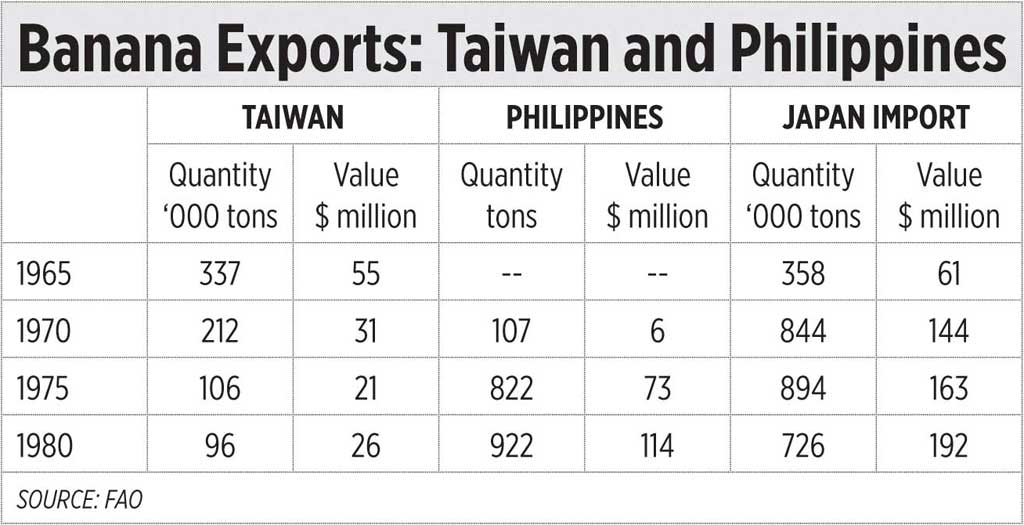
Philippines. Drive for Cavendish banana. In 1965, Japan’s banana needs were mainly supplied by Taiwan and none came from the Philippines. When trade was liberalized in the 1970s, bananas were one of the first agri products to be imported in large amounts, initially from Taiwan and Ecuador. The strategic position of multinationals brought investments to Mindanao. By 1975, the Philippines had supplanted Taiwan as its Asian supplier while Latin American countries, e.g. Ecuador, also expanded exports. (See Table)

FUTURE DISRUPTORS
• Vietnam shifts rice land to coconuts. The latest news emanating from Vietnam is that it is converting some 500,000 has of rice lands to aromatic coconut for export. Competition in the rice market by India, Cambodia, and Myanmar as well as climate change (the sea level rise in the Mekong delta) were crucial to the decision.

The Vietnamese Minister of Agriculture and Rural Development recently announced plans to reduce the 4.1 million has of farm area for rice production by 0.5 million has. Unpredictable weather conditions, capricious tariff policies, and a turbulent global market make rice a risky product to rely heavily on.

Authorities have recommended switching to other crops, such as coconuts. Coconut trees’ ability to cope with saltwater makes them more appealing in light of the effects of climate change, and the global market for them is positive. Rice bran oil, a more lucrative commodity, has also been proposed. (https://saigoneer.com/vietnam-news/17756).

In 2018, the total export value of coconut reached $560 million: Thailand, $124 million; Indonesia, $121 million; and Vietnam $109 million. The Philippines, with the large land area devoted to coconut, is not in the picture.

• Davao, Mindanao’s cacao country, made the strategic decision to shy away from beans production in favor of becoming a single-origin chocolate producer. The bean-to-bar strategy has been led by innovators such as Charita Puestespina, who has won awards for Malagos chocolates. Malagos won seven awards at the prestigious 2019 International Chocolate Awards — Asia Pacific, bringing its total number of accolades to 44 through the years. This includes being named among the “Best 50 Beans in the World” at the 2017 Cocoa Excellence Program, and 16th best in the world in 2019’s Heirloom Designation. (https://malagoschocolate.com/2019-international-chocolate-awards-asia-pacific/)

Then there is a new entrant, Filipinas Oro de Cacao Inc., which is behind the single origin, bean-to-bar Auro brand. It sources its beans from farmers in the Paquibato district, Davao City. The Philippine brand won the British Academy of Chocolate Award in 2018. (https://aurochocolate.com/pages/about)

Another new entrant is Lerio Chocolates of the Ocite family’s VPO farm in Rosario, Agusan de Sur. It sells “single-estate grown cacao.”

The strategic move towards value-added chocolates with a geographic brand is a wise move. The Philippines need innovators to bring higher farm productivity and product diversification to energize the countryside, and increase job creation and exports.

This article reflects the personal opinion of the author and does not reflect the official stand of the Management Association of the Philippines or the MAP.


Rolando T. Dy is the Co-Vice Chair of the MAP AgriBusiness Committee, and the Executive Director of the Center for Food and AgriBusiness of the University of Asia & the Pacific.

map@map.org.ph

rdyster@gmail.com

http://map.org.ph

US senators see PH justice system differently from PH officials

US President Donald Trump’s approval of the Fiscal Year 2020 State and Foreign Operations Appropriations Bill which included a provision prohibiting the entry of Philippine government officials found to be involved in the “wrongful imprisonment” of Sen. Leila de Lima drew various comments from key Philippine officials. Here are some of them:

• “This proved that the US is interfering with the Philippines’ judicial system without even investigating. An affront to the Philippine Supreme Court should be despised by all Filipinos!” — Senate President Vicente Sotto III

• “The US government might have pre-judged the resolution even as the Philippines’ Supreme Court already upheld De Lima’s continued detention.” — Speaker Alan Peter Cayetano

• “An intrusion on the internal affairs of our country. All our institutions are working.” — Senator Richard Gordon

• “Her (Senator De Lima’s) arrest was ordered by a judge and upheld by the Supreme Court.” — Former House Majority Leader Rodolfo Fariñas

• “We will allow the legal staff of these senators to come and authorize them to go over the records and transcripts of the cases and observe the hearings, subject to reasonable regulations, so that they may enlighten their bosses.” — Justice Secretary Menardo Guevarra

• “The recent conviction of the Ampatuans is proof the Philippine Justice System works.” — Foreign Secretary Teodoro Locsin, Jr.

• “I’ve repeatedly explained it cannot be a wrongful detention because the senator went through two processes — one administrative, when the investigating prosecutor conducted proceedings to determine whether there exists a probable cause on the filing of an information and the prosecutor found the existence of one, and the other process is judicial.” — Presidential Spokesman and Legal Adviser Salvador Panelo

The integrity of the Supreme Court and the other institutions of the Philippine justice system that the mentioned high ranking officials zealously and jealously uphold has been assailed by so many civil society groups through the years. A farce of a court of justice, the rubber stamp of the powers that be, the weapon the president wields against his enemies, are some of the derisive terms Filipinos have ascribed to the Supreme Court.

No less than former president Gloria Macapagal Arroyo put the Supreme Court in bad light when in July last year, she told President Rodrigo Duterte, “Most of all, I thank you that when you became President, you provided the atmosphere in which the Court had the freedom to acquit me of the trumped up charges.” The gall of Supreme Court Spokesman Brian Keith Hosaka to issue the statement of “The public can be assured that the Supreme Court has and will always act independently and free from influence from the other branches of Government” immediately after Mrs. Arroyo made the monumental revelation.

During President Duterte’s visit to Beijing in October 2016, he told reporters that Senator De Lima will rot in jail for involvement in the illegal drug trade. The Supreme Court’s denial of Senator De Lima’s petition against her “wrongful imprisonment” is seen by many as another act of servility to the powers that be on the part of the high tribunal.

Contrary to the statement of the rookie spokesman of the Supreme Court, the Court had acted submissively and obsequiously to presidents with authoritarian tendencies. In 2010, the Court affirmed President Arroyo’s appointment of Renato Corona as Chief Justice, in contravention of the Constitution which provides that the President shall not make appointments two months before the next presidential elections.

In 2015, the Court dismissed the disqualification complaint against Mrs. Arroyo’s son Mikey, who ran as a nominee of the party list of tricycle drivers and security guards. To allow Mrs. Arroyo’s other son, Dato, and Arroyo staunch political ally Rolando Andaya to run in separate districts, the Court upheld Congress’ breakup of the 1st District of Camarines Sur into two, in violation of the Constitution as the new district did not meet the population size required by the Constitution,

In 2016, just months into the presidency of Mr. Duterte, who, during his campaign for president, made known that he favored the burial of former President Marcos in the Libingan ng mga Bayani, the Court voted to allow the burial for reasons that included the false claims that he was a be-medalled war veteran and that he was not convicted of moral turpitude.

In 2018, the Court voted to grant the quo warranto petition of Solicitor General Jose Calida to nullify Lourdes Sereno’s appointment as Chief Justice of the Supreme Court for her failure to fully disclose the required statements of assets, liabilities, and net worth when she applied for the Supreme Court top post in 2012, resulting in her removal from the Court. The Constitution says the chief justice can be removed only by impeachment. Political pundits believe President Duterte had her removed as she had resisted many of his policies on the grounds that they flouted human rights and the rule of law.

Chief Justice Renato Corona was impeached for betrayal of public trust, culpable violation of the Constitution, and graft and corruption. Article 1 of the impeachment complaint said, “Respondent betrayed the public trust through his track record marked by partiality and subservience in cases involving the Arroyo Administration.” Among the prosecutors was then Congressman Farinas and among those who voted “Guilty” was Senator Sotto.

Chief Justice Lucas Bersamin said in his farewell address to the justices of the Court, “I have always endeavored to be true to my oath of office and have always discharged my duties and responsibilities in the best lights that God has endowed me with.” But on his last day as chief justice, he shirked his solemn duty when he deferred for the third time the voting on Bongbong Marcos’ electoral protest. “I wanted to delay the vote because I did not like to take part in it,” he told reporters.

The entire Philippine justice system fares no better in the eyes of the Filipino people. In 1993, Joseph Estrada was vice-president and head of the Presidential Anti-Crime Commission (PACC). He alleged that 80% of the cases filed in court by the PACC were dismissed summarily by corrupt judges. He called them “hoodlums in robe.” As many others had made the same accusations, the Supreme Court was prodded to conduct an investigation of “corruption in the judiciary.”

In 2013, the Supreme Court confirmed the reported influence peddling activities of Arlene Lerma. Lerma was said to have influenced court decisions in favor of her clients by paying off judges and justices. In 2014, The Supreme Court dismissed Sandiganbayan Associate Justice Gregory Ong after he was found guilty of “gross misconduct, dishonesty and impropriety” for acquitting alleged pork barrel fund scam brains Janet Lim-Napoles in a malversation case.

Practicing lawyers have been speaking of judges who have an “open back door” through which trial lawyers can enter the judge’s chamber. They imply that a favorable decision can be obtained by enticements offered the judge in his chamber at the back of the court.

Court decisions and temporary restraining orders have long been known to be for sale. That could be President Duterte’s reason for telling judges recently with regard to the vaping ban, “Judges, I warn you, do not issue restraining orders to the Customs. I will not obey your order.”

In 2018, the Sandiganbayan found Imelda Marcos guilty beyond reasonable doubt of seven counts of graft and corruption and sentenced her to serve six to 11 years in prison for each of the seven counts. She was ordered arrested but Philippine National Police (PNP) Director-General Oscar Albayalde did not have her arrested because of her age and gender. This is in contrast to the arrest of suspected Communists who are of the same age and gender as Mrs. Marcos.

Last October, in a Senate hearing, former PNP Criminal Investigation and Detection Group chief and now Baguio City Mayor Benjamin Magalong named 13 police officers involved in the recycling of 162 kilograms of illegal drug valued at P648 million in Pampanga in 2013 and 2014. The “ninja cops” were ordered dismissed by their superior officers and criminal charges filed against them. It turned out they were never dismissed. They were only demoted and assigned to other districts. The raiding team leader, Rodney Baloyo, was even promoted to lieutenant colonel.

In contrast, Senator De Lima was arrested on the testimonies of 13 state witnesses who have all been convicted of either murder, kidnapping for ransom, robbery with homicide, or illegal sale and delivery of shabu. That is contrary to what Justice Secretary Menardo Guevarra said, “No convicted person has been used as a state witness under Rule 119 against Senator Leila de Lima.”

That is our justice system. There is no need for the US Senate to send its legal staff to investigate the imprisonment of Senator De Lima. The arrest and prosecution of Senator De Lima was televised live nationwide by several TV networks, including CNN Philippines. Surely, the vast and high-tech intelligence network of the US State Department closely monitored the government’s action against her as it has to do with human rights. The US is a signatory to the Universal Declaration of Human Rights — as is the Philippines.

That is why the quotes of the above-mentioned officials are laughable, providing me with material for my traditional first article of the year — “Laughable Quotes of (previous year).”


Oscar P. Lagman, Jr. is a retired corporate executive, business consultant, and management professor. He has been a politicized citizen since his college days in the late 1950s.


Top 10 energy news stories of 2019

Here is my modest list of important global and national stories in the energy sector.

1. Stable world oil prices. After experiencing prices of around $100 per barrel in 2011-2014, prices have generally gone down. From 2015 to 2019, we never saw prices reaching $80 a barrel, even for a day.

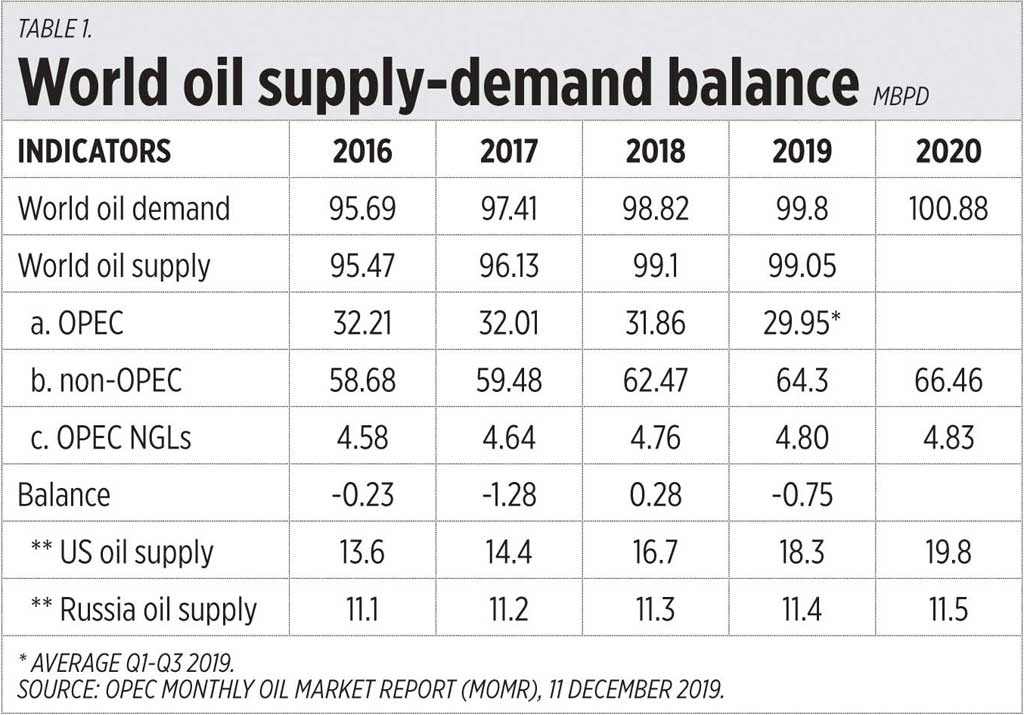
2. Stable world oil balance. World oil demand is rising by 1.1 million barrels per day (mbpd) on average. Russia and Saudi-led OPEC production was flat or declining — this should have resulted in rising oil prices but it did not happen. The reason is rising US oil production, an average of 1.55 mbpd yearly in 2017-2020. OPEC non-gas liquids (NGLs) rose mildly (see Table 1). This is thanks to the US shale oil and gas revolution and Trump’s “energy dominance” policy which neutralized the oil output cut by OPEC and Russia.

3. No global carbon tax. The big annual climate fiesta — aka UN Conference of Parties (COP) meeting 2019 in Madrid — failed to create another scheme that would produce that elusive $100 billion/year of climate money that was promised in Paris Agreement 2015. Many rich countries will not agree to further bleed their people with more energy taxes.

4. US Congress phasing out wind-solar subsidies. The investment tax credit, which reimburses 30% of the cost of new solar systems will begin winding down in 2020, down to 10% for most companies by 2022. The energy production tax credit, which gives wind power generators a roughly two cent per kilowatt boost, will wind down in 2021, decreasing steadily until it becomes zero in 2025 (Houston Chronicle, Dec. 26, 2019).

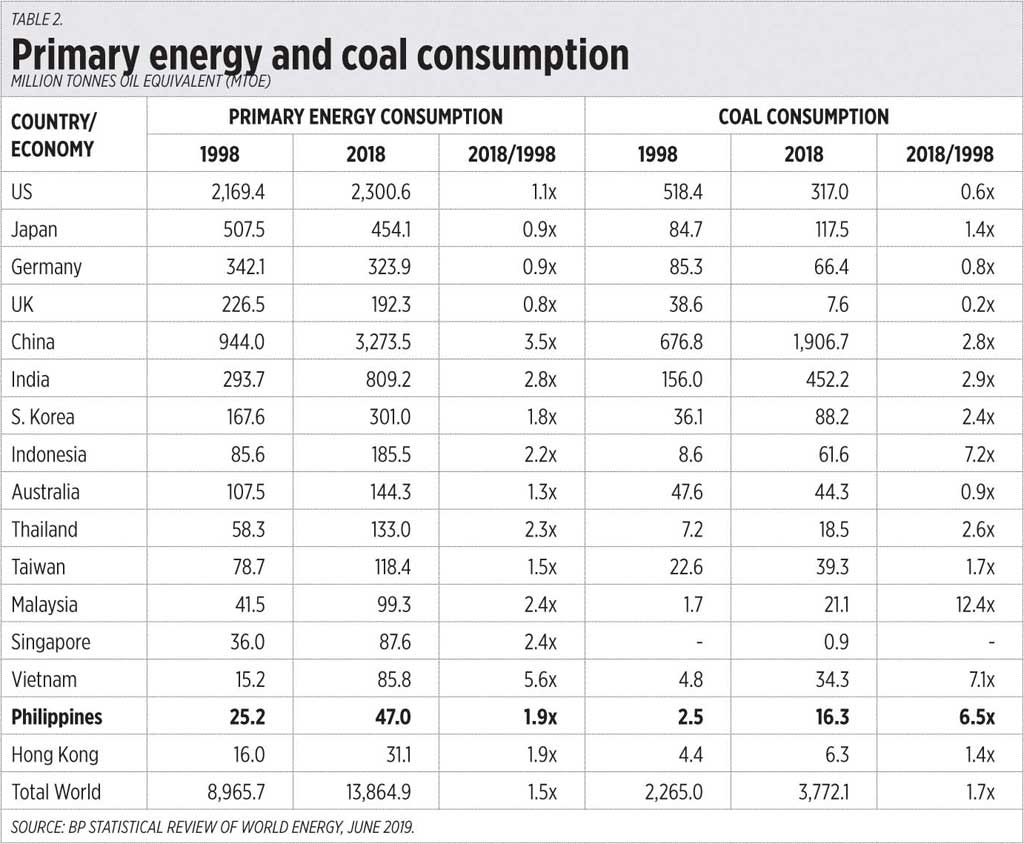
5. Energy consumption is down in the West. A June 2019 report by British Petroleum (BP) showed that after two decades, primary energy consumption in the West is flat or declining but it is rising in Asia (except Japan). The data covers not only electricity generation but also oil-gas consumption for transportation (land, sea, air), agriculture, etc.

6. Coal consumption remains high. Despite rising global climate and anti-coal rhetoric, coal consumption remains high even in “greenie” countries like Japan, Germany, Australia, and South Korea. The Philippines remains bullied by anti-coal activists despite its very small coal consumption compared to its neighbors and greenie countries (see Table 2).

China in particular built 38 gigawatts (GW) of new coal power capacity in 2016, 35 GW in 2017, 43 GW in 2018 to June 2019, plus another 121 GW under construction.

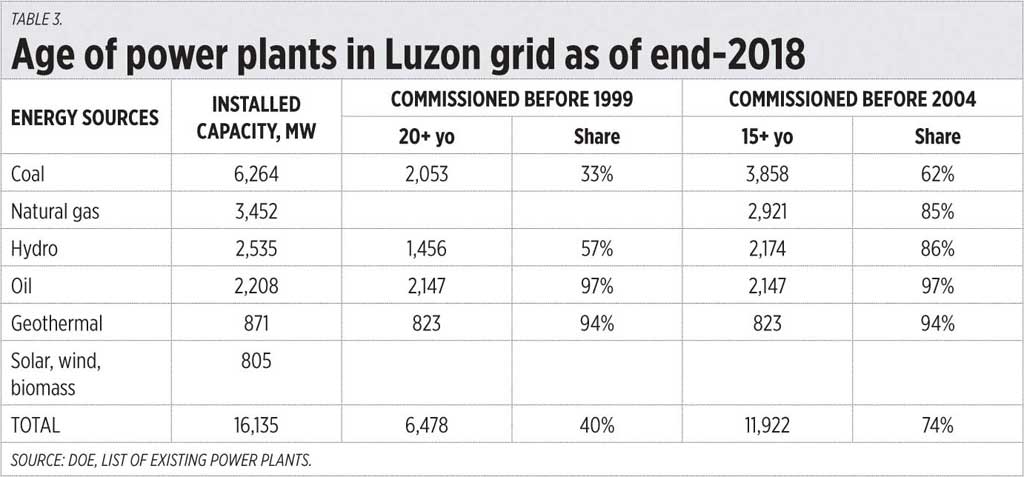
7. Yellow-red alerts in Luzon grid from March-July 2019. Among the reasons for the alerts, No. 1 is there are many old, ageing big conventional plants, and unscheduled and longer maintenance shutdown. Some 40% of all power plants in Luzon are 20 years or older, especially oil and geothermal plants. Reason No. 2 for the many alerts is that many new additions in the power mix are intermittent, unreliable, weather-dependent wind-solar that cannot provide big, dispatchable power. (See Table 3)

8. No new peaking plants constructed. That’s reason No. 3 for all the yellow-red alerts. New capacity additions and committed projects in Luzon grid are: 800 MW coal, 74 MW biomass and hydro in 2019; 1,336 coal, 12.6 hydro in 2020; 600 coal, 650 gas, 3 hydro in 2021; 31 MW geothermal in 2022. Not even a 1 MW oil-based peaking plant to address demand spikes during rush hours was built or under construction.

9. ERC-proposed lower secondary cap at WESM. That’s reason No. 4 for the yellow-red alerts and why no peaking plants were constructed — so the yellow-red alerts of 2019 will be repeated in 2020. And so many companies are buying big gensets as their own peaking plants in their backyard.

10. EPIRA TRO. The retail competition and open access (RCOA) provision of the EPIRA law of 2001 (Electric Power Industry Reform Act, RA 9136) remains suspended after the Supreme Court TRO of February 2017. Three years of continuing uncertainty in retail competition has greatly affected the power supply planning of generation companies while giving some pampered electric cooperatives zero competition in their localities.

More government energy intervention — in giving subsidies to intermittent renewables, in power price control at the Wholesale Electricity Spot Market, in limited retail power supply and competition, etc. — is not good for the consumers.


Bienvenido S. Oplas, Jr. is the president of Minimal Government Thinkers.

minimalgovernment@gmail.com

Challenges as Opportunities: The transnationalization of Philippine higher education

The passage of the Transnational Higher Education Act (RA 11448) in August 2019 signals the Philippine government’s openness to a shift from a focus on student and academic mobility to the mobility of programs and of educational providers in its educational internationalization strategy.

The move by the political leadership, however belatedly, coincides with and reinforces an earlier Commission on Higher Education (CHED) Policy framework on internationalization (CHED CMO 55, s.2016), issued on Nov. 11, 2016, under former CHED chair, Dr. Patricia Licuanan.

The CHED’s “comprehensive” framework recognizes the importance of the internationalization of tertiary education, particularly the movement of different “forms, providers and products” that emanate from the home and cross-border higher education pillars of internationalization. Home-based internationalization in ASEAN and Philippine higher education institutions (HEIs) presupposes that while student, faculty, institution or educational service providers do not necessarily cross jurisdictions, the content and process-based measures and activities on curricula, programs, teaching, learning, service, and research are enhanced by technology, networking, and collaboration with foreign partner HEIs. Alternatively, the UNESCO/Council of Europe Code of Good Practice in the provision of transnational education (2001) defines cross border internationalization as the movement of people, as well as programs and educational service providers across national jurisdictions.

At the outset, higher education expert and scholar Jane Knight (2016) stated that transnational education (TNE) and cross border higher education (CBHE) dominate the discourse on program and provider mobility. TNE basically moves the programs and providers closer to the students in their very own countries which host these mass offerings of academic programs, rather than students moving out to foreign countries to begin with. Although used interchangeably with TNE, CBHE is more specific in its definition as it refers to the mobility of people, programs, providers, and other services as provided in the tertiary setting, across countries’ jurisdictional boundaries.

The past decade has seen an increase in the diversity of TNE activities. From the more common twinning and international branch campuses (IBC), TNE has come to include a wider range of other labels and collaborations such as joint/double/multiple degree program and franchised universities. Branch campuses are quite notable given their general success in attracting students not only from the host country but also from other foreign countries, who choose to go to the campus offered by the former than to the country that hosts the original campus. IBC practice in ASEAN goes all the way back to two decades ago, with Malaysia putting up its first branch campus, the Monash University Malaysia, in 1998, followed by the University of Nottingham in 2000. Recent data inform that Malaysia currently hosts eight other IBCs, including the University of Southampton Malaysia Campus and Xiamen University Malaysia Campus. Malaysia’s higher education strategy is not only limited to IBCs, but is focused on collaborations that put a premium on institutional-level developments involving multilateral partnerships that have a wider consortium, an example of which is the Malaysia-Japan International Institute of Technology.

Singapore has also been aggressive in pushing for international recognition and has since then attracted international universities to set up campuses within the island country. Europe’s INSEAD established its Asia campus in Singapore in 1999, while James Cook University Singapore was established as the university’s first international branch campus in 2003. To date, Singapore’s more than a dozen TNE partnered activities include the Yale-NUS College established in 2011, an independent liberal arts college with strong collaborative ties with the Connecticut-based institution.

These distinct forms of internationalization reflect the overlapping of the globalization forces of “territorialization” and “deterritorialization,” where the former emphasizes the need for resilient domestic institutions, such as the state, at the forefront of information and communication technology (ICT)-engendered interactions (or deterritorialization). Strong educational internationalization, therefore, is reliant on equally robust national, societal, and institutional processes that are needed to regulate the “penetration” of states and of domestic institutions (such as HEIs) by non-state actors, such as firms and private educational providers and their knowledge base and sources.

While Philippine legislation on transnational education is a critical development in strengthening higher education system, it poses a big challenge on educational and digital access. Internally, transnationalism in HE also involves quality and institutional autonomy issues that underpin the various articulations of educational provision with foreign HEI partners. Cross border flows of programs and educational providers will also require greater harmonization and innovation of internal and external quality assurance systems as much as they will bear significant implications on strategy, standards, and financial sustainability.

Malaysia and Singapore have adopted the international recognition of higher education systems as part of their core national strategy. It is only a matter of time before other countries in the ASEAN region, such as the Philippines to take bolder steps forward towards the same direction.


Alma Maria O Salvador, PhD and Pilar Preciousa P Berse, PhD teach full time at the Department of Political Science, Ateneo de Manila University.

Will oil become a weapon of choice for Iran?

By Julian Lee

EVENTS IN 2019 served as a reminder for just how vulnerable the world’s oil supply is, and Iran was usually blamed as the culprit for attacks on ships, pipelines, and processing plants in the Middle East. But the knock-on effects blew over quickly in a world that appeared oblivious to the geopolitics of oil. Now in the wake of the US killing of Qassem Soleimani, the Iranian general who led the Revolutionary Guards’ Quds force, the big question hanging over the market is whether Iran will target oil in its response.

There is no particular reason to expect that Iran’s retaliation will target oil, except that even the best guarded of the industry’s installations have been shown to be vulnerable and the steady stream of oil tankers passing through the Strait of Hormuz presents multiple opportunities to disrupt flows. About 34 million barrels of crude from Saudi Arabia, Iraq, and Kuwait was passing through the channel on their way out of the Persian Gulf and toward US ports last month, according to Bloomberg tanker tracking.

Attacks in September on Saudi Arabia’s oil processing facilities at Abqaiq and Khurais briefly took 5.7 million barrels a day of the country’s oil production capacity offline, the single biggest disruption in supply on record. It served as a wake-up call that the world’s oil security blanket — the spare production capacity that is almost uniquely held by the kingdom — was not nearly as secure as once was thought.

While responsibility was claimed by [Iran-backed] Houthi forces in Yemen, who have been on the receiving end of a Saudi-led aerial bombing campaign since 2015, the US and the Saudis blamed Iran directly. United Nations investigators dispatched to Saudi Arabia were unable to verify US and Saudi claims that Iran was behind the strikes. Iran denied it was involved.

Those attacks briefly sent oil prices soaring, but the rally was short-lived. A combination of a gloomy outlook for oil demand and quick action by the Saudis to calm markets by tapping stockpiles and spare capacity meant that prices were back below pre-attack levels within days.

Things look a bit different now, though. Oil prices have been on an upward trajectory since early October and the killing of Soleimani boosted them to their highest level since April.

Although forecasts for oil-demand growth in the first half of 2020 haven’t yet improved, the promise that a “first-phase” trade deal between the US and China will be signed later this month has injected a little more optimism. Meanwhile, the supply side of the balance may tighten, although I remain skeptical about how much real supply will be removed from the market by the new agreement between the Organization of the Petroleum Exporting Countries and its big oil-producing counterparts (known collectively as OPEC+).

Saudi Arabia’s pledge to cut an additional 400,000 barrels a day beyond its agreed target would only take its production back to the average level it has pumped since March. Russian production of crude and condensate, a form of light oil extracted from gas fields, hit a post-Soviet high last year on an annual average basis. The exclusion of condensates from its new quota, which brings Russia into line with the OPEC countries, will make it easier to comply with its new output target — a quarter of the reduction in crude output by the end of December was offset by higher condensate production, according to the country’s energy ministry.

The supply-side tightness is more likely to come from the slowdown in US output growth and the potential for further losses of supply from OPEC’s own Shaky Six. Higher oil prices may have allowed US shale producers to hedge more of their 2020 production, but that won’t necessarily translate into increased drilling, or supply, as investors continue to demand tighter fiscal discipline.

Just-released official US production data for October show output up by a healthy 170,000 barrels a day over September, but still 90,000 barrels a day short of where the Energy Information Administration had forecast it would be. Continued under-performance in the shale patch could tighten supply further in the coming months.

That tightening market means that any eventual attack on regional oil facilities might have a more prolonged impact than it did in September. That’s good reason for oil markets to be jittery.


BLOOMBERG OPINION

Let the PBA Finals begin

By Michael Angelo S. Murillo
Senior Reporter

AFTER a two-week break for the holidays, the Philippine Basketball Association Governors’ Cup resumes action today with Game One of the best-of-seven finals series between the Barangay Ginebra San Miguel Kings and the Meralco Bolts.

Happening at the Smart Araneta Coliseum at 7 p.m., the Kings and Bolts reengage in the championship for the season-ending PBA tournament after their previous jousts in 2016 and 2017.

Barangay Ginebra has had the number of Meralco in the finals to date, taking the first two encounters, 4-2 and 4-3, respectively.

But the Bolts have fortified their roster of late with solid acquisitions which it hopes could help them finally go over the hump and win their first-ever PBA crown.

In the road to the finals, the Kings fended off a spirited challenge from the upset-minded Northport Batang Pier, 3-1, in their best-of-five semifinal series. Prior to that, fourth-seeded Barangay Ginebra eliminated and crushed the grand slam hopes of the San Miguel Beermen in the quarterfinals where they saw no need to use their twice-to-beat advantage.

On the part of Meralco, it outlasted the TNT KaTropa in a tough best-of-five semifinals series, 3-2, after dispatching the Alaska Aces in the quarterfinals.

Both teams said they are expecting a tightly fought series, requiring them to be at their level best.

For basketball site Humblebola editor-in-chief Karlo Lovenia, the finals series being the third time between the two teams makes it all the more interesting and engaging.

“This will be very interesting because both teams have a bunch of new characters to their rivalry. We cannot discount the value of Stanley Pringle of Barangay Ginebra in the grand scheme of things. He is looking for his first ring after all. Meralco’s Bong Quinto had a stellar end during the semifinals and that’s a lot of confidence gained for a rookie,” said Mr. Lovenia in an interview.

Mr. Pringle has been a force for the powerhouse Kings since being acquired last conference from Northport while Mr. Quinto played a huge role in the Bolts beating TNT in the semifinals. The latter is one of a number of players, the others being Raymond Almazan and Allein Maliksi, that Meralco hopes could help them in their PBA finals return.

Mr. Lovenia sees the series as a battle of contrasting styles — offense versus defense — leaving execution as truly key.

“The key will be execution, especially on defense. Ginebra looks like the heavy favorites because of their firepower but we cannot discount how impressive Meralco’s defense has been,” he said.

Considering the road they took to the finals, Mr. Lovenia said he likes the chances of the Bolts finally breaking through albeit it would not be easy.

“Third time’s a charm. Meralco looks more tested after beating a TNT team many projected to make it to the Finals over them. That type of challenge matters a lot as they’ve built momentum and trust with one another,” he said.

“It will be likely that this series reaches seven games. Both teams know each other very well, but there will be some surprises with the newcomers,” Mr. Lovenia added.

Following Game One today, the Governors’ Cup finals series goes on the road for Game Two in Lucena City on Friday, Jan. 10.

Games 3 and 4 will be back at the Big Dome while Game Five will be played at the Mall of Asia Arena.

If necessary, Games Six and Seven will be at the Philippine Arena in Bulacan.

NFL: Vikings stun Saints; Seahawks defeat Eagles

LOS ANGELES — Russell Wilson guided the Seattle Seahawks past the depleted Philadelphia Eagles 17-9 and the Minnesota Vikings stunned the New Orleans Saints 26-20 in overtime in NFC wildcard victories on Sunday.

The win sends the Seahawks to Green Bay to face the Packers while the Vikings travel to meet the top-seeded San Francisco 49ers in NFC Divisional Round contests next weekend.

Quarterback Wilson iced the game for Seattle when he hit DK Metcalf with a 53-yard touchdown pass in the third quarter to give the Seahawks a 17-6 lead.

“It was a sweet one,” said Wilson, who passed for 325 yards and ran for 45 more.

Metcalf fell down short of the goal line but was untouched and recovered to make it into the end zone. “He had so many yards, he was making plays all over the field,” said Wilson of the 22-year-old wide receiver, who caught seven passes for 160 yards.

A five-yard run by 33-year-old Marshawn Lynch gave Seattle its first touchdown.

Philadelphia played all but nine minutes of the game behind 40-year-old quarterback Josh McCown after starter Carson Wentz suffered a head injury when tackled by Seattle’s Jadeveon Clowney in the first quarter.

In the day’s earlier wildcard game, Kyle Rudolph caught a four-yard pass from Kirk Cousins to seal the overtime win for the Vikings.

“Nobody gave us a chance to win here today except everybody in our organization,” Rudolph said.

“They (the Saints) brought all pressure and Kirk made a great throw. I’m proud of Kirk, blocking out the noise and coming down here and playing huge all game.”

The oft-criticized Cousins completed 19 of 31 passes for 242 yards and the touchdown. His 43-yard pass to Adam Thielen had put the Vikings in scoring position at the New Orleans two-yard-line.

Vikings running back Dalvin Cook rushed for two touchdowns to spark the Vikings to a 20-10 lead before the Saints rallied, with Wil Lutz’s 49-yard field goal with two seconds left in regulation forcing overtime. Cook, who rushed for 94 yards, had scoring runs of five and one yards, the first after New Orleans quarterback Drew Brees was intercepted. Saints backup quarterback Taysom Hill set up a four-yard touchdown run by Alvin Kamara with a 50-yard pass in the second quarter to give New Orleans a 10-3 lead.

Hill later caught a 20-yard pass from Brees in the fourth quarter to bring New Orleans within 20-17.

Brees passed for 208 yards but along with his interception also had his first fumble of the season.

The loss was a bitter one for the Saints, who last season had lost at home to the Los Angeles Rams in overtime in the NFC Conference Championship game.

The Saints, NFC South champions, had gone 13-3 in the regular season. — Reuters