Home Blog Page 946

US will distribute aid to farmers from tariff revenue

REUTERS

WASHINGTON — US President Donald J. Trump said the US will use tariff proceeds to fund aid to farmers.

“We’re going to take some of that tariff money and give it to our farmers,” Mr. Trump said at the White House.

The US farm economy is slumping this year due to low crop prices and trade disputes. Republican lawmakers have warned that farmers are facing significant losses and have urged the administration to issue aid by the end of the year.

Agriculture Secretary Brooke Rollins has said that the administration is weighing an aid program modeled after the approach taken by the previous Trump administration, when farmers were given billions to offset losses from a trade war with China.

Farmers are “for a little while going to be hurt, until it kicks in, the tariffs kick in to their benefit,” Mr. Trump said.

“Ultimately, the farmers are going to be making a fortune,” he said. — Reuters

Aboitiz group says foreign firms drive occupancy at Batangas’ LIMA Tower One

ABOITIZECONOMICESTATES.COM

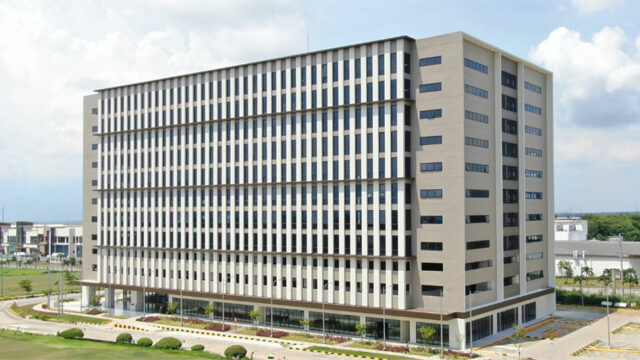
ABOITIZ INFRACAPITAL, Inc. (AIC), the infrastructure subsidiary of the Aboitiz group, said over 12,000 square meters (sq.m.) of office space at LIMA Tower One in Batangas have been leased, citing strong demand from foreign companies seeking to expand in the country.

“A lot of interest is coming from companies that are based internationally and are looking for a world-class office building in the province that’s outside the CBDs (central business districts),” Monica L. Trajano, vice-president for Commercial Strategy at AIC Economic Estates, said on the sidelines of the Arangkada Forum last week.

LIMA Tower One, an 11-storey premium office building with flexible, high-performance spaces, is the first of seven towers at the heart of LIMA Estate’s Biz Hub in Batangas.

It has secured green building certifications such as WELL and BERDE (Building for Ecologically Responsive Design Excellence). The office building is 50% occupied.

Over the weekend, electronic commerce fashion brand REVOLVE opened its office in LIMA Tower One, taking up quarter of a floor.

Aboitiz Power Corp. and JERA Co., Inc. (JERA) have also set up a training facility at LIMA Tower One.

“That pretty much is an exchange of talent between Japan and the Philippines in terms of operating the power plants that Aboitiz Power and JERA own and operate,” Ms. Trajano said. “So, they already have had their first set of students come in.”

Ms. Trajano expressed optimism about demand for LIMA’s office towers, citing the growing return to office, as well as nearby residential and commercial developments.

“For anybody that locates within our estates, there’s that connectivity that we’re providing there, we’re developing our infrastructure to be able to support that, and we’re also integrating residential [developments],” she said.

“We build residential communities that are within or pertinent to our estates.”

LIMA Estate is a 1,000-hectare (ha) mixed-use development owned by the Aboitiz group. It hosts about 4,000 households and is registered under the Philippine Economic Zone Authority. — Beatriz Marie D. Cruz

Brighter smile, thanks to purple

SINCE LAST YEAR, Colgate has been using color theory to fix yellow stained-teeth through its Colgate Optic White Purple Toothpaste. On Sept. 15, they released the Colgate Optic White Purple Serum for a more intense teeth whitening remedy.

Yellow and purple are opposites on the color wheel; when merged, it appears white. For oral beauty, this means purple color-corrects yellow tones to appear white (a company statement emphasizes that it has temporary efficacy and varying results). Purple brighteners work by depositing a sheer violet tint on the tooth surface, effectively cancelling out yellowish hues through an optical illusion.

Carlo Isla, marketing director for oral care at Colgate-Palmolive Philippines told BusinessWorld during the launch in Whitespace, “Both will deliver,” speaking of the new serum and the toothpaste. “It’s a little bit leave-on, so you leave it for two minutes, and you can rinse it out.” He also said that the serum delivers by being of a different texture (it is more viscous), and of a deeper, more intense shade of purple. “The serum and the toothpaste work better together, though,” he added.

“The principal action of this really relies on the type of purple we use,” he said about the efficacy of the products. “What we are proud of, of our serum as well as our toothpaste, is that the shade of purple is specifically engineered to cover types of yellow stains.”

“Stains will be different for everyone,” he added.

What was noticed during the launch was that the toothpaste was marketed not as an oral health tool, but as a beauty product: the product’s face is Korean star IU. “What we realized globally, and this is a global trend, that there is a space, and there’s a need for, I guess, a layering of benefits,” said Mr. Isla.

While the toothpaste works as it should in cleaning in protecting teeth, the beauty component is a prominent add-on (the serum’s bottle warns that it is not to be used as a toothpaste alone). “It takes time for yellowing to change, but this can give you an instant correction — as you would do with other beauty and cosmetic products as well.”

Colgate Optic White Purple Toothpaste and Serum are available nationwide in leading groceries and beauty stores at P49 per tube SRP (37g). — J.L. Garcia

Environmental health and sustainability

STOCK PHOTO | Image from Freepik

Every Sept. 26, the world observes World Environmental Health Day, a reminder that a healthy environment is inseparable from public health. The occasion highlights the urgent need to address environmental risks that threaten communities and to promote actions that safeguard both people and the planet.

One of the most pressing challenges is plastic pollution, which harms human health across its entire lifecycle — from resource extraction and production, to use, and finally disposal. Mismanaged plastics contaminate ecosystems, worsen climate change, and jeopardize the systems that sustain well-being. Yet plastics remain indispensable in many areas of modern life, including healthcare, where they help ensure sterility, patient safety, and access to lifesaving medicines. Balancing these trade-offs requires science-based, evidence-informed approaches that protect health, maintain safety, and accelerate progress toward more sustainable solutions.

The innovative pharmaceutical industry has been proactively addressing its environmental footprint by adopting greener practices. Several companies are reducing plastic waste through recyclable and biodegradable packaging materials, while others are investing in green chemistry and continuous manufacturing to minimize environmental impact throughout the supply chain.

AstraZeneca, for example, redesigned its clinical trial packaging distribution system. Previously, bulky thermal boxes, each weighing 15 kilograms, were discarded after a single use. By working with a distribution partner to create a returns process, and even adding simple prompts like brightly colored instructions, AstraZeneca achieved a 98% packaging return rate across 35 countries. The result was that the reduced waste was equivalent to the weight of a Boeing 747 jumbo jet.

Meanwhile, Sanofi introduced a plastic-free influenza vaccine package made entirely of cardboard. The new design halves box size, optimizes storage, and cuts transportation needs by 30%. It also reduces the carbon footprint per box by 50% and lowers overall environmental impact by up to 50%.

Boehringer Ingelheim, guided by patient feedback, developed a reusable asthma inhaler that can accommodate up to six medication cartridges. The inhaler is propellant-free, producing 20 times fewer CO₂ emissions than conventional inhalers. By 2025, it is projected to prevent 776 tons of plastic waste or equivalent to over 77 million PET bottles and 14,300 tons of CO₂ emissions.

Also, GSK pioneered the UK’s first inhaler recycling program, “Complete the Cycle.” With more than 70 million inhalers prescribed annually in the UK, improper disposal posed serious environmental risks. By 2019, the scheme had already collected 2 million inhalers, while sparking broader conversations on creating a nationwide return system. Its success showed that patients, pharmacists, and healthcare providers can collaborate to reduce waste and greenhouse gases.

Novo Nordisk launched Returpen, a multistakeholder collaboration with Sanofi, Lilly, Merck, the Danish government, patient groups, and waste-management partners. The initiative tackles the challenge of recycling millions of injection pens used worldwide each year. Beyond recycling, Returpen is working to create an integrated, user-friendly solution for handling different types of medical waste, while ensuring compliance and sustainability across the supply chain.

These initiatives demonstrate that innovation in healthcare is not limited to new treatments. It also extends to how medicines are packaged, delivered, and disposed of, with sustainability at the core.

The industry is also engaged at the policy level. The International Federation of Pharmaceutical Manufacturers and Associations (IFPMA) represents the research-based sector in the Intergovernmental Negotiating Committee (INC), which is drafting a global plastics treaty. Adopted by the United Nations Environment Assembly (UNEA) in 2022, this proposed legally binding agreement aims to end plastic pollution by addressing its full lifecycle — from production to disposal. It seeks to protect health and ecosystems by promoting sustainable alternatives and fostering circular economies.

The pharmaceutical industry supports this treaty as a harmonized, global approach that balances environmental stewardship with patient safety. Companies are investing in greener products, sustainable production, and responsible distribution practices to deliver medical innovation in ways that are both effective and environmentally sound.

Protecting environmental health is inseparable from protecting human health. As these industry efforts show, progress depends on partnerships across governments, businesses, healthcare providers, and communities. By rethinking how products are designed, used, and recycled, it is possible to reduce waste, lower emissions, and build more sustainable health systems.

As the world confronts climate change and environmental degradation, the challenge is clear that safeguarding health requires safeguarding the environment. The pharmaceutical industry is committed to being part of this journey, helping ensure that the treatments and technologies people depend on today do not compromise the well-being of future generations.


Teodoro B. Padilla is the executive director of Pharmaceutical and Healthcare Association of the Philippines, which represents the biopharmaceutical medicines and vaccines industry in the country. Its members are at the forefront of developing, investing and delivering innovative medicines, vaccines and diagnostics for Filipinos to live healthier and more productive lives.

BSP Survey: Business Sentiment Less Optimistic While Consumer Spending Seen to Increase in Q3

Philippine businesses turned less optimistic about the economy in the third quarter amid bad weather and sluggish demand during “ghost month,” a survey by the Bangko Sentral ng Pilipinas (BSP) showed. Read the full story.

BSP Survey: Business Sentiment Less Optimistic While Consumer Spending Seen to Increase in Q3

SSS partners with UnionBank for micro loan program

SSS FACEBOOK PAGE

THE SOCIAL SECURITY System (SSS) has partnered with Union Bank of the Philippines, Inc. (UnionBank) to launch a micro loan program to help boost workers’ access to credit.

The program called SSS LoanLite is targeted to be rolled out by the end of the year. Under the initiative, loans with terms from 15 to 90 days will be available, which are meant to help Filipino workers with their urgent financial needs.

“This will really help each Filipino, members of SSS, not to fall victim to loan sharks,” SSS President and Chief Executive Officer Robert Joseph M. De Claro said in a statement. “Through our partnership with UnionBank, we are taking a bold step toward protecting our members from exploitative lending and enhancing their access to responsible financial services.”

“We are also proud to be the first banking partner for SSS’ upcoming micro loan program — a short-term, socially responsive loan designed to support members in times of financial need,” UnionBank President and Chief Executive Officer Ana Maria Aboitiz-Delgado said.

The loanable amount under the program is at P5,000 to P20,000 and will depend on a member’s needs. They will have a rate of 8% per annum plus a service fee.

The application and approval process for the loan is fully digital, with the funds to be transferred directly to members’ UnionBank accounts or MySSS Cards.

SSS said they target to release P40 billion loans under the program within the next two years.

UnionBank’s net income fell by 40.54% year on year to P1.82 billion in the second quarter amid lower income from loans and higher provisions. This brought its first-semester profit to P3.25 billion, down by 38.86% from the same period last year.

Meanwhile, SSS posted a P1.13-trillion net loss in 2024, according to its financial statement posted on its website, wider than the P444.13-billion loss in 2023. However, before changes in policy reserves, it booked a net income of P90.25 billion last year, up from P83.13 billion in 2023. — A.M.C. Sy

How PSEi member stocks performed — September 26, 2025

Here’s a quick glance at how PSEi stocks fared on Friday, September 26, 2025.


PHL shares may extend slide on weak sentiment

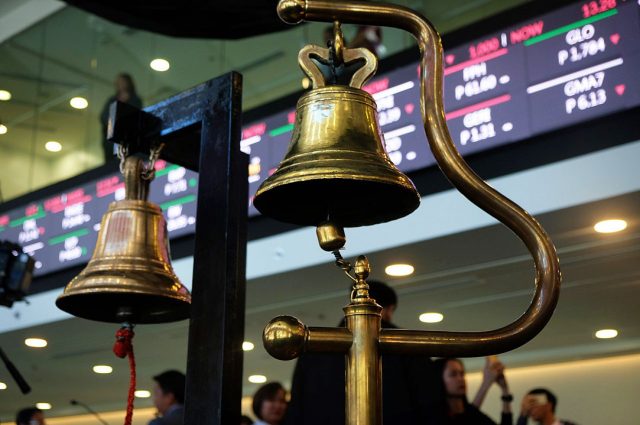
BW FILE PHOTO

PHILIPPINE STOCKS may continue to decline this week as corruption concerns continue to weigh on market sentiment.

On Friday, the Philippine Stock Exchange index (PSEi) dropped by 0.25% or 15.16 points to close at a near six-month low of 6,027.12, while the broader all shares index decreased by 0.23% or 8.7 points to 3,644.80.

Week on week, the PSEi also fell by 237.37 points from its 6,264.49 close on Sept. 19 as it posted losses for five straight sessions.

“Following the prior week’s gain, the local bourse pulled back this week on lingering political uncertainties over investigations in flood control projects,” online brokerage 2TradeAsia.com said in a market report on Friday.

“The local market is still moving with a bearish bias, forming a new low and even visiting the below 6,000 territory last week. Corruption issues over the Philippines’ flood control projects and the peso’s weakening position against the US dollar continue to weigh on the bourse,” Philstocks Financial, Inc. Research Manager Japhet Louis O. Tantiangco said in a Viber message.

The Justice department said on Friday that the National Bureau of Investigation (NBI) has recommended the prosecution of 21 individuals, including several lawmakers and officials of the Department of Public Works and Highways, over their alleged involvement in anomalous infrastructure projects.

Meanwhile, on Friday, the peso closed unchanged at P58.10 per dollar due to these corruption issues and reduced expectations of further US Federal Reserve rate cuts amid strong economic data.

For this week, Mr. Tantiangco said there could be some bargain hunting following the PSEi’s five-day slide.

“A strong rally is not yet expected, however, until the market finds a strong positive catalyst. Investors are also expected to continue dealing with the corruption issues of the country’s flood control projects,” he said. “Investors may also take cues from the movement of other relevant markets. The peso’s direction may still play a significant role in the market’s movement, with further depreciation causing a market decline and an appreciation causing a market rebound.”

The market may also react to the US consumer spending and personal consumption expenditures price index data released on Friday and the S&P Global Philippines Manufacturing purchasing managers’ index report set to come out this week, Mr. Tantiangco said.

“Chart-wise, the local market remains on a downtrend. In last week’s trading, the market fell after failing to hold its position above its 50-day exponential moving average, meaning the line remains as a resistance. On a positive note, the market is still holding its ground above 6,000, meaning the said level remains as a support,” he said.

2TradeAsia.com said the market may remain volatile and further test its support levels. It put the PSEi’s immediate support at 6,000 and secondary support at 5,800, while its resistance is pegged at 6,150-6,200. — Alexandria Grace C. Magno

PHL’s anti-graft drive faces credibility crisis without convictions — analysts

PRESIDENT FERDINAND R. MARCOS, JR. FACEBOOK PAGE

By Chloe Mari A. Hufana and Adrian H. Halili, Reporters

PHILIPPINE President Ferdinand R. Marcos, Jr.’s anti-corruption drive on flood control project risks being dismissed as political theater unless it delivers prosecutions and convictions, political analysts said, as business groups pressed him to match rhetoric with accountability and reforms.

“Investigations alone are not enough to rally the confidence and support of any investors,” Gary D. Ador Dionisio, dean at De La Salle-College of St. Benilde’s School of Diplomacy and Governance, said in a Facebook Messenger chat.

“Tangible results are the real game-changer,” he added, noting that Mr. Marcos’ anti-graft campaign would not stand apart from past administrations unless Filipinos witness concrete outcomes — from the filing of major graft cases to the conviction and jailing of lawmakers, public works officials and private contractors involved in the scandal.

Recent protests have amplified calls for transparency, with business groups, investors and citizens demanding credible investigations, reforms in procurement and auditing systems and stronger safeguards against misuse of funds.

In July, the President launched a sweeping anti-graft campaign after a series of storms and monsoon rains exposed the country’s outdated flood control systems.

This brought several investigations, leadership changes in Congress and agencies and the creation of an independent body for infrastructure probes.

Mr. Ador Dionisio said credit should be given to Mr. Marcos for initiating, exposing and to some extent institutionalizing the crackdown on flood control corruption, even if the primary casualties of this anti-corruption drive are his own party mates and congressional allies.

The investigations have implicated some of the President’s allies in receiving alleged kickbacks from infrastructure projects, including his cousin, former Speaker and Leyte Rep. Ferdinand Martin G. Romualdez.

Hansley A. Juliano, a political science lecturer at the Ateneo de Manila University, cited deeper structural limits on any crackdown made by past administrations.

He said past administrations failed to curb corruption due to entrenched clientelism, congressional dependence on presidential budget largesse and the security of dynastic politicians, letting many to simply lie low and wait for regime transitions.

The President faces a dilemma, Mr. Juliano said. “Can he crack down on allies and court public opinion to demonstrate his sincerity and moral character — something he hasn’t been known to live up to before?” he asked.

“Unless these politicians can be defeated in elections and their machinery subsequently dismantled, they basically can mount a comeback and keep their local and national clientele loyal,” he said via Messenger chat. “Cracking down on their assets via a national bureaucracy loyal to the Constitution is also necessary.”

Flood control has long been a major governance and development issue in the Philippines, a country highly prone to typhoons, heavy monsoon rains and rapid urbanization that worsens flooding. 

Billions of pesos are allocated annually for flood management projects such as drainage systems, dikes, pumping stations and river improvements. The government has since suspended such projects for next year due to corruption issues.

Despite this, severe flooding continues to displace communities, disrupt economic activity and strain disaster response systems, particularly in Metro Manila and other low-lying regions.

LEGITIMACY GAP
Meanwhile, analysts said the government’s independent investigation of anomalous infrastructure projects should be more transparent.

Arjan P. Aguirre, a political science lecturer at the Ateneo, said the Independent Commission for Infrastructure (ICI) must address its legitimacy gap. As an entity created by the Executive, it is inherently unable to oppose the interests of its appointee, so it must at least appear transparent, he said in a Messenger chat.

He said it should allow the public and stakeholders to scrutinize information it gathers during the probe.

“With this openness, other stakeholders such as the media, academic institutions, civil society groups, concerned individuals, etc. can have the opportunity to validate the information that is acquired by the commission,” he added.

Mr. Marcos formed the body to probe anomalies in flood control and other infrastructure projects, with authority to recommend criminal, civil and administrative charges.

Michael Henry Ll. Yusingco, a fellow at the Ateneo Policy Center, said the ICI investigations might only be a smokescreen to protect the President from public outrage.

“The ICI allows Malacañang to promote the narrative that the President is blameless and that he is in fact spearheading the crusade to get to the bottom of it all,” he said in a Messenger chat.

Josue Raphael J. Cortez, who teaches diplomacy at De La Salle-College of St. Benilde, said less transparency might continue to stir public unrest.

“It may erode trust in state institutions, which in turn may also negatively impact how the government can ensure order and security,” he said via Messenger chat. “At the same time, we also need to bear in mind that investors are looking at the political climate in their decision-making processes.”

He added that any preliminary findings by the ICI should be handled with caution and confidentiality.

“The last thing we would want is public opinion clashing with their ongoing investigations — all for the sake of opening up about every step the ICI is taking,” he said.

Last week, thousands of Filipinos marched in the capital in the biggest protest in years against the multibillion-peso flood control scandal, turning weeks of online outrage over corruption into mass street demonstrations that rattled the political establishment.


Philippines seeks bigger role in global peace with UN Security Council bid

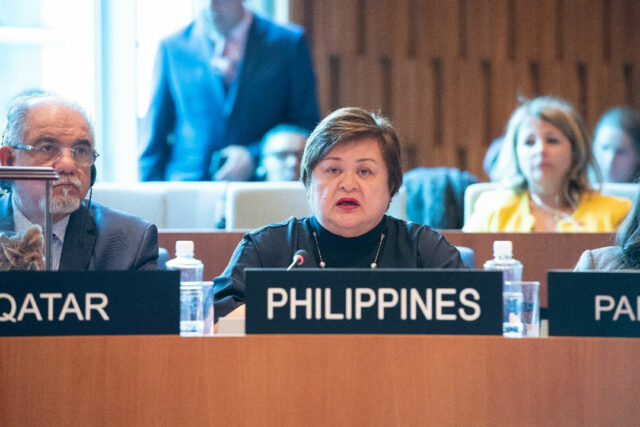
Foreign Affairs Secretary Ma. Theresa P. Lazaro — DFA.GOV.PH/UNESCO PHOTO

THE PHILIPPINES pledged to play a bigger role in promoting peace as it campaigns for a nonpermanent seat in the United Nations Security Council (UNSC), Foreign Affairs Secretary Ma. Theresa P. Lazaro said at the UN General Assembly in New York on Sunday.

“We seek to be a part of it to advance the cause of global peace, with the depth of experience earned from our struggles for peace,” Ms. Lazaro said in a livestreamed address.

Manila is seeking a two-year term for 2027-2028, which will mark its fifth time on the council. Elections will be held in mid-2026, when five of the 10 nonpermanent seats are up for contest.

Earlier, the Department of Foreign Affairs said the Philippines would use the UN gathering to lobby support for its candidacy.

Ms. Lazaro said the country is prepared to consider the views of the broader UN membership and work with other principal organs if elected. “This is a challenge that the Philippines is ready to rise up to, as we seek a nonpermanent seat in the Security Council. We look ahead to the solemn honor of serving this body,” she said.

The UNSC is the UN’s most powerful body, with authority to issue binding resolutions on peace and security. Its five permanent members — China, France, Russia, the UK and the US — hold veto power, while 10 nonpermanent members are elected to two-year terms with full voting rights but without veto privileges.

Ms. Lazaro reiterated Manila’s commitment to diplomacy and the peaceful settlement of disputes, citing tensions in the South China Sea.

“There is no alternative to the United Nations. There is no good global order other than one based on international law and the principle of the sovereign equality of states,” she said. “A rules-based order is indispensable.”

She cited the UN Convention on the Law of the Sea (UNCLOS) and the 2016 arbitral ruling that voided China’s sweeping claims to the South China Sea as the legal basis of the Philippines’ position.

“While our government vessels and fisherfolk continue to be harassed in our own waters, and as we remain on the receiving end of illegal, coercive, aggressive and dangerous actions in the South China Sea, we abide by the UNCLOS as reinforced by the binding 2016 arbitral award,” she said.

China has refused to recognize the award and continues to assert control over areas within the Philippines’ exclusive economic zone, resulting in frequent confrontations at sea.

Beyond security issues, the Philippines also pressed for reforms in development financing, citing budget cuts tied to geopolitical conflicts.

“Amidst current funding shortfalls, we must support reforms to help it deliver value to UN member states, in tight accord with national priorities, with less bureaucracy and fragmentation,” Ms. Lazaro said.

She added that financing cuts limit resources that could have supported the sustainable development goals of developing and middle-income nations. — Adrian H. Halili

Lacson flags P100-billion insertions in 2025 budget

PHILIPPINE STAR/JOHN RYAN BALDEMOR

SENATOR Panfilo “Ping” M. Lacson on Sunday said senators of the previous Congress inserted at least P100 billion worth of items into this year’s P6.79-trillion national budget.

In a statement, Mr. Lacson said “almost all” senators had individual amendments to the budget, with allocations ranging from P5 billion to P9 billion each. These were tagged as “for later release.” He did not name specific lawmakers.

“For the Senate, the insertions amounted to at least P100 billion. I was surprised because these are individual insertions although they were held ‘for later release,’” he said.

He added that he has yet to review the list of insertions made by congressmen, which he described as “long.”

Mr. Lacson said the magnitude of congressional insertions has ballooned compared with the amounts under the now-defunct Priority Development Assistance Fund (PDAF) or pork barrel, which the Supreme Court struck down as unconstitutional in 2013.

“It was humongous,” said Mr. Lacson, who heads the blue ribbon committee. “I have never seen such amounts. Before PDAF was declared unconstitutional, ‘pork’ amounted to hundreds of millions. Now it’s at least P100 billion total for 24 senators alone.”

The 2025 GAA has drawn criticism over congressional insertions. President Ferdinand R. Marcos, Jr. delayed signing the budget for more than a week in December to review its provisions before vetoing more than P194 billion worth of items deemed inconsistent with his administration’s priorities.

Mr. Lacson warned that large-scale insertions could strain the economy by diverting funds from programs that should be implemented at the village, city or regional levels.

He said he would raise the issue during budget deliberations, asking agencies why they allowed such items. “In scrutinizing the budget especially in the plenary, I want to know how much of the insertions were released and how they were implemented,” he said.

He also urged lawmakers to exercise restraint in pushing for locally funded infrastructure projects, which have come under scrutiny amid reports of ghost and anomalous flood control programs. — Adrian H. Halili

Filipino students in US reach 15-year high

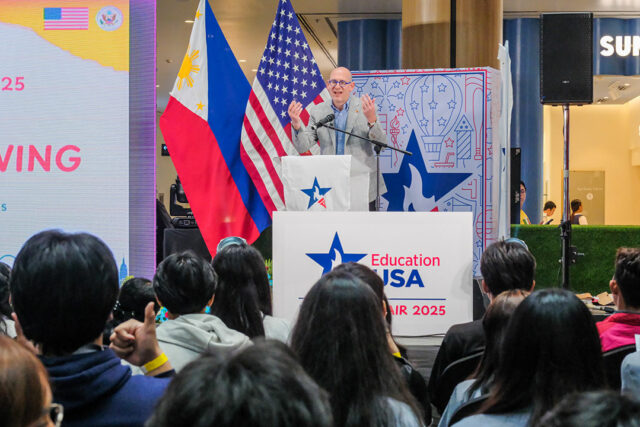
US EMBASSY Chargé d’Affaires Y. Robert Ewing addressing students at the EducationUSA University Fair 2025 in Manila on Sunday. — PHILIPPINE STAR/RYAN BALDEMOR

By Erika Mae P. Sinaking

INTEREST among Filipinos in pursuing higher education in the US is growing, with the number of students enrolled in American universities reaching its highest in 15 years, according to US Embassy officials.

“We are focused on helping Filipinos pursue studies abroad in the United States,” US Embassy Chargé d’Affaires Y. Robert Ewing said during the EducationUSA University Fair 2025 in Manila on Sunday.

The fair, marking its 10th anniversary, featured 29 US colleges and universities and highlighted the rising number of Filipino students studying in the US, which reached more than 4,100 in 2024, up from about 3,000 when the event first started.

Mr. Ewing said recent initiatives include Fulbright-Philippine Space Agency scholarships, an agreement with US energy company EOS to fund exchanges in civil-nuclear energy and new memoranda of understanding with Philippine universities and private companies.

EducationUSA, the embassy’s advising arm, provides a free and impartial resource for Filipinos seeking to study abroad.

“These partnerships are about developing the future workforce of the Philippines,” he said, highlighting key sectors such as energy, cybersecurity, maritime law enforcement and semiconductors.

He also cited the accessibility of the US community college system, which lets students complete two-year programs before transferring credits to four-year universities.

Commission on Higher Education (CHED) Chairperson Shirley C. Agrupis said the agency is promoting policies to allow Filipino students abroad to acquire skills that contribute to national development. “That’s the real picture behind this transnational education,” she told BusinessWorld.

“We are expanding the educational system so that we will partner with universities that have a mutual recognition of the credits of the degree program,” Ms. Agrupis said. “What they earn in the United States is recognized here, and what they earn in the Philippines has an equivalency in the United States or anywhere else in the world.”

She said the policy direction of CHED now is to “prioritize the identified priority programs that are very hard to fill in the Philippines.”

Meanwhile, US sports envoy and retired professional basketball player Taj McWilliams-Franklin cited how athletics could complement academic pursuits by young Filipinos.

“The development of women’s basketball in the Philippines is at a higher level now compared with 2016,” she told BusinessWorld on the sidelines of the event. “Here in the Philippines… that means you’re doing something right and the college system is developing players well.”