Home Blog Page 9449

Djokovic emotional after hosting Belgrade exhibition

BELGRADE — An emotional Novak Djokovic could not hold back the tears while hosting a charity event at his tennis complex by the Danube River on Sunday.

Although the world number one missed out on Sunday’s Adria Tour final, in which Dominic Thiem beat Serbian Filip Krajinovic 4-3 2-4 4-2, the event revived a lot of fond memories for the 17-time Grand Slam champion who staged the exhibition while international tennis remains suspended due to the COVID-19 pandemic.

“I was very emotional on the court today. Childhood memories started flooding back, including those of growing up on these courts and playing here as a young boy,” the 33-year-old told reporters after being cheered on by a 4,000-strong capacity crowd.

“I was overwhelmed and those were tears of joy after the match.

“I try to give back to where I come from and be conscious of my childhood and my upbringing. This tennis was an epicenter of people from my childhood days getting together for this tournament, including my former coaches. They were all here.”

Djokovic beat Germany’s Alexander Zverev on Sunday in his last round-robin match but failed to secure his place in the final after both players and Krajinovic ended up with 2-1 win-loss records and an identical 5-3 set difference in their section.

Krajinovic, who stunned Djokovic on Saturday, squeezed through on the basis of having the best games differential among the three.

However, he was powerless to stop Thiem in the final.

“This tournament was for a good cause and we all gave our best,” Thiem said after finishing off the weekend with a 100% winning record.

“Many high-quality matches in a great atmosphere, in front of a full crowd, so it was a perfect weekend.

“A very big thank you to everyone including Novak and his team, you all made my first trip to Serbia a very special one.”

The eight-man tournament featured a more streamlined format than what is seen on the main tour, with sets slashed to best-of-seven games.

The second leg of the tour will be held in Croatia’s coastal resort Zadar next weekend.

The third leg due in Montenegro on June 27 and 28 was scrapped on Saturday over coronavirus concerns and the final leg is set for Bosnia’s Banja Luka on July 3 and 4. — Reuters

Comfort during uncertain times

Eden Celebrates National Cheese Day by Sharing with the Community

Three months into what can only be described as the most unprecedented event in this lifetime, how are you doing? This is a trying time for everyone, regardless of where you are. One way we can all get through this together is by savoring the special moments that come our way, with the people who matter most – our families and loved ones.

On the internet-proclaimed National Cheese Day on June 4, it’s only fitting that the country’s favorite Eden cheese marks the special day by providing ways for families to make ordinary moments more special and give comfort during these uncertain times.

Giving comfort and deliciousness to Filipino families is what Eden cheese has been doing for the past four decades. Currently, comfort and nourishment are what people need most, things which Eden cheese is ready to provide. “Our purpose is to nurture family connections with every savor-worthy meal,” shares Eden Cheese Brand Manager Kristen Mendoza. “Despite the uncertainty of our current situation, we can still make the most out of our time at home. No family moment is too ordinary to share. We can cherish togetherness and bond over home-cooked dishes which are made more delicious with Eden Cheese.”

Celebrating National Cheese Day with 2,000 Families

With all the challenges in the world today, it’s good to take a break to celebrate the deliciousness and comfort that cheese can bring our meals and snacks. Eden cheese, together with partner Rise Against Hunger, thought to celebrate the role that cheese plays in our lives and kitchens by sharing snack products with the latter’s adopted community.

“We wanted to show our support to the families of Rise Against Hunger’s community in Calauan, Laguna by celebrating National Cheese Day. We provided Eden family packs to 2,000 vulnerable families. We hope the enjoyable meals they can make together as a family and with Eden cheese, brings them some comfort during these uncertain times,” shares Mendoza. Families also received other snack products from the brand’s maker, Mondelez Philippines.

Mondelez Philippines has been sharing its snack products to health front liners and communities in danger of facing hunger since the beginning of the COVID-19 lockdown in March 2020. Their contribution has amounted to some P14 million worth of products distributed by partners like Rise Against Hunger and more than 40 other organizations and individuals nationwide. The Eden Cheese packs shared with families is one of the ways the Company aims to show that as a nation, we are #StrongerTogether.

“It’s so important to keep extending support to communities and families at this difficult time,” adds Jomar Fleras, Executive Director of Rise Against Hunger. “This crisis has impacted everyone, and more so the families who have little. We thank Eden Cheese for providing comfort to the families, so that at home they can experience small moments of delight as we endeavor to get through this crisis as one nation.”

How online selling is thriving in the new normal

By Hannah Mallorca, Features Writer, The Philippine STAR

The growth of many e-commerce platforms is the effect of transition from traditional shopping channels to online platforms during quarantine

The coronavirus disease 2019 (COVID-19) pandemic has caused the rise and fall of several industries worldwide. Even though e-commerce platforms have long been on the rise, the process was fast-tracked when quarantine guidelines were put into place.

With the absence of traditional shopping channels, customers have flocked to e-commerce platforms to secure purchases and transactions. Many stores and restaurants have also transitioned online to serve their target market.

To discuss the current state of online selling in the new normal, The Philippine STAR’s Career Guide shared insights on the progress of e-commerce platforms and other online means during this time.

The online discussion featured Entrego retail director Xervin Maulanin, PurpleBug Inc. president and CEO Marlon Gonzales, La Carnita Modern Mexican Cantina co-founder Lenlen Mesina, Lazada Philippines head of business development Petrus Carbonell, and Seven Days of Greens co-founder Roel Uy Chan.

Growth of e-commerce platforms

Even though various e-commerce platforms were established pre-pandemic, its identity strengthened since the start of quarantine. Mr. Carbonell shared that Lazada has witnessed significant growth.

“So far, we see a lot of demand. We’re also seeing people who are more interested in starting their businesses online,” he added. “I think this will continue even after quarantine and if you think about it, these trends have always been present. Ang nangyari lang ngayong quarantine, na-accelerate siya.”

According to Mr. Carbonell, some of the most popular products in Lazada’s platform are groceries, medical items, and ready-to-eat products.

Mr. Maulanin noted that the transition from traditional shopping methods into online has pushed e-commerce platforms to sell more essential goods and daily needs. He added that delivery personnel are also considered as frontliners due to their service during the quarantine.

Lumalaki ang volume natin compared to before. We’re still a long way to go before online shopping becomes the predominant channel for us, but I think we’re going to see a lot of acceleration there. We’re very excited to see ano’ng magiging trend nito,” he said.

Transitioning from traditional shopping methods to online

The pandemic has caused many businesses to transition to online to cater to its customers. Many restaurants have also moved towards delivery services to serve their target market.

According to Ms. Mesina, proper research and development are needed to ensure the quality of Cantina’s products even in the new normal.

“At the moment, what we’re trying to do, instead of dispensing or distributing the product, we had to come up with product lines that can be experienced by the customers in the comfort of their homes, that’s why we really value the support and the service of third-party suppliers when it comes to delivery,” she shared.

Ms. Mesina also noted that the quarantine is an opportunity for many businesses to understand how to navigate into e-commerce and to incorporate online payments.

“You need to make sure that you’re able to deliver what you’re promising to your online market and that the product is available from you. It’s also not just being available, the products must be consistent and of very good quality kasi ‘yun ‘yung magiging labanan when it comes to online selling,” she added.

On the other hand, Mr. Gonzales said that quarantine has challenged e-commerce platforms, restaurants and other online sellers to develop its services since it will reflect on customers.

“People will always buy if maganda ‘yung feedback na makikita nila. What we’ve noticed din karamihan ng returning customers namin are referrals so very important ‘yung feedback na nakikita nila online,” he said.

Mr. Uy Chan stated that the new normal has also urged online sellers, e-commerce platforms and restaurants to refine collaboration methods with its partner channels to ensure quality service.

“The principle behind online selling is still intact and similar to traditional selling wherever you go. It’s still just a channel,” he added.

In addition, Mr. Carbonell noted that e-commerce platforms and online sellers would continue to grow, even in a post-pandemic society.

“In terms of the potential of people reaching success, I would say that the sky is the limit because we see new millionaire sellers every time that we run a campaign. I’m not saying that everyone who goes online will be successful, but we see many cases that the potential is huge,” he said.

Online selling platforms have witnessed significant growth in customer behavior during the pandemic. With this, it’s up to business sectors to improve its services to ensure loyalty among its target market.

Philippine court finds news site chief Maria Ressa guilty of libel

The head of a Philippine news website known for its tough scrutiny of President Rodrigo Duterte faces up to six years in jail after being found guilty of cyber libel by a Manila court on Monday in what is being seen as a test case for media freedom in the country. Maria Ressa, chief executive of Rappler (www.rappler.com), was charged with cyber libel over a 2012 article, updated in 2014, that linked a businessman to murder and trafficking of humans and drugs, citing information contained in an intelligence report from an unspecified agency.

After handing down the verdict, Judge Rainelda Estacio-Montesa said freedom of the press could not be used as a “shield.”

Ressa, who had denied any wrongdoing, was allowed to post bail. Cyber libel is among the numerous lawsuits filed against Ressa and Rappler that have drawn global concern about a free and open media in the Southeast Asian country.

Rappler’s operating license was rescinded in 2018 over alleged foreign ownership violations, and it is also dealing with a case involving alleged tax evasion. Both cases are ongoing. Media watchdogs have said the charges against Ressa were trumped up and aimed at intimidating those who challenge Duterte’s rule, in particular his deadly crackdown on illicit drugs. — REUTERS

[B-SIDE Podcast] Remote medical imaging and COVID-19 detection

Follow us on Spotify BusinessWorld B-Side

Health experts are still learning how the coronavirus attacks the human body. What they do know is that COVID-19 is a serious infectious disease that hits multiple organs, most commonly the lungs — which are called “ground zero” of the disease. From there, the virus can spread to a patient’s heart, kidneys, and brain.

In areas of the world where there is a lack of adequate access to testing, imaging techniques — such as a chest X-ray — can help in diagnosing the disease.

Lifetrack Medical Systems, a health-tech startup that replaces legacy software and allows radiologists to remotely view and medical diagnoses, partnered with Antique’s local government and offered its technology for free to hospitals and clinics serving as COVID-19 triaging and referral centers.

Carl Nicholas Ng, COO of Lifetrack, explains to BusinessWorld reporter Charmaine Tadalan how this service is vital in the Philippines, where there are only about 1,000 radiologists in a country of more than a hundred million people.

TAKEAWAYS

Access to diagnostic imaging must be improved.

According to the Pan American Health Organization/World Health Organization, between 70% and 80% of diagnostic problems can be resolved through the basic use of X-rays and/or ultrasound examinations. Two-thirds of the world’s population has no access to diagnostic imaging — meaning about five billion people can’t even get a simple X-ray. Access is limited not just by the cost of equipment, but by the lack of radiologists.

A service like Lifetrack, which allows radiologists to interpret images remotely, can alleviate this problem.

Medical imaging accelerates the detection of potential COVID-19 cases.

Aside from offering its technology for free to hospitals in Antique and Leyte, Lifetrack also launched a secure anonymized global COVID-19 image repository that can be used by radiologists and researchers to more quickly identify potential COVID-19 cases. The startup is part of the International Consortium for COVID-19 Imaging AI (ICOVAI).

Recorded remotely on April 29. Produced by Nina M. Diaz, Paolo L. Lopez, and Sam L. Marcelo.

Follow us on Spotify BusinessWorld B-Side

Education’s new normal: a chat with Edukasyon.ph’s Henry Motte-Muñoz

“Only 20% of students are able to complete their journey from enriching education to gainful employment. The odds can be improved.”

Henry Motte-Muñoz is the founder and CEO of Edukasyon.ph, the leading edtech platform in the Philippines committed to helping students make better-informed decisions for their education, career and life choices. He has a background in finance and economics, and worked at firms like Bain Capital and Goldman Sachs before deciding to move to the Philippines in 2015.

Here, he shares his thoughts on distance learning and Philippine education in the new normal:

DepEd will be relying heavily on parents to help this coming school year. The new normal compels them to supervise schoolwork on a more constant basis. How will parents cope with this new responsibility?

This will be a challenge for parents, especially those with children who aren’t in the primary levels. For instance, if the last time you had to use algebra was 18 years ago, how are you going to explain the concept to your kids now? Additionally, they also have to think about how this new school schedule fits in their work schedule. There are going to be considerations in terms of even better organizing their limited time.

How can parents set up a conducive learning environment for their children at home?

Ideally, you will need to have an area dedicated to studying. We know, however, that this is a question of resources. Not everyone has that option. If you live in a small home with six other people, you’re not going to have that dedicated area to study. You’ll probably also have to deal with learning how to overcome distractions like having to block out other people’s conversations.

Online teaching is a different ballgame. Preparing lessons for physical classes is completely different from preparing lessons for virtual ones. How can teachers prepare for this evolution in their roles?

There are free online courses that teachers can use to reskill and upskill on their own, but transitioning to teaching online will get more manageable as the months go by. There are three batches who are dealing with distance learning: the first batch were the ones that dealt with the end of classes last March. That was a trial by fire in terms of how to comply with final requirements and so on. The later batches – those that start on August 24 and on January 2021 onwards – will benefit greatly from the iterations resulting from the first one.

Online learning is different from offline learning too. How can kids shine and succeed while being educated remotely?

I think that for students there are two factors: logistics and aspiration. There’s logistics in terms of time management and organization. There’s also the aspirational factor. Students will have to become acquainted with the concept of grit even at a young age. Because let’s face it: this is an incredibly tough situation. Let’s not sugarcoat it. People will have to overcome. I mean, we hear a lot of stories about Filipinos being so resilient. The thing about resilience is that it also sounds like survival. We don’t want students to just survive; fundamentally, we want them to thrive.

Students in particular need to realize what their purpose for getting a quality education is. It’s to give them a chance at a better future—for themselves and for their families.

I hear that only 20% of state universities will be able to do online learning at this point. What’s the most affordable solution for them to get on board?

There’s no easy answer but things will change as we go along the journey towards distance learning. I am proud to be a Filipino but one thing we’re not good at is feedback. We’re not good at hearing out criticisms. We need to have honesty and clarity in terms of our feedback loop so we can constantly improve how we can effectively implement distance learning. There will be birthing pains for sure.

No discussion on distance learning is complete without mentioning our country’s connectivity problems. Technology is a bridge for some, a chasm for others. Will this aggravate the gaps between the haves and have-nots?

The country has always had inequality. It’s still going to be a similar situation this coming SY 2020-2021. There will be inequality in the post-Covid-19 new normal. Technology is an enabler, but children that do not have technological access will struggle. That is the reality.

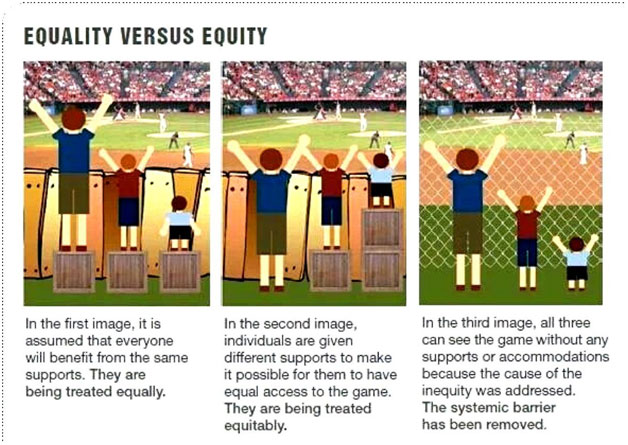
There’s a great meme that’s been going around that illustrates equality and how it’s different from equity. It’s an apt illustration of what true inclusion is.
You mentioned that India is launching 12 new TV channels solely dedicated to education. What do you think of the DepEd’s plan of providing 15% of airtime dedicated to children’s programming? They’re currently working with the Presidential Communications Group towards that end.

I think it’s a great idea! Of course it’s one-way, but people watch TV with a sense of joy. Kids can evoke that same sense of joy when learning through TV. Radio is even better. It’s a cheaper medium and can reach even the remotest areas.

You also mentioned that students are usually around their peers all day long. IATF Resolution #34 says that curricular activities such as sports fests are cancelled. What can be good alternatives for fostering camaraderie and a sense of community?

It goes back to students having to find purpose in group activities. If the joy of sports was doing sports together, then can you work out together whilst live streaming? It’s never gonna replace an actual basketball game, but if you got served half-rotten lemons, what’s the best lemonade you can make?

It’s also being philosophical and answering questions such as: why did you enjoy doing sports with others? If it’s because of reasons like the physical aspect of things, or attaining skills, or spontaneity, can you still exercise by yourself? Watch YouTube videos to improve? Find other ways of being spontaneous with your friends? Understand your why—then you can think of substitutes.

You normally ask this much introspection from adults, but this may be a silver lining that we get a generation that’s a lot more introspective and that understands itself much better.

What role do you see platforms like Edukasyon.ph playing as we learn to live in this brave new world?

We encourage students to really explore what’s out there. That’s at the heart of Edukasyon.ph. We’re not the silver bullet for education in the Philippines, but we want to create an ecosystem where students can find all the support that they need. The role we are trying to play is one of a support system.

We always go back to how we can help students make the best out of the cards they were dealt with. We can’t change the cards, but we can change their understanding of the other cards they might not know they were also dealt with: opportunities they didn’t know existed, scholarships, free online courses, really useful blogs. It’s helping the students through all the decisions they have to make and helping them stay resilient. It’s making sure they find their joy and their purpose.

It’s not easy for anyone. It’s gonna be hard work, but if you know your why, it’ll help you figure out the best available how.


Oil tariff may not affect power rates

By Adam J. Ang

THE additional tariff on imported petroleum products is set to take effect this week, although this may not affect electricity rates immediately as such cost is not automatically passed on to consumers.

President Rodrigo R. Duterte on May 2 signed an executive order temporarily raising duties on imported crude oil and refined petroleum products by 10%, the revenues from which will be used to finance the government’s coronavirus disease 2019 (COVID-19) pandemic response.

The Department of Energy (DoE) expects pump prices to reflect the impact of higher tariffs this week.

The Energy Regulatory Commission (ERC) said the new taxes or increased duties through laws are not automatically reflected on electricity bills as passing these charges on to consumers will require the commission’s approval.

“Any change in law resulting [in] additional taxation, surcharge or tariff [the cost] is not automatically passed on as it will usually require separate ERC approval. That is why some may say na walang (there is no) impact because it is subject to ERC approval,” ERC Spokesperson Floresinda B. Digal told BusinessWorld.

Ms. Digal said power generators may just absorb the added cost from the increase in fuel prices.

“For most [generation companies], knowing how difficult it is to get an ERC approval, what we’ve seen is they will just absorb the increase,” the ERC official said.

The DoE earlier said the government may earn an estimated P6.78 billion by the end of the year from the additional oil import tariffs, which are seen to raise prices of gasoline by P0.60 per liter (L), diesel by P0.84/L, and kerosene by P0.55/L.

DMCI Power Corp. (DPC) sees an increase in electricity charges because of the additional tariff, alongside the general volatility of oil prices amid the global pandemic and economic slowdown.

“As far as the drop in the price of fuel in the world market and the government mandate to increase the oil import tariff, these events will have an impact [on] the electricity rates which effectively affects the revenues of DPC. However, these events will not affect DPC’s net income because of the ‘pass-through’ policy of the regulators,” DPC President Nestor D. Dadivas said.

Some of DPC’s power plants, which serve utilities in Masbate, Palawan, and Oriental Mindoro, run on coal and diesel.

Other power plants will not immediately purchase fuel around this time when demand is still relatively low due to community lockdowns, according to Philippine Independent Power Producers Association (PIPPA), noting their fuel supplies are at a “safe” level.

“[G]iven the low demand, it would seem that the fuel supply is at a safe level given that demand is down and there is no regular dispatch for these plants. As such, there is no immediate effect at this time until these plants decide to purchase more fuel,” PIPPA Executive Director Anne E. Montelibano said.

“Fuel is the largest cost for oil-fed power, [meaning] that any future [price] increase may result in, but does not necessarily automatically translate to, increase [in] power rates,” she added.

The Philippine Electric Plant Owners Association (PEPOA), a group of power utilities, said the added tariff may only affect the cost of transportation of coal used by baseload power plants.

“If ever there will be a price impact on the fuel cost of power supply, it will probably be in the shipping and transportation cost of coal, which is the fuel predominantly used by baseload power plants,” PEPOA President Ranulfo M. Ocampo claimed.

Since May, fuel prices are increasing with the rebalancing of supply and demand in the global oil market.

Year to date, oil prices dropped by P7.97/L for gasoline, P11.09/L for diesel, and P14.44/L for kerosene.

As power demand is starting to pick up with businesses resuming operations after months of lockdown, the Independent Electricity Market Operator of the Philippines earlier said electricity prices at the Wholesale Electricity Spot Market are likely to rise to as much as P4.27 per kilowatt-hour (kWh) this month with peak demand to reach 13,368 megawatts (MW) and a stable average daily supply of 14,970 MW.

Anti-terrorism law needed to stay off ‘gray list’ — AMLC

THE Philippines faces the possibility of being included in a “gray list” of economies with lax laws on anti-money laundering and counter-terrorism financing if it fails to pass and effectively implement the proposed Anti-Terror Act (ATA), the Anti-Money Laundering Council (AMLC) said.

The ATA, which critics fear the government will use to violate human rights, is currently awaiting President Rodrigo R. Duterte’s signature.

The Financial Action Task Force (FATF) had placed the Philippines under a 12-month observation period, originally scheduled to end in October but was extended to February 2021. During this time, the Philippines has to address the gaps identified in the Republic Act No. 9372 or the Human Security Act (HSA) of 2007 and the Anti-Money Laundering Act of 2001 (AMLA).

“This observation period is the last opportunity for the Philippine competent authorities to address identified deficiencies in the (2019 mutual evaluation report) to avoid gray-listing… So passing amendments to both the HSA and AMLA, as amended, is among the conditions to avoid the country’s inclusion in the gray list,” AMLC said in a statement released on Saturday.

Passing the law is not enough, AMLC said. The Philippines should also “demonstrate effective implementation of these amendments before the observation period ends in February 2021,” it added.

AMLC noted the FATF evaluation found the HSA lacked necessary provisions for the Philippines to be compliant with certain UN Security Council Resolutions (UNSCR) aimed at cracking down on foreign terrorist fighters. For instance, a key requirement under UNSCR 1624 is to lawfully ban “incitement to commit terrorist acts.”

It proposed several HSA amendments that are now included in the anti-terror measure, such as the “designation ex parte of terrorist individuals; and terrorist groups; and implementation of targeted financial sanctions to stop the flow of funds or assets to terrorists.”

At the same time, the AMLC warned the country’s inclusion in the gray list would further hurt the economy, already facing a recession this year.

“Consequently, the Philippines’ inclusion in the gray list will result in an additional layer of scrutiny from regulators and financial institutions, thereby increasing the cost of doing business; delaying the processing of transactions; and blocking the country’s road to an ‘A’ credit rating,” AMLC said.

“The pandemic is already adversely affecting our economy. It would be prudent to mitigate other risks and avoid problems gray-listing would further bring to our economy.”

Amid criticisms government prioritized the passage of the ATA over economic stimulus measures, AMLC said “fighting terrorism is just as urgent because it also concerns protecting life.

“If there is anything that this pandemic has taught us, it is the importance of being prepared. Just as we don’t know when pandemics will hit, so too when terrorist acts will occur and take away life,” it added.

Proposed amendments to AMLA, which are also relevant to the FATF assessment, have yet to advance beyond the committee level at both the House of Representatives and the Senate.

House Banks and Financial Intermediaries Committee Chairman and Quirino Rep. Junie E. Cua said in a text message to BusinessWorld the AMLA revisions will be “a priority measure” once Congress resumes session in late July. — L.W.T.Noble

Big banks report slower growth in Q1

By Jobo E. Hernandez, Researcher

THE country’s biggest banks reported lower profits, reduced capacity to absorb risky assets, and slower asset growth in the first three months of the year.

BusinessWorld’s latest Quarterly Banking Report showed the combined assets of 41 universal and commercial banks (U/KBs) grew 7.06% to P17.837 trillion in the January-March period, from P16.660 trillion in the same three months of 2019.

The statements of conditions for five U/KBs were not available as of June 9 when the compilation of the financial data was concluded. The five banks are: Australia & New Zealand Banking Group Ltd.; Bank of America; Bank of China; Chang Hwa Commercial Bank Ltd., Manila Branch; and First Commercial Bank Ltd., Manila Branch.

The first-quarter asset growth was slower than the 8.16% recorded in the fourth quarter of 2019 and 10.91% in 2019’s first quarter.

Bank loans, which made up around 55.76% of big banks’ assets last quarter, totaled P9.946 trillion, up 9.73% from last year’s P9.064 trillion. This is faster than the 9.30% year-on-year growth in the previous quarter, albeit slower than the year-ago 12.38%.

Combined assets of the Philippines’ universal and commercial banks (U/KBs) reach P17.84 trillion as of first quarter of 2020*

In terms of profitability, the median return on equity (RoE) went down to 5.17% from 6.75% in the fourth quarter and 8.05% in 2019’s comparable three months. RoE, which is the ratio of net profit to average capital, measures how well a company makes use of the money from shareholders to generate income. Put another way, it measures the amount that shareholders make on every peso they invest in a firm.

BDO Unibank, Inc. (BDO) retained the top spot among U/KBs in terms of assets, followed by Metropolitan Bank & Trust Co. (Metrobank) and the Bank of the Philippine Islands (BPI).

BDO also issued the most loans in the first quarter at P2.185 trillion, followed by BPI at P1.440 trillion and Metrobank at P1.408 trillion.

Among banks with assets of at least P100 billion, the Development Bank of the Philippines (DBP) posted the fastest asset growth of 20.04% year on year. It was followed by Citibank NA’s 19.26% growth and Asia United Bank Corp.’s 16.93%.

Likewise, DBP saw the fastest growth in loans issued, with a year-on-year rise of 32.43%, followed by Rizal Commercial Banking Corp. with 16.62% and China Banking Corp. with 15.09%.

BDO had the most deposits with P2.576 trillion. Land Bank of the Philippines came in second at P1.828 trillion, followed by Metrobank at P1.714 trillion.

ASSET QUALITY
Meanwhile, the banks’ median capital adequacy ratio — or the ability to absorb from risk-weighted assets — declined to 18.33% in the first quarter from the previous quarter’s 21.53% and the past year’s 18.84%.

Even so, it remains well above the required minimum of 10% set by the Bangko Sentral ng Pilipinas and the international standard of eight percent set under the Basel III framework.

The nonperforming asset ratio — or the nonperforming loans and foreclosed properties in proportion to total assets — rose to 0.86% from 0.73% in the preceding quarter.

Similarly, the nonperforming loan (NPL) ratio of the biggest banks worsened to 1.93% from 1.88% three months prior.

As a percent of total assets, foreclosed real and other properties inched up to 0.31% in the first quarter from 0.30% in the previous quarter.

Banks’ coverage ratio — or the ratio of the total loan loss reserves to gross NPL — was 101.94% during the quarter. This was lower than the 108.89% in the preceding three months, but still enough to cover the entire value of bad loans held by the country’s big banks, with loan loss reserves totaling P191.631 billion.

BusinessWorld has been tracking the financial performance of the country’s U/KBs on a quarterly basis since the late 1980s using banks’ published SOCs.

The full version of BusinessWorld’s quarterly banking report will soon be available for download on www.bworldonline.com.

Combined assets of the Philippines’ universal and commercial banks (U/KBs) reach P17.84 trillion as of first quarter of 2020*

THE country’s biggest banks reported lower profits, reduced capacity to absorb risky assets, and slower asset growth in the first three months of the year. Read the full story.

Combined assets of the Philippines’ universal and commercial banks (U/KBs) reach P17.84 trillion as of first quarter of 2020*

Firms hurt by packaging supply chain disruption

REUTERS

By Jenina P. Ibañez, Reporter

MANUFACTURERS are recovering operations this month after disruptions in the packaging supply chain during the lockdown cut production by as much as half.

Marca Leon Assistant Vice-President for Sales and Distribution Nestor Latay said the company is now able to produce cooking oil, but operations slowed down in the previous two months as packaging suppliers lacked raw materials such as paper and plastic.

“For the month of April and May we were able to serve around 51% of the total requirement, and the major reason for this is our packaging material suppliers cannot supply due to lockdown,” he said.

The Printing Industries Association of the Philippines, Inc. (PIAP), which includes member companies that produce labels for fast-moving consumer goods, had shut down most operations except those in the supply chain for essential goods.

The Trade department’s Bureau of Philippine Standards requires consumer goods sold locally to have a particular set of information in labels, including their registered trade name and ingredients.

PIAP President Benedict S. Santiago said a smaller percentage of their workforce were able to manufacture labels for medicines, rubbing alcohol, and testing kits.

“Slow. Talagang apektado… lahat ng industry kailangan ng packaging materials. (The industry has been affected…all industries need packaging materials),” he said, noting that industries affected most by the pandemic have not been able to order usual printed materials such as brochures and catalogues.

Mr. Santiago said packaging labels production was at almost 20% of operations during the stricter lockdown as they catered to some manufacturers of essential products, but has since ramped up to at least 50%.

Kurin, a company that produces cleaning products, saw 30-40% more demand in recent months.

But Kurin Chief Executive Officer Edgar Lance L. Capulong said that packaging suppliers had not been able to commit to demand due to their minimized workforce and problems with importing materials.

“We ended up having to try to fast-track our accreditation for (new) suppliers,” he said.

The company had problems with supplies for PET bottles and pouches, and replaced its spray nozzles during the lockdown.

Mr. Capulong said the company was able to deliver its commitments with its inventories until April, but had trouble by May and June. Production was slowed not just by lack of supplies, but also by the lack of public transportation for workers.

Marca Leon’s Mr. Latay said packaging materials supply is expected to improve as suppliers boost operations through the return of their workforce.

“We’re expecting that by the end of June…we’ll be back to the normal operations,” he said.

As for Kurin’s Mr. Capulong, he said suppliers are expressing more optimism.

Dahil first week pa lang ng June, we haven’t absolutely felt it. They’re notifying us; they’re telling us they’re resuming, but as far as actual fulfillments concerned we’re still waiting,” he said.

4 auto industry trends in the new normal

As the sector gets up to speed, new pathways appear on the horizon

By Kap Maceda Aguila

FISH OUT that crystal ball from wherever you stashed it and give it a once-over. We’re going to need it to look at the (near) future of the local auto industry. But I digress. Ball-gazing is so passé; any self-respecting person of science and logic already has so many tools at his/her disposal.

Car companies have been allowed to open shop and restart the long shuttered casa for a while now. Of course, operational capacity has been curbed to (ideally) 50% to reflect the number of employees allowed on site for physical distancing considerations. If you’ve been checking out press releases and announcements of auto brands, it’s not easy to glean a pattern that helps define a not-so-new normal way of moving forward and conducting business. Since we all love listicles, let’s do that now.

1. All hail the digital showroom. Sure, any self-respecting auto brand has a virtual presence (website, social media) where we can check out offerings, services, and other goings on. Largely though, this domain had just been an adjunct to the real (i.e. physical) experience. The showroom was the primary showcase brands leveraged not just to display vehicles but, verily, all that they stand for: hospitality (or lack thereof), design ethos, luxury/practicality, service. While real dealerships and showrooms have opened, a growing number of marques have unveiled so-called digital showrooms — essentially microsites that remove much of the fluff of the original website to gear the experience specifically for people browsing models. We spy a few commonalities among brands: easy availability of pricing information, quick links or access to notify a sales agent of your desire to buy, and a function to “e-inspect” a vehicle. To be honest, some or all of these may have been possible on the main website, but the experience in a digital showroom is sleeker and more keenly curated for your e-shopping pleasure.

2. It’s a buyer’s market. This one we saw from miles away, right? As car companies were basically kept from selling vehicles for about three months, many had hemorrhaged as income was halted. The Chamber of Automotive Manufacturers of the Philippines, Inc. (CAMPI) and Truck Manufacturers Association (TMA) jointly reported a sales total of 11,029 units in March — a 63% free fall compared to the same month last year, when the group tallied 29,790 units. CAMPI President Atty. Rommel Gutierrez said in a release that “the double-digit negative growth recorded in March 2020 is the weakest monthly performance of the auto industry so far.” And that was March — with about two weeks of normal selling activities. Wait until we get to April and May numbers, said a car executive to me. But relief should be coming if people bite into a number of tantalizingly great deals from a number of auto brands. A handful of luxury brands are heavily discounting their products, (up to a million pesos and beyond). People contemplating getting vehicle this year before the pandemic happened have a lot more thinking to do as the repriced and repackaged pickings are aplenty.

3. Virtual launches will be the norm. The Ford Everest Sport’s launch last May 21 was bittersweet. While it symbolized a determined stand of business in this age of COVID-19, it was also a reminder that we just cannot simply pick up where we left off. It was surreal to see media colleagues in little Zoom squares and not in some large venue where we’d wait for a vehicle to roll in or be unveiled. But this is a norm that we have to and can live with if we want to keep everyone safe from the opportunistic coronavirus. Since that day, a handful of brands have revealed new models through the digital medium (with a couple of launches scheduled this week, actually). If there’s a silver lining to this, it’s that more people can actually check out the spectacle of launches (those opened to them, anyway), and benefit from the production of materials for the digital medium.

4. “Used cars” and “downgrading” might trend. Toyota Motor Philippines (TMP) probably did some gazing into its own crystal ball and saw an impending shift in local market preference toward pre-loved cars. Last week, TMP sent out word that it is pushing its TCUV (Toyota Certified Used Vehicles) brand. One of its so-called value-chain programs, TCUV vets used Toyota vehicles via a “rigorous 211-point inspection and certification procedure” to remove the guesswork and uncertainty. Come to think of it, the underlying thinking is easy. As companies across a range of industries have been savaged, with unemployment climbing to a record high of 7.3 million, those fortunate enough to keep their jobs need to be generally prudent in their spending, so they might be nixing the idea to get a brand-new vehicle in favor for a more inexpensive used vehicle. Another sentiment I’ve heard expressed is that since people basically have no choice but to bite the bullet on vehicle acquisition (in view of hampered public transportation), they can “responsibly” fill the need of getting a Point A-to-B vehicle by getting a cheaper ride. Instead of a mid-size SUV, the head of the family might opt for a small crossover or even subcompact sedan.