Home Blog Page 9265

House urged to probe delays in vehicle emissions testing

A LEGISLATOR has called for an investigation into the long delays experienced by vehicle owners when applying for emissions tests.

In House Resolution 742, Representative Rufus B. Rodriguez of Cagayan de Oro said he has been receiving complaints about delays of up to two weeks due to the lack of emission testing centers accredited by the Department of Transportation (DoTr) and the Land Transportation Office (LTO).

“The DoTr and the LTO are penalizing car owners for these agencies’ failure to accredit a sufficient number of emission test centers that are easily accessible to the public,” he said in a statement Wednesday.

Mr. Rodriguez said in Cagayan de Oro City, “complaints have been piling up because… owners of motor vehicles have to line up very early in the morning for four to five hours in order to get a number.”

“After getting their numbers, they wait to be called for an appointment for their emission test, which is at least two weeks away. This results in the owners having to pay penalties for late registration of their vehicles,” he said.

In some instances, he said accredited test centers are inconveniently located, forcing owners to travel long distances to comply with the emissions testing requirement.

He said under Republic Act No. 8749, or the Philippine Clean Air Act of 1999, the DoTr is required to implement emission standards for motor vehicles and to authorize a sufficient number of testing facilities.

“As a result of the law, private emission testing centers (PETCs) were put up. However, the DoTr has been shutting down PETCs for violating the law and falsifying test results, allowing car owners to still register their vehicles even if their vehicles fail to pass the emission standards,” he said.

He said the DoTr and the LTO should “find a way to accredit more legitimate PETCs to ensure strict compliance with the law.”

Mr. Rodriguez cited a report by the newly-formed Clear Air Movement of the Philippines, Inc. (CAMPI), an association of test center operators, that 70% of the 1,819 authorized emission test centers nationwide have been shut down due to violations.

“The closure of these PETCs hit some areas of the country harder, forcing motor vehicle owners to go out of their way and spend more to travel to other centers tens of kilometers away,” he said.

Asked to comment, LTO had yet to respond at deadline time.

House Resolution 742 was filed with the committee on rules on March 3. — Genshen L. Espedido

Japan funds strawberry cultivation, farm tourism project in Silay City

IRENE KREDENETS/UNSPLASH

JAPAN has made a grant to support strawberry growers in Negros Occidental and possibly open up their production areas to farm tourism.

Japanese Ambassador Koji Haneda, together with Ikaw-Ako Foundation chairman Yorihisa Goto, signed the grant contract at the Japanese Embassy yesterday.

The P11 million grant contract’s title is A Project for Commercialization of Japanese Quality Strawberry and Promotion of Agri-Tourism in the Highlands.

Ikaw-Ako, a Japanese non-government organization (NGO), hopes to provide the residents of Patag in Silay City opportunities to raise their incomes with the transfer of Japanese strawberry cultivation technology and expertise.

The grant was funded by the Grant Assistance for Japanese NGO projects program and ultimately by Japanese Official Development Assistance (ODA).

Since 2002, Japanese NGOs participating in the program have undertaken 52 projects in the Philippines, taking up funding of 1.2 billion yen. — Revin Mikhael D. Ochave

Food grown without dirt isn’t organic, farmers say in suit

FOOD ACTIVISTS and farmers sued the Trump administration over its decision to let hydroponic operators use the prized “organic” label.

The Center for Food Safety and farmers from Maine to California say in the lawsuit that the decision “undermines the very integrity” of the country’s organic food label — “that consumers trust and that organic farmers rely upon.”

Hydroponic operations grow plants that have their roots in water or air and receive nutrients from solutions created by the operators. Under federal rules, organic crops — aside from being grown without pesticides and other harmful chemicals — must foster “soil fertility,” according to the lawsuit filed Monday in US District Court in San Francisco.

But how can you foster soil fertility without soil, the farmers asked.

The farmers want a judge to declare that the hydroponic operations don’t meet the soil fertility mandate and to order the US Department of Agriculture (USDA) to comply with the requirements for organic certification.

Those who support hydroponic operations said the suing farmers are trying to limit fair competition and drive up prices.

“This is not an issue that should be settled in the courts or politicized,” Karen Archipley of Archi’s Acres in Escondido, California, said in a statement. “Changing the rules now would limit the amount of organic produce available to the public — just as the public is demanding more organic produce.”

The USDA had issued a statement saying certification of hydroponic operations is allowed, and has been since the program began, according to the lawsuit.

“USDA offered no supporting rationale for its statement,” the suing farmers said. “USDA made the statement in a website announcement, without any opportunity for public input.” — Bloomberg

Waivers as bilateral agreements

In December, the Bureau of Internal Revenue (BIR) issued Revenue Memorandum Circular (RMC) 141-2019, reiterating the salient points of Revenue Memorandum Order (RMO) 14-2016 on the proper execution of Waivers of the Defense of Prescription.

By way of background, RMO 14-2016 revised the guidelines relative to the execution of Waiver of the Statute of Limitations, thus repealing the long-standing rules under RMO 20-1990 and Revenue Delegation Authority Order (RDAO) 05-2001, and consequently relaxing the stringent rules on the execution of waivers.

According to RMO 14-2016, the revision was necessary given the rampant practice by taxpayers of contesting the validity of their waivers of the statute of limitations after having availed of its benefits.

I do agree with the BIR’s action of eliminating the strict format and the notarization of waivers, which are mere formalities. However, the substantive requirements should be retained since a waiver, to a certain extent, is a derogation of the taxpayers’ right to security against prolonged and unscrupulous investigations. Waivers must, therefore, be carefully and strictly construed.

Section 222 of the Tax Code is the legal basis for the execution of Waivers of the Defense of Prescription as an exception to the period of limitation for the assessment and collection of deficiency taxes. The law states that if both the Commissioner and the taxpayer agree in writing on the waiver before the expiration of the general three-year assessment period counted from the filing of the return, an assessment can still be conducted subsequently within an agreed period.

Thus, Section 222 implies that the Waiver of the Defense of Prescription is a bilateral agreement as hinted by the words agreed and both, referring to the Commissioner and the taxpayer.

The principle that waivers are bilateral agreements between the taxpayer and the BIR has long been recognized in several decisions of the Supreme Court (SC) and the Court of Tax Appeals (CTA). For instance, in the landmark case of Philippine Journalists, Inc. vs. Commissioner of Internal Revenue, G.R. No. 162852, December 16, 2004, the SC held that a waiver of the Statute of Limitations is not a unilateral act by the taxpayer or the BIR. Rather, it is a bilateral agreement between them, extending to a certain date the period to issue an assessment and collect the taxes due. It is considered an approval to extend the authority of the BIR to examine the taxpayer’s records and issue an assessment over an agreed period.

Notably, there are some provisions of RMC 141-2019 and RMO 14-2016, which are inconsistent with Section 222 of the Tax Code, specifically on the following:

1. The waiver is a unilateral and voluntary undertaking which takes legal effect and will be binding on the taxpayer immediately upon execution.

2. Being a voluntary act of the taxpayer, the waiver shall take legal effect and be binding on the taxpayer upon its execution.

3. The date of acceptance by the BIR Officer is no longer required to be indicated for the waiver’s validity.

Statements 1 and 2 are inconsistent with Section 222 and the SC ruling I mentioned above since the statements consider the waiver as a unilateral and voluntary undertaking of the taxpayer (instead of a bilateral agreement), immediately binding on the taxpayer (rather than on both the BIR and taxpayer). As for Statement 3, the date of acceptance is critical to the validity of the waiver since it signifies the consummation of the agreement to extend the period of prescription, which should be completed before the expiry period under Section 203 of the Tax Code.

Given the glaring inconsistency of the BIR issuances with the Tax Code, the BIR should revisit its guidelines to harmonize them with the law they seek to implement.

While the BIR, in the exercise of its rule-making power, can formulate rules and regulations to implement the declared policies laid down by Congress, administrative issuances, like RMC 141-2019 and RMO 14-2016, must be consistent with the law. Implementing rules cannot exceed or detract from the provisions of the law they are intended to implement.

Otherwise, we shall have a case of unconstitutional legislation by administrative agencies like the BIR, amending an Act of Congress through the issuance of regulations that run contrary to the law they seek to implement, to the detriment of the rights of taxpayers. As French philosopher, Charles de Montesquieu would say, “Useless laws weaken necessary laws.”

The views or opinions expressed in this article are solely those of the author and do not necessarily represent those of Isla Lipana & Co. The content is for general information purposes only, and should not be used as a substitute for specific advice.


Rachel D. Sison is a Senior Manager at the Tax Services Department of Isla Lipana & Co., the Philippine member firm of the PwC network.

+63 (2) 8845-2728

rachel.d.sison@pwc.com

Spies in our midst

Intelligence collection and intelligence analysis are key components of the intelligence-gathering discipline. But, gathering intelligence is not always clandestine, does not necessarily entail espionage, or employ subterfuge. At times, in fact, information is freely given or divulged with consent, either through human source, or research in open publication.

There is another form of intelligence gathering, the type that may be more subtle, and usually unknown or unnoticeable even to the source of information. But it is not necessarily illegal, nor does it constitute espionage. However, it employs technology in the process of collecting intelligence and analyzing it.

And this is what authors Kieron O’Hara and Nigel Shadbolt referred to as “The Spy in the Coffee Machine,” which was also the title of their 2008 book published by OneWorld, which discussed the emergence of “hyper-surveillance” as people increasingly used technology for work and leisure. While 12 years old, the book’s lessons remain timeless, I believe.

The book again came to mind as I read an article in this paper regarding fraud and economic crimes in Philippine businesses, and how they have remained high in the last two years given the limited use or deployment of artificial intelligence or AI-based fraud detection systems. The article quoted the 2020 Isla Lipana & Co./PwC Philippines Economic Crime and Fraud Survey.

Electronic devices, particularly those that use signals, frequencies, air waves, and access the internet are what I refer to as the “spies in our midst,” or the “observers” among us that gather and analyze intelligence, and perhaps share such intelligence with others. These are devices that “watch” us and “learn” about us, and attempt to “understand” how to better “serve” us.

As authors O’Hara and Shadbolt noted, all electronic activity would actually “leave behind digital footprints that can be used to track our movements.” And the spies are “tiny computers” in all our electronic devices like computers and mobile phones that “[communicate] wirelessly via the Internet [and] can serve as miniature witnesses, forming powerful networks whose emergent behavior can be very complex, intelligent, and invasive.”

So, combine our present-day use of electronic devices, and the now sophisticated communication capabilities of these “witnesses” to our daily lives, and then the use of AI-based systems to analyze all the “intelligence” gathered through these “witnesses,” then the unscrupulous would have the opportunity to perpetrate electronic fraud and other crimes, whether against companies or individuals.

In this regard, it is a case of man vs machine. But, perhaps, with respect to fighting electronic crime, it can be better addressed by machine vs machine. The PwC report noted that incidents of cybercrime jumped to 19% in 2020 from 9% in the 2018. At the same time, of those surveyed for the report, 25% of respondents said “costs [were] preventing companies from upgrading technology to combat financial crime.”

The survey also noted that “only a small percentage of companies [are] currently using artificial intelligence to counter fraud, with 40% of companies planning on using voice recognition in the next 12 months and 39% planning on using natural language generation-based systems.”

This, to me, is an issue as machines are no longer just tools with humans behind them. Through AI technology, machines have actually learned to think for themselves, and obviously have far more computing power than humans, and thus have the potential ability to out-think us in every way possible. In this sense, machines can also be better crime fighters than us.

The use of technology in our daily lives is inevitable, and I believe it will continue on an upward trajectory in the years to come. But, given the fact that the pace of technological development will likely continue to outpace the development of laws, policies, and regulations on the use and limits of such technologies, then an AI-based intervention may be a more suitable approach to combatting particularly electronic fraud and crime.

As I have noted in a previous column, the “ability” of an inanimate object, like a coffee machine or a mobile device used to be limited to “following [our] commands.” But these inanimate things, through technology and artificial intelligence, have now become capable to understand, learn, and even memorize or recall our peculiarities, desires, wants, preferences, attitudes, and behavior.

All information, including financial information, that relate to us personally are now stored in some chip within that device, and can be “accessed” from our devices by someone else to either establish a pattern of behavior or steal electronic identity. This simplifies the practice in the old days of intelligence operatives going through a subject’s garbage over a period of time to gather “raw” intelligence, and the same data will have to go through intelligence “analysts” just to establish the subject’s patterns of behavior.

“Big Brother” is no longer the government watching us, but it is that network of computers and mobile phones and other electronic devices that develop, capture, and analyze digital footprints and allow those with legal and illegal access to our information to better understand us and to make “informed” decisions about how to either serve us, or steal from us.

As I had noted previously, George Orwell wrote Nineteen Eighty-Four in 1949, more than 70 years ago. But his concerns about a totalitarian leader who watched and controlled people constantly are now a reality. In this case, however, that “totalitarian leader” is not an individual, or a government, or a company. It is the very network of electronic devices and the internet that we rely on every day that watch and actually control our lives.

And at the end of the day, we may be practically powerless against this phenomenon. But this is not to say that we cannot fight fire with fire. Machine vs machine, AI vs AI. It takes a thief to catch a thief. Protecting electronic information, keeping electronic transactions safe, and fighting electronic fraud and other electronic crimes will require the more efficient and effective use of electronics by people who understand that technology should benefit people.


Marvin Tort is a former managing editor of BusinessWorld, and a former chairman of the Philippines Press Council.

matort@yahoo.com

A TV network for the common good

I’m a regular ABS-CBN patron. I watch ANC, listen to DZMM, and watch Channel 2 for entertainment and excellent documentaries. I even have TV Plus in the condo. The network is part of my daily life, and I appreciate the services it provides. I’m kapamilya.

However, the network does things that make me cringe. I welcome the coming congressional hearings on the renewal of the network’s franchise. I hope that the back-and-forth between President Rodrigo Duterte and the network will not distract Congress from the main issue it needs to resolve: Does ABS-CBN deserve to be entrusted with a public broadcasting franchise for another 25 years? If its franchise is to be extended — and I am hoping for this — what does it need to improve to be more deserving of public trust in the next 25 years?

Let me start with the basics. The airwaves belong to the Filipino people. The privilege to use the airwaves for broadcasting gives private companies the power to enter households and influence minds. Republic Act No. 7925, known as the Public Telecommunications Policy Act, declares that “telecommunications… shall be developed and administered as to safeguard, enrich and strengthen the economic, cultural, social and political fabric of the Philippines.” Has ABS-CBN contributed to this?

The ABS-CBN franchise (RA 7966) gives it the responsibility to “provide adequate public service time to enable the government, through the said broadcasting stations, to reach the population on important public issues; provide at all times sound and balanced programming; promote public participation such as in community programming; assist in the functions of public information and education; conform to the ethics of honest enterprise; and not use its stations for the broadcasting of obscene and indecent language, speech, act or scene, or for the dissemination of deliberately false information or willful misrepresentation to the detriment of the public interest, or to incite, encourage, or assist in subversive or treasonable acts.” Has ABS-CBN done this?

Given these mandates, I wish that the network could improve on two things so that it can truly be “in the service of the Filipino”: 1.) improve family-oriented programming to promote positive Filipino values; and 2.) provide balanced and independent reporting and analysis to help Filipinos become critically engaged citizens.

Since I started teaching at the college level in 1983, I have seen the gradual decline of many aspects of our social and cultural fabric. Traditional values like family closeness, respect for women and elders, and concern for others (pakikipag-kapwa) and the community (bayanihan) seem to be all but a distant memory. Part of the reason is that many parents, wanting to provide more material comfort to their families, slowly defaulted on their role in transmitting positive social values. This role went to TV.

Unfortunately, TV programming became more decadent through the years. Years back, an ABS-CBN noontime show made gyrating, scantily clad young women and off-color humor so common that even young children picked up the behaviors in no time at all. The popular host, after misbehaving again during one show, apologized publicly for his behavior. The host asked for understanding by explaining that he grew up without guidance from elders. I remember thinking: “So why does the network let you enter Filipino homes to be seen by millions of young people.”

What about evening programming? Traditional programming used to be quite wholesome but, it seemed, was not attractive enough for the male demographic. Advertisers needed to reach the males, and so the network pandered in a big way — with violence and skin. Killings are now staple in teleseryes (soap operas) and, not surprisingly, attractive young Filipinas in revealing clothes has become a formula for ratings success.

I suppose the advertisers are happy, and the network has made more money. Companies that sell products — especially for women’s bodies — are now more successful than ever. But is this worth the loss of physical modesty among Filipinas? Is it worth causing insecurity among young girls who worry more about the color of their skin or the shine of their hair than whether they understand science, history, or mathematics? Is it worth producing generations of consumption-obsessed mallers when we can instead produce productive and enterprising citizens?

No.

The network should temper its appetite for advertising revenue and use its powerful creative platform to fulfill its mandate to “safeguard, enrich and strengthen the economic, cultural, social and political fabric of the Philippines.” Instead of selling our beloved families and young people to the marketplace, the network should inspire more viewers to develop the character, civic-mindedness, and sense of enterprise that our country badly needs.

(To be continued next week.)


Dr. Benito Teehankee is the Jose E. Cuisia Professor of Business Ethics and Head of the Business for Human Development Network at De La Salle University.

benito.teehankee@dlsu.edu.ph

TNVS and transport competition

Technology- and app-based transport network vehicle service (TNVS) is cool. It is transparent between the passengers and service providers. Passengers know the fare even before they book and confirm a ride. And after they confirmed the ride, they will know the plate number, driver’s name, etc. of the vehicle that will pick them up. On the part of the drivers, they know the names of their passengers, their cell phone numbers, where they are waiting and their destination, cool.

Today I made an experiment to compare prices and estimated pick-up time or travel time. Which means I have installed all the apps of the various TNVS players in my cell phone, but I did not really book a ride with any of them.

Pick-up area was a shop in Bagtikan St., Makati City, destination was SM Makati, Hotel Drive. I conducted this experiment on Feb. 4, 2020, from 8:43 to 8:46 a.m. and here is what I found. (See Table.)

So who’s the “winner” that passengers like me would choose?

I would say all. It depends on passengers’ needs. If they want comfort in an air-con ride because they are wearing formal or corporate dress, or do not want to be exposed to heat and dust, or are carrying heavy bags, they will get a regular taxi, or a GrabTaxi or GrabCar and pay more. If passengers are not picky and just want the cheapest and fastest way to reach their destination, then any of the three motorcycle taxis will do. Note that innovator Angkas has a higher fare because it has brand awareness already whereas the two new players, JoyRide and Move It, have yet to make a brand name familiar to passengers so they must attract them with lower fares.

There should be more TNVS deregulation, give more options and choices to passengers, and there are three possible ways to achieve this.

One, expand the number of players, both cars and motorcycles TNVS, so long as existing rules and Constitutional provisions are followed. It was reported that Uber wants to come back to the Philippines — good. And there should be a fourth or fifth player among motorcycle taxis. Let there be fierce competition among them to attract passengers’ loyalty.

Two, remove the cap or maximum number of cars and motorcycles for all players, expand the supply of vehicles. If this happens, many people will leave their cars and motorcycles at home and stop worrying about traffic congestion and where to park and not risk being clamped or towed by the MMDA (Metropolitan Manila Development Authority) or LGUs. Finding safe pay-parking fast is among the big headaches for many motorists now. Sometimes travel time is shorter than finding a parking slot, especially in BGC Taguig area.

Three, if government cannot remove the cap, then it should optimize the utilization of that cap. In TNVS cars for instance, the LTFRB (Land Transportation Franchising and Regulatory Board) has put a cap of 65,000 vehicles but it is not optimized this as only 55,000 slots have been opened while 10,000 slots have yet to be awarded. And of these 55,000 cars, some have become inactive and their slots are not quickly filled by new aspiring drivers with their own cars.

Price and fare competition will be assured by the three measures above. Passengers then have to be assured of good safe service — that they will not be involved in accidents, sexual harassment, or driver bullying. In the same way, drivers should also be protected from bullying or criminal passengers.

Companies and TNVS players should announce to the public the kind of training they give to their partner drivers. Like requiring them to undergo and complete exercises in training center/s — learning how to drive in potholed, muddy and pebbled roads, wet and slippery roads, navigating roads when there are accidental oil spill, etc. Passengers will be more at ease with drivers who are better trained.

Government regulators like the LTFRB should recognize established brands who want to join and expand competition. Normally these established brands are the ones more careful not to be involved in accidents and shenanigans because they have been there for many years. A few accidents or sexual scandals involving their vehicles and drivers can erase the goodwill they have earned over many years.

Government should allow and expand competition among players, be competition-friendly. But when frequent accidents or trouble occur among certain player/s, government should come down hard to penalize violators or less-responsible players. Government then should be accidents unfriendly.


Bienvenido S. Oplas, Jr. is the president of Minimal Government Thinkers.

minimalgovernment@gmail.com

Ready, aim… post

By Tony Samson

DEMOLITION JOBS used to employ investigations by the legislature or some regulatory agency aided by biased witnesses. TV coverage of the proceedings (live with no commercial breaks) were aired and then summarized in the next news cycle. Battling narratives were played out until the public got tired and switched back to their teleseryes (soap operas) with more interesting twists and turns, villains and victims, and commercials for pee breaks.

The art of demolition has changed. It is much easier now to destroy reputations and damage them for good.

The weaponization of social media and the employment of troll armies with message discipline make demolition jobs easier and quicker, and maybe less costly? Public opinion is now segmented and targeted for specific groups.

The combination of unverified accusations, conspiracy scenarios, and celebrity sniping (with their fan bases getting into the act) does not wait for the news cycle. Trolls post attacks on social media as easily as photos of what one had for lunch — look at that scrumptious canard a l‘orange. And unlike food critics and chat groups, the assailants of reputations are anonymous and work from home, before attending to their book reports.

In trials by publicity, the verdict is determined ahead of any evidence or chance for defense. A court case has stricter rules of evidence and tends to be stretched out over time. The results may be the same with a biased judge, but courts just get too technical. They don’t offer sound bites and engage only lawyers who talk to each other. What does “quo warranto” mean?

Much handier as a battering ram to break down the doors of a good reputation is a coordinated social media blast. Still, those who start a fire can find the wind blowing in their direction. They then beg the courts for a “gag rule” to stop a target from exposing not-so-hidden agendas like a change of ownership of a company. (Stick to the facts? Yeah, right.)

The rise of social media in the demolition business can still employ traditional media to pick up the sparks and spread the fire. The business of reputation mangling becomes a two-headed monster with both digital and traditional media at work.

Public figures can be pressured by attacks to change positions on franchises, government contracts in force, and country embargoes of flights. They will cite new information. (The task force recommended that the country embargo be lifted). Maybe, the sudden realization of the public good is even invoked.

This is the era of social media being used to demonize persons and corporations. Stop me if you’ve heard of troll farms being used as mercenaries for hire in taking down previously unblemished reputations. It’s a matter of having a set of talking points and then it’s ready, aim, post.

The biggest damage, especially for large corporations dealing with the public sector as contractors, franchise holders, or utilities is reputational risk. This risk affects access to credit, customer stickiness, and stock price for a listed corporation. The mention of a corporation or business person in an unprovoked diatribe launched in some unrelated event like a ribbon-cutting of a new facility is the signal for the launch of a concerted troll attack.

News reporting as the recorder of events and trends has been devalued. The phrase “fake news” has been uttered too often. Legitimate news has been thrown into the soup of unreliable reports. Conspiracy theories are unverified and even in chat groups there is a debate on whether incredible items spelling the end of mankind (is the virus a biological weapon gone wrong?) should be posted and reposted to spread panic.

Divisiveness is fostered by troll wars. The them-and-us approach in the national conversation has eroded the meaning of the common good. Can the idea of promoting the country’s welfare flourish in this social climate change? Has cynicism replaced patriotism and love of country? Maybe, weaponized social media armies will eventually cancel each other out. The nuclear doctrine of mutually assured destruction (MAD) ensures that there will be no winners in the exchange of fire. And ironically, this belief preserves the status quo of nuclear deterrence.

When a marketing candidate for Netflix was supposedly asked who the biggest competitor of the company was, her short answer was “sleep.” (Hired.) Maybe the trolling and demolition jobs will stop when we stop paying attention.

Can we just go back to watching movies? Hey, you can forget about the one where Bad Boy plays Andres Bonifacio… unless you love farce.


Tony Samson is Chairman and CEO, TOUCH xda.

ar.samson@yahoo.com

Is Developing Asia ready for the Industry 4.0 Revolution?

By Shixin Chen

SMART TECHNOLOGIES such as artificial intelligence promise to disrupt the long-standing “Asian growth model” that has fueled industrial development in developing Asia. The region must prepare its labor market now for automation and other technologies that may take away jobs — particularly routine tasks in the global production chain — as well as pump prime upgraded ones in the new era.

Policies need to quickly adapt if countries are to leverage opportunities from this new industrial revolution, widely dubbed “Industry 4.0.” Governments should prioritize skills development programs and focus on soft skills, digital literacy, and practical training in all levels of education to prepare their workforce for Industry 4.0.

Until now, developing Asia has largely benefited from the “flying-geese” pattern of industrial succession. Initially, Japan was the “lead goose” to upgrade from labor-intensive to high-tech industries. As Japan shifted to advanced industries, labor-intensive manufacturing was relocated to developing countries (e.g., India, Bangladesh, and Vietnam). Such offshoring generated jobs in these countries. But this “passing flock” approach may not work anymore. Automation will reduce production costs making traditional offshoring unnecessary in the global value chain.

For example, a recent Asian Development Bank study shows that the unit labor cost of producing a cotton shirt in the United States — previously about $7 compared to about $0.50 in India or $0.22 in Bangladesh — would fall to $0.40 in the United States and Europe if robots were used. This would encourage reshoring as advanced economies replace human inputs in routine tasks. Vietnam, for example, might lose 26% of its jobs to this reshoring.

Even within developing Asia, automatic machines have started to replace human labor. For example, a recent government report shows that the total number of garment workers in Bangladesh declined from 4.4 million in 2013 to 3.6 million in 2017, with automation believed to be the main cause. At the Esquire Knit Composite in the northern outskirts of Dhaka, Bangladesh, fully automatic machines from Italy are used for cutting and semi-automatic machines from Japan are used for sewing and finishing. Only ironing and folding remain manual, which accounts for 30% of labor in the factory. Even this will likely change soon, as automatic ironing and folding machines recently appeared in some factories.

To future-proof the labor force, modernizing the region’s skill development system is necessary. In this regard, four areas need to be addressed urgently.

First, authorities need to develop a workforce that can adapt to the dynamic demands of Industry 4.0 technologies. Foundational and occupational skills as well as the ability to learn continuously are core requirements for the new generation of workers. At least half of existing workers in Asia need significant new or upgraded skills, says the World Economic Forum. And around half of these retraining activities have to rely on external private and public training providers.

Second, we need to strengthen digital skills. The Philippines has introduced a national digital literacy education framework for students at the primary and secondary levels. It aims to produce 21st-century digital citizens who can use information and communication technologies (ICT) and digital tools confidently, responsibly, and ethically.

Third, the region needs to move away from rote learning practices, putting the emphasis instead on creativity, critical thinking, and problem solving, as well as on soft skills such as communication.

Last, the region needs to respond to emerging opportunities by developing industry-relevant skills. The top trends in the job market include new skills such as machine learning engineers, application development analysts, back-end developers, and data scientists. While very few institutions in developing Asia are ready to prepare workers in these new fields, some have begun exploring programs to do so.

For example, Sri Lanka is establishing new technology faculties in 11 public universities. Industry collaboration and innovation centers are established in these universities to produce a new breed of professionals who are equipped with the ability to use Industry 4.0 technologies.

Meanwhile, in Bangladesh, 640 ICT learning centers in secondary schools across the country started operation in 2019 as a pilot for digital literacy education. Kyrgyz Republic and Armenia are explicitly planning to strengthen science, technology, engineering and mathematics, or STEM education. Such initiatives should be prioritized and expanded. Countries can learn from such experiences to develop effective systems for skills development based on their own institutional structures and context.

As this new industrial revolution unfolds, skills development systems in developing Asia need major transformation. Failure to act now will have serious consequences. For the continued rapid growth of developing Asia depends on it.


Shixin Chen is Vice-President (Operations 1) of the Asian Development Bank.

Unlocking the potential for FDI to the Philippines

By Zhiwen Jiao

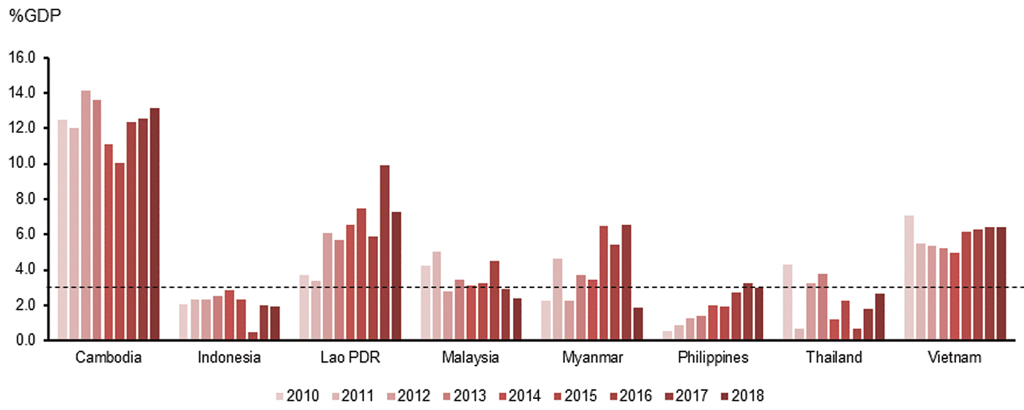
THE PHILIPPINES has witnessed a rapidly rising trend of foreign direct investment (FDI) inflows since the 2008/09 Global Financial Crisis. FDI increased ten-fold in less than a decade, from around $1 billion in 2010 to around $10 billion in 2018, making the Philippines the most rapidly growing FDI recipient in Asia. This has raised more attention on the country’s potential for FDI inflows as the US-China trade tensions are expected to lead to a wave of industry relocations. However, to benefit from this unique window of opportunity, the country needs to put in place the right policies and reforms to win the battle of attracting FDI against regional peers.

As a share of GDP, FDI to the Philippines rose from less than 1% in 2010 to around 3% in 2018, surpassing Malaysia, Thailand and Indonesia. (See Table).

However, FDI inflows in the Philippines have been mainly supported by intercompany lending — or debt flows between parent and affiliate companies and existing FDI companies, which is unique to the country. The debt instruments accounted for around 58% of FDI between 2010 and 2018.

KEY DRIVERS OF FDI INFLOWS
The impressive performance of FDI inflows to the Philippines can be attributed to the improvements in the institutional, policy, and economic environments. Since 2010, the government has been making efforts to reform governance and fight corruption, ensure sound public finances, modernize infrastructure, and improve macroeconomic management. These efforts have led to notable improvements in administrative efficiency, government accountability, and doing business environment. These positive developments have substantially changed foreign investors’ confidence in the prospects of the Philippine economy.

While the improved policy framework and economic fundamentals provide the basis for foreign investments, the composition and dynamics of different components are shaped more by idiosyncratic factors.

Although the Philippine government has been gradually lifting restrictions on foreign investment, the scope remains limited. Ownership limitations and burdensome reporting and registration procedures may have discouraged equity investment and encourage intercompany borrowing. With relatively high restrictions on ownership, existing companies have resorted to intercompany borrowings for capital investment and expansion of operations when faced with business opportunities. This tendency can become stronger when changing ownership structure becomes burdensome, or local partners are not keen or have no capacity to increase their share of the capital.

Besides, financing for capex spending, particularly infrastructure-related imports, can also drive up intercompany lending. It is common for the seller to provide financing arrangements, in the form of loans and trade credits, to the buyer in order to facilitate the sales of big-ticket equipment and machinery. In the case of the Philippines, the start of the rising trend of intercompany lending coincides with the start of the infrastructure investment push from 2013 onwards. And, the strong correlation between change of investment in durable equipment and the change of debt instruments in FDI also reveals the important role of (infrastructure) investment in pushing up intercompany lending.

SUSTAINING THE TREND AND UNLOCKING THE POTENTIAL
While intercompany lending can continue to support the rising FDI trend in the short-to-medium term, equity capital investment is critical to sustain this trend in the longer term. Several developments on both the external and domestic fronts seem to point to favorable prospect for FDI flows to the Philippines.

Externally, in light of China’s rising cost structures, ongoing global trade tensions, and secular low interest rates in advanced economies, foreign investors are looking to shift production to new locations with lower costs. The Philippines is one of those locations with high potential, as it is endowed with abundant labor and a relatively large domestic market. Domestically, the Philippine government has made attracting FDI a key policy objective. A series of reforms have been passed, with a number of others still in the process of legislation, aiming at addressing investment constraints and enhancing the ease of doing business.

However, policy design should also take into account the characteristics of this new wave of FDI flows. Unlike the 1980s and the late 1990s to early 2000s, when industry relocation was mainly driven by cost consideration, the recent relocation is also driven by the need for production to be closer to the market, to produce better synergy across different markets, and to diversify the risk of supply chain disruptions, which has become an important consideration, especially for companies producing complex products. As a result, the Philippine government will need to constantly benchmark its investment regime against regional peers and accelerate reforms to ensure the economy remains appealing to foreign investors.


Dr. Zhiwen Jiao, an economist at ASEAN+3 Macroeconomic Research Office (AMRO), is responsible for country macroeconomic surveillance at AMRO. He is the desk economist for the Philippines and backup economist for China. He graduated from Beijing Normal University with a Ph.D. in Economics.

UAAP: NU Bulldogs twice a winner in Season 82 debut

By Michael Angelo S. Murillo
Senior Reporter

NATIONAL University made an auspicious start to its University Athletic Association of the Philippines Season 82 volleyball campaign with its women’s and men’s teams hacking out victories in their season debuts on Wednesday at the Mall of Asia Arena.

The Lady Bulldogs fashioned out a gutsy five-set win over last year’s losing finalists University of Santo Tomas Golden Tigresses, 22-25, 25-23, 20-25, 25-20 and 15-13., while the NU men were 27-25, 23-25, 25-19 and 27-25 winners over the Tiger Spikers.

The Lady Bulldogs showed no let-up in the last two sets on their way to tallying their first win of the season.

The trio of rookie Margot Mutshima, sophomore Ivy Lacsina and come-backing Risa Sato led the NU women in the win, finishing with 23, 19 and 17 points, respectively.

The two teams fought hard throughout, alternately splitting the first four sets of the match to set up the deciding the frame.

In the fifth set, UST had its early struggles, seeing NU build a 7-2 lead.

But rookie Imee Hernandez and sisters Eya and EJ Laure would tow the Tigresses to a 6-2 run after to come within a point, 9-8.

NU, however, regained its footing with Mutshima and Sato propelling their team to match point, 14-11.

UST still tried to salvage the win, narrowing its deficit to one, 14-13, following a block by Hernandez of Lacsina.

Lacsina though would come back, providing the winning point by hammering down a quick kill to douse any chance of a comeback from the Tigresses.

Eya Laure, last season’s rookie of the year, led UST with 20 points with Hernandez adding 19 in her UAAP debut.

The game marked the return of EJ Laure after sitting out the last two seasons. She had 17 points.

“The players had early jitters and it showed. In the fourth and fifth sets we were able to settle down and play our game and it helped us in winning this game,” said Lady Bulldogs coach Norman Miguel as he talked about their debut outing.

THREE PEAT-SEEKING BULLDOGS
Meanwhile, in the first game of the day, the NU Bulldogs began their quest for a men’s UAAP three-peat with a four-set victory over the UST Growling Tigers.

Nico Almendras came through for the reigning champions with a double-double performance of 20 points and 14 excellent receptions. Former University of the East stalwart Ed Camposano opened up his one-and-done year with NU on a high, scoring 19 markers with four coming from blocks.

NU captain James Natividad supplied 11 points while Joshua Retamar ably distributed the wealth with 21 excellent sets.

Jau Umandal led all scorers with 25 points for UST with Lorenz Señoron and Wewe Medina adding 15 and 14 markers, respectively.

Despite the win, NU coach Dante Alinsunurin reiterated that they are far from the form they want to be in as they continue to fine-tune their attack.

“We’re continuing to integrate our system and we’re still adjusting. We started slow in this game but in the end we picked it up and our defense stepped up,” said Mr. Alinsunurin in the vernacular postgame.

NU returns to action on March 8 against Adamson University at the MOA Arena.

LeVert’s career-high 51 carries Nets past Celtics

BOSTON — Caris LeVert scored a career-high 51 points, 37 from the fourth quarter on, as the Brooklyn Nets rallied from 21 points down to stun the host Boston Celtics 129-120 in overtime Tuesday.

LeVert shot 17 of 26 from the field and scored all 11 of the Nets’ points in the extra period as they overcame 21 turnovers to snap a four-game losing streak. Timothe Luwawu-Cabarrot added 16 points off the bench for Brooklyn.

Jaylen Brown had 22 points, and Kemba Walker scored 21 in his return from five games missed with a knee injury for the Celtics, who have lost back-to-back games for the first time since Jan. 16–18.

The Nets scored a franchise-record 51 points in the fourth quarter to overcome a 71-50 deficit with 6:28 left in the third quarter. They entered the fourth down 84-67.

LeVert got Brooklyn within four on back-to-back threes with 2:47 remaining. Another LeVert three trimmed Boston’s lead to 110-108 with 1:32 left.

The Celtics led by three with the ball and 6.7 seconds left, but a Rodions Kurucs steal gave the Nets a chance to tie. LeVert was fouled by Smart on a 3-point attempt with 0.2 seconds on the clock and sunk all his free throws to force overtime.

LeVert outscored Boston 11-2 the rest of the way.

The Celtics played without All-Star forward Jayson Tatum, sidelined by an illness. Gordon Hayward didn’t play in the second half due to a right knee contusion he appeared to sustain on an inadvertent collision with Daniel Theis late in the second quarter.

DAVIS SCORES 37 AS LAKERS SMASH 76ERS
Anthony Davis had 37 points, 13 rebounds and four steals, leading the Los Angeles Lakers to a 120-107 victory over the visiting Philadelphia 76ers on Tuesday night.

Davis, who also had two blocks, converted 13 of 19 shots from the floor, including 4 of 5 from 3-point range. He scored 26 points in the first half.

LeBron James contributed 22 points, 14 assists and seven rebounds for the Lakers, winners of nine of their past 10. Dwight Howard added 11 points, and Kentavious Caldwell-Pope and Avery Bradley chipped in 10 apiece.

Glenn Robinson III led the Sixers with 25 points on 10-of-15 shooting. Tobias Harris finished with 18 points and seven rebounds for Philadelphia, which played without All-Stars Joel Embiid (shoulder), Ben Simmons (back) and Josh Richardson (concussion). — Reuters