Home Blog Page 9149

[B-SIDE Podcast] Navigating the ‘next normal,’ according to McKinsey and Company

Follow us on Spotify BusinessWorld B-Side

After two months in lockdown, Philippine cities are slowly opening up to a new reality,

Management consulting firm McKinsey and Company recently released a report titled “Beyond coronavirus: The path to the next normal” that defined this “new reality,” this “next normal” as a time when “we will witness a dramatic restructuring of the economic and social order in which business and society have traditionally operated.”

In this episode, Kristine Romano, managing partner of McKinsey Philippines elaborates on this report and applies it to the Philippine context. She tells BusinessWorld reporter Jenina Ibanez how the country’s business leaders might navigate the COVID-19 crisis and find an economically and socially viable path to the next normal.

TAKEAWAYS

This is a unique crisis.
The COVID-10 pandemic, unlike previous global crises, affects both supply and demand. Businesses have a hard time producing goods, and worried consumers are holding back on buying.

Remittances grew amid the 2008 global financial crisis, and outsourcing bounced back. But McKinsey sees the risks of a contraction in remittances, and outsourcing contracts may be cancelled among companies unable to shift to work-from-home measures.

Businesses will prioritize resilient supply chains.
In the past, economies of scale was king. But creating efficient supply chains by consolidating resources in one place is now considered risky. Supply chains could easily be disrupted by lockdowns. As a result, business priorities will shift to resilient supply chains retaining flexibility and productivity through automation and training.

The new normal will also see a shift to digital transactions, and companies that give value for money will likely capture a bigger share of the market.

Vulnerable businesses and workers may see new opportunities.
There is a significant number of Filipino workers on “no work, no pay” schemes. The social safety nets for these workers are not as strong as those of developed countries. But opportunities may shift to other sectors as the need for sanitation and delivery services requires manpower.

The country also has a reputation for high manufacturing productivity and a talented workforce that could attract firms shifting operations from China.

Recorded remotely on April 28. Produced by Nina M. Diaz, Paolo L. Lopez, and Sam L. Marcelo.

Follow us on Spotify BusinessWorld B-Side

#COVID-19 Regional Updates (05/25/20)

Local governments have hands full with returning residents, OFWs

EMERGENCY response staff set up modular tents at the Dipolog Sports Complex, which will be used as an isolation facility to prevent potential coronavirus transmissions. — @DIPOLOGCITYGOVERNMENT

LOCAL government units (LGU) around the country have been on the double setting up isolation facilities — tapping sports centers, unutilized housing projects, and other public and even private spaces — as residents start coming home after being stranded elsewhere in the country due to the lockdowns or returning from overseas work. In Dipolog City, capital of Zamboanga del Norte, the LGU purchased rapid test kits and modular isolation tents to handle what are now labelled as locally stranded individuals (LSIs) who could possibly be carrying the virus. “Both (kits and tents) are part and parcel of the preparedness and response intervention of the city government in addition to the current health and emergency services provided by our Corazon C. Aquino Hospital, City Health Office and the City Disaster Risk Reduction and Management Office,” Mayor Darel Dexter Uy T. Uy said. Zamboanga del Norte has so far only one recorded coronavirus disease 2019 (COVID-19) case, a patient at a hospital in Metro Manila who has travel history in Dipolog. In Ormoc a housing project with 699 units has been converted into the Ligtas COVID center to isolate LSIs and even families together for 14 days before being allowed to go back to their communities. The first batch of returning Ormoc residents are expected May 26. The city government, meanwhile, has also announced that Energy Development Corp. (EDC) has offered to donate equipment for the planned RT-PCR testing facility that will be set up at the private OSPA Farmers Medical Center.

DANGER
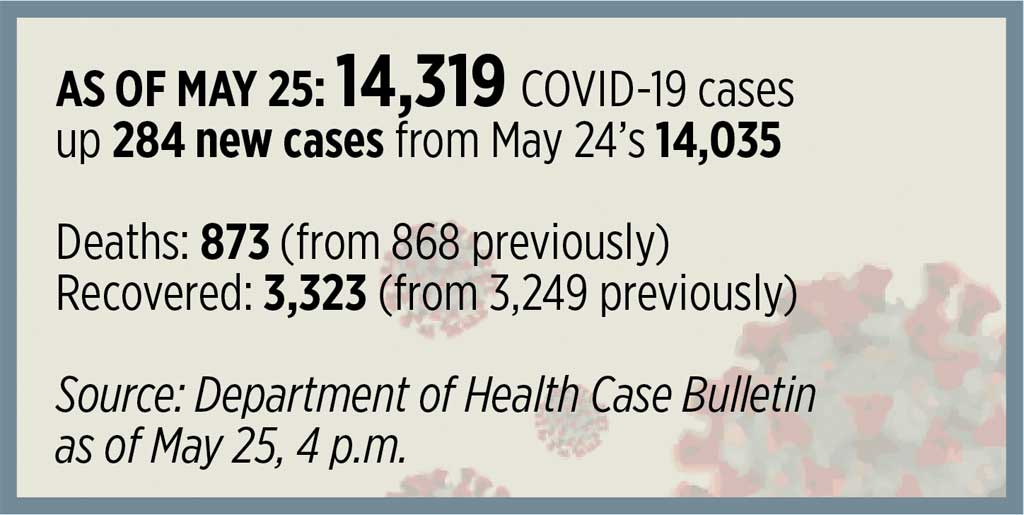
Governor Manuel N. Mamba of Cagayan, which like all other LGUs have set up online platforms for LSIs who are not just required to undergo quarantine but also need to comply with several documentary requirements, said the stringent rules are necessary to “avoid the danger brought by COVID-19.” Bohol Gov. Arthur C. Yap expressed the same position saying “aggressive prevention must be sustained because it is our best weapon” against the dreaded virus.” Bohol has maintained a zero COVID-19 status since one case in January, a Chinese tourist who has since recovered and left the island province. Mr. Yap added, “We can manage, but we also have to admit the limitation of our healthcare system in case of one infection graduating into an outbreak.” Of the 14,035 cases in the country, about 65% are in the National Capital Region and about another 15% are concentrated in the highly-urbanized cities such as Cebu, Davao and Zamboanga. Meanwhile, Philippine National Police chief Gen. Archie Francisco F. Gamboa has ordered cops to allow LSIs without quarantine passes to move around to process documents needed to return to their hometowns. Mr. Gamboa cited LSIs such as students who were stranded in Metro Manila when the lockdown was implemented. “I hope policemen who are listening now, dapat iba ‘yung trato nila kapag (they should give a different treatment to) LSIs because our intention is pauwiin siya sa probinsya (to let them go home to the province),” Mr. Gamboa said in an interview over ANC.— Marifi S. Jara and Emmanuel Tupas/PHILSTAR

Infrastructure spending falls in Q1

INFRASTRUCTURE spending slumped in the first quarter, as public construction activities were temporarily halted in March due to the enhanced community quarantine (ECQ).

Data from the Department of Budget and Management (DBM) showed disbursements on infrastructure and other capital outlays dropped 12.4% to P156.1 billion in the January to March period, due to “base effect of high infrastructure expenditures” a year ago, and the “temporary suspension of construction activities due to the ECQ.”

The latest figure fell short of its P191.1-billion program set by the Development and Budget Coordination Committee (DBCC) in late March.

“Infrastructure and other capital outlays was below the P191.1 billion program by P35.0 billion or 18.3% resulting mainly from the combined effects of the delays experienced during the ECQ, pending submissions of budget requests and documentary requirements for the release of For Later Release (FLR) capital outlays, as well as the late/incomplete submission of documentary requirements to facilitate release of funds/payments,” DBM said in the report published Monday.

For March alone, infrastructure and other capital expenditures rose 4.1% to P62.2 billion. DBM attributed this to the payment of right-of-way acquisition for the Light Rail Transit (LRT) Cavite Extension and Metro Manila subway project, and higher payments to suppliers of foreign-assisted projects.

“The increase in capital expenditures was dampened by lower DPWH (Department of Public Works and Highways) disbursements following the unintended delays in the implementation of some infrastructure projects due to restrictions imposed during the Luzon-wide ECQ starting in early March this year to control the spread of COVID-19,” DBM said.

The Inter-Agency Task Force on Emerging Infectious Diseases (IATF-EID) did not allow construction work on big-ticket infrastructure projects during the ECQ. Earlier this month, work on public and essential private projects were allowed to resume under both ECQ and general community quarantine.

For the second quarter, DBM said ongoing programs of the government and infrastructure projects “will continue to face unintended delays” as lockdown continued through May.

However, it said infrastructure spending should “gradually restart once the ECQ is lifted.”

“The lower-than-programmed spending performance during the first three months of the year is, thus, expected to be offset in the second quarter with the reprioritization, reprogramming, and realignments of existing programs, activities, and projects (PAPs) of the government and measures to generate savings to finance COVID-19 emergency response pursuant to the Bayanihan to Heal as One Act,” DBM said.

The government is banking on the resumption of construction work on flagship infrastructure projects in the second half to help the economy get back on track. — Beatrice M. Laforga

Gov’t reconsiders tariff on imported goods

THE government is weighing the costs and benefits of additional tariffs on imported products as a revenue-generating measure during the coronavirus crisis, as it reconsiders a proposal that could raise as much as P245 billion.

Trade Undersecretary Ceferino S. Rodolfo said in a mobile phone message on Monday that the government will further study the measure, including the impact on costs for businesses and inflation on consumers, after a meeting with the technical committee on tariff related matters.

Mr. Rodolfo said in an online press conference on May 20 that the government was looking at imposing a five percent additional tariff on all imported products to raise revenues.

He said the proposed tariff, which would be added to existing tariffs, will only be imposed if the Finance department signals that the resources are needed to respond to the effects of the coronavirus disease 2019 (COVID-19).

However, the Finance department, Mr. Rodolfo noted that the measure was not needed at this time.

The P245-billion revenue estimate is based on import levels close to the 2016-2018 average.

Mr. Rodolfo on Wednesday said there are concerns over keeping the country’s commitments under international trade agreements. ASEAN member countries can only apply a tariff rate of up to five percent for goods originating from member countries.

There are also concerns over the impact of such a measure on inflation.

Lahat ng produkto, lalagyan natin ng 5% tariff. Para hindi lumabas na protectionist. Wala tayong pinipiling produkto na pinoprotektahan. (We will impose 5% tariffs on all products. So it won’t come off as protectionist. We’re not picking a product to protect.) It’s really across-the-board because we need to raise money for our COVID-related activities,” he said.

“It’s just 5% para hindi siya maging (so it won’t be) inflationary.”

Mr. Rodolfo on Monday then said that the government will study the inflation impact and that the 5% added tariff, for the moment, has been “abandoned.”

President Rodrigo R. Duterte on May 2 temporarily raised tariffs on imported crude oil and refined petroleum products to raise revenues for COVID-19 relief measures.

The Energy department estimated the government could raise up to P6.78 billion in revenues from the increased import duty this year.

SAFEGUARD DUTY
Meanwhile, the results of the Trade department’s preliminary investigations on a possible safeguard duty on automotive imports is set to be released by the end of May.

The Philippine Metalworkers Alliance last year submitted an application for such a measure to the department, saying that there is a link between a surge in automotive imports and injury to the domestic sector, particularly local jobs in making automotive parts.

Mr. Rodolfo said national public interest during the pandemic is also a concern.

Siguro si (Trade Secretary Ramon M. Lopez) iisipin niya okay, public interest, parang timing ba ngayon na mag-iimpose ang government ng additional safeguard duty, given the environment under the pandemic and possible impact on the industry or hindi?,” he said, adding Mr. Lopez may also consider that duties are more important given the reduced demand for cars.

The World Trade Organization (WTO) in March suspended consideration of Philippine retaliation against Thailand in a 12-year trade dispute, after the WTO’s appellate body was effectively suspended without new judges. Mr. Lopez said the Philippines will continue pursuing the issue as it looks to place tariff or quantitative restrictions on Thailand’s automotive exports to the Philippines. — Jenina P. Ibañez

Amendments to Anti-Money Laundering Act take backseat in House

By Genshen L. Espedido
Reporter

A MEASURE seeking to amend the Anti-Money Laundering Act (AMLA) has been placed on the back burner as Congress focuses on passing measures such as the Philippine Economic Stimulus Act (PESA) and Financial Institutions Strategic Transfer (FIST) Bill which aims to address the economic impact of the ongoing coronavirus crisis.

House Committee on Banks and Financial Intermediaries Chair and Quirino Rep. Junie E. Cua said the coronavirus pandemic has prompted Congress to change its priorities in legislation.

“We need to attend more importantly to rescuing our economy and so we need to focus more on measures that will enable us to recover fast, to empower our banking industry… in anticipation of business failures in the coming months. So ito ngayon ang (for now, this is) more important to us,” Mr. Cua told BusinessWorld in a phone interview on Sunday.

House Bill 6174, which proposes to introduce more stringent provisions in Republic Act 9160 or the AMLA, has been pending with the House Committee on Banks and Financial Intermediaries since February. At the Senate, the counterpart measure, Senate Bill 1412, is also pending at the committee level.

Mr. Cua said the committee hearings on the AMLA amendments will resume as soon as the “first opportunity” comes.

“Meanwhile, the Financial Action Task Force (FATF) because of the character of this crisis…it took the initiative of extending the period required of us and I think that should provide some space in making the necessary adjustments in our timeline,” he said.

After the country’s mutual evaluation review, the Asia Pacific Group (APG) on money laundering placed the Philippines under a 12-month observation period to address deficiencies in anti-money laundering measures. Changes to the AMLA are needed so the Philippines can avoid being gray-listed by the FATF.

The FATF has extended the deadline of its observation period to February 2021 from October 2020 due to the global crisis, saying that the pandemic made it “impossible for assessed jurisdictions and assessors alike to conduct on-site visits and in-person meetings.”

Anti-Money Laundering Council (AMLC) Executive Director Mel Georgie B. Racela said that he hopes deliberations on AMLA amendments will resume after President Rodrigo R. Duterte’s State of the Nation Address (SONA) in July.

“The FATF decision gives Congress more room to accommodate COVID-19 related measures, especially given the limited session days of Congress, which is until June 4 only. With this development, we understand that sessions will resume after the SONA. The AMLC will appreciate it if deliberations will resume immediately by then,” he told BusinessWorld via Viber message on Sunday.

Asked about money-laundering risks during the lockdown, Mr. Racela said that the AMLC is “business as usual” in collaborating with law enforcement officers.

“In particular, the PNP (Philippine National Police) Anti-Cybercrime Group has always been our most active partner both before and during the lockdown. In addition, we have recently initiated several studies including analysis of reports submitted to the AMLC during the lockdown. This will be released sometime in June,” he said.

NEW PRIORITIES
Meanwhile, House Majority Leader and Leyte Rep. Ferdinand Martin G. Romualdez said the Defeat COVID-19 Committee is set to approve on Tuesday the FIST and PESA bills. PESA proposes to inject P568 billion in the economy to help businesses and workers cope with the pandemic.

On May 11, Mr. Cua’s committee approved House Bill 6622 or FIST Bill,which provides for the transfer of banks’ bad loans to asset management companies (AMCs), as a spike in nonperforming loans is expected during the coronavirus crisis.

Under the proposed bill, bad loans and real and other properties acquired (ROPA) in settlement of loans and receivables will be sold to AMCs or so-called FIST corporations.

“It’s not really an expensive price to pay for enabling our banking sector to cope up with these mounting nonperforming loans and mounting nonperforming assets which if not handled properly…They (banks) will have liquidity problems and that’s the worst that can happen to the banking industry when we are trying to recover from this pandemic. We need the money circulating in the system and the best way to do it is through the special purpose vehicle or through the FIST Law,” Mr. Cua said.

Mr. Cua said that Congress can conduct a special session on the measure if it fails to pass the lower chamber before Congress goes on recess on June 5.

“I really would like to pass it ASAP (as soon as possible) because this is very important to the country. Once we pass it, we pass it right away to the Senate and hopefully they can act on it. But I think if the House and the Senate would not be able to pass this before we adjourn, I think these measures deserve a special session,” he said.

Mr. Cua said that he will also consider conducting a hearing on House Bill 5913 or the Virtual Banking Act of 2020 which seeks to provide a regulatory framework for virtual banks, following the need for more digital alternatives due to the pandemic.

Top firms pay taxes ahead of deadline

THE country’s top companies, led by BDO Unibank, Inc., settled their income taxes ahead of the extended deadline, according to the Department of Finance (DoF).

The Sy-led lender topped the initial list of the Top 500 Annual Income Tax Returns filers for 2019 released by the DoF on Monday.

The firms were ranked based on the amount of taxes paid per annual income tax return as of May 19. However, the exact amount of taxes paid were not disclosed.

Gokongwei-led real estate company Robinsons Land Corp. ranked second on the list, followed by Manila Electric Co. (Meralco), Ayala’s Bank of the Philippine Islands and pharmaceutical company Unilab, Inc.

Rounding out the top 10 are drugstore chain Mercury Drug Corp., water concessionaire Maynilad Water Services, Inc., Metrobank Card Corp., telecommunications firm Globe Telecom, Inc. and Philippine Ports Authority.

“We hope that the commendable act of these taxpayers would inspire other taxpayers to do the same and contribute to our nation-building as we work together to get the economy back on its feet in the face of the COVID-19 (coronavirus disease 2019) pandemic,” Finance Secretary Carlos G. Dominguez III was quoted as saying.

Ranked 11th to 20th on the list are: Innove Communications, Inc., Manila International Airport Authority, Citra Metro Manila Tollways Corp., Taganito Mining Corp., Security Bank Corp., Monde Nissin Corp., Eagle Cement Corp., Huawei Technologies Phil., Inc., Phil Gold Processing & Refining Corp. and First Gas Power Corp.

Other top taxpayers ranked 21st to 30th are: Robinson’s Supermarket Corp., Metro Retail Stores Group, Inc., Pfizer, Inc., Philippine Seven Corp., The Manufacturers Life Insurance Co. Inc., Cebu Energy Development Corp., Masinloc Power Partners Co. Ltd., South Luzon Tollway Corp., Cebu Air, Inc., and Monde M.Y. San Corp.

The full list is available on the DoF website https://bit.ly/Top500AITRfilers2019.

Due to the implementation of the enhanced community quarantine (ECQ), the Bureau of Internal Revenue (BIR) extended the deadline for filing and payment of ITR and other returns three times from the original schedule of April 30. The latest deadline is now on June 15.

However, BIR said last week it would no longer extend the deadline for filing and payment of these tax returns, citing the government’s need to collect revenues to fund programs amid the coronavirus pandemic.

Citing BIR regulations, the DoF said those that filed their ITRs ahead of the extended deadline can still amend the tax returns any time prior to the new deadline, without having to pay penalties in case the amended return results in additional taxes.

If the amended tax returns will result in overpayment, the DoF said taxpayers can either carry over the overpaid taxes as credit against their taxes due for the similar type of tax or file for a refund.

The DoF, citing preliminary data, said combined collections of the BIR and Bureau of Customs (BoC) dropped to P105.75 billion last month, 63% lower than a year earlier. BIR collected P71.78 billion in taxes for the month of April, down 70% year on year.

For the first four months of 2020, total collections of the BIR and BoC fell 21% to P706.85 billion. The sharp drop in tax collections was largely attributed to deferment of tax payment deadlines and the lower collections in value-added and excise taxes amid the ECQ.

Revenue collection targets for this year were slashed by 17.7% to P2.61 trillion from the P3.17-trillion program approved in March amid a dire economic output forecast and weak global demand. — Beatrice M. Laforga

ePLDT offers cybersecurity to hospitals

By Arjay L. Balinbin, Reporter

ePLDT, Inc. is in talks with medical centers to equip them with a cyber-threat monitoring and response solution as more criminals exploit the pandemic to take advantage of vulnerable hospital systems, the top official of PLDT Inc.’s digital business solutions subsidiary said.

In an e-mailed reply to questions on May 20, Juan Victor I. Hernandez, ePLDT president and chief executive officer, said the company is offering a free three-month cyber-security solution to healthcare facilities in the country.

He added that the objective of the offering is to contribute to the fight against the coronavirus disease 2019 (COVID-19) pandemic.

“After the three-month period, the healthcare facilities can choose to proceed with the subscriptions at mutually agreed terms with ePLDT or decide to discontinue the engagement,” said Mr. Hernandez, who is also senior vice-president and head for PLDT and Smart enterprise business groups.

“With more and more threats emerging each day, we cannot stress enough the importance of having cyber-security measures in place especially as organizations tread a new normal of business,” he said.

On March 24, the Department of Information and Communications Technology (DICT) warned of potential cyber-attacks against hospitals and healthcare facilities.

It said Philippine hospitals and healthcare facilities should “employ emergency backup systems to ensure operational continuity for both databases and infrastructure in case of outages caused by malware or cyber-attacks.”

Mr. Hernandez said ePLDT has built a comprehensive cyber security operations center, which can provide organizations in any industry a holistic capability to predict, detect, prevent and respond to threats and incidents.

In a statement, PLDT said Metro Pacific Hospital Holdings, Inc. (MPHHI) hospitals are availing of the free three-month cyber-security service.

The hospitals under MPHHI’s portfolio include Makati Medical Center, Cardinal Santos Medical Center, Our Lady of Lourdes Hospital, Asian Hospital, De Los Santos Medical Center, Manila Doctors Hospital, Marikina Valley Medical Center, Inc., and Dr. Jesus C. Delgado Memorial Hospital.

“The free service has also been extended to other industries such as government and manufacturing, to name a few,” PLDT said.

Mr. Hernandez said further: “By giving companies free trials of our cyber-security service, we hope to let our customers become worry-free when it comes to cyber security threats during this critical time. By experiencing it firsthand, we hope for them to realize cyber-security’s value for their business which outweighs the cost. From our end, we are giving our very best in getting the service to the most cost effective level possible.”

Hastings Holdings, Inc., a unit of PLDT Beneficial Trust Fund subsidiary MediaQuest Holdings, Inc., has a stake in BusinessWorld through the Philippine Star Group, which it controls.

DoubleDragon sets REIT offering in fourth quarter

By Denise A. Valdez, Reporter

DOUBLEDRAGON Properties Corp. (DoubleDragon) is targeting to pursue its P11-billion real estate investment trust (REIT) offering in the fourth quarter, unfazed by the ongoing coronavirus disease 2019 (COVID-19) pandemic.

“Our plans have not changed except that instead now we plan to do the REIT offering by Q4 (fourth quarter) this year 2020,” DoubleDragon Chairman Edgar “Injap” J. Sia II told BusinessWorld via e-mail over the weekend.

“Although there is a global pandemic now going on, there are still investors looking to invest in specific companies that they think have a good, relevant and resilient portfolio. Right now what matters the most is the longterm relevance and resilience of the business model more than anything else,” he added.

For this year’s offering, DoubleDragon is looking to offer the first one-fourth or 200,000 square meters (sq. m.) from its portfolio of 803,000 sq. m. leasing assets. Mr. Sia said the exact composition will be announced next month.

In January, DoubleDragon said it wants to do a REIT listing of about 200,000 sq. m. leasing assets in the next six years until 2025 at an estimated cap rate of 6%.

“This COVID-19 crisis has allowed DoubleDragon to demonstrate that its four pillars of growth are resilient, relevant and well-positioned to capture the future,” Mr. Sia said. The four pillars are provincial retail leasing, office leasing, industrial leasing and hotels.

DoubleDragon owns properties such as CityMalls, DD Meridian Park, Jollibee Tower, Hotel 101, Jinjiang Inn Philippines and CentralHub. In the first three quarters of 2019, the company’s revenues jumped 47% to P6.93 billion, driven by a 41% rise in recurring revenues to P2.9 billion.

Mr. Sia is also the chairman of grocery operator MerryMart Consumer Corp., which is doing a public offer of shares from May 27 to June 5. Listing at the exchange is scheduled on June 15.

The company announced last week it will offer its shares at P1 each to raise a total of P1.6 billion from the offering. This would mark the country’s first initial public offering for 2020.

“We see this year 2020 as the new beginning of the next decade and both DoubleDragon and MerryMart will continue to pursue its goals to make it more and more entrenched in the Philippine market as years go by,” Mr. Sia said.

“In the Philippines, it’s not easy for a new starting entrepreneur to grow a business because (established players) are all over the place, but we will strive hard to still rapidly grow both DoubleDragon and MerryMart more importantly now that we just entered this new decade,” he added.

Shares in DoubleDragon at the stock exchange closed at P17.68 each on Friday, up 74 centavos or 4.37% from a day ago.

Aside from DoubleDragon, Ayala Land, Inc. also has an application with regulators to do a P15.1-billion REIT offer involving three commercial buildings in Makati City.

The increased interest in REITs came after the Securities and Exchange Commission released new REIT rules in January allowing a minimum public ownership of 33%, a minimum paid-up capital of P300 million and tax exemption for the transfer of property into a REIT vehicle.

The Philippines’ REIT law was legislated in 2009 but failed to attract property developers in the past decade because of stricter requirements then.

Five Filipino movies coming to Netflix

NETFLIX has announced that five Filipino movies will be available on the streaming service in June. The titles come from a “wide variety of genres from horror, comedy, to drama,” according to its regional acquisitions executive.

“We are constantly amazed by the creativity of storytellers and the quality of talent coming out of the Philippines. Filipinos are avid entertainment fans, so at Netflix we are committed to bringing the best stories locally and from around the world to our members here,” said Raphael Phang, manager of content acquisition at Netflix, said in a statement.

“This growing slate of Filipino content on Netflix is a true reflection of the diversity of what Philippine cinema has to offer. And Netflix giving space to more Filipino films is an affirmation that the Philippines has the potential of globalizing its local market,” Mary Liza B. Dino, chairperson and CEO of the Film Development Council of the Philippines, was quoted as saying in the statement.

Pinoy Sunday (2010), the full-length feature debut of Widing Ho, is a Taiwanese comedy-drama about two OFWs who, during their day off, find a discarded couch that leads them to an adventure. The film stars Bayani Agbayani, Jeffrey Quizon, Nor Domingo, Dave Ronald Chang, Meryll Soriano, and Alessandra de Rossi

“The underlying story and the premise of the story speaks to us all regardless of nationality or background. I think we all have commitments and burdens and temptations and struggles and friendships, passions, and dreams,” Mr. Phang said of the film, during a digital press conference on March 22.

He added that Pinoy Sunday is an “easy watch from start to finish.”

“I never thought the feature debut I made 10 years ago can have a second life and finally get shown to the Philippine audience, thanks to Netflix. It is a tremendous honor to have my second movie after Cities of Last Things (2018) to be included on a platform which has done so much to promote filmmakers’ works from around the world to a global audience. I am lucky to be part of the family,” Mr. Ho said in a statement.

Pinoy Sunday streams starting June 5.

Carlo Ledesma’s horror film Sunod (2019) follows a mother who takes a demanding call center job to pay for her daughter’s medical expenses — but then the office building’s sinister secrets begin to haunt her. The film stars Carmina Villaroel, Mylene Dizon, JC Santos, Kate Alejandrino, Krystal Brimner, Rhed Bustamante, and Susan Africa,

“What’s important is the underlying premise of this horror film is… about doing anything to make ends meet. You can see the quality performance of Carmina [Villaroel],” Mr. Phang said during the conference.

“Having Sunod screen theatrically during the 2019 Metro Manila Film Festival was an incredible experience, and now I’m excited for the film to find a new audience online, especially on Netflix, which has the best streaming,” Mr. Ledesma was quoted as saying in the statement. “Speaking on behalf of myself and my crew, we took great pains to make the movie look and sound good, so it’ll be a rush to see it stream in high quality.”

The film streams on June 14.

Eduardo Roy, Jr.’s award-winning film Lola Igna (2019) by might seem to be a comedy at first glance since it is about a cantankerous old woman whose life is disrupted when her family and village realize she has a chance at a world record for being the oldest grandmother alive, but at its core it is about the loneliness of old age, family, and forgiveness. The film won Best Picture, Best Screenplay, Best Musical Score, and Best Actress at the 2019 Pista ng Pelikulang Pilipino. The film stars Angie Ferro, Yves Flores, and Meryll Soriano.

The film streams on June 18.

Another Eduardo Roy, Jr. film, Ordinary People (locally known as Pamilya Ordinaryo), will also be available on Netflix though no set date has been announced yet. The big winner of the 2016 Cinemalaya Independent Film Festival — it won Best Film, Best Editing, Best Actress, and Best Director — Ordinary People revolves around a destitute couple living on Manila’s streets who are forced to take drastic measures to recover their kidnapped son. The film stars Ronwaldo Martin and Hasmine Kilip.

“I felt flabbergasted when I got the news from Netflix that the team loved my film, not just one but two of my films. I’m personally thankful to Netflix for introducing Lola Igna and Ordinary People to a larger audience, not only in the Philippines, but to the whole world. Now my films can be easily accessible anytime, and anywhere around the world,” Mr. Roy said in a statement.

The fifth Filipino film to hit the service is Sigrid Andrea Bernardo’s psychological thriller Untrue (2019), about two people who meet in Georgia and embark on a highly volatile relationship as secrets of their past are revealed. The film stars Cristine Reyes and Xian Lim.

The film streams on June 22.

“The key element here is really the psychological portion and how they kind of go back and forth. The performances by the two actors were just fantastic,” Mr. Phang said during the conference.

Aside from the movies, Netflix will also be premiering Filipino-American comedian Jo Koy’s third Netflix special called Jo Koy: In His Elements on June 12. In this special, the comedian comes to the Philippines to celebrate his heritage by telling jokes about life as a Filipino-American while highlighting the culture of Manila. — Zsarlene B. Chua


Diokno says policy remains appropriate

THE CURRENT policy stance of the Bangko Sentral ng Pilipinas (BSP) will remain appropriate once the modified enhanced community quarantine (MECQ) is transitioned to a general community quarantine (GCQ), according to BSP Governor Benjamin E. Diokno.

Sought for comment on whether the policy measures implemented by the BSP will still be relevant once GCQ is imposed in Metro Manila, Mr. Diokno said in a text message: “Absolutely.”

Mr. Diokno said among the factors they will consider at the Monetary Board’s next policy-setting meeting scheduled on June 25 include May inflation data as well as the first-quarter gross domestic product (GDP) report.

Headline inflation stood at 2.2% in April, marking the third consecutive month of a slower rise in prices of commodities. Last month’s decline was on the back of lower oil prices and other non-food items.

May inflation data will be reported by the Philippine Statistics Authority on June 5.

Meanwhile, first-quarter GDP dropped by 0.2%, the first contraction since the three percent fall recorded in the fourth quarter of 1998. Economic managers now expect the economy to shrink by 2-3.4% on expectations of a worse fallout due to the pandemic.

“We’ll also look at some high frequency indicators, in both the supply and demand sides of the economy, which could suggest how the economy is shaping up,” Mr. Diokno said.

These data would include the purchasing managers’ index, export and import numbers and the number of flights and passengers, which will be used to gauge if there will be a pickup in transport and tourism when the lockdown is lifted.

As for government data, Mr. Diokno said they will look at disbursements as an indicator for government consumption and public capital formation.

The Metro Manila Council of city mayors will meet on Wednesday to assess whether the National Capital Region can already be transitioned to GCQ. The body’s chairman and Parañaque Mayor Edwin L. Olivarez earlier said he will endorse to place Metro Manila under GCQ starting June as the economic impact of the pandemic on the region has been “horrible and horrifying.”

The BSP has slashed rates by a total of 125 basis points (bps) this year after the 75 bps worth of easing done in 2019. This means the central bank has already reversed the 175 bps in rate hikes implemented in 2018.

Benchmark rates are currently at record lows, with the overnight reverse repurchase rate at 2.75% and the overnight deposit and lending rates at 2.25% and 3.25%, respectively.

Meanwhile, the reserve requirement ratio (RRR) of universal and commercial banks was reduced by 200 bps to 12% in April. The RRR of thrift and rural banks are at four percent and three percent, respectively. The central bank has also reduced minimum liquidity ratio of standalone smaller lenders by 400 bps to 16% until yearend.

The Monetary Board has authorized Mr. Diokno to cut banks’ RRR by a total of 400 bps this year to boost liquidity amid the pandemic situation.

EASING THE LOCKDOWN
A rate cut could still be possible depending on how things move forward after the GCQ is imposed, said ING Bank N.V. Manila Senior Economist Nicholas Antonio T. Mapa.

“We’ve penciled in a 25 bps policy rate cut at the June meeting as BSP looks to give an added boost to economic activity once GCQ begins,” ING Bank’s Mr. Mapa said in an e-mail.

Mitzie Irene P. Conchada, an economist at De La Salle University, meanwhile, said the central bank is likely to hold rates “for the meantime until there are developments in economic indicators after the GCQ.”

She said the decision on whether to transition to GCQ is a tough one as the outbreak hasn’t been contained.

“It’s a dilemma between keeping the coronavirus figures at bay and at the same time jump-start the economy after two months of depressed economic activity for most industries,” Ms. Conchada said.

“I also think the government would want to keep small industries a chance to catch up and maybe assess what they can do with their business in the new normal,” she added.

UnionBank of the Philippines, Inc. Chief Economist Ruben Carlo O. Asuncion said a policy rate cut could be “warranted” if the BSP’s expectation of subdued inflation is seen in the May data. He, however, noted that there was an uptick in inflation for the bottom 30% in April as well as in the prices of rice and fuel.

“All these factors taken together seem to put an upward pressure on headline inflation and more data would be needed. The additional cut may have to be postponed if inflation may not actually be subdued as expected,” Mr. Asuncion said in an e-mail.

Easing lockdown measures may result in an uptick in inflation, he said.

“More movement or production of goods and services contributes to the rise of price levels in the economy. These are known drivers that have to be taken into consideration by the BSP on future monetary policy moves,” Mr. Asuncion said. — Luz Wendy T. Noble

CSS Corp. expects hiring growth after work-from-home shift

OUTSOURCING company CSS Corp. sees its Manila operations as a primary driver of aggressive hiring through fiscal year 2021 after it had transitioned to 100% work-from-home operations prior to the lockdown.

“One hundred percent of our workforce currently is working from home without any disruptions to our customer commitments… but at the same time also making sure employee safety is first,” CSS Corp. Philippines Associate Vice-President and Country Head Arvind Appavu said in an online interview in March.

The technical support company, which Mr. Appavu described as “mid-sized” compared to larger outsourcing operations in the country, began moving its 1,500 employees to work-from-home operations on March 9.

President Rodrigo R. Duterte announced a Metro Manila community quarantine on March 12, then extended it to the entirety of Luzon on March 16. Metro Manila remains under a relaxed lockdown until the end of May.

Mr. Appavu said the company had seen a spike in demand as its customers mobilized to respond to the crisis.

“At this point in time, one of the things that we are seeing is there’s increased demand with most of our customers because of the nature of customers that we’re working with,” he said.

Most of CSS Corp.’s customers are technology companies, with telecommunications companies coping with demand to migrate connections to homes.

CSS Corp. also works with original equipment manufacturers that are now working with governments to support hospital networks.

The revenue growth of its Philippine operations is up 10% quarter on quarter in the fiscal year that ended in March 2020, ahead of the global company’s 4%.

The company will be onboarding 1,000 new employees virtually, and had given incentives to employees that had helped in the shift to work-from-home operations.

Mr. Appavu said the company would maintain its growth expectations set at the beginning of the year, but is watching for the further impact of the COVID-19 pandemic.

Outsourcing industry players recently said the Philippines might lose clients to other countries if it is not able to boost work-from-home connectivity, as well as ensure data security.

CSS Corp. said that prolonged work-from-home operations could create susceptibility to laptop and desktop hacking.

“To tighten the security measures further, we have doubled the monitoring on systems and networks to safeguard our data integrity,” it said. — Jenina P. Ibañez

Fun beats fear in Rube Goldberg annual contest to fetch soap amid coronavirus pandemic

NEW YORK — Caitlin Diel waited in the shower as her brother started their chain-reaction machine, dropping a marble into a tube that sent a toy train speeding, a deodorant stick flying, and a stuffed bunny racing along a zip line to finally shoot a bar of soap into her hands.

Cheers erupted in their bathroom in Laurel, Maryland, where, after 106 failed attempts over six hours, the Diel children accomplished their goal and qualified to enter a video contest in the age of COVID-19: build a Rube Goldberg contraption that drops a bar of soap into someone’s hands.

“So confident!” Caitlin said as she stood in her swimsuit, hands cupped in anticipation of the catch that would get their video into the competition run by Rube Goldberg, Inc., a nonprofit organization named for the Pulitzer Prize-winning cartoonist, who drew overly complex, zany inventions.

New York-based Rube Goldberg Inc. holds an annual contest in which entrants string together everyday items to make complicated systems to accomplish a simple task. This year’s competition to “Turn on a light” was canceled when the coronavirus pandemic shut schools — the primary participants — but was replaced by a remote video contest focused on the guidance to wash one’s hands to curb the virus’s spread.

Winners who make the best kooky machines with 10 to 20 chain reactions to deliver a bar of soap get Rube Goldberg Swag Bags with books, water bottles, light-up hats and more.

The late cartoonist’s granddaughter, Jennifer George, said the competition was designed in part to keep families engaged during a seemingly endless quarantine.

It aims to deliver vital lessons with creativity, artistic expression and just plain fun, she said.

“If the whole trajectory of your machine is to drop a bar of soap into someone’s hands, I hope that sends the message of how important handwashing is,” George said.

As the United States reopens, handwashing remains a key step for staying safe from the virus that has killed more than 93,000 people in the nation and more than 327,000 worldwide, health experts say.

The contest’s silliness is key to generating positive feelings about what may have become a negative, frightening experience for children, say mental health experts.

“Every time they are coming to wash their hands, we’re triggering all this fear, they are seeing that their parents are anxious,” said Dr. Anne Glowinski, who teaches child and adolescent psychiatry at Washington University School of Medicine in St. Louis.

“Creativity and play introduces an element of pleasure and levity that is really important to connect kids. It brings more joy to the message as opposed to ‘Ahhh! We have to wash our hands because of this horrible virus!’,” Glowinski said.

The contest has drawn at least 225 submissions from more than 33 states, cities as far away as Liverpool, England, and countries as distant as Mozambique. Winners are set to be announced on June 7.

The Diel children — Madeline, eight, Caitlin, 11, and Ben, 13 — said the contest demanded brainstorming, cooperation and perseverance, and that the end result was something completely different from what they expected.

“Remembering all the times that me and my family spent building that, putting it back together, it was great memories that completely erased the fear from my mind,” Ben said.

“When I hear ‘Wash your hands’ now, my mind goes to ‘Ahhh, remember that Rube Goldberg machine that drew us all together — and also made us go partly insane?’” Caitlin said, laughing.

Madeline added, “We were like ‘We can do it!’ And that’s what this was really about.”— Reuters