Home Blog Page 906

What’s that smell? Trump unveils new fragrances with his name as the brand

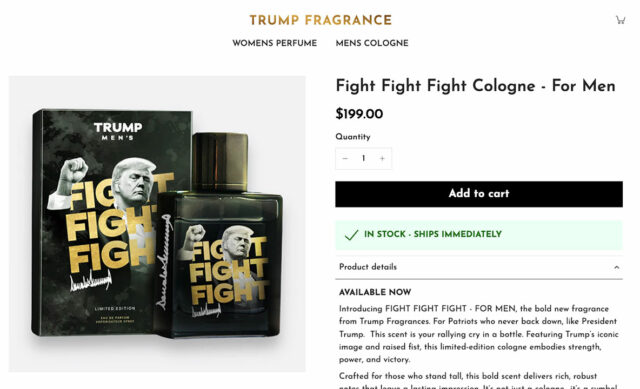
SCREENSHOT FROM GET TRUMP FRANGRANCES WEBSITE

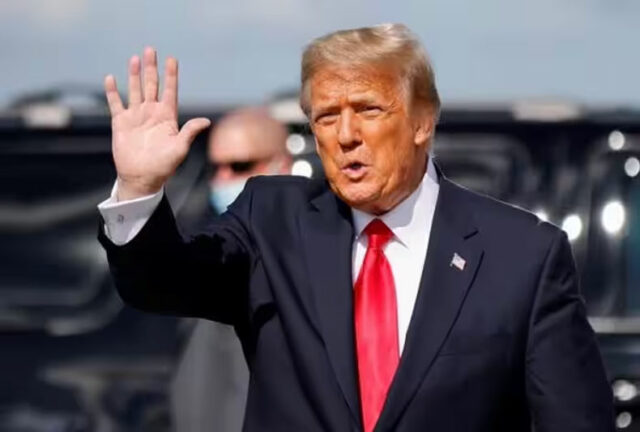
WASHINGTON — US President Donald J. Trump is adding fragrances to the growing list of merchandise that bear his name, raising fresh questions about his use of the presidential bully pulpit to hawk products that enrich him and his family.

The former New York real estate tycoon, who moved back into the White House in January for his second term, announced this week that a new Trump-branded cologne for men and perfume for women were available for purchase.

“Trump Fragrances are here. They’re called ‘Victory 45-47’ because they’re all about Winning, Strength and Success,” he wrote on his Truth Social account on Monday.

Mr. Trump, a Republican, served as the 45th US president from 2017-2021 and became the country’s 47th president with his 2024 win.

The fragrances come in a black box with gold lettering for men and a red box with gold lettering for women. The fragrance containers look like mini statues of Mr. Trump.

Reaction was swift online, with critics accusing the president of corruption.

“There’s never been, and I don’t think in American history, someone who’s stealing so much in plain sight — grifting and graft,” US Senator Mark Warner of Virginia said in a video shared on X.

Senator Peter Welch, a Democrat from Vermont, noted Mr. Trump was advertising the fragrances while Republicans sought to reduce Medicare benefits for low-income Americans in his budget bill.

“Senate Democrats are fighting to prevent President Trump from kicking 17 million people off their health care and he’s promoting his line of fragrances,” Mr. Welch said on X.

The White House declined to comment on the criticism.

The scents are the most recent products that the Trump family has unveiled. In June his family business licensed its name to launch a US Mobile service and a $499 smartphone. The phone was promoted as sleek and gold, Mr. Trump’s preferred color.

The president has said he put his business interests in a trust managed by his children to avoid conflicts of interest, but income from such business ventures will eventually enrich the president, who sits atop the series of Trump family firms.

Mr. Trump receives income from licensing deals, crypto projects, golf clubs and other ventures. He has also hawked gold sneakers and a “God bless the USA Bible.” — Reuters

Pag-IBIG Fund earns 13th straight Unmodified Opinion from CoA

Pag-IBIG Fund has earned its 13th consecutive Unmodified Opinion from the Commission on Audit (CoA), reaffirming its commitment to excellence in financial management, sound governance practices, and consistent compliance with accounting and auditing standards, officials announced on July 1.

The latest audit opinion followed the CoA’s comprehensive review of Pag-IBIG Fund’s financial statements and operations for the year 2024. The review confirmed that the agency’s transactions were properly conducted in accordance with applicable laws and regulations, and that its financial statements were fairly presented, in all material respects, in line with relevant government accounting and reporting standards.

“This is further proof that Pag-IBIG Fund has been, and continues to be, managed with professionalism, prudence, and integrity,” said Secretary Jose Ramon P. Aliling, head of the Department of Human Settlements and Urban Development and Chairperson of the 11-member Pag-IBIG Fund Board of Trustees. “It is a testament to how Pag-IBIG Fund upholds the highest standards in managing our members’ hard-earned savings and in fulfilling its mandate to serve the Filipino worker. This achievement also reflects Pag-IBIG Fund’s strong position, as it plays a key role in the administration’s flagship Expanded Pambansang Pabahay para sa Pilipino (4PH) Housing Program. We remain committed to the directive of President Ferdinand Marcos, Jr. to build a more secure, resilient, and prosperous future for every Filipino family.”

The CoA had previously issued Unqualified Opinions on Pag-IBIG Fund from 2012 to 2017 and Unmodified Opinions from 2018 to 2024. With this latest result, Pag-IBIG Fund joins a short list of Philippine government agencies and GOCCs that have consistently received Unqualified and Unmodified Opinions for over a decade, a noteworthy distinction that underscores its sustained fiscal discipline and commitment to transparency.

Pag-IBIG Fund Chief Executive Officer Marilene C. Acosta likewise emphasized the significance of this recognition, highlighting how it reflects the agency’s outstanding performance and service delivery in 2024.

“Pag-IBIG Fund exceeded the one-trillion-peso mark in total assets and posted a historic net income of ₱66.78 billion last year. We also achieved all-time highs in our housing loan releases, cash loan disbursements, and loan collections, enabling more Filipino workers to access affordable home financing and meet their short-term financial needs. Earning CoA’s Unmodified Opinion for the 13th consecutive year affirms that we accomplished all these while upholding the highest standards of integrity, in line with President Marcos, Jr.’s call for excellence and accountability in public service,” said Ms. Acosta.

“This recognition reinforces our members’ trust, knowing that their savings are safe, protected, and responsibly managed. We will continue to serve them with Tapat na Serbisyo, Mula sa Puso, and remain focused on sustaining this track record of integrity in the years ahead,” she added.

The Unmodified Opinion from the CoA adds to the list of recognitions earned by Pag-IBIG Fund from governing bodies for its excellence in public service last year. In 2024, Pag-IBIG Fund was also named as one of the top-performing government firms for good governance by the Governance Commission for GOCCs (GCG). Pag-IBIG Fund also earned a satisfaction rating of 99.52% in its 2024 Client Satisfaction Measurement, in accordance with the standards set by the Anti-Red Tape Authority (ARTA) and the GCG.


Spotlight is BusinessWorld’s sponsored section that allows advertisers to amplify their brand and connect with BusinessWorld’s audience by publishing their stories on the BusinessWorld Web site. For more information, send an email to online@bworldonline.com.

Join us on Viber at https://bit.ly/3hv6bLA to get more updates and subscribe to BusinessWorld’s titles and get exclusive content through www.bworld-x.com.

Learning about Philippine history through money

“The Philippine peso is part of everyday life, and it also holds a key to understanding Philippine history and cultural identity — specifically how it has evolved over time, from the precolonial gold of our ancestors to the designs of the latest polymer bank series.

Numismatics — the study of currency — is the focus of the Bangko Sentral ng Pilipinas’ (BSP) recently reopened public collection of historic gold and banknotes, now viewable at the Museo BSP. Its head, Cecille Gelicame, tells BusinessWorld what to expect at the museum.

Interview by Bronte Lacsamana
Video editing by Arjale Queral

DigiPlus strengthens responsible gaming frameworks first introduced in 2024

Players can easily manage their gaming habits with DigiPlus’ pioneering in-app self-exclusion features, launched in 2024 to promote balanced and responsible play.

DigiPlus Interactive Corp., the brand behind Filipino favorite gaming brands BingoPlus, ArenaPlus, and GameZone, today announced updates in its comprehensive responsible gaming framework — an industry-leading effort it first established in 2024 with in-app self-exclusion tools, advanced player safeguards, and community ambassador programs now reaching millions nationwide.

Since 2024, DigiPlus has been setting the pace for player protection, having launched the Philippines’ first fully integrated in-app self-exclusion features across its platforms. These pioneering tools allow players to set daily time limits, create gaming schedules, or apply loss caps — directly through a few taps in the app. DigiPlus combines these tools with the industry’s tightest player restrictions: enhanced electronic Know Your Customer (e-KYC) processes with facial recognition, strict age and eligibility screening, and cross-checks against PAGCOR’s National Database of Restricted Persons.

DigiPlus also built a Responsible Gaming Ambassadors Program that taps authentic voices to foster healthy gaming habits. Household name Vice Ganda and other personalities like sports icon Kiefer Ravena, along with his family, also lend their voices as trusted ambassadors, amplifying the message that responsible gaming is not just a corporate promise but a cultural movement shared by influencers and real players alike.

Entertainment icon Vice Ganda joins GameZone as a Responsible Gaming Ambassador, lending star power to peer-led advocacy for mindful gaming habits.

GameZone, one of DigiPlus’ gaming platforms, also recently unveiled its newest Responsible Gaming Ambassadors, chosen directly from its community of players. 2024 GameZone Tablegame Champions Cup winners now stand as peer role models, proving that the best advocates for mindful gaming often come from within the player base itself.

Through its flagship “Tamang Laro, Tamang Panalo” financial coaching series, players learn from licensed psychologists and financial coaches how to enjoy gaming responsibly and budget for entertainment. The “Pusta de Peligro” short film series, aired nationwide, has sparked new conversations about when a bet crosses into risk — reaching millions and helping drive change in gaming culture.

Participants take part in DigiPlus’ “Tamang Laro, Tamang Panalo” sessions which offer practical financial coaching designed to help players enjoy gaming responsibly while protecting household finances.

Internally, every DigiPlus gaming employees complete mandatory Responsible Gaming training — from spotting early warning signs to guiding players to seek support. Regular refresher sessions and scenario-based drills keep the commitment sharp on the ground.

“As the market leader, we don’t just talk about player protection — we build it, train for it, and champion it alongside our players,” said DigiPlus Chairman Eusebio Tanco. “Since 2024, we have invested in pioneering in-app safeguards, strict compliance, and credible community voices to ensure that gaming remains safe, entertaining, and socially sustainable.”

With these evolving tools, stricter safeguards, and peer-led advocacy programs, DigiPlus continues to contribute to an industry that puts player welfare and social responsibility at its core.


Spotlight is BusinessWorld’s sponsored section that allows advertisers to amplify their brand and connect with BusinessWorld’s audience by publishing their stories on the BusinessWorld Web site. For more information, send an email to online@bworldonline.com.

Join us on Viber at https://bit.ly/3hv6bLA to get more updates and subscribe to BusinessWorld’s titles and get exclusive content through www.bworld-x.com.

Alibaba Cloud announces new data centers in Malaysia, the Philippines

BEIJING – Alibaba Cloud, the cloud computing arm of Chinese tech giant Alibaba Group, announced the opening of its third data center in Malaysia on Tuesday and disclosed plans to launch a second data center in the Philippines in October, according to a statement released on Wednesday.

The expansion ensures that Alibaba Cloud can meet the rising global demand for secure, resilient and scalable cloud services, the company said. — Reuters

US Senate passes Trump’s sweeping tax-cut and spending bill, setting up House battle

By United_States_Capitol_-_west_front.jpg: Architect of the Capitolderivative work: O.J. - United_States_Capitol_-_west_front.jpg, Public Domain, https://commons.wikimedia.org/w/index.php?curid=17800708

 – U.S. Senate Republicans passed President Donald Trump‘s massive tax-cut and spending bill on Tuesday by the narrowest of margins, advancing a package that would slash taxes, reduce social safety net programs and boost military and immigration enforcement spending while adding $3.3 trillion to the national debt.

The legislation now heads to the House of Representatives for possible final approval, though a handful of Republicans there have already voiced opposition to some of the Senate provisions.

Mr. Trump wants to sign it into law by the July 4 Independence Day holiday, and House Speaker Mike Johnson said he aimed to meet that deadline.

The measure would extend Mr. Trump’s 2017 tax cuts, give new tax breaks for income from tips and overtime pay and increase spending on the military and immigration enforcement. It also would cut about $930 billion of spending on the Medicaid health program and food aid for low-income Americans and repeal many of Democratic former President Joe Biden’s green-energy incentives.

The legislation, which has exposed Republican divides over the nation’s fast-growing $36.2 trillion debtwould raise the federal government’s self-imposed debt ceiling by $5 trillion. Congress must raise the cap in the coming months or risk a devastating default.

The Senate passed the measure in a 51-50 vote with Vice President JD Vance breaking a tie after three Republicans – Thom Tillis of North Carolina, Susan Collins of Maine and Rand Paul of Kentucky – joined all 47 Democrats in voting against the bill.

The vote followed an all-night debate in which Republicans grappled with the bill’s price tag and its impact on the U.S. healthcare system.

Much of the late horse-trading was aimed at winning over Republican Senator Lisa Murkowski of Alaska, who had signaled she would vote against the bill without significant alterations.

The final Senate bill included two provisions that helped secure her vote: one that sends more food-aid funding to Alaska and several other states, and another providing $50 billion to help rural hospitals cope with the sweeping cuts to Medicaid.


‘NOT FISCAL RESPONSIBILITY’

The vote in the House, where Republicans hold a 220-212 majority, is likely to be close.

Mr. Johnson, the House speaker, said during an interview with Fox News’ Sean Hannity that Republican leadership would seek to move the legislation through the Rules Committee on Wednesday morning and get it before the entire House before Friday’s holiday, unless travel plans were upset by thunderstorms that have menaced the Washington area.

“Hopefully we’re voting on this by tomorrow or Thursday at latest, depending on the weather delays and travel and all the rest – that’s the wild card that we can’t control,” Mr. Johnson said.

A White House official told reporters that Mr. Trump would be “deeply involved” in pushing House Republicans to approve the bill.

“It’s a great bill. There is something for everyone,” Mr. Trump said at an event in Florida on Tuesday. “And I think it’s going to go very nicely in the House.”

An initial version passed with only two votes to spare in May, and several House Republicans have said they do not support the Senate version, which the nonpartisan Congressional Budget Office estimates will add $800 billion more to the national debt than the House version.

Republicans have struggled to balance conservatives’ demands for deeper spending cuts to reduce the impact on the deficit with moderate lawmakers’ concerns that the Medicaid cuts could hurt their constituents, including service cutbacks in rural areas.

The House Freedom Caucus, a group of hardline conservatives who repeatedly threatened to withhold their support for the tax bill, has criticized the Senate version’s price tag.

“There’s a significant number who are concerned,” Republican Representative Chip Roy, a member of the Freedom Caucus, said of the Senate bill.

A group of more moderate House Republicans, especially those who represent lower-income areas, have objected to the steeper Medicaid cuts in the Senate’s plan.

Meanwhile, Republicans have faced separate concerns from a handful of House Republicans from high-tax states, including New York, New Jersey and California, who have demanded a larger tax break for state and local tax payments.

The legislation has also drawn criticism from billionaire Elon Muskthe former Trump ally who has railed against the bill’s enormous cost and vowed to back challengers to Republican lawmakers in next year’s midterm elections.

House Democrats are expected to remain unanimously opposed to the bill.

“This is the largest assault on American healthcare in history,” House Democratic Leader Hakeem Jeffries told reporters. “It’s the largest assault on nutrition in American history.”


TAX BREAKS, IMMIGRATION CRACKDOWN, TIGHTER BENEFITS

The Senate bill would deliver some of its biggest benefits to the top 1% of U.S. households, earning $663,000 or more in 2025, according to the Tax Foundation. These high earners would gain the most from the bill’s tax cuts, the CBO has said.

Independent analysts have said the bill’s tightening of eligibility for food and health safety net programs would effectively reduce poor Americans’ incomes and increase their costs for food and healthcare. The nonpartisan Congressional Budget Office forecast that nearly 12 million more people would become uninsured under the Senate plan.

The bill’s increase in the national debt effectively serves as a wealth transfer from younger to older Americans, nonpartisan analysts have said.

Senate Democratic Leader Chuck Schumer said the vote “covered this chamber in shame,” adding that the bill would be “ripping health care away from millions of Americans, taking the food out of the mouths of hungry kids.”

Republicans rejected the cost estimate generated by the CBO’s longstanding methodology and have argued the Medicaid cuts would only root out “waste, fraud and abuse” from the system. – Reuters


Trump urges Hamas to accept ‘final proposal’ for 60-day Gaza ceasefire

PALESTINIANS inspect the damage at the site of an Israeli strike on a house in Gaza City, June 1, 2025. — REUTERS

 – U.S. President Donald Trump urged Iran-backed Hamas militants on Tuesday to agree to what he called a “final proposal” for a 60-day ceasefire with Israel in Gaza that will be delivered by mediating officials from Qatar and Egypt.

In a social media post, Mr. Trump said his representatives had a “long and productive” meeting with Israeli officials about Gaza.

He did not identify his representatives but U.S. special envoy Steve Witkoff, Secretary of State Marco Rubio and Vice President JD Vance had been due to meet Ron Dermer, a senior adviser to Israeli Prime Minister Benjamin Netanyahu.

Mr. Trump said Israel has agreed to the conditions to finalize a 60-day ceasefire, “during which time we will work with all parties to end the War.” He said representatives for Qatar and Egypt will deliver “this final proposal” to Hamas.

“I hope, for the good of the Middle East, that Hamas takes this Deal, because it will not get better — IT WILL ONLY GET WORSE. Thank you for your attention to this matter!” he said.

Mr. Trump told reporters earlier in the day that he is hopeful that a ceasefire-for-hostages agreement can be achieved next week between Israel and Hamas militants in Gaza. He is set to meet Netanyahu at the White House on Monday.

Hamas has said it is willing to free remaining hostages in Gaza under any deal to end the war, while Israel says it can only end if Hamas is disarmed and dismantled. Hamas refuses to lay down its arms.

The war in Gaza was triggered when Hamas-led militants attacked Israel on October 7, 2023, killing 1,200 people and taking 251 hostages, according to Israeli tallies.

The two sides have shown little sign of a readiness to budge from their entrenched positions.

The U.S. has proposed a 60-day ceasefire and the release of half the hostages in exchange for Palestinian prisoners and the remains of other Palestinians.

Israeli Foreign Minister Gideon Saar said earlier this week Israel has agreed to a U.S.-proposed 60-day ceasefire and hostage deal, and put the onus on Hamas.

Mr. Trump and his aides appear to be seeking to use any momentum from U.S. and Israeli strikes on Iran nuclear sites, as well as a ceasefire that took hold last week in that conflict, to secure a lasting truce in the war in Gaza.

Mr. Trump told reporters during a visit to Florida that he would be “very firm” with Netanyahu on the need for a speedy Gaza ceasefire while noting that the Israeli leader wants one as well.

“We hope it’s going to happen. And we’re looking forward to it happening sometime next week,” he told reporters. “We want to get the hostages out.”

Gaza’s health ministry says Israel’s post-Oct. 7 military assault has killed over 56,000 Palestinians. The assault has also caused a hunger crisis, internally displaced Gaza’s entire population and prompted accusations of genocide at the International Court of Justice and of war crimes at the International Criminal Court. Israel denies the accusations. – Reuters

Trump escalates feud with Musk, threatens Tesla, SpaceX support

REUTERS

 – U.S. President Donald Trump on Tuesday threatened to cut off the billions of dollars in subsidies that Elon Musk’s companies receive from the federal government, in an escalation of the war of words between the president and the world’s richest man, one-time allies who have since fallen out.

The feud reignited on Monday when Mr. Musk, who spent hundreds of millions on Mr. Trump’s re-election, renewed his criticism of Mr. Trump’s tax-cut and spending bill, which would eliminate subsidies for electric vehicle purchases that have benefited Tesla, the leading U.S. EV maker. That bill passed the Senate by a narrow margin midday Tuesday.

“He’s upset that he’s losing his EV mandate and … he’s very upset about things but he can lose a lot more than that,” Mr. Trump told reporters at the White House on Tuesday.

Though Mr. Musk has often said government subsidies should be eliminated, Tesla has historically benefited from billions of dollars in tax credits and other policy benefits because of its business in clean transportation and renewable energy. The Trump administration has control over many of those programs, some of which are targeted in the tax bill, including a $7,500 consumer tax credit that has made buying or leasing EVs more attractive for consumers.

Tesla shares dropped more than 5% Tuesday.

The Tesla CEO renewed threats to start a new political party and spend money to unseat lawmakers who support the tax bill, despite campaigning on limiting government spending. Republicans have expressed concern that Mr. Musk’s on-again, off-again feud with Mr. Trump could hurt their chances to protect their majority in the 2026 midterm congressional elections.

Treasury Secretary Scott Bessent pushed back on Mr. Musk’s criticism that the bill would balloon the deficit, saying, “I’ll take care of” the country’s finances.

Mr. Musk spearheaded the Department of Government Efficiency (DOGE), aimed at cutting government spending, before he pulled back his involvement in late May. Mr. Trump on Truth Social on Tuesday suggested Mr. Musk might receive more subsidies “than any human being in history, by far,” adding: “No more Rocket launches, Satellites, or Electric Car Production, and our Country would save a FORTUNE.”

Mr. Trump later doubled down, telling reporters with a smile, “DOGE is the monster that might have to go back and eat Elon.”

In response to Mr. Trump’s threats, Mr. Musk said on his own social media platform X, “I am literally saying CUT IT ALL. Now.” He later added that he could escalate the exchange with Trump but said, “I will refrain for now.”


CHALLENGES TO TESLA

The feud could create new challenges for Mr. Musk’s business empire, particularly as the electric automaker — his primary source of wealth — bets heavily on the success of its robotaxi program currently being tested in Austin, Texas. The speed of Tesla’s robotaxi expansion depends heavily on state and federal regulation of self-driving vehicles.

“The substance of Tesla’s valuation right now is based on progress towards autonomy. I don’t think anything is going to happen on that front, but that is the risk,” said Gene Munster, managing partner at Tesla investor Deepwater Asset Management.

Analysts expect another rough quarter when the EV maker reports second-quarter delivery figures on Wednesday. Sales in major European markets were mixed, data showed Tuesday, as Mr. Musk’s embrace of hard-right politics has alienated potential buyers in several markets worldwide. The elimination of the EV credit could hit Tesla’s earnings by as much as $1.2 billion, about 17% of its 2024 operating income, J.P. Morgan analysts estimated earlier this year.

The Electrification Coalition, an EV advocacy group, on Tuesday urged the U.S. House to revise the Senate bill. Shares of smaller EV players Rivian and Lucid Group lost 2% and 3.8%, respectively, on Tuesday.

Gary Black, a longtime Tesla investor who manages money for the Future Fund LLC, sold his shares recently as car sales declined. He told Reuters he is considering when to reinvest and that eliminating electric vehicle credits would harm Tesla. In a separate post on X, Black said: “Not sure why @elonmusk didn’t see this coming as a result of him speaking out against passage of President Trump’s big beautiful bill.”

The U.S. Transportation Department regulates vehicle design and will play a key role in deciding if Tesla can mass-produce robotaxis without pedals and steering wheels, while Musk’s rocket firm SpaceX has about $22 billion in federal contracts.

Tesla also gets regulatory credits for selling electric vehicles, and has reaped nearly $11 billion by selling those credits to other automakers who are unable to comply with increasingly strict vehicle emissions rules. Without those sales, the company would have posted a first-quarter loss in April.

Mr. Trump had in early June threatened to cut Mr. Musk’s government contracts when their relationship erupted into an all-out social media brawl over the tax-cut bill, which non-partisan analysts estimate would add about $3 trillion to the U.S. debt.

Asked if he was going to deport Musk, a naturalized U.S. citizen, Mr. Trump told reporters as he left the White House on Tuesday: “I don’t know. We’ll have to take a look.” – Reuters

Spain to shift $1.9 billion in reserve assets to help developing countries

PEXELS

 – Spain will redirect an additional $1.9 billion in Special Drawing Rights to the International Monetary Fund as part of an effort to support developing countries, Economy Minister Carlos Cuerpo told Reuters on Tuesday.

Speaking on the sidelines of a UN conference on development financing in Seville, Cuerpo said Spain has committed to shifting up to 50% of its SDRs, or over 5.5 billion euros ($6.5 billion), showcasing the country’s dedication to contributing to global economic stability and development.

SDRs are international reserve assets created by the IMF to supplement member countries’ official reserves, providing liquidity to the global economy. They are allocated to member countries in proportion to their IMF quotas and can be exchanged among governments for freely usable currencies in times of need.

“Spain will always be part of the solution, for example, with the commitment to re-channel most of our SDRs … that would benefit developing countries,” Cuerpo said.

The additional funds will go into the IMF’s Poverty Reduction and Growth Trust, which is used to provide concessional loans to poor countries.

Spain’s move aligns with broader efforts among donors to support countries in need, if with the notable absence of the United States after Washington refused to back the summit’s plan of action hammered out over the last year.

The pre-summit “outcomes” agreement included tripling multilateral lending capacity, debt relief, a push to boost tax-to-GDP ratios to at least 15%, and shifting the special IMF money to countries that need it most. – Reuters

Google hit with $314 million US verdict in cellular data class action

REUTERS

A jury in San Jose, California, said on Tuesday that Google misused customers’ cell phone data and must pay more than $314.6 million to Android smartphone users in the state, according to an attorney for the plaintiffs.

The jury agreed with the plaintiffs that Alphabet’s Google was liable for sending and receiving information from the devices without permission while they were idle, causing what the lawsuit had called “mandatory and unavoidable burdens shouldered by Android device users for Google’s benefit.”

Google spokesperson Jose Castaneda said in a statement that the company would appeal, and that the verdict “misunderstands services that are critical to the security, performance, and reliability of Android devices.”

The plaintiffs filed the class action in state court in 2019 on behalf of an estimated 14 million Californians. They argued that Google collected information from idle phones running its Android operating system for company uses like targeted advertising, consuming Android users’ cellular data at their expense.

Google told the court that no Android users were harmed by the data transfers and that users consented to them in the company’s terms of service and privacy policies.

Another group filed a separate lawsuit in federal court in San Jose, bringing the same claims against Google on behalf of Android users in the other 49 states. That case is scheduled for trial in April 2026. – Reuters

Manufacturing PMI expands in June

WORKERS paint the fur of realistic pet plushies at a factory in Angeles City, Pampanga, March 10, 2023. — REUTERS/LISA MARIE DAVID

PHILIPPINE factory activity in June expanded at its fastest pace in two months as production rebounded and new orders rose, S&P Global said.

The S&P Global Philippines Manufacturing Purchasing Managers’ Index (PMI) improved to 50.7 in June from 50.1 in May.

Manufacturing Purchasing Managers’ Index (PMI) of select ASEAN economies, June 2025June also marked the third consecutive expansion since the 49.4 reading in March.

A PMI reading above 50 denotes better operating conditions than in the preceding month, while a reading below 50 shows deterioration.

“The overall performance of the Filipino manufacturing sector remained relatively subdued as the first half of the year concluded,” Maryam Baluch, economist at S&P Global Market Intelligence said.

“However, while new orders continue to rise, they do so at a historically muted pace, weighed down by a stalled exports picture,” she added.

Uncertainty over the Trump administration’s tariff policy has weighed on the Philippines and other Southeast Asian countries, which are reliant on exports to the US market.

S&P Global data on the Association of Southeast Asian Nations (ASEAN) showed only two countries reported an expansion in PMI in June, Thailand and the Philippines. Thailand had the highest PMI reading at 51.7, followed by the Philippines (50.7). Both were above the ASEAN average of 48.6.

On the other hand, Malaysia (49.3), Myanmar (49), Vietnam (48.9) and Indonesia (46.9) reported a contraction in manufacturing activity.

In April, US President Donald J. Trump announced a baseline 10% tariff on all its trading partners, as well as higher reciprocal tariffs on some countries. The Philippines was slapped with a 17% tariff, the second lowest among Southeast Asian countries.

While the reciprocal tariffs have been paused for 90 days until July 9, the baseline 10% tariff remains in place.

NEW ORDERS
In June, S&P Global said Philippine manufacturers reported a further rise in new orders.

“The pace of growth was slightly stronger than that recorded in the previous month, although it remained below the long-run survey average. Anecdotal evidence attributed this latest uptick to successful customer acquisitions, improving underlying demand trends, and effective promotional efforts,” it added.

S&P Global noted that production levels returned to expansion territory, although “only fractionally.” This was a reversal of the marginal contraction seen in May.

“The rate of output growth lagged the increase in incoming new business,” it said.

Manufacturers ramped up purchasing activity in response to better demand.

However, Ms. Baluch noted that delayed delivery times for inputs and material shortages have affected production capacity.

“Delayed delivery times for inputs and material shortages also meant that goods-producing firms in the Philippines were unable to replenish their post-production inventories effectively, reflecting the challenges faced by manufacturers in effectively expanding production amid growing demand,” S&P Global said.

Meanwhile, Philippine manufacturers increased employment for the first time in four months, in response to the increased demand.

S&P Global said inflationary pressures remained historically subdued in June.

“Rates of both input price and output charge inflation were slightly slower than seen in May. Where input prices were raised, this was primarily linked by panelists to higher material costs,” it said.

S&P Global noted that business confidence strengthened compared with May but was still significantly below historical levels.

“The next couple of months will be important to gauge if the sector is able to return to growth rates seen in much of last year,” Ms. Baluch said.

“Lower inflationary pressures and sustained demand will in part help Filipino manufacturers to achieve this through scope for improved pricing power. However, historically muted business confidence suggests a more subdued path for the year ahead.” — A.R.A.Inosante

Infrastructure spending declines by 28% in April

WORKERS excavate a road in Quezon City. — PHILIPPINE STAR/MIGUEL DE GUZMAN

By Aubrey Rose A. Inosante, Reporter

STATE SPENDING on infrastructure slumped in April due to the election ban on disbursements for public works projects, the Department of Budget and Management (DBM) said.

In its latest disbursement report on Tuesday, the DBM reported that spending on infrastructure and other capital outlays declined by 27.8% to P85.8 billion in April from P118.9 billion in the same month last year.

“This was due mostly to the muted infrastructure spending of the Department of Public Works and Highways (DPWH), resulting from election-related prohibition on public spending for specific activities, goods, or services, as well as lower volume of contractor billings,” the DBM said.

Government agencies likely frontloaded and accelerated the implementation of infrastructure projects earlier this year, the DBM said.

The Commission on Elections implemented a 45-day ban on the release, disbursement or expenditures of public funds from March 28 to May 11.

The elections were held on May 12.

The DBM also attributed the decline in infrastructure spending to lower direct payments for foreign-assisted rail projects of the Department of Transportation, as well as the releases for local counterpart funds.

These rail projects include the South Commuter Railway Project and the Metro Manila Subway Project.

For the first four months of the year, infrastructure spending rose by 3.6% to P347.6 billion from P335.7 billion in the same period in 2024.

The DBM attributed the increase in infrastructure spending to the “robust spending performance of the DPWH for the implementation of various infrastructure projects, right-of-way settlements, and payment of progress billings (i.e., partially completed works) and accounts payables.”

Meanwhile, overall infrastructure disbursements inched up by 2.4% to P419.4 billion in the January-to-April period from P409.7 billion a year ago.

This includes infrastructure components of subsidy/equity to government corporations and transfers to local government units.

Analysts said infrastructure spending will likely pick up in the next few months.

“We may expect infrastructure spending to continue ramping up to boost the economy both through higher spending and employment in the construction sector, but also better economic activity comes with better infrastructure,” Oikonomia Advisory & Research, Inc. economist Reinielle Matt M. Erece said.

Budget Secretary Amenah F. Pangandaman earlier said infrastructure-related disbursements would likely increase after the election ban ended.

Rizal Commercial Banking Corp. Chief Economist Michael L. Ricafort said government spending, particularly on infrastructure, would be a major contributor to overall economic growth.

“Infrastructure spending has been prioritized and increased in recent years to 5%-6% of GDP (gross domestic product), much higher vs. below 2% of GDP about 20-30 years ago,” he said in a Viber message.

For this year, the government’s infrastructure program is set at P1.538 trillion, equivalent to 5.4% of total output.

The Development Budget Coordination Committee earlier said infrastructure spending will be sustained at 5-6% of GDP annually.