Home Blog Page 905

Gonzalez quits PFF; Gutierrez vows to continue programs

FREDDY GONZALEZ — PFF.ORG.PH

THE Philippine men’s football squad is set for more changes up top with key executive Freddy Gonzalez leaving this time.

Mr. Gonzalez relinquished his dual role as the Philippine Football Federation’s (PFF) senior national teams director and men’s national team manager on Wednesday, marking the departure of another vital cog of the program in the last two months.

Last May, Spanish coach Albert Capellas stepped down for undisclosed reasons, with his assistant Albert Cuadras temporarily taking over and eventually steering the Pinoy booters to a 2-2 draw with Tajikistan in last week’s AFC Asian Cup Qualifiers in Capas.

“This was a very difficult decision to make and one that required much reflection and introspection,” said Mr. Gonzalez in a statement. “Now is the time for me to focus on other pursuits and opportunities, both personal and professional.”

Assistant manager Mikkel Paris joined his boss in quitting from the team.

Under Mr. Gonzalez’s management that started in January last year, the squad has seen an influx of exciting young talents, carved a historic semifinal run in the Asean championship and made a promising start in the Asian Cup Qualifiers.

As he thanked Mr. Gonzalez for his contribution and dedication, PFF President John Gutierrez vowed to continue work to grow the program.

“The PFF remains fully committed to building upon the foundations laid for Philippine football. We assure the players that we will continue Fred’s (Gonzalez) framework for the national team, diligently ensuring our programs are well-supported and thriving,” he said.

“We are dedicated to providing every available resource, and with the support of football stakeholders, we look forward to continued progress and success for our national teams in the months and years ahead,” he added. — Olmin Leyba

Alas Pilipinas men lose to Pakistan in four sets at AVC Nations Cup

ALAS PILIPINAS MEN’S TEAM — ASIANVOLLEYBALL.NET

ALL Alas Pilipinas wanted when it plunged into action in the Asian Volleyball Confederation (AVC) Men’s Volleyball Nations Cup in Manama, Bahrain was to gain experience going into bigger battles ahead.

It showed in the Filipinos’ 25-18, 25-12, 18-25, 25-22 defeat at the hands of the taller, higher-ranked Pakistanis in Tuesday’s opener of the annual meet in the Bahraini capital.

There were flashes of brilliance in that defeat to the World No. 49 as the Filipinos, ranked 62nd on the planet, as evidenced by their third-set win and fierce resistance in the fourth.

And the Nationals did it minus their beloved skipper Marck Espejo, who was injured late in the opening set.

It didn’t matter that Alas played lackadaisical in that lopsided losses in the first two sets as long as the Angiolino Frigoni-mentored squad showed marked improvement in that important final two frames when it battled Pakistan toe to toe.

Despite the defeat, the country remained in quarterfinal contention and should advance if it could pull the rug from under World No. 45 Chinese Taipei, which was being played last night.

But then again, expect the Nationals, who are preparing for the FIVB World Championship the country will host this September and the Southeast Asian Games in Thailand this December, to just go out there and continue to learn by experience, win or lose. — Joey Villar

ROS rules 11U Batang PBA age-group against SMB

FACEBOOK.COM/PBAOFFICIAL

RAIN OR SHINE (ROS) saved its best for last, snapping San Miguel Beermen’s (SMB) perfect campaign with a 75-70 win to rule the 11U division of the 2025 Batang PBA age-group tournament in the finals on Wednesday at the PhilSports Arena in Pasig.

The Batang Elasto Painters raced to a 39-28 lead at the break and led by as many as 19 in the second half but still needed one last stand to repel the comeback attempt by the Batang Beermen.

Xavier Jeongco led the way with 20 points including the game-sealing free throws after the Beermen managed to strike within 70-73 in the waning seconds.

Kyrie Erickson Llego and Elijah Alexander Tirona contributed 18 points each while Ulan Rico added 14 for ROS, which also stunned Group A’s top-seed and unbeaten Meralco in the semis, 64-53.

In the process, the Batang Elasto Painters avenged their 65-49 defeat in the eliminations against the Batang Beermen to settle for second place in Group B for a fitting reversal of roles.

Glenn Mikael Mabulac (21), Mikkael Dominic Castañeda (16) and Ralph Lucas Sy (13) led SMB in a runner-up finish when it mattered the most.

Over at the 9U division, Blackwater essayed a sweet comeback from 17 points down to escape with a 59-58 win against Converge and complete a perfect 5-0 campaign.

Zyn Khalleb Cadallo fired 11 points while Carmelo Keeyan Leongson and Kendrick Dominguez scored 10 points each to lead the Batang Bossing’s comeback from a 15-32 deficit at the break.

The Batang Bossing, who also pulled off a 60-58 comeback win against the Batang FiberXers in the eliminations, limited the tournament’s top-scorer in Christian Jacob Tan to 19 points after scoring 82 points in the last two games.

Mr. Tan, who had 42 and 40 points in back-to-back games to lift Converge to the finale, drew solid support from Sebastien Gray Castro (13) and Francis Ian Mendoza (10) but to no avail. — John Bryan Ulanday

The Scores:

First Game (9U)

Blackwater 59 – Caballo 11, Leongson 10, Dominguez 10, Selibio 9, Maninang 6, Simbulan 5, Emerenciana 4, Garcia 3, Rodriguez 1, Lim 0, Villaluz 0, Marohom 0, Torres 0.

Converge 58 – Tan 19, Castro 13, F. Mendoza 10, Cochongco 8, Bahillo 4, Miciano 3, Feliciano 1, A. Mendoza 0, Sarmiento 0, Duncil 0, Azuin 0, Bo 0.

Quarterscores: 11-21, 15-32, 41-41, 59-58.

Second Game (11U)

Rain or Shine 75 – Jeongco 20, Llego 18, Tirona 18, Rico 14, Lagandaon 3, S. Pineza 2, Torres 0, Pine 0, Barreto 0, Rosuello 0, Fabros 0, M. Pineza 0, Quiambao 0.

San Miguel 70 – Mabulac 21, Castañeda 16, Sy 13, Tan 8, Custodio 4, Reyes 4, Cruzim 2, Obra 2, Marcos 0, Castro 0, Peña 0, Alcantara 0, Maristañez 0, Timbol 0.

Quarterscores: 21-11, 39-28, 57-44, 75-70.

Carlos Alcaraz battles past lucky loser Adam Walton to advance at Queen’s Club

CARLOS ALCARAZ — PA VIA REUTERS

LONDON — Top seed Carlos Alcaraz got his grasscourt campaign up and running with a 6-4, 7-6(4) victory over Australian Adam Walton to move into the last 16 at the Queen’s Club Championships on Tuesday.

Playing in his first match since his epic 5-1/2-hour French Open final victory over world number one Jannik Sinner nine days ago, Alcaraz was tested by Walton who had set points in the second set before the Spaniard recovered and won the tiebreak.

Alcaraz was meant to play compatriot Alejandro Davidovich Fokina but the Spaniard withdrew due to illness, giving lucky loser Walton the chance to play the French Open champion as he warmed up for his Wimbledon title defense.

“I realized that I was going to play against Adam after my warm-up… He has played a few matches already before this one. I think he played really great tennis,” said Alcaraz, the champion at Queen’s Club in 2023.

“It surprised me a little bit. So I knew that I was going to struggle a little bit today, but just really happy to get the win.

“I feel super happy to be back on grass. It is a special surface, a special place to me.”

Walton is ranked number 86 in the world and the Australian did not seem overawed by the occasion as he showcased some attacking tennis to hold serve until Alcaraz finally got to grips with the surface and broke to take a 4-3 lead.

Alcaraz used serve and volley to good effect, showing finesse with some exquisite drop shots while he was also virtually unstoppable on serve, sealing the opening set with an ace.

But Walton held serve well in the second set and nearly broke Alcaraz with his first break points — which were also set points — when he was 5-4 up but the Spaniard held on.

Once he forced a tiebreak, there was no looking back as Alcaraz wrapped up the contest.

French qualifier Corentin Moutet pulled off the biggest win of his career, saving a match point to stun American third seed Taylor Fritz 6-7(5), 7-6(7), 7-5 in a marathon battle.

The 26-year-old, who earned just his second career victory over a Top-10 opponent, will face Britain’s Jacob Fearnley in the last 16.

Second seed Jack Draper warmed up the home crowd when he claimed an impressive 6-3, 6-1 victory over American Jenson Brooksby for his first win on grass this season.

Draper had beaten defending champion Alcaraz in the second round last year and the Briton is hoping to improve on his quarterfinal run.

“It’s tricky coming onto the grass after clay, to adapt, I’m hitting the ball a bit late, not on time,” Draper said.

“The more matches and time I have on practice courts, I’ll get better and better. It’s definitely a surface I really enjoy playing on.”

Australia’s fifth seed Alex de Minaur bowed out of the tournament after a 6-4, 6-2 loss to Jiri Lehecka while Alexei Popyrin beat Aleksandar Vukic 6-2, 6-7(9), 7-6(3) in an all-Australian battle.

American sixth seed Ben Shelton, who had reached the semifinals in Stuttgart last week, was also knocked out in a 7-6(5), 7-6(4) loss to French qualifier Arthur Rinderknech. — Reuters

Mbappé doubtful for Real’s Club World Cup opener

MIAMI — Real Madrid’s Kylian Mbappé is a doubt for their opening Club World Cup match against Saudi Arabian side Al-Hilal, after missing training on Tuesday due to illness.

The club said Mbappé had been suffering from a fever and newly-appointed manager Xabi Alonso, who will make his debut in the dugout in Wednesday’s match, added that a decision on his participation would be made in the morning.

“Kylian was a bit better this morning but he was not fully fit so we thought it would be best for him to skip training. Let’s see how it evolves and we’ll make a last-minute decision,” Alonso told a press conference on the eve of the clash at the Hard Rock Stadium.

The potential absence of Mbappé leaves Alonso facing a selection dilemma, as the Frenchman is currently the only recognized center forward in the squad.

Brazilian teenager Endrick, who could have provided an alternative, was left out of the travelling party following a leg muscle injury sustained during Real’s LaLiga fixture at Sevilla last month.

Mbappé has been instrumental for Real Madrid this season, scoring 31 LaLiga goals since his high-profile summer move from Paris Saint-Germain.

Regardless of Mbappé’s potential absence, Alonso insisted his team would need to press “like a unit.”

“Defensive work is important. It’s one of the tasks we need to address in the short term, and in the long term, it will be decisive for our success,” the Spaniard said.

Real Madrid enter the tournament as one of the favorites, having dominated European football over the last decade, winning five of the last 10 Champions League titles.

Al-Hilal secured their place in the competition by triumphing in the AFC Champions League in 2021 and will look to capitalize on any weakness in Madrid’s lineup.

Real and Al-Hilal were drawn in Group F with Mexican side Pachuca and RB Salzburg of Austria. — Reuters

FDI flows into developing nations fell to lowest since 2005 — report

The World Bank logo is seen at the 2023 Spring Meetings of the World Bank Group and the International Monetary Fund in Washington, US, April 13, 2023. — REUTERS/ELIZABETH FRANTZ

WASHINGTON — Foreign direct investment (FDI) flows into developing economies dropped to $435 billion in 2023, the lowest since 2005, with just $336 billion flowing into advanced economies, the lowest since 1996, the World Bank reported on Monday.

It said growing investment and trade barriers, fragmentation and macroeconomic and geopolitical risks were depressing the outlook for FDI flows into developing countries, posing a threat to development efforts.

“The sharp drop in FDI to developing economies should sound alarm bells,” Ayhan Kose, the World Bank’s deputy chief economist, said in a statement released with the report. “Reversing this slowdown is not just an economic imperative — it’s essential for job creation, sustained growth, and achieving broader development goals.”

The report noted that global and national recessions were associated with a significant deterioration in FDI, with FDI starting to weaken before a recession hit. It said the decline in foreign investment had left “vast infrastructure gaps unmet” in developing countries, while eroding efforts to end global poverty and address urgent climate change needs.

Mr. Kose said bold domestic reforms were needed to improve the business climate and expand global cooperation, which could spur increased rates of cross-border investment.

The report, based on data from 2023, the latest available, said developing economies should ease restrictions that have built up in recent years, promote trade integration and encourage more people to participate in the formal economy.

It urged countries to work together to ensure FDI flows went to developing economies with the largest investment needs.

The bank released the report a week after downgrading its 2025 global economic forecast by four-tenths of a percentage point to 2.3%, warning that higher tariffs and heightened uncertainty posed a “significant headwind” for nearly all economies.

World Bank Chief Economist Indermit Gill said in the statement the dwindling FDI, a key driver of economic growth, is the direct result of public policy that had seen a proliferation of trade and investment restrictions.

“In recent years, governments have been busy erecting barriers to investment and trade when they should be deliberately taking them down. They will have to ditch that bad habit,” he said.

FDI has averaged almost $2 trillion per year globally during the past decade, the bank said, adding that data suggested that a 10% increase in FDI inflows could boost GDP in an average developing economy by 0.3% after three years. The impact could be much larger — 0.8% — in countries with stronger institutions, lower informality and greater trade openness.

As a share of their gross domestic product, FDI inflows to developing economies in 2023 were just 2.3%, about half the number during the peak year of 2008.

FDI flows to emerging markets and developing economies grew rapidly during the 2000s, peaking at nearly 5% of gross domestic product in the typical economy in 2008, but they have declined since then, the report said.

Trade growth also weakened significantly from 2020 to 2024, dropping to its slowest pace since 2000, while economic uncertainty spiked to the highest since the turn of the century, the bank said.

The three largest developing countries — China, India and Brazil — jointly received almost half of total FDI inflows during the 2012-2024 time period. Advanced economies accounted for nearly 90% of total FDI in developing economies over the past decade, with about half of that coming from the European Union and the United States, the bank said. — Reuters

Trump calls for Iran’s ‘unconditional surrender’

A general view of the White House, June 17, 2025. — REUTERS/KEVIN MOHATT

JERUSALEM/WASHINGTON/DUBAI — Iran and Israel launched new missile strikes at each other on Wednesday as the air war between the two longtime enemies entered a sixth day despite a call from US President Donald J. Trump for Tehran’s unconditional surrender.

The Israeli military said two barrages of Iranian missiles were launched toward Israel in the first two hours of Wednesday morning. Explosions were heard over Tel Aviv.

Israel told residents in a southwestern area of Tehran to evacuate so its air force could strike Iranian military installations. Iranian news websites said Israel was attacking a university linked to Iran’s Revolutionary Guards in the east of the capital.

Iranian news websites said Israel was also attacking a university linked to Iran’s Revolutionary Guards in the country’s east, and the Khojir ballistic missile facility near Tehran, which was also targeted by Israeli airstrikes last October.

The US Office of the Director of National Intelligence says Iran is armed with the largest number of ballistic missiles in the Middle East. Iran has said its ballistic missiles are an important deterrent and retaliatory force against the US, Israel and other potential regional targets.

Mr. Trump warned on social media on Tuesday that US patience was wearing thin. While he said there was no intention to kill Iran’s leader Ayatollah Ali Khamenei “for now,” his comments suggested a more aggressive stance toward Iran as he weighs whether to deepen US involvement.

“We know exactly where the so-called ‘Supreme Leader’ is hiding,” he wrote on Truth Social. “We are not going to take him out (kill!), at least not for now… Our patience is wearing thin.”

Three minutes later Mr. Trump posted, “UNCONDITIONAL SURRENDER!”

Mr. Trump’s sometimes contradictory and cryptic messaging about the conflict between close US ally Israel and longtime foe Iran has deepened the uncertainty surrounding the crisis. His public comments have ranged from military threats to diplomatic overtures, not uncommon for a president known for an often erratic approach to foreign policy.

A source familiar with internal discussions said Mr. Trump and his team are considering a number of options, including joining Israel on strikes against Iranian nuclear sites.

A White House official said Mr. Trump spoke to Israeli Prime Minister Benjamin Netanyahu by phone on Tuesday.

Mr. Trump also met for 90 minutes with his National Security Council on Tuesday afternoon to discuss the conflict, a White House official said. Details were not immediately available.

The US is deploying more fighter aircraft to the Middle East and extending the deployment of other warplanes, three US officials told Reuters. The US has so far only taken indirect actions in the current conflict with Iran, including helping to shoot down missiles fired toward Israel.

A source with access to US intelligence reports said Iran has moved some ballistic missile launchers, but it is difficult to determine if they were targeting US forces or Israel.

However, Britain’s leader Keir Starmer, speaking at the Group of Seven nations summit in Canada that Mr. Trump left early, said there was no indication the US was about to enter the conflict.

REGIONAL INFLUENCE WEAKENS
Mr. Khamenei’s main military and security advisers have been killed by Israeli strikes, hollowing out his inner circle and raising the risk of strategic errors, according to five people familiar with his decision-making process.

With Iranian leaders suffering their most dangerous security breach since the 1979 Islamic Revolution, the country’s cybersecurity command banned officials from using communications devices and mobile phones, Fars news agency reported.

Israel launched a “massive cyber war” against Iran’s digital infrastructure, Iranian media reported.

Ever since Iran-backed Hamas attacked Israel on Oct. 7, 2023, and triggered the Gaza war, Khamenei’s regional influence has waned as Israel has pounded Iran’s proxies — from Hamas in Gaza to Hezbollah in Lebanon, the Houthis in Yemen and militias in Iraq. Iran’s close ally, Syria’s autocratic president Bashar al-Assad, has been ousted.

Israel launched its air war, its largest ever on Iran, on Friday after saying it had concluded the Islamic Republic was on the verge of developing a nuclear weapon.

Iran denies seeking nuclear weapons and has pointed to its right to nuclear technology for peaceful purposes, including enrichment, as a party to the international Non-Proliferation Treaty (NPT).

Israel, which is not a party to the NPT, is the only country in the Middle East believed to have nuclear weapons. Israel does not deny or confirm that.

Mr. Netanyahu has stressed that he will not back down until Iran’s nuclear development is disabled, while Mr. Trump says the Israeli assault could end if Iran agrees to strict curbs on enrichment.

Before Israel’s attack began, the 35-nation board of governors of the UN nuclear watchdog, the International Atomic Energy Agency (IAEA), declared Iran in breach of its non-proliferation obligations for the first time in almost 20 years.

The IAEA said on Tuesday an Israeli strike directly hit the underground enrichment halls at the Natanz facility.

Israel says it now has control of Iranian airspace and intends to escalate the campaign in coming days.

But Israel will struggle to deal a knock-out blow to deeply buried nuclear sites like Fordow, which is dug beneath a mountain, without the US joining the attack.

Iranian officials have reported 224 deaths, mostly civilians, while Israel said 24 civilians had been killed. Residents of both countries have been evacuated or fled.

Global oil markets are on high alert following strikes on sites including the world’s biggest gas field, South Pars, shared by Iran and Qatar. — Reuters

Transatlantic airfares slump as Western Europeans skip US travel

STOCK PHOTO | Image by Stefan Fluck from Unsplash

NEW YORK/LONDON — Airfares from Europe to the United States have dropped to rates not seen since before the pandemic, as travelers from Western Europe lead a pullback in travel to the US that is expected to continue through at least July.

Overseas arrivals to the United States fell 2.8% in May from a year ago, according to preliminary data from the US National Travel and Tourism Office (NTTO) within the US Department of Commerce. Travel from Western Europe fell 4.4% in May although travel from Eastern Europe rose 4.6% in the same period.

Forward bookings suggest sustained declines are on the horizon, with total inbound bookings to the US in July down 13% year over year, according to OAG Aviation, an analytics firm.

Transatlantic airfare has been declining since the first quarter when Europeans started reconsidering travel to the US after President Donald J. Trump suggested annexing Greenland, launched a global trade war, and issued orders that focus on stricter border policy. A stronger dollar has also deterred some trips.

In March, travel from Western Europe fell 17% year over year, according to the NTTO.

Average round-trip economy airfares for over 50 routes from the US to Europe in the first quarter were down an average of 7% year over year, with rates to fly between Atlanta, Georgia, and London, down 55%, according to data from Cirium, an aviation analytics firm.

As American consumers have been bargain-hunting and waiting closer to their departure dates to finalize travel plans, the decline in demand from Europe is another factor contributing to cheaper travel.

“Fewer seats filled by European travelers to the US, and a slower pace of growth in US outbound to Europe than last year, will tend to cast 2025 as a tougher year to make money on transatlantic routes,” said Aran Ryan, director of industry studies at Tourism Economics, a subsidiary of Oxford Economics.

This summer, the price of round-trip tickets from the US to Europe is down 10% compared with a year ago, travel booking app Hopper said. Average fares of $817 per ticket are in line with prices to Europe in the summer of 2019 before the pandemic.

Major carriers, including Air France KLM and Germany-based Lufthansa, expect slowing activity. Lufthansa Chief Executive Officer (CEO) Carsten Spohr said the company expects weaker demand in the third quarter, while Air France KLM CEO Ben Smith said the company is seeing a “slight pullback” in transatlantic traffic and will slash prices to keep cabins on its transatlantic flights full.

Airlines including Lufthansa and US air carrier United Airlines say higher demand from U.S. travelers flying to Europe is offsetting the decline of Europeans flying the opposite direction. United said international bookings from Europe fell 6% in the first quarter, but added that US-originating demand made up for the pullback. Rival Delta Air Lines said 80% of its long-haul international demand originates from the US, and fares in the region are “significantly higher” than in the rest of the world.

Lufthansa said it plans to market its transatlantic flights to more Americans given the higher demand, despite travel from Western Europe showing moments of recovery. Travel from the region to the US increased 12.1% in April before falling again in May, according to data from the NTTO.

As of mid-May, there are 4.3% more international flights scheduled to depart from US airports for international destinations this summer, said Hopper.

“We feel really good about the transatlantic market,” American Airlines CFO Devon May said at a Wolfe Research transportation and industrials conference in May. — Reuters

Streaming surpasses broadcast and cable TV viewing in US for first time

REUTERS

LOS ANGELES — Streaming services, which have been steadily gaining in popularity, have finally dethroned broadcast and cable television in the US, winning more viewers in May than broadcast and cable combined, audience measurement firm Nielsen reported on Tuesday.

Nielsen, in its monthly report The Gauge, said streaming captured 44.8% of total TV usage in the US in May, highlighting the growing dominance of streaming platforms like YouTube and Netflix over the past four years.

Google’s YouTube alone accounted for 12.5% of all television viewing in May, representing the largest audience share for a streaming service. Free ad-supported streaming services, such as Paramount Global’s PlutoTV, Roku Channel and Fox’s Tubi, also have gained popularity, collectively capturing 5.7% of TV viewership, Nielsen reported.

Broadcast accounted for 20% of TV viewership in May, while cable accounted for 24%, Nielsen said.

The rise of streaming, which received a big boost during the coronavirus pandemic when people were forced to seek entertainment at home, reflects the broader transformation in media consumption, as viewers increasingly favor on-demand content over traditional TV schedules. The trend is reshaping the television landscape, with implications for advertisers and content creators alike. — Reuters

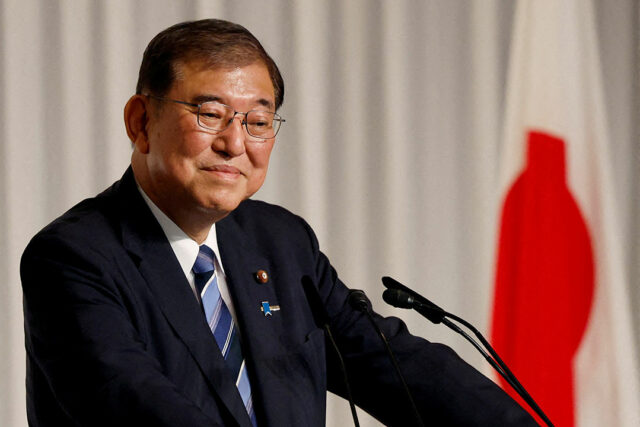
Japan’s Ishiba departs G7 with US trade deal and political future in doubt

JAPANESE PRIME MINISTER SHIGERU ISHIBA — REUTERS FILE PHOTO

KANANASKIS, Canada — Japanese premier Shigeru Ishiba’s bid to get US President Donald J. Trump to relax tariffs imperiling his country’s economy and his political future fell flat this week, underlining the gulf between the allies as more levies are set to kick in.

Mr. Ishiba traveled to the Group of Seven (G7) summit in Canada hoping a direct appeal might get talks back on track after Japanese negotiators struggled to secure respite on a 25% tariff imposed on imported cars, according to two officials with knowledge of the matter.

While the sun beamed down as Mr. Ishiba and Mr. Trump reclined in lounge chairs in the foothills of the Canadian Rockies, Monday’s brief encounter did little to alter the grim forecast for Japanese industry girding for broader 24% levies due on July 9.

The lack of progress could knock confidence in Mr. Ishiba’s diplomacy just as he prepares to contest a dicey upper house election next month that some political analysts say could result in his ouster.

“Despite our persistent efforts to find common ground through serious discussions, yesterday’s meeting with President Trump confirmed that we still have discrepancies in our understanding,” Ishiba told reporters on Tuesday before his departure from Canada.

Mr. Trump earlier told reporters aboard Air Force One that “there was a chance of a deal” but appeared in little mood to cede ground. “Ultimately you have to understand we’re just going to send a letter saying this is what you’re going to pay otherwise you don’t have to do business with us,” he said.

CAR TROUBLE
The most pressing issue for Japan has been the impact of Mr. Trump’s tariffs on its auto sector, which employs nearly one in 10 of the country’s workers and accounts for a fifth of exports.

Japan’s overall exports fell in May for the first time in eight months, piling pressure on its fragile economy, the world’s fourth largest.

Toyota Motor Corp., Japan’s leading car company, has already flagged that tariffs have likely sliced off ¥180 billion ($1.2 billion) from its profit in April and May alone. Honda has said it expects a ¥650 billion ($4.5 billion) hit to its earnings this year from tariffs in the US and elsewhere, while Mazda Motor declined to issue a full-year profit forecast, citing uncertainty due to tariffs.

Publicly, Mr. Ishiba’s government has said it aims to win total exemption from Mr. Trump’s auto tariffs, but behind the scenes its negotiators had been trying to convince Washington to knock them down to around 10%, the sources said, requesting anonymity due to the sensitivity of the matter.

Mr. Trump’s trade deal with Britain, where he agreed to allow a quota of cars to be subject to a lower 10% levy has provided somewhat of a template, although Japan is a far larger exporter of cars to the United States.

In exchange for relief on the autos sector, Tokyo had pledged to step up purchases of US gas and other items to rebalance a trade deficit that has long irked Mr. Trump.

But just days before Mr. Ishiba was due to arrive in Kananaskis, Canada for the G7 summit, it became clear to Japan’s negotiators that Washington was unwilling to budge, said one of the sources.

DIPLOMATIC SKILL
Mr. Ishiba likely miscalculated by raising expectation of an agreement with Mr. Trump, said Kenji Minemura, a senior researcher at the Canon Institute for Global Studies.

He will now have put a trade deal aside and focus on convincing Mr. Trump to extend the pause on the broader reciprocal levies, a senior lawmaker close to the premier said.

Otherwise, Mr. Ishiba faces the prospect of contesting elections next month with the full force of Mr. Trump’s tariffs in effect. The combined tariffs could shave nearly 1% off Japan’s gross domestic product, Mizuho Research & Technologies has estimated.

“The fact that nothing was agreed at the summit could raise doubts about the diplomatic skills of the Ishiba administration,” said Hiroshi Shiratori, professor of contemporary political analysis at Hosei University.

His ruling coalition may struggle to hold on to its majority in the upper house vote, a repeat of the result in the more powerful lower house election in October, which could potentially trigger his ouster, political analysts say.

Even if the Liberal Democratic Party limps on in minority rule, there is around a 70% chance the party would replace its leader, said Michael Cucek, a political science professor at Temple University in Tokyo.

“If they do have a significant loss then Ishiba has to go. You can’t lose two elections in a row,” he said.

Mr. Ishiba may get another chance to make progress with Mr. Trump later this month with the two leaders due to attend the two-day NATO summit in the Hague from June 24. — Reuters

India regulator says no ‘major safety concerns’ on Air India’s Boeing 787 fleet

INDIA’S aviation safety watchdog said on Tuesday surveillance conducted on Air India’s Boeing 787 fleet did not reveal any major safety concerns, days after one of its jets crashed, killing at least 271 people.

“The aircraft and associated maintenance systems were found to be compliant with existing safety standards,” the Directorate General of Civil Aviation (DGCA) said in a statement.

The Boeing 787-8 Dreamliner bound for London with 242 people on board crashed seconds after take-off in Ahmedabad on Thursday hitting nearby buildings. All but one passenger on board was killed, along with about 30 people on the ground.

The DGCA also said 24 of Air India’s 33 Boeing 787 aircraft had completed an “enhanced safety inspection” it had ordered the airline to carry out.

The regulator, in a meeting with senior officials of Air India, raised concerns about recent maintenance-related issues reported by the airline.

It advised the carrier to “strictly adhere to regulations,” strengthen coordination across its businesses and ensure availability of adequate spares to mitigate passenger delays, it added.

The DGCA had met senior officials of Air India and Air India Express to review their operations amid increasing flight volumes. — Reuters

Taal Volcano: A beauty and a curse

“Club Balai Isabel has experienced both the economic gains of Taal’s beauty and the challenges brought by its periodic volcanic activity in recent years.

“Taal Volcano is both a gift and a curse,” says Cecille Terrible, Chief Operating Officer of Club Balai Isabel.

Interview by Edg Adrian Eva
Video editing by Arjale Queral