TO PREPARE for the possible return to action of the Philippines Football League (PFL), the local football federation has been busy preparing its training center in Cavite for league use.
The Philippine Football Federation (PFF), the body overseeing the affairs of the PFL, said following the approval of the Inter-Agency Task Force for the Management of Emerging Infectious Diseases (IATF) for the local professional football league to resume training albeit under strict health and safety protocols, it has been constantly working on the National Training Center so as when teams start coming in to train everything will be ready and up to standards.
The two-hectare facility inside the San Lazaro Leisure and Business Park in Carmona is being groomed to be a “bubble” for all the competing PFL teams not only in training but also during league matches when given the go-ahead by the IATF, the lead government agency in the country’s fight against the coronavirus disease 2019 (COVID-19) pandemic.
Everything being done in the PFF training center is in compliance with the operations protocols the federation submitted to the IATF, which did a lot in convincing the latter to grant the PFF’s request for a gradual return to activities.
The PFF is building on the developments it has done in the facility, which has hosted various competitions, in the last couple of years.
The National Training Center now consists of one FIFA-funded 105mx68m artificial turf and two 20mx40m mini artificial pitches funded by the Asian Football Confederation. Floodlights systems for all pitches are now awaiting electricity connection.
With the mini-pitches, the PFF said clubs may utilize three artificial pitches for training sessions, in line with the health and safety guidelines put up, particularly that on physical distancing.
Other measures in the PFF operations protocols include mandatory temperature checks and health declaration prior to entry, sanitizing mats in the entry and exit areas, regular surface and equipment disinfection before and after each training session, availability of hand sanitizers at key areas and mandatory wearing of face masks when not training in the pitch.
The fourth season of the PFL was supposed to start in March but was postponed to a still-to-be-determined date because of COVID-19.
It got good new early this month when the IATF approved its application for a return to some activities.
The league recently conducted swab testing of players and coaches as part of its return preparations.
“Football we will be back. Right now safety of everybody is primary for us and we just have to be patient,” said PFL commissioner Coco Torre. — Michael Angelo S. Murillo
TOKYO — The rearranged Tokyo Olympics are likely to be a pared-down version of recent editions of the four-yearly Games, Japanese Olympic Committee (JOC) Chairman Yasuhiro Yamashita said on Tuesday.
Japan and the International Olympic Committee postponed the Tokyo Games until 2021 in March because of the coronavirus pandemic.
Since then, organizers have spoken of trying to simplify the event — which had been due to start in less than 10 days — to reduce costs and ensure athletes’ safety.
“The Games (used to be) gorgeous and extravagant, which I experienced before…,” Yamashita, a former Olympic gold medallist judoka, said at JOC headquarters.
“But I don’t think the concept of these Games will pursue these things. The first priority is to be safe and secure.”
Yamashita, installed as JOC chairman in June last year in place of Tsunekazu Takeda, who is being investigated over corruption allegations, said the pandemic was also causing his organization to suffer financially.
“In regards to the next fiscal year (the financial situation of JOC) will be quite tough,” he said after a difficult first year in charge. “…I think there is a high possibility that we may have to consider borrowing money.”
The situation under which a president of a host country’s Olympic committee is changed a year before the Games “shouldn’t happen,” he added. — Reuters
EVEN after more than four months on hiatus, the Los Angeles Clippers are not planning to push All-Star Kawhi Leonard as the NBA season restarts.
Leonard said he is healthy and treated the break like an offseason. Last summer, Leonard went from Toronto to the Clippers in a free-agent tour that wrapped in July. By late September, he was already in training camp with the Clippers.
Head coach Doc Rivers said Leonard has “no limits” in the team’s eight seeding games before the playoffs begin.
“Kawhi is healthy for the most part. That still doesn’t mean that we don’t want to maintain him and get him through the first eight games and get ready for the playoffs. We want to be smart about this,” Rivers said.
Leonard is averaging a career-best 26.9 points, 7.3 rebounds and 5.0 assists in his first season with the Clippers. He arrived to the Walt Disney World Resort, where all 22 NBA teams with a chance for the playoffs are housed, a few days after his teammates to handle a personal matter.
The Clippers (44-20) are fighting for top position in the Western Conference.
Leonard said he’s “excited” despite the notion that the 2019-2020 season isn’t going to crown a “normal” champion.
“This is just the layout of this year,” Leonard said. “Just pretty much stay focused. It’s not like a regular NBA season. Nobody’s life is pretty much how they planned it to be at this point with the pandemic, so I mean, you take it for what it is. Everybody is happy that a [champion] will be crowned this year, and if that’s the 2020 championship, then we want it. You know, that’s how I look at it. This is what the layout is, as far as to go out there and complete this journey.” — Reuters
The Youth Esports Program (YEP) recently got an added boost in its push after it struck a partnership with global game developer and publisher Riot Games Southeast Asia.
YEP, a collaboration between Mineski Philippines and the Philippine Collegiate Champions League (PCCL) which aims to develop future esports talent in the country through students, said it is excited to gain another platform to further its vision through Riot.
Under the partnership, students that are part of YEP will gain access to Riot’s speakers through workshops and career talks, participation in activities organized by the publisher, and other support for student initiatives.
Among these initiatives are the weekly Legend of Runeterra tournaments for YEP chapter organizations.
Also, the partnership marks the inclusion of Valorant as an official tournament game in YEP’s soon-to-be-announced national cross-campus esports league.
“The Philippines has always been one of our most important markets and we have been consistently blown away by the passion and talent discovered within the community here. We are excited to partner with the Youth Esports Program and to support their efforts in nurturing the next generation of esports and game industry professionals,” said Chris Tran, Head of Esports for Riot Games Southeast Asia, Taiwan, Hong Kong and Macau, of their decision to partner with YEP.
“We’re very happy and excited to have Riot Games be part of the program. We are aligned on our objective of raising the level of esports to the level of other varsity sports in schools. Together, we hope to create the infrastructure needed for students to responsibly pursue their passions in the exciting industry of esports and gaming. The Philippines’ best professional teams of the future will come from the current youth.” YEP Director Marlon Marcelo, for his part, said.
YEP was unveiled in February this year. It aims to establish a coalition of student esports organizations in campuses across the country as accredited YEP chapters, and support student esports initiatives through career opportunities, event support, esports skills development and more. – Michael Angelo S. Murillo
Last May 16, 2020, Tiger Beer presented “Stronger than Ever”, an online benefit concert featuring Tiger Beer’s endorser Bamboo. The benefit concert aimed to raise funds for sari-sari stores impacted by the pandemic to bounce back and recover their businesses during the crisis.
With the commitment from Tiger Beer, a total donation of Php 557,700 was raised during the online concert, and will be going to Hapinoy, a social enterprise supporting sari-sari store owners. Funds raised from “Stronger than Ever” will be used to help support the sari-sari stores in the Hapinoy network that have been badly affected by the current crisis.Sari-sari stores will be provided with ReStart puhunan, Covid safety merchandise, training, mentorship and community membership as well as a possible cashless system to engage in e-loading and bills payment.
“Stronger Than Ever” called on Filipinos to band together under the shared spirit of bayanihan to help uplift small businesses.Inspired by the song “Here I Am” that was co-created by Tiger Beer and Bamboo, this campaign is a localized execution of a Global Tiger Beer initiative to #SupportOurStreets.
Embodying Tiger Beer’s line of “Uncage Your Tiger,” Bamboo performed his hit songs such as Truth, Ulan, Ikot ng Mundo, These Days, Light On, In This Life, Noypi, and Here I Am to the delight of his fans.
“This is the first time that we have partnered in this one of a kind effort and we are very thankful to Tiger Beer for choosing us as this will definitely help our cause to support our sari-sari store owners. Hapinoy provides education, linkages to capital, new business opportunities, technology enablement, and a peer network for sari-sari store owners called Samahang Hapinoy.” said Mark Ruiz, Co-Founder and President of Hapinoy.
In these unprecedented times, Tiger Beer believes that every Filipino has the potential to embrace change and take courage to unleash possibilities in the “New Normal.”
The burger will be on menus at selected stores in Miami, New York, Austin, Portland, and Los Angeles while stocks last, the company said. It’s also partnering with suppliers in Latin America and Europe to expand on the effort.
Burger King will begin selling Whoppers sourced from cows that belch out less methane as the fast-food industry grapples with a questionable sustainability record.
The chain, owned by Restaurant Brands International Inc., debuted a sandwich Tuesday made from cattle raised on a diet supplemented with lemongrass during the final months of their lives, the company said. That’s expected to cut greenhouse gas emissions from those animals by about a third while on the diet.
The new menu offering comes as a growing number of major food brands reckon with their large role in contributing to global emissions. Meat producers and retailers have been under growing pressure from investors and consumers to cut the climate impact of their products.
“To make a real impact in the world, we need the whole industry to change,” Fernando Machado, Burger King’s global chief marketing officer, said in an interview. “Just offering at Burger King is kind of like a drop in the ocean.”
Agriculture-related industries are second only to energy in terms of greenhouse gas emissions, and raising animals accounts for about 14.5% of the global total. Cows emit methane that’s about 30 times more powerful than carbon dioxide at warming the planet.
The logistics of selling low-methane beef at scale across a fast-food empire are daunting. Meat suppliers and retailers will need to be ready to pay up more for that sort of beef. Any feed supplements or modified diets are likely to carry extra costs for cattle farmers who are already grappling with squeezed incomes, a problem compounded by the coronavirus pandemic.
SELECTED STORES
Mr. Machado didn’t say how much the lower-methane beef would cost Burger King, which doesn’t plan to charge more for the limited-time product. The burger will be on menus at selected stores in Miami, New York, Austin, Portland, and Los Angeles while stocks last, the company said. It’s also partnering with suppliers in Latin America and Europe to expand on the effort.
This isn’t the first green initiative taken by the company, which sells meatless burgers under a partnership with Impossible Foods Inc. Still, the restaurant doesn’t disclose its target for cutting emissions, making the impact of this latest step difficult to gauge. Green product releases, meanwhile, can help companies dodge calls for transparency while giving them a sales and public-relations boost.
While initial experiments have shown that Burger King’s modified diet cuts methane emissions by an average of 33% per day during the last three to four months of the cows’ lives, the method is still pending validation from an academic peer review after initial experiments. If sold on a mass scale, lower-emission beef may require the right certification to win consumer trust. The company said it will openly share its cow diet formula to convince others to follow suit.
“Next, I hope to see Burger King and others research how to reduce methane emissions—and emissions from manure and fertilizer—during all phases of beef production, not just the last 3-4 months,” Dan Blaustein-Rejto, director of food and agriculture at environmental research organization the Breakthrough Institute, said on Twitter.
Meat-sourcing companies are far behind on globally accepted corporate sustainability initiatives. Most of these companies have not yet disclosed the emissions the company and its products produce, according to FAIRR, an initiative set up by environmentally minded investors. Disclosures are key to assessing whether any of the company’s green initiatives lead to promised emissions cuts or not.
HARD TO SCALE
Researchers and companies have explored a range of feed supplements, vaccines and diets that would help cut methane emitted by ruminants’ stomachs. But so far it has been tricky because microbes responsible for creating methane have shown resistance to some methods, while other solutions may be hard to scale up.
One UK-based startup is even working on methane-eating masks for cows.
Even if successful, modifying diets only partly cuts emissions, raising the need for other methods. Some companies have pushed into a type of farming known as regenerative agriculture that aims to cull carbon’s release into the air through biodiversity and soil health. General Mills Inc. aims to convert 1 million acres of land into regenerative farming by 2030. — Bloomberg
The iconic American gym will emerge from bankruptcy with a healthy balance sheet, 61 company-owned gyms, and more than 600 franchise-owned gyms.
RSG Group GmbH, the Berlin-based fitness company that owns the McFit chain, won a court-approved auction to buy Gold’s Gym for $100 million, according to a news release.
Gold’s saw its business drop during the COVID-19 pandemic and filed for court protection in May. The company tapped a $20 million bankruptcy loan shortly after to keep operating even as most of its gyms remained shut.
The iconic American gym will emerge from bankruptcy with a healthy balance sheet, 61 company-owned gyms, and more than 600 franchise-owned gyms, according to the RSG news release. The sale still needs to be approved in a bankruptcy court hearing scheduled for July 24.
“Gold’s Gym is a fitness institution that had a major influence on the industry’s development. It was a huge source of inspiration when I was setting up my first McFit studio in Würzburg, Germany back in 1997,” RSG Group’s founder and CEO Rainer Schaller said in the statement.
Representatives for Gold’s didn’t immediately respond to an email seeking comment.
Retired merchant marine veteran Joe Gold launched his fitness empire in a rough cinder-block building near Muscle Beach in Venice, California in 1965 with weight-lifting equipment he built himself. The company had its strongest-ever year of worldwide growth in 2019, but the coronavirus, social distancing and gym closures were a major blow to its business.
“No single factor caused more harm to the debtors’ business than the current COVID-19 pandemic,” the company said in a court filing when it furloughed almost 4,600 employees and declared bankruptcy. — Bloomberg
Atmospheric levels of the gas—emitted by digesting cows, leaky gas pipelines, and natural sources such as wetlands—have increased 2 1/2 times from pre-industrial levels, according to a study. — REUTERS
Global emissions of methane, a greenhouse gas multiple times more potent than CO2, rose by 9% in the decade through 2017, putting Earth on a track to warm by more than 3 degrees Celsius by the end of the century, according to an international study scheduled to be released Wednesday.
Atmospheric levels of the gas—emitted by digesting cows, leaky gas pipelines, and natural sources such as wetlands—have increased 2 1/2 times from pre-industrial levels, researcher Marielle Saunois said in a press briefing in Paris. Human activity accounts for about 60% of methane emissions, led by growing herds of livestock and emissions linked to oil and gas production.
Methane’s warming potential over a century is 28 times that of an equivalent mass of CO2, the researchers said. The current path of methane emissions lies between the two warmest scenarios used in projections by the Intergovernmental Panel on Climate Change, implying large cuts are needed to meet Paris Agreement targets. Warming by 3 degrees would be double the rate scientists have identified as needed to constrain the worst impacts of climate change.
“We’re on track for a scenario that is rather hot, and above 3 to 4 degrees,” Ms. Saunois said in her presentation of the study. “Emissions are rising, particularly in tropical zones.”
After stabilizing in the late 1990s and early 2000s, methane emissions have been rising since 2007, accelerating since 2014, according to the study. Average annual emissions of methane rose to an estimated 596 million tons in the period through 2017, from 546 million tons in the 2000–2006 period.
23% OF WARMING
The study, the work of more than 90 researchers as part of the Global Carbon Project, was published in the journal Earth Systems Science Data. A related paper on methane sources published in Environmental Research Letters found agriculture and fossil fuels were the main drivers behind increased emissions.
Methane—chemical formula CH4—is responsible for about 23% of all warming produced by greenhouse gases so far, the researchers said. Its lifetime in the atmosphere of around 9 years makes the gas a good target for climate change mitigation. Stabilizing or reducing emissions would have an impact on global warming within a few decades, they said.
Tropical regions were the source of 64% of global methane emissions, while northern high latitudes contributed 4%. The study didn’t find a significant effect from melting permafrost, though Ms. Saunois said “if the permafrost melts strongly, the emissions will increase.”
Agriculture and waste represented 56% of anthropogenic methane emissions, mainly linked to growing numbers of ruminant livestock that burp it up as they digest, the study found.
Contributions from Asia and Africa increased as livestock herds expanded there, Ms. Saunois said. Europe was the only region to lower methane emissions over the period, helped by a drop in dairy cattle numbers and changes in how farms store and treat manure.
Production and use of fossil fuels accounted on average for 35% of emissions linked to human activity. Oil and gas accounted for almost two-thirds of the fossil emissions, notably leaks during drilling of wells and from cast-iron natural gas distribution grids in older cities. Coal mining made up most of the remainder, mainly due to methane pumped from mine-ventilation shafts. — Bloomberg
Confidence in the $43 trillion banking system is eroding among the nation’s more than 1 billion account holders, threatening a cornerstone of China’s rise into an economic powerhouse. — KSTUDIO / FREEPIK
Social media-fueled rumors about banks collapsing are popping up at an unprecedented frequency in China, forcing regulators and even the police to step in to calm depositors.
Just since the past month, worried savers have descended on three banks to withdraw funds amid rumors of cash shortages that were later dismissed as false. Over the weekend customers rushed to a bank in the northern Hebei province to take out money, prompting local regulators to publicly vouch for the soundness of its lenders as the police halted the run.
Confidence in the $43 trillion banking system is eroding among the nation’s more than 1 billion account holders, threatening a cornerstone of China’s rise into an economic powerhouse. After several bailouts and the first bank seizure in more than two decades last year, the coronavirus outbreak and its economic fallout have exacerbated an already shaky situation in the world’s largest banking system.
“The perception Chinese savers had of banks being risk-free is changing even though in nearly all recent cases their deposits have been protected,” said Zhang Shuaishuai, a Shanghai-based analyst at China International Capital Corp. “Once a rumor like this spreads, it brings immediate liquidity risk to a bank.”
For decades, deposit-taking has provided a stable and low-cost funding base for China’s financial market, playing a key part in the rise of its economy to the second largest in the world. Chinese households hold about 90 trillion yuan ($13 trillion) of bank deposits, more than anywhere else in the world.
Regulators are now not only seeking to soothe nerves publicly, but are also raising the protection to preserve this cushion for banks. The run in Hebei came after authorities kicked off a pilot program to limit large transactions in the province.
The two-year program, which is set to be expanded to Zhejiang and Shenzhen in October to encompass 70 million people, would require retail clients to pre-report any large withdrawals or deposits of 100,000 yuan ($14,000) to 300,000 yuan.
The China Banking and Insurance Regulatory Commission on Saturday again warned that lenders are facing a surge in bad debt as the economy sputters at its slowest pace in four decades.
While stopgap measures, which have included rolling over debt and delaying loan payments, have limited an immediate surge in bad debt, the regulator said the fundamental issues of poorly managed banks and the deteriorating ability of companies and individuals to repay loans are still far from solved. They are also asking banks to forgo 1.5 trillion yuan in profit this year by offering lower lending rates, cutting fees, deferring loan repayments, and granting more unsecured loans to small businesses to help the economy.
Authorities have more than 3,000 banks to oversee, most of which are small, rural entities without ready access to capital. In another unprecedented move, China now plans to allow local governments to use about 200 billion yuan from bond sales to help smaller banks replenish their capital.
The industry overall may suffer an 8 trillion yuan increase in bad debt this year, S&P Global has estimated. Small banks are facing a $349 billion shortfall in capital, according to an analysis by UBS Group AG. Putting that figure at only $50 billion, the regulator said the shortfall could mean slower profit growth or even sliding profits at some institutions.
Corporate bonds are also suffering, adding further pressure on banks. About 80 billion yuan worth of Chinese bonds defaulted on and offshore so far this year, the most in at least three years, according to data compiled by Bloomberg.
SQUASHING RUMORS
In the most recent episodes, authorities stepped in last month to halt banks runs at two local lenders in Hebei and Shanxi. On July 11, savers rushed to withdraw money from Hengshui Bank Co., also based in Hebei, before the police put a stop to it.
In response, the local offices of the People’s Bank of China and the CBIRC said in a joint statement that Hengshui Bank and its branches are legitimate financial entities where any savings under half a million yuan are protected under China’s deposit insurance regulation. They reassured depositors that their money is safe and urged them not to “blindly” withdraw savings.
Police took people into custody, issuing reprimands to those spreading rumors, according to the statement.
Hengshui Bank said in an e-mailed reply on Wednesday that the city government is actively dealing with the issue and called for less publicity for fear the incident leads to regional systemic risks.
More broadly, regulators have been working on a plan since last year that would see more small banks merge to shore up their strength, but so far little of that effort has come to fruition.
Investors were spooked last year when authorities seized inner-Mongolia-based Baoshang Bank Co., in the first state takeover since 1998. They have since engineered rescues by having state-run entities inject capital into other struggling lenders such as Bank of Jinzhou Co.
“China has too many banks,” said Zhang. “Quite a few of them are weak in corporate governance and earnings capacity. A better option is to take a more proactive approach to restructuring those regional banks.” — Bloomberg
More testing along with mindful adherence to hygiene practices will allow companies and employees to exist with COVID-19, said Iloilo District 1 Congresswoman and Project ARK-PCR Private Sector Chief Implementer Janette L. Garin at the project’s Balik Kabuhayan webinar held on July 14.
“When health meets economy, when testing fills the gap in making social distancing, hygiene practices, and other new normal behaviors more effective, we can exist with COVID-19,” she said.
Project ARK is a private sector-led initiative that aims to make massive testing possible through Antibody Rapid test Kits.
Project ARK has partnered with 437 companies to date, with 1,788,628 total kits procured so far for the workforce.
POOLED TESTING
Its second phase involves a pooled testing method, which will maximize limited resources. Using this method, swab samples of multiple individuals go through a single reverse transcription-polymerase chain reaction (RT-PCR) test, which is more sensitive and accurate than an antibody rapid test.
If a positive result surfaces from a single batch of pooled tests, further individual assessments will be made. The test is designed to be sensitive enough to come up positive when at least one sample in the batch is positive. If the swab test of multiple individuals comes back negative, then individual tests need not be performed.
Ongoing research focuses on pools of five, 10, and 20 samples. “Implementation will depend on the output of this. We need to have early testing so we can have early isolation,” Dr. Garin said. “Pooled PCR testing allows us to balance both health and economy.”
Pooled testing will reduce the cost of a PCR test, which costs P1,500 to P2,000, by P350 to P375.
If the pooled method is effective, it will be used to test workers in the construction and business process outsourcing sectors, as well as returning overseas Filipino workers. Dr. Garin is eyeing the end of July for its rollout. The areas that will be covered by the pooled PCR testing are Makati, Mandaluyong, Cebu, and Zamboanga.
PROTECTION AND HYGIENE
Dr. Gisela Concepcion, President of the Philippine-American Academy of Science & Engineering, gave recommendations for the protection and hygiene of the workforce, including:
• Staggered, low-density work schedules and workplace seating arrangements;
• Education through signs and flyers as well as constant reminders on hygiene best practices such as the use of the proper type of face masks and entry shoe baths;
• A healthy and balanced diet in addition to vitamin and mineral supplements;
• Good ventilation and dry, clean air exchange in offices and public transport; and
• Support for MSMEs to jumpstart operations in regulated conditions and produce more environment-friendly products and services.
“Let’s not be too ambitious about bringing the economy back to top level,” said Dr. Concepcion.
OPEN-AIR SPACES
Dr. Garin also emphasized open-air spaces being safer than enclosed ones. “Open-air is a lot better than air-conditioned rooms. When in an airconditioned room, don’t stay long, especially if you don’t have a HEPA filter,” she said, referring to a High-Efficiency Particulate Air filter, a type of mechanical air filter.
The Iloilo Congresswoman also offered advice on public transport, as some vehicles may have barriers that may not have been thoroughly disinfected. “Air-conditioned jeepneys are more contagious than open-air ones. (Open-air) jeepneys and tricycles actually eliminate a lot of infection.”
RESPECT THE VIRUS
Dr. Dominga “Minguita” Padilla, Project ARK medical team leader, commented on several hospitals in Metro Manila announcing that they have reached their full capacity of allocated COVID-19 intensive care unit (ICU) beds.
“We still have beds for COVID cases that are non-ICU. We also have beds for non-COVID cases. It’s only too much when hospitals are overrun and we can’t even treat the non-COVID cases anymore. Malayo pa naman tayo dun. [We’re far from that scenario.] It’s not yet a cause for concern per se but we also need to protect those who are non-COVID cases,” she said.
“We don’t fear the virus as much as we respect the virus. Go about your lives but with respect to the virus. Be sure to follow these three steps diligently: wear a mask; practice physical distancing; and wash your hands,” said Dr. Padilla.
Consumer complaints involving online transactions rose by 89.99% during the enhanced community quarantine (ECQ), shared the Department of Trade and Industry (DTI).
In a previous report by BusinessWorld, the department disclosed that they received 985 complaints from January to March and 8,059 for April and May. During an online forum held on July 14, DTI reported that the month of June brought in 1,782 more cases.
This makes a total of 10,826 for the first six months of the year alone, more than four times of the 2,457 complaints reported during the entirety of 2019.
“From April to June we had 9,841 complaints, because in the new normal, … everything is already online,” said Undersecretary Ruth B. Castelo, who heads the department’s Consumer Protection Group (DTI-CPG).
Of this year’s total complaints, 30.81% were against Lazada and Shopee, lower than its previous tally of 45%. Ms. Castelo credits this to the two e-commerce platforms’ stringent reputation management. “They are foreign companies and they do business around the world. They cannot afford to not resolve the consumer complaints,” she said.
Consequently, more complaints now involve transactions from Facebook and other online platforms due to the number of unregistered businesses operating on these sites.
Price Act-related violations continue to make up the majority of the complaints, tallying 7,395 cases or roughly 75% of the total number. This is higher than its previously reported 51% mark in May.
Most involved overpricing of rubbing alcohol, face masks, and other medical essentials and devices. There were also many complaints regarding defective products, poor customer service, and deceptive sales acts and practices, wherein the seller “provides a misinterpretation in the character and nature of the item sold”.
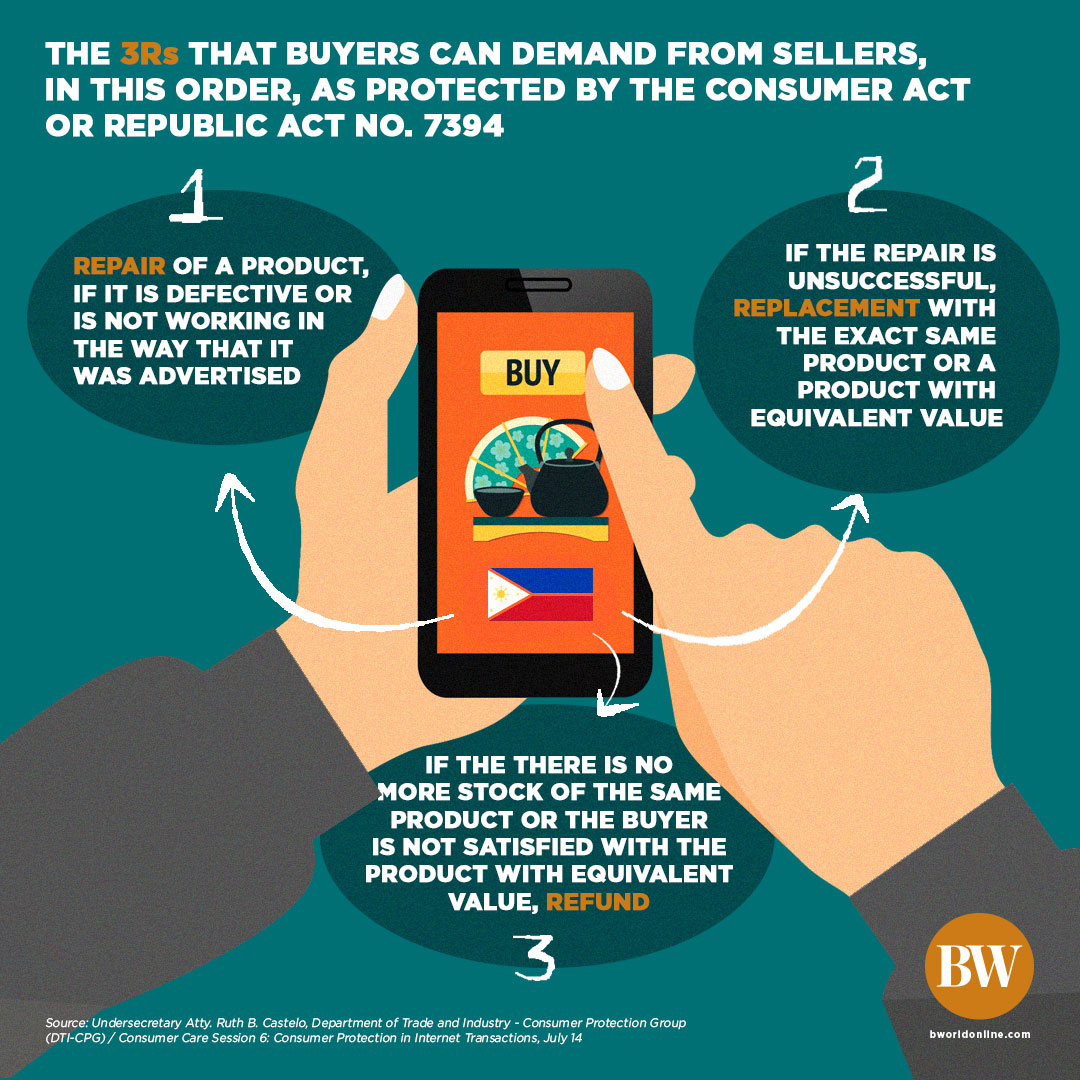
If any consumer experiences these issues or other concerns of a similar nature, DTI reminds them that they have the right to demand a repair, replacement, or refund of a product, in this order, from the seller.
They may also file a complaint through the official channels of the department, whether through their hotline, consumer care email address, snail mail, or SMS. If the complaint is validated, it is resolved through two possible processes.
The two involved parties will first undergo mediation, wherein a DTI mediator will help them resolve the issue amicably. If unsuccessful, the mediation division will issue a certificate to file action, which leads to the process of adjudication.
“This is already a formal charge. You will have to file the complaint, and then the office, FTEB [Fair Trade Enforcement Bureau under DTI], will file a formal charge against the respondent,” explained Ms. Castelo. “It’s a formal hearing but it’s very fast—around two hearing days—and then you will be given time to complete all the documentary requirements. Within 20 days upon completion of all the requirements, the case will have to be resolved.”
However, she also reminds consumers that responsibilities to take action accompany their rights. This includes, for example, speaking out on behalf of a buyer at a physical store who may be too meek to assert themselves to the cashier or management.
“If we see anything wrong that is happening around us, as consumers, please take action… We need to be wise consumers. We need to be responsible,” said Ms. Castelo.
OAKLAND — Alphabet Inc.’s Google records what people are doing on hundreds of thousands of mobile apps even when they follow the company’s recommended settings for stopping such monitoring, a lawsuit seeking class action status alleged on Tuesday.
The data privacy lawsuit is the second filed in as many months against Google by the law firm Boies Schiller Flexner on behalf a handful of individual consumers. The firm’s clients also have included Google competitors such as Facebook Inc., and Oracle Corp.
Google did not immediately respond to a request for comment on the filing.
The new complaint in a US district court in San Jose accuses Google of violating federal wiretap law and California privacy law by logging what users are looking at in news, ride-hailing, and other types of apps despite them having turned off “Web & App Activity” tracking in their Google account settings.
The lawsuit alleges the data collection happens through Google’s Firebase, a set of software popular among app makers for storing data, delivering notifications and ads, and tracking glitches and clicks. Firebase typically operates inside apps invisibly to consumers.
“Even when consumers follow Google’s own instructions and turn off ‘Web & App Activity’ tracking on their ‘Privacy Controls,’ Google nevertheless continues to intercept consumers’ app usage and app browsing communications and personal information,” the lawsuit contends.
Google uses some Firebase data to improve its products and personalize ads and other content for consumers, according to the lawsuit.
Reuters reported in March that US antitrust investigators are looking into whether Google has unlawfully stifled competition in advertising and other businesses by effectively making Firebase unavoidable. — Reuters