Home Blog Page 8863

SEC permanently shuts CROWD1

THE Securities and Exchange Commission (SEC) has denied the request of CROWD1 Asia Pacific, Inc. to have its shutdown order lifted.

In a statement over the weekend, the corporate regulator said its cease-and-desist order against CROWD1 has been rendered permanent when it denied the company’s motion to lift the order.

“A careful review of the (motion) will show that except for its general denials, CROWD1 failed to present any evidence in support of its claim that it is not engaged in the sale and/or offer for sale of securities in the form of investment contracts,” the SEC said.

To recall, the SEC ordered CROWD1 to shut down in May after it was found to operate a fraudulent investment scheme.

CROWD1 has since filed a motion to lift the order, but was rejected by the SEC for lack of merit.

The regulator said CROWD1 solicited and accepted investments from the public in the guise of a digital marketing business. Through its investigation, the SEC found CROWD1 offered “educational packages” priced P6,000 to P240,000 and promised investors several bonuses through referrals.

The SEC said this violates the Securities Regulation Code, which requires that an operator obtains a license from the SEC to offer investment contracts.

“CROWD1 neither secured a secondary license to operate as a broker/dealer, registered as issuer of mutual funds, exchange-traded funds or proprietary/ nonproprietary shares, nor registered any securities,” it said.

CROWD1 is now ordered to permanently stop engaging in investment activities and to stop promoting its schemes online. It is also prohibited from transacting any business involving funds in its depository banks. — Denise A. Valdez

Rates of Treasury bills seen moving sideways

RATES OF Treasury bills (T-bills) on offer on Monday will likely move sideways on ample demand and while the retail Treasury bonds (RTBs) are on sale.

The Bureau of the Treasury (BTr) is set to borrow P20 billion via T-bills on Monday: P5 billion each via 91- and 182-day debt papers and P10 billion via the 364-day securities.

Meanwhile, the BTr canceled the offering of seven-year Treasury bonds (T-bonds) scheduled on Tuesday to give way to the ongoing RTB offering.

Traders interviewed on Friday said they expect yields on the T-bills on offer to move sideways as the market remains liquid, with one trader projecting rates to slip by five to 10 basis points (bps).

“For the T-bills, we still see lower rates, by around 5-10 bps from the previous auction…(due to) sufficient liquidity in the market and preference on the short-term,” the first trader said via phone.

The second trader said yields will move sideways versus the previous auction since rates are already very low and some players might opt to buy the five-year retail bonds currently on sale.

“With the RTB (still on offer), some of it pwede ’yung mga interested baka mapunta sa RTB pa eh (some interested investors can opt for the RTBs), otherwise, more sideways kasi masyado mababa na rin ’yung yields (yields will move sideways movement since they’re already low),” the trader said.

Last week, the BTr made a full award of the P20 billion in T-bills it offered as rates declined across-the-board, with total bids soaring to P93.974 billion.

It accepted P5 billion as planned in three-month papers from total tenders of P21.065 billion at an average rate of 1.587%, lower compared to the 1.649% rate seen in the July 6 auction.

It also made a full award of the six-month T-bills, raising P5 billion from P27.1 billion in bids at an average rate of 1.687%, down from 1.75% previously.

For the one-year securities, the BTr raised P10 billion as planned from tenders worth P45.809 billion. The papers fetched an average rate of 1.782%, from 1.855% previously.

Yields on the 91-, 182- and 364-day debt papers were at 1.587%, 1.66% and 1.838%, respectively, at the secondary market on Friday, the PHP Bloomberg Valuation Service Reference Rates showed.

Both traders said demand for the T-bills will not be very affected by the ongoing RTB offer since these securities cater to different clients.

“Given the current uncertainties in the market, most investors prefer to really stay in the short-end so that’s why we continue to see strong demand on T-bills,” the first trader said.

The BTr is offering five-year RTBs carrying a coupon of 2.625%. The offer period is scheduled to run until Aug. 7, unless closed earlier.

At the RTB rate-setting auction on Thursday, investors swamped the offer, with total bids hitting P278.572 billion, almost ten times the initial P30-billion offer. This prompted the Treasury to upsize its award to P192.71 billion.

This marked the second RTB sale of the government this year and 24th overall, following the issuance in February when it raised a record P310.8 billion from three-year retail bonds at a rate of 4.375%.

The BTr also opened an exchange offer program wherein bondholders of the RTB 10-01, FXTN 05-73, RTB 10-02 or FXTN 07-57, can swap their old securities for the new RTB.

“The total outstanding amount of bonds eligible for the switch is about P321 billion,” the Finance department said in a statement over the weekend.

The retail bonds will be issued on Aug. 12 and are set to mature on Aug. 12, 2025.

Meanwhile, the second trader said the market is very liquid right now and some players are opting to stay on the sidelines while they look for other channels to invest in, such as the upcoming short-term securities of the Bangko Sentral ng Pilipinas.

“The market is very liquid so it’s more of kung saan pwede mag-invest (It’s a matter of where to invest). With expectation of more corporate debt to issue and even BSP will be issuing their (securities or) T-bills version sa market, so I guess medyo, based on the yield na talaga (investors are now looking for yield),” the trader said.

The central bank has said it will issue the BSP securities this quarter to provide more risk-free assets for investors aside from the government instruments.

The government has set a P205-billion borrowing program for July and will offer P145 billion in T-bills via weekly auctions and P60 billion in T-bonds to be auctioned off fortnightly

It borrows from local and foreign lenders to plug its budget deficit seen to hit 8.4-9% of gross domestic product this year. — B.M. Laforga

Bali hotels go on sale for cheap with virus hammering tourism

GONE are the Australian surfers and Chinese tour groups. Also missing are yoga aficionados seeking inner peace, like Julia Roberts in Eat Pray Love.

With no tourists and no income courtesy of the coronavirus pandemic, struggling hotel owners on the Indonesian resort island of Bali have been forced to put their properties up for sale. Given the dire state of the market, some may have to stomach a loss. For investors with a long view, it’s a chance to grab a slice of paradise on the cheap.

Balangan Wave, a 50-villa resort under construction near its namesake surfing beach, has hit the market, and developer Michael Halim has slashed his asking price to $9 million from $17 million in May.

“In the current market, one can’t avoid selling at a loss,” Halim said. “Businesses are closing, there’s cash flow issues.”

While the halt to international travel has devastated holiday hot spots from Hawaii to Phuket in Thailand, Bali is more vulnerable than most. Tourism accounts for more than 60% of the island’s economy, providing jobs for everyone from chefs and cleaners at five-star resorts to self-employed guides and drivers.

A record 6.2 million travelers flocked to the island’s beaches, hotels and yoga retreats in 2019.

This year, tourist arrivals slumped 22% to 1.04 million in the first quarter, even before the worst of the outbreak. Now, the usually pumping beach clubs lie quiet and the once-thronged Tanah Lot Temple is deserted.

While major global chains such as Marriott International, Inc. and Hilton Worldwide Holdings, Inc., have the financial firepower to stay afloat during the pandemic, smaller hotels at the budget end of the market are struggling to survive. The number of lodgings listed for sale in Bali has jumped 30% since the pandemic struck, according to Indonesian property firm Galaxy Kuta.

“It’s a good time to buy,” said Chandran V R, managing director of Singapore-based Cosmopolitan Real Estate, which is handling the Balangan Wave sale. “Bali will bounce back to normal. When that happens, prices will soar again.”

Also looking for a buyer is the two-star POP! Hotel Teuku Umar in Denpasar. With eye-catching neon window frames and interiors, the 140-room hotel was put up for sale for $7.7 million in May.

Situated a 30-minute taxi ride from Kuta and Seminyak beaches, and with rooms as low as $14 a night, it was a hit with backpackers. Not anymore.

“The hotel has no income at all and has maintenance costs to pay,” said Meirina Rajianto, an agent at Bali-based Galaxy Kuta, who is handling the sale. “The owner decided to sell rather than bleeding more money.”

Before the coronavirus hit, hotel deals across Asia Pacific were at record levels, fueled by cashed-up private equity and real estate funds, along with wealthy individuals, said Corey Hamabata, senior vice president of JLL’s hotels and hospitality group in Hong Kong.

Among those drawn to Bali was the Trump Organization, which signed an agreement in 2015 to lend its name to a new hotel and golf club on the island. Even it is scaling back, with its local partners signaling last week they may opt for a four- or five-star resort — not six — to make it more affordable.

Still, buyers are likely to remain active as opportunities to buy discounted assets arise, Hamabata said. “We expect most buyers will be driven by three main themes: buying at a discount; buying under-utilized properties to improve them; or buying properties in strategic locations to grow a brand or platform.”

A growing domestic travel market in Indonesia, the world’s fourth-most populous country, may also prop up hotels until the globe-trotters return. The number of internal trips rose to 303 million in 2018 from 270 million in 2017.

“We are expecting domestic demand will be quicker to recover than international demand,” said JLL’s Hamabata.

While the island of 4.2 million had early success in containing the virus, it has recently seen a spike in infections to more than 1,400, with 13 deaths. Indonesia has surpassed 54,000 cases, with 2,754 deaths, making it the worst hit Southeast Asian nation.

That may dent plans to reopen Bali’s economy. Under a three-step strategy, domestic tourists would be allowed back in August, with international sun-seekers welcomed in September if everything goes according to plan, the Jakarta Globe reported, following a visit by tourism minister Wishnutama Kusubandio to the island.

Even in the best-case scenario, it’s unlikely tourists will arrive in droves.

Its biggest source of tourists, Australia, has signaled it’s likely to keep borders closed until next year. In Singapore, just a 2 1/2-hour flight away, the government is only allowing essential trips and has warned that mass holiday travel will take longer to resume.

That makes Bali a risky bet. The 5,780-square-kilometer island has more than 4,300 hotels, according to government figures. Intense competition at the budget end of the market had many hotel owners strained even before the virus hit.

“Those with little cash flow to cover the lockdown period and unable to restructure or delay debt payments will likely come under pressure very quickly,” said Govinda Singh, head of hotels and leisure for valuation and advisory services in Asia at Colliers. — Bloomberg


One in four British fashion jobs may disappear, group says

MORE THAN a quarter of jobs in the British fashion industry may be lost because of the fallout from pandemic-induced lockdowns, a study shows.

About 240,000 of the 890,000 people employed in fashion in the UK are predicted to lose their jobs, the British Fashion Council (BFC) said in a statement Thursday, citing data from Oxford Economics. The figure increases to 350,000 if supply chain positions and other indirect roles are included, which is equivalent to 1% of the UK’s total workforce, according to the report.

“The COVID-19 recession could hit the fashion industry twice as hard compared to the UK overall,” the BFC said. “An entire generation of creative talent is threatened to disappear, putting in danger the UK’s position as the creative crucible of global fashion.”

Revenue generated by the industry will drop by more than a quarter to 88 billion pounds ($110.40 billion) this year from 118 billion pounds in 2019, the fashion council estimated. UK fashion house Burberry Group Plc announced plans on Wednesday to eliminate 500 positions globally, including 150 in the UK, after lockdowns caused revenue to plunge by almost half in the three months ended in June. That represents about 5% of the company’s total workforce.

The government should provide assistance by enabling lease renegotiations when landlords don’t act responsibly, and granting moratoriums on duties and tariffs, among other measures, the not-for-profit industry group said in the statement. — Bloomberg

Megaworld targets sales of P1.5 billion from condo tower in Iloilo City township

MEGAWORLD CORP. has recently launched a new condominium tower project in its 72-hectare township in Iloilo City.

In a statement over the weekend, the property developer said it aims to expand its residential portfolio in the Iloilo Business Park with the introduction of the township’s sixth residential property.

The new project, called The Pinnacle, is scheduled for completion in six years. It is expected to raise P1.5 billion in sales.

The 20-storey condominium is composed of 572 residential units offered in varying sizes, namely studio (up to 34 square meters), studio with loft (up to 56 sq. m.), executive studio with loft (up to 73 sq. m.), one-bedroom (up to 40 sq. m.), executive one-bedroom (up to 61 sq. m.), two-bedroom (up to 84.5 sq. m.), two-bedroom with loft (up to 89.5 sq. m.), and two-bedroom with deck (up to 113.5 sq. m.).

It will also have an amenity deck with a lap pool and a kiddie pool, a fitness center, an outdoor fitness area, a function room, an outdoor lounge, a daycare center, a children’s play area, a jogging path, a private dining room and an atrium garden.

“Iloilo City, particularly Iloilo Business Park, remains to be an attractive location for property investments,” Jennifer Palmares-Fong, Megaworld Iloilo vice-president for sales and marketing, was quoted as saying in the statement.

“Since we started selling our first residential condo tower here in 2013, prices per square meter have already more than doubled. Those who bought a P3-million unit with a size of 40 square meters seven years ago would see their property appreciating to P6.8-million today,” she added.

The other residential projects Megaworld has introduced in Iloilo City are One Madison Place, Lafayette Park Square, The Palladium, Saint Honore and Saint Dominique. These make up the 1,741 units in Iloilo Business Park’s current residential inventory.

Aside from residential projects, Iloilo Business Park also offers commercial establishments and office spaces. Megaworld is investing P35 billion to develop the township over a 10-year period.

In the first quarter, Megaworld’s earnings slid 9% to P3.5 billion due to a non-recurring gain and a flat topline. The coronavirus pandemic pulled revenues from its hotel business, which fell 4% to P551 million.

Shares in Megaworld at the stock exchange shed one centavo or 0.32% to close at P3.15 each on Friday. — Denise A. Valdez

LANDBANK receives further P1.44B for agri loan program

AN ADDITIONAL P1.44 billion was transferred to the Land Bank of the Philippines (LANDBANK) by the Department of Agriculture (DA) for a lending program targeted at farmers, fisherfolk and agripreneurs.

Agriculture Secretary William D. Dar said the lending program, known as the Agricultural Competitiveness Enhancement Fund (ACEF), can now lend out nearly P6 billion to the targeted beneficiaries.

“The fresh funds augment the previous P4.50 billion the DA has cumulatively entrusted to LANDBANK, being the administrator of the ACEF lending program,” Mr. Dar said.

The DA said the ACEF lending program focuses on increasing the production and incomes of farmers and fisherfolk through credit to purchase agricultural equipment, facilities and farm inputs.

LANDBANK President and Chief Executive Officer Cecilia C. Borromeo said the bank has approved P3.68 billion worth of projects under ACEF, with P796 million worth of applications still being processed.

ACEF-funded projects are concentrated in the Cagayan Valley and the provinces of Occidental Mindoro, Nueva Ecija, Isabela and Capiz.

The DA said that farmers in Northern and Central Luzon have availed of ACEF loans amounting to P1.4 billion, followed by Mindanao at P923 million, Southern Luzon at P704 million, and the Visayas at P693 million.

Individual farmers and fisherfolk can borrow from ACEF up to 90% of their total project cost, not exceeding P1 million, while farm cooperatives and associations, and micro and small-scale enterprises may borrow up to P5 million at 2% interest per annum.

The DA said that 80% of the funds in ACEF go to loans, 10% to research and development grants to accelerate the commercialization of agricultural and fishery products, and 10% to scholarships for studies in agriculture, forestry, fisheries and veterinary medicine.

Implemented in 1996, the ACEF loan program will end in December 2022 and is funded by tariffs and duties collected on imports of agricultural products except rice.

Mr. Dar said he plans to ask the Department of Budget and Management for another P2.1 billion for ACEF. — Revin Mikhael D. Ochave

Yields on government debt end flat

YIELDS ON government securities (GS) ended flat last week after the Bangko Sentral ng Pilipinas (BSP) said it will keep an accommodative policy over the next two years as well as the recent outcome of the retail Treasury bond (RTB) offering.

Debt yields, which move opposite to prices, inched up by 0.1 basis point (bp) on average week on week, the PHP Bloomberg Valuation Service Reference Rates as of July 17 published on the Philippine Dealing System’s website showed.

“Market was initially seeing some buying interest at the start of the week as the central bank said it will maintain easy policy for the next two years to jump-start economic activities,” First Metro Asset Management, Inc. (FAMI) said in an e-mail interview.

“Action reversed following auction results for the new five-year RTB with bids advancing most in the belly area,” FAMI said in an e-mail interview, adding that there was “good pickup for the issuance.”

“Yields were broadly unchanged over the week as the upward pressure from liquidity needs for the latest retail treasury bond offering was offset by renewed safe-haven bond demand amid the escalation of geopolitical tensions between the United States and China.” a bond trader said in separate e-mail interview.

In an interview with Bloomberg on Tuesday, BSP Governor Benjamin E. Diokno said that for at least two years, it will keep its bond-buying and liquidity support programs to accommodate the economy. This signal came after the central bank chief said there’s space to adjust policy further but there’s no need to trim key rates in the coming quarters.

The central bank’s Monetary Board last month decided to cut policy rates on the overnight reverse repurchase, lending, and deposit facilities by 50 bps to new record lows of 2.25%, 2.75 and 1.75%, respectively.

This brought cumulative reductions this year to 175 bps as the BSP looks to support the economy against COVID-19.

Meanwhile, investors flocked the government’s latest five-year RTB last Thursday as it raised a total of P192.75 billion at a 2.625% rate. The auction was met by total bids reaching P278.572 billion, nine times more than the P30-billion initial offering, prompting the Bureau of the Treasury to hike the award.

Last week, Reuters reported that the Trump administration is contemplating an action that would create more tensions to their relations by banning all members of the Chinese Communist Party and their families from traveling to the United States.

Moreover, in response to China’s national security law, President Donald J. Trump directed to put an end to Hong Kong’s special economic treatment which led to China accusing the US saying it was “gangster logic.”

At the secondary market, yields on the 91-, 182-, and 364-day T-bills went down by 10.8 bps, 7.5 bps, and 4.1 bps respectively, to fetch 1.587%, 1.660%, and 1.838%.

Yields at the belly of the curve went up except for the 7-year T-bonds which recorded a marginal decline of 0.1 bp to 2.574%. Rates on two-, three-, four-, and five-year debt papers increased by 2.9 bps (2.048%), 4.6 bps (2.189%), 4.5 bps (2.297%), and 3.3 bps (2.396%), respectively.

At the long end, the 10-year debt paper dropped by 4.1 bps, yielding 2.722%. On the other hand, yields of the 20- and 25-year went up by 9.2 bps and 3.2 bps, respectively, to 3.681% and 3.742%.

For this week, FAMI anticipates GS yields “to correct some more as the market digests the results of the 5-year retail bonds issuance.”

For the bond trader: “Local yields are seen to move higher as expectations of upbeat United states and Eurozone manufacturing reports might revive optimism of a brief recovery in global economic activity.”

“Moreover, lingering domestic liquidity demand for the latest RTB issuance might also exert some upward pressure on yields,” the bond trader added. — Jobo E. Hernandez

Navotas public school receives gadgets from Huawei, PLDT-Smart Foundation

North Bay Boulevard North Elementary School in Navotas, Metro Manila, recently received a School-In-A-Bag (SIAB) donation from Huawei Technologies Phils., Inc. through the PLDT-Smart Foundation (PSF) to help the school’s teachers and students manage digital education which is part of the DepEd’s blended learning strategy in these challenging times of the pandemic.

The redesigned SIAB 2.0, which contains 20 tablets, one laptop, and a Smart Pocket Wifi, is in line with PLDT and Smart’s efforts to improve the digital tools and solutions for the education system in the country.

Chosen as the first public school recipient of the SIAB 2.0 by PLDT and Smart Chairman Manuel V Pangilinan, thru the PSF, the North Bay Boulevard North Elementary is located in one of the poorest informal settler communities in Metro Manila. It has a population of over 900 students and 60 teachers.

The donation also included 66 tablets that will be given to graduating students who reside in Navotas Market Three as personally endorsed by Pangilinan.

The School-In-A-Bag donation forms part of Huawei’s $50K grant to PSF. Other public schools in the country will also receive SIABs in the near future.


PhilWeb Corporation sets stockholders’ meeting via remote communication

MG Philippines introduces website-based MG live chat support service

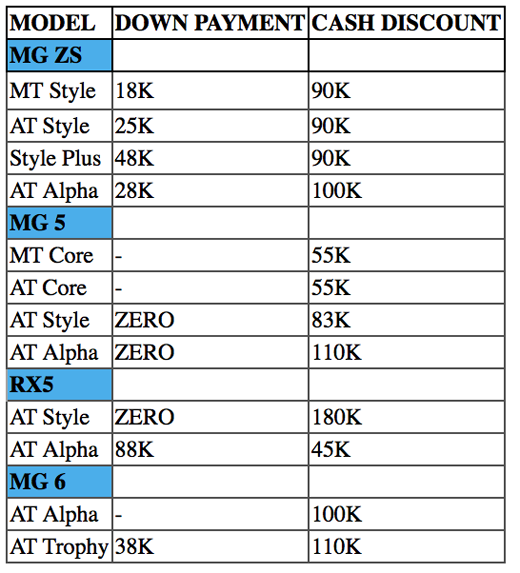
  • MG Philippines offers essential workers and their family members access to exclusive promos, including zero-percent down payment offers or cash discounts on select,brand-new MG vehicles.
  • MG Philippines launches MG Live Chat Support: a website tool on mgmotor.com.ph which allows users to engage in a real-time, live chat session with accredited MG Philippines consultants for sales, aftersales, and product inquiries.
  • MG Philippines dealerships nationwide adhere to strict sanitization protocols and social distancing practices for the safety of its clients. For physical dealership visits, clients are encouraged to call ahead or book an appointment with their preferred dealership using the My MG App, through the 24/7 MG Hotline, or via the new MG Live Chat Support.


The global pandemic that is COVID-19 has changed our way of life and, as we all adjust to the new normal, we cannot deny the significant contributions made by our front liners and essential workers. Their efforts impact everyone’s lives and it is safe to conclude that without them, progress in areas such as medical research advancement, healthcare, mobility, service, and infrastructure would come to a screeching halt.

MG Philippines acknowledges the work and the sacrifices put in by these modern day heroes and offers all MG-owning front liners and essential workers exclusive perks. These include a 20% discount on parts and labor, and access to a priority lane completely dedicated to service front liners and essential workers. More information on this may be obtained by calling your MG dealership of choice or calling our 24/7 MG Philippines hotline (02-5328-4664).

Likewise, MG Philippines also announces its latest sales promo called “MG Forward With All Front Liners.” This isour way of saying “Thank You” to those who, despite the threat of the COVID-19 virus, carry on and fulfill their roles for everyone’s benefit. With this latest promo, front liners and essential workers (as well as their family members)gain access to competitive zero- or low down payment options,or a choice of generous cash discounts on select, brand-new, British heritage MG cars.


Peso to rise ahead of data releases

THE peso is expected to extend its gains this week ahead of the release of key economic data on the country’s balance of payments (BoP) and budget deficit.

The local unit ended trading at P49.44 versus the dollar on Friday, appreciating by 9.5 centavos from its P49.535 finish on Thursday, data from the Bankers Association of the Philippines showed.

It also gained 4.5 centavos from the P49.485 close on July 10.

Analysts attributed the peso’s appreciation to the latest affirmation of the country’s credit rating.

“The peso got a boost from Moody’s [Investors Service] reaffirmation of the Philippines Baa2 with a stable outlook rating,” UnionBank of the Philippines, Inc. Chief Economist Ruben Carlo O. Asuncion said in a text message.

Moody’s on Thursday kept the Philippines’ sovereign credit rating at Baa2, a notch above the minimum investment grade, saying the country’s strong fiscal position developed in recent years will protect it from the impact of the coronavirus crisis. The Baa2 rating was given in December 2014.

The credit rater also assigned a “stable” outlook to the rating, suggesting this will be maintained over the next six months to two years.

Aside from the rating affirmation, improvement in US economic data also backed investor risk appetite, said Michael L. Ricafort, chief economist at Rizal Commercial Banking Corp. Chief Economist Michael L. Ricafort.

“[There was] improved global market risks appetite that reduced demand for safe haven investments amid improved US economic data such as retail sales,” Mr. Ricafort said in a text message.

Data released by the US Labor Department on Thursday showed retail sales grew 7.5% in June following the 18.2% in May. The 7.5% growth is faster than the 5% estimate in a Reuters poll of economists.

Core retail sales, which exclude automobiles, gasoline, building materials and food services, also picked up 5.6% in June after the 10.1% growth in May.

Mr. Ricafort said local data releases may affect market sentiment this week.

“Major leads include upcoming Philippine economic data including BoP and budget deficit,” he said.

June balance of payments data will be reported on July 20. Data from the Bangko Sentral ng Pilipinas showed the country’s May BoP position was at a surplus of $2.431 billion, its fourth successive month in surfeit. It is also bigger than the $928-million surplus a year ago and the $1.666 billion surfeit in April.

On the other hand, the June budget balance report will be released on July 22. The government’s budget balance stood at a deficit of P202.1 billion in May, a reversal of the P2.6-billion surplus a year ago but slimmer than the P273.88-billion budget gap in April.

Meanwhile, Mr. Asuncion said the peso is likely to stay within its “sub-50 level with Q2 GDP (gross domestic product) growth data still to be released in early August”.

The economy contracted by 0.2% in the first quarter due to the Taal volcano eruption and the early part of the Luzon lockdown. Second-quarter GDP likely logged a deeper contraction due to the strict lockdown during that period.

For this week, Mr. Asuncion said the peso will move around the P49.40 to P49.70 while Mr. Ricafort gave a forecast range of P49.30 to P49.60. — L.W.T. Noble with Reuters

Local shares likely to fall on Q2 earnings reports

LOCAL SHARES are seen to keep declining this week as investors anticipate lower corporate earnings and monitor rising coronavirus disease 2019 (COVID-19) cases.

The benchmark Philippine Stock Exchange index (PSEi) closed Friday’s session at 6,088.75, down by 58.91 points or 0.95% from the previous day.

On a weekly basis, the main index was lower by 108.63 points or 1.75%, recording its second consecutive week of decline.

Value turnover last week fell 22% to an average of P5.12 billion, while net foreign selling was trimmed 34% to an average of P745.04 million.

“The local bourse lost steam, with lethargic tirades for most of the week, following ABS-CBN Corp.’ franchise revocation, and in anticipation of sharp weakness in second quarter earnings,” online brokerage 2TradeAsia.com said in a market note.

Shares in ABS-CBN have suspended trading since July 10, when Congress denied the renewal of its franchise, which resulted in its inability to operate several business segments. The company has since started laying off employees to stay afloat.

This worried investors that other companies whose operations are heavily regulated may encounter similar problems with the government.

Aside from the ABS-CBN issue, another factor that weakened the market last week was anticipation for second-quarter corporate earnings, which companies and investors project as the worst performing quarter due to the COVID-19 pandemic.

2TradeAsia.com said this sentiment will continue influencing the market’s performance this week, as more corporations are expected to make announcements in the coming days.

“A descending triangle formation has been noted in our last note — this remains the case, warranting extra prudence in trades, in the face of a potential break from the critical 6,000 zone,” it said.

It also said investors will keep watch of the COVID-19 tally both locally and abroad, which have been expanding nonstop. Local COVID-19 cases stood at 65,304 as of Saturday, and global cases stood at 14.23 million as of Sunday.

Philstocks Financial, Inc. Research Associate Claire T. Alviar noted if the rise in COVID-19 cases in Metro Manila continues, this would fan worries that quarantine measures would be heightened again.

“If this happened, negative sentiment would spillover, and may lead to sell-off, as this will be detrimental to the economy, especially that we are still recovering from the strict lockdown during the first and second quarter,” she said in a text message.

“Some investors were also priced-in recovery in the third quarter, so if Metro Manila returns to more stringent measures, they may sell some shares which could weigh on the bourse,” she added.

2TradeAsia.com is putting initial support for the market at 6,000 and secondary support at 5,500, with resistance at 6,400. Ms. Alviar anticipates the PSEi to test the psychological support at the 6,000 level. — Denise A. Valdez