Home Blog Page 8287

PHL food manufacturing poised for modest expansion in 2021 — USDA

THE PHILIPPINE food manufacturing sector is expected to post flat to higher growth this year in line with growth in consumption, the United States Department of Agriculture (USDA) said in a report.

The USDA said positive growth indicators for the food manufacturing sector include the 5.3% increase in household expenditure on food and non-alcoholic beverages in the fourth quarter.

It also noted that food manufacturers have started selling online directly to consumers, although volumes were limited.

“According to industry sources, the outlook for 2021 food manufacturing performance remains relatively stagnant at 0-3% growth, which while below the long-term 6% average would be an improvement over the previous two down years,” the USDA said.

The USDA added that the retail food sector is projected to grow 10% during the year as convenience stores, supermarkets, and hypermarkets made progress with online shopping following the coronavirus disease 2019 (COVID-19) pandemic.

“An increase in purchasing power boosted warehouse clubs and awareness of imported products and have at times faced shortages due to COVID-19 related supply and demand shocks,” the USDA said.

“Stay-at-home orders continue to keep many workers and children at home, which has fueled demand for pantry items, including baked goods and mixes, canned goods, cooking oils, milk, and snack foods as well as products, larger package sizes, and products with extended shelf-life, as well as allowed consumers to redirect their discretionary spending on purchasing premium products,” it added.

Meanwhile, the USDA said it sees no current prospect of recovery for the food service sector this year, after it posted a 34% decline in 2020 due to COVID-19 related measures.

“Food service providers that still remain in operation have generally shifted to online delivery platforms and curbside pickups,” the USDA said.

In a separate report, the USDA also projected that the market for plant-based food products will grow 3-5% in 2021.

“Traders are optimistic the market will grow 3-5% in 2021 as consumers become increasingly aware of health trends and responsible consumption,” the USDA said.

“Ease of sharing information on social media is fueling demand for plant-based food products. More than 100 vegan restaurants have shifted to a cloud-kitchen model to cope with COVID-19 community quarantine restrictions,” it added. — Revin Mikhael D. Ochave

Cirtek to procure COVID-19 vaccines for over 1,900 employees

FREEPIK

LISTED Cirtek Holdings Philippines Corp. said on Thursday that it is looking to buy vaccines for 1,979 employees in an effort to inoculate its workers against the coronavirus disease 2019 (COVID-19).

“The Company has facilitated the reservation of vaccines to its 1,979… employees with a leading pharmaceutical company,” Cirtek told BusinessWorld in an e-mail.

The firm said it could not give details yet on the pharmaceutical company from which it will be buying the vaccines as it did not have consent to do so yet.

“The cost is estimated over [a] million of pesos and delivery time is estimated [in the] third quarter this year. The company is exerting maximum efforts toward the employees’ protection and benefits,” it added.

This came shortly after Cirtek told the local bourse on Wednesday that it had reserved COVID-19 vaccines by tying up with “a leading pharmaceutical company” to hasten the achievement of herd immunity against the disease and ensure the good health of its workers.

The move, which the firm said was welcomed by its employees, is part of the company’s commitment to the social responsibility aspect of its ESG (environmental, social and governance) principles.

In its earlier disclosure, Cirtek forecast that this year would see an increased growth in its semiconductor and wireless business segment driven by the shortage of semiconductor chips, the return of customer demand for various electronics parts, and “the positive outlook of the end of the crisis.”

The firm said that its telecommunications business would possibly grow in 2021 since it plans to roll out its 5G-model Quintel antennas by yearend.

Seven months ago, Cirtek said that its wholly owned unit Quintel USA, Inc. inked a master purchase agreement with a new telecommunications operator in North America. The carrier was said to launch its full commercial services for fifth-generation (5G) services from 2021.

“With this positive improvement of the business, Cirtek is hiring additional people to augment its current work force. This development thus gives assurance of continued employment as opposed to what the other business sectors are unfortunately experiencing,” Cirtek said.

Cirtek is engaged in the development of high-technology products that focus on 5G wireless communication. Shares of Cirtek in the stock exchange shed 1.09% or seven centavos to close at P6.35 apiece on Thursday. — Angelica Y. Yang

Chery Auto PHL vows no price increase in April

PHOTO FROM CHERY AUTO PHILIPPINES

CHERY AUTO Philippines announced that it is keeping the current prices of all its models throughout April.

In a release, Chery Auto Philippines President Rommel Sytin said, “In light of the difficulties of the Filipino families posed by the ongoing pandemic, we have decided to continue absorbing the safeguard tariff instead of passing it on to the consumer in the form of higher vehicle prices.”

Early in March, Chery Auto Philippines issued a statement that “it had elected to absorb the price increases from the newly implemented safeguard tariff.” Mr. Sytin added, “The use of public transportation stays as a challenge for those who essentially need to travel for work, transport items for business, or attend medical emergencies. We want to give the Filipinos more options — safe, reliable, and affordable options — through our Chery Tiggo crossovers.”

The Chery Tiggo 2, Tiggo 5x, Tiggo 7 Pro, and Tiggo 8 will retain their pre-safeguard tariff prices (as follows):

Chery Auto Philippines, through its distributor United Asia Automotive Group, Inc. (UAAGI), expressed its commitment to deliver “safe, secure, and value-packed mobility.”

In January, Chery vehicle sales demonstrated growing consumer confidence in its feature-packed, high-value products by exceeding its January sales projections. The all-new Tiggo 7 Pro was introduced just last Jan. 27 but quickly sold out its initial batch within a month. The company reported that the “number of deposits and pre-orders for the upcoming new shipments is fast-growing.”

Chery Auto Philippines boasts industry-leading warranty and PMS programs: a 10-year/one- million-km engine warranty, a five-year general warranty, a three-year free full preventive maintenance service, and three years’ worth of roadside assistance. Other factors that the company said contributed to strong sales are “easy-on-the-budget auto loan packages given support by Chery’s bank partners, the availability of Chery’s EC Mobile Home Service, and the fast-growing nationwide network of Chery dealers, which now total 18 dealerships.”

For more information, follow Chery Auto Philippines on social media — Chery Auto Philippines (Facebook) and @cheryautophilippines (Instagram) for more updates. The 24/7 Chery Auto Philippines hotline is 0917-552-4379; e-mail chery@uaagi.com.

Bargain hunting, growth prospects lift PLDT stock

JGSUMMIT.COM.PH

INVESTORS loaded up on PLDT, Inc. shares on bargain hunting and expectations of sustained growth amid the ongoing lockdown restrictions that led to an increase in demand for data services.

A total of P541-million worth of 432,340 shares were exchanged from April 5 to 8, data from the Philippine Stock Exchange showed, making it the eighth-most actively traded stock in the bourse last week.

Shares of the telco company rose 2.8% to P1,255 apiece on Thursday compared with the closing price of P1,221 on March 31. For the year, its stock price has fallen 7.9%.

Financial markets were closed last Friday in observance of the Day of Valor.

“[A]t P1,221 (per share), PLDT was trading at a price-to-earnings ratio of 10.89 times which is below its 2016 – 2020 average of 14.63 times, implying that the share is undervalued,” Philstocks Financial, Inc. Senior Research Analyst Japhet Louis O. Tantiangco said in an e-mail.

Mr. Tantiangco also noted the company’s good financial performance last year, in contrast to those of other firms amid the pandemic-induced economic recession.

“The telecommunication firm’s service revenues climbed 7.6% year on year to P173.6 billion. This comes on the back of strong data service revenues from both its wireless and fixed-line segment,” he said.

PLDT’s gross revenue rose 7% to P181 billion last year. Likewise, its telco core income and attributable net income picked up by 3.7% and 7.8%, respectively, to P28.09 billion and P24.28 billion.

“Assuming that demand for data services would be strong for the whole year, together with further improvements in PLDT’s overall cost efficiency, we may see its telco core income grow by around 8% for 2021,” Mr. Tantiangco said.

For Mercantile Securities Corp. Analyst Jeff Radley C. See, PLDT “might maintain the bottom line growth or even surpass it depending on the expansion they have for 2021,” he said in a separate e-mail.

The company is hoping to exceed its core profit guidance of P29-30 billion for this year despite the “worrisome” economic outlook, PLDT Chairman and Chief Executive Officer Manuel V. Pangilinan said at a briefing on March 4.

PLDT plans to spend between P88 billion and P92 billion this year, mainly to support the exponential rise in mobile data traffic. From 2011 to 2020, its consolidated capital expenditure investments reached P286.4 billion.

Philstocks’ Mr. Tantiangco noted that aside from rising demand for telco services, PLDT will also benefit once right-of-way (ROW) issues are solved.

“Resolving the ROW issues would allow PLDT to further expand its network infrastructure and improve its services,” he said.

In a news release last Tuesday, Aileen D. Regio, first vice-president and head of PLDT’s Regulatory and Strategic Affairs, said the company will be “relentless” in securing government issuances that “will provide a more permanent solution” to ROW issues as it will help speed up the company’s rollout and maintenance of its fiber infrastructure.

This is in line with Department Order No. 29 issued by Department of Public Works and Highways Secretary Mark A. Villar that will “facilitate the erection of infrastructure that will allow speedy expansion of telecommunication services and facilities while ensuring public safety, availability of government’s ROW, and the structural integrity of roads and bridges.”

The order will cease application three years after its launch on March 23.

Philstocks’ Mr. Tantiangco placed PLDT’s initial support and initial resistance at P1,190 and P1,300, respectively.

Mercantile Securities’ Mr. See said PLDT might move in a range between P1,200 and P1,300.

Hastings Holdings, Inc., a unit of PLDT Beneficial Trust Fund subsidiary MediaQuest Holdings, Inc., has a stake in BusinessWorld through the Philippine Star Group, which it controls. — Marissa Mae M. Ramos

Bayer, Corteva in ‘two-dog battle’ over soy market

REUTERS

CHICAGO — Bayer AG is launching a new genetically modified soybean in the United States, striking back against rival Corteva, Inc. in a bid to retain its dominant position supplying seeds to the $40 billion US soy industry.

Billions of dollars are on the table for companies producing a growing variety of seeds for soybeans, the top US export crop, as farmers expand acreage this year due to soaring crop prices.

Bayer’s new XtendFlex soybeans and Corteva’s Enlist E3 soy are shaping up to be the most popular with farmers in the coming years, according to interviews with a dozen seed makers, dealers and farmers. Each seed tolerates three chemical herbicides so farmers can destroy weeds without damaging their crops, as weeds grow increasingly resistant to the once-universal glyphosate herbicide.

XtendFlex soybeans are marketed alongside the previous top US soybean seed, Bayer’s Xtend, but offer resistance to one additional weedkiller.

Bayer bought glyphosate-developer Monsanto for $63 billion in 2018. The following year, Corteva challenged Monsanto’s two-decade-long US market dominance by launching Enlist on a small scale. For farmers, the competition is welcome after they had little choice but to accept Monsanto’s seeds for years.

“It is setting up to be a two-dog battle between XtendFlex and Enlist,” said Jim Herr, a manager for Beck’s Hybrids, a seed company that sells Bayer and Corteva brands.

Corteva, spun off in 2019 after a merger of Dow Chemical and Dupont, says Enlist will account for about 30% of US soy plantings this year, or about 26 million acres. That is up from 20% in 2020, the first year they were widely available, according to the company.

Another player, BASF SE, is distributing a new soybean brand, Xitavo, which contains Enlist technology. It will cover just a few hundred thousand acres in its first year, BASF said.

Enlist was the first soybean genetically modified to withstand sprays from two weed chemicals as well as glyphosate. Corteva expects it will eventually account for half of North America’s soybean plantings, said Susanne Wasson, president of the company’s crop protection business.

At Latham Hi-Tech Seeds, an Iowa-based company that sells seed to farmers across seven US states, total soybean seed sales are up about 20% and Enlist is the most popular, President John Latham said.

Seed sellers said some farmers have been reluctant to try XtendFlex because they are unsure of how well it will produce crops.

Dealers could not sell the seeds to farmers last year because Bayer was awaiting approval for XtendFlex from soybean importers. The final clearance did not come until September from the European Union.

In February, Bayer estimated XtendFlex soybeans will account for at least 15 million acres this spring, or about 17% of plantings. That is down from the 20 million acres the company estimated last year, likely due to the delayed approval.

“People want to see it, feel it themselves, and that just wasn’t possible this last year because of the late approval,” Latham said.

XtendFlex soybeans resist a herbicide known as dicamba that tends to drift and damage vulnerable plants, along with the weedkillers glufosinate and glyphosate. The crop appeals to some farmers who do not want to spray dicamba because of the drifting risk, but want protection if neighbors spray it.

Illinois farmer Dan Henebry said he dumped plans to plant Enlist in favor of XtendFlex after the EU approval. He wants to use dicamba to kill weeds and prevent them from emerging from his soil. He said he will turn to glufosinate if he needs to fight weeds late in the summer.

For each crop season from 2021 to 2025, the Environmental Protection Agency (EPA) has banned farmers from using dicamba after June 30 because heat can increase the risk of drifting.

Bayer’s Xtend soybeans resist dicamba and glyphosate only. The company said it expects to remain “the number one soybean system for weed control in North America” in 2021 with its Xtend and XtendFlex offerings.

Bayer declined to estimate Xtend soy plantings, which flatlined at about 50 million acres last year amid increased competition from Enlist soy.

Companies generally strike deals with farmers to produce crops for seeds ahead of the spring growing season based on expected demand. The companies then sell the seeds to other farmers to plant the following year.

Projecting demand for 2021 was trickier than usual, dealers said, after a US appeals court in California in June blocked Bayer from selling dicamba, making Xtend soybeans less attractive.

Nebraska farmer Scott Langemeier said Corteva called him in August offering to buy the Enlist soybeans he was growing, anticipating a surge in seed demand for 2021 plantings after the dicamba court verdict. He had not planned to sell his crop for seed but agreed when Corteva offered a premium.

Then, the Trump administration’s EPA in October approved dicamba use for five years, nullifying the court’s decision and dealing a blow to Corteva in the seed battle.

“Now that dicamba went through, I think they’re sitting on some beans that they didn’t need,” Langemeier said of Corteva. — Reuters

Gov’t debt yields end mixed on inflation, Fed minutes

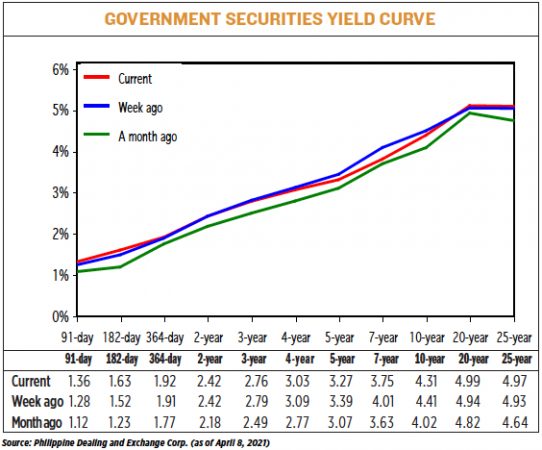
YIELDS ON government securities (GS) ended mixed last week after the slower-than-expected March inflation print and the release of dovish minutes from the US Federal Reserve’s latest policy meeting.

GS yields, which move opposite to prices, went down by an average of 2.7 basis points (bps) week on week, based on the PHP Bloomberg Valuation Service Reference Rates as of April 8 published on the Philippine Dealing System’s website.

Local financial markets were closed last Friday in observance of the Day of Valor.

At the secondary market on Thursday, rates at the short end of the curve rose from their March 31 finish, with the 91-, 182-, and 364-day Treasury bills increasing by 7.16 bps, 10.82 bps, and 1.64 bps, respectively, to fetch 1.3555%, 1.628%, and 1.9242%.

At the belly, the yields on the two-, three-, four-, five-, and seven-year Treasury bonds fell by 0.39 bp (to 2.4151%), 2.54 bps (2.7633%), 6 bps (3.027%), 12.91 bps (3.2656%), and 26.85 bps (3.7453%), respectively.

The long end of the yield curve ended mixed as the 10-year debt dropped by 9.89 bps to fetch 4.3096%, while the rates of the 20- and 25-year notes picked up by 4.9 bps and 4.40 bps, respectively, to finish at 4.9879% and 4.9737%.

“[Last] week, buying momentum in the local GS space was spurred by the slower-than-expected March inflation print as well as lower US Treasury yields. Overall, the GS curve ended the week flatter with yields in the belly (five- to 10-year sector) outperforming the rest of the curve,” First Metro Asset Management, Inc. (FAMI) said in an e-mail on Thursday.

“While yields are still higher month on month, the disinflation surprise led to some buying in oversold bonds across the curve,” it added.

Aside from the slower-than-expected March inflation rate, yields “were likewise pulled down by some caution ahead of the release of the US Federal Reserve policy minutes, which reiterated its dovish monetary policy stance while keeping an optimistic outlook on the US economy,” a bond trader said in an e-mail on Thursday.

The government on Tuesday reported that the March headline inflation rate settled at 4.5%. This was slower than the 4.7% seen in the previous month but faster than the 2.5% posted in March 2020.

The March print was slower than the 4.8% median in a BusinessWorld poll but was within the 4.2-5% estimate range given by the Bangko Sentral ng Pilipinas for the month.

Year to date, inflation averaged at 4.5%, still higher than the central bank’s 2-4% target for 2021 and its forecast of 4.2%.

Meanwhile, the minutes of the Fed’s March 16-17 meeting showed the US central bank remains cautious over the coronavirus pandemic and will continue to support the world’s largest economy until its recovery is more secure, Reuters reported on Wednesday.

With their own forecasts projecting the strongest run of US economic growth in nearly 40 years, “participants agreed that the economy remained far from the (Fed’s) longer-run goals and that the path ahead remained highly uncertain,” the minutes showed.

“For [this] week, we may continue to see persistent demand in the local bonds space should global bond yields continue to trade within range,” FAMI said.

“We see the lower inflation trend as well as reduced economic activity following the implementation of stricter lockdown measures to prevent the yield curve from steepening in the near term,” it added.

For the bond trader: “Local yields might track its global peers to move higher [this] week on expectations of stronger inflation reports from the US and the eurozone. Moreover, global optimism might likewise prevail amid a potentially upbeat Chinese economic growth report for the first quarter of 2021.” — Jobo E. Hernandez

Style (04/12/21)

UNIQLO, JW Anderson

UNIQLO, JW Anderson collaborate for 2021 Spring/Summer Collection

THE 2021 Spring/Summer UNIQLO and JW Anderson collection will be launched on April 23. The new lineup is the fruit of an ongoing collaboration with the London-based brand revolutionizing contemporary fashion. The collection continues to evolve UNIQLO’s LifeWear with signature JW Anderson craftsmanship and heirloom charm. Designer Jonathan Anderson says that, “I was really thinking of Spring when I was working on this collection. We were all staying inside and I was looking forward to when we could venture out again. I also wanted to incorporate a feeling of craft, as it’s very important to me” A playful sense of ease threads through the range. T-shirts, blouses, hats, tote bags, and other items feature wildflower embroidery accents with appearances that vary according to hue and fabric. Other noteworthy touches are blanket stitching on men’s T-shirts and work shirts and on women’s denim items, as well as bohemian smocking on dresses and skirts. Cool linen and seersucker lighten the impact of such key collection colors as khaki, brown, and ivory. Men’s and women’s offerings include shorts and feature the homespun feels of linen blends and slub cotton. Signature JW Anderson craftsmanship shines through in the stitchwork and simple silhouettes of this relaxing collection. The lineup includes 15 items for women, 13 items for men and two goods items. Check out the items on https://www.uniqlo.com/jwanderson.

Longchamp and Filt join for summer bags

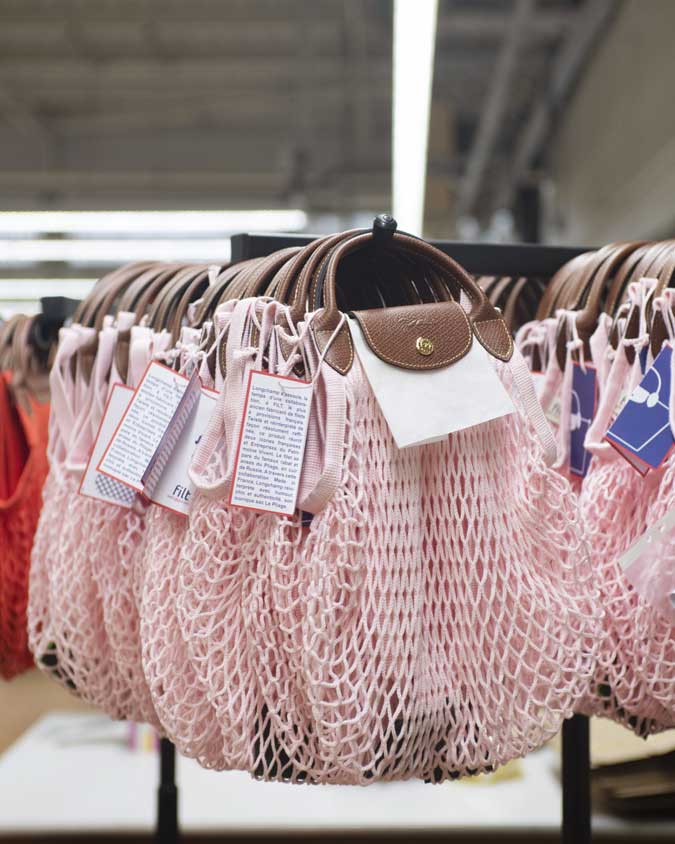
THE TWO French Maisons Longchamp and Filt joined forces in a collaboration that revisited and added a new twist to two iconic bags: Le Pliage and the essential string shopping bag. This hybrid design is available in six colors, adopts the large mesh of the string shopping bag and is adorned with the Russian leather handles and flap of the Le Pliage bag. Signature details add a touch of sophistication and make it the must-have bag for Summer 2021. “It’s rare for a collaboration to bring together two bags. But I like the idea of a union between two icons that combine to exalt an allure, personality and a little humor,” says Sophie Delafontaine, Artistic Director of Maison Longchamp in a company statement. Longchamp is exclusively available at Rustan’s Makati, Rustan’s Shangri-La, Rustan’s Cebu, Greenbelt 5 and Rustans.com

Dickies Philippines relaunched this month

DICKIES reintroduces its brand of iconic workwear to the Philippines through a complete brand relaunch that stays true to its heritage of sturdy and durable workwear worn by independent makers through the generations. Since 1921, Dickies has provided authentic and durable workwear across the world. This year, Dickies returns to the Philippines, with an iconic range of workwear and work-inspired style now available online in Lazmall, to be followed soon by Zalora. Its all-new flagship store will be in Robinsons Place Manila. Follow Dickies on the new Facebook page @DickiesPH and on the new Instagram at @dickies_PH for more information and updates. Check out Dickies Philippines on Lazmall at http://www.lazada.com.ph/shop/dickies-philippines.

ASICS launches two new shoes

ASICS has launched two high-performance running shoes that take the power of human-centric design to the next level. METASPEED Sky and METASPEED Edge have each been scientifically designed with a distinct type of running style in mind. The new racing shoes help elite athletes to reach the top of their game, because they don’t have to adjust their running style to fit the shoe anymore; instead, ASICS is giving them high-performance shoes that support their running style. The unique design story behind the two new shoes centers on a crucial insight by scientists at the ASICS Institute of Sport Science (ISS). They recognized that the type of shoes powering the world’s fastest were only favoring one type of runner — stride runners — those with a long-loping gait with large periods spent airborne who increase their speed by extending their stride length. ASICS research however showed that these shoes do not fully support elite athletes who prefer the second major running style — cadence, which features smaller steps made while hovering over the ground with minimal up and down motion. Crucially, these runners increase their speed by both extending their stride length and increasing the number of steps they take per minute. The sports scientists at the ISS were able to measure that athletes perform better when running in shoes that are optimized for their running style. Addressing the challenge, ASICS has created the METASPEED Sky for stride runners and METASPEED Edge for those with a cadence style — both specially optimized and proven to improve runner performance for each of the two major running styles. The METASPEED Sky will be available globally this April at ASICS Bonifacio High Street via the ASICS website and is already available at selected specialty retail stores. The METASPEED Edge will be available from June 4. Both shoes will retail for P13,890.

Beauty Bar holds summer sale

FROM April 9 to May 2, Beauty Bar is offering discounts of up to 60% off on selected items in its Summer Sale, with flash deals and Buy One Get One promos. Among the items included are Anastasia Beverly Hills Tinted Brow Gel, Anastasia Beverly Hills Matte Lipstick, the organic, certified vegan and cruelty free Hurraw Classic Lip Balm, the Sphynx Portable Razor, Kinetics Cuticle Oil, Miss Kay fragrances, Dr. Pawpaw Tinted Balm, Ecococo Body Scrub, the Somerset Toiletry Co. AAA Travel Set, Smashbox Art of Play limited-edition makeup gift sets, among a lot more. Flash sales run from April 9 to May 2 from noon to 3 p.m. Visit beautybar.com.ph, facebook.com/BeautyBarPH, ssilife.com.ph, or follow @beautybarph and @ssilifeph on Instagram for more information about schedules and promo codes.

Health and wellness essentials at the Shopee 4.15 Payday Sale

ON APRIl 15, save up to 90% off on personal hygiene items, health supplements, baby care products, and more at Shopee’s Payday Sale. These include “New Normal” staples like Ilwoul KF94 Mask, Zenutrients Sanitizer, CleanSol Isopropyl Alcohol, and Wellspring Vitamins; grocery basics like Capitan Del Mar Milkfish, Knorr Nido Oriental Soup, and Bear Brand Powdered Milk; baby care items like Tender Care Baby Wash, Pampers Diaper Pants, UniLove Baby Wipes, and Cradle Bottle & Nipple Cleanser; personal care products including L’Oreal Paris Shampoo and Conditioner, Protex Antibacterial Soap, Nivea Body Lotion, and Garnier Serum and Sunscreen. For more information, visit https://shopee.ph/m/payday-sale.

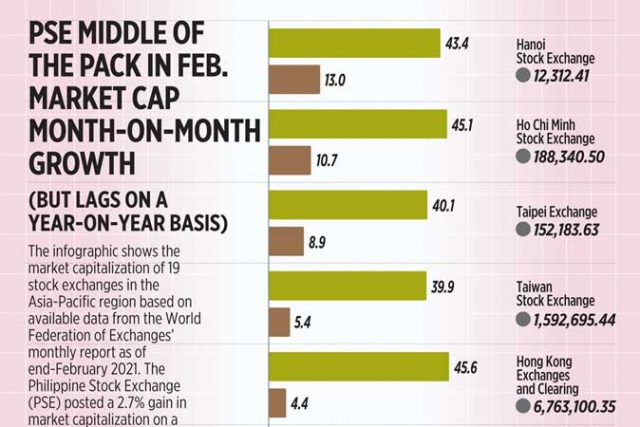
PSE middle of the pack in Feb. market cap month-on-month growth

PSE middle of the pack in Feb. market cap month-on-month growth

Peso may rise vs dollar on remittances data

THE PESO could strengthen versus the dollar this week on the back of an expected recovery in remittances.

The local unit finished at P48.54 against the greenback on Thursday, gaining 4.5 centavos from its P48.585 close on Wednesday, data from the Bankers Association of the Philippines showed.

Meanwhile, it depreciated by a centavo from its P48.53-per-dollar finish on March 31.

The market was closed on Friday in observance of the Day of Valor.

The peso strengthened due to signs of weakness in imports, Rizal Commercial Banking Corp. Chief Economist Michael L. Ricafort said.

Merchandise imports fell 5.6% to $16 billion in the first two months of 2021 from $16.96 billion a year earlier, data released by the Philippine Statistics Authority on Thursday showed. For February alone, merchandise imports rose 2.9% to P7.9 billion.

Meanwhile, the improved global economic outlook of the International Monetary Fund (IMF) also affected currency trading last week, UnionBank of the Philippines, Inc. Chief Economist Ruben Carlo O. Asuncion said.

The IMF’s World Economic Outlook released on Tuesday said the multilateral lender expects the global economy to pick up this year with a growth of 6.5% from its previous 5.5% estimate on additional fiscal stimulus in large economies and an anticipated vaccine-induced recovery in the second half of the year.

The IMF also upwardly revised its growth forecast for the Philippines to 6.9% from 6.5% due to base effects following the record 9.6% economic contraction seen in 2020. It, however, warned that the virus surge and the lockdown are “substantial” threats to recovery.

For this week, Mr. Asuncion said market expectations of an uptick in remittances could push the peso up versus the dollar. February remittances data will be released by the Bangko Sentral ng Pilipinas (BSP) on April 15.

Cash remittances in January declined by 1.7% to $2.603 billion from a year ago, based on central bank data.

Inflows dropped by 0.8% to $29.903 billion in 2020 from the record $30.133 billion in 2019.

Meanwhile, Mr. Ricafort said the market will await the government’s decision on the lockdown in Metro Manila and some nearby provinces.

Coronavirus cases in the country rose 12,674 to 853,209 on Saturday. Active cases stood at 190,245.

Mr. Ricafort sees the peso trading at P48.45 to P48.65 versus the dollar this week, while Mr. Asuncion expects the local unit to move within the P48.40 to P48.70 band. — L.W.T. Noble

COVID-19, tensions with China to affect market

COURTESY OF PHILIPPINE STOCK EXCHANGE, INC.

TRADING at the stock market this week will remain choppy as investors monitor the rising of coronavirus disease 2019 (COVID-19) cases in the country and recent tensions in the disputed West Philippine Sea.

The Philippine Stock Exchange index (PSEi) declined by 106.54 points or 1.6% to close at 6,545.17 on Thursday.

Week on week, the PSEi gained 102.08 points from its 6,443.09 close on March 31. Financial markets were closed on Friday last week in observance of the Day of Valor.

“The market’s been moving with a downward bias since peaking at a little above 7,400 in January. Investor sentiment has flowed and ebbed along with developments regarding the pandemic,” PNB Securities, Inc. President Manuel Antonio G. Lisbona said in a text message on Saturday.

“A surging case count has also contributed to the market’s gloomy mood,” Mr. Lisbona added.

The country logged 12,674 new coronavirus disease 2019 infections on Saturday, the second highest single-day tally thus far.

Metro Manila and nearby provinces have been under the strictest form of lockdown since March 29 as the government tries to curb the fresh surge in cases.

Analysts said for this week, the market will continue to monitor COVID-19 developments in the country.

“Market participants [will] continue to assess the COVID-19 situation in the country, as well as how the vaccine rollout plan comes into play,” Timson Securities, Inc. Trader Darren Blaine T. Pangan said in a Viber message on Sunday.

“Internationally, investors might employ a wait-and-see stance amid the recent tensions between the US and China over the West Philippine Sea,” Mr. Pangan added.

“The market will continue to be choppy,” PNB Securities’ Mr. Lisbona said.

Tensions are escalating over China’s move to mass militia vessels in disputed areas of the West Philippine Sea, with the US and Philippines expressing renewed concern and an investigation underway into reports that armed Chinese navy ships chased down a civilian craft carrying a Filipino news crew, Bloomberg reported.

The growing tension comes as Chinese vessels — initially numbering in the hundreds — were spotted at Whitsun Reef, prompting protests from Manila. The US last month said it stands by the Philippines while accusing China of using a “maritime militia to intimidate, provoke and threaten other nations.” China said last month that the ships were simply “taking shelter from the wind” and the Philippines should view the situation in a “rational light.”

For this week, Mr. Lisbona expects the main index to finish between 6,150 to 6,200. Timson Securities’ Mr. Pangan placed the PSEi’s support at 6,380 to 6,400, with 7,300 as the “major resistance area” for the index. — Keren Concepcion G. Valmonte with Bloomberg

Chiefs of Philippine, US military discuss South China Sea affairs

PHILSTAR

By Vann Marlo M. Villegas and Kyle Aristophere T. Atienza, Reporters

THE PHILIPPINE Defense chief discussed the situation in the South China Sea and regional security developments with his US counterpart on Sunday, according to the country’s military spokesman, amid increased Chinese presence in the disputed waterway.

Philippine Defense Secretary Delfin N. Lorenzana and US Secretary of Defense Lloyd J. Austin III are both looking forward to war games that got canceled last year because of a coronavirus pandemic, local military spokesman Arsenio R. Andolong said in a statement sent via Viber.

During the teleconference, Mr. Austin also reiterated the importance of the visiting forces agreement “and hopes that it would be continued.” “Secretary Lorenzana committed to discuss the matter with the President as the final approval lies with him,” Mr. Andolong said.

Mr. Lorenzana also sought the help of Mr. Austin in fast-tracking the delivery of coronavirus vaccines that the government had ordered from Moderna, Inc. Mr. Austin promised to look into the issue and bring it to the attention of the office concerned.

The Philippines has protested the continued presence of what it claims are Chinese militia vessels at Whitsun Reef in the South China Sea. China insists the reef, which the Philippines calls Julian Felipe, is part of China’s Nansha Island.

The Philippines should increase surveillance in the South China Sea, while reaching out to international groups and other allies as China tries to militarize the area, according to political analysts.

While filing diplomatic protests may be an “appropriate response,” the government should also keep monitoring the area within its exclusive economics zone, said Jay L. Batongbacal, head of the University of the Philippines Institute for Maritime Affairs and Law of the Sea

“Letting the world know what is happening in the course of this controversy is also necessary to ensure transparency and also to enable the Philippines to gather diplomatic support from other countries,” he said by telephone.

The Philippines can also take the issue to various global fora such as the Food and Agriculture Organization of the United Nations and denounce China as a state sponsor of “illegal, unreported, and unregulated” fishing without its consent, he said.

China faces trade sanctions if it’s proven that it has been sponsoring illegal fishing in the disputed waterway, Mr. Batongbacal said. “There are economic repercussions.”

‘BACKED BY ACTIONS’
The government should also ensure that its navy and coast guard are there to protect Filipino fishermen from harassment since the Mutual Defense Treaty with the US only covers attacks against state vessels, he said. 

Diplomatic protests should be backed by actions, Renato C. de Castro, an international studies professor at De La Salle University, said in a Zoom Cloud Meetings interview. “Words are not enough.”

The government should also send planes, not just ships, “just to show the Chinese that we’re watching over them,” he said.

Mr. de Castro said the Philippines should renegotiate its visiting forces agreement and fully implement its enhanced defense cooperation agreement with the United States, which will allow American reconnaissance planes to monitor China’s presence in the South China Sea.

“So the consequence of course would be greater American military presence in the South China Sea,” he said. “It is the last thing that the Chinese would want to see.”

Mr. Lorenzana on April 3 urged the remaining 44 Chinese vessels to leave. He said the Chinese had no reason to stay there since the weather had improved.

The Chinese Embassy said the waters around the reef had been “a traditional fishing ground for Chinese fishermen for many years.” It also said Philippines authorities should avoid “unprofessional remarks.”

Herman Joseph S. Kraft, who heads the University of the Philippines Political Science Department, said the Philippines should mobilize its resources to confront China.

Agencies such as the Fisheries and Aquatic Resources bureau, police units and the coast guard should be involved in the conflict.

“The narrative that the only option we have apart from not confronting China in the West Philippine Sea is going to war with China is false,” Mr. Kraft said, referring to parts of the sea within the Philippines’ exclusive economic zone.

“Vietnam has shown that not backing down in a confrontation is not going to lead to war — some tension or even violence perhaps, but not necessarily war,” he added.

Ronald U. Mendoza, dean of the Ateneo De Manila University’s School of Government, said the latest expansion of China in the disputed territory is “the result of mismanagement and bad governance.”

“These threats notwithstanding, our vulnerability right now is self-inflicted,” he said in an e-mail, citing President Rodrigo R. Duterte’s alleged silence on the issue.

“In periods of crisis — and clearly we have one right now with the pandemic and the blatant security threat posed by the Chinese incursion into our territory — leadership plays a key role in setting the tone, direction and forcefulness of our nation’s response,” he said.

Mr. Mendoza said only Mr. Duterte could mobilize both public and private resources and trigger the needed international support so the country can respond and decisively.

“We are facing security threats at a time when our health situation is at its worst,” he said. “Duterte’s absence shows a lack of direction, indecisiveness and vulnerability for our nation.”

Mr. Duterte earlier said the Philippines would stand by its rights but he did not see the need to use force against the Chinese maritime militias occupying Whitsun Reef, according to his spokesman.

Mr. Duterte thinks the sea dispute could be resolved through peaceful means, Presidential Spokesperson Herminio “Harry” L. Roque, Jr. said last week.

Lockdown in metro, nearby areas eased from April 12 to 30

PCOO.GOV.PH

By Kyle Aristophere T. Atienza and Vann Marlo M. Villegas, Reporters

PHILIPPINE President Rodrigo R. Duterte on Sunday eased the lockdown in Manila, the capital and nearby cities and provinces while urging local governments to boost their response to the coronavirus pandemic.

Metro Manila would be under a modified enhanced community quarantine from April 12 to 30, Presidential Spokesperson Herminio “Harry” L. Roque, Jr. told an online news briefing on Sunday, a day before a two-week strict lockdown was to expire.

The same applies to the provinces of Bulacan, Rizal, Laguna and Cavite, which were also locked down amid a fresh surge in COVID-19 infections.

Santiago City, Isabela, Quirino province and Abra in northern Philippines would also be placed under the modified enhanced lockdown, Mr. Roque said.

“The failure of the government to make a timely announcement on this week’s quarantine qualification speaks volumes of the current quality of Malacañang’s response to the crisis,” InfraWatch PH convenor Terry L. Ridon said in a Facebook Messenger chat.

“If the government makes a belated announcement today, sufficient time should be afforded to all to adjust to a new classification,” the former congressman said hours before the announcement.

The Department of Health (DoH) reported 11,681 coronavirus infections on Sunday, bringing the total to 864,868. The death toll rose by 201 to 14,945, while recoveries increased by 55,204 to 703,404, it said in a bulletin.

There were 146,519 active cases, 96.8% of which were mild, 1.7% did not show symptoms, 0.5% were critical, 0.6% were severe and 0.34% were moderate.

Mr. Roque, who was hospitalized at the weekend after testing positive for the virus for the second time, said beds and health staff should be adequate, while local governments should ensure a well-coordinated triage and referral system for coronavirus patients.

Hospitals should be decongested through temporary treatment and monitoring facilities “provided there is proof of capacity to do adequate quarantine/isolation.”

“Local government units in the National Capital Region Plus are likewise enjoined to set up their respective local tele-health triaging systems equipped with sufficient medical personnel available to provide immediate medical and patient referral advice,” Mr. Roque said in a separate statement.

The Health, Public Works and Education departments as well as the Metro Manila Development Authority should work together to increase bed capacity for coronavirus patients in isolation, quarantine and health facilities, he said.

He added that the Labor and Trade departments had been ordered to decide on the number of workers who may undertake alternative work arrangements.

The Philippines has been experiencing a fresh surge in infections, just like many countries in the world, amid a slow vaccination program that started last month. The government was set to take delivery of 500,000 CoronaVac doses from China on Sunday, according to an inter-agency task force.

INTER-AGENCY ORDER
Based on the order issued by the task force on Sunday, all barred establishments and activities during the two-week strict lockdown may now operate at 50% capacity.

Entertainment venues, recreational hubs, personal care services, casinos and other nonessential establishments were still barred from operating.

Public vehicles, ships, rail and air transportation may operate in accordance with the rules issued by the Transportation department.

Religious gatherings will be allowed up to 10% of the venue capacity. Local governments may increase the capacity to 30%.

Gatherings outside residences will remain banned, except for essential activities related to health and government services and authorized humanitarian programs.

Mr. Duterte canceled his weekly address last week given the risk of infection, the palace has said.

Michael Henry Ll. Yusingco, a research fellow at the Ateneo De Manila University Policy Center, said it was normal for people to get anxious about the President’s prolonged absence from public view

“Questions about who is exercising presidential control are certainly warranted under the circumstances,” he said in an e-mail.

“Regardless of the President’s health, the government should still have been able to make a timely decision yesterday, as the entire economy and communities are dependent on the government’s next steps,” Mr. Ridon said.

The belated announcement causes unnecessary delays in manpower planning, Asian Institute of Management economist John Paolo R. Rivera said in a Viber message.

“The government needs to be sharper and clear in its policies especially during a potential transition from an enhanced community quarantine to another form of quarantine,” Ruben Carlo O. Asuncion, chief economist at UnionBank of the Philippines, Inc. said in a Viber message.

Even if companies try to foresee possible situations “the government should be many steps ahead,” he added.

The Health department on April 2 reported the highest daily tally at 15,310 cases since the pandemic started last year.

The agency on Sunday said 22 duplicates had been removed from the tally and 13 recovered cases were reclassified as deaths. Six laboratories failed to submit data on April 10.

About 10.1 million Filipinos have been tested for the coronavirus as of April 9, according to DoH’s tracker website.

The coronavirus has sickened about 136.1 million and killed 2.9 million people  worldwide, according to the Worldometers website, citing various sources including data from the World Health Organization.

About 109.5 million people have recovered, it said.

The agency on Saturday reported 363 new infections with the more contagious variants first detected in the United Kingdom, South Africa and Brazil.

In a statement, DoH said it had detected 192 new infections with the variant first detected from South Africa, bringing the total to 344.

A total of 170 new cases were detected to have been infected with the variant first found in the United Kingdom, raising the total to 392.

A person from the Soccsksargen region was infected with the variant from Brazil, it said, bringing the total to two.

The Health department also said 19 people had been infected with the variant first detected in the Philippines, bringing the total to 123.


ADVERTISEMENT
ADVERTISEMENT