WASHINGTON – President Joe Biden on Monday defended his proposal to raise corporate taxes to help pay for his infrastructure spending plans, saying he was not worried the hike would harm the economy and that there was no evidence it would drive business abroad.
Speaking to reporters in Washington after spending Easter weekend at the Camp David presidential retreat in Maryland, Biden again took aim at the 50 or 51 corporations on the Fortune 500 list that paid no taxes at all for three years, saying it was time for them to pay their share.
Asked if raising the corporate tax rate to 28% from 21% would drive away corporations, Biden said: “Not at all … there’s no evidence of that.”
Biden’s predecessor, Donald Trump, and Republican lawmakers cut the corporate rate to 21% in 2017 from 35%. Trump repeatedly promised to tackle the nation’s crumbling infrastructure during his presidency but never delivered on that.
Biden’s plans have drawn criticism from both Republicans and Democrats, including Democratic Senator Joe Manchin, whose support could be critical to ensuring passage in a Senate split evenly between the two parties.
White House press secretary Jen Psaki told reporters the Democratic president was open to discussions with Republicans and Democrats about how to fund the proposed investments.
Asked if the administration had analyzed the cost of agreeing to a lower corporate tax rate of 25%, the highest Manchin says he would accept, Psaki noted the 28% rate would be lower than it was at any time since World War Two.
“Combined with the other tax proposals, it would pay for the totality of the package. That’s why he felt it was a responsible proposal to make,” Psaki said of Biden.
“There will be different ideas for pay-fors, there will be different ideas for tax proposals. That will all need to be weighed … with leaders in Congress.”
TOKYO – Japanese health authorities are concerned that variants of the coronavirus are driving a nascent fourth wave in the pandemic with just 109 days remaining until the Tokyo Olympics.
The variants appear to be more infectious and may be resistant to vaccines, which are still not widely available in Japan. The situation is worst in Osaka, where infections hit fresh records last week, prompting the regional government to start targeted lockdown measures for one month from Monday.
A mutant COVID-19 variant first discovered in Britain has taken hold in the Osaka region, spreading faster and filling up hospital beds with more serious cases than the original virus, according to Koji Wada, a government adviser on the pandemic.
“The fourth wave is going to be larger,” said Wada, a professor at Tokyo’s International University of Health and Welfare. “We need to start to discuss how we could utilize these targeted measures for the Tokyo area.”
Japan has twice declared a state of emergency that covered most of the country in the past year, most recently just after New Year as the pandemic’s third and most deadly wave struck. Officials are now opting for more targeted measures that allow local governments to shorten business hours and impose fines for noncompliance.
Osaka city cancelled Olympic Torch relay events there, but Prime Minister Yoshihide Suga has insisted Japan will carry out the Games as scheduled. Suga said on Sunday that measures employed in the Osaka area could be expanded to Tokyo and elsewhere if needed.
There were 249 new infections in Tokyo on Monday, still well below the peak of over 2,500 in January. In Osaka, the tally was 341, down from a record 666 cases on Saturday.
The true extent of the mutant cases is unknown, as only a small fraction of positive COVID-19 cases undergo the genomic study necessary to find the variants.
A health ministry report last week showed 678 cases of variants from Britain, South Africa, and Brazil had been discovered nationwide and at airports, with the biggest clusters in Osaka and nearby Hyogo prefecture.
Those three all have the N501Y mutation, and the latter two also have the E484K mutation. Authorities in Japan have found more than 1,000 cases that only have E484K.
That variant was present in about 70% of coronavirus patients tested at a Tokyo hospital last month, Japanese public broadcaster NHK said on Sunday.
The rebound in cases came within weeks of the government lifting state of emergency measures, and the priority measures being rolled out now are intended to halt an unexpected rise in mutant cases, said Makoto Shimoaraiso, a Cabinet Secretariat official for Japan’s COVID-19 response.
“Even though we looked at (various scientific) indicators before lifting the state of emergency, there is some possibility of criticism that we should have forecasted the status of variants.”
As hospitals in the Philippine capital reach capacity from a new surge of coronavirus cases, increasingly desperate Filipinos are stocking up on oxygen tanks and touting unapproved medications amid fears the health care system may collapse.
Daily infections rose to a record last week in the Southeast Asian nation, where one in nearly five COVID-19 tests comes back positive and vaccination rates lag its neighbors.
The Philippines is at risk of a “humanitarian crisis that will overwhelm the country and wipe out families” unless the government steps up testing, tracing and treatment efforts, opposition Senator Francis Pangilinan said in an April 3 statement.
The country is behind neighbors in vaccinations, according to World Bank data, having administered 0.2 doses per 100 people as of mid-March, compared to Indonesia’s 2.4 doses and Malaysia’s 1.1 doses.
The strain on hospitals has even hit one of the country’s ex-presidents.
Former President Joseph Estrada spent the night in an emergency room after being rushed to a Manila hospital with Covid-19 complications on March 28, since the regular beds were occupied. Estrada was later admitted to the intensive care unit, where he is in stable condition, his son said.
Others don’t make it into the hospital at all.
“Many have already died inside tents outside hospitals, waiting to be admitted to the ERs, in ambulance while in transit, at home without receiving any medical help,” Vice President Leni Robredo, who leads the political opposition, said in a Facebook post last week.
A spike in cases since the middle of March prompted President Rodrigo Duterte to put Metro Manila and nearby provinces in lockdown for at least two weeks through April 11. The Philippines, with 803,398 infections as of April 5, has the most active cases in Southeast Asia. Deaths have risen to 13,435 or about 1.7% of total cases.
Duterte, in a March 29 briefing, warned of bleak months ahead. “I’m grappling with the issue of Covid,” he said. “It takes most of my time actually.”
HOME SERVICE Unable to accept new patients, some private hospitals are offering home care. The Medical City, an 800-bed hospital in Metro Manila, has three- to 10-day programs costing as much as P65,000 ($1,340) which includes infection control, virtual monitoring, swabbing and blood extraction services. On March 22, the hospital said its COVID-19 emergency, floors and ICU units reached full capacity.
On social media such as Twitter, users are touting Ivermectin, an anti-parasitic veterinary drug, as a possible COVID-19 cure. The Philippines’ Food and Drug Administration is processing an application for the use of Ivermectin on humans, the health department said on April 5.
Filipinos like Manila resident Jomarlo Moreno have resorted to buying oxygen tanks. After a relative with asthma tested positive for the virus and had difficulty breathing but could not be accommodated in a hospital ward, Moreno shelled out P3,500 for the equipment.
“We are lucky that we have the resources,” he said. “What about others who do not?”
Nearly 80% of intensive-care capacity in Metro Manila is filled, 60% of ventilators already in use and 70% of isolation beds are occupied, according to the health department. Occupancy of health facilities has increased since the agency started reporting data two weeks ago.
Health Undersecretary Maria Rosario Vergeire blamed the surge on the spread of variants. From October to February, fewer than 3,500 people tested positive daily but infections climbed to a record 15,298 on April 2. The daily tally was at 8,355 on April 5 as many laboratories closed during the Easter break.
At the Philippine Orthopedic Center in Manila, 117 of 180 staff tested positive last week, forcing it to shut its outpatient department that serves as many as 450 patients a day. Manila’s Lung Center of the Philippines, with its emergency room at 200% capacity, is not accepting walk-in patients.
The government will transfer recovering patients to isolation facilities and hotels, Vergeire said, and move health workers from provinces with fewer infections to Manila.
“It’s not that we aren’t prepared,” she said on Monday. “The increase in the number of cases was something not expected. Unfortunately, the variants have spread faster, and the increase has been tremendous.” — Bloomberg
NEW YORK – Asian Americans and community activists rallied against anti-Asian hate crimes on Monday outside a New York courthouse where a man charged with assaulting a 65-year-old Asian woman in a hate crime was due to face his first hearing before a Manhattan Criminal Court judge.
Police have identified Brandon Elliot, 38, as the man seen in a video kicking the woman to the ground and then kicking her head several times on March 29 near Times Square.
Mr. Elliot was on lifetime parole since 2019 after serving a prison term for murdering his mother in 2002, according to local media citing court records. He was arraigned last week on two charges of second-degree assault as a hate crime and one count of first-degree attempted assault as a hate crime.
“This attack would not have happened if he was not released,” said Phil Wong, president of the Chinese American Citizens Alliance of Greater New York, standing in front of the courthouse, where demonstrators raised signs to “speak up against Asian hate” and to support the police.
The New York Times identified the victim as Vilma Kari, an immigrant from the Philippines, citing a law enforcement source.
Hate crimes reported against Asian Americans increased 149% annually in 2020 in 16 major U.S. cities, according to the Center for the Study of Hate and Extremism at California State University, San Bernardino.
Concern over such crimes was heightened when six Asian women were among eight people shot dead last month at Atlanta-area spas.
In California, Orange County prosecutors on Monday charged a man with hate crimes for throwing rocks at an Asian woman and her 6-year-old son as they drove, cracking their car’s windshield.
“The man later told police Koreans in the area were trying to control him,” the District Attorney’s office said.
A 28-year-old man was charged with felony violation of civil rights and vandalism with a hate crime enhancement, plus a misdemeanor count for throwing the rock, prosecutors said. – Reuters
Headline inflation eased in March following five consecutive months of picking up, the government’s statistical agency reported earlier this morning.
Preliminary data from the Philippine Statistics Authority (PSA) showed headline inflation at 4.5% in March, slowing from the year-on-year rate 4.7% in February. However, this was still above the 2.5% recorded in March last year.
The latest headline figure is lower than the 4.8% median in a BusinessWorld poll conducted late last week and falls within the 4.2%-5% estimate given by the Bangko Sentral ng Pilipinas (BSP) for March.
Year-to-date inflation settled at 4.5%, already beyond the BSP’s 2-4% target range as well as the 4.2% forecast for 2021.
Core inflation, which discounted volatile prices of food and energy items, stood at 3.5%. This was unchanged from the rate recorded in the previous month, but faster than the 3% in the same month last year.
The PSA attributed the easing in March to the slower increase in prices of heavily-weighted food and non-alcoholic beverages at 5.8% from 6.7% in February. Food and non-alcoholic beverages account for 38.3% of the theoretical basket of goods that an average Filipino household consumes.
The PSA also noted slower annual rates in alcoholic beverages and tobacco (12.1% from 12.2% in February); furnishing, household equipment and routine maintenance of the house (1.9% from 2.4%); communication (0.2% from 0.3%); and restaurant and miscellaneous goods and services (3.1% from 3.2%).
Meanwhile, the inflation rate for the bottom 30% of income households stood at 5.5% in March, steady from the rate recorded in the previous month, but still faster than the 2.4% in March 2020.
The inflation rate for the bottom 30% takes into account the spending patterns of this income segment. Thus, its consumer price index differs from that of the average household with the former assigning heavier weights on necessities. — Ana Olivia A. Tirona
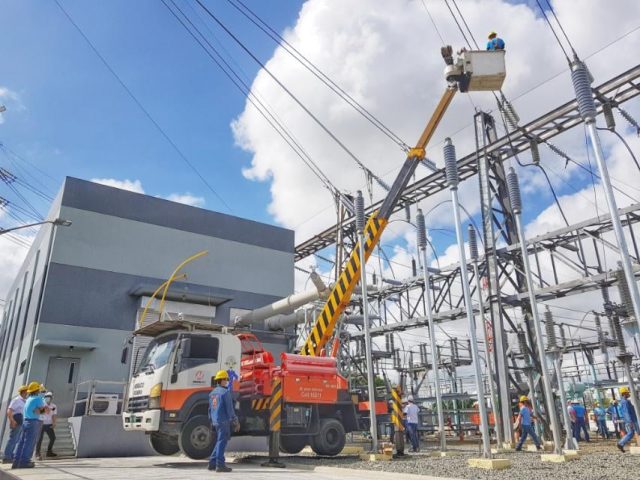
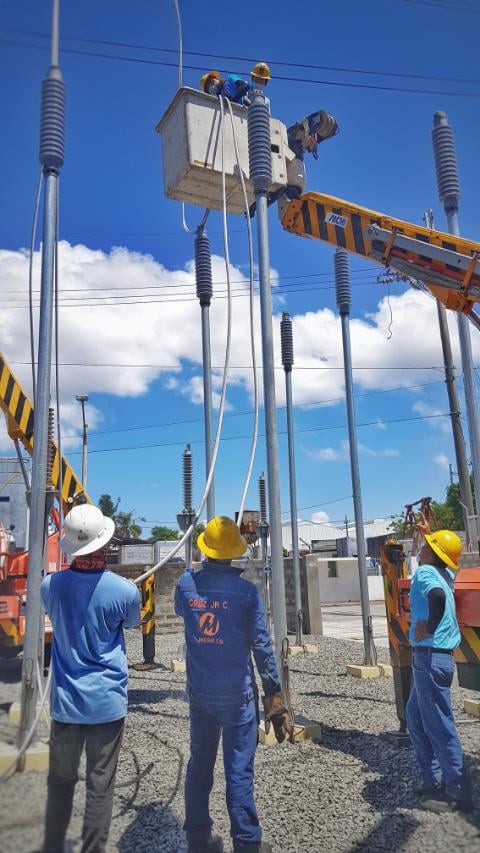
Seen in the photo are linemen and engineers from Meralco and Miescor during the ongoing commissioning of a new double bus indoor Gas-Insulated Switchgear (GIS) of LIIP Substation located at Binan, Laguna. This project will ensure the continuous power supply of the customers served by the said substation even during contingency, preventing possible power outages to many industrial customers in the area of Sta. Rosa and Binan, Laguna.Despite the heightened community quarantine measures due to the recent surge of COVID-19 cases, Meralco and its subsidiaries are continuously working hard to improve its distribution system in order to provide its customers with the highest level of service.
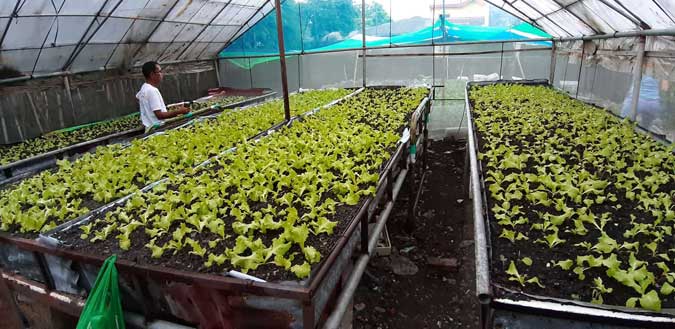
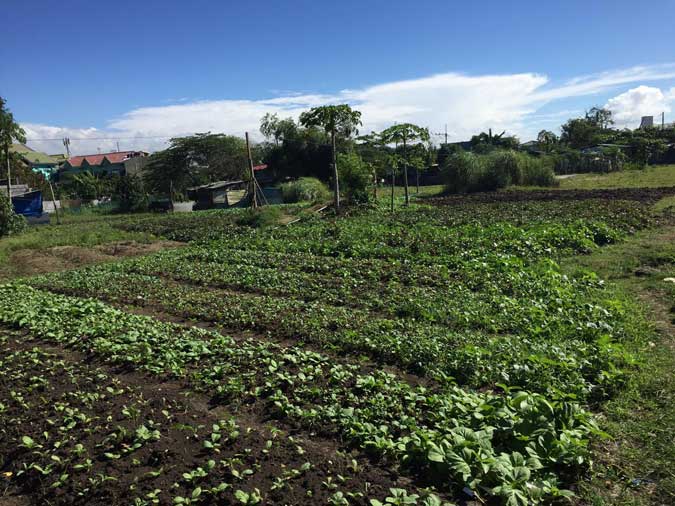
The coronavirus pandemic is continuously changing the world in unprecedented ways. And one industry flourished during this pandemic – urban farming. The lockdowns imposed to curb the spread of coronavirus is pushing more city dwellers to grow vegetables in the comforts of their own homes. For many Filipino people, fresh food is not a given.
Sen. Cynthia Villar, a staunch advocate of urban farming, started her Urban Farming Project in Las Piñas in 2011 as part of the city’s annual Food Festival Competition. It was initially envisioned as a showcase of the gardening and farming skills of the 20 barangays of Las Piñas. The yearly festival sees dozens of entries from various sectors and areas in Las Piñas. From Barangays, Home Owners Associations, and Schools, each group presents their very best in terms of farming and planting skills, landscaping, and design.
Senator Cynthia A. Villar in Gulayan sa Baseco in Tondo, Manila
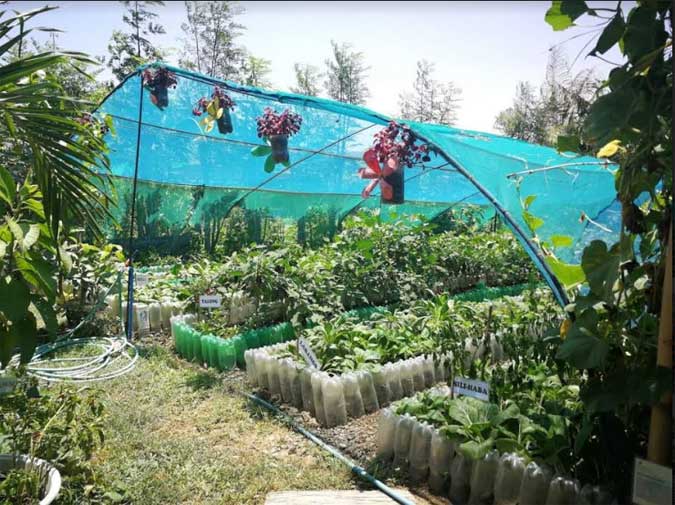
Seeing the potential of urban farming, and not allowing anything to limit her, in addition to growing backyard gardening projects, Sen. Villar, in 2015, partnering with the Department of Agriculture’s Bureau of Fisheries and Aquatic Resources, set up aquaponic garden systems in the City of Las Piñas. Aquaponics is a way of growing vegetables without solid and growing fish at the same time in one set-up. The two aquaponics systems flourishing in the City of Las Piñas can be found at the Christ The King Subdivision an area under the Community Mortgage Program (CMP) in Talon 4 and in Heritage Homes, BF Resort.
“It is really time for city dwellers to grow their own food even in an urban setting with limited space. Food self-sufficiency is very important especially during disasters or emergencies,” said Sen. Villar.
“We are very pleased with the warm reception of our constituents to the Urban Farming Project,” said Las Piñas Rep. Camille Villar. “This projects continuous to beautify the community, minimize air pollution, provide food security and create livelihood and jobs,” added Rep. Villar.
At the height of the pandemic, where many Filipinos were left with little to no access to food, Sen. Villar joined by Rep. Villar gave away vegetable seeds and organic fertilizers in Las Piñas to enable people to grow their own food during the lockdown. The organic fertilizer comes from the eighty (80) composting and vermicomposting facilities set up all over the City of Las Piñas, which provides seventy (70) tons of organic fertilizer every month.
This old garbage site was cleaned and transformed into a vegetable garden
Ms. Marlyn Montinola, a resident of Talon 2 and wife of a former OFW shared, “vegetable gardening became my husband’s hobby after he went back to the Philippines due to pandemic. We placed our garden on the rooftop because we don’t have enough space in our house. We used the seeds and fertilizer given by Senator Villar, now we don’t buy vegetables in the market anymore and we are sure that we are eating healthy and safe food. I sell some in the office too.”
Ms. Montinola’s appreciation of urban farming is shared by Ms. Maria Myra La Roza from Bacoor City who expressed her gratitude to Sen. Villar, “I am really thankful for the seeds and fertilizer gave by Villar SIPAG, I was able to transform our idle lot into [a] vegetable garden. I am really happy because my daughter and I are eating fresh vegetables and I am able to share our harvest with our neighbors in the village. Now, I can proudly say I am a gurong magsasaka.”
Aquaponics Garden in Christ the King Subdivision
Seeing the positive impact of urban gardening in her home city, Sen. Villar expanded her program promoting urban farming to other provinces such as Bulacan, Nueva Ecija, Pampanga, Tarlac, and Bataan, seeing to the distribution of seeds and fertilizers to eighty-six (86) and counting towns in the Philippines. To date, 1,694 individuals have received seed packets for their own home vegetable gardens.
“We should support other LGUs who also desire to establish farms and vegetable gardens. Now, more than ever, we need to spread the interest on people growing their own food to other LGUs, so that we can help them and their constituents in their goal to achieve food sustainability amid the COVID-19 pandemic,” added Sen. Villar.
Congw. Camille Villar
Urban agriculture is a viable intervention to guarantee that poor households and communities have access to healthier and affordable food. COVID-19 has given us cause to reevaluate how important local urban green spaces are to us, and what we want from our high streets, parks, and pavements.
Just last month, in observance of International Women’s Day, which was celebrated last March 8, Sen. Villar and Rep. Camille Villar, through the Villar SIPAG Foundation, aired a special webinar to help empower Filipino women, entitled, “Kabuhayan Para sa Kababaihan sa Mapanghamong Panahon.”
Lettuce garden in Pulang Lupa 2
In partnership with East-West Seed Foundation Inc., the program was especially helpful for women interested in urban agriculture to equip them with the right knowledge and skills to practice this in order for them to make their households and communities healthier and more food sufficient. The East-West Seed Foundation Inc. also teaches urban farming in four (4) Villar SIPAG Farm Schools located in Las Piñas-Bacoor, San Jose Del Monte, Bulacan, San Miguel Iloilo, and in Davao City.
Sen. Villar, champion of women empowerment, believes that women have a lot to contribute to the country’s development if they would just be given opportunities and tools such as learning new skills; “when we empower women, we empower families and generations of people.” Sen. Villar also said that empowering women is one of the most effective ways to make a positive difference in society because “women have the power to lead, serve, nurture and transform.”
Urban garden in Castillan Subdivision
Through the Villar SIPAG Foundation, Senator Villar and Rep. Villar are able to provide jobs and livelihood opportunities to women so they can help augment the earnings of their husbands. In this way, Sen. Villar said women no longer need to leave their homes in order to earn money. “They can do their work at home while taking care of their children,” noted by the senator.
Urban garden in Manuyo 2
Sen. Villar and Rep. Villar continue to champion urban farming by authoring their respective legislation in the Senate of the Philippines and House of Representatives, respectively. Considering that this is the perfect time to institutionalize urban agriculture, Sen. Villar authored Senate Bill No. 141, which seeks to strengthen and promote urban agriculture and vertical farming to meet food sufficiency targets and address hunger. Backyard vegetable gardening will not only address food sufficiency but will likewise promote the health and wellness of families. Deputy Speaker Villar shares the same advocacy and has co-authored House Bill No. 8385, which promotes urban farming to help families to produce their own food to tide the expenses of their respective households. Under the proposed legislation, idle, abandoned lands, buildings and open spaces will be converted into urban gardens.
Aquaculture in Heritage House Talon
“We continue to empower our citizens through urban farming as we are actively promoting this as an alternative and additional source of livelihood especially for those affected by the pandemic. Not only do they have extra income but they also help ensure food security as they have an immediate solution to possible food shortage due to crisis,” Rep. Villar.
The senator will continue to work with national and local governments, as well as communities to further promote urban gardening in order for Filipino families will be able to meet their daily nutrition needed especially today as we continue to battle the COVID-19 health crisis.
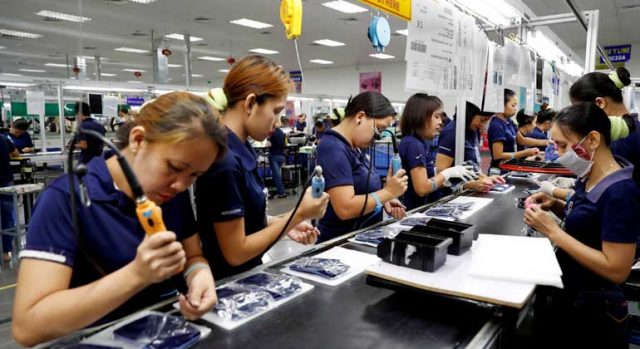
PHILIPPINE manufacturing activity continued to expand in March albeit at a slower pace than the previous month due to a softer rise in new orders, a survey conducted by IHS Markit showed.
The Philippine Manufacturing Purchasing Managers’ Index (PMI) in March stood at 52.2, inching down from the 52.5 posted in February but still above the neutral 50 mark that separates growth from contraction. This also marks the third straight month of expansion.
New orders rose slightly in March, and still weaker than the long run average, IHS Markit said.
“The Philippines manufacturing sector ended the first quarter on a positive note with a modest expansion recorded in March. Promisingly, output volumes rose despite a moderation in new order growth. Meanwhile, employment levels fell only marginally with anecdotal evidence suggesting that this was mostly voluntary, and not due to cost-cutting efforts at firms,” Shreeya Patel, economist at IHS Markit, said in the report released on Monday.
Despite this, the country’s PMI was still better than the ASEAN PMI which stood at 50.8. The ASEAN PMI reading showed expansion, after it stood at 49.7 in February.
Among select Association of Southeast Asian Nations (ASEAN) economies, the Philippines saw the third quickest expansion pace after Vietnam (53.6) and Indonesia (53.2). The Philippines was ahead of Singapore (50.7).
Meanwhile, manufacturing activity in Malaysia (49.9), Thailand (48.8), and Myanmar (27.5) remained in contractionary mode.
“The ASEAN manufacturing sector saw a fresh improvement in conditions at the close of the first quarter, with growth driven by renewed increases in both output and inflows of new work following slight falls in February,” IHS Markit economist Lewis Cooper said in a note.
The Philippines saw a drop in overseas demand as the pandemic continued.
“Foreign client demand was especially subdued during the month as restrictions linked to the coronavirus disease 2019 (COVID-19) pandemic persisted in abroad markets,” IHS Markit said.
Despite this, output accelerated in March, with some Philippine firms noting efforts to accumulate finished goods in anticipation of greater demand in the coming months.
Amid optimism for higher sales and output, IHS Markit’s Ms. Patel warned that Philippine manufacturers are facing rising production costs.
“A key area of concern, however, continues to be rising price pressures. Material shortages were often blamed for the higher costs incurred by firms. A sustained increase in client demand, however, allowed some firms to partially pass on rising expenses,” she said.
In March, factories had to deal with mounting supply chain pressures as lead times for inputs stretched.
“Panelists continued to cite freight delays as driving the deterioration in vendor performance, with delivery times lengthening markedly. As such, firms sought to increase their inventory holdings to minimize future shortages due to delays,” IHS Markit said.
March also saw a drop in employment due to falling backlog and voluntary resignations. This led to the 13th consecutive month of contraction in employment.
The pandemic continues to affect sentiment as optimism is below the long-run trend, IHS Markit said. Despite this, manufacturing players are pinning their hopes on stronger economic conditions, with the outlook for production still in positive territory in March.
“Nevertheless, a strong first quarter places the sector in good stead for a return to industrial production growth in 2021, with our current forecast expecting a 7.1% expansion,” Ms. Patel said.
The country’s PMI reading at beyond 50 for three months straight shows that firms are looking to rebuild inventory, said ING Bank N.V. Manila Senior Economist Nicholas Antonio T. Mapa. However, he warned that the renewed imposition of a strict lockdown will have a negative impact on both demand and supply in the manufacturing sector.
Metro Manila, Cavite, Laguna, Rizal, and Bulacan are under the strictest lockdown until April 11 in a bid to curb the increasing COVID-19 infections.
“With the economy shuttered, firms may readjust production schedules given expectations for weaker demand,” Mr. Mapa said in an e-mail.
Under guidelines of the Inter-Agency Task Force for Management of Emerging Infectious Diseases, manufacturing firms with activities related to medicine and medicine supplies; food and other essential goods; and those that supply products related to construction will be allowed to operate with full on-site capacity.
Despite this, Mr. Mapa said the overall restrictions on movement could impede production in the near term.
“April could see another dip in the index but not necessarily a contraction with the length of the lockdowns being the telling factor,” Mr. Mapa said. — Luz Wendy T. Noble
MANILA WATER Co., Inc. will no longer be allowed to charge its customers for corporate income tax and implement foreign currency differential adjustments (FCDA) under the new concession agreement (CA) it signed with the government.
“Isang revised concession agreement ang nabuo na nagbibigay ng mas maganda serbisyo ng tubig sa Metro Manila at advantageous sa pamahalaan at consumers (We have sealed a revised concession agreement that ensures better water services in Metro Manila and will be more advantageous to the government and consumers),” Presidential Spokesperson Herminio “Harry” L. Roque, Jr. told a televised press briefing on Monday.
In a disclosure to the stock exchange, Manila Water said the revised agreement will allow it to retain the concession for the east zone of Metro Manila until July 31, 2037.
The revised deal is patterned after the provisions of the New Clark City — joint venture agreement (NCC-JVA), which also removed the recovery of corporate income taxes and FCDA.
FCDA is a quarterly reviewed tariff mechanism that allows water concessionaires like Manila Water to regain losses or return gains resulting from the movement in foreign exchange rates. The companies pay foreign currency-denominated loans that are used to fund the expansion and improvement of water and sewerage services.
Manila Water is unlikely to implement the FCDA for the second quarter that was approved by the regulatory office of the Metropolitan Waterworks and Sewerage System (MWSS) last month.
“To mitigate the impact of tariff increases on customers, the Revised CA lowers the inflation factor to 2/3 of the Consumer Price Index (CPI) adjustment and imposes caps on increases in standard rates for water (1.3x the previous standard rate) and wastewater (1.5x the previous standard rate). Instead of a market-driven appropriate discount rate, Manila Water shall now be limited to a 12% fixed nominal discount rate,” the listed company said.
Manila Water said the rate-rebasing mechanism included in the original concession deal will be retained.
“Thus, the rates for water and sewerage services provided by Manila Water shall be set at a level that will permit it to recover over the term of the concession expenditures efficiently and prudently incurred and to earn a reasonable rate of return,” the company said.
Manila Water will also implement a tariff freeze until Dec. 31, 2022 to help consumers amid the pandemic.
“The Undertaking Letter of the Republic is retained but has been amended to exclude the non-interference clause. It now applies only to contracts and obligations existing at the time of execution of the Revised CA,” the company said.
During the Palace briefing, Mr. Roque said under the new deal, all debt and expenditures of the concessionaire must be reviewed and approved by the regulator.
LOPSIDED? The new contract is “favoring the government, limiting private sector discretion but not necessarily benefiting the public, which should be the core interest in all of these negotiations,” InfraWatch PH convenor Terry L. Ridon told BusinessWorld in a Facebook messenger chat.
Mr. Ridon said the requirement that all debt and expenditures be reviewed and approved by the MWSS-Regulatory Office destroys the nature of the concession as a public-private partnership (PPP), “effectively reducing the concessionaires into mere suppliers or vendors of government.”
“This contradicts private sector independence in investment and operations initiatives, which is a main feature in PPPs,” he said. “Effectively, the government does not only exercise regulatory power over tariff, but also operational control.”
The government should clarify whether the tariff adjustment for inflation at only two-thirds of CPI will now be the standard for all PPPs “as this will similarly run the risk of a constitutional challenge on equal protection,” Mr. Ridon said.
“Is the government taking on the remaining one-third inflation risk, or will it be the private sector?” the former lawmaker said.
“As long as this deal will warrant or make the services of utility companies better (less interruptions, reasonable charges, efficient services) and accountability to government is strictly enforced as mentioned, then the new deal is favorable,” Asian Institute Management economist John Paolo R. Rivera said in a Viber message.
The deal would encourage investment in public utilities if it was proven to be efficient in creating better services for consumers, Mr. Rivera said.
“There were trade offs but terms have been leveled at the very least without sacrificing the economic and financial viability of the water concessionaires,” he said when asked whether the contract was fair to concessionaires.
Meanwhile, Justice Secretary Menardo I. Gueverra said the terms of a deal with water concessionaire Maynilad Water Services, Inc. would likely be similar with that of Manila Water’s.
“The other concession agreement with Maynilad, the negotiations with respect to that will start immediately and we will be proposing essentially the same terms and conditions as those that were contained in the revised agreement with Manila Water. But of course, we recognize the fact na differently situated ang Maynilad compared to Manila Water so there will probably be a lot of discussions also with respect to possible modification of the terms and conditions,” he said during the Palace briefing.
Mr. Duterte last year threatened to file a case of economic sabotage against the water firms after an international arbitration court ruled that the Philippine government must pay Manila Water P7.4 billion and Maynilad P3.4 billion for losses incurred from unenforced water rate increases.
Shares in Manila Water went up 0.12% to P16.10 each on Monday. — withRevin Mikhael D. Ochave
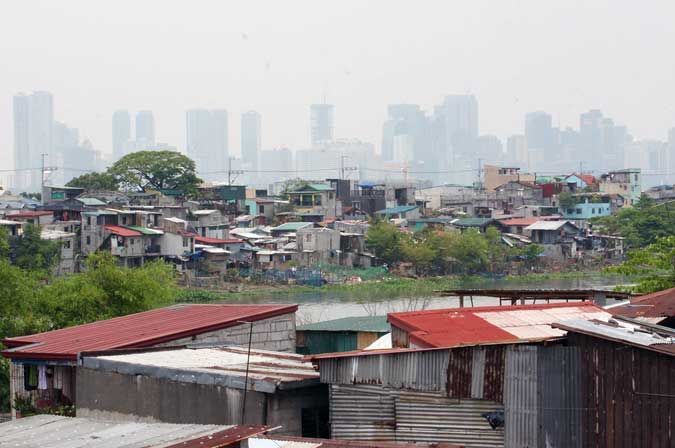
The Ortigas business district is seen in the background of houses along the Pasig floodway, April 5. — PHILIPPINE STAR/ MICHAEL VARCAS
By Luz Wendy T. Noble and Jenina P. Ibañez, Reporters
THE Philippines faces a rough road to recovery as more restriction measures will likely be required to arrest the surge in coronavirus cases, Fitch Solutions Country Risk and Industry Research said on Monday.
This as business groups are seeking more government support as economic activity slows down due to the extension of the enhanced community quarantine (ECQ) in Metro Manila and nearby provinces until April 11.
“We expect the lockdown measures to be extended given the continued surge in cases and the prolonged impact on hospital capacity,” Fitch Solutions said in a report.
“The Philippines economy is highly vulnerable to lockdowns given its high reliance on domestic consumption and investment and thus growth will likely fall again until lockdown measures are eased,” it added.
The research unit of Fitch Ratings said it downgraded its 2021 growth projection for the Philippines to 5.8%, from the 7.6% it penciled in January. The economy shrank by a record 9.5% in 2020 due to the prolonged lockdown.
The Health department on Monday reported 8,355 new COVID-19 cases, bringing the active cases to a record 143,726.
“Our expectation for a modest recovery (i.e. real GDP not returning to its pre-pandemic levels until 2022) assumed that domestic demand would gradually recover and the government’s infrastructure plans would come to fruition, resulting in a sharp increase in domestic activity,” Fitch Solutions said.
This outlook is now clouded by the struggle to contain the surge in COVID-19 infections and the slow vaccine rollout.
“The likelihood of further outbreaks in other regions remains high and given the slow vaccination rollout in the country (less than 1% of the population has been vaccinated as of end-March), we believe the Philippines’ recovery will continue to be hampered by the pandemic,” Fitch Solutions said.
Amid the gloomier economic outlook, Fitch Solutions expects remittance inflows and recovery in external demand to be supportive of growth this year.
The central bank expects remittances to grow by 4% this year, after it slipped 0.8% to $29.903 billion in 2020 due to the pandemic. Cash remittances fuel household consumption which makes up 70% of the economy.
MORE SUPPORT Meanwhile, Philippine Retailers Association Vice-Chairman Roberto S. Claudio in an e-mail on Sunday advocated for unhampered online selling, noting that consumers still want to buy products.
“There is just no opportunity for people to consume, except for food, medicines and essential products,” he said.
Retail stores selling nonessential goods are not allowed to operate during ECQ.
He is asking the government to allow retailers of nonessential products to continue online transactions, including online ordering, contactless payment and delivery options. Mr. Claudio last week said that he expects nonessential retailers and dine-in restaurants to have no revenue during a strict lockdown.
The retail industry group at the start of the year reported that it anticipates “soft” growth for 2021, or 10% higher than last year, when the sector suffered from sparse foot traffic amid the lockdown and increasing health anxiety among consumers. This potential sales improvement would still be around 20-30% lower than 2019 or pre-pandemic sales.
“Let’s try to help everyone do business during lockdowns. Many retailers are already breaking down with the continued lockdowns but we have no choice but to comply with medical protocols of the government,” Mr. Claudio said.
Benedicto V. Yujuico, president of the Philippine Chamber of Commerce and Industry, said that Filipino citizens should receive COVID-19 vaccines as soon as possible, noting that the government is mitigating the negative effects of the lockdown on business by allowing some sectors like essential businesses and logistics to continue operations, and improve contact tracing.
“Needless to say, the government should also expedite (and if possible increase the amount) the distribution of ‘ayuda.’ There are too many people who are unemployed and without funds to provide for their basic daily needs,” he said in an e-mail.
During the ECQ, full operations are allowed for public and private hospitals, healthcare services, manufacturers of medicine and medical supplies, agriculture and fishery, mining, outsourcing, export, and delivery and courier services transporting food, medicine and other essential goods.
An outsourcing industry group in an e-mail last week said that government agencies have extended guidance to the sector through their issuances.
“(We have) been working with various government agencies and industry stakeholders to ensure our member companies are able to continue their operations while keeping employees healthy,” Information Technology and Business Process Association of the Philippines (IBPAP) President and Chief Executive Officer Rey E. Untal said.
As for foreign investors, the European Chamber of Commerce of the Philippines (ECCP) maintained that the Philippine government should identify COVID-19 mitigation and economic reform best practices done by other countries.
“Continued enforcement of health and safety measures, intensified immunization programs,and unhampered business activities are all essential in stabilizing the current landscape. These are also important signals that the Philippines remains a viable investment destination,” ECCP President Nabil Francis said in a mobile message.