Home Blog Page 8149

Philippines eyes $400-million loan from World Bank

The Philippine government is seeking a $400-million loan from the World Bank, which will be used to boost financial inclusion, among others. — REUTERS/JOHANNES P. CHRISTO/FILE PHOTO

THE GOVERNMENT is seeking a $400-million (P19.22-billion) loan from the World Bank to support financial sector reforms and boost the economy’s recovery from the pandemic.

In a World Bank document published on its website on Tuesday, the World Bank’s board directors are likely to act on the proposed “Philippines First Financial Sector Reform Development Policy Financing” by June 24.

“The proposed development policy loan supports the government of the Philippines in achieving a resilient, inclusive, and sustainable financial sector to enable a more inclusive green recovery from the coronavirus disease 2019 (COVID-19) pandemic,” the World Bank said.

The Washington-based multilateral bank said the program is the first out of two operations that will help the government boost the stability and resilience of the financial sector. This will be achieved by “addressing legal, regulatory and supervisory gaps in the financial sector and increasing the availability and mobilization of long-term finance.”

It also aimed to broaden financial inclusion among individuals and companies in the country by promoting new financial services, fast-tracking reforms, and give small businesses better access to finance.

Lastly, the loan will also be used to promote disaster risk and sustainable finance through reforms to make the economy’s recovery more sustainable.

Among the reforms that will be supported by the program includes the improvement in the country’s anti-money laundering system and in combating the financing of terrorism (AML/CFT) regime; the establishment of the Philippines Catastrophe Risk Insurance Facility (PCIF) to help nonlife insurers to implement risk management systems based on international standards; and the adoption of central bank requirements on climate risk management and governance by domestic systemically important banks (D-SIBs) to help banks assess the impact of climate change on their portfolios better.

“The COVID-19 pandemic’s economic repercussions further highlight the importance of a strong financial infrastructure and diversified financial sector to support recovery. The COVID-19 shock has increased the urgency for reforms — not only to maintain financial sector stability or increase financial inclusion but also to support sustainable economic recovery and minimize the impact of future shocks, particularly on poor and vulnerable segments of the population,” the World Bank said.

However, the bank warned that prolonged crisis is a threat to the timely implementation of the proposed program and the economic and implementation risks should be mitigated to avoid reallocation of the budget away from the main objectives. — Beatrice M. Laforga


Meat importers want lower tariffs until 2025

PHILIPPINE STAR/ MICHAEL VARCAS
Based on the Agriculture department’s price monitoring report on Tuesday, the price of pork kasim ranged from P340 to P390 per kilogram and pork liempo at P360 to P400 per kilogram. — PHILIPPINE STAR/ MICHAEL VARCAS

LOCAL MEAT importers want the government to extend the implementation of lower tariffs on imported pork until 2025, in order to provide a steady supply for consumers and give time for the hog industry to recover.

In a letter to Senate President Vicente C. Sotto III dated May 3, Meat Importers and Traders Association (MITA) President Jesus C. Cham said the decision to reduce tariffs on imported pork for one year was a “bold and courageous move,” but should be effective for the next five years.

He expressed support for the Senate’s compromise proposal to lower the tariff rates for pork imports within the minimum access volume (MAV) quota to 15% and out-quota pork imports at 20%.

“MAV pork has never entered the Philippines in large quantities… Hence maintaining the 30-40% rate would not help the supply situation, but would keep the Philippines from competing with other pork importing countries, China in particular,” he said.

If lower tariffs are implemented until end-2025, Mr. Cham said benefits include a stable supply of pork for consumers and allowing local hog raisers to recover losses from the African Swine Fever (ASF) outbreak. This will also lessen opportunities for graft and corruption, allow importers to be competitive, and potentially unify in-quota and out-quota rates and set aside the MAV, he said.

“We find reasonable the compromise rate of 15% for the remaining nine months. However, the rate should be incorporated into the upcoming tariff schedule and remain in effect until end-2025,” Mr. Cham said in the letter.

On May 1, Mr. Sotto said in a radio interview that the Senate asked the Executive department for a compromise, proposing to cut the MAV allocation to 200,000 metric tons (MT) from the proposed total of 404,000 MT, and the imported pork tariff rates to 15% for in-quota and 20% for out-quota.

In a Viber message on Tuesday, Mr. Sotto said the Senate already sent these proposals to Finance Secretary Carlos G. Dominguez III, but declined to give details.

Under Executive Order (EO) No. 128 signed by President Rodrigo R. Duterte on April 7, the tariff on pork imports within the MAV quota was lowered to 5% in the first three months and to 10% in the following nine months.

Mr. Duterte also reduced the tariff on out-quota pork imports to 15% in the first three months and 20% in the succeeding nine months.

Mr. Cham said in a mobile phone message that once the tariffs are lowered, the estimated price of imported pork shoulder (kasim) will be at P300 per kilogram, while pork belly (liempo) will be at P350 per kilogram.

“This is about providing affordable food to consumers. It is not fair that consumers will be burdened by high retail prices of pork,” Mr. Cham said.

Since April 9, the Department of Agriculture (DA) has implemented a suggested retail price (SRP) for imported pork kasim at P270 per kilogram and imported pork liempo at P350 per kilogram. No new SRPs were issued for local pork products.

Nicanor M. Briones, Agricultural Sector Alliance of the Philippines, Inc. (AGAP) president, said in a mobile phone interview that local hog raisers have agreed to the compromise concerning tariff rates and import allocations.

“From 40% to 20%, and from 30% to 15%. And the MAV allocation will be reduced to 200,000 MT. We are already fine with that. But if they push for anything lower, we will not be in favor of it,” he said. 

Mr. Briones said the local hog industry will suffer if the government decides to extend the effectivity of lower tariff rates for five years.

“If they do extend the lower tariff rate until 2025, there will be no one involved in hog raising. We will not earn for five years,” Mr. Briones said.

“It will not only kill hog raisers, but it will also kill other farmers such as coconut farmers, corn farmers, rice farmers, and others since we use their products as feeds,” he added.

Samahang Industriya ng Agrikultura (SINAG) Executive Director Jayson H. Cainglet said in a mobile phone message that importers are earning P35 to P50 per kilogram with the high tariff rates.

“With the SRP of imported pork liempo at P350, importers earn at P200 per kilogram. Their profit is just too much,” Mr. Cainglet said.

Based on the DA’s price monitoring report on Tuesday, the price of pork kasim ranged from P340 to P390 per kilogram and pork liempo at P360 to P400 per kilogram. — Revin Mikhael D. Ochave

Petron earns P1.7B, says oil refining back in June

BW FILE PHOTO

PETRON Corp. said on Tuesday that its first-quarter consolidated net income hit P1.73 billion, swinging from losses of P4.9 billion year on year, despite a decline in the number of oil barrels sold and lower revenues.

In a press release, the country’s largest oil company said that its end-March profit was higher than the P1.2 billion earned in the fourth quarter last year.

“First quarter volumes reached 19.38 million barrels, 21% lower than the 24.66 million barrels sold in the same period last year, while consolidated revenues decreased 20% to P83.3 billion from P104.62 billion a year ago,” said the listed company, which refines and markets oil in the Philippines.

Petron, also a leading participant in the Malaysian market, noted an improvement in its January-March sales compared with the average in the fourth quarter last year. But it said its sales performance “reflected the demand destruction” brought about by the global health emergency.

For the first quarter, Petron’s operating income stood at P3.7 billion, a reversal of its P4.4-billion operating loss in the same period last year. The firm did not disclose its net income attributable to parent firm equity holders.

Petron said that its parent company San Miguel Corp. is spending nearly P1 billion for its “Ligtas Lahat” vaccination program, which aims to inoculate all 70,000 SMC employees and extended work force.

“As a company, we are doing all that we can to create a safe and healthy work environment while ensuring that our recovery stays on track. Petron is constantly evolving, and we will continue to work towards our goal of emerging stronger from this pandemic,” Petron President and Chief Executive Officer Ramon S. Ang said.

Petron has built 14 new stations in the first quarter. It operates around 40 oil terminals in the region and has 2,800 service stations where it retails gasoline and diesel.

The company has set aside P11 billion for its 2021 capital expenditures, which covers the building of steam generator plants, strategic retail network expansion, and maintenance requirements.

It added that its two major expansion projects in Malaysia’s Port Dickson Refinery — the Diesel Hydrotreater and Marine Import Facility 2 — are on track.

REFINERY OPERATIONS TO RESUME IN JUNE
In the same media release, Mr. Ang said Petron would resume the operations of its Bataan oil refinery in June. The refinery, which was placed on a temporary economic shutdown earlier this year, processes 180,000 barrels per day (bpd).

Mr. Ang earlier announced the temporary shutdown of operations to “reduce losses due to weak margins.”

In January, Petron said that it was infusing nearly P3 billion to improve its Bataan refinery operations after the Authority of the Freeport Area of Bataan (AFAB) approved of the firm’s registration in the province’s freeport area. The oil firm previously told the local bourse that its registration with the AFAB will improve the refinery’s financial viability in the long term.

Petron has a combined refining capacity of 268,000 bpd. It produces a full range of fuels and petrochemicals.

Shares of Petron in the local bourse improved by 3% or 10 centavos to close at P3.50 apiece on Tuesday. — Angelica Y. Yang

Understanding NFTs

Everydays — The First 5000 Days by Beeple (graphic designer Mike Winkelmann) was sold to Singapore-based technopreneur Vignesh Sundaresan at a Christie’s auction for $69.3 million worth of the crypto-currency Ether. The South Carolina graphic designer and motion artist creates a picture every single day for 5,000 days — 13 years — creating the first purely digital artwork to be auctioned by a major auction house. — MAKERSPLACE.COM/BEEPLE
Everydays — The First 5000 Days by Beeple (graphic designer Mike Winkelmann) was sold to Singapore-based technopreneur Vignesh Sundaresan at a Christie’s auction for $69.3 million worth of the crypto-currency Ether. The South Carolina graphic designer and motion artist creates a picture every single day for 5,000 days — 13 years — creating the first purely digital artwork to be auctioned by a major auction house.
— MAKERSPLACE.COM/BEEPLE

The world of non-fungible tokens is a major part of this year’s Art Fair Philippines

IN MARCH 2021, a collage of images called Everydays — The First 5000 Days by Beeple (graphic designer Mike Winkelmann) was sold to Singapore-based technopreneur Vignesh Sundaresan at a Christie’s auction for $69.3 million worth of the crypto-currency Ether. The sale positioned Beeple as among the top three most valuable living artists, after English painter David Hockney and American sculptor Jeff Koons.

Just last month, the meme Disaster Girl, showing the then four-year-old Zoe Roth (now 21 years old) grinning at the camera with a burning house in the background, sold at an auction for  $473,000.

Meanwhile, Filipino artist Luis Buenaventura III recently sold 222 editions of Satoshi The Creator – Genesis, a collaboration with Argentinian artist Jose Delbo, for $1,999 each on the Nifty Gateway platform.

Everydays The First 5000 Days, the Disaster Girl meme, and Satoshi The Creator – Genesis were all sold as non-fungible tokens (NFTs).

WHAT IS AN NFT?
NFTs are one-of-a-kind digital properties (a drawing, meme, animated GIF, video, etc.) which are bought through crypto-currency. NFTs use a blockchain, a digital ledger where its record of ownership is stored.

Artists can create an NFT through minting — making limited copies or offering it via bid — their artworks on NFT platforms. Notable NFT platforms include SuperRare, Nifty Gateway, Rarible, and Foundation.

NFTs are purely digital and can be sold anywhere globally without the worry of shipping costs and insurance.

THE COST OF NFTS
The mining of an NFT requires high usage of computer power since artists have to pay a fee to tokenize their NFT in a blockchain.

According to an article by Time magazine, “Ethereum mining consumes about 26.5 terawatt–hours of electricity a year, nearly as much as the entire country of Ireland and its almost 5 million residents.”

NFT art platform SuperRare, however, argues that NFT trading does not increase carbon emissions as it has a fixed energy consumption.

An article by the SuperRare Team titled, No, CryptoArtists Aren’t Harming the Planet stated that “the total energy spent on mining depends on a relationship between Ethereum price, which is the source revenue for miners, and the cost of energy.” It states further that carbon emissions remain the same whether or not users take a break from their Ethereum apps and if no transactions are sent for an entire day.

In an effort to reduce carbon emissions by NFT trading, the Ethereum community is looking at more efficient alternatives such as the development of ETH2, aimed at increasing Ethereum sustainability.

NFTS IN THE PHILIPPINES
With the goal to educate and introduce the local art market to digital arts, this year’s Art Fair Philippines — which goes fully online for the first time from May 6 to 15 — will have a section called the Metaverse, which takes visitors “to the world of digital media via our NFT 101 Showcase.” 

There one can view artworks from 43 local and international galleries and explore the world of crypto arts, including a showcase of Narra Art Gallery and Tropical Futures Institute, a series of talks with topics ranging from getting started in crypto arts to mining an NFT and its environmental impact.

“[W]ith all the publicity surrounding [NFTs], it is becoming very attractive and very much an option,” Art Fair Philippines co-founder Lisa O. Periquet said on BusinessWorld’s B-side podcast.

“So, it tells me that this whole subject is really soaking in to a much wider audience than you would imagine. From the beginning, it’s not just people in the crypto world. It’s now people who are just interested and they could be interested in both the art, and in investing in it as a currency,” she added.

Salcedo Auctions director Ramon “Richie” Lerma noted that NFTs have an impact on both artists and collectors.

“If your definition of an artist is someone who creatively expresses themselves through a chosen medium and can sell that creation to a collector, then by that definition, anyone can become an artist by creating and selling NFTs,” Mr. Lerma wrote in an e-mail to BusinessWorld.

“In fact, this is precisely what we’re seeing with the sale of internet memes and even tweets as NFTs, and is definitely a point of interest for new and established collectors. We’re now once again faced with questions like, ‘So what is art?’ and ‘Can anyone really be an artist?’,” he said.

“As a collector, it’s interesting to note that NFTs, as a cryptocurrency, have a digital record of their transactions on the blockchain which can technically serve as provenance. [And] because the creation and sale of NFTs is an unfolding story, it also opens up avenues for first-time collectors to acquire something they perceive to be of value,” he added.

“Curiosity and outright interest are two different things. It’s hard to say at this point whether the primary market for NFTs will find its way to the local secondary art market,” Mr. Lerma said of the potential of NFTs at local auctions.

“Right now, we see the two audiences existing in separate spheres. But again, the beauty of working in the auction industry is being able to see firsthand that curiosity growing into interest, and maybe into a dedicated following. Who knows? But it will certainly be interesting —  and fun —   to see this all unfold,” he said. — Michelle Anne P. Soliman

Ayala Land profit drops 36% due to pandemic restrictions

AYALA Land, Inc. (ALI) recorded a 36% profit drop to P2.8 billion in the first three months of 2021 from the P4.3 billion generated year on year due to pandemic restrictions, the company said in a statement on Tuesday.

The company’s consolidated revenues amounted to P24.6 billion, 13% lower than the P28.4 billion in 2020.

Revenues from ALI’s property development business suffered a six percent dip to P16.2 billion from the P17.2 billion seen in the same period last year, which was said to be “cushioned by higher bookings and construction progress.”

Around 49% of the construction work force were working on projects as supported by the off-site facilities of the Makati Development Corp.

Meanwhile, sales reservations improved by 15% to P28.5 billion from P24.7 billion year on year “as local demand remained robust amid the community quarantines.”

“Our residential business registered higher sales in the first quarter versus a year ago with new product launches gaining favorable market acceptance,” said Bernard Vincent O. Dy, president and chief executive officer of ALI.

ALI earned P13.6 billion in residential revenues, 1.45% lower than the P13.8 billion seen in the January-to-March period last year.

The company generated P1.8 billion from the sale of office units, 85% more than its P962-million revenues earned year on year due to the number of bookings in projects such as Alveo Land Corp.’s Park Triangle at the Bonifacio Global CIty and Ayala Land Premier’s One Vertis Plaza at Vertis North.

Meanwhile, revenues from the sale of commercial and industrial lots posted a 67% fall to P818.4 million from P2.5 billion due to lower Vermosa and Alviera sales.

ALI’s commercial leasing revenues went down by 41% due to pandemic restrictions, finishing the quarter with P5.1 billion in revenues from P8.7 billion year on year.

Earnings from shopping centers declined by 58% to P2 billion, while hotels and resorts revenues fell by 60% to P640 million.

“These are not expected to fully recover until mobility restrictions are eased,” Mr. Dy said.

However, headquarter and sustained BPO (business process outsourcing) operations improved office leasing revenues by two percent to P2.5 billion.

“Compared to the fourth quarter of last year, commercial leasing revenues improved by 13%. Shopping center and office revenues grew 16% and 22%, respectively. Meanwhile, revenues from hotels and resorts were 19% lower,” the company said without disclosing figures.

ALI launched six projects during the period worth a total of P17.4 billion. The company has set aside P100 billion for projects this year.

Capital expenditures (capex) for the quarter, meanwhile, amounted to P15.3 billion, which is 17% of this year’s P88-billion capex.

“Approximately, 59% was spent on residential projects, 12% on commercial projects, 10% for land acquisition, 17% for the development of estates, and 2% for other purposes,” Ayala Land said.

BOND LISTING
On Tuesday morning, the company listed P10-billion fixed-rate bonds due 2025 with a coupon rate of 3.6262% at the Philippine Dealing & Exchange Corp. (PDEx).

The listing is the sixth tranche of the company’s P50-billion securities program and is said to have been oversubscribed by nearly four times.

“Demand for the bonds from both retail and institutional investors reached over P36 billion and this translated to an oversubscription of 3.6 times, allowing us to price at the lowest end of the marketing range, carrying a coupon of 3.6%,” said Augusto D. Bengzon, ALI chief finance officer and chief compliance officer and treasurer, during the bonds’ virtual listing ceremony.

The offer is expected to net P9.88 billion in proceeds. It will be used to refinance short-term loans used to fund the early redemption of its P8-billion fixed-rate bonds due 2025, general corporate requirements, and property acquisitions.

“We are a proud partner of the PDS Group [the Philippine Dealing Systems Holdings Corp.] as we pilot a bond issuance under their new digital platform,” Mr. Bengzon said.

ALI was also the first to list securities using the newly launched Electronic Securities Issue Portal or e-SIP, which is the digital platform that facilitates the online registration and processing of documents in the primary market.

“For this first-run of e-SIP, we are delighted to hear that the number of bondholders registered for the issue has reached 4,138,” PDEx President and Chief Executive Officer Antonino A. Nakpil said.

For Finance Secretary Carlos G. Dominguez III, the system “democratizes bond investing,” adding that ALI’s issuance is a “testimony to the strength of [the] country’s fiscal and financial position.”

“This low-interest environment makes financing investments cheaper and will help power our strong economic recovery,” Mr. Dominguez said.

ALI’s new bond listing marks the seventh listing at the PDEx this year, bringing the year-to-date total to P70.24-billion new listings.

The total tradable debt instruments at the market are at P1.44 trillion, which are issued by 54 companies with 204 securities.

“Today, aside from the four and five-year bonds that we have been able to secure, we are now in talks with our banks for a 10-year issue,” Mr. Bengzon said.

On Tuesday, ALI shares at the stock exchange declined by 1.39% or 45 centavos to close at P31.85 apiece. — Keren Concepcion G. Valmonte

Escuela Taller continues projects and skills learning amid pandemic

WORK continues on restoring the west tower of the Holy Rosary parish church in Angeles, Pampanga. — FACEBOOK.COM/ESCUELATALLER.DEFILIPINAS

EVERY year, a team of young people undergo training in specialized skills for the upkeep of heritage structures — construction, painting, welding, plumbing, and electrical maintenance —  at the Escuela Taller de Filipinas. Like everyone else, the foundation was affected by the coronavirus disease 2019 (COVID-19) lockdowns this past year, and had to suspend the training. But it did not give up on its current conservation projects around the country.

Located in Manila’s walled city of Intramuros, Escuela Taller de Filipinas Foundation, Inc. is a training center founded in 2009 specializing in training out-of-school youth with skills focused on preserving heritage structures. Some of the oldest sites they have restored in Manila are Malate Church, Sta. Ana Church, and the Paco Park and Cemetery.

The school celebrated its 12th anniversary last March. To date, Escuela Taller has had over 500 graduates.

ADJUSTMENTS IN LOCKDOWN
Due to the lockdowns last year, Escuela Taller’s restoration projects in the Holy Rosary Parish in Angeles, Pampanga and the Jesuit House in Cebu were temporarily put on hold. The Angeles project — which began in Sept. 2019 and focuses on repairing damage to the church’s west bell tower — resumed in June 2020, with 30 of Escuela Taller’s “heritage protectors.”

Since they had to suspend trainee applications last year, the ongoing conservation projects are being handled by Escuela Taller alumni.

“Right now we don’t have trainees. At the moment, what we are doing, however, is working with graduates of [Escuela] with ongoing projects,” Carmen Bettina “Tina” Bulaong, executive director of Escuela Taller, told BusinessWorld via Zoom in April.

“We were still able to resume work. It was quite challenging because during the lockdown, our graduates were stranded there. Although luckily, the community was able to take care of them. There was provision for food and other necessities, and they were also housed,” Ms. Bulaong said.

The program in the Jesuit House in Cebu, however, remains on hold.

THE LEARNING CONTINUES
Ms. Bulaong recalls the impact the school has had on its alumni.

“I know that some of our graduates have managed to put up their own construction company, [they have become] supervisors in the installation of plumbing works in high rise buildings, and I learned of graduates who actually decide to go back to school and finish college,” she said.

“I remember feeling so elated at the sight of those people who visit sometimes,” she added. “It makes me proud that they really gain this knowledge and take their skill seriously.”

Escuela Taller has spent the time during lockdown to reprogram its curriculum and projects.

“We were set already in reprogramming our training activities and projects, such that we respond to the changing needs of our principal partners, that being the out of school youth,” Ms. Bulaong said.

The school has implemented a blended learning method and satellite training where, Ms. Bulaong explained, there is intervention “in particular sites without having to come to the campus doing face to face training.”

Escuela Taller will be offering micro-credential courses in wood technology in partnership with the Universidad de Manila’s Center for Micro-credential and Industry Training and the city government of Manila.

Ms. Bulaong believes that the Philippines has come a long way in heritage conservation awareness. “[I think] it has been mentioned repeatedly that the practice of heritage conservation in the Philippines is still in its developing stages, but I also recognize that heritage conservation practice abroad is also still in its developing stages. We can never stop developing, and we can never stop evolving.”

“Skills transfer still continues. We have to be more headstrong in this mission,” she said.

For more information, visit http://escuelataller.org.ph/. Donations for the conservation project of the Holy Rosary Parish, Pampanga are being accepted. For details on donations, visit https://www.facebook.com/escuelataller.defilipinas    Michelle Anne P. Soliman

P12.1B allotted for MPT South projects this year

BW FILE PHOTO

MPT South Corp. said it is spending P12.1 billion this year on its C-5 Southlink Expressway, Manila-Cavite Expressway (CAVITEX) Segment 4 Extension, and Cavite–Laguna Expressway (CALAX) projects.

MPT South’s capital expenditures for 2021 are broken down as follows: “P5.34 billion for C5 Southlink, P0.27 billion for CAVITEX Segment 4 Extension, and P6.49 billion for CALAX,” MPT South Corp. President and General Manager Roberto V. Bontia said in an e-mailed statement on Monday.

Mr. Bontia said on Friday last week that the CALAX Subsection 5 that is targeted to be opened in the third quarter of the year is now 95% complete.

The CALAX Subsection 5 links Sta. Rosa-Tagaytay Interchange to Silang East Interchange. It is part of the 45-kilometer CALAX expressway running from Kawit, Cavite to Mamplasan Interchange in Biñan, Laguna.

The initial operational CALAX segments connect Mamplasan to Santa Rosa in Laguna.

CALAX, once completed, is expected to serve around 45,000 vehicles daily. The Public Works and Highways department targets to finish works by the end of 2022.

“Just like most businesses, the toll road industry has been affected by the mobility restrictions implemented,” Mr. Bontia said.

“Still, our construction remains in full swing for areas with adequate available ROW (right of way), while strictly adhering to COVID-19 (coronavirus disease 2019) protocols set by the national government,” he added.

MPT South is under the Metro Pacific Investments Corp., one of three Philippine units of Hong Kong-based First Pacific Co. Ltd., the others being PLDT, Inc. and Philex Mining Corp.

Hastings Holdings, Inc., a unit of PLDT Beneficial Trust Fund subsidiary MediaQuest Holdings, Inc., has an interest in BusinessWorld through the Philippine Star Group. — Arjay L. Balinbin

Palacio de Memoria to hold Segundo auction

A set of 3-piece reverse glass painting depicting Quotidian scenes

STUCK at home amidst the pandemic, many people have turned to decorating their homes and making sure their private spaces reflect their personal taste and style. And if their tastes run towards the antique, Casa de Memoria can help them out.

Casa de Memoria will be offering European and Filipino antique pieces as it marks its 5th anniversary with Segundo auction on May 22, 2 p.m.

“Art is an integral part of our lives as it’s an expression of one’s emotions and captures particular moments in time. Incorporating art pieces in our house truly makes it a home. It can lend fun and visual drama to your home, while uplifting your mood during these times,” Palacio de Memoria general manager Camille Lhuillier-Albani said in a statement.

Some of the highlight pieces at the Segundo auction are a framed 18th century engraved map of the Philippines and neighboring countries signed by Isaak Tirion; a Romeo Tabuena (1921-2015) pencil-on-paper drawing depicting a Filipino indigenous man, signed and dated in 1960; a pair of 20th century pencil-on-paper drawings depicting seated figures; and a 19th century oil painting of a courtyard scene by Manuel Montoya.

There are also pieces of religious art, including a mid- to late-19th century oil painting on canvas depicting the Holy Trinity attributed to Filipino painter Justiniano Asunción (1816-1896); an oil painting on wood of St. Jerome from the 18th to 19th century by Juan Arzeo; a 19th century oil-on-wood icon depicting St. Barbara by Filipino artist Antonio Malantic; and a Peruvian School pair of portraits depicting St. Francis Xavier and St. Francis of Paola, each of which comes in a mirrored frame depicting angels.

Non-religious decorative items include a three-piece reverse glass painting depicting quotidian scenes and an 19th century English ivory trinket box.

Casa de Memoria will donate part of the auction proceeds to a local charitable institution to help those badly affected by the pandemic.

The auction preview runs until May 21. To set an appointment to view the items in person, send an e-mail to hello@casadememoria.com. To explore the auction pieces online, visit bit.ly/CasaDeMemoriaOnline. For more information, visit www.casadememoria.com, call 8253-3994, or e-mail hello@casadememoria.com. — Michelle Anne P. Soliman

Megawide, JV partners sign P2.9-B Malolos-Clark railway deal

BW FILE PHOTO

MEGAWIDE Construction Corp. announced on Tuesday that it recently signed a subcontracting agreement with Hyundai Engineering & Construction Co., Ltd. and Dong-ah Geological Engineering Co. Ltd. to supply ready-mix concrete for the package 1 of the Philippine National Railways (PNR) Clark Phase 2 (Malolos-Clark) railway project.

The company said it signed the agreement with its joint venture (JV) partners on April 21.

“The P2.9-billion contract provides for the installation and operation of concrete batching plants and supply of ready mix concrete to the project,” the company said in a disclosure to the stock exchange.

Megawide will put up two mobile batching facilities with rated capacities of 120 and 80 cubic meters per hour.

The company said in April its batching plant, formworks, and construction equipment and logistics businesses were preparing to supply concrete materials and provide support facilities to the consortium of Hyundai Engineering & Construction, Dong-ah Geological, and Megawide after winning a “stringent” bidding process.

“The combined contracts for the services is more than P3.1 billion — P2.9 billion for the supply of concrete materials, P152 million for the provision of temporary facilities, and another P59 million for the initial equipment supply contract,” Megawide said in a news release.

“The 54-kilometer PNR Clark Phase 2 (Malolos-Clark), which will feature the country’s first airport railway express service, forms part of the 148-kilometer NSCR Project, stretching from Laguna to Clark, Pampanga. The other two segments are the PNR Clark Phase 1 (Tutuban-Malolos) and PNR Calamba (Solis-Calamba),” the company noted. — Arjay L. Balinbin

Gov’t fully awards 5-year bonds as rate declines

BW FILE PHOTO
THE BUREAU of the Treasury made a full award of the five-year bonds it offered on Tuesday as demand for government debt remained strong. — BW FILE PHOTO

THE GOVERNMENT made a full award of the reissued five-year Treasury-bonds (T-bonds) it auctioned off on Tuesday and opened the tap facility to raise another P10 billion via the tenor on the back of strong demand.

The Bureau of the Treasury (BTr) borrowed P35 billion as planned on Tuesday via its offer of reissued five-year bonds, which have a remaining life of four years and 11 months.

Total bids reached P75.716 billion, making the offer more than two times oversubscribed. To accommodate the excess demand, the Treasury opened the tap facility to raise another P10 billion from the papers.

The five-year notes fetched an average rate of 3.295%, slightly lower than 3.3% coupon quoted when the papers were first offered on April 6, but a tad higher than the 3.255% yield for the tenor at the secondary market, based on the PHL Bloomberg Valuation Reference Rates published on the Philippine Dealing System’s website before the auction.

“[The offering saw] good participation, with tenders more than twice our offer and rates within secondary level,” National Treasurer Rosalia V. de Leon told reporters via Viber.

Ms. De Leon added that the robust demand seen yesterday may have been caused by market expectations of another rate cut by the Bangko Sentral ng Pilipinas (BSP) as the coronavirus pandemic continues to cloud the country’s economic outlook.

The central bank’s policy-setting Monetary Board will have its next review on May 13.

Bangko Sentral ng Pilipinas (BSP) Governor Benjamin E. Diokno has said the central bank will remain supportive of the country’s recovery and will ensure that its exit from easy monetary policy would not cause economic risks.

Last year, the central bank slashed borrowing costs by 200 basis points, which brought down the key policy rate to a record low of 2%.

Meanwhile, a bond trader said the market was taking positions ahead of the release of April inflation data on Wednesday.

Headline inflation could have accelerated again in April to go beyond the annual target for the fourth consecutive month due to high food and transport prices, according to analysts.

A BusinessWorld poll last week of 17 analysts yielded a median estimate of 4.7% for April headline inflation, near the upper end of the 4.2% to 5% estimate given by the BSP for the month.

If realized, inflation would be faster than the 4.5% print in March as well as the 2.2% a year earlier. It would also mark the fourth straight month of inflation overshooting the 2-4% target set by the BSP, and the quickest print since the 5.1% in December 2018.

Analysts said higher meat prices likely fueled a faster increase in the consumer price index after the lifting of the 60-day price cap on selected pork and chicken products on April 8, coupled with elevated transport costs due to the continued increase in oil prices.

The central bank expects inflation to average at 4.2% this year, faster than the 2.6% in 2020 and beyond the 2-4% target. By 2022, the BSP sees headline inflation easing to 2.8%.

Ms. De Leon said investors also expect headline inflation to go back to BSP’s 2-4% annual target range next year, making investors willing to put their money in slightly longer bond tenors.

The BTr plans to raise P170 billion from the local bond market this month: P100 billion via the weekly offering of Treasury bills and P70 billion in T-bonds to be auctioned off fortnightly.

The government is looking to borrow P3 trillion this year from domestic and external sources to help fund a budget deficit seen to hit 8.9% of gross domestic product. — B.M. Laforga

RBA lifts outlook, to review YCC in July

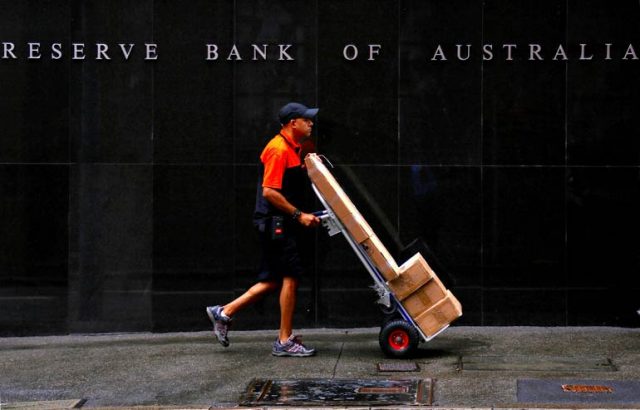
REUTERS

AUSTRALIA’s central bank upgraded its economic outlook and said policy makers will review its bond programs in July, while maintaining interest rates will remain at emergency levels until at least 2024.

Reserve Bank of Australia (RBA) Governor Philip Lowe kept the cash rate and three-year yield target at 0.10% on Tuesday. He said the board will decide at its July 6 meeting on a third tranche of quantitative easing and whether to shift yield curve control (YCC) to target the November 2024 maturity from the current April 2024 bond.

“Despite the strong recovery in economic activity, the recent CPI data confirmed that inflation pressures remain subdued,” Mr. Lowe said in a statement. “The board is prepared to undertake further bond purchases to assist with progress toward the goals of full employment and inflation. The board places a high priority on a return to full employment.”

The RBA’s decision to stand still comes a week before the government delivers its annual budget that’s expected to include targeted spending to help boost jobs and spur a faster recovery. Treasurer Josh Frydenberg has lined up behind Mr. Lowe’s goal of pushing the economy to full employment as quickly as possible to rekindle inflation.

Mr. Lowe said the bank’s central scenario for GDP growth was revised up, with an expansion of 4.75% now expected this year and 3.5% over 2022. Unemployment is expected to continue to decline to around 5% at the end of this year and around 4.5% at the end of 2022.

Australia’s jobless rate has already declined almost 2 percentage points from its pandemic-peak in July last year. The RBA estimates it probably needs to fall closer to 4% before wage growth accelerates.

The central bank releases its quarterly Statement on Monetary Policy with the full suite of economic forecasts on Friday, and Deputy Governor Guy Debelle is due to speak in the mining-centered state capital Perth the night before that.

“Moving in July means this week’s quarterly SoMP will be the last one before” the YCC and QE3 decisions, said Ben Jarman, a senior economist at JPMorgan Chase & Co. in Sydney. “So the staff’s forecasts for wages — and the upside scenario — in that document will be important.”

While Australia has experienced a sharp V-shaped recovery, the RBA shows no sign of following the Bank of Canada in early withdrawal of stimulus. Instead, like the Federal Reserve and European Central Bank, it will keep pumping monetary support until the economy is fully repaired. It would also like to trail any move by the US to avoid unnecessary exchange rate appreciation.

“The RBA continues to mirror the US Fed — acknowledging an improved outlook but arguing that further progress is required,” said Kellie Wood, fixed income portfolio manager at Schroder Investment Management. “Lowe is on a mission to see how tight the labor market can get before inflation picks up meaningfully.”

The one area likely causing a headache for Mr. Lowe is the property market. Housing has surged in response to record low borrowing costs, government assistance and a lack of supply. Property prices rose 7.8% in the past year, and while similar increases have occurred across the globe, a return to boom times Down Under threatens to swell an already worrisome pile of household debt.

“The bank will be monitoring trends in housing borrowing carefully,” the governor said today. “It is important that lending standards are maintained.”

The government’s budget next Tuesday is likely to show an improved bottom line due to better employment outcomes that boost the tax take and cut welfare costs. It’s similarly benefited from the high price of iron ore, the nation’s largest export. The steelmaking ingredient is currently trading at around $190 and Citigroup, Inc. is forecasting an extended shortfall in the commodity and expects new highs of $200 to be hit over the next few weeks. — Bloomberg

Golden Globes group floats changes to address diversity, ethics complaints

EN.WIKIPEDIA.ORG
EN.WIKIPEDIA.ORG

LOS ANGELES —  The board of the Hollywood Foreign Press Association (HFPA), the group that hands out the annual Golden Globe awards for television and film, proposed several changes on Monday to address criticism over its membership’s diversity and ethics.

In a letter to members, the HFPA board suggested several steps to diversify its roster, including hiring a chief diversity officer, putting emphasis on recruiting Black journalists and widening the pool of potential applicants. The board also proposed adding at least 20 new members in 2021 and boosting its ranks by 50% over the next 18 months. The changes must be approved by current members and will be discussed at the group’s next meeting, the letter said.

“We have created a roadmap for transformational change in our organization,” the board said.

The moves follow an investigation published in February by the Los Angeles Times that noted there were no Black people among the 87-member group of foreign entertainment journalists who make up the HFPA.

The Los Angeles Times also raised long-standing ethical questions over the close relationships between the HFPA and movie studios that may influence the choice of Golden Globe nominees and winners. The controversy overshadowed the Golden Globes ceremony in February, one of the major Hollywood award shows leading up to the Oscars in April.

The HFPA board said it developed the recommendations with input from outside advisers and inclusion experts as well as media partners. Comcast Corp.’s NBC network broadcasts the Golden Globes ceremony each year and welcomed the plan as “an encouraging step in the right direction.”

“It outlines the thorough reforms that are critical for our continued relationship,” NBC said.

Among other proposals, the board urged that HFPA members stop accepting promotional items from film and TV studios and that the group post a public list of members with links to their work.

“We want to be clear — these outlined changes are just the first steps in the long journey ahead,” the letter said. “We also know that in this existential moment for our association, change is difficult and sometimes scary.” — Reuters