Home Blog Page 809

‘Secret’ Villanueva ruling released

OFFICE OF THE OMBUDSMAN PHILIPPINES FACEBOOK PAGE

OMBUDSMAN Jesus Crispin C. Remulla on Thursday released a copy of the “secret” decision by former Ombudsman Samuel R. Martires reversing a 2016 ruling that found Senator Emmanuel Joel J. Villanueva administratively liable for the alleged misuse of P9.7 million in Priority Development Assistance Fund (PDAF) allocations.

In a five-page order dated Sept. 13, 2019, Mr. Martires granted the motion for reconsideration filed by Mr. Villanueva — then a congressman — and officials of the Department of Agriculture (DA), setting aside their dismissal from service and clearing them of grave misconduct, serious dishonesty, and conduct prejudicial to the best interest of the service.

Last week, Mr. Remulla dropped his plan to write to the Senate leadership requesting the enforcement of the dismissal order against Mr. Villanueva, issued by then-Ombudsman Conchita Carpio-Morales in 2016.

Mr. Remulla said he was “surprised” by what he described as a “secret decision” of Mr. Martires, who had granted the motion for reconsideration — a fact, he noted, that was not made public.

Mr. Villanueva earlier denied that he was facing renewed pressure, saying he had already anticipated possible “harassment” and “fake news.” He also shared documents showing that the case was dismissed in 2019, along with a clearance from the Office of the Ombudsman dated 2025.

The 2016 Ombudsman decision had dismissed Mr. Villanueva and several DA officials for their alleged role in the release of P9.7 million to Aaron Foundation Philippines, Inc. (AFPI), a non-governmental organization tapped by the National Agribusiness Corp. (NABCOR) to implement agri-based livelihood projects.

Mr. Martires said in the ruling that there was “no adequate evidence on record” linking Mr. Villanueva to the loss of public funds, adding that the signatures attributed to him were unverified. He also said other public officials involved in project selection and monitoring should have been investigated to determine the extent of any conspiracy.

Antonio A. Ligon, a De La Salle University professor and former executive director of the Integrated Bar of the Philippines, said cases involving public officials “should be made public,” stressing that transparency is vital to accountability and considering their compensation and perks are paid for by the public.

He added that so-called “secret decisions” should not carry any legal effect, warning that such practices could undermine the fight against corruption.

“If secret decisions are allowed, then expectedly [that] it will weaken corruption cases, as respondents can easily make complicit arrangements with the judge or anyone in charge of hearing the case,” Mr. Ligon told BusinessWorld in a Viber chat.

In a separate Facebook messenger chat, Antonio Gabriel M. La Viña, constitutional law and legal philosophy professor at Ateneo de Manila University, meanwhile, said that while it is legally allowed, it is “improper from an accountability point of view. It also contradicts basic norms of transparency.” Erika Mae P. Sinaking

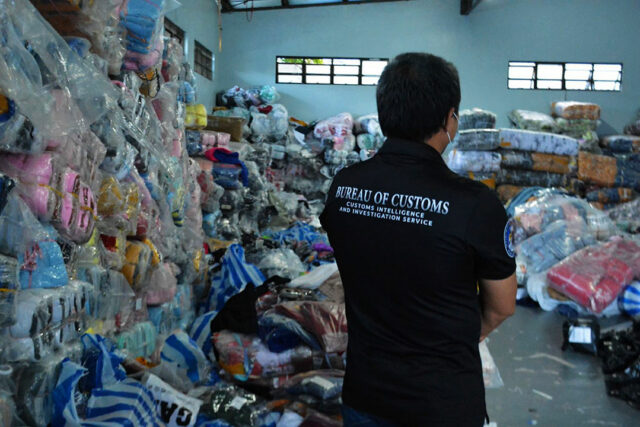
BoC seizes P482-M fake apparel

MEMBERS of the Bureau of Customs-Customs Intelligence Investigation Service inspect various counterfeit shirts, perfumes and other luxury goods at a warehouse in Las Piñas City. — PHILIPPINE STAR/MIGUEL DE GUZMAN

THE BUREAU of Customs (BoC) has seized P482.63 million worth of counterfeit apparel from Bangladesh that bore popular international and local brands.

“The sale and distribution of counterfeit products not only deceive consumers but also harm honest businesses that comply with the law. This operation reflects our continuing resolve to ensure that only legitimate goods enter the Philippine market,” Assistant Commissioner Atty. Vincent Philip C. Maronilla said in a statement on Thursday.

The confiscated goods arrived at the Port of Manila in August after being transshipped to Singapore from Bangladesh to evade the Customs’ profiling system.

“The containers were flagged for examination following intelligence reports indicating possible misdeclaration and suspected Intellectual Property Rights (IPR) infringement,” the BoC said.

The agency conducted a 100% physical inspection of the shipments on Oct. 9 and found 1,287 boxes of counterfeit branded apparel misdeclared as socks, each valued at P2,500.

The items bore the trademarks of multiple global and local brands, including but not limited to Jag, Bench, Zara, Givenchy, Fubu, Lee, H&M, Cotton On, Lacoste, Burberry, Essentials, Champion, Jordan, Levi’s, Bathing Ape, Oakley, RRJ, Calvin Klein, and Off-white. — Aaron Michael C. Sy

Bill abolishes tax tiering for vape juices

PHILIPPINE STAR/ RUSSELL PALMA

A MEASURE abolishing the tax distinction between vape juices was filed at the House of Representatives, aiming to impose a uniform excise rate.

Filed by Cagayan de Oro Rep. Rufus B. Rodriguez and Party-list Rep. Maximo B. Rodriguez, Jr. In early October, House Bill No. 5364 seeks to plug what they see as regulatory gaps in tobacco taxation, including the differing excise rates applied to freebase and nicotine salt juices.

“Certain traders deliberately misrepresent products as containing only freebase nicotine when, in truth, such products contain nicotine salts, with the intent of evading the higher excise tax imposed,” they said in the measure’s explanatory note.

The measure proposes a P10-per-milliliter tax on all vape liquids, with a 5% yearly hike by 2027. — Kenneth Christiane L. Basilio

Swift passage of bill creating independent body for infra probe pushed

PHILIPPINE STAR/JOHN RYAN BALDEMOR

A PHILIPPINE senator on Thursday called for the swift passage of a bill that seeks to create an independent commission that would investigate all government infrastructure projects.

In a statement, Senator Francis “Kiko” N. Pangilinan called on President Ferdinand R. Marcos, Jr. to certify as urgent Senate Bill No. 1215, which seeks to create the Independent People’s Commission (IPC). This institutionalizes and strengthens the Independent Commission for Infrastructure (ICI), created under Executive Order No. 94.

“If the President certifies it as urgent, it will be even more feasible. We also need to pursue the national budget debates in the Senate,” he said in Filipino.

“When the Senate budget debate begins, there is nothing else to discuss. We need to make sure that we will — as best as we can — pass this measure. And we hope all senators will support this measure,” he added.

The proposed measure grants the IPC contempt, subpoena, and freeze order powers, which the current ICI does not have.

Investigations would also cover all infrastructure projects by the national and local government, including projects for education, agriculture, flood control, disaster resilience, among others.

The bill also mandates all investigations to be completed within 60 days, and a full report issued to the public after 30 days.

“We need to hurry up,” he added. “The people are saddened because they see that no one is being imprisoned.”

The Philippines faces a mounting corruption scandal allegedly involving lawmakers, government engineers and private contractors siphoning of billions from flood control projects. — Adrian H. Halili

Wanted Dawlah bombmaker arrested in Sultan Kudarat

COTABATO CITY — Police intelligence agents arrested a known bombmaker in the Dawlah Islamiya, wanted for high-profile criminal cases pending in different courts, in an anti-terror operation in Barangay Ligao in Palimbang, Sultan Kudarat on Wednesday.

Local officials and members of two erstwhile secessionist Moro groups, who supported the law-enforcement operation of the Police Regional Office-12 (PRO-12), said on Thursday, the now-detained bombmaker is well-versed in fabrication of improvised explosive devices using either ammonium nitrate or potassium chlorate as blasting charges.

Brig. Gen. Arnold P. Ardiente, PRO-12 director, told reporters that the suspect was cornered by operatives from their Regional Intelligence Division and other PRO-12 units before dawn on Wednesday.

Mr. Ardiente said the suspect is wanted for multiple murders, multiple frustrated murders, destructive arsons and violations of the Republic Act No. 11479, or the Anti-Terrorism Act of 2020.

Local officials said the bombmaker yielded peacefully when policemen barged into his hideout and showed him warrants for his arrest from different courts.

Mr. Ardiente said the raiding team had confiscated from him an improvised explosive device rigged with a blasting mechanism that can be detonated from a distance using a mobile phone. — John Felix M. Unson

PSEi retreats as focus shifts to key data releases

REUTERS

PHILIPPINE SHARES retreated again on Thursday after ending in the green the past two sessions as cautious sentiment prevailed after the US Federal Reserve chief’s hawkish statement and before the release of key economic data next week.

The Philippine Stock Exchange index (PSEi) went down by 0.57% or 34.09 points to close at 5,929.68, while the broader all shares index fell by 0.33% or 11.93 points to end at 3,593.28.

“The market continued to tread water despite the US Federal Reserve rate cut after Fed Chairman Powell cautioned that there is a “growing chorus” amongst FOMC (Federal Open Market Committee) members to hold rates steady when they meet again in December,” AP Securities, Inc. Research Head Alfred Benjamin R. Garcia said in a Viber message.

“Trading remained cautious, with markets closely monitoring commentary from Fed officials on the timing of potential additional easing,” Regina Capital Development Corp. Head of Sales Luis A. Limlingan said in a Viber message.

The Fed cut interest rates on Wednesday by a quarter of a percentage point as expected, but the US central bank’s new policy statement included several references to the lack of official data during the ongoing federal government shutdown, and Fed Chair Jerome H. Powell told reporters later that policymakers are likely to become more cautious if it deprives them of further job and inflation reports, Reuters reported.

Those comments prompted traders to slash their forecasts for a 25-basis-point rate cut from the US central bank in December, which had been viewed as a near-certainty earlier. Fed funds futures now imply a 67.8% probability that the Fed will hold rates at its next meeting on Dec. 10, compared with a 9.1% chance on Wednesday, according to the CME Group’s FedWatch tool.

“The Philippine market slipped lower as selling pressure persisted throughout the session. Traders remained cautious as they are waiting for the release of gross domestic product and inflation data next week,” Mr. Limlingan added. The Philippine Statistics Authority is set to release the October inflation data on Nov. 5 (Wednesday), while the third-quarter GDP data will be released on Nov. 7 (Friday).

Most sectoral indices closed in the red on Thursday. Financials dropped by 0.99% or 19.71 points to 1,961.93; property fell by 0.72% or 15.75 points to 2,165.73; holding firms went down by 0.52% or 25.44 points to 4,819.45; industrials decreased by 0.3% or 26.88 points to 8,867.22; and services slipped by 0.15% or 3.55 points to 2,264.50.

Meanwhile, mining and oil rose by 0.98% or 124.63 points to 12,757.68.

Decliners outnumbered advancers, 95 to 82, while 64 names closed unchanged.

Value turnover dropped to P4.98 billion on Thursday with 660.39 million shares changing hands from Wednesday’s P6.46 billion with 690.95 million issues traded.

Net foreign selling went down to P354.32 million from P477.97 million. — Alexandria Grace C. Magno

Budget seen leaving no room for long-term spending items

STOCK PHOTO | Image by Wirestock from Freepik

By Kenneth Christiane L. Basilio, Reporter

THE GOVERNMENT risks taking its eye off longer-term strategic needs after years of devoting more than half of the budget to immediate spending priorities, the Congressional Policy and Budget Research Department (CPBRD) said.

The congressional think tank said since 2016, 50.9% of the national budget has gone to paying for current items like salaries, services and public works, with automatic appropriations absorbing 29.9% and special purpose funds 7.8%.

“Nearly 90% of the budget is pre-allocated for existing programs or mandatory obligations — leaving very limited room for new or emerging priorities,” the CPBRD said in an October report written by Johnry A. Castillo.

The Philippines adopted a two-tier budgeting approach in 2016, with the Tier-1 category devoted to ensuring that ongoing projects are sustained. This led to “a significant unintended consequence — an over-reliance on historical budgeting,” the CPBRD said.

As a result, the think tank said, commitments to ongoing spending items grew “dramatically” in subsequent years.

Only 11.7% of the enacted national budgets since the two-tier approach was implemented were set aside for “new and innovative priorities,” the CPBRD estimated. It added that a declining share of the budget for new programs could lead the government to neglect strategic concerns.

“If unaddressed, this trend risks creating a rigid budget that crowds out strategic investments and undermines the government’s fiscal consolidation efforts,” it said.

The Philippines aims to lower its debt-to-gross domestic product (GDP) ratio to 58% by 2028 after coming in at 63.1% at the end of June — the highest level since 2005. Development banks consider a 60% debt-to-GDP ratio as manageable for developing economies.

The CPBRD said the growing share of allocations for ongoing programs has also, in some years, pushed national budgets beyond their approved ceilings.

“Such trends underscore the need to periodically reassess Tier 1 commitments through performance-based reviews or strategic expenditure reviews,” it said. “Without this, the budget risks becoming a rigid financial plan with limited adaptability.”

Policymakers should prepare a comprehensive framework to help agencies reduce ongoing expenses and carve out fiscal space for new and strategic programs, it said, citing the need for greater oversight by the Finance and Budget departments over the budget process.

Congress and civil society groups should be given access to budget documents to better monitor the budget process and strengthen government transparency, it added.

The CPBRD also recommended the revival of a multi-agency subcommittee on program and project assessment to evaluate the budget proposals at the agency level.

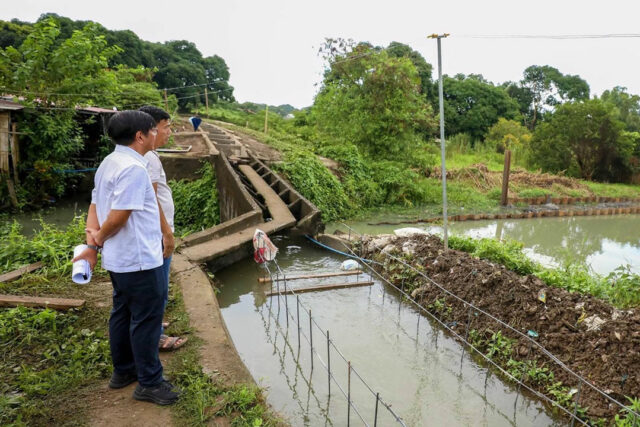
DA to take over farm-to-market road projects from DPWH in 2026

DPWH.GOV.PH

THE Department of Agriculture (DA) said it will take over farm-to-market road (FMR) projects from the Department of Public Works and Highways (DPWH) starting 2026.

In a statement, the DA said the takeover will make farm infrastructure more focused on the actual needs of farming communities.

Agriculture Secretary Francisco P. Tiu Laurel, Jr. and Public Works Secretary Vivencio B. Dizon met on Tuesday to review audits of past farm road projects, the DA said.

The review sought to determine the extent to which the farm road program has been affected by the broader infrastructure corruption scandal, which surfaced in flood control projects shortly after the heavy July rains.

At the meeting, the DPWH discussed pending projects slated for 2025, which Mr. Dizon proposed to complete under a catch-up plan.

“There are roughly 1,000 kilometers of roads that still need construction in 2025. We must think outside the box to ensure these roads are completed as quickly as possible. Local government units will be engaged, similar to our approach with classrooms,” Mr. Dizon added.

At a recent Senate hearing, Mr. Laurel said that the backlog of FMRs totals 60,000 kilometers — a distance that would take six decades to complete at the current pace.

Regarding the corruption review, Mr. Laurel said of the nearly 1,000 kilometers of farm roads inspected by the DA out of over 4,000 kilometers built in recent years, “a few short stretches” may warrant referrals to the Ombudsman and the Independent Commission on Infrastructure for possible investigation and prosecution.

PCCI throws support behind infrastructure quality measure

BONGBONG MARCOS VIA FACEBOOK/PHILSTAR FILE PHOTO

THE Philippine Chamber of Commerce and Industry (PCCI) urged Congress to pass the proposed National Quality Infrastructure (NQI) Act to unlock Philippine industries’ global competitiveness.

“The PCCI and other stakeholders are urging expedited action emphasizing that delays constrain Philippine industries from fully leveraging quality infrastructure to compete globally,” it said in a statement on Thursday.

The proposed NQI Act “seeks to establish a unified and modern framework for quality standards and competitiveness across Philippine industries.”

The proposed NQI Act is currently in bill form from multiple authors, but these have yet to be consolidated.

“PCCI therefore calls on lawmakers and agencies to treat the bill as a priority, so the Philippines can move from fragmented quality systems to a cohesive, internationally recognized infrastructure for standards, testing, metrology, accreditation and conformity assessment.

During the National Quality Infrastructure Conference on Oct. 29, PCCI Executive Vice-President Ferdinand A. Ferrer said exporters face technical barriers without reliable standards, calibration, testing and conformity assessment systems.

“Quality infrastructure is no longer a luxury — it is a necessity, a prerequisite to market access,” he said. “When our products cannot demonstrate compliance with international standards, they cannot enter foreign markets.”

A strong NQI signals to investors that Philippine-made goods and services meet global norms, the PCCI added.

“When instruments of measurement (metrology), testing, certification and standardization are fragmented or weak, firms face duplication of tests, slower time-to-market, and higher costs — undermining productivity,” the PCCI said.

Mr. Ferrer also noted that agriculture, manufacturing, construction, and services need reliable measurement, testing, and certification, as well as regulatory coherence.

“The absence of a unified policy across sectors limits growth,” he said. — Beatriz Marie D. Cruz

Integrating into multinational supply chains considered ASEAN’s big investment opening

REUTERS

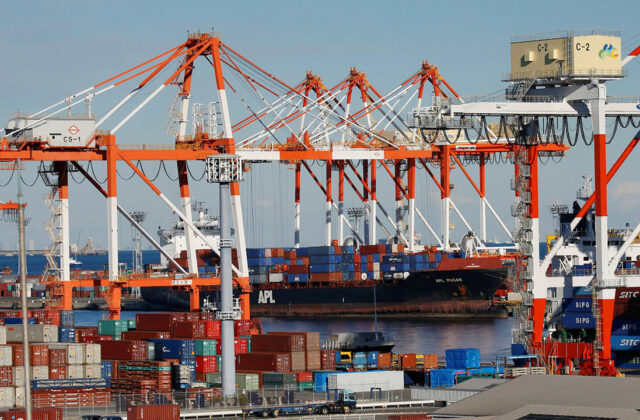
MULTINATIONAL GROUPS seeking to diversify their supply chains are considered the main opportunity for Association of Southeast Asian Nations (ASEAN) economies seeking to attract investment, the UN Trade and Development (UNCTAD) said.

“What’s happening in the global investment environment today is leading multinational enterprises looking for opportunities to make their supply chains more resilient, to diversify their supply chains,” UNCTAD Head of Investment Research Richard Bolwijn told BusinessWorld on the sidelines of the Invest Korea Summit on Thursday.

“That presents opportunities for countries across the ASEAN region to attract investment in new production locations for supply chain-intensive manufacturing,” he added.

He said infrastructure and skills will be key to attracting such investment.

“The factors that decide whether a country can be competitive in this are having good infrastructure, having the right skills across the labor force, and having the capacity to absorb the technologies needed to produce and to have market access,” he said.

“Investment of that nature will increasingly regionalize, or will increasingly be within the region,” he added.

The ASEAN Investment Report 2025, released this month, indicated that foreign direct investment (FDI) in ASEAN increased 8% to $226 billion, in the face of an 11% decline in global flows.

“Since 2021, FDI in the region has been exceptionally strong, with annual inflows exceeding $200 billion, compared with an annual average during the last decade of less than $130 billion,” the report added.

UNCTAD estimates global FDI to decline by approximately 3% this year, following an 11% decline last year, Mr. Bolwijn said.

“Greenfield announcements around the world are declining; international project finance is having a really hard time because of tighter financing conditions. The only area that is growing around the world is the digital economy area of investments,” he said.

However, he said that while bigger projects are being announced, they are fewer in number.

“You need to be attractive for those types of projects, but as I said, with fewer but very large projects, fewer countries can attract them,” he said.

Nearly 30% of new project announcements last year involved the digital economy, compared to less than 20% in 2020, he said.

“The only sectors that are growing are digital infrastructure and services, which were up more than double. If we look at semiconductors, it rose 140%,” he said, with digital-economy investments dominated by rich countries.

“It is becoming, of course, for countries that are lower down on the development ladder, increasingly difficult to compete for new investment because it is more knowledge-intensive and more technology-intensive. It can be hard, as a country, to become attractive for that type of investment,” he said. — Justine Irish D. Tabile

IMF urges use of more data sources for Residential Property Price Index

REUTERS

THE Bangko Sentral ng Pilipinas (BSP) needs to tap more data sources to improve the Residential Property Price Index (RPPI), the International Monetary Fund (IMF) said.

“The BSP should continue to engage other agencies and stakeholders who have relevant information on property prices to broaden the coverage of the RPPI in the long run,” the IMF said in its Report on the Residential Property Price Index Mission for the Philippines released on Thursday.

The RPPI measures the average price changes over time of various residential properties using bank mortgage data.

The BSP first launched the RPPI in the first quarter of 2025, replacing its predecessor, the Residential Real Estate Price Index.

In the report, the IMF urged the BSP to consider including in the index indicators such as the volume and value of transactions and using other administrative data sources.

Currently, the central bank uses residential real estate loans extended by universal and commercial banks as well as thrift banks as a reference for the RPPI, which the IMF said excludes cash purchases as well as transactions financed by developers and the Home Development Mutual Fund.

“While current loan data is sufficient for index compilation in the short to medium term, the BSP should expand its data sources by leveraging administrative data and employing advanced techniques like web scraping,” it said. “This approach will address existing data gaps and enhance the comprehensiveness of the index in the long run.”

The BSP has been developing its Real Property Information System project with the Department of Finance’s Bureau of Local Government Finance.

The project will serve as a database of all real property transactions that would allow early preparation of the schedule of market values, the IMF said.

The IMF also urged the central bank to enhance the visibility of the RPPI on its website.

“The authorities should provide more prominence to the RPPI statistical release,” it said, noting that the existing data is “quite difficult” to access. — Katherine K. Chan

Template introduced to streamline power permit process at LGU level

BW FILE PHOTO

THE Department of Energy (DoE) said it launched a template to streamline the permit process for energy infrastructure projects across local government units (LGUs).

In a statement on Thursday, the DoE said it developed the LGU Ordinance Template to help local governments harmonize and simplify their permit system. 

The template is designed to ensure predictable timelines for power projects, boosting investor confidence, and accelerating energy development.

“The LGU Ordinance Template empowers local government units to recognize and fulfill their vital role in developing energy infrastructure,” Energy Undersecretary Mylene C. Capongcol said.

The DoE met with officials of Siquijor province to present accelerated guidelines for infrastructure development and provided updates on national and regional energy programs.

Discussions covered the benefits of communities hosting energy projects, net metering programs, and the expansion of lifeline rates, and solar rooftop installation. 

The DoE has conducted similar consultations with provincial governments in Batangas, Rizal, Ilocos Norte, Iloilo, Pangasinan, Tarlac, Negros Occidental, and Sorsogon. — Sheldeen Joy Talavera

ADVERTISEMENT
ADVERTISEMENT