Home Blog Page 8088

Estate Tax Amnesty: To extend or not to extend?

“To be or not to be” is one of Shakespeare’s most famous lines — the opening of a Hamlet soliloquy in Act 3, Scene 1. Prince Hamlet is speaking it aloud, but none of the characters seem to hear him. Is it possible that the characters have chosen not to listen because the topic is death?

In our culture, death is a topic best avoided in most conversations. In my own family, we seldom talk about our deceased loved ones. We find comfort in knowing that their memories will always be in our hearts and, less poetically, their names etched in land titles that form part of their legacy.

When we speak of estate and inheritance, we think of estate tax and the legal processes that paying such taxes entail. On May 4, 2021, the Senate Committee on Ways and Means conducted a hearing to discuss proposals to extend the estate tax amnesty law for an additional two years. The deadline for the estate tax amnesty law is June 14, 2021 and the Senators need to hurry, as they only have a few session days left to extend the deadline.

During the hearing, it emerged that many individuals are ready to pay estate tax. However, the heirs find it difficult to comply with the requirements of the amnesty, particularly with regard to the submission of proof of settlement. It will be noted that under the Tax Amnesty Act, otherwise known as Republic Act 11213, one of the requirements to avail of the amnesty is proof of settlement of the estate, whether judicial or extrajudicial.

Some of the things that make securing settlement among the heirs difficult are the fact that some heirs reside outside the Philippines, some have been prevented from doing so by the pandemic protocols, and others have unresolved conflicts with regard to the settlement terms.

Hence, one suggestion during the hearing was for the heirs be allowed to pay estate taxes first before the settlement of the estate This suggestion will ultimately make the payment of tax easier. As a gentle reminder, though, the Bureau of Internal Revenue (BIR) may still require proof of settlement after the payment of estate taxes and prior to the release of the Certificate Authorizing Registration.

In addition to proposals geared towards making it easier to avail of the estate tax amnesty, the extension of deadline for payment of such taxes will give more time to ensure that the heirs are interested in undergoing the process to avail of the amnesty.

The estate tax amnesty allows heirs to have the unpaid estate taxes settled at the rate of 6%, without penalty. This applies to estates of decedents who died on or before Dec. 31, 2017. The amnesty also covers “undeclared estates” or properties that were not included in previously filed estate tax returns and were not subjected to estate taxes. The 6% amnesty tax rate is imposed on the net estate of the decedent; and in determining the net estate, deductions are allowed against the value of the gross estate of the decedent at the time of death.

In case the heirs opt not to avail of the estate tax amnesty, the estate will be subjected to a graduated estate tax rate of 5% to 20% (for decedents who died from 1998 to 2017), plus interest, surcharge, and compromise penalty. For estate tax due several years ago, say, 15 years ago or 20 years ago, one can imagine how substantial the interest cost might be.  Considering the graduated tax rate plus penalties, the heirs might be surprised to see large assessments by BIR. Thus, it is obvious that the extension of the deadline to avail of the estate tax amnesty would definitely benefit the heirs.

For heirs whose questions about the settlement of estate usually revolve around who gets to inherit property left by decedents, questions that sometimes reflect selfishness, perhaps it is time that heirs get to be better informed about how to settle estate taxes. The process of inquiry could spur family teamwork.

I always believe that everything that has a beginning has an end, and that endings are just beginnings in disguise. The government’s estate tax amnesty will end soon. I hope lawmakers choose to extend it and make it easier to avail of in a bid to urge more heirs to finally settle their estate taxes.

Let’s Talk Tax is a weekly newspaper column of P&A Grant Thornton that aims to keep the public informed of various developments in taxation. This article is not intended to be a substitute for competent professional advice.


Lex D. Tabilog is a manager of the Tax Advisory & Compliance division of P&A Grant Thornton, the Philippine member firm of Grant Thornton International Ltd.


pagrantthornton@ph.gt.com

Rising infections in northern Philippines flagged 

BLOOMBERG

By Vann Marlo M. Villegas and Kyle Aristophere T. Atienza, Reporters

HEALTH authorities on Monday flagged the increasing coronavirus cases in northern Philippines after nine more people from Cagayan Valley got infected with the coronavirus variant first detected in the United Kingdom.

“This might explain why cases are increasing in Tuguegarao City,” Health Undersecretary Maria Rosario Vergeire told an online news briefing on Monday. “We will submit samples for whole genome sequencing.”

The region had 2,835 active coronavirus cases as of May 16. The UK COVID-19 variant is said to have a reproduction rate that is 1.35 times the usual coronavirus.

DoH on Saturday said 13 more people had gotten infected with the coronavirus variant from the United Kingdom, bringing the total to 967. The nine people from Cagayan Valley were among these.

The Department of Health (DoH) reported 5,979 coronavirus infections on Monday, bringing the total to 1.15 million.

The death toll rose by 72 to 19,262, while recoveries increased by 6,602 to 1.08 million, it said in a bulletin.

There were 54,235 active cases, 1.4% of which were critical, 93.3% were mild, 2% did not show symptoms, 2% were severe and 1.25% were moderate.

It said 17 duplicates had been removed from the tally, 11 of which were tagged as recoveries and one as death. Thirty-one recoveries were reclassified as deaths.

About 11.8 million Filipinos have been tested for the coronavirus as of May 15, according to DoH’s tracker website.

The coronavirus has sickened about 163.7 million and killed 3.4 million people worldwide, according to the Worldometers website, citing various sources including data from the World Health Organization.

About 142.2 million people have recovered, it said.

‘BELOW CRITICAL’
Meanwhile, the use rates of facilities for coronavirus patients in the Philippines were now below critical levels, presidential spokesman Herminio “Harry” L. Roque, Jr. said at a separate news briefing.

“We haven’t reached a moderate risk level in all our healthcare care utilization,” he said.

Only 58% of intensive care unit beds in the country had been used and about 43% of isolation beds were occupied, he said. Mr. Roque said only 47% of ward beds had been occupied, while about 40% of ventilators were used.

In the capital region, 57% of ICU beds had been occupied, while 42% of isolation beds were occupied. Mr. Roque also said 47% of ward beds had been occupied, while 46% of ventilators were used.

Ms. Vergeire said local governments should not be complacent and should monitor compliance with health standards. They should also shorten the detection to isolation period to 5.5 days to reduce cases by two-thirds, she said.

President Rodrigo R. Duterte last week put Metro Manila and the provinces of Bulacan, Cavite, Laguna and Rizal under a general community quarantine (GCQ), with heightened restrictions from May 15 to 31.

Mr. Roque said the stricter version of the general lockdown was imposed to  sustain the gains of previous lockdowns.

He said libraries, gyms, swimming pools, indoor tourist destinations and venues for conferences in these areas were still barred from operating.

Mr. Roque said President Rodrigo R. Duterte was ready to use his social fund to help the Philippine General Hospital (PGH) after it was hit by fire at the weekend.

“The last message from the President was ‘Ask and you shall receive,’” Mr. Roque said at the briefing attended by PGH Director Gerardo D. Legaspi.

Meanwhile, the Philippines targets to start vaccinating economic frontliners and other sectors next month, he said.

Frontline workers in the transport sector, media, wet and dry markets, several government agencies and migrant Filipino workers were recently included in the vaccination priority. People working in telecommunications, cable and internet service companies, electricity and water distribution utilities who deal directly with customers were also included.

Also included were people in basic and higher education institutions, religious leaders, workers in the Justice sector, security and social protection services, among other government workers.

More than 2.9 million coronavirus vaccines have been given out as of May 15. About 2.2. Million Filipinos have received their first dose, while about 700,000 completed the required doses.

Mr. Roque said 35% of 110 million target Filipinos may be vaccinated against the coronavirus by August. He added that people outside the priority groups might be inoculated by the third quarter.

Vaccine czar Carlito G. Galvez, Jr. earlier said Metro Manila, Cebu and Davao would be prioritized in the vaccination drive.

Philippine Red Cross buys 200,000 doses of Moderna vaccine

THE PHILIPPINE Red Cross would charge P3,500 for two doses of coronavirus vaccines made by Moderna, Inc.

The Red Cross had ordered 200,000 doses of the Moderna vaccine for 100,000 people, Senator Richard J. Gordon told an online news briefing on Monday.

The senator, who heads the Red Cross, said the price includes the cost of personal protective equipment used by their staff, electricity and other things. “I think that’s a fair thing to do,” Mr. Gordon said of the price.

The local Food and Drug Administration early this month approved the emergency use of Moderna’s vaccines.

The vaccine is 94% effective against the coronavirus, FDA Director General Rolando Enrique D. Domingo said this month, citing phase three clinical trials.

The Health department earlier said mayors and governors would be prioritized in the state’s vaccination program against the coronavirus.

An inter-agency task force approved their inclusion in the priority list because they are the primary movers in local governments’ pandemic response, Health Undersecretary Maria Rosario S. Vergeire told an online news briefing on Monday.

“They are also vulnerable because they are frequently exposed.”

Ms. Vergeire said the decision came given sufficient vaccine supply, adding that this would boost public confidence in vaccines.

Mayors and governors would be prioritized “regardless of the risk classification of their respective local government units,” presidential spokesman Herminio “Harry” L. Roque, Jr. told a separate news briefing.

“They may not be doctors, but they are equally frontliners because mayors and governors lead all our strategies.”

More than 2.5 million vaccine doses had been given as of May 11 — 2.03 million for the first dose and 514,655 for the second dose.

Health workers, senior citizens and seriously ill people were still being vaccinated, the agency said.

The country’s 1.7 million health workers are the top priority group for vaccines. The elderly and seriously ill people are next.

Meanwhile, Ms. Vergeire said the Health department, the Department of Science and Technology and its panel of vaccine experts were evaluating a proposal to mix coronavirus vaccines.

“The proponent of this trial already presented to us their protocol,” she said. “We are studying this mix and match procedure, where you can get a different vaccine for your second shot,” she added in mixed English and Filipino.

Vaccine czar Carlito G. Galvez, Jr. earlier said the Philippines was expected to take delivery of as many as 40 million doses of the coronavirus vaccine made by Pfizer, Inc. by the third quarter, as it tries to boost its vaccination drive.

The government expects to receive 20 to 40 million doses, vaccine czar Carlito G. Galvez, Jr . told a televised news briefing on Tuesday.

The government also expects to take delivery of Pfizer vaccines under a global initiative for equal access, he said.

The first shipment of Pfizer vaccines should have arrived in February but was delayed due to logistical problems and after the government failed to sign a document freeing the drug maker from potential lawsuits.

Mr. Galvez said he and other government representatives have signed the indemnity clause.

He said the country was also set to take delivery by May of about 194,000 coronavirus vaccine doses made by Moderna, Inc.

The National Government ordered about 13 million doses from Moderna. The private sector, led by billionaire Enrique Razon, also bought 7 million doses. — VMMV

Repatriation of Filipinos in Israel not possible for now — OWWA

OWWA Administrator Hans Leo J. Cacdac
OWWA Administrator
Hans Leo J. Cacdac

THE REPATRIATION of Filipinos in Israel is not immediately possible with the continuing exchange of Israeli airstrikes and Palestinian militant rockets, according to the head of the Overseas Workers Welfare Administration (OWWA).

But coordination and preparations for bringing the Philippine citizens home are ongoing should the Gaza-Israel conflict further escalates, said OWWA Administrator Hans Leo J. Cacdac in a briefing on Monday.

“Yan ang pinag-hahandaan natin in case lumala ang situation. Sa alam ko sarado pa ang international airports (That is what we are preparing for in case the conflict worsens. From what I know, their international airports are still closed),” he said.

The Israeli Embassy in Manila said last week that the Ben Gurion Airport, the main international airport in Israel, has temporarily stopped all inbound and outbound flights.

Mr. Cacdac said most Filipinos in Israel are for now safe indoors with their employers, but some asked for assistance to be brought to safety.

“Ang mga humingi ng tulong ay hindi ganun kadami…in general hindi po widespread ang evacuation (Those who asked for help were not that many… in general there is no widespread evacuation),” he said.

There have been no reported injuries or deaths among Filipinos.

There are more than 30,000 Filipinos in Israel, mostly of workers, some students, and diplomats, according to data from the Israel Embassy. — Gillian M. Cortez

Retired high court justice backs call for speedy disposition of cases

PHILSTAR

RETIRED Supreme Court Associate Justice Francis H. Jardeleza has backed the call made by business organizations and legal practitioners for courts to ensure the speedy disposition of cases by strictly implementing the maximum periods provided under the Constitution.

“I would like to join the call made last March 29, by 22 organizations representing the business community, three law deans in Iloilo City and the Iloilo integrated bar, urging this Court to lead by example and treat the 24-month period as uniformly mandatory across all levels of the courts to ensure the speedy disposition of cases,” Mr. Jardeleza said during the last oral arguments on the Anti-Terror Act on Monday.

Article VIII, Section 15 of the Constitution states that “all cases or matters…must be decided or resolved within (24) months from date of submission for the (Supreme Court), and, unless reduced by the (SC), (12) months for all lower collegiate courts, and three months for all other lower courts.”

Mr. Jardeleza was earlier appointed amicus curiae for the anti-terror law oral arguments, meaning someone who is not involved in the case being heard but presents information, expertise, or insights on the case.

Mr. Jardeleza made the point on case disposition period after stating his position that the 37 petitions against the Anti-Terror Act should be dismissed.

“None of the petitioners has claimed direct personal or constitutional injury or has alleged actual prosecution under the (Anti-Terror Act) as to be entitled to relief. Thus, following the court’s ruling, all 37 petitions should be dismissed,” he said.

The Supreme Court “is not a trier of facts,” he said. “Cases presenting factual issues such as the veracity of the allegations of torture must first be tried under the doctrine of the hierarchy of courts: thus, before the trial courts first and then on appeal before the Court of Appeals.”

He said following the hierarchy doctrine will also hasten the resolution of court cases. — Bianca Angelica D. Añago

Duterte remains supportive of Bangsamoro transition extension   

The guns of 106 Moro Islamic Liberation Front combatants from Lanao del Sur are displayed during a decommissioning ceremony held February 18, 2020. The decommissioning and normalization process in the Bangasamoro region has been set back by the coronavirus pandemic. — BARMMGOVT

THE PALACE on Monday said President Rodrigo R. Duterte remains supportive of the peace pact between the government and the Moro Islamic Liberation Front (MILF), and the extension of the transition body that seeks to normalize the situation in the conflict-torn region of Bangsamoro in southern Philippines.

“He continues to be supportive po of the initiative for the transition,” Presidential Spokesman Herminio “Harry” L. Roque, Jr. told a televised news briefing on Monday.

Bangsamoro Islamic Freedom Fighters (BIFF), a breakaway group from the MILF, clashed with government troops in Datu Paglas in Maguindanao province last week following weeks of conflict in the more remote surrounding areas.   

Facing Bangasamoro leaders a few days after the incident, Mr. Duterte had warned armed groups to stop their operations in Mindanao or risk facing an all-out offensive by government forces. He asked the Bangsamoro officials to help the government solve the conflict in the region while he’s still in office.

Mr. Roque said the President’s strong statement was an “expression of exasperation” and a warning that the state will not tolerate such acts of violence.

“He is not blaming the BARMM (Bangsamoro Autonomous Region of Muslim in Mindanao). We know that those who are wreaking havoc are the BIFF, the bandits, splinter groups of BARMM,” Mr. Roque said in Filipino.   

BTA EXTENSION
Various groups have been urging the President to certify as urgent proposed measures extending the term of the Bangsamoro Transition Authority (BTA) officials by another three years from 2022.

The Palace last year said the President would ask legislators to amend the Bangsamoro Organic Law to extend the life of the BTA.

“That is moving and what is important, as the President has repeatedly said, even if he can certify anything as urgent, if Congress is not really convinced, then it will face difficulties,” Mr. Roque said.

The proposed BTA extension has both supporters and opponents among lawmakers.

Congress has only nine remaining session days before it adjourns sine die on June 4.

The Office of the Presidential Adviser on the Peace Process (OPAPP) earlier said the normalization track of the peace pact is yet to be achieved more than three years after the transition team was established in 2018.

Budget realignments and logistical problems caused by the coronavirus pandemic affected the normalization process, according to OPAPP.

The decommissioning of 70% MILF combatants, or approximately 28,000 fighters, is yet to be done, OPAPP said at a Senate hearing on the proposed legislation seeking to extend the term of BTA officials.

The normalization plan aims to disarm MILF’s armed members, initiate socio-economic programs, create transitional justice and reconciliation, and implement confidence-building initiatives. — Kyle Aristophere T. Atienza

Zamboanga City allows home-based isolation as COVID-19 cases continue to spike

FOOD delivery riders are among the very few allowed on the streets in Zamboanga City on Sundays as the local government implements a no-movement Sunday policy until the end of May. — ZAMBOANGA CITY CMO-CIO

ZAMBOANGA City residents who test positive for coronavirus disease 2019 (COVID-19) but are asymptomatic are now encouraged to stay at home in isolation as available facilities reach critical level.

“Amidst depleting hospital and isolation facilities due to continuous increase in COVID-19 cases, home isolation is an option,” Mayor Maria Isabelle Climaco-Salazar said in a statement Monday.

The city has been placed under the second strictest lockdown level from May 14 to 31 due to a continued uptrend in cases beginning early April.

As of May 15, Zamboanga City had 2,359 active cases out of the total 8,439 recorded since the start of the pandemic, based on the local government’s COVID-19 tracker site.

Of the total, 5,774 recovered while 306 died, with 112 or more than a third of the deaths recorded in April and May this year.

Majority of the active cases are through community transmission at 2,292.

The Zamboanga City Medical Center, the main coronavirus hospital for the city, was at over capacity as of May 15 with 160 patients and 152 beds. Most other hospitals were at over 50% bed occupancy rate.

In terms of facilities and equipment in both public and private hospitals dedicated to COVID-19 patients, Zamboanga City has 15 intensive care unit beds, 426 ventilators and six ambulances.

Patients who will choose to go on home-based isolation are required to be in close coordination with the barangay-level health teams. — MSJ

NBI recommends prosecution of Zamboanga town mayors for corruption

PHILSTAR FILE PHOTO

THE NATIONAL Bureau of Investigation (NBI) Anti-Graft Division has recommended the prosecution of a former and the incumbent mayor of Siayan town in Zamboanga del Norte for graft and corruption over questionable contracts with businesses allegedly owned by the former.   

The complaint filed before the Deputy Ombudsman for Mindanao names former Siayan mayor Flora L. Villarosa, incumbent mayor Josecor S. Gepolongca, and two others.

In the 31-page recommendation sent to the Office of the Ombudsman on Monday, the NBI alleges that Ms. Villarosa “acquired numerous businesses, real estate properties, vehicles, and money which are manifestly disproportionate to her salary and other sources of lawful income.”

The information was reported by a woman who claims to be one of the people whom Ms. Villarosa had “dummy arrangements” with. Her name was allegedly used as “dummy owner” of Midway Gas Station and Midway Enterprises in Siayan, Zamboanga Del Norte.

Midway Gas Station and Midway Enterprises, allegedly owned by Ms. Villarosa, bagged contracts from the Siayan local government during her term as mayor from 2014 to 2019.

Information submitted by the Commission on Audit to the NBI showed that Midway Gas Station and Midway Enterprises had a total of 190 contracts and projects with the municipality amounting to P32.3 million during that period.

Mr. Gepolongca, who succeeded as mayor in 2019, has been included in the complaint due to “continuous and intentional non-compliance and non-submission of the public documents” requested by the NBI relating to their investigation of Ms. Villarosa.

Ms. Villarosa’s secretary and the “dummy owner” of the two companies are also implicated in the graft case. — Bianca Angelica D. Añago

Corporate Governance’s Principle of Transparency: Disclosure of compensation received by directors or trustees

RAWPIXELS.COM/FREEPIK

Recommendation 8.4 of the Corporate Governance (CG) Code for Publicly-Listed Companies (PLCs) is that proper disclosure should be made of the policies and procedures in setting Board remunerations, thus: “The company should provide a clear disclosure of its policies and procedure for setting Board and executive remuneration, as well as the level and mix of the same in the Annual CG Report. Also, companies should disclose the remuneration on an individual basis, including termination and retirement provisions.”

The Explanation to Recommendation 8.4 is to the effect that disclosure of remuneration policies and procedure enables investors to understand the link between the remuneration paid to directors and key management personnel and the company’s performance. It noted that while the 2014 Revised CG Code required only a disclosure of all fixed and variable compensation that may be paid, directly or indirectly, to its directors and top four management officers during the preceding fiscal year, it regarded as good practice mandated in many countries, to disclose board and executive remuneration on an individual basis, including termination and retirement provisions.

The Revised Corporation Code of the Philippines (RCCP) is actually fascinated with the principle of disclosing the compensation received by each director or trustee on an annual basis, and provides for such obligation in three distinct sections, thus:

(a) SECTION 29: Requires that corporations vested with public interests “shall submit to their shareholders and the [SEC] an annual report of the total compensation of each of their directors or trustees;”

(b) SECTION 49: Makes it a mandate for all corporations, not just those vested with public interests, to present to the shareholders or members at the annual meeting, a director or trustee compensation report; and

(c) SECTION 177: Reiterates the obligation of corporations vested with public interests to submit to the SEC a director or trustee compensation report, and adds in addition the submission of “A director or trustees appraisal or performance report and the standards or criteria used to assess each of director or trustee” an obligation to report to the SEC directors’ or trustees’ compensation.

In addition, Section 177 provides that the SEC may place the corporation under delinquent status in case of failure to submit the reportorial requirements three times, consecutively or intermittently, within a period of five years.

Finally, Section 161 imposes a criminal penalty of a fine for the “unjustified failure or refusal by the corporation, or by those responsible for keeping and maintaining corporate records, to comply with” Section 177 of the RCCP.

CG PRINCIPLES OF ‘ACCOUNTABILITY’ AND ‘RESPONSIBILITY’: ASSESSMENT OF THE PERFORMANCE OF DIRECTORS OR TRUSTEES
Principle 6 of the CG Code for PLCs expresses the CG principles of responsibility and accountability by providing that the best measure of the Board’s effectiveness is through an assessment process, thus: “The best measure of the Board’s effectiveness is through an assessment process. The Board should regularly carry out evaluations to appraise its performance as a body, and assess whether it possesses the right mix of backgrounds and competencies.”

Recommendation 6.1 of the CG Code for PLCs recommends that the Board should conduct every three years an annual self-assessment of its performance, including the performance of the Chairperson, individual members and committees, which assessment should be supported by an external facilitator.

Recommendation 6.2 provides that the Board should have in place a system that provides, at the minimum, criteria and processes to determine the performance of the Board, the individual directors, committees, and that such a system should allow for a feedback mechanism from the shareholders.

The RCCP now mandates a system of individual appraisal of directors or trustees in the following manners:

(a) SECTION 49: Provides that at the annual meeting of shareholders or members of all corporations, not just those vested with public interests, the Board of Directors shall endeavor to present to shareholders or members, among others, “(h) Appraisals and performance reports for the board and the criteria and procedure for assessment;” and,

(b) SECTION 177: Provides that corporations vested with public interests must also submit on an annual basis to the SEC, in addition to the GIS and the Audited Financial Statements, “(2) A director or trustee appraisal or performance report and the standards or criteria used to assess each director or trustee.”

In addition, Section 177 provides that the SEC may place the corporation under delinquent status in case of failure to submit the reportorial requirements three times, consecutively or intermittently, within a period of five years.

Finally, Section 161 of the RCCP imposes a criminal penalty of fine the “unjustified failure or refusal by the corporation, or by those responsible for keeping and maintaining corporate records, to comply with” Section 177.

This article reflects the personal opinion of the author and does not reflect the official stand of the Management Association of the Philippines or the MAP.


Attorney Cesar L. Villanueva is Chair of the MAP Corporate Governance Committee, Trustee of Institute of Corporate Directors (ICD), was the first Chair of Governance Commission for GOCCs (August 2011 to June 2016), was Dean of the Ateneo Law School (2004 to 2011), is author of The Law and Practice in Philippine Corporate Governance and the National Book Board Award-winning Profession, and Founding Partner of Villanueva Gabionza & Dy Law Offices.

map@map.org.ph

cvillanueva@vgslaw.com

http://map.org.ph

Can digital cash make inflation worse?

FREEPIK

INFLATION is coming. Or wait, it’s already here. Bond investors are looking at the 4.2% annual rate that US consumer prices jumped to in April and wondering if it’s all because of depressed levels from last year. Could it be that the Federal Reserve is wrong about higher prices being transitory?

In that case, the Fed and other central banks may have to rethink, among other things, their space-race-type competition to offer digital cash.

It’s a project best undertaken after price pressures have eased, and the vast pools of excess liquidity to fill the gaping economic hole left by the pandemic have dried. A premature contest to introduce a digital yuan, digital euro, FedCoin, or BritCoin could see them emerge as widely accepted substitutes, not only for physical cash but for bank reserves. Tackling inflation could then get harder.

To see why, consider the typical response to unexpected inflation from a monetary authority that has done a lot of quantitative easing. It has to taper its bloated balance sheet by selling some government and corporate bonds to the banking sector, draining the excess reserves they’re keeping with the central bank. Less liquid lenders would, in turn, sell loan assets. Tighter monetary conditions would tame inflation.

Now, think of a twist in this standard playbook: You and I are free to convert the funds in our bank accounts into electronic cash issued directly by a monetary authority. Commercial institutions lose our deposits, but if they aren’t bothered about becoming a little less liquid, they won’t sell income-earning loan assets to compensate. Instead, they may shed another asset to balance their books: their idle cash with the central bank.

The monetary authority now owes a little less to commercial banks, and a little more to us. The size of its balance sheet hasn’t changed, and the tapering it wanted to achieve by selling bonds to the private sector hasn’t occurred. Digital cash “renders the current asset-purchase programs quasi-permanent, as reversing such programs becomes harder to implement,” says a recent study by researchers at the Swiss Finance Institute.

Central banks in China and Sweden have fairly advanced plans to introduce currencies in electronic form for retail use. Other major economics are toying with the idea or conducting experiments. None that I know of foresees digital cash to replace bank reserves.

The immediate goal of national authorities is to tamp down the cryptocurrency mania by giving citizens a safe, sovereign alternative to Bitcoin — something that Elon Musk can’t refuse to accept as payment for a Tesla. For China and the US, though, the motivation behind launching digital cash extends to challenging — and defending — the outsize role of the US dollar in the global economy.

Whatever their reasons to offer electronic currencies, the return of global inflation shows that caution is warranted. Record low yields on junk bonds is one indicator of the surplus cash floating around. Global liquidity has risen by $32 trillion over the past year, equivalent to more than a third of world output, according to London-based Crossborder Capital Ltd., which estimates that another $15 trillion is slated through the end of 2021. In its quest to maximize profit, a part of the commercial lending system could easily jettison the parachute of sticky retail deposits — allowing them to turn into digital cash — without selling risky assets. The pursuit of profit by sacrificing liquidity usually ends with socialization of losses: expensive, taxpayer-funded bank rescues.

The trajectory and persistence of inflation needs a close watch. Maybe the combination of aggressive fiscal stimulus and generous monetary easing has managed to release the price genie out of the bottle — something that quantitative easing alone couldn’t do after the 2008 financial crisis. If that is indeed what we’re witnessing, then monetary authorities should hope that public reception to digital cash remains like it is in China’s pilots right now: lukewarm. Anything hotter would be risky.

BLOOMBERG OPINION

GDP contraction, government overspending, and non-green recovery

In 2020, the Philippines was the worst performing economy in Asia with a 9.6% GDP contraction. Nine East Asian economies reported their First Quarter (Q1) 2021 GDP as of this writing, and the Philippines is again the worst performing: China’s Q1 2021 GDP is 18.3%, Taiwan’s is 8.2%, Hong Kong’s 7.8%, Vietnam’s 4.5%, South Korea’s 1.8%, Singapore’s 0.2%, Malaysia’s -0.5%, Indonesia’s -0.7%, and the Philippines’s -4.2%.

There are many proposals that are supposedly meant to help the Philippines recover faster. For this piece, I will deal with two of those proposals: 1.) government spending must expand, and, 2.) there should be “green path” to recovery.

Among the Opinion pieces here in BusinessWorld arguing for (1) is “Why we need extraordinary government spending” (by Men Sta. Ana, May 16) and arguing for (2) is “How to ensure a green recovery from the pandemic” (by Nazrin Camille D. Castro, April 27).

Both arguments are wrong and not based on hard facts.

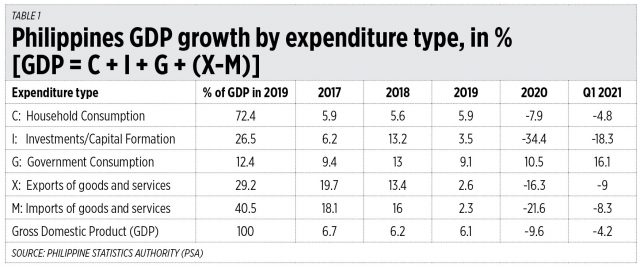
For (1), it has been done — government spending grew double-digits in 2020 and Q1 2021 but this was not enough, or government may have worsened contraction in household spending and private investments because these two constitute the largest portions of GDP (see Table 1).

Spain and the UK also did (1), their budget balance as percentage of GDP expanded four to six times: for Spain, -2.9% in 2019 to -11.5% in 2020, and for the UK, -2.3% in 2019 to -13.4% in 2020. And yet they are the worst performing countries among the world’s top 50 largest economies in 2020: Spain’s GDP was -11.0% and the UK’s GDP was -9.9% (see https://www.bworldonline.com/10-reasons-to-lift-the-lockdown/, April 26).

There is a close positive relationship between power generation and GDP growth, so if we want to propel faster and sustained economic recovery, our electricity production and power supply should rise more at competitive and cheaper prices. In Table 2, I divided the selected countries (all belong to the top 50 largest economies in the world) into group A, Europe; group B, North and South America’s largest economies, and group C, major East Asian economies.

Table 2 shows two important trends:

One, as experienced by many countries, as the percent change in power generation declines from the 2000s to 2010s, average GDP growth also declines.

Two, European economies with low and anemic growth have a high share of wind-solar over total power generation. Conversely, Asian economies with fast growth have a low share of wind solar over total power generation.

The Philippines needs to prioritize more growth and economic dynamism, more businesses and job creation, and this is possible only with more fossil fuel use, not less. Or use nuclear power but many people are still scared of it.

Efforts to attain “net zero” carbon emission by 2050 or 2040 for the Philippines will be counter-productive and poverty expanding, not reducing. As of 2020, wind + solar + biomass combined contributed only 3.5% of total electricity generation. Geothermal + hydro contributed 17.7% of the total. So, the total RE share is 21.2% of total electricity generation. To demand that this should rise to 100% by 2050 is unrealistic and irrational.

Concerns about climate change is understandable but climate change is natural (nature made), not man-made. It is cyclical (warming-cooling) and not “unprecedented, unequivocal warming” since the planet Earth was born about 4.6 billion years ago. We do not “fight” what is naturally and cyclically occurring and, in the process, condemn our economy and people to perennial poverty.


Bienvenido S. Oplas, Jr. is the president of Minimal Government Thinkers

minimalgovernment@gmail.com

Filipino Louie Sangalang proving worth on ONE’s The Apprentice

FILIPINO LOUIE SANGALANG has been impressive on The Apprentice: ONE Championship Edition with his business acumen and toughness in the physical challenges, allowing him to be a consistent contestant of note in the program. — ONE CHAMPIONSHIP

By Michael Angelo S. Murillo, Senior Reporter

THE ONE Championship edition of The Apprentice is nearing the homestretch and one of the candidates proving his worth and flourishing is Louie Sangalang from the Philippines.

As of this writing, Mr. Sangalang, 43, is the only male candidate left standing and one of five contestants still in the running for the $250,000 job offer to be the protégé of ONE chairman and CEO Chatri Sityodtong and his chief of staff at the ONE Championship Global Headquarters in Singapore.

The former mixed martial arts fighter and corporate executive has been impressive with his business acumen and toughness in the physical challenges, allowing him to be a consistent contestant of note on the program.

In a recent media availability with Filipino sports journalists, Mr. Sangalang shared that finding the right balance and taking things as they come have been serving him well up to this point.

“I didn’t really have a game plan coming into the competition because I didn’t know what to expect. So my preparation was quite simple: I told myself that I’m just going to be my best professional self and practice mental toughness, then I will adapt to the situation along the way,” said Mr. Sangalang, who also made a mark as the first Filipino cancer survivor to finish the North Pole Marathon.

As further proof of his consistency, of all the 16 candidates in the show he is the only one who has stayed undefeated as a project manager.

It is the same course he wants to stay in all the way to the end.

He went to say that the competition gets only tougher as it moves to the finish and that each and every one of them still in the mix are deserving to win.

But he is confident of what he can bring to the table and reiterated that he is out to win it all.

“What matters is proving one’s self. Chatri found strong characteristics and abilities in each one of us. So it doesn’t matter whether you’re male or female. We’re here and there’s a reason why we’re here. Probably, Chatri sees some greatness in us that he believes he can unlock once he chooses ‘the one,’” he said.

“From my end, my mind-set is when you’re part of something, you have to make yourself valuable. Make your mark, show that you bring value.”

Apart from Mr. Sangalang, still in contention in The Apprentice: ONE Championship Edition are Irina Chadsey of Russia, Jessica Ramella of Venezuela, Minca Millington of the United States, and Paulina Purnomowati of Indonesia.

The Apprentice: ONE Championship Edition is hosted by Mr. Sityodong, who has an estimated net worth of $350 million. It can be seen in the Philippines every Thursday on AXN at 8:50 p.m. and on Mondays on One Sport at 9 p.m.