Home Blog Page 8005

Coco Levy Trust Fund Act ‘marginalizes farmers’

THE recently signed Republic Act No. 11524 or the Coconut Farmers and Industry Trust Fund Act has “serious” deficiencies, including the marginalization of farmers, according to the Federation of Free Farmers (FFF).

In a mobile phone message, FFF Chairman Leonardo Q. Montemayor said coconut farmers are not represented in the Trust Fund Management Committee created after the law was passed.

“(There is) no coconut farmer representation in the Trust Fund Management Committee chaired by the Finance Secretary. Yet the trust funds came from levies on coconut farmers,” Mr. Montemayor said.

“The new law seriously marginalizes coconut farmers, who are excluded from the powerful trust fund committee,” he added.

Under Section 10 of the new law, a trust fund management committee will comprise representatives from the Departments of Finance, Budget and Management, and Justice, with the Bureau of the Treasury as the committee secretariat.

The committee is charged with setting of investment priorities and asset allocation, among others.

Signed by President Rodrigo R. Duterte late Friday, the law places coconut levy assets in a trust that will modernize the coconut industry and help improve the lives of farmers.

The modernization process will follow a development plan prepared by the Philippine Coconut Authority (PCA).

The law directs the Bureau of the Treasury to transfer P10 billion to the trust fund in the first year, followed by another P10 billion in the second year, P15 billion in the third year, P15 billion in the fourth year, and P25 billion in the fifth year.

Mr. Montemayor, a former Agriculture Secretary, noted that another deficiency of the law is the division of the P5-billion annual budget allocation among various government agencies.

According to the law, an initial P5 billion will be available for the implementation of programs like the development of hybrid coconut seed farms, crop insurance, training, and credit access, among others.

“Many of these agencies are not engaged in the coconut industry. Farmers and farmers’ groups will be dealing with so many of them for credit, equipment, training, farm roads, etc.,” Mr. Montemayor said.

“Agencies like the Commission on Higher Education (CHED), Department of Public Works and Highways (DPWH), Development Bank of the Philippines (DBP), and Technological Education and Skills Development Authority (TESDA), to my knowledge, have minimal or no direct involvement,” he added.

Agriculture Secretary William D. Dar said in a statement Saturday that the law will be a “game changer” and pave the way for the industrialization of the industry.

“This ushers in a new policy that will set in motion big reforms in the coconut industry using efficiently the proceeds of the coconut levy for the benefit of 2.5 million coconut farmers and their families, and the coconut industry in general,” Mr. Dar said.

Mr. Dar said the PCA board will comprise the Secretaries of Agriculture, Finance, Budget, Science and Technology, and Trade, as well as the PCA administrator and three coconut farmer representatives from Luzon, the Visayas, and Mindanao.

According to the Department of Agriculture (DA), the Philippines is the world’s second-largest producer and number one exporter of coconut products.

However, the DA said the coconut sector has faced lower productivity due to the reduced harvest area and lower yields.

Citing data from the PCA, the total area planted to coconut was 3.6 million hectares in 2018, with 347 million standing trees yielding about 44 nuts per tree a year.

“While we are replanting with high-yielding coconut varieties, our efforts are not enough due to limited budget. But with the coconut industry trust fund, we could do much more.”

In the same statement, PCA Administrator Benjamin R. Madrigal, Jr. said the PCA made changes in its organizational structure to be more efficient in addressing the needs of coconut farmers.

Mr. Madrigal said the PCA has established regular regional and provincial industry fora that gather the input of coconut farmers’ groups, government agencies, local government units, and other stakeholders.

Former President Ferdinand E. Marcos and his associates imposed the coconut levy on farmers, promising to improve the industry with the proceeds as well as a share of the investment returns.

However, the money was diverted to purchase corporate assets like the United Coconut Planters Bank and San Miguel Corp.

In 2019, Mr. Duterte vetoed a previous version of the measure, citing inadequate safeguards to prevent wealthy coconut farmers from taking control of the trust. — Revin Mikhael D. Ochave

The lost freedom to explore inspires Burberry’s Tisci

LONDON — Burberry’s Riccardo Tisci said the dream of being able to explore — a freedom denied during coronavirus disease 2019 (COVID-19) lockdowns — had inspired his first menswear-focused collection for the British luxury label.

“Enclosed indoors, I dreamt of the outdoors and its beauty, fueled by the thought of the creativity that comes when we are together,” Mr. Tisci said.

“With this dream in mind, I became fascinated by the widespread British craft and outdoor movements of the early 20th century, when people escaped to explore the unknown countryside.”

Outerwear was a focus in the Autumn/Winter 2021 collection, filmed at Burberry’s flagship Regent Street store in central London before being released on social media channels on Feb. 22.

Burberry’s traditional trenches were re-imagined with pleats, panels and fringes, while the color palette centred on tonal shades of beige, bark brown, oxblood burgundy and city greys.

Mr. Tisci joined the 165-year-old brand in 2018 to give creative direction to chief executive Marco Gobbetti’s repositioning of the house further upmarket.

His designs have attracted new younger customers, particularly in the important Chinese market.

Like other labels, Burberry has been hit hard by global restrictions on shop opening and travel and tourism.

It reported a 9% decline in sales in its third quarter, a bigger drop than the 6% in the second quarter.

The company said last month trading would remain susceptible to regional disruptions but it was confident of rebounding when the pandemic eased given the brand’s resonance with customers. — Reuters

Volkswagen PHL brings in 2021 Santana

VOLKSWAGEN PHILIPPINES recently introduced the 2021 version of its Santana subcompact sedan. The updates are reflected on both the 180 MPI AT S and 180 MPI AT SE variants.

The sedan, which has one of the longest wheelbases in its class (promising a stable ride and enhanced comfort) now gets automatic headlights with Leaving Home and Coming Home function, front fog lamps, intermittent control wipers with rain sensor, and a sunroof for its SE trim.

Power features are included in the S variant, while additional specs are available for the SE. These include leather and fabric seat material, a front center armrest with height adjustment, front and rear door pockets with bottle holder, front and rear reading lights, and a multifunction steering wheel with cruise control. The SE gets a touchscreen infotainment system with radio, USB, Bluetooth, and six speakers. A seven-inch infotainment with Apple CarPlay and Android Auto is available as a dealer option.

The Santana is still powered by the familiar 1.5-liter engine delivering 111ps and 145Nm, mated to a six-speed automatic transmission. It has Volkswagen’s BlueMotion technology, which results in frugal fuel consumption.

Standard safety features include dual front air bags, electronic stability program, anti-lock brakes, and anti-slip regulator. Additional features in the SE are driver and front passenger side air bags and rear parking distance control.

The Volkswagen Santana gets a comprehensive three-year/100,000-km-warranty coverage, yearly preventive maintenance service for every 10,000 kilometers, and 24/7 emergency roadside assistance. The vehicle comes in Polar White, Reflex Silver, and Deep Black, and is priced at P755,000 for the 2021 Santana 180 MPI AT S, and P898,000 for the 2021 Santana 180 MPI AT SE. For more information, visit www.volkswagen.com.ph or like and follow Volkswagen PH’s Facebook and Instagram accounts.

Analysts’ February inflation estimates (2021)

HEADLINE INFLATION is likely to have breached the central bank’s target for a second straight month in February, as food and fuel prices remain elevated, according to economists. Read the full story.

Analysts’ February inflation rate estimates (2021)

Vaccines, inflation, and GDP recovery to drive financial markets this year

By Michelle Anne P. Soliman

THE FOURTH QUARTER of 2020 saw local financial markets rebound somewhat with reports of the COVID-19 (coronavirus disease 2019) vaccine developments and expectations of economic recovery driving performance during the period.

The peso averaged P48.27 against the dollar in the October to December period, appreciating 1.37% from the previous quarter’s average of P48.94:$1, Bangko Sentral ng Pilipinas (BSP) data showed. Likewise, the local unit appreciated by 5.4% compared with the P50.99-to-a-dollar average seen in the fourth quarter of 2019.

Meanwhile, Treasury bill (T-bills) auctions conducted in the last three months of 2020 saw robust demand with total subscriptions of reaching around P918.91 billion, which is around four times the P230-billion aggregate offered amount. This oversubscription amount of P688.91 billion was higher compared with the P626.08 billion posted in the previous quarter.

Similarly, auctions of Treasury bonds (T-bonds) during the period had a total subscription amount of P453 billion, around 2.5 times more than the offered amount of P180 billion.

At the secondary market, domestic yields were lower by a range of 4.8 basis points (bps) for the 91-day T-bill to 29.30 bps for the three-year T-bonds compared to end-September 2020 levels.

Quarter on quarter, most of the tenors saw their yields fall except those for the 10-, 20-, and 25-year debt papers, which rose by 1.6 bps, 8.9 bps, and 7.4 bps, respectively. Yields were lower by an average of 12.28 bps during the reference period, according to the PHP Bloomberg Valuation Service Reference Rates published on the Philippine Dealing System’s website.

For equities, the benchmark Philippine Stock Exchange index (PSEi) closed at 7,139.71 on Dec 29, 2020, 21.8% higher compared with the PSEi close of 5,864.23 on Sept. 30, 2020.

In an e-mail to BusinessWorld, the BSP said movements in the fourth quarter were driven mainly by macroeconomic developments as well as the developing COVID-19 situation in the country and the government’s policy measures in response to the pandemic.

“Positive developments on vaccine advancements would continue to positively impact the financial markets. Information on existing vaccines’ efficacy to the new virus strain would significantly boost market confidence. Vaccines could potentially steer the domestic and global economy towards recovery,” the BSP said.

For the equities market, the BSP pointed to various factors, which include among others the improvements in the earnings performance of listed companies in the third quarter, the optimism surrounding the prospects of an economic rebound following plans to gradually reopen the economy, the expected pickup in spending amid the holiday season, and the central bank’s implementation of further monetary stimulus measures such as the P540-billion provisional advances to the National Government and the 25-bp policy rate cut in November last year.

“Meanwhile, local firms opted to tap the bond market as an alternative funding option amid the tightened lending requirements as banks manage their capital and nonperforming loans,” the BSP added.

On the other hand, the central bank said the lingering difficulty in procuring vaccine doses in developing countries posts a downside to this outlook.

“The Philippines and Vietnam, for instance, have only secured doses for 5.1% and 6.2% of their populations, respectively. Though this may have already improved as negotiations continue with vaccine manufacturers,” it said.

Moreover, the BSP noted the emergence of the new virus strain “can necessitate prolonged restrictions on movement and economic activities.”

“This can further strain economic recovery and result in volatility in financial markets. For countries struggling to contain outbreaks, this can prolong the economic pain,” the BSP said.

“Good management of the vaccine drive will be essential, especially for developing markets such as the Philippines…,” it added.

While these factors affecting financial markets could potentially linger in 2021, the central bank looks to the proposed implementation of fiscal reforms such as the Government Financial Institutions Unified Initiatives to Distressed Enterprises for Economic Recovery (GUIDE) bill, which seeks to provide financial assistance to distressed micro, small and medium enterprises;  and the Financial Institutions Strategic Transfer (FIST), which seeks to help banks and other financial institutions recover from potential losses.

Meanwhile, private sector economists see inflation as a major indicator that could affect growth.

“The higher-than-expected uptick in domestic headline inflation may altogether keep monetary policy rates at all-time low as the BSP juggles that difficult job of helping the economy recover and keeping price stability,” UnionBank of the Philippines, Inc. Chief Economist Ruben Carlo O. Asuncion said.

Bank of the Philippine Islands Lead Economist and Vice-President Emilio S. Neri, Jr. said they are observing upside risks which will likely prop up the inflation rate above three percent in the coming months.

“The distribution of vaccines around the world in 2021 may lift global demand and push oil prices higher. However, even at current levels ($47), oil is expected to register a 180% year-on-year increase in the second quarter given the low base from last year,” Mr. Neri said.

Headline inflation stood at 3.5% in December 2020, bringing the average inflation for the year to 2.6% — matching the BSP’s forecast for the year, but still faster than the 2.5% recorded in 2019.

To recall, the average inflation rate registered in 2018 at 5.2%, the fastest since 2008’s 8.2%, was driven by swelling crude oil prices in the world market.

“Inflation is fast becoming an issue and will likely threaten the economic recovery,” said ING Bank N.V. Manila Senior Economist Nicholas Antonio T. Mapa, adding the upcoming presidential elections in 2022 may also affect market sentiment this year with “increased spending and political maneuvering.”

Rizal Commercial Banking Corp. Chief Economist Michael L. Ricafort looks to increased infrastructure this year to pump-prime the economy as supported by the timely approval of the 2021 national budget, as well as the extension of the appropriation/funds availability for 2020 national budget to end-2021 and for the Bayanihan II to end-June 2021.

Of the P4.506-trillion 2021 national budget, the Department of Public Works and Highways was given the second largest allotment of P694 billion, following the health sector with P287 billion.

PROSPECTS FOR GDP RECOVERY
The country’s gross domestic product (GDP) shrank by a record low 9.5% in 2020 — the fastest year-on-year decline since the 1940s — following the 8.3% contraction posted in the fourth quarter.

For this year, Mr. Neri expects the GDP to still contract, albeit at a slower pace than what was seen in 2020. He also considered the possibility of a double-digit growth in some quarters, assuming the government will refrain from imposing stricter quarantine restrictions.

“Given all these, our baseline forecast for 2021 is now at 6.8% as the [fourth-quarter] print exceeded our expectations. However, even at this brisk pace, economic output will not be able to return to the 2019 level yet and a full recovery may only happen in 2022…,” he said.

Meanwhile, Mr. Asuncion expects better GDP performance this year to drive financial markets this year.

“Historically, equities move up when the economy performs better. Fixed-income markets, like today in this crisis, take advantage of profit opportunities, not on the long-end but on the short and belly of the curve. Players will wait for better prospects before deciding to position longer. For forex, if the economy performs better, it is expected that the Peso will depreciate and help trade perform better,” Mr. Asuncion said.

Mr. Mapa shared this view, adding government spending and the Treasury’s borrowing program “will also come into play” although neither would likely figure in the country’s economic performance at the onset.

Mr. Ricafort said further reopening of the economy will lift hopes of coming back to the 6% growth trajectory. “The negative GDP base for 2020 at -9.5% would mathematically increase the odds of a GDP growth of at least 6% for 2021, provided that the economy reopens further, including easing of some restrictions of public transportation that allows greater productivity for the labor force…,” he said.

With these in mind, see the BSP’s and analysts’ outlook for each of the key markets.

FIXED-INCOME SECURITIES
BSP: Domestic bond market is expected to be liquid and have robust demand as the BSP continues to ensure the proper functioning of financial markets. With the market flushed with liquidity and with lingering uncertainty, some (most) market players will possibly continue placing funds in safe havens, as evidenced by the high oversubscription consistently seen in the weekly Bureau of the Treasury (BTr) auctions.

Security Bank Corp. Chief Economist Robert Dan J. Roces: For [the first-quarter of 2021], while the economy is projected to pick up this year, the pace looks slow while downside risks remain with regard to the rising COVID-19 cases as well as issues with vaccine procurement. In the meantime, we expect yields to be range-bound with a slight upward bias. As usual, volatility may be triggered by RTB’s (retail T-bonds), policy rate signals, and black swan events.

Mr. Asuncion: Market will look to the BSP and what will be its next move: to cut further or to hold for a long time. Steeper US treasuries pushing BTr to accept incrementally higher long bond yields amid rising inflation risk providing guidance on direction of longer-tenor bonds.

Mr. Ricafort: The sustained and lingering excess liquidity in the financial system would help keep short-term interest rates relatively low. Further monetary easing measures remain possible to do more of the heavy lifting for the economy amid the limited funds for any additional stimulus measures. Federal Reserve officials signalled that the key Fed Funds Rate could remain at the record low of 0.00%-0.25% over the next two to three years in able to help support economic recovery after the COVID-19 pandemic by way of lower borrowing costs.

Mr. Mapa: We may see a steepening of the yield curve with inflation forcing a correction for longer dated issues with short dates still anchored due BSP’s accommodative stance.  Increased borrowing by the BTr or any other development that may cause tightening of liquidity conditions may also force the entire yield curve higher.   

Mr. Neri: BSP officials have suggested that they intend to keep interest rates low until the economy returns to its pre-pandemic growth rate, so there’s a chance that government securities rates will stay at current levels. But then higher inflation in the coming months and government borrowings to fund deficit spending may pose a challenge and may cause the yield curve to steepen. The market also looks to the fiscal stimulus program of the incoming Biden administration, and its impact on US debt yields as well.

EQUITIES
BSP: In 2021, the PSEi is expected to continue to rise amid expectations of economic recovery due to continued improvement in demand. Although the decline in household income amid the pandemic has forced consumers to tighten their spending, ecommerce and the widespread use of delivery services can help offset the decline in consumer spending.

Mr. Roces: With the expectation of a long pause in policy rates at low levels and some recovery in corporate earnings and economic activity, the environment would be more favorable to risky assets than risk-free. Our view is that any weaknesses in the market are an opportunity to increase exposure, especially in cyclical names that can leverage on the economic recovery.

Mr. Asuncion: Local equities will continue to dominate trading and the PSEi’s direction, although the macroeconomic backdrop may not be as upbeat relative to offshore market developments. Local vaccine news may provide positive gains including positive corporate earnings reports or those that will mimic [fourth quarter of 2020] GDP’s improvement.

Mr. Ricafort: Further rollout of COVID-19 vaccines worldwide and eventually in the country would help reduce new COVID-19 cases that would justify further reopening of the economy, such as easing Metro Manila’s GCQ (since June 2020) to MGCQ that allows increased capacity for many businesses/industries, as well as further easing of restrictions on public transportation, thereby could lead to higher production, sales, incomes/livelihood, and higher investment valuations.

Mr. Mapa: Equities will move sideways with bouts of rallies when GDP shows a headline grabbing growth prints by the second quarter. Market remains susceptible to sell-offs once investors realized that despite the façade of strong growth, economic activity remains well-below pre-pandemic levels.

Mr. Neri: The performance of local stocks will depend on the pace of the country’s recovery, the management of the pandemic, and subsequent rollout of the vaccines. If we’re able to avoid another lockdown, equities might stay within the 7,000-7,500 range.

FOREIGN EXCHANGE (FX) MARKET
BSP: Over the near term, the peso should continue to reflect emerging demand and supply conditions in the FX market as well as the continued soundness in the country’s macroeconomic fundamentals. Meanwhile, the impact of expected weaker inflows (i.e., decline in exports and tourism receipts) should be offset by favorable investor sentiment over the strong position of the economy, including in terms of sound debt management and adequate FX cover.

Mr. Roces: For FX, year to date, the PHP (Philippine peso) ranks eighth in the region and could be signaling a slowdown in its appreciation trajectory.

Mr. Asuncion: Regardless of what the BSP does, the balance of payments surplus outlook will stoke the PHP’s further strength. On the flipside, rising gross international reserves supports an upward push on the PHP further. BSP seems serious about maintaining the psychological P48-level no matter what. And since BSP has been committed to the prevailing record low interest rate setting and a lavish liquidity backdrop, keeping price stability may come in the guise of a stronger PHP that can imports further.

Mr. Ricafort: The peso exchange rate has been hovering among the strongest levels vs. the US dollar in more than four years at a little over P48, as supported by slower demand for imports amid softer demand in the economy since the COVID-19 pandemic, as well as relatively weaker US dollar vs. major global currencies among 2.5-year lows recently after US interest rates reached record lows near zero during the COVID-19 pandemic.

Mr. Mapa: PHP should remain supported in the near term as import demand is expected to remain soft in the coming months as economic activity stays well below pre-pandemic levels.

Mr. Neri: With the economy slowly reopening, we expect imports to recover further in the coming months in line with the expected improvement in local demand. Hence, dollar demand may pick up and the exchange rate may move closer to the 49 level. A risk to this outlook is government underspending, especially in infrastructure. With businesses still struggling, the lack of fiscal support and public construction may stall the recovery and dampen the demand for capital goods.


DAR reduces land distribution duration to four months

THE PROCESS of land acquisition and distribution under the Comprehensive Agrarian Reform Program has been reduced to four months, the Department of Agrarian Reform (DAR) said.

Acting Agrarian Undersecretary Elmer N. Distor said in a statement that the process used to take six months, but has been accelerated in compliance with the government’s directive to finish land distribution on or before June 2022.

“Now that we have simplified the process of acquiring and distributing land, we are confident that we can make our agrarian reform beneficiaries’ dream — own a farm lot — come true,” Mr. Distor said.

Agrarian Reform Undersecretary Carim L. Panumpang warned farmer-beneficiaries to not sell their farm lots and threatened them with blacklisting for any future programs. Repossession proceedings will be initiated against lot buyers, he added.

Undersecretary Virginia N. Orogo said DAR personnel will be visiting agrarian reform beneficiaries to gather information on their current economic standing and the status of the awarded farm lots. — Revin Mikhael D. Ochave

Budget-friendly home redesign tips from expert

FROM repurposing old knick-knacks to handcrafting personalized home décor, an interior design expert shares her budget-friendly tips and tricks on how to restyle rooms and studio apartments.

“Nowadays, because of the pandemic, 90% of our time is spent at home. It made us assess what is missing or what needs to be done,” interior designer Katherine Anne Correa, the Chairperson of the Interior Design Program of the De La Salle-College of Saint Benilde School of Design and Arts,  explained.

According to Ms. Correa, first on the to-do list is to declutter. Identify which items can be disposed of or can be upcycled and reused. “When you rearrange and fix your space, it feels rejuvenating,” she said. “Somehow we feel like we enhanced some parts of our lives. This is actually therapeutic.”

Repainting could be next on the list. A repainted accent wall gives a new vibe, while wallpaper is another option. “There are a lot of wallpapers that are less expensive,” she noted. “You can buy sticker options that are affordable and are easy to install. I actually did a whole plan using this type.”

For those who wish to accentuate their spaces and get extra crafty, Ms. Correa suggests exploring découpage or the art of decorating an object by blending recycled colored paper cut-outs, special paint effects and art elements. “You can use old books, paint it over with a polyurethane finish and hang it on your shelves,” she said.

Large mirrors may be a great addition to a wall, both as an aesthetic yet functional piece and as a tool to double the impression of space in any tiny zone. “This is a trend now and a lot of different styles of mirrors have been coming out in the market,” Ms. Correa said.

Refurnishing does not necessarily mean purchasing new furniture. Old wooden chairs may be repainted or reupholstered with bright colors for a refreshing new look, while night tables may be constructed out of a pile of old hardbound books. “Use an upcycled bottle and add dried flowers as an accessory or wrap some fairy lights around it — this will serve as your bedside lamp,” she said.

For those who think they need new furniture, Ms. Correa suggests visiting flea markets or thrift shops first. “The items are second hand but are a lot cheaper,” she noted. “There are a lot of good buys if you know what you are looking for.”

“Accentuate [a space] with personalized crocheted or handwoven bedspreads and throw pillows. You can also buy traditional weaves such as inabel or inaul.”

She believes it is possible to achieve a trendy, stylish, and “Instagrammable” home without spending much. The keyword: Do-it-yourself. “DIY projects always make for reasonable and affordable home décor,” she said.

Porsche tops 2021 JD Power dependability ranking among European brands

PORSCHE is the best European automotive brand, according to the JD Power 2021 US Vehicle Dependability Study (VDS). The honor was helped to be realized by the Porsche 911, which ranked first among all models in terms of trouble-free ownership (the second time in three years it has achieved the feat), and the Porsche Macan, cited as most dependable among premium compact SUVs.

Porsche customers reported 18 fewer PP100 in the latest study to bring the overall score down to 86 PP100, compared to this year’s luxury average of 118 PP100. The 911 came in with 57 PP100, the fewest of any model across the automotive sector.

PP100 represents the number of problems per 100 vehicles experienced during the past 12 months by original owners of three-year-old vehicles. A lower score reflects higher dependability, and the study covers 177 specific problems grouped into eight major categories of vehicle features, such as infotainment systems, engine and transmission, and interior and exterior equipment.

Said Porsche Cars North America, Inc. President and CEO Kjell Gruner, “Porsche strives to make our customers’ sports car dreams come true. It is gratifying to see our iconic 911 and Macan exemplify our commitment to developing, building and maintaining exciting and dependable Porsche vehicles.”

Meanwhile, the Porsche 718 Cayman won its category in the JD Power 2020 US Best Resale Value Awards. In the study, the 718 Cayman was found to retain more of its value than any other model in its class.

The latest VDS reveals vehicle dependability is at an all-time high, with the overall level of problems cited by owners declining 10% from a year ago. The 2018 model-year vehicles measured in this year’s study were first examined in the JD Power 2018 US Initial Quality Study when new-vehicle quality had improved for the fourth consecutive year and reached its best level. Six of the 10 brands that ranked highest in that study also appear among the 10 highest ranked in the 2021 VDS. This is the 32nd year of the survey.

DITO to bring 5G tech to Davao City by late 2022; Eastern Communications starts service for businesses

DAVAO CITY — DITO Telecommunity Corp. is aiming to bring in 5G technology to Davao City by 2022, simultaneous with the company’s planned rollout of the fifth generation (5G) technology in other parts of the country.

As the newest telecommunications industry player prepares to officially launch services in the central and southern parts of the Philippines by March 8, DITO Chief Administrative Officer Adel A. Tamano said they are already planning on the network upgrade by next year.

“Our purpose is to bring the first world not just 4G, but 5G technology in the Philippines so we will start off initially with 4G technology, but it is 4G convertible to 5G,” he said during the online forum hosted by the Davao City Chamber of Commerce and Industry, Inc. on Friday.

“And hopefully by the latter part of next year, we can bring the 5G in Davao City and the rest of the country,” he added.

DITO will start its commercial operations in 17 cities of the Visayas and Mindanao, and launch later this year in Metro Manila and other parts of Luzon.

“Part of it is because we are Mindanao-based, but also because we truly believe that we want to send a different message that the DNA of DITO is to serve the underserved,” Mr. Tamano said.

DITO, formerly known as Mindanao Islamic Telephone Company, Inc., is a joint venture of Davao City-headquartered Udenna Corp., Chelsea Logistics Holdings Corp., and China Telecommunications Corp.

EASTERN COMMUNICATIONS
Meanwhile, internet service provider Eastern Communications, which is said to be the country’s oldest telecom firm, has started offering its products to Davao City.

“We have recently opened businesses in Davao City, in the CBD (central business district) in Metro Davao, but we also have plans of covering as well areas outside of the CBD,” Eastern Communications Strategic Segment Marketing Head Tonie Casas said in another forum on Friday hosted by the European Chamber of Commerce.

The company is initially providing services to business clients.

“With the addition of Eastern in Davao, you can now really rely on additional bandwidth for the businesses… 100 gigabytes per second,” Mr. Casas said.

He added that they are currently rolling out cables “that will address the need of Mindanao for connectivity.”

Eastern Communications allocated a P2.8-billion capital expenditure budget in 2020 for the expansion of its coverage in various parts of the country, including Tarlac, Cagayan Valley and La Union in Luzon, Iloilo and Bacolod in the Visayas, and Davao and Cagayan de Oro in Mindanao. — Maya M. Padillo and Marifi S. Jara

Challenges for big banks continue in Q4 2020 as total loans decline, soured loans grow

THE COUNTRY’S biggest banks lent less to households and firms in the fourth quarter of 2020, as profits fell and soured loans increased amid the coronavirus pandemic. Read the full story.

Challenges for big banks continue in Q4 2020 as total loans decline, soured loans grow

Economic rebound, asset quality to drive bank stocks — analysts

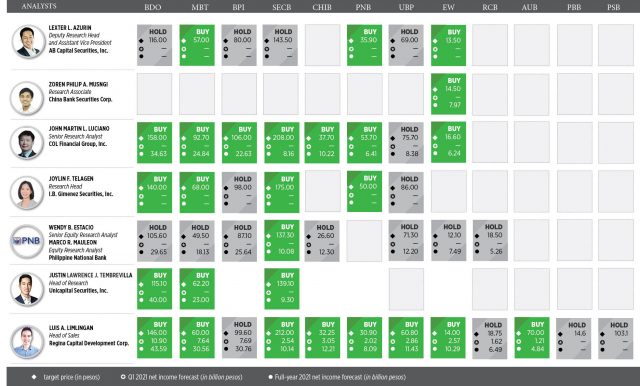
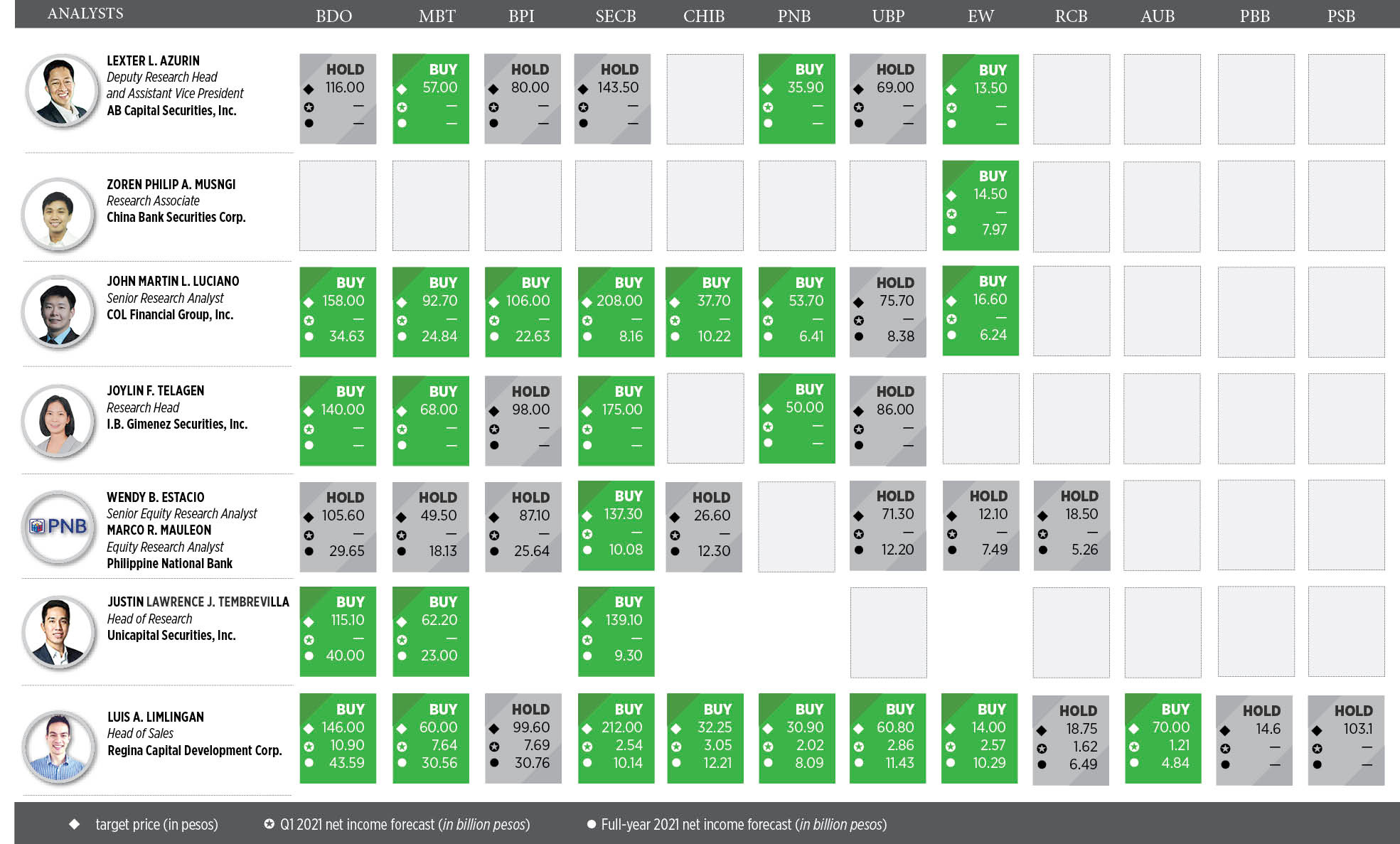
ANALYSTS expect bank stocks to perform better this year as market players look for catalysts that will aid on economic recovery, but noted banks’ provisions for credit losses to continue weighing down on their outlook.

The barometer Philippine Stock Exchange index (PSEi) jumped 21.8% in the fourth quarter of 2020, a reversal from the 5.5% decline in the previous quarter and faster than the 0.5% pace logged in the same period in 2019.

Likewise, the financials subindex, which included the banks, surged by 26.8%, a big rebound from the 7.5% drop in the third quarter.

The fourth quarter period saw all of the 14 listed banks logged quarter-on-quarter increments on their share prices with 12 posting double-digit increases. Among the banks, Security Bank Corp. (ticker symbol: SECB) marked the biggest climb at 45.4%, followed by Philippine Business Bank (PBB, 35.0%), UnionBank of the Philippines, Inc. (UBP, 32.7%), Metropolitan Bank & Trust Co. (MBT, 28.4%), Philippine Bank of Communications (PBC, 26.0%), East West Banking Corp. (EW, 25.4%), Philippine National Bank (PNB, 25.4%), Bank of the Philippine Islands (BPI, 24.1%), BDO Unibank, Inc. (BDO, 23.8%), China Banking Corp. (CHIB, 14.7%), Rizal Commercial Banking Corp. (RCB, 14.4%), Philippine Trust Co. (PTC, 12.1%). Philippine Savings Bank (PSB, 5.2%), and Asia United Bank (AUB, 0.9%).

“In a broader sense, the pandemic is still the greatest influence over the banks’ 2020 profitability. Demand for loans is likely still muted in the fourth quarter for both the retail and corporate client bases,” Regina Capital Development Corp. Head of Sales Luis A. Limlingan said.

For Philippine National Bank (PNB) Senior Equity Research Analyst Wendy B. Estacio and Equity Research Analyst Marco R. Mauleon, the share price increases among listed banks were driven by the overall bullish investment sentiment during the October to December period.

“There were more bullish investors in the [fourth quarter 2020] as news on the vaccine started coming out as interest rates in the Philippines continued to go down,” they said.

The fourth quarter saw the Bangko Sentral ng Pilipinas (BSP) cut rates unexpectedly by 25 basis points (bps) in their November policy meeting and then maintaining these rates in its final meeting in December. In total, the BSP slashed benchmark interest rates by 200 bps last year, bringing down the overnight reverse repurchase, lending, and deposit facilities to record lows of 2%, 2.5%, and 1.5% respectively. These settings were likewise maintained in its first policy meeting this year.

Unicapital Securities, Inc. Head of Research Justin Lawrence J. Tembrevilla said the low interest rate environment persists to be beneficial for banks to book higher net interest income on the back net interest margin (NIM) expansion, as funding costs remain cheap.

In addition, Mr. Tembrevilla noted that provisions for loan losses continued as the “main focal point” for banks in the fourth quarter.

BSP data on universal and commercial banks (U/KBs) showed NIM — the ratio that measures banks’ efficiency in investing their funds by dividing annualized net interest income to average earning assets — improved to 3.58% as of December 2020 versus 3.44% in December 2019.

Meanwhile, provision for credit losses on loans and other financial assets among universal and commercial banks (U/KBs) reached P192.71 billion in the fourth quarter, 4.3 times more than the P45.13 billion recorded in the same three months in 2019.

Unsurprisingly, this increase in provisions dragged net income among U/KBs in the fourth quarter. For the period, the country’s biggest banks booked a P142.56 billion in net income, 32.6% lower than the P211.57 billion posted in the same period in 2019.

Meanwhile, the nonperforming loan (NPL) ratio among U/KBs stood at 3.11% at end-December 2020, lower than 3.26% in November but still higher than the 1.57% in end-December 2019.

The banks’ asset quality remains the “main theme for 2021” along with the potential recovery of loan demand following the contraction seen last year, COL Financial Group, Inc. Senior Research Analyst John Martin L. Luciano said.

“The improvement in the visibility of asset quality generally drove the banks’ share prices higher. Recall that banks underperformed last year (before third quarter results) on the back of the uncertainty caused by the loan moratorium under Bayanihan I (Republic Act No. 11469 or the Bayanihan to Recover as One Act),” Mr. Luciano said.

The Bayanihan I gave a one-month debt holiday to borrowers, which expired on June 24 last year. Another 60 days were granted upon passage of Bayanihan II that expired in December.

OUTLOOK
Analysts expect listed banks to be among those that will perform better this year.

“We expect the sector to benefit from the gradual recovery of the economy from the COVID-19 pandemic. Moreover, with the availability of the vaccines domestically, we believe that the government could further ease restrictions, boosting consumer and business confidence and ultimately increasing the demand for loans,” Mr. Luciano said.

“More importantly, the further reopening of the economy would allow more businesses to operate at higher capacities, which could temper the rise in NPLs,” he added.

Meanwhile, Mr. Tembrevilla expects listed banks to “perform slightly better” than the PSEi, explaining the financial sector will not be a “direct beneficiary” of a faster COVID-19 vaccine rollout.

“Banks have been somewhat resilient during the stretch of community quarantine, with bottom line impact deriving only from the front-loaded provisions for loan losses,” Mr. Tembrevilla said.

He also advised investors to keep an eye on the asset quality of banks amid expectations of faster NPL formation following the expiration of the loan moratorium under Bayanihan II last December.

“If banks managed to record NPLs below the consensus of 4-6%, then this should translate to a healthier macro backdrop and faster recovery trajectory,” he said.

Ms. Estacio and Mr. Mauleon shared a similar view, saying investors should be looking at how banks will be adapting to the lifting of the loan moratorium under the Bayanihan Act.

“This will give a clearer indication of how the pandemic affected the bank and the overall economy. Therefore, investors should continue watching out for banks’ capital buffers, which will provide cushion to potential deterioration in asset quality,” they added.

Ms. Estacio and Mr. Mauleon also noted that investors would likely consider adding banks that would be able to maintain or improve their NIM despite the low interest rate environment.

“Moreover, banks that will be able to exhibit acceleration in loan growth without damaging asset quality should also be a strong investment case. However, these should also result in profit growth for the bank,” Ms. Estacio and Mr. Mauleon said.

For China Bank Securities Corp. Research Associate Zoren Philip A. Musngi, investors will likely take positions in bank stocks once the outlook for economic recovery improves, noting the performance of banks to be “largely tied” to the state of the economy.

“[E]conomic outlook remains heavily predicated on pandemic containment efforts and vaccine rollout, so positive developments with regard to these should also consequentially affect investor sentiment for bank stocks,” Mr. Musngi said.

Mr. Musngi also advised investors to monitor “monetary policy actions and regulatory developments” that may drive interest into bank stocks such as the Corporate Recovery and Tax Incentives for Enterprises (CREATE) bill and the recently signed Financial Institutions Strategic Transfer (FIST) Act (Republic Act No. 11523).

The FIST law allows financial institutions to clean up their books by selling their soured loans to so-called FIST Corporations.

Meanwhile, the CREATE bill will immediately slash the corporate income tax (CIT) to 25% from 30%. It further cuts CIT to 20% for micro, small, and medium enterprises with net taxable income below P5 million and total assets below P100 million.

CREATE will also lower the minimum CIT to 1% from 2% from July 2020 to June 2023, as well as taxes on nonprofit hospitals and educational institutions to 1% from 10% within the same period.

The measure, which was originally known as the Corporate Income Tax and Incentives Reform Act, also streamlines the government’s fiscal incentives program. As of this writing, Congress has ratified the final version of CREATE, which is now awaiting President Rodrigo R. Duterte’s signature.

This is best time to “slowly accumulate” on bank stocks, said I.B. Gimenez Securities, Inc. Research Head Joylin F. Telagen.

“Financials are the biggest sector losers last year 2020 and I think the worst is over and time to slowly recover… [T]he best strategy is slowly accumulate bank stocks and be part of the portfolio. And since it’s coming from a low base, financials could possibly perform better than PSEi/other sector indices,” she said.

Mr. Limlingan said that investors interested in the banking sector should keep an eye out for the BSP’s decision on interest rates and reserve requirement ratio, as well as banks’ earnings performance, and loan and deposit appetite.

“The top three banks underperformed compared to the PSEi last year, especially during the beginning of the lockdown. Hence, their current levels are comparatively cheaper. It may attract some investors to position. However, earnings performance and progress in the vaccine will still play a role,” he added, referring to BDO, BPI, and MBT. — Jobo E. Hernandez

Yields on government debt climb on US Treasuries’ movement, inflation

YIELDS ON government securities (GS) jumped last week amid rising inflation expectations and US Treasury rates.

GS yields, which move opposite to prices, went up by an average of 21.97 basis points (bps) week on week, based on the PHP Bloomberg Valuation Service Reference Rates as of Feb. 26 published on the Philippine Dealing System’s website.

“The rising 10-year US Treasuries and rising inflation expectations were reasons for the rise,” Jonathan L. Ravelas, chief market strategist at BDO Unibank, Inc., said in a text message.

“Basically, the theme [last] week was higher interest rates on inflation concerns. Adding to the pressure is the same upward pressure in bond yields in US,” a bond trader said in a Viber message.

The Bangko Sentral ng Pilipinas (BSP) gave a February inflation forecast range of 4.3% to 5.1% last Friday on faster fuel and food price increases. This is already beyond the 2-4% inflation target this year and faster than two-year high of 4.2% in January.

The February inflation report will be released on March 5.

The central bank left benchmark interest rates untouched at record lows at its Feb. 11 policy meeting but adjusted its average inflation forecast for this year to 4% from 3.2% previously, citing upward pressures from food and oil prices. For next year, it trimmed its inflation forecast to 2.7% from 2.9%.

It will hold its next policy meeting on March 25.

Meanwhile, yields on the benchmark 10-year US Treasuries surged above 1.6% last week for the first time in a year amid weaker-than-expected bids for offered seven-year notes, Reuters reported.

US bond yields had accelerated last week after adjusting for inflation, an indication that central banks would begin to scale back ultra-loose policies even officials keep a dovish stance.

US Federal Reserve Chair Jerome Powell said on Wednesday that the US central bank would not tighten its policy until the economy gets better.

Back home, yields increased across the curve. Yields on the 91-, 182- and 364-day Treasury bills went up 14.67 bps, 5.26 bps, and 5.92 bps, to 0.9962%, 1.1131%, and 1.5555%, respectively.

At the belly, the rates of the two-, three-, four-, five-, and seven-year Treasury bonds (T-bonds) rose by 11.93 bps (2.1151%), 10.88 bps (2.4536%), 11.53 bps (2.7532%), 15.58 bps (3.027%), and 34.49 bps (3.4814%).

Rates on long-tenored papers likewise climbed, with the yields on the 10-, 20-, and 25-year T-bonds rising by 60.40 bps (3.893%), 41.35 bps (4.4601%), and 29.61 bps (4.3132%), respectively.

Analysts said bond yields will likely move sideways this week as the economic environment remains uncertain.

“Markets to remain wary given uncertainty over inflation…and will likely remain so until the BSP’s guidance, if at all, when the February inflation number is released on Friday,” Security Bank Corp. Chief Economist Robert Dan J. Roces said in an e-mail.

“Continue to expect interest rates to move sideways to up in the near term,” BDO’s Mr. Ravelas added.

“We see continuous upward pressure on yields ahead of the February CPI (consumer price index) data,” the bond trader said. — Lourdes O. Pilar