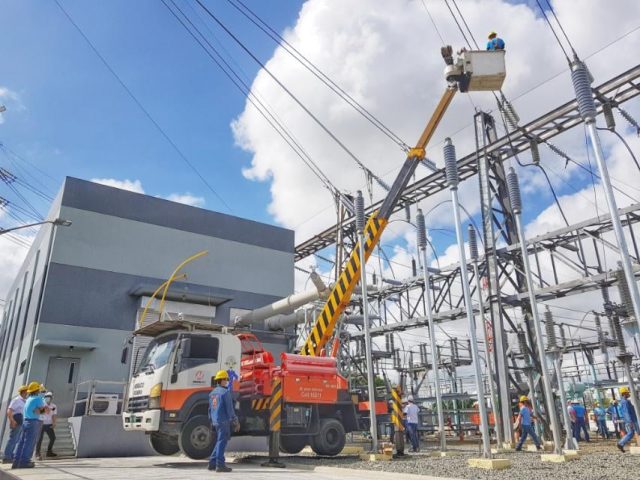
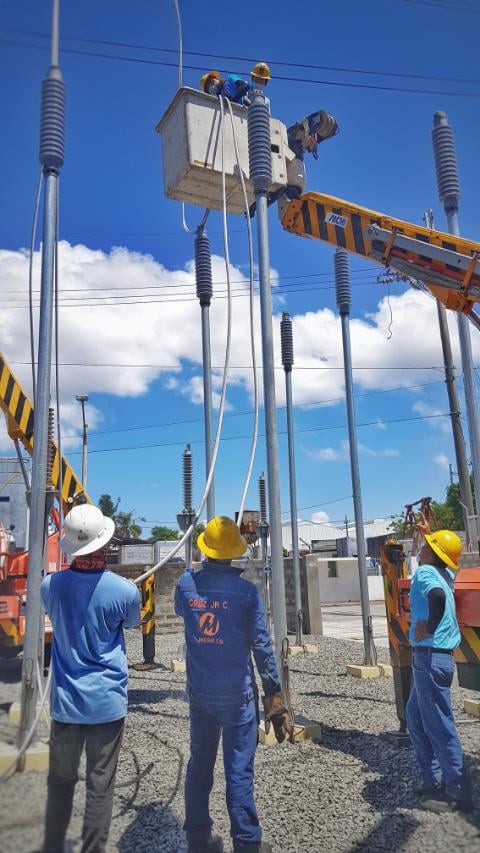
Seen in the photo are linemen and engineers from Meralco and Miescor during the ongoing commissioning of a new double bus indoor Gas-Insulated Switchgear (GIS) of LIIP Substation located at Binan, Laguna. This project will ensure the continuous power supply of the customers served by the said substation even during contingency, preventing possible power outages to many industrial customers in the area of Sta. Rosa and Binan, Laguna.Despite the heightened community quarantine measures due to the recent surge of COVID-19 cases, Meralco and its subsidiaries are continuously working hard to improve its distribution system in order to provide its customers with the highest level of service.
The coronavirus pandemic is continuously changing the world in unprecedented ways. And one industry flourished during this pandemic – urban farming. The lockdowns imposed to curb the spread of coronavirus is pushing more city dwellers to grow vegetables in the comforts of their own homes. For many Filipino people, fresh food is not a given.
Sen. Cynthia Villar, a staunch advocate of urban farming, started her Urban Farming Project in Las Piñas in 2011 as part of the city’s annual Food Festival Competition. It was initially envisioned as a showcase of the gardening and farming skills of the 20 barangays of Las Piñas. The yearly festival sees dozens of entries from various sectors and areas in Las Piñas. From Barangays, Home Owners Associations, and Schools, each group presents their very best in terms of farming and planting skills, landscaping, and design.
Senator Cynthia A. Villar in Gulayan sa Baseco in Tondo, Manila
Seeing the potential of urban farming, and not allowing anything to limit her, in addition to growing backyard gardening projects, Sen. Villar, in 2015, partnering with the Department of Agriculture’s Bureau of Fisheries and Aquatic Resources, set up aquaponic garden systems in the City of Las Piñas. Aquaponics is a way of growing vegetables without solid and growing fish at the same time in one set-up. The two aquaponics systems flourishing in the City of Las Piñas can be found at the Christ The King Subdivision an area under the Community Mortgage Program (CMP) in Talon 4 and in Heritage Homes, BF Resort.
“It is really time for city dwellers to grow their own food even in an urban setting with limited space. Food self-sufficiency is very important especially during disasters or emergencies,” said Sen. Villar.
“We are very pleased with the warm reception of our constituents to the Urban Farming Project,” said Las Piñas Rep. Camille Villar. “This projects continuous to beautify the community, minimize air pollution, provide food security and create livelihood and jobs,” added Rep. Villar.
At the height of the pandemic, where many Filipinos were left with little to no access to food, Sen. Villar joined by Rep. Villar gave away vegetable seeds and organic fertilizers in Las Piñas to enable people to grow their own food during the lockdown. The organic fertilizer comes from the eighty (80) composting and vermicomposting facilities set up all over the City of Las Piñas, which provides seventy (70) tons of organic fertilizer every month.
This old garbage site was cleaned and transformed into a vegetable garden
Ms. Marlyn Montinola, a resident of Talon 2 and wife of a former OFW shared, “vegetable gardening became my husband’s hobby after he went back to the Philippines due to pandemic. We placed our garden on the rooftop because we don’t have enough space in our house. We used the seeds and fertilizer given by Senator Villar, now we don’t buy vegetables in the market anymore and we are sure that we are eating healthy and safe food. I sell some in the office too.”
Ms. Montinola’s appreciation of urban farming is shared by Ms. Maria Myra La Roza from Bacoor City who expressed her gratitude to Sen. Villar, “I am really thankful for the seeds and fertilizer gave by Villar SIPAG, I was able to transform our idle lot into [a] vegetable garden. I am really happy because my daughter and I are eating fresh vegetables and I am able to share our harvest with our neighbors in the village. Now, I can proudly say I am a gurong magsasaka.”
Aquaponics Garden in Christ the King Subdivision
Seeing the positive impact of urban gardening in her home city, Sen. Villar expanded her program promoting urban farming to other provinces such as Bulacan, Nueva Ecija, Pampanga, Tarlac, and Bataan, seeing to the distribution of seeds and fertilizers to eighty-six (86) and counting towns in the Philippines. To date, 1,694 individuals have received seed packets for their own home vegetable gardens.
“We should support other LGUs who also desire to establish farms and vegetable gardens. Now, more than ever, we need to spread the interest on people growing their own food to other LGUs, so that we can help them and their constituents in their goal to achieve food sustainability amid the COVID-19 pandemic,” added Sen. Villar.
Congw. Camille Villar
Urban agriculture is a viable intervention to guarantee that poor households and communities have access to healthier and affordable food. COVID-19 has given us cause to reevaluate how important local urban green spaces are to us, and what we want from our high streets, parks, and pavements.
Just last month, in observance of International Women’s Day, which was celebrated last March 8, Sen. Villar and Rep. Camille Villar, through the Villar SIPAG Foundation, aired a special webinar to help empower Filipino women, entitled, “Kabuhayan Para sa Kababaihan sa Mapanghamong Panahon.”
Lettuce garden in Pulang Lupa 2
In partnership with East-West Seed Foundation Inc., the program was especially helpful for women interested in urban agriculture to equip them with the right knowledge and skills to practice this in order for them to make their households and communities healthier and more food sufficient. The East-West Seed Foundation Inc. also teaches urban farming in four (4) Villar SIPAG Farm Schools located in Las Piñas-Bacoor, San Jose Del Monte, Bulacan, San Miguel Iloilo, and in Davao City.
Sen. Villar, champion of women empowerment, believes that women have a lot to contribute to the country’s development if they would just be given opportunities and tools such as learning new skills; “when we empower women, we empower families and generations of people.” Sen. Villar also said that empowering women is one of the most effective ways to make a positive difference in society because “women have the power to lead, serve, nurture and transform.”
Urban garden in Castillan Subdivision
Through the Villar SIPAG Foundation, Senator Villar and Rep. Villar are able to provide jobs and livelihood opportunities to women so they can help augment the earnings of their husbands. In this way, Sen. Villar said women no longer need to leave their homes in order to earn money. “They can do their work at home while taking care of their children,” noted by the senator.
Urban garden in Manuyo 2
Sen. Villar and Rep. Villar continue to champion urban farming by authoring their respective legislation in the Senate of the Philippines and House of Representatives, respectively. Considering that this is the perfect time to institutionalize urban agriculture, Sen. Villar authored Senate Bill No. 141, which seeks to strengthen and promote urban agriculture and vertical farming to meet food sufficiency targets and address hunger. Backyard vegetable gardening will not only address food sufficiency but will likewise promote the health and wellness of families. Deputy Speaker Villar shares the same advocacy and has co-authored House Bill No. 8385, which promotes urban farming to help families to produce their own food to tide the expenses of their respective households. Under the proposed legislation, idle, abandoned lands, buildings and open spaces will be converted into urban gardens.
Aquaculture in Heritage House Talon
“We continue to empower our citizens through urban farming as we are actively promoting this as an alternative and additional source of livelihood especially for those affected by the pandemic. Not only do they have extra income but they also help ensure food security as they have an immediate solution to possible food shortage due to crisis,” Rep. Villar.
The senator will continue to work with national and local governments, as well as communities to further promote urban gardening in order for Filipino families will be able to meet their daily nutrition needed especially today as we continue to battle the COVID-19 health crisis.
PHILIPPINE manufacturing activity continued to expand in March albeit at a slower pace than the previous month due to a softer rise in new orders, a survey conducted by IHS Markit showed.
The Philippine Manufacturing Purchasing Managers’ Index (PMI) in March stood at 52.2, inching down from the 52.5 posted in February but still above the neutral 50 mark that separates growth from contraction. This also marks the third straight month of expansion.
New orders rose slightly in March, and still weaker than the long run average, IHS Markit said.
“The Philippines manufacturing sector ended the first quarter on a positive note with a modest expansion recorded in March. Promisingly, output volumes rose despite a moderation in new order growth. Meanwhile, employment levels fell only marginally with anecdotal evidence suggesting that this was mostly voluntary, and not due to cost-cutting efforts at firms,” Shreeya Patel, economist at IHS Markit, said in the report released on Monday.
Despite this, the country’s PMI was still better than the ASEAN PMI which stood at 50.8. The ASEAN PMI reading showed expansion, after it stood at 49.7 in February.
Among select Association of Southeast Asian Nations (ASEAN) economies, the Philippines saw the third quickest expansion pace after Vietnam (53.6) and Indonesia (53.2). The Philippines was ahead of Singapore (50.7).
Meanwhile, manufacturing activity in Malaysia (49.9), Thailand (48.8), and Myanmar (27.5) remained in contractionary mode.
“The ASEAN manufacturing sector saw a fresh improvement in conditions at the close of the first quarter, with growth driven by renewed increases in both output and inflows of new work following slight falls in February,” IHS Markit economist Lewis Cooper said in a note.
The Philippines saw a drop in overseas demand as the pandemic continued.
“Foreign client demand was especially subdued during the month as restrictions linked to the coronavirus disease 2019 (COVID-19) pandemic persisted in abroad markets,” IHS Markit said.
Despite this, output accelerated in March, with some Philippine firms noting efforts to accumulate finished goods in anticipation of greater demand in the coming months.
Amid optimism for higher sales and output, IHS Markit’s Ms. Patel warned that Philippine manufacturers are facing rising production costs.
“A key area of concern, however, continues to be rising price pressures. Material shortages were often blamed for the higher costs incurred by firms. A sustained increase in client demand, however, allowed some firms to partially pass on rising expenses,” she said.
In March, factories had to deal with mounting supply chain pressures as lead times for inputs stretched.
“Panelists continued to cite freight delays as driving the deterioration in vendor performance, with delivery times lengthening markedly. As such, firms sought to increase their inventory holdings to minimize future shortages due to delays,” IHS Markit said.
March also saw a drop in employment due to falling backlog and voluntary resignations. This led to the 13th consecutive month of contraction in employment.
The pandemic continues to affect sentiment as optimism is below the long-run trend, IHS Markit said. Despite this, manufacturing players are pinning their hopes on stronger economic conditions, with the outlook for production still in positive territory in March.
“Nevertheless, a strong first quarter places the sector in good stead for a return to industrial production growth in 2021, with our current forecast expecting a 7.1% expansion,” Ms. Patel said.
The country’s PMI reading at beyond 50 for three months straight shows that firms are looking to rebuild inventory, said ING Bank N.V. Manila Senior Economist Nicholas Antonio T. Mapa. However, he warned that the renewed imposition of a strict lockdown will have a negative impact on both demand and supply in the manufacturing sector.
Metro Manila, Cavite, Laguna, Rizal, and Bulacan are under the strictest lockdown until April 11 in a bid to curb the increasing COVID-19 infections.
“With the economy shuttered, firms may readjust production schedules given expectations for weaker demand,” Mr. Mapa said in an e-mail.
Under guidelines of the Inter-Agency Task Force for Management of Emerging Infectious Diseases, manufacturing firms with activities related to medicine and medicine supplies; food and other essential goods; and those that supply products related to construction will be allowed to operate with full on-site capacity.
Despite this, Mr. Mapa said the overall restrictions on movement could impede production in the near term.
“April could see another dip in the index but not necessarily a contraction with the length of the lockdowns being the telling factor,” Mr. Mapa said. — Luz Wendy T. Noble
MANILA WATER Co., Inc. will no longer be allowed to charge its customers for corporate income tax and implement foreign currency differential adjustments (FCDA) under the new concession agreement (CA) it signed with the government.
“Isang revised concession agreement ang nabuo na nagbibigay ng mas maganda serbisyo ng tubig sa Metro Manila at advantageous sa pamahalaan at consumers (We have sealed a revised concession agreement that ensures better water services in Metro Manila and will be more advantageous to the government and consumers),” Presidential Spokesperson Herminio “Harry” L. Roque, Jr. told a televised press briefing on Monday.
In a disclosure to the stock exchange, Manila Water said the revised agreement will allow it to retain the concession for the east zone of Metro Manila until July 31, 2037.
The revised deal is patterned after the provisions of the New Clark City — joint venture agreement (NCC-JVA), which also removed the recovery of corporate income taxes and FCDA.
FCDA is a quarterly reviewed tariff mechanism that allows water concessionaires like Manila Water to regain losses or return gains resulting from the movement in foreign exchange rates. The companies pay foreign currency-denominated loans that are used to fund the expansion and improvement of water and sewerage services.
Manila Water is unlikely to implement the FCDA for the second quarter that was approved by the regulatory office of the Metropolitan Waterworks and Sewerage System (MWSS) last month.
“To mitigate the impact of tariff increases on customers, the Revised CA lowers the inflation factor to 2/3 of the Consumer Price Index (CPI) adjustment and imposes caps on increases in standard rates for water (1.3x the previous standard rate) and wastewater (1.5x the previous standard rate). Instead of a market-driven appropriate discount rate, Manila Water shall now be limited to a 12% fixed nominal discount rate,” the listed company said.
Manila Water said the rate-rebasing mechanism included in the original concession deal will be retained.
“Thus, the rates for water and sewerage services provided by Manila Water shall be set at a level that will permit it to recover over the term of the concession expenditures efficiently and prudently incurred and to earn a reasonable rate of return,” the company said.
Manila Water will also implement a tariff freeze until Dec. 31, 2022 to help consumers amid the pandemic.
“The Undertaking Letter of the Republic is retained but has been amended to exclude the non-interference clause. It now applies only to contracts and obligations existing at the time of execution of the Revised CA,” the company said.
During the Palace briefing, Mr. Roque said under the new deal, all debt and expenditures of the concessionaire must be reviewed and approved by the regulator.
LOPSIDED? The new contract is “favoring the government, limiting private sector discretion but not necessarily benefiting the public, which should be the core interest in all of these negotiations,” InfraWatch PH convenor Terry L. Ridon told BusinessWorld in a Facebook messenger chat.
Mr. Ridon said the requirement that all debt and expenditures be reviewed and approved by the MWSS-Regulatory Office destroys the nature of the concession as a public-private partnership (PPP), “effectively reducing the concessionaires into mere suppliers or vendors of government.”
“This contradicts private sector independence in investment and operations initiatives, which is a main feature in PPPs,” he said. “Effectively, the government does not only exercise regulatory power over tariff, but also operational control.”
The government should clarify whether the tariff adjustment for inflation at only two-thirds of CPI will now be the standard for all PPPs “as this will similarly run the risk of a constitutional challenge on equal protection,” Mr. Ridon said.
“Is the government taking on the remaining one-third inflation risk, or will it be the private sector?” the former lawmaker said.
“As long as this deal will warrant or make the services of utility companies better (less interruptions, reasonable charges, efficient services) and accountability to government is strictly enforced as mentioned, then the new deal is favorable,” Asian Institute Management economist John Paolo R. Rivera said in a Viber message.
The deal would encourage investment in public utilities if it was proven to be efficient in creating better services for consumers, Mr. Rivera said.
“There were trade offs but terms have been leveled at the very least without sacrificing the economic and financial viability of the water concessionaires,” he said when asked whether the contract was fair to concessionaires.
Meanwhile, Justice Secretary Menardo I. Gueverra said the terms of a deal with water concessionaire Maynilad Water Services, Inc. would likely be similar with that of Manila Water’s.
“The other concession agreement with Maynilad, the negotiations with respect to that will start immediately and we will be proposing essentially the same terms and conditions as those that were contained in the revised agreement with Manila Water. But of course, we recognize the fact na differently situated ang Maynilad compared to Manila Water so there will probably be a lot of discussions also with respect to possible modification of the terms and conditions,” he said during the Palace briefing.
Mr. Duterte last year threatened to file a case of economic sabotage against the water firms after an international arbitration court ruled that the Philippine government must pay Manila Water P7.4 billion and Maynilad P3.4 billion for losses incurred from unenforced water rate increases.
Shares in Manila Water went up 0.12% to P16.10 each on Monday. — withRevin Mikhael D. Ochave
The Ortigas business district is seen in the background of houses along the Pasig floodway, April 5. — PHILIPPINE STAR/ MICHAEL VARCAS
By Luz Wendy T. Noble and Jenina P. Ibañez, Reporters
THE Philippines faces a rough road to recovery as more restriction measures will likely be required to arrest the surge in coronavirus cases, Fitch Solutions Country Risk and Industry Research said on Monday.
This as business groups are seeking more government support as economic activity slows down due to the extension of the enhanced community quarantine (ECQ) in Metro Manila and nearby provinces until April 11.
“We expect the lockdown measures to be extended given the continued surge in cases and the prolonged impact on hospital capacity,” Fitch Solutions said in a report.
“The Philippines economy is highly vulnerable to lockdowns given its high reliance on domestic consumption and investment and thus growth will likely fall again until lockdown measures are eased,” it added.
The research unit of Fitch Ratings said it downgraded its 2021 growth projection for the Philippines to 5.8%, from the 7.6% it penciled in January. The economy shrank by a record 9.5% in 2020 due to the prolonged lockdown.
The Health department on Monday reported 8,355 new COVID-19 cases, bringing the active cases to a record 143,726.
“Our expectation for a modest recovery (i.e. real GDP not returning to its pre-pandemic levels until 2022) assumed that domestic demand would gradually recover and the government’s infrastructure plans would come to fruition, resulting in a sharp increase in domestic activity,” Fitch Solutions said.
This outlook is now clouded by the struggle to contain the surge in COVID-19 infections and the slow vaccine rollout.
“The likelihood of further outbreaks in other regions remains high and given the slow vaccination rollout in the country (less than 1% of the population has been vaccinated as of end-March), we believe the Philippines’ recovery will continue to be hampered by the pandemic,” Fitch Solutions said.
Amid the gloomier economic outlook, Fitch Solutions expects remittance inflows and recovery in external demand to be supportive of growth this year.
The central bank expects remittances to grow by 4% this year, after it slipped 0.8% to $29.903 billion in 2020 due to the pandemic. Cash remittances fuel household consumption which makes up 70% of the economy.
MORE SUPPORT Meanwhile, Philippine Retailers Association Vice-Chairman Roberto S. Claudio in an e-mail on Sunday advocated for unhampered online selling, noting that consumers still want to buy products.
“There is just no opportunity for people to consume, except for food, medicines and essential products,” he said.
Retail stores selling nonessential goods are not allowed to operate during ECQ.
He is asking the government to allow retailers of nonessential products to continue online transactions, including online ordering, contactless payment and delivery options. Mr. Claudio last week said that he expects nonessential retailers and dine-in restaurants to have no revenue during a strict lockdown.
The retail industry group at the start of the year reported that it anticipates “soft” growth for 2021, or 10% higher than last year, when the sector suffered from sparse foot traffic amid the lockdown and increasing health anxiety among consumers. This potential sales improvement would still be around 20-30% lower than 2019 or pre-pandemic sales.
“Let’s try to help everyone do business during lockdowns. Many retailers are already breaking down with the continued lockdowns but we have no choice but to comply with medical protocols of the government,” Mr. Claudio said.
Benedicto V. Yujuico, president of the Philippine Chamber of Commerce and Industry, said that Filipino citizens should receive COVID-19 vaccines as soon as possible, noting that the government is mitigating the negative effects of the lockdown on business by allowing some sectors like essential businesses and logistics to continue operations, and improve contact tracing.
“Needless to say, the government should also expedite (and if possible increase the amount) the distribution of ‘ayuda.’ There are too many people who are unemployed and without funds to provide for their basic daily needs,” he said in an e-mail.
During the ECQ, full operations are allowed for public and private hospitals, healthcare services, manufacturers of medicine and medical supplies, agriculture and fishery, mining, outsourcing, export, and delivery and courier services transporting food, medicine and other essential goods.
An outsourcing industry group in an e-mail last week said that government agencies have extended guidance to the sector through their issuances.
“(We have) been working with various government agencies and industry stakeholders to ensure our member companies are able to continue their operations while keeping employees healthy,” Information Technology and Business Process Association of the Philippines (IBPAP) President and Chief Executive Officer Rey E. Untal said.
As for foreign investors, the European Chamber of Commerce of the Philippines (ECCP) maintained that the Philippine government should identify COVID-19 mitigation and economic reform best practices done by other countries.
“Continued enforcement of health and safety measures, intensified immunization programs,and unhampered business activities are all essential in stabilizing the current landscape. These are also important signals that the Philippines remains a viable investment destination,” ECCP President Nabil Francis said in a mobile message.
THE Bureau of Internal Revenue (BIR) released the draft guidelines for the implementation of the law that will immediately slash corporate income tax to 25% from 30%.
The Corporate Recovery and Tax Incentives for Enterprises (CREATE) Act was signed by President Rodrigo R. Duterte on March 26 as Republic Act No. 11534.
The proposed implementing rules and regulation (IRR) lays out the tax rates that will be implemented during the transition period of the CREATE law.
Based on the draft guidelines, regular corporate income tax rates will be retroactively reduced by 42 basis points (bps) starting July 2020. This means that the applicable rate for July 31 will be at 29.58% (from 30%) and will be brought down each month by another 42 bps until it reaches 25% by June 30, 2021.
Other domestic corporations with net taxable income lower than P5 million and total assets less than P100 million exclusive of land will see a reduction of 0.84 bp every month. This means applicable rates starting the accounting period July 31, 2020 will be reduced to 29.16%, until it reaches 20% by the accounting period June 30, 2021.
“For taxpayers who have already filed their income tax returns for taxable year 2020 (calendar year 2020; fiscal year ending from July 31, 2020 to fiscal year ending February 28, 2021) they may amend their income returns using the transitory rates per above matrix, and any resulting excess/overpayment can be claimed for refund or carried over to the next taxable year, at taxpayers’ option,” the proposed IRR stated.
CREATE aims to bring down corporate income tax to 25% starting July 2020 and will continue to slash it by a percentage point (100 bps) each year from 2023 to 2027 until it reaches 20%.
In the first two years of implementation, the law is expected to result in P251 billion in foregone tax revenues or P1 trillion worth of tax relief for a decade. Savings incurred by firms from the measure is expected to bring in job creation in the next five years. — Luz Wendy T. Noble
GMA Network is countering the proliferation of online media options by launching a new free digital channel, I Heart Movies, on GMA’s Affordabox and GMA Now.
Called OTT (over-the-top), these are media —such as Netflix, Amazon Prime, and Hulu — that bypass cable, broadcast, and satellite TV platforms.
“We are now contending with a fickle-minded audience,” said GMA First Vice-President for Program Management Jose Mari Abacan in a statement. “The pandemic has given birth to an abundance of content and through the advent of OTT platform services, viewers are now spoilt for choice; where to watch; and when to watch. By offering a more diverse line-up of movies, we hope to provide a free TV alternative for everyone.
“We want to provide the Filipino audience a one-stop shop, ‘freemium,’ digital channel, which is readily accessible and offers a mix of foreign and local film features especially during this period of pandemic when viewers crave for entertaining content while in the convenience of their homes,” he said.
With the tagline: “Experience all the feels,” the digital channel offers a selection of free-to-air films across genres from local and international film studios such as Viva, Regal, GMA Films, Warner Brothers, Disney, Columbia, and Paramount.
I Heart Movies is programmed with four movie blocks: Timeless Telesine, Takilya Throwback, Block Screening, and Pinoy Movie Date.
Timeless Telesine focuses on “GMA Telesine” stories; Takilya Throwback features Pinoy classics from the 1970s to the early 2000s; Block Screening showcases blockbuster foreign movies; and the Pinoy Movie Date will air widely followed contemporary Filipino movies.
To access I Heart Movies, press the “scan” button on the GMA Affordabox remote control. I Heart Movies will appear on the channel list.
I Heart Movies is available on Channel 5 on the GMA Affordabox and GMA Now. For more information, visit www.gmanetwork.com or visit I Heart Movie’s official Facebook pagewww.facebook.com/IHeartMoviesPH/. —M.A.P. Soliman
TEN years after leaving her Philippine career behind and moving abroad, singer and power belter Sheryn Regis returns to the country of her birth with new music.
Ms. Regis began in the local music industry as a contestant in the singing competition Star in a Million in 2003 where she was a runner-up with her cover of Wendy Moten’s “Come On In Out of the Rain.” After the competition, the singer recorded four studio albums from 2004 to 2008, and performed in concerts in the Philippines and abroad. Ms. Regis was known as the singer behind the theme songs on ABS-CBN TV series such Marina (2004), Krystala (2005), and Kampanerang Kuba (2005).
Then, in 2010, at the peak of her career, she decided to take a break and move to the US.
She was suffering from depression and anxiety brought about by her work when she decided to join her family in Houston, Texas, she explained during a press conference via Zoom on March 25.
But she did not stop singing. She continued performing even as she worked as a part-time teacher for pre-school to middle school students. After surviving thyroid cancer, she resumed performing and hosted a talk show called Chit Chat Houston in 2018.
Through 2013 to 2018, Ms. Regis would often visit the Philippines and perform in concerts and shows. She officially returned to the Philippines with the Back to Love comeback concert at the Music Museum in February 2020.
“Iba kasi ‘yung nagpe-perform dito, at iba pa rin yung nagre-record ka dito (It is a different experience performing and recording here),” Ms. Regis explained.
She will be resuming her local music career under Star Music and has already released a homecoming single, “Tulad ng Dati.” The song is about the experience of “ghosting” or being cut off from a partner without explanation.
“This is my first original song after 10 years that I’ve been away from the Philippines,” said MS. Regis. “Ito ang kantang maraming makaka-relate kasimaraming nakaka-relate sa ghosting at sa sakit ng pagmamahal (Many people will relate to this song since many can relate to ghosting and the pain of love),” Ms. Regis said.
The song features the singer’s signature sound incorporated with an indie-pop style that focuses on storytelling over vocal acrobatics.
Ms. Regis is set to sign a contract with Star Music. Digital concerts and guestings, as well as a new album, are in the pipeline.
“Sa ngayon, babalik kami sa roots ni Sheryn, kung saan siya minahal (For now, we will return to Sheryn’s roots where she was admired),” said songwriter, music producer, and creative director of ABS-CBN Star Music Jonathan Manalo (who happens to have produced Ms Regis’ break-out song “Come On In Out of the Rain”).
With her exposure to different genres like country, rock, R&B, and gospel during her US residency, Ms. Regis has incorporated these into her new sound.
“Ang daming instrumento [na] tumulong sa akin para mabigyan ko ng tiwala ang sarili ko na I can still do it. May boses pa ako. (Many things were instrumental in giving me the self-confidence that I can still do it. I still have a voice),” Ms. Regis said.
For more details on Sheryn Regis’s music, follow Star Music on Facebook (fb.com/starmusicph), Twitter, and Instagram (@StarMusicPH). “Tulad ng Dati” is available on all digital streaming platforms. — M.A.P Soliman
A SUBSIDIARY of First Gen Corp. has entered into a five-year contract to charter a liquefied natural gas (LNG) carrier from a unit of Norway-based BW Gas Ltd. in line with the Lopez-led company’s offshore gas terminal project in Batangas.
In a disclosure on Monday, First Gen said the floating storage regasification unit (FSRU) that will be provided to its wholly owned subsidiary FGEN LNG Corp. is a vessel with a storage capacity of 162,400 cubic meters (m3) under their five-year time charter party.
The FSRU, a liquefied natural gas carrier, will be provided by BW FSRU IV Pte Ltd. The vessel — the BW Paris — has a nominal and peak gas send-out capacity of 500 million standard cubic feet per day (MMscfd) and 700 MMscfd, respectively.
The charter deal comes around two weeks after First Gen said that FGEN LNG was due to select between BW Gas Ltd and Hoegh LNG Asia Pte. Ltd as its FSRU provider by the end of March.
“The nominal send out capacity of the BW Paris is 25% more than the production capability of Malampaya, which at its peak produced a maximum gas volume of approximately 400 MMscfd, and which is now declining,” First Gen told the stock exchange in its regulatory filing.
An FSRU, which typically has a storage capacity of between 125,000 and 170,000 cubic meters, has an onboard regasification plant that can turn LNG back into its gaseous state and supply it directly into a gas network.
The Department of Energy earlier said that the reserves of the offshore Malampaya project, which fuels gas-fired power plants in Luzon, will be completely depleted by 2027.
BW Paris can provide ancillary services in addition to providing storage and regasification, First Gen said, adding that the vessel can reload LNG into trucks and small-scale LNG vessels, which will then distribute the gas to nearby areas.
The firm said that the LNG project will allow its subsidiary to introduce LNG to the country by the third quarter next year to serve the natural gas requirements of existing and future gas-fired plants of FGEN LNG’s affiliates and third parties.
Aside from spurring new power plant developments, the entry of LNG in the Philippines will encourage various industries to consider the fuel as a replacement to “more costly and polluting” fuels, First Gen said.
“FGEN LNG believes the Project will play a critical role in ensuring the energy security of the Luzon Grid and the Philippines, particularly as the indigenous Malampaya gas resource is expected to be less reliable in producing and providing sufficient fuel supply for the country’s existing gas-fired power plants,” First Gen said.
BW FSRU IV is engaged in the global market of transportation and floating regasification services of LNG. It is under BW Gas Ltd., which is wholly owned by the BW Group, a global maritime company.
The group is involved in shipping, floating infrastructure, deep-water oil and gas production, and new sustainable technologies.
In October, FGEN LNG selected McConnell Dowell Philippines, Inc., the local unit of an Australian contractor, for the LNG terminal’s engineering, procurement and construction contract.
In the same month, First Gen signed a joint cooperation agreement with Japan’s Tokyo Gas Co., Ltd to design, develop, test, commission, construct, own, operate and maintain the interim offshore project, which will be built at the First Gen Clean Energy Complex in Batangas City.
Shares of First Gen in the local bourse were unchanged at P30.10 apiece on Monday. — Angelica Y. Yang
When music fans listen to their favorite album, there’s a certain satisfaction derived from knowing that they paid for the music they love — they’re giving back to the artists who made it.
That’s not the case on music streaming platforms, where artists aren’t paid a fixed fee when you stream their songs or albums. Instead, your subscription fee enters a big pot which is then split between every artist on the platform based on their share of overall streams. You can think of the payment pot as a pie chart: the size of an artist’s slice of revenue is determined by how many streams they get compared with their fellow artists.
This might seem a fair way to distribute music streaming revenue. If Rihanna gets 1% of all streams on Spotify, it’s fair that she is paid 1% of the subscription revenue. But this system, called the pro rata payment model, begins to look unfair when the effects of curated playlists are taken into account.
Popular playlists are streamed repeatedly by millions of people, constituting around a third of all streams on platforms like Spotify — a third of the pro rata pie. Because the third of the streaming pie represented by playlists mostly features the world’s most prominent musicians, the effect of playlists is to enlarge the slices enjoyed by the biggest artists at the expense of smaller artists, who see their tiny slices shrink further.
This uneven playing field was the subject of our recent investigation into playlists on Spotify, conducted with royalty-pricing expert Daniel Antal. We found that playlists don’t just benefit top artists, but the curators of these playlists may unfairly favor such artists, influenced by the negotiating power of the major music labels that manage them.
Over the last few years, music streaming has become the dominant form of music distribution around the world. Today, streaming makes up over half of global revenue from the selling of recorded music.
Globally, almost four in five listeners use Spotify, Apple Music, Amazon, Tencent, or YouTube. Some of the music that listeners on these platforms come across is the result of a targeted search for a specific artist or an album, but many people choose to simply defer to a playlist of some sort to throw together their musical diet.
The biggest playlists on Spotify are curated by the platform’s editors, attracting several million regular listeners. As an artist, featuring in a top playlist is like hitting the jackpot: your streams will rocket, and your slice of the pie will increase.
There are over 4 billion playlists on Spotify, but those that make up the top 100 attract a quarter of all playlist followers. Our study found that 81% of the songs in these top 100 Spotify playlists are recordings by major music labels. A 2018 study found inclusion in a top playlist with 18.5 million followers raises an artist’s streams by almost 20 million, and results in a payout of at least $116,000.
Naturally, artists, record labels and their distribution partners are all interested in maximizing the streams their songs receive and consequently the revenue they can pocket. Getting into the top playlists is a smart way of achieving this, but with around 60,000 new songs uploaded each day on Spotify alone, this is not a trivial task.
Major record labels, with their enormous catalogue of current and past music as a bargaining chip, are in a strong position to negotiate preferential playlist access. Their bargaining power is further enhanced by the minimum payment guarantees they include in their contracts with streaming platforms, and the equity stakes they hold in some of them. The major labels also have their own large playlists, such as Filtr and Topsify, which further enhances playlist access for their artists.
As a result, our analysis of Spotify data suggests that independent label artists are getting less than their fair share of access to the most popular playlists. And under the pro rata system, that means smaller artists are seeing their streaming revenues further depleted — especially by heavy users, such as pubs and cafes, who are constantly playing popular playlists throughout the day.
In March, musicians held a series of worldwide protests outside Spotify’s offices. One of their demands was for Spotify to move towards a “user-centric” payment model.
It’s a system we’d urgently recommend, as it would see the royalties generated by your subscription split simply between the artists you choose to listen to. The available evidence suggests that a move to user-centric payments would benefit local and national artists that cater for more niche tastes, redistributing this cash from the more international and mainstream stars.
In the UK, the Department for Digital, Culture, Media and Sport has formed a committee to investigate whether the economics of music streaming is fair to all artists. Our study is one of the submissions to help the committee plan the way forward for music streaming in the UK.
In a pandemic hit world, where live music is almost completely (although hopefully only temporarily) eradicated, music streaming is an important source of income for musicians. But if independent labels and artists are left without a sufficient slice of the pie, it threatens the wonderful diversity of music we currently have on-demand access to, wherever we are in the world.
Peter Ormosi is an Associate Professor of Competition Economics, University of East Anglia. Amelia Fletcher is a Professor of Competition Policy, University of East Anglia.
LOS ANGELES —Courtroom drama The Trial of the Chicago 7 and jazz period film Ma Rainey’s Black Bottom were the big winners at the Screen Actors Guild (SAG) awards, one of the last major ceremonies before the Oscars.
The Trial of the Chicago 7, set during a Vietnam War protest in 1968, took the prize for best ensemble with a cast that includes Sacha Baron Cohen, Eddie Redmayne, Frank Langella, and Mark Rylance.
Mr. Langella credited writer and director Aaron Sorkin for the win, saying his “voice is the soul of this movie.”
All four of the winning film actors were people of color, the first time this has happened in the SAG awards’ 27-history.
Chadwick Boseman, who died of cancer last year at age 43, picked up another award for his final role as an ambitious 1930s trumpet player in Ma Rainey’s Black Bottom. Sunday’s SAG win positioned him as front-runner for his first Oscar at the Academy Awards on April 25.
Accepting on Mr. Boseman’s behalf, his widow Simone Ledward Boseman cited a saying from the late actor himself. “If you see the world unbalanced, be a crusader that pushes heavily on the see-saw of the mind.”
Viola Davis won best actress for playing a jazz diva in Ma Rainey, besting presumed favorites Frances McDormand for Nomadland and Carey Mulligan in revenge drama Promising Young Woman.
The SAG awards, chosen by members of the acting union, are closely watched because actors form the largest voting group in the Academy of Motion Picture Arts and Sciences, which organizes the Oscars.
The win for The Trial of the Chicago 7 boosted the film’s chances of winning the best picture Academy Award in a year that has seen modern recession-era movie Nomadland grab many of the pre-Oscar awards.
Because of the coronavirus pandemic, this year’s SAG ceremony was scaled down from a gala dinner to a one-hour presentation, held remotely, and peppered with jokes about how actors filled their free time during lockdown or got a start in their careers.
Helen Mirren spoke of a close encounter with a bear during the pandemic, Sterling K. Brown demonstrated his juggling skills, and Jimmy Fallon played the harmonica.
Minari, the Korean-language story of an immigrant family struggling to make it in 1980s Arkansas, brought a supporting actress award for South Korean veteran Youn Yuh-jung as a cantankerous grandmother.
“I am very pleased and happy,” said Youn, 73.
British actor Daniel Kaluuya won for his supporting role as the late Black Panther activist Fred Hampton in Judas and the Black Messiah.
The SAG awards also recognize television performers, with the casts of Schitt’s Creek and The Crown taking the top prizes for comedy and drama respectively.
Many of the SAG winners and nominees are also up for honors at the British BAFTA awards next week, and the Independent Spirit awards on April 22. — Reuters