THE DEPARTMENT of Energy (DoE) has cleared four more renewable energy (RE) suppliers for the green energy option program (GEOP), bringing the number of approved firms to ten.
On Friday, the DoE posted on its website the four new eligible RE firms: Citicore Energy Solutions, Inc.; Aboitiz Energy Solutions, Inc.; Prism Energy, Inc.; and Adventenergy, Inc.
The GEOP is a voluntary policy mechanism which allows users consuming at least 100 kilowatts of power to source their supply from qualified retail energy suppliers that generate electricity from renewables.
Firms that want to participate in the GEOP need to secure an operating permit from the DoE’s Renewable Energy Management Bureau. Those with permits are allowed to supply electric power to end-users, according to a department circular issued in April last year.
In January, the DoE released the list of the first batch of firms that qualified for the program: Bacman Geothermal, Inc.; First Gen Energy Solutions, Inc.; SN Aboitiz Power-Magat, Inc.; SN Aboitiz Power-Res, Inc.; AC Energy Philippines, Inc.; and Sparc-Solar Powered Agri-Rural Communities Corp. — A.Y. Yang
AIR PURIFIERS may be placed in the list of goods that must be certified for quality before being sold in the Philippines, the Department of Trade and Industry (DTI) said.
“Dapat i-certify ‘yan. Actually nirereview ng aming Philippine standards bureau para magkaroon din ng mandatory compliance,” DTI Secretary Ramon M. Lopez said in an interview with DZBB on Friday.
Air purifiers must deliver on the claim of improved air quality, he said.
Manufacturers and importers of products on the mandatory certification list must secure a Philippine standard (PS) mark to sell their goods in the local market. The DTI conducts factory and product audits.
The DTI in February returned ceramic tiles to the list of products that must be certified for quality, while plywood was put back in the list last year.
Demand for disinfection products and services increased amid public health fears during the coronavirus pandemic.
Intech Group Innovations Corp., the distributor of UV Care sterilization and air purifier products, in May last year said growing demand for their products at the time had led to global scarcity. — J.P. Ibañez
STOCKS declined on Friday following the release of data showing the National Capital Region’s (NCR) output contracted by double digits in 2020, which weighed on the Philippine economy.
The Philippine Stock Exchange index shed 116.64 points or 1.79% to close at 6,370.87 on Friday, while the all shares index dropped by 44.93 points or 1.13% to 3,923.03.
“The market slid especially during the last minute of trading as investor sentiment was affected by the PSA’s (Philippine Statistics Authority) report that the NCR shrunk 10.1% in the year 2020,” Darren Blaine T. Pangan, trader at Timson Securities, Inc., said via Viber message.
“More corporate earnings reports are also being assessed by market participants, to get a feel of how the sectors have performed during the last few months,” Mr. Pangan added.
AB Capital Securities, Inc. Junior Equity Analyst Lance U. Soledad said stocks closed the week lower due to “slower recovery expectations” after the government continues to impose lockdown measures due to the number of coronavirus disease 2019 (COVID-19) infections.
“For this week, Fitch [Ratings] and ADB (Asian Development Bank) downgraded their 2021 GDP (gross domestic product) growth forecasts for the Philippines,” Mr. Soledad said in a separate Viber message.
NCR’s economy, alongside those of Calabarzon and Central Luzon, suffered double-digit contraction that weighed heavily on the country’s output last year, the PSA reported on Thursday.
posted declines, reflecting the Philippine economy’s downward revised record 9.6% drop last year amid strict lockdowns put in place to contain the spread of COVID-19.
Preliminary results from the PSA 2020 Regional Accounts showed NCR shrank by 10.1% last year from the 7% growth recorded in 2019.
Metro Manila remained the largest contributor to the country’s economic output at 31.9%, albeit lower from 32.1% share in 2019.
Meanwhile, Fitch Ratings lowered its Philippine GDP growth forecast to 6.3% from the 6.9% it gave in January due to the surge of COVID-19 cases in the country. The ADB also cut its outlook to 4.5% from 6.5% previously.
Both are lower than the government’s 6.5% to 7.5% target.
All sectoral indices closed the week in the red on Friday except for mining and oil, which gained 196.77 points or 2.08% to finish at 9,644.29.
Meanwhile, property lost 88.99 points or 2.81% to 3,077.94; holding firms declined by 117.12 points or 1.78% to 6,441.31; financials went down by 16.05 points or 1.13% to 1,394.23; services shaved off 12.41 points or 0.85% to end at 1,443.11 points; and industrials decreased by 30.3 points or 0.34% to 8,679.35.
Value turnover jumped to P8.62 billion on Friday with 6.77 billion shares switching hands, from the P4.73 billion seen the previous day with 4.23 billion shares traded.
Decliners outnumbered advancers, 110 versus 91, while 47 names closed unchanged.
Net foreign selling went down to P307.2 million on Friday from the P394.39 million seen on Thursday. — K.C.G. Valmonte
WELLINGTON – New Zealanders are still reporting negative impacts on mental health and income from the coronavirus pandemic, despite living in one of the world’s few countries to have largely returned to normal.
The Pacific island nation, which has had only about 2,200 cases and 26 deaths in a population of 5 million, enforced strict lockdowns and social distancing rules that helped to virtually eliminate the virus.
But it’s now undergoing what economists call a ‘K-shaped’ recovery in which wealth inequalities are widening, compounded by surging property prices and a housing shortage.
The survey, released to Reuters, shows 46% of New Zealanders said they or a household member had trouble sleeping because of the spread of COVID-19, higher than the 43% recorded by the survey in June-July last year. About 40% continue to say they feel depressed. (Survey link: https://bit.ly/2Sb53SZ)
“As one of the very few countries in the world that is largely back to ‘normal’, we would have expected mental health to improve,” said Jagadish Thaker, senior lecturer at the School of Communication, Journalism & Marketing at Massey University in Wellington, who published the report.
“But our survey shows that a substantial proportion of the public is still struggling with economic and mental health issues.”
The findings highlight the lasting impact of the pandemic on people’s lives, raising concerns about other nations suffering a more severe crisis. (FACTBOX on the global spread of coronavirus )
One in five who participated in the survey said they or a household member lost income from a job or business, while nearly one in nine said they or a family member lost a job or have filed for unemployment benefits, showing little improvement from last year.
The survey found poorer ethnic minorities were disproportionately affected, with Māori, Pasifika, and Asians two to three times more likely to have lost a job and filed for employment benefits.
“Together, these findings suggest that government should increase momentum on policies supporting individuals and communities most impacted by COVID-19,” Thaker said.
Failure to do so could mean Prime Minister Jacinda Ardern will squander much deserved international recognition from tackling the spread of COVID-19, he added.
New Zealand will hand down its annual budget on May 20, which is expected to focus on tackling COVID-19 and its impact. The government did not immediately respond to a request for comment.
The report was based on a survey of 1,083 New Zealanders between Feb. 15 and Mar. 6, and is yet to be made public.
BRASILIA – Brazil’s Senate on Thursday approved a bill to suspend patent protection for COVID-19 vaccines, tests and medications during the pandemic, sending the proposal to the lower house of Congress for consideration and possible amendments.
It remains unclear if lower house lawmakers will pass the bill, with implications for pharmaceutical firms such as AstraZeneca and China’s Sinovac Biotech, which have arranged local production of their COVID-19 vaccines.
U.S. firm Pfizer also made its first delivery of coronavirus vaccines to Brazil on Thursday evening.
The government of President Jair Bolsonaro has publicly opposed proposals to suspend patent protections, arguing that such a move could endanger talks with vaccine producers.
Brazil on Thursday saw its death toll from the pandemic pass 400,000, the second-highest tally in the world after the United States. Experts say that Brazil’s slow vaccine rollout is likely to keep the daily death toll high for months.
“We can’t remain passively watching, day after day, 3,000 to 5,000 deaths. The opportunity is there, we must do our part,” said Senator Nelsinho Trad, one of the backers of the bill.
The bill was passed by 55 votes in favor, and 19 against.
According to the proposal, patent holders would be obliged to provide authorities with all the information needed to produce COVID-19 vaccines and medicines. Then, if the government were to call a state of emergency, they could be produced locally under a licensing agreement.
The objective, according to Senator Paulo Paim, who drafted the bill, is to streamline vaccine production in order to accelerate inoculations.
Neither the president’s office nor health ministry immediately responded to requests for comment. – Reuters
SHANGHAI – China stocks slipped on Friday, after the country’s factory activity growth slowed in April, with Shanghai shares set for weekly decline on worries over policy tightening and Sino-U.S. tensions.
The CSI300 index fell 0.3% to 5,150.71 by the end of the morning session, while the Shanghai Composite Index lost 0.5% to 3,457.09.
For the week, CSI300 firmed 0.3%, while SSEC eased 0.5%.
China’s factory activity expanded at a slower pace and missed forecasts in April as supply bottlenecks and rising costs weighed on production and overseas demand lost momentum.
Despite the soft data, analysts and traders said overall solid economic growth allowed Beijing more leeway to rein in bubbles in its financial markets.
China’s economic recovery quickened sharply in the first quarter with record growth of 18.3%, shaking off the hit from last year’s slump.
“People are still worried about China’s monetary policy, and the market remains pessimistic given the current monetary conditions,” said Song Zhenyu, a fund manager at Beijing Jiayi Asset Management Company.
Song said any gradual policy shift would happen with a tightening bias as the central bank had recently noted the rapid rise in commodities prices, raising worries over inflation.
Tensions between Beijing and Washington also added to the pressure on the market.
U.S. President Joe Biden took aim at China in his first speech to Congress, pledging to maintain a strong U.S. military presence in the Indo-Pacific and promising to boost technological development and trade.
In Hong Kong, tech stocks led the slide on Friday, as Beijing widened its crackdown on fintech firms.
Chinese financial watchdogs on Thursday summoned 13 internet platforms engaged in finance business, including heavyweights Tencent and ByteDance, to order them to strengthen compliance with regulations, the central bank said.
The Hang Seng index dropped 1.5% to 28,856.26,while the Hong Kong China Enterprises Index lost 1.6% to 10,870.34. – Reuters
Theme focuses on the digital economy and economic recovery
With the coronavirus disease 2019 (COVID-19) pandemic accelerating digital transformation across industries, digitalization is highly regarded to spur economic recovery. The Philippines Digital Economy Report 2020 by the World Bank and the National Economic and Development Authority stressed that the rapid adoption of digital technologies can help the country recover from the crisis the pandemic brought. Thus, new normal gives the economy an opportunity to hasten its recovery and build up its resilience by further embracing digital technologies.
BusinessWorld, the country’s leading business newspaper, will lead the conversation about building the digital economy as it holds a special edition of the BusinessWorld Virtual Economic Forum, with the theme “The Digital Economy PH: Towards a Faster Economic Recovery”.
The two-day forum, happening on May 26 and 27, will gather esteemed corporate executives, government officials, industry leaders, and experts to discuss the current situation regarding digital transformation and the steps to take in hastening this adoption and in realizing a digital economy.
The first day of the online forum will have several talks expounding on digital transformation, digital payments, and the digital divide. There will be a keynote on the theme “Accelerated by the Pandemic: Digital Transformation as the Way Forward”; panel discussions on “Digital Transformation for a Better Normal” and “Bridging the Digital Divide”. It will also be graced with fireside chats with corporate and government officials discussing on the topics “2021 Digital Transformation Trends”, “Digitalizing the Philippine Economy Now”, and “The Philippines’ Digital Payments Transformation Roadmap”.
The forum’s second day will bring discussions on the most recent developments that are expected to stick in a digital economy. Keynotes will center on the themes “The Emerging New Economy: New Skills, Jobs, and Business Tools” and “From Brown to Green Economy: Is the Philippines Ready?”.Panel discussions, meanwhile, will look further into trends as the panels share their thoughts on the topics “A Blueprint for the Hybrid Office: How Workplaces Will Evolve” and “Effective Convergence of Physical & Digital: The Omni-Channel Retail Experience”.Fireside chats, on the other hand, will bring discussions on “Building Brands through Sustainability and Purpose” and “Helping SMEs Survive and Thrive through Digital Tools: An APEC Perspective”.
Aside from the keynotes, panel discussions, and fireside chats, the forum will also stage virtual exhibits as well as networking opportunities. Moreover, paying attendees will receive a free copy of the latest issue of BusinessWorld In-Depth digital magazine. Premium attendees, meanwhile, will also get a free printed copy of the latest BusinessWorld Top 1000 Corporations in the Philippines magazine.
Registration for this virtual forum is now open. Grab your chance to avail of early bird rates and head on to www.bworldonline.com/BWVEFDigitalPH to learn more about this awaited event in the business scene.
BusinessWorld Virtual Economic Forum – Special Edition is presented by BusinessWorld Publishing Corp., with co-presenter GCash; gold sponsor Globe; silver sponsor FWD; and bronze sponsors First Gen Corp. and PayMaya.
For inquiries and sponsorship opportunities, call BusinessWorld marketing at 8535-9901 or e-mail marcom@bworldonline.com.
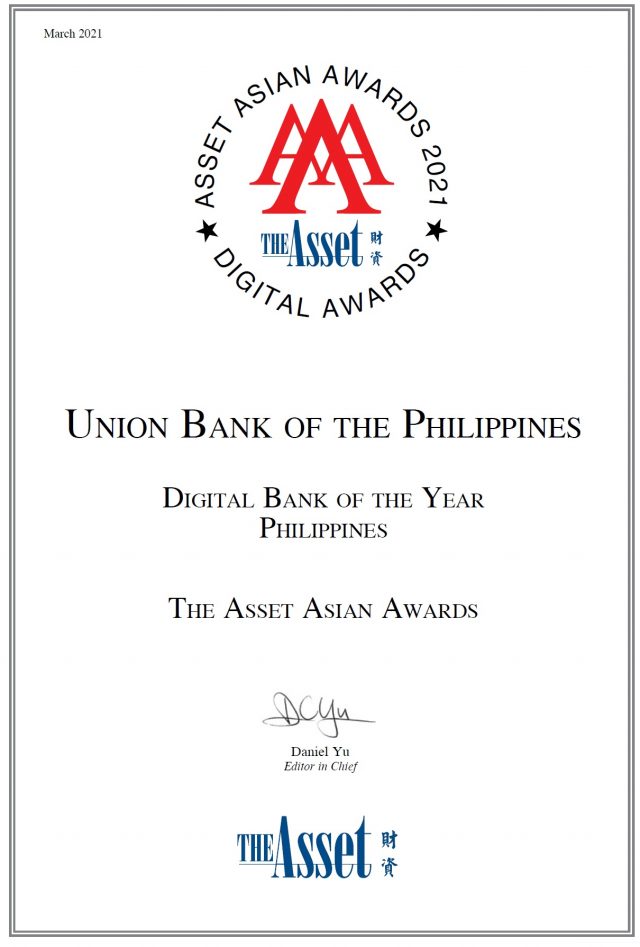
The Asset Triple A’s 4-time Digital Bank of the Year winner Union Bank of the Philippines (UnionBank) surpassed the globally challenging year with strong 2020 results, sustaining its digital leadership as it holds the distinction of being the only Philippine bank to receive the award four years in a row.
It set aside credit reserves due to COVID and still recorded a net income of Php11.6 billion in 2020. This translated to a return on equity of 11.5%, significantly higher than the industry’s 6.6% average.
At the Bank’s annual stockholders meeting on Friday, President and CEO Edwin Bautista said that as the pandemic accelerated the shift toward digital, the Bank experienced great traction including a 300% increase in digital take-up with more than 2.2 million digital customers to date; 43,000 accounts per month opened via UnionBank Online App during COVD which was 370% higher than pre-pandemic average, and the Bank is now the number 1 bank in ‘send transactions’ via Instapay and number 2 via PESONet.
Moreover, several partners “teched up” with the Bank’s help including the Department of Social Welfare and Development (DSWD) and the Bureau of the Treasury. Recently the Supreme Court of the Philippines entrusted the Bank to “Tech Up” their Judiciary Payment System so that its stakeholders can make digital payments to courts nationwide.
“UnionBank is going full throttle in our digital transformation. The Bank shall compress its five-year plans into two years by accelerating the digital onboarding of new customers. Our success today was a product of looking ahead into the future and preparing for the evolution of banking,” Mr. Bautista said. With the recent regulations, the Bank is gearing up for the entry of more digital banks and the anticipated shift towards an open finance environment. “We shall continue to launch pioneering solutions and test new technologies.”
With this, Mr. Bautista announced that the Bank is starting 2021 strong, posting a net income of P4.7 billion in the first quarter, which is 79% higher than the same period in 2020 and 53% higher quarter-on-quarter. This is despite additional provisions as credit buffer.
Net revenues were at Php14.3 billion, up 50% vs. the same period last year and up 39% vs. the previous quarter. Net interest income increased by 6% to Php7.2 billion despite muted credit demand. This was attributable to the robust growth of the current account and savings account (CASA) deposits, which was higher by 29% vs. the same period last year. Non-interest income rose by 2.6x to Php7.1 billion mainly driven by trading gains.
As of end-March 2021, total assets were at Php747.3 billion, nearly flat versus a year ago. Total loans and receivables were down by 12% to Php344.9 billion driven by weak demand for corporate loans. Total high-cost deposits were lower by 22% to Php222.8 billion as funding requirements were supported by low-cost CASA deposits.
“This digital shift motivates us to continue enhancing features across our digital platforms. We recently launched InstaPay 2.0 which enables fund transfers by inputting mobile numbers or email addresses. Also, small businesses can now open their business accounts and perform banking transactions digitally with the launch of our SME Business Banking App,” he added.
“We are confident that the Bank’s “Tech Up Pilipinas” efforts, focused on promoting wide-scale digital transformation, would allow all of us to weather this crisis and emerge more resilient than before. Together, we can power the Future of Banking and help ensure the renaissance of our nation,” Mr. Bautista said.
METRO MANILA, Bulacan, Cavite, Laguna and Rizal will remain under a modified enhanced community quarantine until May 14 as the country continues to have one of the worst coronavirus disease 2019 (COVID-19) outbreaks in the region. — PHILIPPINE STAR/ MICHAEL VARCAS
By Beatrice M. Laforga, Reporter
THE Philippine economy’s recovery will likely be weaker than initially expected, as Metro Manila and major economic hubs remain under strict lockdown until mid-May amid the continued rise in coronavirus infections.
Nomura Global Research said in a note on Thursday that the economy is now expected to grow by 5.5% this year, slower than the previous estimate of a 6.8% expansion, due to the extension of the modified enhanced community quarantine (MECQ) which they assume will last for up to two months.
If realized, Nomura said the estimated gross domestic product (GDP) growth will be a “fairly weak recovery” from the record 9.6% contraction last year.
“The main rationales for our more cautious view include the significant economic impact of the lockdowns (even if less stringent than last year), the fragile starting point with unemployment rates rising again, limited prospects for a sizeable fiscal support package, and monetary policy that is hamstrung by inflation risks,” Nomura said.
President Rodrigo R. Duterte on Wednesday evening extended the MECQ in Metro Manila, Bulacan, Cavite, Laguna and Rizal until May 14 as the country continues to have one of the worst coronavirus disease 2019 (COVID-19) outbreaks in the region.
The Health department on Thursday reported 8,276 new cases, bringing the number of active cases at 69,354.
ING Bank N.V. Manila Senior Economist Nicholas Antonio T. Mapa said this year’s 4.9% growth forecast will likely be cut if the lockdown will be further extended.
Both GDP estimates of ING Bank and Nomura are far below the government’s target of a 6.5-7.5% expansion this year.
“Should we do find ourselves in a situation of a lower growth trajectory, we can expect at least an outlook revision from one of the major credit ratings agencies with several houses, including the ADB (Asian Development Bank), slashing their initial growth forecasts for the year,” Mr. Mapa said in an e-mail.
ADB already cut its GDP outlook for the country to 4.5% from its earlier 6.5% forecast due to the prolonged lockdown.
“The protracted recession will sap even more momentum from the fledgling recovery and increases the likelihood that the Philippines does slip into a lower growth path in the coming quarters,” Mr. Mapa added.
If the hard lockdowns in Metro Manila and adjacent provinces will last for the entire second quarter, this could trim 1-1.2 percentage points from the full-year GDP, Security Bank Corp. Chief Economist Robert Dan J. Roces said in an e-mail.
“The likelihood of a less-than-expected economic growth increases given prolonged restrictions,” Mr. Roces said.
Slower economic growth also poses a threat to state’s coffers, as dampened economic activity will mean lower tax collections while the government has to prop up growth by ramping up spending further, he said.
“Prolonged curbs likewise entail that capital expansion be put on hold and this depresses bank lending further,” he added.
Meanwhile, Nomura said that the government’s slow vaccination rollout compared with its regional peers, will also be a threat to its economic recovery.
Nomura said that only up to 25% of the population in the country can be vaccinated by year’s end, leaving the Philippines vulnerable to virus resurgences throughout the year.
Sought for comment, the National Economic and Development Authority (NEDA) did not respond to queries at the deadline time.
NEDA previously estimated that foregone wages of workers due to the five-week lockdown from March 29 to April 30 could have reached P83.3 billion.
It said the two-week ECQ alone in early April may have shaved 0.8 percentage point off the GDP this 2021.
Economic managers are set to meet next month to review its growth targets.
A picture illustration shows US 100 dollar banknotes taken in Tokyo, Aug. 2, 2011. — REUTERS/YURIKO NAKAO
By Luz Wendy T. Noble, Reporter
FOREIGN portfolio investments (FPI) yielded a net outflow for a second straight month in March as a surge in coronavirus infections prompted investors to seek safe havens.
Data from the Bangko Sentral ng Pilipinas (BSP) showed “hot money” — dubbed as such due to the ease by which these funds enter or exit an economy — posted a net outflow of $540.97 million in March, 44% smaller than the $961.08 million a year earlier but significantly bigger than the $40.41 million in February.
The March net outflow was also the biggest in 10 months or since the $1.006 billion seen in May 2020.
“Developments during the month included investor reaction to rising inflation and vaccine rollout amid the surge in virus infections and reimposition of restrictions on mobility in the National Capital Region and nearby provinces,” the BSP said in a statement on Thursday.
Stricter lockdown measures were implemented in Metro Manila and four adjacent provinces starting mid-March due to the sharp rise in coronavirus disease 2019 (COVID-19) cases.
ING Bank N.V. Manila Senior Economist Nicholas Antonio T. Mapa said investors moved to safe havens in March as benchmark rates in the United States inched up.
“March saw a stark shift in global sentiment with US Treasury bonds rising quickly and taking the global market yields with it. This shift in sentiment pushed investors to exit from emerging markets, with the Philippines not spared from the exodus,” Mr. Mapa said in an e-mail.
During the month, hot money inflows declined by 13.6% to $824.23 million from a year ago and by 38% from the $1.337 billion in February.
Outflows likewise dropped 28.6% to $1.365 billion from $1.914 billion in March 2020 and by 0.94% from the $1.378 billion the prior month.
The BSP identified the United Kingdom, United States, Luxembourg, Switzerland, and Hong Kong as top sources of investments in March.
The bulk (90.5%) of these investments went to securities listed in the Philippine Stock Exchange (PSE), particularly to banks, property companies, holding firms, food, beverage and tobacco companies and transportation services firms.
However, year-to-date hot money transactions for PSE investments resulted in a net outflow, the BSP said.
Mr. Mapa noted the local market saw net foreign selling for 20 straight trading sessions “and counting.” He said this is a sign investors are more cautious over the Philippine growth outlook.
Analysts said policies to control the coronavirus surge could make or break investor sentiment and affect the course of hot money flows in the coming months.
“Flows would mostly be a function of measures to control the uptick in COVID-19 cases relative to a wider vaccine rollout, and the duration of lockdowns. A rolling lockdown without structural improvements could still affect investor perceptions and thus outflows might still be seen in the next month,” Security Bank Corp. Chief Economist Robert Dan J. Roces said in a Viber message.
President Rodrigo R. Duterte on Wednesday evening said Metro Manila and four nearby provinces will remain under a modified enhanced community quarantine (MECQ) for another two weeks to curb the continued rise in COVID-19 infections.
Mr. Mapa is hoping restriction measures would help arrest the surge in coronavirus cases, although he admitted these will have some negative impact on the economy.
The government expects the economy to expand by 6.5% to 7.5% this year, but these will likely be revised next month.
“Should the growth outlook dim further, and we’ve seen a lot of evidence that happening already, we could see a scenario wherein sentiment towards the Philippines sours further, which could lead to a second and even third straight month of hot money outflows,” Mr. Mapa said.
The central bank expects hot money to yield a net inflow of $5.7 billion this year. If realized, this would be a turnaround from the $4.24 billion FPI net outflows in 2020.
THE country’s balance of payments (BoP) stood at a deficit for the third straight month in March as the National Government continued to pay its dollar obligations, according to the Bangko Sentral ng Pilipinas (BSP).
The BoP posted a deficit of $73 million in March, reversing the $448-million surplus a year earlier, based on data released by the central bank on Thursday. It was, however, 96% smaller than the $2.019-billion deficit recorded in February.
“The BoP deficit in March 2021 reflected outflows arising mainly from the National Government’s net withdrawal of its foreign currency deposits with the BSP, which were largely used for debt servicing,” the BSP said.
In the first quarter, BoP posted a $2.844-billion gap, surging from the $68-million deficit during the same period in 2020.
The BoP shows a glimpse of the country’s transactions with the rest of the world. A deficit means more funds fled the country, while a surplus shows that more money came in.
The March BoP position reflects gross international reserves worth $104.48 billion, 0.64% lower than the $105.16 billion as of end-February.
This end-March dollar reserves level is enough to shield the economy against external shocks, as it is equivalent to 12 months’ worth of imports of goods and payments of services and primary income, the BSP said.
“It is also about 7.3 times the country’s short-term external debt based on original maturity and 5.2 times based on residual maturity,” it added.
The extension of the strict lockdown measures, which could slow economic activities and imports, may affect BoP in the coming months, Rizal Commercial Banking Corp. Michael L. Ricafort said in a text message.
President Rodrigo R. Duterte on Wednesday night said Metro Manila, Bulacan, Rizal, Laguna, and Cavite will remain under modified enhanced community quarantine (MECQ) until May 14.
Meanwhile, latest data from the Philippine Statistics Authority showed the trade deficit stood at $2.29 billion in February, as exports declined 2.3% to $5.31 billion while imports rose 2.7% to $7.6 billion.
The central bank projects the BoP to post a $6.2-billion surplus this year, equivalent to 1.6% of the economy.
Last year, the BoP reached a record surplus of $16 billion due to the rise in foreign debt and a slump in imports. — Luz Wendy T. Noble