Home Blog Page 7781

Hitting the ‘Reset’ button toward a brighter, greener future

According to the World Economic Forum 2020, renewable energy can help boost the economy by creating jobs, ensuring energy security, and strengthening resilience.

The COVID-19 pandemic has reminded everyone that reliable and uninterrupted energy supply is critical to managing the crisis. For Meralco, this means that there can be no return to a business-as-usual mindset.

“In order for us to bounce back, we simply cannot afford to return to business as usual and continue to pursue a high carbon, unsustainable growth template. Rather, a global recovery measure should target a green and resilient future,” said Ferdinand O. Geluz, Meralco First Vice President and Chief Commercial Officer.

Last year, Meralco pledged to source 1,500 megawatts of its power requirements for the next five years from renewable energy sources. It also committed to building renewable sources through the most advanced and cleanest technologies, one of which is BulacanSol. The 50-megawatt power plant, located in San Miguel, Bulacan, aims to provide clean and renewable energy to the Luzon grid.

In an effort to promote the reduction of greenhouse gases by using less diesel and gas, the energy distributor commissioned 121 electric vehicles—59 of which are already in use—and set up charging facilities for these.

Come October, Meralco will be using natural ester oil, which is 99% recyclable and biodegradable, in its distribution transformers.

Meralco is not alone in its quest for a more sustainable future.

The way forward for businesses, said Regis Partners Inc. chief strategist and co-head of research Rafael Garchitorena, is to focus on ESG (Environmental, Social, and Corporate Governance), with the underpinning philosophy of doing well by doing good.

“Sustainable investment funds exceeded $1 trillion in 2020. People are putting their money where their mouth is—investing in sustainable technology, including on the power generation side,” he said.

According to the World Economic Forum 2020, recovery plans are also opportunities to align energy policies with the goal of achieving access to affordable, reliable, sustainable, and modern energy for all.

“As nations press the ‘reset’ button, they need to make the right choice and direct investments toward a green and healthy recovery, which is the best insurance against future disasters. Renewable energy can revitalize the economy by creating ‘green’ jobs, ensuring energy security and strengthening resilience,” the WEF said during its Sustainable Development Impact Summit in September last year.

“Meralco also provides counsel to our customers to guide them in making informed energy-related decisions that may change the way we conduct our businesses and our lives, especially in this new normal,” added Geluz.

City of Dreams Manila partnered with Spectrum, a wholly-owned subsidiary of Meralco focused on renewable energy, for a P76-million 1.2-megawatt solar project launched in January 2020. The initiative is part of the luxury integrated casino resort’s move toward fully sustainable operations.

Aside from Spectrum, Meralco’s subsidiaries have been on the path toward cleaner and greener energy:

• Meralco PowerGen Corporation (MGen) is looking into setting up liquefied natural gas (LNG) facilities. They’re currently considering sites in Quezon, Batangas, and the Zambales-Bataan area.

• MServ has been helping LGUs that want to convert their old street lights into smart LED lamp posts that offer brighter illumination, lower energy needs, and reduced light pollution. The smart LED street lamps can also be connected to a dashboard to monitor consumption and outages real time.

While the pandemic remains the “heaviest burden” that businesses have had to face, Geluz said that both public and private sectors must stand united in fighting the invisible enemy that is COVID-19, while ensuring that the country is able to weather a possible subdued and prolonged economic recovery, with an eye on sustainability.

“Amid the uncertainty, companies must now consider how the pandemic is impacting recovery strategies. Now, more than ever, we must continue to engage, unite, and stand by each other and collaborate because it is only through working together in a synchronized manner toward a common goal that we will overcome these hurdles at hand,” Geluz said.

To learn more on Meralco partnerships, call 16210 or email us at corporatepartners@meralco.com.ph. Join Meralco Corporate Partners on Viber.

Join us on Viber to get more updates from BusinessWorld: https://bit.ly/3hv6bLA

Fitch Ratings revises Philippines’ outlook to negative

Photo by Michael Varcas, The Philippine Star

Fitch Ratings on Monday maintained its investment grade “BBB” credit rating for the Philippines but revised its outlook to “negative” from “stable”, citing the impact of the prolonged coronavirus pandemic.

“The revision of the Philippines’ outlook to negative reflects increasing risks to the credit profile from the impact of the pandemic and its aftermath on policy-making as well as on economic and fiscal out-turns,” the credit rater said in a statement.

The “negative” outlook means Fitch may downgrade the Philippines’ credit rating if it reverses reforms or departs from the prudent macroeconomic policy framework that leads to continued higher fiscal deficits. A weaker macroeconomic outlook over the medium-term and “diminishing policy credibility may also lead to a downgrade.

“Fitch believes there are downside risks to medium-term growth prospects as a result of potential scarring effects, and possible challenges associated with unwinding the exceptional policy response to the health crisis and restoring sound public finances as the pandemic recedes,” it said.

The credit watcher said the pandemic weakened the country’s fiscal position both in absolute terms and in comparison to its peer medians. The Philippines’ general government debt-to-GDP ratio is expected to reach 52.7% and 54.5% in 2021 and 2022, much higher than the 34.1% in 2019 and will exceed the median increase for BBB-rated peers.

“Fitch will monitor the evolution of the fiscal deficit and debt levels, as the balance between fiscal consolidation and ongoing government spending to support economic recovery will be an important consideration for the rating,” it said.

Fitch expects gross domestic product (GDP) to grow by 5% and 6.6% in 2021 and 2022, lower than previous than April estimates which were at 6.3% and 8.3%, respectively. Both projections are also below the 6-7% and 7-9% targets set by the government for the 2021 and 2022, respectively.

While there are already signs of economic recovery, Fitch also flagged the relatively high coronavirus infections.

It also described the government’s target to vaccinate up to 70% of the eligible population by end-2021 as “ambitious,” given only less than 3% of the population have received two jabs as of end-June.

The upcoming 2022 elections will pose some uncertainty regarding fiscal and economic strategy under a new administration, Fitch said. “Nevertheless, Fitch assumes broad policy continuity will be maintained given the Philippines’ track record and sound medium-term policy framework,” it added.

It also warned that the impact of the Supreme Court decision commonly known as the Mandanas ruling – which will increase revenue transfers to local government units from the national government – also poses uncertainty on the fiscal front.

“Poor execution could lead to underspending by local governments, which the authorities are seeking to address through capacity building,” it said.
Fitch said a deterioration in foreign currency reserves, net external debt, and current account deficit could be factors for a downgrade as these would lower the Philippines’ resilience to economic shocks.

Meanwhile, the government’s economic managers welcomed Fitch’s rating affirmation for the Philippines, noting that other economies have faced downgrades due to the pandemic.

The Philippines has kept the “BBB” rating, which is one notch above the minimum investment grade, since December 2017.

“Although the negative impact of the pandemic on the Philippines has been significant, this will only be temporary. We expect to head back to the road of fiscal consolidation once the virus is contained and public spending normalizes to pre-COVID levels” Finance Secretary Carlos G. Dominguez III said in a statement.

Mr. Dominguez said they expect strong growth in the second quarter on the back of vaccine rollout and economic recovery measures.

“Our solid fundamentals and ongoing reform initiatives should carry us through toward a solid rebound — to a state that is well-calibrated to the emerging new economy,” Bangko Sentral ng Pilipinas Governor Benjamin E. Diokno said.

The government is aiming to secure an “A” long-term credit rating by 2022.

In May, S&P Global Ratings retained its “BBB+” rating with a “stable” outlook for the country, citing its expectation of a healthy economic recovery will allow the Philippines to return to a better fiscal standing.

In July 2020, Moody’s Investors Service affirmed its “Baa2” credit rating with a “stable” outlook, noting the country’s “strong fiscal position” will be its shield from the impact of the crisis.

FDI inflows surge to $679M in April

REUTERS

FOREIGN DIRECT investments (FDI) surged in April coming off last year’s low base, and reflecting positive investor sentiment over the passage of a key tax reform law.

FDI net inflows more than doubled to $679 million in April from $317 million in the same month a year ago, data from the Bangko Sentral ng Pilipinas (BSP) showed.

However, the latest inflows were 19% lower than the $808 million in March.

The central bank attributed the year-on-year improvement in FDI net inflows to “positive foreign investor sentiment on the country’s macroeconomic fundamentals and strong growth prospects.”

FDIs mean more capital for the Philippine economy, fueling business expansion that helps generate jobs and spurs overall domestic activity.

Net inflows in the first four months of 2021 climbed 56.3% to $3.056 billion from $1.955 billion in the same period last year.

“As expected because of low base in April 2020, pledges from before have materialized because of significant improvements in our pandemic response — from zero to some vaccination; from strict lockdown to less tighter protocols,” Asian Institute of Management economist John Paolo R. Rivera said in a text message.

To recall, the country was under the strictest form of lockdown in April 2020 in order to curb the spread of the coronavirus disease 2019 (COVID-19).

Metro Manila and nearby provinces were once again placed under lockdown from late March to April as new infections rose.

Rizal Commercial Banking Corp. Chief Economist Michael L. Ricafort attributed the higher FDI inflows to positive investor sentiment following the passage of the Corporate Recovery and Tax Incentives for Enterprises (CREATE) Act.

CREATE, which streamlines tax incentives and cuts corporate income tax to 25%, was signed into law by President Rodrigo R. Duterte on March 26.

Meanwhile, BSP data showed April’s FDI net inflows were driven by a 121.2% year-on-year increase in investments in debt instruments or inter-company borrowings to $500 million.

Equity inflows soared to $97 million in April from a mere $3 million in the same month last year. This, as placements surged 131% to $108 million, while withdrawals dropped 75% to $11 million.

Equity capital placements in April were mostly from Japan, the United States, and Singapore, the central bank said. These funds went mainly to the manufacturing and real estate industries.

Meanwhile, equity and investment fund shares almost doubled to $179 million from $91 million a year ago.

On the other hand, reinvestment of earnings slipped by 6.2% to $82 million in April. These are funds that foreign businesses chose to keep here for business expansion.

Investors are expected keep a close eye on how the Philippine government handles the pandemic, especially as new coronavirus variants emerge.

“(FDI inflows can be sustained) but that depends if improvements on pandemic management can still be demonstrated. It is also possible depending on who will run and is likely to win (in the 2022) elections as it will affect future investment environment,” AIM’s Mr. Rivera said.

The central bank in June trimmed its FDI projection for 2021 to $7.5 billion from $7.8 billion previously. — Luz Wendy T. Noble

NEDA wary of risks from Delta variant

PHILIPPINE STAR/ MICHAEL VARCAS
The Health department on Monday reported 5,204 new coronavirus disease 2019 (COVID-19) infections. — PHILIPPINE STAR/ MICHAEL VARCAS

THE National Economic and Development Authority (NEDA) stressed the need to hasten the rollout of vaccines, particularly in areas with high infection rates, amid risks from fast-spreading coronavirus disease 2019 (COVID-19) variants.

“We recognize the higher risk brought about by the Delta variant,” NEDA Secretary Karl Kendrick T. Chua told reporters in a Viber message on Monday.

“Our effort should be on accelerating vaccine deployment. As supply resumes next week, we will exert effort to increase vaccination centers, including in malls and workplaces, and prioritizing areas of highest risk of infection,” he added.

Mr. Chua said the threat of the new COVID-19 variants can be dealt with if the government improves health protocols and only impose localized lockdowns on areas with high infections.

Infectious disease expert Rontgene M. Solante, who is also a member of the state vaccine expert panel, reportedly recommended that Metro Manila and other areas with high infection rates remain under a general community quarantine until December when 40% of the population are expected to be vaccinated.

The World Health Organization has said the more infectious Delta variant, which first emerged in India, is on track to become the world’s dominant strain.

As of last week, the Health department said there are still no reported local case of the Delta variant, since the previous 19 cases came from returning overseas Filipinos and foreigners.

‘MOST VULNERABLE’
The Philippines is one of the economies most vulnerable to the Delta variant, along with Peru, Colombia, South Africa and Thailand, according to a July 8 research note by JPMorgan.

The investment bank cited the country’s low vaccination rate relative to its total population as it could delay the economy’s recovery.

As of July 4, the Health department said 2.86 million have been fully vaccinated against COVID-19, less than 3% of the population.

Around 50% of the total population or 75% of the adult population need to be vaccinated for mobility to return to its pre-pandemic level and economic recovery to pick up, JPMorgan said.

JPMorgan estimated the Philippines could only reach the vaccination threshold by the third quarter of 2023, and the economy to return to its pre-crisis level by the third quarter of next year.

“The model estimates suggest that the Philippines, Peru, South Africa, Thailand, and Colombia face the longest journeys back to pre-pandemic levels of mobility, while Singapore, Turkey, India, and Brazil have the shortest journeys,” the report said.

Meanwhile, think tank Moody’s Analytics on Monday also warned of the potential risks if quarantine restrictions will be loosened prematurely since the Delta variant is still spreading fast across Asia-Pacific.

This as the government considers easing restrictions in Metro Manila and its nearby areas since the daily tally of new infections have gone down from the peak in April.

“The Philippines is still dealing with cases of around 4,000 which is quite significant. Given that social distancing in the Philippines has increased a little bit, that increases vulnerability of the Philippines to that Delta strain,” Katrina Ell, senior economist for Asia-Pacific at Moody’s Analytics, told One News in an interview on Monday.

She said the country will keep “underperforming” if its vaccination program will not accelerate and it continues to struggle containing the outbreak.

“One of the key upsides is the increase in vaccine supply that appears to be coming online… [given the expected delivery of Johnson & Johnson vaccines this month], which only needs one dose to be considered fully vaccinated… This one dose is positive because that means the Philippines can speed up the campaign to fully vaccinate their population,” Ms. Ell added.

The Health department reported 5,204 new COVID-19 infections in the country on Monday, bringing the total number of active cases to 49,128.

Economic managers are expecting the economy to grow by 6-7% this year. — Beatrice M. Laforga

BSP chief keen on keeping accommodative policy

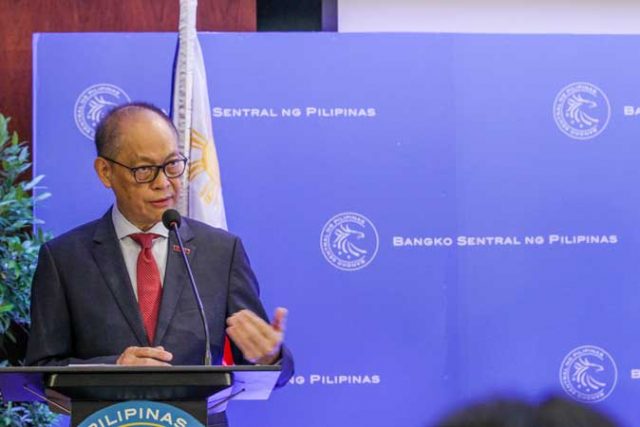
Bangko Sentral ng Pilipinas Governor Benjamin E. Diokno — PHILIPPINE STAR/ GEREMY PINTOLO

THE central bank is committed to maintaining an accommodative monetary policy while the economy is starting to recover from the coronavirus pandemic, Bangko Sentral ng Pilipinas Governor (BSP) Benjamin E. Diokno said.

“[I]’m comfortable that we will continue to be supportive of the economy, given that the economy is still at its nascent recovery phase,” he said in an interview with ANC on Monday.

The Monetary Board maintained the key policy rate at an all-time low of 2% at its June 24 meeting, citing the need to support the economy as the coronavirus continues to be a threat.

Mr. Diokno expects the economy to have fared better in the second quarter as strict lockdown restrictions were eased.

“I think we’ll see a big positive for the second quarter, [and] there will be a strong second half of the year. And so, let’s see from there whether we will make some adjustments in our policy,” he said.

The central bank has four more policy reviews this year, with the next one set on Aug. 12.

Mr. Diokno also noted the US Federal Reserve’s eventual policy tightening is unlikely to pose a problem for the Philippines, thanks to its ample dollar reserves.

“We have hefty gross international reserves and we have multiple sources of foreign exchange coming in. We have OFW remittances, BPO receipts, and foreign direct investments continue to come in. So I’m not worried of the Fed’s interest rates going up,” the BSP chief said.

Meanwhile, ING Bank N.V. Manila Senior Economist Nicholas Antonio T. Mapa said the economy’s growth likely picked up in the second quarter from a year ago, although mainly due to low base effect.

To recall, the economy shrank by 16.9% in the April-June period last year as nearly all economic activity was halted during the strictest lockdown in Luzon.

“On a quarter-on-quarter basis, we expect gross domestic product (GDP) to actually be negative in the second quarter, due to renewed lockdowns, with successive quarter-on-quarter growth numbers not likely to revisit the highs enjoyed in the second half of 2020,” Mr. Mapa said in an e-mail.

The country’s GDP shrank by 4.2% in the first quarter of 2021.

Mr. Mapa said monetary stimulus will still be needed as GDP growth will likely be “modest” in the coming quarters. A rate hike could harm the growth momentum and further delay recovery, he added.

The government expects the economy to grow by 6-7% this year, although multilateral lenders and think tanks flagged downside risks arising from another possible virus surge and the sluggish vaccine rollout.

“With bank lending negative for six months and counting, consumer confidence still deep in the red and unemployment well-above pre-pandemic norms, we do contend that the economy is in need of all the help it can get,” Mr. Mapa said.

Bank lending, which supports capital formation or the investment component of an economy, declined by 4.5% in May following the 5% fall in April.

‘GRAY LIST’ EXIT
Meanwhile, Mr. Diokno, who is also the Anti-Money Laundering Council (AMLC) chairman, said it may take the Philippines 18 months to exit the Financial Action Task Force’s (FATF) “gray list” or by January 2023, as the upcoming elections may have an impact on anti-money laundering and counter-terrorism financing (AML/CTF) efforts.

“You know the wildcard here why it will take 18 months is because there is an intervening election next year. We could comply with this within say, one year, but we expect some changes in the officials of law enforcement agencies like the PNP (Philippine National Police), the NBI (National Bureau of Investigation), and PAGCOR (Philippine Amusement and Gaming Corp.), for example, we provided for that,” he said.

On June 25, the FATF placed the Philippines on its gray list, as it saw deficiencies in the country’s AML/CTF framework.   

The AMLC recently issued new rules related to handling freeze orders and raising red flags for transactions of newly covered sectors including the real estate industry.

“The compliance of covered persons with the AMLC Registration and Reporting Guidelines contributes to addressing the International Co-operation Review Group  action plan item that all relevant supervisors of designated nonfinancial businesses and professions (such as real estate developers and brokers) should demonstrate risk-based AML/CTF supervision of covered sectors through onsite and offsite examinations and enforcements measures,” AMLC Executive Director Mel Georgie B. Racela said in a Viber message.

Gray-listed countries are required to regularly submit progress reports to show their progress in implementing AML/CTF measures. For the Philippines, its first progress report to the FATF is due in September. — L.W.T.Noble

PHL oxygen suppliers may start exports to Indonesia

PHILIPPINE STAR/ MICHAEL VARCAS
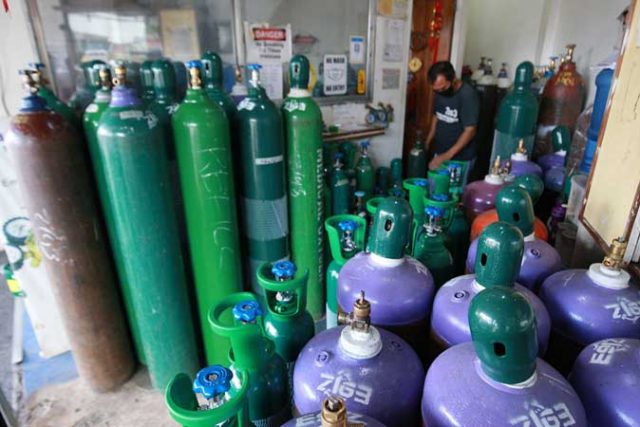
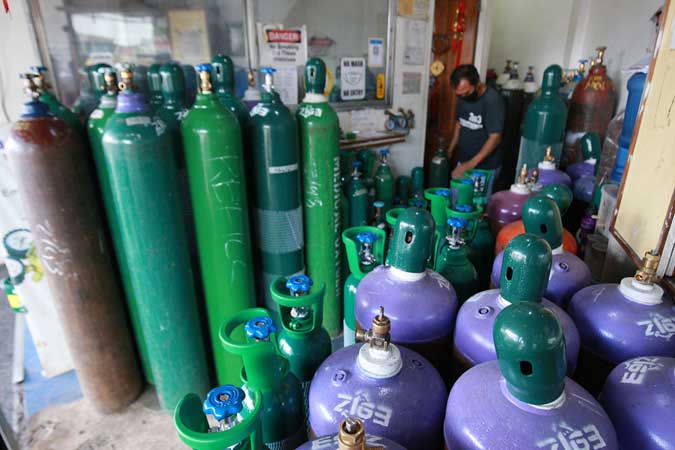
Philippine firms may start exporting medical oxygen to Indonesia, where supplies are low amid a surge in coronavirus disease 2019 cases. — PHILIPPINE STAR/ MICHAEL VARCAS

PHILIPPINE companies could soon start exporting medical oxygen to Indonesia, where supplies are low amid a fresh surge in coronavirus disease 2019 (COVID-19) cases.

The Indonesian government has been seeking emergency supplies from neighboring countries like Singapore and China as its daily need for medical oxygen rises.

Trade Secretary Ramon M. Lopez said two local suppliers could export to Indonesia. He said at a press briefing on Monday that potential exporters should have excess supply and can still cover local demand surges if necessary.

Local oxygen producers have been urged to expand operations in case of a local surge of COVID-19 cases, he said.

The Department of Trade and Industry (DTI) in May said that the industry must ramp up manufacturing by up to 50% in the event of a surge in local COVID-19 infections. After surveying the four domestic producers, Mr. Lopez had said that there was a surplus at the time.

New producer Cryogenics Gases will start operations in Butuan by the end of the year, he had added, noting that domestic suppliers should be preferred in government procurement.

Indonesia recorded 38,000 COVID-19 cases on both Thursday and Friday. Its daily need for oxygen has reached 1,928 tons, the Associated Press reported.

Singapore donated 1,000 oxygen cylinders and other health devices, while Australia sent 1,000 ventilators. The Southeast Asian country also plans to buy 36,000 tons of oxygen and 10,000 concentrators from Singapore.

INCREASED OPERATIONS
Meanwhile, Mr. Lopez said at the same briefing that the interagency taskforce on the coronavirus could discuss increasing operational capacity for businesses with fully vaccinated employees.

Pwede kang magdagdag, theoretically ng capacity kung safe naman ang tao du’n, bakunado na. That could be another policy, pero hindi pa sa ngayon (Theoretically, you may increase your capacity if the people are safe, fully vaccinated. That could be another policy, but not at this time),” he said.

For now, businesses that secure government safety seals — stickers displayed at establishment entry points if they comply with health safety protocols — could increase capacity by 10%.

The Health department reported 5,204 new COVID-19 cases on Monday, bringing the active cases to 49,128. — Jenina P. Ibañez

MerryMart set to get control of pharmacy chain

MERRYMART Consumer Corp. on Monday said it inked an agreement to own a majority or a minimum post-investment stake of 67% in pharmacy chain Carlos Drugs-Lucena, Inc.

“We are excited to soon work with the Carlos Group to further grow the business and at the same time welcome the Pharmacy DNA to the MerryMart ecosystem,” MerryMart Chairman Edgar “Injap” J. Sia II said in a statement.

Also known as Carlos SuperDrug, the pharmacy chain is said to be the biggest in Quezon province. It was founded in 1946 by husband-and-wife entrepreneurs Diomedes and Generosa Carlos in Lucena City.

Its existing management team will continue to run the company, along with the MerryMart team. It has 27 operating branches to date.

“This transaction will give MerryMart greater market share in the region and increase its competitiveness whilst strengthening its supply chain as MerryMart continues to strive to deliver better value to its customers and stakeholders,” Marriana H. Yulo-Luccini, chief financial officer of MerryMart, said.

Mr. Sia said it will look for more opportunities to “accelerate its growth to capitalize on the continued consolidation from traditional to modern retail in the Philippines.”

MerryMart plans to continue seeking mergers and acquisitions with groceries and pharmacies for its organic expansion, as it aims to have a total of 1,200 branches across the country by 2030.

It also set a goal of generating P120 billion in system-wide recurring consumer sales revenue.

The company runs MerryMart Store, MerryMart Market, MerryMart Grocery, MerryMart Wholesale and Dark Groceries. It recently formed MM Consumer Technologies Corp. with MBOX Smart Lockers to kickstart its consumer technology portfolio.

Shares of MerryMart at the stock exchange went up by 4.02% or 16 centavos on Monday, closing at P4.14 each. — Keren Concepcion G. Valmonte

Sta. Lucia Land files 3-billion shares offering

LISTED property developer Sta. Lucia Land, Inc. (SLI) filed a registration statement with the Securities and Exchange Commission (SEC) on Friday for a follow-on offering, the company disclosed on Monday.

“Up to 3,000,000,000 new shares are being issued by the company from its authorized and unissued capital stock by way of a primary offer,” Sta. Lucia Land said in its registration statement.

The follow-on offer consists of 2.5 billion common shares to be priced at P2.38 to P3.29 apiece at most, with an over-allotment option of 500 million common shares.

Should the over-allotment option be exercised, the company’s total outstanding shares may increase up to 11,196,450,000. The offer shares will make up 26.79% of Sta. Lucia Land’s outstanding capital stock.

If offer shares are priced at P3.29 apiece, the company can net up to P9.87 billion.

Sta. Lucia Land said it aims to use net proceeds from the offer to partially fund capital expenditures for new and ongoing projects, “strategic” landbanking activities, to refinance short-term debts, and other corporate purposes.

The company plans to allocate some of the proceeds for its projects in Central Visayas, Western Visayas, Calabarzon, Davao Region, Soccsksargen, Mimaropa, Cordillera Administrative Region, and in the National Capital Region.

It also named Calabarzon, Western Visayas, Central Luzon, and the Davao Region as target areas for its landbanking activities.

“The company’s strategy for development is to focus on provincial areas that are largely ignored and underserved by its bigger competitors whose project have, until recently, been concentrated in Metro Manila which is already congested and near saturation,” Sta. Lucia Land said.

The company said it is currently present in 11 regions in the Philippines.

Sta. Lucia Land assigned China Bank Capital Corp. as the sole issue manager, lead underwriter, and sole bookrunner for the transaction.

On Monday, its shares at the stock exchange went up by 2.35% or seven centavos to close at P3.05 each. — Keren Concepcion G. Valmonte

China to order Tencent Music to give up music label exclusivity

TENCENT has the exclusive rights to music from Jay Chou, one of the Chinese-speaking world’s most influential artists. — GEM_ADY/EN.WIKIPEDIA.ORG

HONG KONG — China’s antitrust regulator is poised to order the music streaming arm of Tencent Holdings Ltd. give up exclusive rights to music labels, two people with direct knowledge of the matter said on Monday.

The penalty, plus a 500,000 yuan ($77,150) fine for misreporting the acquisition of two apps, is the culmination of an investigation by the State Administration of Market Regulation (SAMR) into Tencent Music Entertainment Group, China’s dominant music streaming company, the people told Reuters.

In April, Reuters reported that the regulator was preparing to fine Tencent Holdings as part of a sweeping antitrust clamp-down on the country’s internet giants, with two people saying the company should expect a penalty of at least 10 billion yuan.

The people said at the time that the gaming and social media leader was lobbying for a more lenient penalty.

Reuters could not immediately determine whether Tencent Holdings faces further antitrust penalties beyond the expected ruling on Tencent Music.

SAMR, Tencent Holdings and Tencent Music did not respond to Reuters’ requests for comment on Monday.

Under the terms of the penalty, SAMR will fine Tencent Music for not properly reporting the 2016 acquisitions of competing apps Kugou and Kuwo for antitrust review, an offense capped at 500,000 yuan, the people said.

In April, Reuters reported that SAMR had told Tencent Music it may have to sell Kuwo and Kugou, but the people on Monday said it no longer faces that outcome.

Still, SAMR on Saturday said it would block Tencent Holding’s plan to merge China’s two biggest videogame streaming site operators —  Huya, Inc. and DouYu International Holdings Ltd. —  on antitrust grounds, confirming an earlier Reuters report.

EXCLUSIVITY
SAMR began investigating Tencent Music in 2018 but stopped in 2019 after the company agreed to stop renewing some of its exclusive rights, which normally expire after three years, two people with knowledge of the matter previously told Reuters.

Tencent Music, China’s equivalent to Spotify Technology SA, had been pursuing exclusive streaming rights with record labels including Universal Music Group, Sony Music Group, and Warner Music Group Corp.

However, it kept exclusive rights to music from Jay Chou —  one of the Chinese-speaking world’s most influential artists —  which it used, along with some others, as a competitive edge against smaller rivals.

China has since late last year sought to curb the economic and social power of its once loosely regulated internet giants, in a clamp-down backed by President Xi Jinping.

In April, SAMR imposed a record 18 billion yuan fine on Alibaba Group Holding Ltd., ruling the e-commerce leader had abused its dominant market position for several years. — Reuters

Cirtek unit’s supply deal with 2 telcos extended

A UNIT of technology company Cirtek Holdings Philippines Corp. has extended a master supply agreement with two telecommunication companies in North America.

Cirtek said in a regulatory filing on Monday that the agreement between its telecom base station antenna unit Quintel USA, Inc. and two unnamed carriers provides for a business extension of another five years.

“This comes at a time following a series of new product introductions released by Quintel when fifth generation (5G) is at an inflection point,” Cirtek said.

“Quintel’s 5G products are precisely designed with the customer’s network architecture in mind allowing synergies in terms of backwards compatibility to existing infrastructure while providing 5G capability at a fraction of the cost against competitor products,” it added.

Jorge S. Aguilar, Cirtek vice-chairman, said Quintel is projected to grow its business in the near to medium term due to the relevance of its products and positive customer reception.

“Our products allow carriers to stay ahead of their game and maximize 5G services in the quickest and most cost economical manner. We are preparing our supply chain, planning, capacity expansion and capital expenditures to fully support the demand as we look to grow our market share to double digit figures in the next three to five years,” Mr. Aguilar said.

Cirtek said that based on a research and market study published in March, the global 5G base station market is estimated to grow by a compound annual growth rate of around 32% over the period of 2020 to 2028 and is seen to cross market valuation of $177 billion by 2028.

On Monday, shares of Cirtek at the stock exchange ended flat at P5.52 apiece. — Revin Mikhael D. Ochave

How far can friendships go?

Alessandra de Rossi wrote, acted, and directed My Amanda which premieres on Netflix

A FRIENDSHIP between a man and a woman does not always have to take a romantic route. The film My Amanda  written, directed, and starred in by Alessandra de Rossi —  explores how much people are willing to give for friendship.

The film —  which premieres on Netflix on July 15 —  follows two close friends, TJ (played by Piolo Pascual) and Amanda (play by Alessandra de Rossi), who share every aspect of their lives together.

The character of TJ is based of Ms. De Rossi’ real life best friend of the same name.

“This story is very personal to me because it’s about my friendships… But, of course, the story (of the film) has nothing to do with real life,” Ms. De Rossi said at an online press conference on July 8 held via Zoom.

“It’s something that I wanted to share with Filipinos also, that a guy and a girl can be friends. I don’t want people to always be beside the opposite sex and think that [there is] some sexual tension. I want people to treasure friendships and appreciate them as they are,” she added.

Their characters share many experiences from taking long road trips, sharing vacations, and witnessing each other’s milestones. As their respective lives evolve, their bond remains the only constant.

“If you really have the purest of intentions, then it is possible to not cross the line and just be there for each other and just be there for that person that you value the most,” Mr. Pascual said of the character’s relationship in the film.

Despite having fun shooting, Ms. De Rossi found it draining to multi-task between acting, directing, and deciding on camera shots.

“’Yung challenging is doing all three together. Wala na sigurong mas challenging pa doon (Nothing can probably be more challenging than that),” Ms. De Rossi admitted.

Gusto kong ulitin yung [pagiging] director na hindi ako actor, kasi wala ako sa monitor to feel the scene. Preview na lang pinapanood ko (I want to experience being the director when I am not also an actor, because I am not behind the monitor to feel the scene. I only get to watch the preview),” she said, adding that she only got to experience the directing task in post-production, doing sound design, editing, and color grading.

On the other hand, Mr. Pascual had a relaxed preparation for shooting the film since he was mostly “being himself” around Ms. De Rossi.

“It was easy being directed by Alessandra because she knew her material, she knew her script, she knew what she wanted, she knew her shots, so I didn’t have to think about Alessandra as an actress, because I knew she could take it on,” he said.

Also in the film’s cast are Luz Valdez, KC Montero, and Helga Krapf.

The film’s producer, Spring Films, which was founded and managed by Mr. Pascual, got in touch with Netflix and offered the film for a global release.

“When they gave us a deadline, we made sure [to] put in all our efforts, whatever we can do to make this beautiful film,” Mr. Pascual said.

My Amanda premieres on Netflix on July 15. For more information, visit www.netflix.com/myamanda. — Michelle Anne P. Soliman

Filinvest REIT gets PSE nod for nearly 5-B shares offer

THE Philippine Stock Exchange (PSE) said it approved the application of Filinvest REIT Corp. (FILREIT) to list 4,892,777,994 common shares under the local bourse’s main board, which would include the shares for its initial public offering (IPO).

“The exchange’s approval of the conduct of the IPO and listing of the company’s shares is subject to its compliance with all of the post-approval requirements of the exchange,” the PSE said.

FILREIT, formerly Cyberzone Properties, Inc., is the real estate investment trust unit sponsored by Filinvest Land, Inc. (FLI).

The portfolio contains 17 office buildings, 16 of which are located in Northgate Cyberzone in Filinvest City in Alabang while one is in the gateway of Cebu IT Park. It has over 300,000 square meters (sq.m.) of gross leasable area (GLA).

The IPO is a secondary offering of up to 1,634,187,850 common shares offered by FLI priced at P8.30 apiece at most, with an overallotment option of nearly 163,418,785 common shares. Its final offer price will be determined on July 19.

“In total, the offer shares will represent approximately 36.74% of FILREIT’s issued and outstanding capital stock after the completion of the offer, assuming the full exercise of the overallotment option,” Filinvest Land said in a disclosure on Monday.

Parent firm Filinvest Land will receive all proceeds from the offer, which may total up to P14.92 billion if the overallotment option is exercised.

FILREIT’s offer period will run from July 26 to Aug. 3, while its tentative listing date is set to Aug. 12. It will be listed under the ticker symbol “FILRT.”

“The third REIT company is set to join our roster of listed firms and we trust that this will send a strong signal for more companies to consider REIT listing as a viable mechanism to raise capital for their expansion plans; as well as provide our investors alternative investment opportunities,” PSE President and Chief Executive Officer Ramon S. Monzon said in a statement.

Filinvest Land has 14 operational office buildings as of end-March, with 11 more under construction in central business districts “that may form additional pipeline acquisitions for the company.” It said these would add around 315,000 sq.m. to its GLA.

Shares of Filinvest Land at the stock exchange rose by 1.75% or two centavos on Monday, closing at P1.16 each. — Keren Concepcion G. Valmonte