Home Blog Page 7694

House clears Manila Water, Maynilad franchise bills

Patrizhialreyes, CC BY-SA 4.0 , via Wikimedia Commons

LAWMAKERS at the House of Representatives have approved on Tuesday measures to grant the franchises of Manila Water Co., Inc. and Maynilad Water Services, Inc. on third and final reading.

Voting 206-7-0 for both bills, they approved House bills 9422 and 9423, which grant separate 25-year congressional franchises to the two companies.

If legislated, these will extend the authority of the water concessionaires to establish, maintain waterworks and sewerage systems in Metro Manila and nearby provinces.

The approval comes after Manila Water and Maynilad signed their revised water concession contracts with the government through the Metropolitan Waterworks and Sewerage System (MWSS) on March 31 and May 18, respectively.

Bayan Muna Party-list Representative Carlos Isagani T. Zarate criticized the approval of the bills, noting the speedy process by the House Committee on Legislative Franchises without scrutinizing and debating on the provisions of the new concession agreements.

“In fact, even the MWSS-Corporate Office itself has expressed issues with the franchise proposals. Moreover, consumers were not consulted [on the proposals],” he said.

He expressed concern over the charges that have been imposed on consumers such as environmental charges, rate rebasing, and unrelated company expenses such as donations and flowers.

Cagayan de Oro City Rep. Rufus B. Rodriguez also urged the House leadership on Wednesday to recall the approval of the measures. He added that he would have debated on whether concessionaires are required to install sewerage system and plants along with the matter on “systems loss.”

“Why should we pay for water or electricity that is pilfered or stolen, that is lost due to leaks, negligence, inefficiency, and other causes beyond the control of the consumer? Like electricity, is wasted water subjected to the 12-percent value added tax,” Mr. Rodriguez said.

Metro Pacific Investments Corp., which has a majority stake in Maynilad, is one of three Philippine units of Hong Kong-based First Pacific Co. Ltd., the others being Philex Mining Corp. and PLDT, Inc.

Hastings Holdings, Inc., a unit of PLDT Beneficial Trust Fund subsidiary MediaQuest Holdings, Inc., has interest in BusinessWorld through the Philippine Star Group, which it controls. — Russell Louis C. Ku

Chinese crypto addresses sent $2.2 billion to scams, darknets in 2019-2021 — report

TRUSTPAIR.COM

NEW YORK — Chinese cryptocurrency addresses sent more than $2.2 billion worth of digital tokens to addresses tied to illegal activity such as scams and darknet operations between April 2019 and June 2021, according to a report from blockchain data platform Chainalysis released on Tuesday.

These addresses received $2 billion in cryptocurrency from illicit sources as well, making China a large player in digital-currency related crime, it added. The report analyzes China’s cryptocurrency activity amid government crackdowns.

However, China’s transaction volume with illicit addresses has fallen drastically over the two-year period in terms of absolute value and relative to other countries, Chainalysis said. The big reason is the absence of large-scale Ponzi schemes such as the 2019 scam involving crypto wallet and exchange PlusToken that originated in China, it noted.

Users and customers lost an estimated $3 billion to $4 billion from the PlusToken scam.

The vast majority of China’s illegal fund movements in crypto has been related to scams, although that has declined as well, the Chainalysis report said.

“This is most likely because of both the awareness raised by PlusToken, as well as the crackdowns in the area,” said Gurvais Grigg, global public sector chief technology officer at Chainalysis, in an e-mail to Reuters.

The report also cited trafficking out of China in fentanyl, a very potent narcotic pain medication prescribed for severe pain or pain after surgery.

Chainalysis described China as the hub of the global fentanyl trade, with many Chinese producers of the drug using cryptocurrency to carry out transactions.

Money laundering is another notable form of crypto-based crime disproportionately carried out in China, Chainalysis said.

Most cryptocurrency-based money laundering involves mainstream digital currency exchanges, often through over-the-counter desks whose businesses are built on top of these platforms.

Chainalysis noted that China appears to be taking action against businesses and individuals facilitating this activity.

It cited Zhao Dong, founder of several Chinese OTC businesses, pleading guilty in May to money laundering charges after being arrested last year. — Reuters

Demand for health, life insurance products grows due to pandemic

VAN TAY/UNSPLASH
THE Philippine American Life and General Insurance Co. said it is seeing increased demand for life insurance products due to the pandemic. — VAN TAY/UNSPLASH

MORE FILIPINOS are now interested in availing insurance products for health and life protection versus investment-linked offerings amid the coronavirus disease 2019 (COVID-19) pandemic, officials from The Philippine American Life and General Insurance Co. (AIA Philam Life) said.

“What we’ve seen is that there was really heightened awareness for protection products: medical, critical illness, even life insurance products that provide something for the family in case someone passes away,” AIA Philam Life Chief Marketing Officer Leonardo T. Tan, Jr. said at an online briefing on Wednesday.

He noted that while they still continue to offer products targeting long-term savings which still sell “quite well,” there have been “product shifts” amid the health crisis.

He said the insurer has paid around P375 million in claims since March last year or when the first lockdown occurred until July 2021. These claims were both hospitalization and death claims attended to by AIA Philam Life, their joint venture bancassurance firm BPI-Philam Life Assurance Corp., as well as their partnership with Citigroup, Inc.

Among the pandemic-related offerings the insurer launched this year is an accommodation feature for their medical plans, which includes coverage for the side effects caused by vaccination versus COVID-19.

“This is also our way of helping the government in achieving herd immunity,” Mr. Tan said.

Another product is the AIA Health Cover, which includes coverage for COVID-19.

AIA Philam Life Chief Executive Officer Kelvin Ang said the company’s learnings from the global financial crisis have helped them through the impact of the pandemic.

“AIA Philam Life has maintained a very strong financial standing because most of our customers buy insurance policies with a commitment for a whole life, they pay for 10 years, 20 years…. It is important to ensure that their insurance company will still be around,” he said.

AIA Philam Life recorded the largest assets among life insurers last year with P291 billion, based on data from the Insurance Commission.

Meanwhile, it ranked second in terms of net income that year with P4.52 billion, and fourth in terms of net premiums, logging P16.77 billion. — L.W.T. Noble

Udenna units seek to extend Malampaya life  

PHILSTAR

The Udenna Corp. subsidiaries that are set to control the Malampaya deepwater gas-to-power project plan to hold drilling activities aimed at increasing reserves and extending the gas field’s lifespan.

In a statement on Wednesday, Malampaya Energy XP Pte. Ltd. and UC38 LLC – collectively the Malampaya Energy Group – said: “At the core of [our] program is the planned drilling campaign in the SC (service contract) 38 license area to add reserves and extend the life of the asset.”  

The group added that it would evaluate well and production enhancement technologies, which could improve recovery from the main Malampaya field.

Belinda C. Racela, the group’s top executive, said the companies would draw on “proven rejuvenation” strategies that successfully increased production and extended the lifespan of mature and divested oil fields in other countries.

“There is a brilliant, highly motivated and experienced team in place at Malampaya that can make this happen when we support them with the right, highly specialized technical experts and contractors,” she said.

Department of Energy estimates show that the Malampaya gas field is set to be completely depleted by the first quarter of 2027.

Malampaya Energy, a unit of Dennis A. Uy-led holding firm Udenna, seeks to fully acquire the stake of the gas field’s operator Shell Philippines Exploration B.V. (SPEx).

His group of companies said they are prepared to ramp up investments in new exploration and production enhancement technologies.

“There are a range of innovative new production enhancement tools and techniques that have emerged in recent years that have never been applied at Malampaya,” Ms. Racela said.

“We now have a window of opportunity to increase production while simultaneously exploring for new resources in the SC38 license area. There is potential to breathe new life into the Malampaya field if we act quickly and decisively,” she added.

Ms. Racela is also the president of UC38 LLC, which owns a 45% stake in the offshore gas field that supplies 20% of the country’s energy needs.

Malampaya Energy Group describes itself as a 100% Filipino-owned business led by a qualified team of energy professionals who have worked with Shell, Chevron and ExxonMobil.

In May, SPEx announced that it had signed an agreement for the sale of 100% of its shareholdings in the project to Malampaya Energy XP. The deal comes after SPEx said in September last year that it was selling the stake.

The base consideration of the SPEx sale is $380 million, with additional payments of up to $80 million from 2022 to 2024 depending on asset performance and commodity prices.

The agreement is projected to be completed by the end of 2021, and is contingent on partner and regulatory consent.

SPEx holds a 45% interest in SC 38. State-led Philippine National Oil Co.-Exploration Corp. holds the remaining 10%. — Angelica Y. Yang

Philippine ranks 52nd in global startup ranking

The Global Startup Ecosystem Index by research center StartupBlink assesses the startup ecosystems of 1000 cities and 100 countries based on the quantity and quality of startups and other supporting organizations, as well as the prevailing business environment*. In the report, StartupBlink said the index is used annually by startups and other stakeholders to “support critical decisions about strategy, relocation, and investment.” Moreover, StartupBlink is using the index and related datasets in their analyses and policy advising projects related to the development of startup ecosystems for governments and international organizations. Results of the 2021 index** show the Philippines ranking 52nd out of 100 countries, up one spot from the previous year. The report noted the Philippines is making strides toward becoming a “formidable startup ecosystem” in the Asia-Pacific region, and that it has a promising future in terms of startup development given the interest from both international and local venture capitalists. However, it noted some challenges that limited the country from developing into a fully mature startup ecosystem such as the lack of infrastructure and “slow regulatory support” faced by entrepreneurs for their startups. Beside the country rankings, there are five Philippine cities included in the top 1,000 cities list: the Manila Area (87th overall), Cebu City (268th), Cagayan de Oro City (493rd), Davao City (786th), and Baguio City (944th).

PHL ranks 52<sup>nd</sup> in global startup ranking

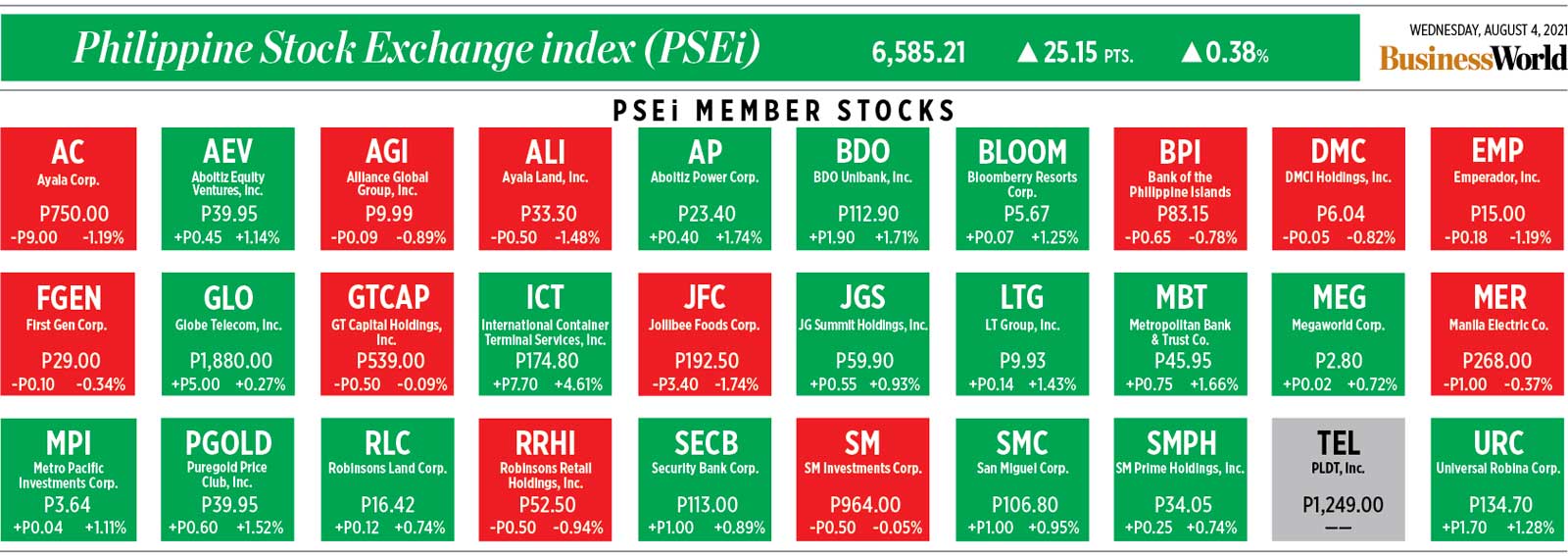
How PSEi member stocks performed — August 4, 2021

Here’s a quick glance at how PSEi stocks fared on Wednesday, August 4, 2021.


Peso weakens anew vs dollar as gov’t cuts outlook for agriculture sector

BW FILE PHOTO

THE PESO retreated versus the greenback on Wednesday due to risk-off sentiment as the government lowered its target for the agriculture sector’s growth.

The local unit closed at P49.75 per dollar, weaker by 14 centavos from its P49.61 close on Tuesday, based on data from the Bankers Association of the Philippines.

The peso opened Wednesday’s session at P49.85 per dollar, which was also its weakest showing for the day. Meanwhile, its intraday best was at P49.59 versus the greenback.

Dollars exchanged slipped to $1.041 billion on Wednesday from the $1.098 billion recorded on Tuesday.

The revision of the growth target for the agriculture sector and its resulting impact on the economy caused risk-off sentiment, Rizal Commercial Banking Corp. Chief Economist Michael L. Ricafort said.

The Department of Agriculture on Wednesday said it trimmed its 2021 growth target for the farm sector to 2% from 2.5% previously, citing the impact of the African Swine Fever and the lockdowns.

Meanwhile, a trader attributed the peso’s weakness to safe-haven demand amid reports of the US Treasury department taking steps to prevent hitting their debt ceiling.

US Treasury Secretary Janet Yellen on Monday through a letter to House Speaker Nancy Pelosi and other congress leaders said she was suspending investments in the Civil Service Retirement and Disability Fund and the Postal Service Retiree Health Benefits Fund that are not immediately required to pay beneficiaries, Reuters reported.

The move was seen as a step to keep the federal government’s borrowing capacity under a reinstated debt limit. A two-year debt-ceiling suspension expired on Saturday, which means the effectivity of the cap at the current debt level of about $28.5 trillion.

Ms. Yellen warned Congress in late July that a critical date could be Oct. 1, when the government faces $150 billion in mandatory payments as the 2022 fiscal year starts.

For today, Mr. Ricafort gave a forecast range of P49.60 to P49.80 per dollar, while the trader expects the local unit to move between P49.65 to P49.90. — L.W.T. Noble with Reuters

Stocks rally as companies report higher profits

COURTESY OF PHILIPPINE STOCK EXCHANGE, INC.

PHILIPPINE shares continued to rally on Wednesday following positive earnings reports from companies, but analysts said the market could consolidate as the week comes to an end.

The Philippine Stock Exchange index (PSEi) gained 25.15 points or 0.38% on Wednesday to close at 6,585.21, while the all shares index went up by 18.77 points or 0.46% to end at 4,059.59.

“Philippine shares traded slightly up after the new string of positive corporate earnings results overshadowed investor concerns over the coronavirus and Chinese regulatory action against technology stocks,” Regina Capital Development Corp. Head of Sales Luis A. Limlingan said in a Viber message.

Property firm Megaworld Corp. said it recorded a net attributable income worth P2.6 billion in the second quarter, up by 39% from last year’s P1.9 billion.

SM Investments Corp. also saw its net income surge to P20.1 billion in the first semester, nearly a threefold improvement from the P7.1-billion profit booked in the same period last year.

Meanwhile, Metro Pacific Investments Corp. recorded an 82% growth in core net income for the quarter to P3.5 billion from P1.9 billion year on year.

On the other hand, shares in US and European-listed gaming companies fell on Tuesday after a steep sell-off in China’s social media and video games group Tencent driven by fears the sector could be next in regulators’ crosshairs, Reuters reported.

The slide in European and US gaming stocks followed a tumble in Tencent, down more than 10% at one point in Hong Kong in a decline that wiped off almost $60 billion from its market capitalization, after a Chinese state media outlet branded online video games “spiritual opium.”

“[A] follow-through buying on attractive valuation lifted the market but gains are losing steam and likely set to go on consolidation mode tomorrow and until [the] weekend,” First Metro Investment Corp. Head of Research Cristina S. Ulang said in a separate Viber message.

Majority of sectoral indices posted gains on Wednesday except for property, which inched down by 3.36 points or 0.1% to finish at 3,078.05.

Meanwhile, services climbed 29.10 points or 1.85% to 1,595.29; mining and oil rose 84.21 points or 0.86% to 9,840.62; financials increased by 10.98 points or 0.76% to 1,438.99; industrials went up 34.44 points or 0.37% to close at 9,262.94; and holding firms inched up by 3.70 points or 0.05% to 6,555.32.

Value turnover inched down to P4.64 billion with 1.10 billion issues traded on Wednesday, from the P4.89 billion with 799.68 million issues switched hands the previous day.

Advancers beat decliners, 115 against 73, while 46 names closed unchanged.

Net foreign buying decreased to P83.72 million yesterday from the P108.49 million logged on Tuesday. — K.C.G. Valmonte with Reuters

Airlines to seek fresh government aid next week

REUTERS

AIRLINES are hoping to meet with the government’s transport agencies next week to seek an extension of the waiver of airport fees as the aviation industry continues to struggle due to the pandemic and lockdowns, the Air Carriers Association of the Philippines (ACAP) said Wednesday.

“The government-backed guarantees were discussed as early as Bayanihan I, but (the matter remains) pending,” ACAP Chairman and Philippines AirAsia, Inc. Chief Executive Officer Ricardo P. Isla said at an online briefing. He was referring to the first Bayanihan stimulus package passed last year.

“However, what we are now asking for is an extension of the waived airport fees and parking fees. That alone will be a big help to the airline companies,” he added.

Mr. Isla also said ACAP is due to meet by next week with the Civil Aviation Authority of the Philippines, the Civil Aeronautics Board, and the Manila International Airport Authority.

He noted that some airport tenants are also asking for rent relief. 

“The parking and runway fees that we pay the airports — I think these are the basics that we can ask for right now,” he added.

Philippines AirAsia officials presented during the briefing the results of its survey conducted on July 23, 24, 27 and 28 involving 1,600 guests flying out of Ninoy Aquino International Airport Terminal 3 to destinations like Bohol, Bacolod, Cagayan de Oro, Cebu and Davao.

The low-cost carrier said 91.4% of the respondents agreed that having a fully vaccinated crew gives them confidence to travel by air. 

“As of August 2, 2021, 67% of the 1,500 Filipino (AirAsia employees) have received their COVID-19 shots. With the threat of the Delta variant, AirAsia Philippines is proactively campaigning to inoculate its entire workforce within the year,” the company said in a statement.

“Meanwhile, 729 guests or 45.5% claimed to have been vaccinated; 410 of whom were fully vaccinated or were traveling two weeks after receiving their second dose; 190 received their first dose; and 120 claimed to have gotten their second dose,” it added. — Arjay L. Balinbin

Emerging COVID-19 variants seen threatening PHL economic recovery

PHILIPPINE STAR/ MICHAEL VARCAS

AN ECONOMIC recovery for the Philippines could come “sooner than later,” though the main downside will come from the emergence of more infectious variants of the coronavirus, First Metro Investment Corp. (FMIC) and University of Asia and the Pacific (UA&P) said in a joint report Wednesday.

“The emergence of coronavirus disease 2019 (COVID-19) variants and possible draconian response still pose threats to a rapid economic reboot,” FMIC and UA&P said in their July market call.

The analysis noted that indicators in May including employment, manufacturing output, and government spending are helping to raise optimism that the economy is on the mend.

“The likelihood of continued improvement will largely depend on the roll-out of vaccines, the control of the spread of the COVID-19 and the relaxation of mobility restrictions. Employment gains should translate to higher aggregate spending, which will hopefully create more jobs in the second half,” according to the market call.

The May unemployment rate was 7.7%, equivalent to 3.73 million jobless, declining from 8.7% or 4.138 million in April, according to the Philippine Statistics Authority.

The June Labor Force Survey released Tuesday also came in at 7.7%, but estimated unemployment numbers at 3.764 million.

FMIC and UA&P are bullish that higher employment in sectors such as manufacturing and construction will help to propel a recovery in those sectors.

Factory activity continued to expand thought at a slower pace last month even as neighboring countries saw contractions due to the infection surge, according to IHS Markit. The Philippine Manufacturing Purchasing Managers’ Index was at 50.4 in July, slipping from a 50.8 reading in June, although still above the 50 neutral mark that separates contraction from expansion.

Another important factor that could help boost growth is the pickup in government spending, according to the market call.

“We expect National Government spending to accelerate further for the rest of the year as the May 2022 Presidential elections draw closer,” the two institutions said. 

Government spending in June rose 13.2% from a year earlier to P395.4 billion, according to the Bureau of the Treasury. Government spending in the first half of the year was P2.206 trillion, up 9.6% from a year earlier but still 9.56% short of the P2.44-trillion target for the January to June period.

In July, FMIC trimmed its GDP (gross domestic product) growth forecast for the year to 5-6% from the 5.5-6.5% estimate it issued in January. The official government target is 6-7%.

The economy contracted by 4.2% in the first quarter following the record 9.6% contraction in 2020. — Luz Wendy T. Noble

Schools seek prompt passage of tax relief bill

PHILSTAR

PRIVATE SCHOOLS said they are hoping a bill granting them eligibility for a lower tax rate is signed this month or in September, to remove the distraction of the dispute with the Bureau of Internal Revenue (BIR) and allow them to focus on their core teaching mission.

“We are hopeful that the bill can be signed into law before the new school year starts in earnest this August and September, so that our schools can fully focus on dealing with the Learning Crisis and the COVID (coronavirus disease) pandemic that our country is currently grappling with,” Coordinating Council of Private Educational Associations (COCOPEA) Managing Director Joseph Noel M. Estrada said in a statement Wednesday. 

Mr. Estrada also urged private educators to join COCOPEA in appealing to Congress to swiftly pass the bill “to extend a lifeline to our struggling schools during this pandemic, to ensure the continuity of learning for our students, to secure the jobs of our teachers and personnel, and to provide livelihoods for the many small businesses… who are dependent on our schools.

The House of Representatives’ Committee on Ways and Means passed the bill on second reading Monday.

House Bill 9913 amends Section 27 (B) of the National Internal Revenue Code of 1997 to explicitly allow all proprietary educational institutions and non-profit hospitals to avail of a 10% preferential tax rate for a limited period to allow them to recover from the economic crisis. 

Under the bill, the tax rate of private schools will further be reduced to 1% from July 1, 2020 to June 30, 2023, as authorized by Republic Act 11534 or the Corporate Recovery and Tax Incentives for Enterprises (CREATE) law. 

The BIR’s view on eligibility for tax relief was that it only applied to non-profit institutions, leaving for-profit schools to pay the regular corporate tax rate, currently at 25%. 

The BIR has since withdrawn its interpretation of the tax treatment for private schools. — Bianca Angelica D. Añago

Hedcor resumes hydro operations in Benguet after deal with IP groups

HEDCOR.COM

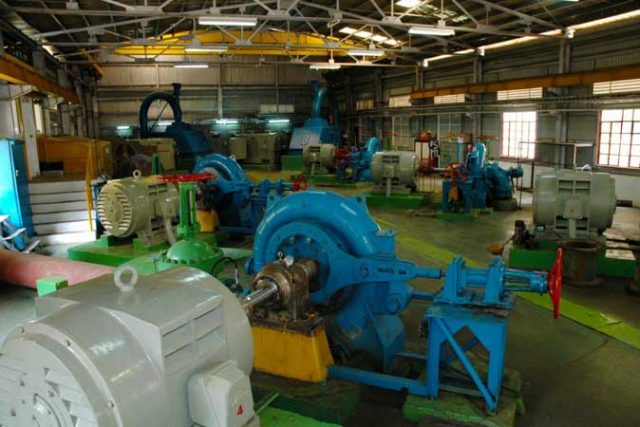
ABOITIZPOWER Corp. unit Hedcor, Inc. has resumed the operations of its three hydroelectric facilities in Bakun, Benguet, after reaching a deal with indigenous groups, which earlier withdrew their consent for the power plants over a royalty dispute.

The hydro plants are the 2.4-megawatt (MW) Lower Labay, 3.6-MW Lon-oy, and 5.9-MW FLS hydro facilities.

“Hedcor’s (plants) resumed operations on July 28, 2021 and synchronized to the Luzon grid. This is following the successful conduct of a negotiation participated in by Hedcor, the Bakun Indigenous Tribe Organization (BITO), together with the local government officials of Bakun last July 27-28,” AboitizPower said in a regulatory filing Wednesday.

“The Bakun community will collectively receive about 14 centavos per kWh (kilowatt hour) of the generation of the Bakun Plants which is an aggregation of mandatory shares, voluntary benefits, and projects,” the firm said.

Under the Energy department’s Energy Regulation 1-94 program, power generating firms are required to give one centavo for every kilowatt-hour of sales to their host communities to finance electrification, livelihood and development projects.

In June, the National Commission on Indigenous Peoples-Cordillera Administrative Region (NCIP-CAR) served a halt order on Hedcor due to alleged issues in securing consent from the tribes. The Bakun groups requested a cease-and-desist order in April, which the NCIP’s regional office issued “as a legal and necessary consequence of a resolution of non-consent.”

NCIP-CAR Concurrent Director IV Marlon P. Bosantog has said that one of the main disagreements stems from royalty issues following the expiry of an initial deal signed in 1991.

On Wednesday, Hedcor President and Chief Operating Officer Rolando G. Pacquiao said the company will continue its partnership with the Bakun tribes for another 25 years.

“We are very grateful that the (community) expressed their support over the resumption of our operations in Bakun. We are equally thankful for the support of the NCIP-CAR in opening the doors to dialogue, and to the community for the opportunity to sit down and talk so that we can work on a resolution,” he said.

With the new agreement, Hedcor hopes to complete its FPIC (free prior informed consent) application and secure a certificate of precondition (CP), which will both be issued by the NCIP.

According to the Indigenous Peoples’ (IP) Rights Act of 1997, developers may secure permits and licenses only after receiving the CP, which expresses consent from the indigenous community hosting the project.

Hedcor, a wholly owned subsidiary of AboitizPower, operates 22 hydropower plants supplying the country with over 277 MW of renewable energy. — Angelica Y. Yang

ADVERTISEMENT
ADVERTISEMENT