Home Blog Page 7674

Victorias Milling readies COVID-19 vaccines for employees

VICTORIAS Milling Co., Inc. said its 2,000 employees and service providers are set to be vaccinated against the coronavirus disease 2019 (COVID-19) in the coming months.

In a stock exchange disclosure on Tuesday, Victorias Milling President Minnie O. Chua said the company had submitted the names of its employees and other outsourced personnel who signed up for its vaccination program.

“The safety and well-being of our people will always be our top priority. As such, the vaccination program is necessary to protect their employees and their families from getting severely affected when infected by the virus,” Ms. Chua said in the disclosure.

“We’ve had a few employees who contracted the virus and thankfully, they are now fully recovered. The program will also help in restoring normalcy in our operations and allow us to continue serving our planters,” she added.

Ms. Chua said the company’s work force showed hesitation when initially asked regarding mass vaccination, but said more than 90% of them signed for the program after undergoing a week of advocacy and testimonials from those previously infected or those who lost loved ones after contracting the virus.

“This is one of the greatest challenges the company faced. We are thankful that despite the restrictions and protocols we’ve established, the employees and our clients cooperated,” she said.

Ms. Chua also said the company is creating mechanics that will allow the families and households of their employees to have access to the vaccines.

MANULIFE TO PROVIDE VACCINES FOR EMPLOYEES
Separately, global life insurer Manulife said in a statement on Tuesday that it will have a COVID-19 vaccination program for its 8,500 employees and active agents in the Philippines.

The company announced that the vaccination program will cover personnel from Manulife Philippines, Manulife China Bank Life, Manulife Investment Trust Corp., Manulife Business Processing Services, Manulife IT Delivery Center Asia, and other active insurance advisors and agency leaders.

According to Manulife, the vaccination support program is voluntary for employees and agents.

“As the COVID-19 situation in the country evolves, the safety and well-being of our team members remain our top priority. We want to give them the protection and peace of mind they need, as they continue to serve our customers and our communities,” said Richard Bates, Manulife Philippines president and chief executive officer. — Revin Mikhael D. Ochave
BSP set to release second phase of sustainable finance regulation

BW FILE PHOTO

THE central bank will unveil the second-phase regulation for sustainable financing, which will take into account climate change risk in the assessment of credit and operational risk management of the banking industry.

“This issuance will provide granular expectations on the integration of climate change and other environmental and social risks in banks’ credit and operational risk management frameworks,” Bangko Sentral ng Pilipinas Governor Benjamin E. Diokno said at the Investment Forum on Energy Transition held on May 20.

The upcoming regulation is anchored on expectations for banks to gear towards sustainability principles through pushing for strategic, concrete, and progressive actions to address climate change.

“The framework safeguards the stability of the financial system against potentially significant and protracted impact of climate change and other environment related risks,” Mr. Diokno said.

In April last year, the central bank launched its sustainable finance framework and gave banks a three-year transition period to adopt its provisions.

The regulation includes directing banks to adopt sustainability principles through environmental and social risk management systems as well as environmental, social and governance (ESG) considerations in their governance frameworks, risk management systems, strategies and operations.

Part of the sustainability drive is launching instruments to boost financing for sectors affected by the crisis such as micro-, small- and medium-sized enterprises (MSMEs), health, education and food security.

The central bank governor stressed that reducing greenhouse gas concentrations by shifting from fossil fuels to renewable sources is crucial to the climate change mitigation goal.

“We should note, however, that a successful transition is not just a matter of isolated changes in the energy sector. We must also consider the potential risks associated with this transition given the interplay among economic activities,” he said. — Luz Wendy T. Noble

National Government Fiscal Performance

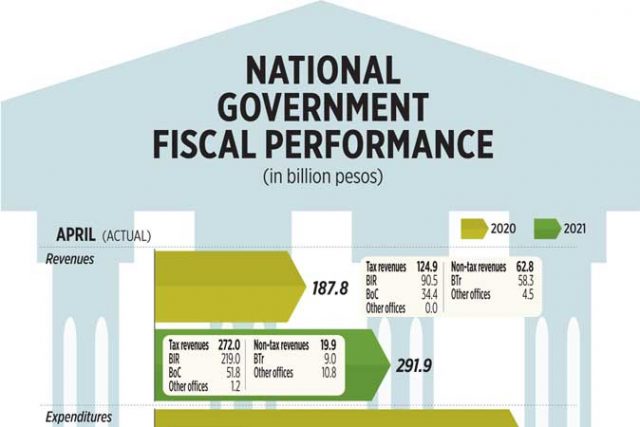
THE NATIONAL Government’s budget deficit shrank to P44.4 billion in April, following the sharp drop in spending and a base effect-induced spike in revenues. Read the full story.

National Government Fiscal Performance

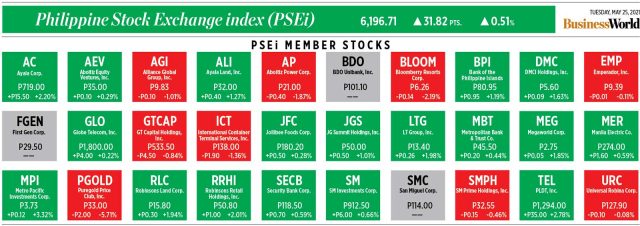
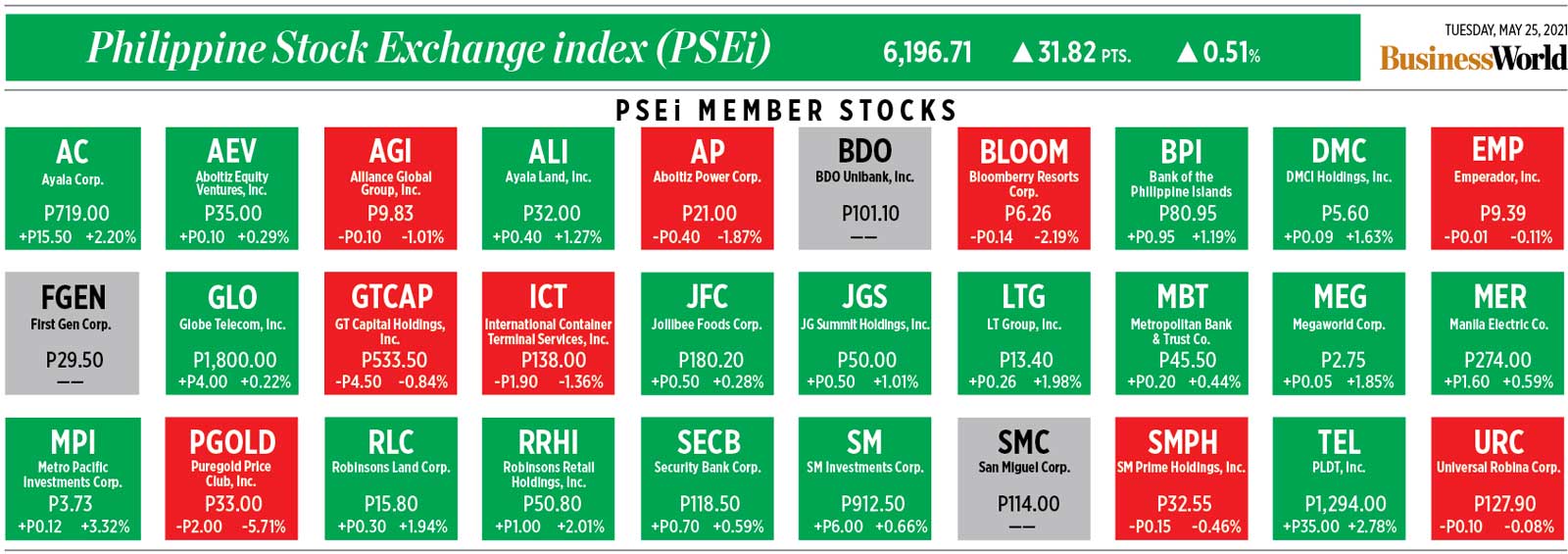
How PSEi member stocks performed — May 25, 2021

Here’s a quick glance at how PSEi stocks fared on Tuesday, May 25, 2021.


Global recovery signs, lower US virus cases lift stocks

BW FILE PHOTO

PHILIPPINE shares inched up on Tuesday despite cautious market sentiment as investors turned optimistic about global recovery after the United States reported lower cases of coronavirus disease 2019 (COVID-19).

The benchmark Philippine Stock Exchange index (PSEi) climbed 31.82 points or 0.51% to close at 6,196.71 on Tuesday, while the all shares index gained 13.51 points or 0.35% to end at 3,834.78.

“The local bourse ended higher together with most Asian markets, as overnight markets finished on green territory due to investors feeling optimistic over the recovery of the global economy,” Darren Blaine T. Pangan, trader at Timson Securities, Inc., said in a Viber message.

“This comes after reports circulated that the daily new COVID-19 cases in the US started to decline already,” Mr. Pangan said.

However, with the lack of developments at home, investors remained cautious.

“The market managed to end slightly higher, mainly flat despite increased trading and volatility in several blue-chips,” AAA Southeast Equities, Inc. Research Head Christopher John Mangun said in an e-mail, referring to some of the companies in the 30-member PSEi.

“The sentiment remains overly cautious as investors have not gained any optimism from the positive vaccine progress on the perception that the uncertainty risks, vastly outweigh the developments,” Mr. Mangun added.

Sectoral indices were split on Tuesday. Holding firms went up by 59.80 points or 0.97% to 6,192.66; financials improved by 7.05 points or 0.51% to 1,376.20; and property climbed 12.26 points or 0.41% to 2,962.65.

Meanwhile, mining and oil declined by 54.94 points or 0.59% to 9,197.88; services lost 3.18 points or 0.21% to finish at 1,447.10; and industrials shed 5.42 points or 0.06% to 8,535.10.

Value turnover went up to P6.02 billion with 1.16 billion shares switching hands on Tuesday, from the P4.48 billion with 1.09 billion issues traded on the previous trading day.

Advancers outnumbered decliners, 98 against 88, while 58 names closed unchanged.

Net foreign selling dropped to P88.89 million on Tuesday from the P667.86 million in net outflows logged on Monday.

Timson Securities’ Mr. Pangan said he expects the index to trade between 6,150 and 6,490.

“The market is expected to continue lower, and we highly encourage medium to long-term investors to start accumulating,” AAA Southeast Equities’ Mr. Mangun said. — Keren Concepcion G. Valmonte

Peso weakens for fifth day on rising oil prices

BW FILE PHOTO

THE PESO continued to weaken for a fifth straight trading day against the greenback on Tuesday amid rising global crude oil prices.

The local unit closed at P48.135 versus the dollar on Tuesday, dropping by 7 centavos from Monday’s finish of P48.065, data from the Bankers Association of the Philippines’ website showed.

This was the peso’s worst close in three weeks, or since the April 29 finish of P48.315 per dollar.

The peso opened Tuesday’s session at P48.05 against the dollar, while its intraday best was at 48. It dropped to as low as P48.16 versus the greenback.

Dollars traded went up to $1.039 billion on Tuesday from $937.64 million on Monday.

“The peso’s weak performance was partly brought about by the latest increase in global crude oil prices to a two-month high, thereby increasing the country’s import bill,” said Rizal Commercial Banking Corp. (RCBC) Chief Economist Michael L. Ricafort in a text message.

Goldman Sachs forecast oil prices to climb to $80 per barrel in the fourth quarter of this year, saying that the market has “underestimated a rebound in demand even with a possible resumption in Iranian supply.”

Mr. Ricafort said another factor that influenced the peso’s performance was the move from Moody’s Investors Service to cut its 2021 growth estimate for the Philippine gross domestic product to 5.3% from 6.3% due to the country’s faster inflation rate in the first quarter, among others.

Meanwhile, a trader said that expectations of an upbeat US consumer confidence report this month might support views of a strong economic recovery in the US. The local currency might depreciate further from a better report on durable goods in the US last April.

For Wednesday, the trader expects the peso to move between P48.05 and P48.25 versus the dollar, while RCBC’s Mr. Ricafort gave a forecast range of P48.08 to P48.18. — Isabel B. Celis with Reuters

DICT pitches telecom spectrum user fee to drive telco investment

BW FILE PHOTO

THE Department of Information and Communications Technology (DICT) said Congress needs to legislate a spectrum user fee (SUF) to ensure the sustainability of telecommunications industry development and improve access to the internet.

At a House hearing Tuesday, Information and Communications Undersecretary Emmanuel Rey R. Caintic said the SUF was on the DICT’s wish list when legislators were discussing the proposed third Bayanihan economic stimulus package. The DICT said the fee can only be imposed by law. The funding generated by the fee will allow more fiber connectivity in remote areas.

“If you will allow us… (to unlock the) spectrum users fee, we will be able to invest in digital infrastructure… so that it is sustainable, economical, and better,” he said, in response to Catanduanes Rep. Hector S. Sanchez’s question on the DICT’s plan to “fiberize” the telecom infrastructure.

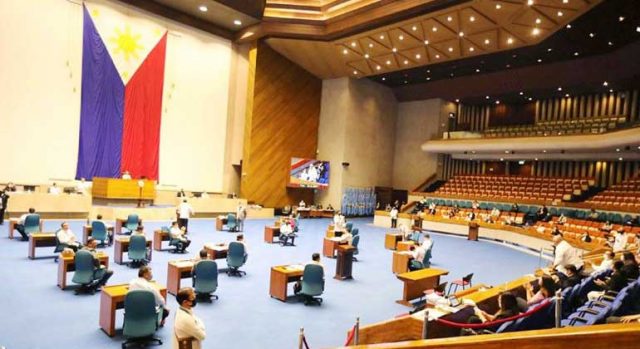
The House Committee on Good Government and Public Accountability was holding the hearing Tuesday to debate House Resolution No. 1751, investigating irregularities in the implementation of the free public Wi-Fi program.

The DICT said the program has enabled up to 6,000 communities along the so-called last mile to access free internet services.

Mr. Caintic said the free Wi-Fi roll-out was carried out in partnership with the United Nations Development Program. It has led to the activation of 9,122 sites. Mr. Caintic said in 2021, more sites will be set up and funds are available to establish 14,000 more. — Gillian M. Cortez

PHL debt service bill seen as manageable even if rates rise

REUTERS

EMERGING MARKETS including the Philippines are expected to be “quite resilient” in the event interest rates rise, with many countries weighting their government debt in favor of local-currency issues, according to S&P Global Ratings.

A stress-test scenario of a 300-basis points rate hike indicated that emerging markets are likely to incur a 1 percentage point increase in interest expenses relative to gross domestic product (GDP) by 2023.

“Emerging-market borrowers — Brazil, China, India, South Korea, the Philippines, and South Africa — finance themselves almost exclusively in local currency, giving them greater control over their cost of funding,” it said in a note Monday.

S&P expects the Philippines to incur interest expenses equivalent to about 1.9% of GDP between 2021 and 2023. This remains largely the same in a scenario where a 100- and 300-basis points rate hike shock is applied.

The Philippine debt stock was P10.774 trillion at the end of March, up 27% from a year earlier and up 3.5% from a month earlier, according to the Bureau of the Treasury. The Philippine debt mix is 72% local.

“Several emerging-market sovereigns (Hungary, India, Indonesia, the Philippines, Poland, South Africa, and Turkey) have already launched asset purchase programs targeting domestic government securities, either in the primary or secondary market, although the expansion of their central banks’ balance sheets has been more restrained than for developed-market peers,” S&P said.

In January, the Bangko Sentral ng Pilipinas (BSP) granted a fresh P540 billion to the National Government. The central bank has also been active in purchasing government securities in the secondary market.

S&P said emerging markets that are most vulnerable to higher refinancing costs include Egypt, South Africa, Ghana, and Kenya.

It also noted that Colombia, Egypt, Ghana, Kenya, Turkey, and Ukraine have sizeable foreign currency-denominated government debt, which will complicate their ability to control their cost of funding.

“If rates rise quickly to reflect rapid employment gains and buoyant GDP growth, against the backdrop of steady increases in productivity, the higher cost of debt servicing will almost certainly be offset by improving state revenue and more rapid consolidation of the primary (non-interest) government accounts,” S&P said.

On the other hand, in a scenario where higher rates are due to a delayed response from a central bank to inflation “caused by stagnating post-pandemic productivity”, S&P warned rate shocks could result in weaker exchange rates and risks the credit fundamentals of sovereigns.

The BSP maintained its key policy rate at 2% earlier this month to continue its support for the recovery. Officials have said they will act immediately if needed to respond to second-round effects of higher inflation including wage and transport fare hikes. — Luz Wendy T. Noble  

BPO industry touts expedited-vaccination deal with QC as model for other LGUs

REUTERS

THE Business Process Outsourcing (BPO) industry has signed an agreement with Quezon City to speed up the vaccination of 67,000 outsourcing workers based there.

Twenty-nine companies have registered their employees for access to coronavirus vaccines under a program offered by the Quezon City government.

“The local government unit (LGU) will facilitate and expedite the inoculation of qualified IT-BPM employees who report to offices located in Quezon City,” the Information Technology and Business Process Association of the Philippines (IBPAP) said in a statement Monday.

Healthcare workers from the participating firms could also volunteer to help inoculate colleagues.

“We hope that this will serve as a template for our ongoing efforts with other LGUs. Early access to the vaccine is really top-of-mind for our sector,” IBPAP President and Chief Executive Officer Rey E. Untal said.

Participating business groups include IBPAP, the Contact Center Association of the Philippines, and the Healthcare Information Management Association of the Philippines.

The industry is procuring over a million doses of the AstraZeneca, Moderna, and Novovax vaccines for employees and their dependents. The vaccines will arrive in the latter part of the second quarter, IBPAP said.

BPO workers have also been placed in the A4 vaccination category on the priority list for publicly-procured vaccines.

Workers group BPO Industry Employees Network campaigned for the inclusion of outsourcing workers in the A4 priority list due to health risks taken by those working on site. — Jenina P. Ibañez

House plenary passes e-cigarette bill amid claims of weaker health safeguards, youth protections

REUTERS

THE HOUSE of Representatives has approved on third and final reading a bill that proposes to regulate e-cigarettes and heated tobacco products, in the face of opposition from some legislators over the deletion of health safeguards.

Voting 192 to 34 with four abstentions, legislators approved House Bill 9007, or the proposed Non- Combustible Nicotine Delivery Systems Regulation Act. The bill sets regulations for the manufacture, use, sale, packaging, distribution, advertisement, and promotion of electronic nicotine and non-nicotine delivery systems (ENDS/ENNDS) and heated tobacco products (HTPs).

If signed, the bill will also set product standards for ENDS/ENNDS which will be determined by the Department of Trade and Industry in consultation with the Food and Drug Administration (FDA). It will also outline standards for HTPs as identified by the DTI in consultation with the Inter-Agency Committee on Tobacco.

Penalties for noncompliance are capped at P500,000 for a first offense and P750,000 for a second offense. Third offenses warrant a fine of more than P1 million or imprisonment of up to five years.

The bill will also lower the minimum age for persons allowed to purchase from 21 years to 18 years.

The bill will allow the online sale and advertisement of ENDS/ENNDS and HTPs as long as the website or e-commerce platform restricts sales to those under 18.

The head of the House health committee opposed the passage of HB 9007, claiming that the health safeguards are too lax.

Quezon Rep. Angelina DL Tan said in explaining her No vote that “I cannot in any manner support House Bill No. 9007… as it pretends to be a health measure for all when if in fact gives primordial consideration to trade and commercial interests of the few.”

She added that the bill runs afoul of various health laws since it does not require warnings on the possible hazards of ENDS/ENDDS and HTP use.

Muntinlupa Rep. Rozzano Rufino B. Biazon said in explaining his No vote that HB 9007 has put some distance on its original intent as a health measure and lacks teeth in denying young people access to such products.

“This bill has turned into a trade and industry measure rather than a health measure as we started out. This bill does not protect the youth from the harm of END/ENNDS abuse addiction and as well as the vapes and HTPs because of the permissiveness of the online trading and advertising rules, which IT experts said cannot guarantee the protection of the youth from access,” he said.

Agusan del Norte Rep. Lawrence H. Fortun said that the bill also deleted crucial provisions such as designating the FDA as the regulatory agency for e-cigarettes and prohibition of advertising methods attractive to children. — Gillian M. Cortez

Pressed for time, House adopts Senate tax amnesty extension bill

PHILSTAR

THE proposed extension for availing of the estate tax amnesty will head to Malacañang directly without the need to go through the bicameral conference committee stage after the House of Representatives moved to adopt the Senate’s version of the measure.

Late Monday, House legislators approved a motion to concur with the Senate’s version of the measure, adopting Senate Bill (SB) 2208. The bill’s House counterpart is House Bill (HB) 7068, which proposes to extend the estate tax amnesty by another two years.

“We have been informed that the Committee on Ways and Means, sponsor of House Bill No. 7068, as well as the authors thereof, are in concurrence with the provisions of Senate Bill No. 2208. In accordance with our rules, I move to adopt Senate Bill No. 2208 as an amendment to House Bill No. 7068,” Iloilo City Rep. Lorenz R. Defensor said at the plenary session Monday.

With the House adopting the measure, there will be no need for a bicameral meeting on the bill and the bill will be transmitted to the President, skipping a potentially time-consuming stage before Congress adjourns on June 4.

The Senate approved SB 2208 on third and final reading on Monday afternoon. HB 7058 was approved in September.

If signed, the proposed law will amend Republic Act (RA) No. 11213 or the Tax Amnesty Act of 2019, which was set to expire on June 15.

The bill amends the expiration provision to “four years from the effectivity of the Implementing Rules and Regulations of this Act” from the original two years provided for in RA 11213. This will move the expiration date for amnesty applications to June 14, 2023. — Gillian M. Cortez

DPWH, CCP, Navy found violating rules on release of wastewater into Manila Bay

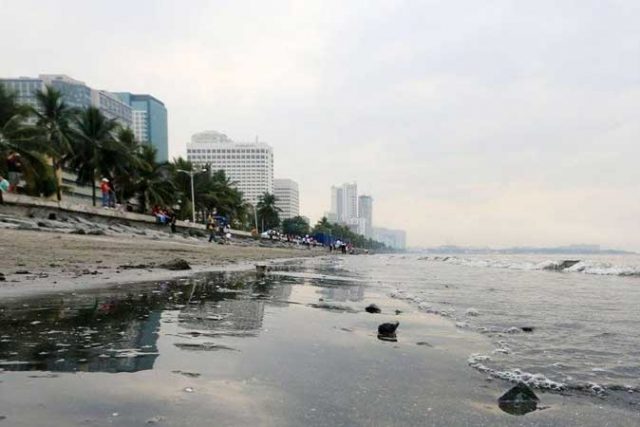
THE DEPARTMENT of Environment and Natural Resources (DENR), via its Laguna Lake Development Authority (LLDA) unit, has issued cease and desist orders to the Department of Public Works and Highways (DPWH), the Cultural Center of the Philippines (CCP) and the Philippine Navy for releasing wastewater into Manila Bay.

According to documents provided by DENR Undersecretary Jonas R. Leones, the DPWH, CCP and Philippine Navy failed to meet the department’s effluent standards following water inspections in various outlets to the bay managed by the three agencies.

The failures were described as non-compliance with the standard for Class SB water, in terms of total suspended solids, and biochemical oxygen demand, among others. Class SB water is deemed suitable for bathing, swimming, skin diving, and other forms of contact recreation.

Water discharges by the three institutions were higher than the standard 200 most probable number (MPN) of contaminants per 100 mL, with some exceeding 160,000 MPN/100 mL.

“The discharged wastewater coming from the respondent(s)… is an immediate threat to life, public health, safety and welfare to animals and plant life,” the LLDA said.

The orders were in effect immediately and will remain until the institutions are compliant, or until a temporary stay is issued. The DPWH, CCP and Navy are required to pay fines and other penalties for the violations, the DENR said.

The orders were signed by LLDA General Manager Jaime C. Medina.

On Tuesday, the CCP said that it does not object to the halting of its wastewater discharge.

“(We are) still awaiting the completion of the CCP’s Sewage Treatment Plant, which was delayed due to the current pandemic. It is targeted to begin operations by July 2021,” the CCP said in a issued by its corporate communications division.

It added that it has ramped up the siphoning and hauling of generated sewage, and has asked water concessionaire Maynilad to help in draining the center’s septic tanks.

BusinessWorld asked the DPWH and the Navy for comment, but they had not replied at the deadline. — Angelica Y. Yang