Home Blog Page 766

Stuff to Do (10/17/25)


Catch the PPO’s cello concert

THE NEXT CONCERT of the Philippine Philharmonic Orchestra (PPO) will feature cellist Tomasz Strahl as the guest. It will also see the world premiere of Jeffrey Ching’s Creation Fugue and Arctic Chase, along with Schumann’s Cello Concerto in A minor, and Lutosławski’s Concerto for Orchestra. Under the baton of Grzegorz Nowak, the concert will take place on Oct. 17, 7:30 p.m. at the Metropolitan Theater in Manila. Tickets are available via TicketWorld.


Enjoy the bar takeover at Grand Hyatt Manila

ON OCT. 17 and 18, The Peak at Grand Hyatt Manila will host a special guest behind the bar: Wayan Agus Wiyantara, beverage manager of Alila Seminyak in Bali, Indonesia. Known in the industry as “Mr. Mustacho,” Wiyantara, or “Wi,” is acclaimed for his inventive and sustainable approach to cocktail creation. He has earned recognition for his work at Seasalt, the signature bar of Alila Seminyak. Under his leadership, Seasalt’s cocktail program underwent a bold transformation, introducing a pioneering zero-waste initiative that reimagines ingredients and techniques to minimize environmental impact while delivering exceptional flavor and creativity. During his two-night bar shift at The Peak, he will present a curated menu of cocktails that reflect his commitment to sustainability, innovation, and Balinese heritage. This event is part of his ongoing series of international collaborations, which have included bar takeovers and joint events with luxury properties such as Park Hyatt Jakarta. Guests can enjoy the following featured cocktails, available for P650 and at a special offer of two for P1,018+: Coco Pandan Nectar (Volcan Blanco Tequila with Coconut Malibu, lemon, and coco pandan sodas), Tropical Highland (Glenmorangie 12 Years Scotch paired with homemade tropical land sodas), Emperor’s Sour (Hennessy V.S. with lemon and a homemade emperor cordial), and Luneta Blossom (Belvedere Vodka, calamansi, lemon, betel cordial, and betel oil). Guests can experience his zero-waste cocktails at The Peak, Grand Hyatt Manila on Oct. 17 and 18 from 7 p.m. onwards. Live DJ entertainment courtesy of the venue’s resident acts will complement the drinks. For more information on the hotel, visit www.grandhyattmanila.com.


See some German movies

THE German Film Festival, known as KinoFest, returns this year to the Red Carpet Cinemas in Shangri-La Plaza mall. This year’s edition, ongoing until Oct. 19, features eight contemporary German films and five Filipino short films. The program spans a range of genres and styles, exploring themes of memory, belonging, and care — and how cinema connects cultures across perspectives and histories. Tickets are free on a first-come, first-served basis. Tickets may be claimed at the KinoFest booth near the mall’s Cinema 3 starting one hour before each screening.


Watch Anino sa Likod ng Buwan

IDEAFIRST LIVE, the theater arm of IdeaFirst Company, will be presenting filmmaker Jun Robles Lana’s award-winning play, Anino sa Likod ng Buwan, from Oct. 17 to Nov. 9. The play was initially staged 30 years ago and last staged in March this year. This time, it will be performed at the PETA Theater Center in Quezon City. Set in a remote village in the rebel-wracked countryside of the 1990s, it revolves around the relationship of a couple and a soldier. The play is directed by Tuxqs Rutaquio, and stars Martin del Rosario, Elora Españo, and Ross Pesigan. Tickets are available through Ticket2Me.


Watch contemporary dance at Areté

MARI DANCE, in partnership with Areté at the Ateneo de Manila University, is presenting “A Dance in a Day in a Dance,” a contemporary dance production running this weekend until Oct. 19. It features original works by award-winning choreographer JM Cabling that tackle the collective stories of contemporary dance artists. His homegrown students will star, alongside two dancers who are making their return to the Philippine stage: Al Garcia coming from Taiwan, and Katrene San Miguel coming from Hong Kong. Tickets are available via Ticket2Me and this direct link: bit.ly/a_dance_2025.


Shop for pet products, join a pet fashion show

THE Shopwise pet fair titled “Pawp-Up” is taking place this weekend, until Oct. 19 at Gateway Mall 2’s Quantum Skyview on Upper Ground B of the Gateway Mall, Cubao, Quezon City. The three-day event offers affordable deals for a wide array of pet products. On Oct. 19 at 2 p.m., pet parents are invited to join the Shopwise pet fair fashion show, where pets can strut the runway in hip pop culture costumes.


Enjoy the Dedma twin bill again

THEATRE TITAS is bringing back its twin bill Dedma, last staged in April, on Oct. 17 to 26. It is made up of two plays — Let’s Do Lunch (directed by Maribel Legarda) and The Foxtrot (directed by Paul Alexander Morales) — both penned by Theatre Titas Co-founder Chesie Galvez-Cariño. It follows members of Manila’s elite whose beautiful pretenses are mixed with ugly truths. The play runs at the Mirror Studio Theatre 2, with 8 p.m. performances Fridays through Sundays and 3 p.m. matinées on Saturdays and Sundays. Issa Litton, Ash Nicanor, Naths Everett and Mayen Cadd star in Let’s Do Lunch while Royce Cabrera and Jackie Lou Blancostar in Foxtrot. Tickets are available through Ticket2Me.


Enjoy Song of the Fireflies at Ayala Museum

AS PART of the “Pamanang Pilipino” program, Ayala Museum is holding a film screening of Song of the Fireflies, with select shows set to have talkback sessions afterwards. The film tells the origin story of the world-renowned Loboc Children’s Choir, founded by teacher Alma Taldo in the 1980s. It stars Morissette, Rachel Alejandro, Noel Comia, Jr., and Krystal Brimner. The film also features original music by Krina Cayabyab, Louie Ocampo, Raimund Marasigan, Jazz Nicolas, and National Artist for Music Ryan Cayabyab. The screenings take place on Oct. 17, and 18, at 2 and 5 p.m. Tickets range in price from P150 to P300 depending on student, senior, or PWD discounts.


Listen to jazz music at The M

TO RING in the holiday season, the Metropolitan Museum of Manila (The M) is holding a jazz concert, The M Concert Hour: Jazz in Time for the Holidays, on Oct. 18. It will feature saxophonist Roxy Modesto, accompanied by guitarist Tim Cada. Their setlist will include soulful tunes as a warm-up for the holidays. The museum’s all-access pass, priced at P550, is good for the concert as well as access to the exhibitions on view. It starts at 4 p.m. at the second floor foyer of The M in Bonifacio Global City, Taguig.


Drink beer at Forbes Town street party

FORBES TOWN in Bonifacio Global City is hosting its first-ever street party titled “Sip & Soirée: Beer Fest Night.” The Oktoberfest kicks off on Oct. 18, from 4 to 11 p.m. along Forbes Town Road. The event is set to have premium brews, live DJ performances, interactive beer games, and lively street activities.


Catch Sandwich at Newport World Resorts

NEWPORT WORLD RESORTS is kicking up the energy at Bar 360, located at the ground floor of the Newport Garden Wing, with the launch of the NITE LIVE concert series. It kicks off on Oct. 18, 10:15 p.m., with a headline performance by Sandwich, one of the most iconic names in Filipino rock, preceded by a set by Sugar High at 8 p.m., and followed by a set by Angelo Miguel at 11:30 p.m. The series will continue with Juris on Nov. 29 and Duncan Ramos on Dec. 13. Guests can catch these live performances for a minimum cover charge of P2,000, fully consumable on Bar 360’s menu of food and drinks.


Catch The Bodyguard The Musical

THE BODYGUARD THE MUSICAL — 9 Works Theatrical’s latest production — runs until Oct. 19. It is an adaptation of the 2012 stage musical with a book by Alexander Dinelaris, which in turn was based on the 1992 film The Bodyguard with songs by Whitney Houston. Directed by Robbie Guevara, and with musical direction by Daniel Bartolome, it will be the first theater production staged at the brand-new Proscenium Theater in Rockwell, Makati City. Telling the story of a musical superstar and her bodyguard as their relationship develops while she is under threat, the musical features West End stars Christine Allado and Matt Blaker as the leads, alongside Sheena Palad, Elian Santos and Giani Sarita, Tim Yap, John Joven-Uy, Vien King, Jasper Jimenez, CJ Navato, Paji Arceo, and Radha. Tickets are available at TicketWorld.


Explore the conflict in Gaza with Japanese performance

THE Japan Foundation, Manila (JFM) will present a program titled IKUSAMONOGATARI II: Stories of Battle in Gaza on Oct. 20, 21, 23 and 25 in Manila, Davao, and Cagayan de Oro. JFM will present a unique chronicle of the conflict in Gaza as told through traditional Japanese music and storytelling. The performance aims to explore the shared human experiences of grief, hope, and impermanence across cultures and generations. Register via this link: https://bit.ly/storiesofbattle.


Bring the kids to Rep’s Wonderland

REPERTORY THEATER for Young Audiences presents the fantastical world of Alice in Wonderland every weekend until Dec. 14. Based on the book by Lewis Carroll, with music and lyrics by Janet Yates Vogt and Mark Friedman, it is directed by Joy Virata and Cara Barredo. As Alice follows the rabbit into Wonderland, the production highlights audience participation with kids in attendance. It runs at the REP Eastwood Theater in Quezon City. For ticket inquiries and showbuying opportunities, message REP’s pages @repertoryphilippines, call 0962-691-8540 or 0966-905-4013, or e-mail info@repphil.org or sales@repphil.org.


The creative attitude

STOCK PHOTO | Image by Pikisuperstar from Freepik

Creativity is a quality, an attitude “to cause to come to existence.” One can develop it when he opens his mind to all the possibilities. There is more than one correct answer. There may be a hundred ways to find a solution. We need to appreciate life and see it from different angles.

A photojournalist once wrote, “Creativity is looking at the ordinary and seeing the extraordinary.”

It does not belong exclusively to the realm of artists, musicians, and writers. Scientists, teachers, businessmen, students, parents can develop and possess a creative attitude if only they would take a fresh and profound look at everyday experiences see beyond the ordinary.

A National Geographic veteran freelance photographer Dewitt Jones had a third eye on capturing images of nature. Through his videos and photos, he shared his fresh perspective beyond the ordinary. He explained, “It is passion that gives us the energy to creatively tackle the challenges before us.”

A vision can materialize with passion, solid technique, and craftmanship. This applies to daily life.

A burst of creativity does not always come as a flash of lightning. Creative inspirations may come from persistence, hard work, and the determination to challenge ourselves. Working within certain time constraints and limited resources, we are forced to be creative in our work and our relationships.

Life is satisfying if we strive to tap our potential; to achieve creativity.

The key concepts:

1. The ability to look at the ordinary and see the extraordinary. Our vision comes to life if we open our minds, apply our knowledge and venture beyond what is expected.

2. Focus and balance are always changing. We should remember that change is constant, and we should adjust and be flexible.

3. Every act can be creative. Everyone has this innate ability. Educators make lesson plans. Students write theses. Scientists discover formulae and vaccines. Entrepreneurs plan new businesses. Executives create new strategies. Artists create masterpieces — paintings, musical compositions, poems, films, books, dances and other art forms.

4. Creativity is a matter of perspective. See life from different angles. We should transform the way we look at things. We need to change our old ways of thinking.

5. Reframe problems into opportunities. See the world with a sense of abundance rather than scarcity. Look at the positive. Recognize but downplay the negative.

6. Think outside the box. Take risks. Don’t be afraid to make mistakes.

7. In the search, go to the edge.

8. Learning never stops. The world’s greatest pioneers and achievers made innumerable mistakes. They did not become successful overnight. We should continually ask, “What can we learn from the mistake? How can we make things work?”

9. Break the pattern. Patterns and systems are important because they provide us with guidelines. But we should remember that patterns can become prisons.

10. Train your technique. Know how to do things properly. Master the craft. Be prepared for opportunities to use your technique.

11. Balance emotions and intellect. Care about the work you do and about the people you work with. Show them that their work contributions are valuable.

The great Renaissance artist Michelangelo was once asked what motivated him to create a sculpture. “I saw an angel in the stone and carved to set it free,” he replied. He saw beyond the marble slab. He had a vision and strove to replicate it in a material sense. We may not have the touch and artistry of the master. We all have the unique talents and the innate sense to see beyond the physical limitations of the mundane. Taking a risk is the first step to creativity.

On another level, here are some thoughts from the book The Fifteen Principles of Deep Creativity by renowned psychologist Dr. Jennifer Leigh Selig.

“We chose the word principles to suggest our fundamental thoughts, the underpinning of the union of depth psychology and creativity.

“These are themes rather than definitions; these are convictions rather than truths; these are perspectives rather than facts. They are the way we see the creative world and our place within it, and we offer that vision to you.”

1. Deep Creativity is idiosyncratic. We are each unique and our creativity is heightened when we express our individual voice and vision.

2. Archetypal.

3. Alchemical. We transform ourselves as we create the world anew and renew the world as we recreate ourselves.

4. Receptive. We breathe in the world, taking everything in, opening ourselves to the grace of inspiration.

5. Responsive.

6. Emotional.

7. Healing. Our creative acts may heal ourselves, when we share our creative products, they may be healing or others.

8. Aesthetic.

9. Autonomous.

10. Attentive.

11. Mysterious.

12. Participatory. Call it God… the gods or goddesses. Call it the Muse, the Force, the Source, the Universe. It creates along with us. We do not create alone.

13. Reciprocal.

14. Embodied. When we come to creativity, we come with our senses, and we come to our senses.

15. Ensouled.


Maria Victoria Rufino is an artist, writer and businesswoman. She is president and executive producer of Maverick Productions.

mavrufino@gmail.com

How corruption shrinks market value

I want to begin by laying out something stark: when news broke of the mess surrounding flood control projects, people claimed the Philippine Stock Exchange lost as much as P1.7 trillion in market value. But that number was later adjusted. The SEC eventually said the real damage was closer to P185 billion wiped out in market capitalization. The initial shock, however, lingered — and investors reacted harshly.

When corruption seeps into public works or governance, capital markets tremble. I’ve watched this play out, not just here, but across many nations. The logic is simple: trust collapses, risk perceptions rise, investment slows, valuations shrink. Let me walk you through how that works, and how others have experienced it.

At the firm level, corruption acts like a tax. When corruption seeps into a system, companies often find themselves forced to grease palms or wait endlessly for unclear approvals. Some play favorites to get things done. All of this eats away at their earnings and clouds the business climate. Investors, seeing how messy the process has become, start worrying about where their money will actually end up. They start pricing in more risk and expecting larger profits to justify it, which pushes share values down. Some companies even think twice about going public because the process becomes mired in hidden costs and questionable dealings.

A study by Chowdhury et al. explores “Corruption and Stock Market Development” and finds that in developed economies, lower corruption correlates significantly with larger stock markets (as a share of gross domestic product). But interestingly, in many developing economies the effect is weaker or not statistically significant. The reason, the authors argue, is that in poorer countries, baseline productivity is low and corruption is already severe — so a small improvement doesn’t move the needle much.

Other research backs the idea that corruption leads to lower stock returns and higher volatility. Lakshmi and her team looked into market data covering the years 1995 to 2014 and found a clear pattern: when corruption takes root and institutions lose strength, stock prices tend to suffer. Krishnamurti’s work on “Corruption risk and stock market effects” shows that when firms are disclosed to have low corruption risk, markets tend to reward them with lower volatility and better liquidity.

I also like the paper titled “Corruption and Trust: Evidence from Stock Market,” which looks at how misconduct in one firm spill over to its industry peers. When investors see corruption in a firm from a country already perceived as corrupt, they punish other firms from the same country — especially smaller ones or those with weaker oversight. That contagion effect adds another layer: corruption is not just bad for one company; it drags down sectors and even markets.

Across borders, corruption deters foreign capital. A classic study by Javorcik and Wei finds that in emerging markets, corruption erects an invisible barrier: foreign investors shy away, choose local partners (even if less efficient), or scale back investment entirely. That weakens capital inflows, decreases competition, and limits growth potential in capital markets.

I’ve seen this in practice in countries like Nigeria, Brazil, or India during episodes of institutional breakdown. Trust vanishes, capital flees, initial public offerings dry up, and market participants retreat to safer assets. Even in advanced systems, corruption has bite. In the United States, one study showed that corruption within politics still eats into company value, even in markets known for competition. What helps reduce the damage, though, are solid watchdogs, open reporting, and consistent oversight that keep players in check.

The issue with the flood control projects in the Philippines showed just how quickly confidence can collapse. As soon as stories about misuse of funds surfaced, many traders got jittery. They began to doubt whether government projects were being handled with any care. The worry didn’t just sit with company heads; it quickly spread to the trading floor. Traders began letting go of their shares, fewer deals were made, and prices kept sliding. The P185 billion lost wasn’t an estimate on paper — it was real money, disappearing as people watched. The earlier talk of a P1.7-trillion loss may have caught attention, but the real damage was quieter and deeper: investors lost faith, and that’s the hardest thing to rebuild. Investors now question the integrity of infrastructure spending; some may demand higher risk premiums or simply hold back.

One more point: corruption undermines disclosure and information flow. If regulators, auditors, or courts are compromised or slow to act, then financial statements lose honesty. Investors discount them heavily or avoid those markets altogether. When facts become blurred and data can’t be trusted, the very role of capital markets — to guide funds to where they create the most value — starts to break down.

Corruption leaves scars that show up fast. It forces firms to spend more just to survive, pushes investors to demand better returns or pull out entirely, scares off capital from abroad, and chips away at the trust that holds markets together. We’re watching that happen here at home. The P185 billion lost in value is not just a number on paper — it’s the cost of faith slipping away from our financial system.

The views expressed herein are his own and do not necessarily reflect the opinion of his office as well as FINEX.


Reynaldo C. Lugtu, Jr.is the founder and CEO of Hungry Workhorse, a digital, culture, and customer experience transformation consulting firm. He is a fellow at the US-based Institute for Digital Transformation. He is the chair of the Digital Transformation: IT Governance Committee of FINEX Academy. He teaches strategic management and digital transformation in the MBA Program of De La Salle University. The author may be e-mailed at rey.lugtu@hungryworkhorse.com

Early release of bonus to a worker in need

A longtime supervisor is requesting that management release of his 13th month pay and performance bonus early. He needs the money to pay for the hospital expenses of his spouse. The HMO benefit is not enough to cover the treatment. Could you help HR in making an intelligent decision? — Twinkle Tony.

It happens every year starting from the “ber” months and long before Christmas jingles fill the air, especially at shopping malls. Then, out of the blue, one employee quietly knocks on HR’s door, asking if they could get their yearend bonus pay and performance bonus a little earlier. ​

This time, it’s not about shopping or travel plans — it’s for medical treatment, a family emergency, a hospital bill that won’t wait until December. Should HR’s compassion override policy? How?

Presidential Decree No. 851 gives all rank-and-file employees in the Philippines 13th month pay. The law requires that it be released on or before Dec. 24 of every year.

The worker is a supervisor, not an ordinary worker. Whatever, here’s my advice regardless of the employee’s rank. I suggest releasing the 13th month pay in advance for humanitarian as long as it’s properly documented. In fact, it is no different from when companies release half of the 13th month pay in May or June to coincide with school enrollment.

Legally speaking, giving it early to a worker in genuine need isn’t just permissible — it’s humane compliance. In short, you won’t get in trouble with the Department of Labor and Employment (DoLE) for showing a bit of heart. Just make sure you have the paperwork to prove it.

HR’S HEART
In theory, it’s an easy decision. In practice, it’s tricky, especially when the supervisor is asking for both the 13th month and performance bonus, which I suppose is given only to those with an above-average performance for the year.

Also, you must remember that once you grant early release for one employee, others might follow with every imaginable excuse. Someone might suddenly “remember” an ailing grandmother or a dog that needs surgery. Compassion is contagious — but so are bad precedents.

The challenge for HR and management is to balance empathy with performance. You don’t want to appear cold-hearted, but you also can’t afford to turn the 13th month fund and the performance bonus into an on-demand cash advance facility.

That’s why documentation is your best ally with the following procedural steps:

One, require a written request for the early release of the bonuses. Let the worker attach the supporting documents like a hospital estimate or final bill. Ensure that the spouse is the same person who was reported to HR on the date of the supervisor’s first day of work or days after getting married.

Two, analyze the context of the supervisor’s letter. Be critical. Discover loopholes that could make or unmake the early grant of the 13th month bonus. If it’s in order, recommend that top management approve it.

Three, write a letter approving the release. Explain that the early release is to be deducted from the 13th month statutory requirement. To protect the company, emphasize that it’s being done as an exception to the general rule. Better if the CEO co-sign it.

Four, emphasize that such approval should not establish a precedent. You can frame this case as a special circumstance in recognition of his long years of service and above-average work performance.

PERFORMANCE BONUS
This depends on the mechanics of your performance bonus system. This one requires some finesse. Unlike the statutory requirement of 13th month pay, performance bonuses are discretionary and based on the actual performance of employees. That means an average worker could end up receiving no performance bonus at all.

In addition, they’re based on either a long-established company policy, management prerogative, or existing collective bargaining agreement with the supervisor’s union.

Of course, it can be given in advance if management wants to for any reason. Otherwise, you’re under no legal obligation to do so. But if you decide to, make it clear that it’s a humanitarian exception, not a change in policy and may not apply to other supervisors even if similarly situated.

Otherwise, expect next year’s queue at HR to look like a Black Friday sale. If your top management decides to approve its release as well, a wise practice is to record it as an “advance subject to adjustment.” That means, if the performance bonus hasn’t been computed yet, the early payout will later be deducted or adjusted once actual amounts are finalized.

COMPASSION
Beyond legality and paperwork lies the real reason this topic matters: compassion and trust. When an organization shows genuine compassion, employees notice. They may forget last year’s teambuilding theme, but they’ll remember the time their boss released their 13th month early so their immediate family member could get a decent medical treatment.

That’s not just generosity — it’s leadership capital.

People don’t stay in companies because of free coffee or ping-pong tables. They stay because they feel being supported. An early release, when justified, sends the message that management values people more than policies.

Ironically, it often pays off later through stronger loyalty and better performance. In other words, policies should guide people, not guard against them.


Join Rey Elbo’s Nov. 14, 2025 public seminar on “Smart Strategies for Dealing with Difficult Workers.” E-mail elbonomics@gmail.com or https://reyelbo.com/contact-us

EEI acquires First Orient for P2.8 billion

EEI.COM.PH

LISTED construction firm EEI Corp. has fully acquired First Orient International Ventures Corp. for P2.8 billion, bolstering its real estate investment holdings.

In a stock exchange disclosure, EEI said it executed a share purchase agreement with KC Land Oriental Pacific Inc. to acquire 100% or 46,805 common shares in First Orient.

First Orient owns 49 hectares of land in Cavite, including Island Cove, a Philippine offshore gaming operator (POGO) hub, and is engaged in acquiring, developing, leasing, and holding real estate for investment purposes.

EEI said the transaction will diversify its revenue streams and add long-term value to its business.

“Real estate development represents a logical and timely progression for EEI. By integrating development into its portfolio, EEI strengthens its competitive position,” the company said.

For the second quarter, EEI reported attributable net income of P18.34 million, down from P59.77 million a year ago, on lower expenses.

Combined revenue for the three months ending June declined 2.66% to P4.03 billion, while total expenses fell 4.6% to P3.73 billion.

At the local bourse on Thursday, EEI shares gained four centavos, or 1.34%, to close at P3.02 each. — Ashley Erika O. Jose

Warner joins race to develop K-drama with Korea streaming deal

WARNER BROS. Discovery, Inc. is entering a race to produce original Korean content by teaming up with one of the country’s biggest media conglomerates, seeking to catch up to early movers Netflix, Inc. and Disney.

Starting early next year, the US media giant will host CJ ENM’s streaming service TVING as a branded content hub on its HBO Max platform across 17 Asian markets, including Southeast Asia, Taiwan, and Hong Kong, the companies said Thursday in a joint statement. The partnership will expand TVING’s international footprint while helping Warner strengthen HBO Max’s regional presence.

The US streaming giant has been aggressively launching its HBO Max service in Asia through partnerships with local platforms. Its strategy to catch up with rival platforms Netflix and Disney+ comes as the Asian market shows relatively strong growth in subscriptions, with particular affection for Korean content.

“K-content captivates audiences everywhere with its creativity and originality,” said Miky Lee, vice-chairwoman of CJ Group. “Together, we will deliver authentic narratives that transcend borders on a platform where fans can discover new favorites, revisit timeless classics and experience the best in global content.”

For CJ ENM, South Korea’s largest drama production house, the deal is a major step forward in its global ambitions. Its subsidiary Studio Dragon found worldwide success with hit series including The Glory and Queen of Tears. But local streaming platforms like TVING have struggled to profit from the boom. Founded in 2020, TVING is also moving ahead with a planned merger with rival Wavve, owned by SK Group, to create Korea’s biggest streaming platform with nearly 10 million combined monthly active users. — Bloomberg

OpenAI’s pivot to porn is problematic — but lucrative

STOCK PHOTO | Image by Goonerua from Freepik

By Parmy Olson

WHEN you’re building artificial intelligence (AI) to benefit humanity, you might have to compromise. AI is expensive, so you raise billions of dollars from investors like Microsoft Corp., Nvidia Corp., and the United Arab Emirates. As you strive to build super-intelligent computers that will cure cancer, you also need to make money for your backers. So, after pitching your powerful chatbot technology to businesses, who struggle to make it useful, your next option may be monetizing your enormous user base of 800 million weekly visitors — with a sex bot.

That’s the ignoble trajectory of OpenAI under Sam Altman, who’s made a career of justifying opportunistic business moves — like inflating the AI bubble with circular dealmaking or releasing a TikTok clone — with the promise that his tech will eventually, one day, solve intractable human problems. There’s little evidence that OpenAI’s systems will do that, but in the short term it can make some money, especially with erotic roleplay.

This December, ChatGPT will be imbued with more personality and the ability to engage in “erotica” with verified adult users, Altman brazenly announced on X. The news was met with some repulsion on X but celebrated on Reddit, where many ChatGPT users have spent the last two years sharing tricks for jailbreaking the bot to sext with it.

OpenAI has batted off criticism that its bot causes mental health problems and dependency, and was recently sued by the parents of a teenage boy who followed instructions on the bot to die by suicide. Altman said, with no further explanation, that those mental health risks had now been “mitigated” and it would relax ChatGPT’s restrictions “in most cases.”

Chatbot romance was around for years before Altman brought ChatGPT to the world in November 2022, and it’s a confirmed money maker. Replika launched in 2017 as a friendship bot — until most of its users started treating it like a virtual girlfriend or boyfriend and its growth soared. Elon Musk’s Grok, a chatbot made by his company xAI, counts two hyper-sexualized manga characters as its main draw for users.

Ads for AI girlfriends have swarmed Facebook and Instagram, and a recent study by academics from Oxford and Cambridge Universities found that the 110 most popular AI companion apps were “overwhelmingly designed around heterosexual male fantasies.” In aggregate, those dating-themed AI chatbots captured 88 million monthly visits globally (more than the 75.8 million visits that social media platform Bluesky gets), a conservative estimate that didn’t include popular, general-purpose companion apps like Character.ai. (Character.ai, which had around 20 million monthly users earlier this year, had also been heavily used for sexual role-play up until the company recently put new restrictions in place.)

The makers of ChatGPT will have noticed this phenomenon. Roughly 30% of the prompts being typed into general purpose AI assistants including ChatGPT are romantic or sexual in nature, according to Lauren Kunze, chief executive officer of San Francisco-based AI chatbot company ICONIQ.

What’s with the appeal? Kunze, who’s been in the chatbot space for 20 years and recently launched a virtual astrologist called Celeste, suggests there might be an evolutionary drive in humans to evaluate any seemingly sentient being as a potential mate. And historically, porn has driven mainstream tech adoption.

“The consumer demand is overwhelmingly there,” she says. Chatbot companies that don’t allow pornographic content often find it harder to stay in business. When Replika banned sexual roleplay in February 2023, its user numbers dropped from the single-digit millions to the hundreds of thousands. Character.ai also saw a usage drop when it did the same earlier this year.   

Altman himself seems to have tried to resist all this. Here’s him on Cleo Abram’s podcast two months ago (and the specific clip is here):

Altman: There’s a lot of short-term stuff we could do that would, like, really like juice growth or revenue or whatever and be very misaligned with [our] long-term goal… Sometimes we do get tempted.

Abram: Are there specific examples that come to mind?

Altman: Well, we haven’t put a sexbot avatar in ChatGPT yet.

Abram: That does seem like it would get time spent.

Altman: Apparently it does.

“Time spent” is a metric used by social media developers to gauge the stickiness of an app. OpenAI’s pivot to erotica points to an uncomfortable truth about the state of AI today — that for all its promise to transform industries and uplift civilization, the easiest way to commercialize it is still through the basest human instincts. Altman’s vigorous dealmaking has left him with few qualms about chasing them.

BLOOMBERG OPINION

Bitget Wallet launches crypto card

BITGET WALLET

BITGET WALLET has launched a card in the Philippines and other select Asia-Pacific markets that will let users pay using cryptocurrencies.

The Bitget Wallet Card lets customers spend their cryptocurrencies by connecting self-custodied digital assets to Mastercard’s and Visa’s partner merchants and networks.

“Launching the Bitget Wallet Card in Asia-Pacific is a pivotal milestone in our strategy. It strengthens our vision of combining self-custody, compliance, and real-world utility, giving users a single gateway to spend, save, and earn with digital assets,” Bitget Wallet Chief Marketing Officer Jamie Elkaleh said in a statement on Thursday.

The application process for the card is fully digital on the Bitget Wallet App. It can be added to Apple Pay or Google Pay for global acceptance.

Transactions are funded through on-chain swaps and deposits into the USDT and USDC stablecoins, and top-ups are free of charge.

Bitget Wallet said the card will help bridge blockchain-native assets with mainstream finance in Asia-Pacific amid the growing on-chain activity in the region, which refers to transactions recorded and validated on the blockchain.

Citing a study by Chainalysis, it said on-chain activity in the region has reached $2.36 trillion, up 69% year on year.

“The region has become a hub for both institutional stablecoin adoption and retail payments, with Southeast Asia driving remittance flows and developed markets like Japan and Australia demanding transparent, cost-efficient payment solutions,” it said.

Bitget Wallet has over 80 million users and supports over 130 blockchains, 20,000 DApps or decentralized applications, and a million tokens. It also enables multi-chain trading across hundreds of DEXs or decentralized exchanges and cross-chain bridges.

It offers crypto services such as swaps, market insights, staking, rewards, a DApp browser, and crypto payment solutions. — A.M.C. Sy

How PSEi member stocks performed — October 16, 2025

Here’s a quick glance at how PSEi stocks fared on Thursday, October 16, 2025.


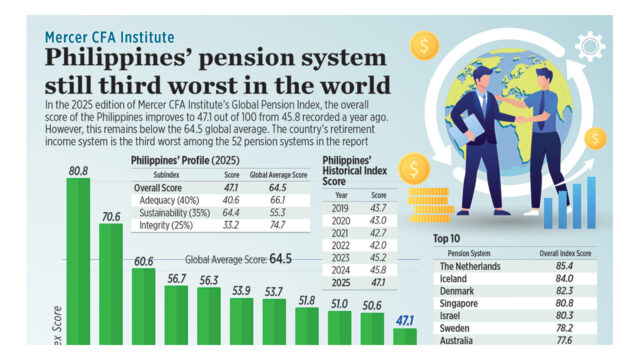
Mercer CFA Institute: Philippines’ pension system still third worst in the world

THE PHILIPPINES’ pension system remained the third worst in the world, according to the 2025 edition of Mercer CFA Institute’s Global Pension Index. Read the full story.

Mercer CFA Institute: Philippines’ pension system still third worst in the world

Manila says Chinese forces harassed patrol plane near Scarborough Shoal

A People’s Liberation- Navy helicopter flies below a Philippine Coast Guard maritime patrol plane in the South China Sea, based on a handout image released by Manila’s coast guard on Oct. 15. — PCG

By Kenneth Christiane L. Basilio, Reporter

CHINESE FORCES harassed a Philippine maritime patrol aircraft near the disputed Scarborough Shoal in the South China Sea, Manila’s coast guard said late on Wednesday, in the latest flare-up of tensions that have simmered since Sunday.

The Philippine Coast Guard (PCG) said a Chinese fighter jet harassed its patrol plane and endangered its “safe flight path,” while a People’s Liberation Army-Navy helicopter flew directly beneath it during a maritime domain awareness (MDA) mission that spotted a floating buoy at the northern tip of Scarborough Shoal.

“The PCG’s MDA flight was subjected to aggressive interference by forces from the People’s Republic of China,” it said in a statement.

The Chinese Embassy in Manila did not immediately reply to a Viber message seeking comment.

The Wednesday encounter was the latest in a string of confrontations between the Philippines and China in the South China Sea, where tensions have persisted since Sunday’s collision between a Chinese coast guard vessel and a Philippine government ship within what Manila said were its territorial waters off Thitu Island in the Spratlys.

A China Coast Guard (CCG) spokesman said Beijing took “necessary control measures” to expel ships that allegedly intruded into the disputed Sandy Cay near Thitu, the biggest Philippine-held island in the Spratly Islands.

Competing claims between the Philippines and China in the disputed waters have led to frequent confrontations involving repeated use of water cannons and sideswiping maneuvers by Chinese vessels against Philippine ships.

Beijing claims nearly all of the South China Sea via a 1940s nine-dash line map that overlaps with the exclusive waters of the Philippines and neighbors like Vietnam and Malaysia despite a 2016 ruling by the Permanent Court of Arbitration in The Hague that voided its claims.

The maritime surveillance flight was conducted to follow up on a first buoy it had spotted earlier this week at the center of Scarborough Shoal, which the Philippines calls Panatag. Manila’s coast guard said the finding indicates there are “ongoing activities in the area.”

The secondary buoy was spotted at the northern tip of Scarborough Shoal, the PCG said.

In September, China approved the creation of a 3,500-hectare nature reserve at the northeast rim of Scarborough, which it said is intended to preserve the ecological diversity of one of the most contested areas in the South China Sea.

Chinese maritime forces have repeatedly barred Filipino fishermen from accessing Scarborough, which lies within Manila’s 200-nautical mile exclusive economic zone. The atoll is a vast fishing lagoon near major shipping lanes that China seized in 2012 after a standoff with Philippine troops.

The contested feature lies about 222 kilometers west of Luzon Island and is nearly 900 kilometers away from Hainan, the nearest major Chinese landmass.

Meanwhile, the Philippine Navy said it conducted multinational maritime drills together with US, Japanese, Canadian and French forces off Palawan province, near the South China Sea, where they performed combat readiness exercises aimed at improving interoperability.

Seven warships, including the Philippine frigate BRP Antonio Luna, US destroyer USS Spruance and Canadian patrol vessel HMC Max Bernays held a simulated naval engagement aimed at testing coordination, maneuver warfare and strategic decision-making, with support from a French maritime patrol aircraft.

The drills “reinforce the shared commitment of partner navies in promoting regional stability, maritime cooperation and a free and open Indo-Pacific region,” the Philippine Navy said in a statement.

The drills were part of the annual Exercise Sama-Sama — Filipino for “together” — and form part of broader multilateral exercises the Philippines conducts with allies amid lingering tensions in the South China Sea, a vital waterway for trillions of dollars in annual seaborne trade.

PHL steps up recovery of billions from anomalous flood control programs

PHILIPPINE STAR/MIGUEL DE GUZMAN

By Erika Mae P. Sinaking and Kenneth Christiane L. Basilio, Reporters

THE GOVERNMENT has begun coordinating efforts to recover billions of pesos in assets tied to anomalous infrastructure projects spanning past and present administrations, officials said on Thursday.

The Independent Commission for Infrastructure (ICI) led an interagency meeting on Thursday that gathered officials from the Office of the Ombudsman, Department of Justice, Department of Public Works and Highways (DPWH), Office of the Solicitor General, Anti-Money Laundering Council (AMLC) and several other agencies to exchange information and align recovery measures.

“This is a collective approach on how we can recover assets that may have been illegally obtained from public funds,” ICI Executive Director Brian Keith F. Hosaka told a news briefing.

He said the AMLC has frozen P4.6 billion to P5 billion in assets across almost 280 bank accounts flagged in investigations. Forfeiture proceedings — independent of criminal prosecution — are also being prepared before the Court of Appeals.

The task force is expected to meet regularly to expedite recovery measures, he added.

Public Works Secretary Vivencio B. Dizon said a review is under way for contracts awarded in the past decade including those under the Duterte administration. He said special attention is being paid to deals involving Pacifico F. Discaya II and his wife Cezarah Rowena C. Discaya, contractors alleged to have orchestrated a large-scale flood control scam.

The Discayas’ firm, St. Gerrard Construction, partnered in 2017 with CLTG Builders, a company linked to Senator Christopher Lawrence “Bong” T. Go through his father Deciderio L. Go.

Following the Discayas’ refusal to cooperate with the ICI, citing their right against self-incrimination, Mr. Dizon said Ombudsman Jesus Crispin C. Remulla had instructed him to review all related contracts and joint ventures.

At a separate briefing, Mr. Go denied any involvement with the Discayas or the corruption scandal. “I welcome any investigation,” he said. “Let the facts speak for themselves. I am not involved in any anomalies.”

“I support any investigation by the Ombudsman, and I do not know the Discayas,” he added.

ICI Chairman Andres B. Reyes, Jr., a former Supreme Court associate justice, cited the importance of restitution alongside prosecution. “All those persons responsible for this may be prosecuted and jailed, but to completely heal our nation, justice is not enough. We need restitution,” he said in a speech.

The ICI was formed earlier this year to trace, investigate and recover public funds lost to corruption in infrastructure development.

‘CONFLICT OF INTEREST’
Meanwhile, Batangas Rep. Leandro Antonio L. Leviste said Mr. Dizon should disclose all alleged ties to construction contractors, including those of his appointees, citing connections surfacing amid the fallout from a widening flood control scandal.

The lawmaker told reporters he had heard talk linking Mr. Dizon and his team to contractors, warning of potential conflicts of interest as the government cracks down on corruption tied to the DPWH’s anomalous flood-control deals.

He offered no proof during his hour-long briefing, saying the claims came from fellow lawmakers. He took a call during the press conference and later said the person on the line was among those accused of having ties.

“I’ve heard talk, including in Congress, that Secretary Dizon and his team have connections with DPWH contractors, and that certain members… are, in fact, contractors,” he said.

“If it’s true that new appointees in DPWH have interests in companies that do business with DPWH, are we sure that there will be no conflict of interest in the awarding of contracts under the new leadership?” he asked.

In response, Mr. Dizon committed to purge the agency from top to bottom following claims that some undersecretaries are connected to flood control contractors.

“We have started and we will cleanse the department from top to bottom,” he separately told a news briefing. “I am open to any information you can provide… My commitment is to fire that person immediately and if needed, we file cases.”

President Ferdinand R. Marcos, Jr. last month appointed Mr. Dizon to lead the Public Works department, which has been plagued by allegations of widespread corruption following a multibillion-peso flood control scandal in the flood-prone country.

He has since ordered an agency cleanup and cut the department’s 2026 budget by P255 billion, citing corruption concerns over locally funded flood control deals. — with Ashley Erika O. Jose