Home Blog Page 7620

US expresses ‘serious concerns’ about Jerusalem clashes, evictions of Palestinians

Image via David Shankbone/CC BY 3.0/Wikimedia Commons

WASHINGTON — US National Security Adviser Jake Sullivan on Sunday expressed “serious concerns” to his Israeli counterpart about violent clashes in Jerusalem sparked by planned evictions of Palestinians from East Jerusalem, the White House said in a statement. 

Mr. Sullivan in a phone call with Israeli National Security Adviser Meir Ben-Shabbat “encouraged the Israeli government to pursue appropriate measures to ensure calm during Jerusalem Day commemorations.” 

New confrontations broke out between Palestinians and Israeli police in parts of East Jerusalem on Sunday, including in Sheikh Jarrah and outside the walled Old City, as well as in Haifa, a mixed Arab-Jewish city in northern Israel at the height of the Muslim holy month of Ramadan. 

The clashes have been sparked by the planned evictions of several Palestinian families from the Sheikh Jarrah neighborhood in East Jerusalem, an area captured by Israel in a 1967 war. 

Israel’s attorney-general secured a deferment on Sunday of an Israeli Supreme Court hearing on the evictions, a session that had threatened to stoke more violence in the holy city and heighten international concern. 

“Mr. Sullivan also reiterated the United States’ serious concerns about the potential evictions of Palestinian families from their homes in the Sheikh Jarrah neighborhood,” the White House statement said. 

Messrs. Sullivan and Ben-Shabbat “agreed that the launching of rocket attacks and incendiary balloons from Gaza towards Israel is unacceptable and must be condemned,” the White House added. 

It said Mr. Sullivan also expressed the Biden administration’s commitment to Israel’s security and to supporting peace and stability throughout the Middle East and would remain fully engaged in the days ahead to promote calm in Jerusalem.  Reuters 

SpaceX accepts dogecoin as payment to launch lunar mission next year 

Image via Marco Verch/CC BY 2.0

SpaceX will launch the DOGE-1 Mission to the Moon in the first quarter of next year, with Elon Musks commercial rocket company accepting the meme-inspired cryptocurrency dogecoin as payment. 

SpaceX launching satellite Doge-1 to the moon next year  Mission paid for in Doge  1st crypto in space  1st meme in space, Mr. Musk said in a tweet. 

Geometric Energy Corporation announced the dogecoin-funded mission earlier on Sunday, with the statement not disclosing the mission’s financial value. 

This mission will demonstrate the application of cryptocurrency beyond Earth orbit and set the foundation for interplanetary commerce, SpaceX vicepresident of commercial sales Tom Ochinero was quoted as saying in the statement released by Geometric Energy. 

Mr. Musk said on Twitter in April that SpaceX was going to put a literal Dogecoin on the literal moon. 

Dogecoin lost more than a third of its price on Sunday, after Mr. Musk called it a hustle during his guest-host spot on the Saturday Night Live comedy sketch TV show. 

Mr. Musks tweets this year turned the once-obscure digital currency, which began as a social media joke, into a speculators dream. 

On crypto data tracker CoinGecko.com, dogecoin has jumped more than 800% over the last month and is now the fourth-largest digital currency, with a market capitalization of $73 billion. It hit a record high Thursday above $0.73. 

Electric carmaker Tesla Inc., where Mr. Musk is CEO, said in February it bought $1.5 billion worth of bitcoin and would soon accept it as a form of payment for its electric cars, a large stride toward mainstream acceptance that sent bitcoin soaring to a record high of nearly $62,000. — Reuters

US government working to aid top fuel pipeline operator after cyberattack 

Image via Colonial Pipeline

The White House was working closely with top US fuel pipeline operator Colonial Pipeline on Sunday to help it recover from a ransomware attack that forced the company to shut a critical fuel network supplying populous eastern states. 

The attack is one of the most disruptive digital ransom schemes reported and has prompted calls from American lawmakers to strengthen protections for critical US energy infrastructure from hacking attacks. 

Commerce Secretary Gina Raimondo said the pipeline fix was a top priority for the Biden administration and Washington was working to avoid more severe fuel supply disruptions by helping Colonial restart as quickly as possible its more than 5,500-mile (8,850 km) pipeline network from Texas to New Jersey. 

Its an all hands on deck effort right now, Ms. Raimondo said on CBS’ Face the Nation program. We are working closely with the company, state and local officials, to make sure that they get back up to normal operations as quickly as possible and there aren’t disruptions in supply. 

Colonial said on Sunday its main fuel lines remain offline but some smaller lines between terminals and delivery points are now operational. Neither Raimondo nor the company gave an estimate for a full restart date and Colonial declined further comment on Sunday. 

US gasoline futures jumped more than 3% to $2.217 a gallon, the highest since May 2018, as trading opened for the week and market participants reacted to the closure. 

Colonial transports roughly 2.5 million barrels per day of gasoline and other fuels from refiners on the Gulf Coast to consumers in the mid-Atlantic and southeastern United States. 

Its extensive pipeline network serves major US airports, including Atlantas Hartsfield Jackson Airport, the world’s busiest by passenger traffic. 

A Charlotte Douglas International Airport spokesperson said the airport had supply on-hand and was monitoring the situation closely, adding that the complex is supplied by another major pipeline as well as Colonial. 

Retail fuel experts including the American Automobile Association said an outage lasting several days could have significant impacts on regional fuel supplies, particularly in the southeastern United States. 

During previous Colonial outages, retail prices in southeastern states have risen substantially. 

Offices of governors in several of the US states most vulnerable to fuel shortages  including Tennessee, Georgia and Maryland — were not immediately available for comment. 

CYBERCRIMINALS SUSPECTED 

While the US government investigation is in the early stages, a former US official and three industry sources said the hackers are suspected to be a professional cybercriminal group called DarkSide. 

DarkSide is one of many ransomware gangs extorting victims while avoiding targets in post-Soviet states. The groups gain access to private networks, encrypt files using software, and often also steal data. 

They demand payment to decrypt the files and increasingly ask for additional money not to publish stolen content. 

In the Colonial attack, the hackers took more than 100 gigabytes of data, according to a person familiar with the incident. 

 As the Federal Bureau of Investigation (FBI) and other government agencies worked with private companies to respond, the cloud computing system the hackers used to collect the stolen data was taken offline Saturday, the person said. 

Colonials data did not appear to have been transferred from that system anywhere else, potentially limiting the hackers leverage to extort or further embarrass the company. 

Cybersecurity firm FireEye is among those dealing with the attack, industry sources said. FireEye declined to comment. Colonial said it was working with a leading, third-party cybersecurity firm, but did not name the firm. 

Messages left with the DarkSide hackers were not immediately returned. The groups dark website, where hackers regularly post data about victims, made no reference to Colonial Pipeline. 

Colonial declined to comment on whether DarkSide hackers were involved in the attack, when the breach occurred or what ransom they demanded. 

BIDEN BRIEFED ON HACK 

President Joseph R. Biden. Jr., was briefed on the cyberattack on Saturday morning, the White House said, adding that the government was working to try to help the company restore operations and prevent supply disruptions. 

US Senator Bill Cassidy, a Republican from Louisiana who sits on the Energy Committee, said lawmakers are prepared to work more with privately held critical infrastructure companies to guard against cyberattacks. 

The implication for this, for our national security, cannot be overstated. And I promise you, this is something that Republicans and Democrats can work together on, he said on NBCMeet the Press. 

Another fuel pipeline serving the same regions carries a third of what Colonial does. Any prolonged outage would require tankers to transport fuels from the US Gulf Coast to East Coast ports. 

The Federal Motor Carrier Safety Administration is issuing a temporary hours of service exemption to truckers transporting refined products to 17 southern and east coast states including Alabama, Delaware, Florida, Georgia, New Jersey and New York. 

Complicating the fallback plans, according to one industry source familiar with the federal response, was that the ranks of fuel-truck drivers for the main road transportation companies, which could pick up some of the pipeline volume, are down by 25% or more because of coronavirus infections. 

Oil refining companies contacted by Reuters over the weekend said their operations had not yet been impacted. Some were working to find alternative transport for customers. 

The privately held, Georgia-based company is owned by CDPQ Colonial Partners L.P., IFM (US) Colonial Pipeline 2 LLC, KKR-Keats Pipeline Investors L.P., Koch Capital Investments Company LLC and Shell Midstream Operating LLC.  Laila Kearney, Doina Chiacu and Laura Sanicola/Reuters

Monde Nissin attracts GIC, Fidelity to $1 billion IPO

Philippine food maker Monde Nissin Corp. is in talks with Singapore state investment fund GIC Pte and Hong Kong insurer AIA Group Ltd. to become cornerstone investors in what could be the country’s biggest-ever initial public offering, according to people familiar with the matter.

Fidelity International and Capital Group Cos. are also in discussions to buy stock in the offering for the Makati-based company, said the people, who asked not to be named as the information is private. Monde Nissin set a final price of P13.50 per share for its IPO, according to a stock exchange filing. That would put the Philippine food maker on track to raise P48.6 billion ($1 billion), according to data compiled by Bloomberg.

Deliberations are still ongoing and the investor lineup could change, said the people. An external representative for Monde Nissin and representatives for AIA and Fidelity International declined to comment. Representatives for Capital Group and GIC didn’t immediately respond to requests for comment.

Monde Nissin, which makes the best-selling Lucky Me! instant noodles in the Philippines and meat alternative Quorn in the U.K., started gauging demand for the listing in April, Bloomberg News reported. At P48.6 billion, the IPO will overtake SM Investments Corp.’s P28.8 billion offering in 2005, the Philippines’ biggest to date, the data show.

Monde Nissin’s shares are expected to begin trading on June 7, according to an earlier prospectus. It plans to use the IPO proceeds for purposes including loan repayment and general corporate use, according to an earlier filing.

UBS Group AG, Citigroup Inc. and JPMorgan Chase & Co. are the joint global coordinators of the deal, while the local lead underwriters are BDO Capital & Investment Corp., BPI Capital Corp. and First Metro Investment Corp. — Bloomberg

[B-SIDE Podcast] The private sector’s role in public health 

Follow us on Spotify BusinessWorld B-Side

Companies might be spending on the wrong things when it comes to employee health. “We found that businesses were losing P100 billion annually due to poor employee health. That’s in spite of companies already spending roughly P150 billion taking care of their employees,” said Santiago J. Arnaiz, co-founder and chief operating officer of Project Fort, a health data consultancy. 

In this B-Side episode, Mr. Arnaiz (formerly of BusinessWorld) and Project Fort co-founder and Chief Executive Officer Erika M. Modina tell BusinessWorld reporter Patricia B. Mirasol how the private sector can contribute to public health with the help of data. If [companies] are given the right tools to collect data, then they can make evidence-based health strategies that save money and engage employees, said Ms. Modina. This is the perfect time to rebuild the health system because people understand its importance. 

TAKEAWAYS 

A data-driven culture situates a company for success. 

Having the infrastructure to analyze health data — and how it affects the bottomline — serves a firm well as it digitally transforms its other areas of business. 

“There is a clear incentive to invest in data infrastructure for employee health,” said Mr. Arnaiz. A data-driven community, he said, is one where the data infrastructure penetrates all levels of the corporation and everyone is unified in the mission of health. 

“This infrastructure becomes your jumping point for creating a data-driven culture,” he added, “and that’s priceless when it comes to situating yourself for success as a company.”  

Companies spend money on the wrong things.  

From the policies they enact to the resources they provide, companies control many factors in the day-to-day lives of their staff.  

“The social networks that people belong to affect their health,” said Ms. Modina. “One of those social networks is a person’s working conditions.”  

The workplace presents a prime opportunity to create a healthier Philippines, and yet employers do not spend their money right when it comes to employee health.  

 “In our research in Project Fort, we found that businesses were losing P100 billion annually due to poor employee health,” said Mr. Arnaiz. “That’s in spite of companies already spending roughly P150 billion taking care of their employees.”  

 Proper insights into employee care, Mr. Arnaiz added, are available through health-tech solutions. MSMEs (micro, small, and medium enterprises) with limited resources can likewise build a robust data infrastructure by prioritizing their needs first, and then finding a firm that understands their desired outcome.  

 There are roadblocks in translating data insights into meaningful policies. 

“One problem is that people aren’t collecting data,” said Ms. Modina, who is also president of EpiMetrics, a research institution advancing health equity through the conception, translation, and communication of health systems and policy research. “Another problem is that they may be collecting data, but don’t know how to make sense of it.”  

Making sense of, and collecting insights from, data means that data collection should have an aim from the very start. For companies, this means knowing their employees, having a baseline on their health, and realizing there are so many factors that come into play beyond a person’s individual choice.  

“If companies have health champions, and if they’re given the right tools to collect data, then they could make evidence-based health strategies that save money and engage employees,” she said. 

The pandemic is an opportunity to rebuild the health system. 

“We have to do an analysis of what we already have and where we’re situated,” said Ms. Modina, adding that this covers human resources, medical supplies, technologies, information systems, service delivery networks, finance, and governance. 

“We can’t solve what we don’t know.” The data that is now being collected on COVID-19 hospitalizations and deaths, she said, can be expanded in the future to determine free bed space in a hospital, or that quantity of available medicines in a pharmacy.  

Determining all the factors that make up these building blocks gives a clearer picture on how partnerships between the public and private sectors can happen. 

“This is the perfect time to rebuild the health system because people understand its importance, said Ms. Modina. 

Recorded remotely on May 5. Produced by Paolo L. Lopez, and Sam L. Marcelo.

Follow us on Spotify BusinessWorld B-Side

GDP likely shrank anew in Q1 — poll

PHILIPPINE STAR/ MICHAEL VARCAS
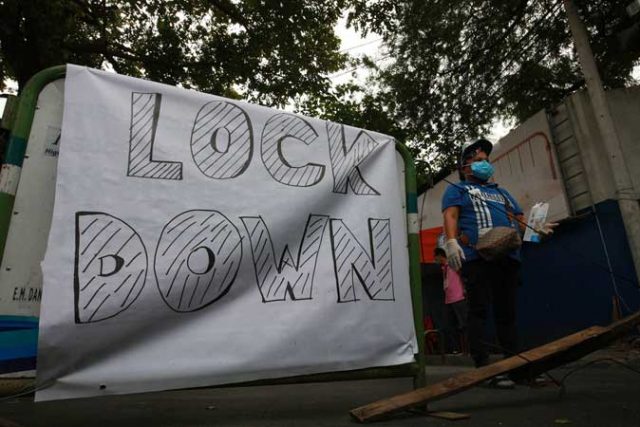
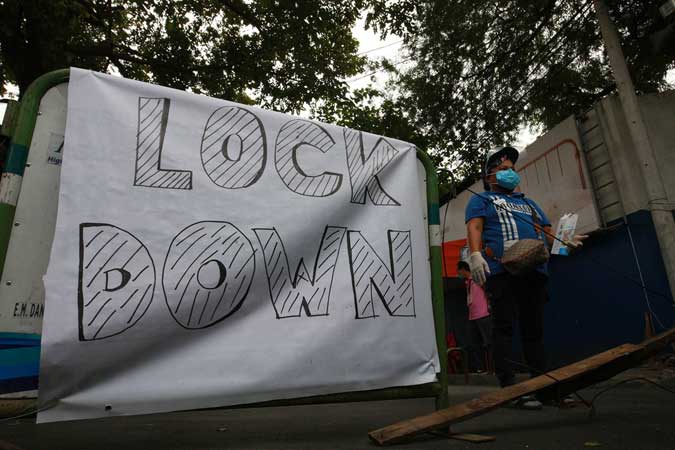
Localized lockdowns have been implemented due to the rising number of coronavirus cases. — PHILIPPINE STAR/ MICHAEL VARCAS

PHILIPPINE gross domestic product (GDP) likely declined at a slower pace in the first three months of 2021 compared with the previous quarters, a BusinessWorld poll showed, as a renewed surge in coronavirus infections and a stricter lockdown imposed in Metro Manila and adjacent provinces dampened recovery.

A BusinessWorld poll of 18 analysts yielded a median GDP decline of 2.6% for the first quarter, easing from the -8.3% in the fourth quarter of 2020, but still slower than the -0.7% in the first quarter of 2020.

If realized, this would be the slowest decline since the first quarter of last year when Luzon was placed under the strictest form of lockdown starting mid-March.

Q1 2021 GDP Growth Forecast

The poll’s first-quarter GDP forecast is way below the government’s 6.5%-7.5% target range. Economic managers are set to meet sometime this month to assess the impact of the renewed lockdowns on growth targets.

From March 29 to April 11, Metro Manila and the provinces of Bulacan, Cavite, Laguna, and Rizal were placed under enhanced community quarantine (ECQ). The areas are currently under the less restrictive modified ECQ (MECQ) until May 14.

The Philippine economy suffered its worst annual contraction in 2020 with 9.5%, according to the Philippine Statistics Authority (PSA) which began collecting data in 1947. The last three months of 2020 posted an 8.3% decline, improving from the revised -11.4% in the third quarter and the record -16.9% in the second quarter.

The first quarter of 2021 is expected to be the fifth consecutive quarter of GDP contraction. This would be the Philippines’ longest recession since the Marcos era when the economy shrank for nine straight quarters from 1982 to 1985.

While differing on the first-quarter economic performance, analysts agreed the recently imposed stricter lockdowns in the capital region had an impact on recovery.

“We initially expected a 0.5% growth for GDP [in the first quarter] before the recent implementation of new restrictions. Furthermore, we thought that there has not been a significant improvement in consumption, particularly household demand,” said UnionBank of the Philippines, Inc. Chief Economist Ruben Carlo O. Asuncion, who estimated a 3.6% decline in the first three months of the year.

“Non-discretionary consumption has been steady, with improvements in discretionary spending but not enough to pull the economy out of the red,” he added.

ING Bank N.V. Manila Senior Economist Nicholas Antonio T. Mapa penciled in a 3.5% contraction in the first quarter, noting household consumption is expected to “have been challenged at the start of the year” with consumer confidence remaining “deep in the red.”

“Labor market data recently released [last week] showed unemployment improved slightly by March but was for the most part still elevated compared to year-ago levels. High levels of both unemployment and underemployment translate to depressed consumption all the more compounded as inflation rose to 4.5% in the period,” Mr. Mapa said.

Preliminary results of the PSA’s March 2021 round of the labor force survey showed an unemployment rate of 7.1% during the month, the lowest since the 5.3% in January 2020 as well as the record-high 17.6% posted in April 2020. The underemployment rate — the proportion of those already working but still looking for more work or longer working hours, improved to 16.2% in March from 18.2% in February.

Separate PSA data showed headline inflation averaging 4.5%, slightly above the Bangko Sentral ng Pilipinas’ 2-4% target, as well as its inflation forecast of 4.2% for the year.

OUTLOOK
Economists, however, see diverging prospects for the second quarter and the rest of the year amid uncertainty over the COVID-19 pandemic.

Asian Institute of Management economist John Paolo R. Rivera said the ongoing lockdown and further delays of social amelioration “would have lingering effects in economic growth in succeeding quarters” and that economic recovery this year would depend on the pace of the mass vaccination program.

“However, I expect in the succeeding quarters that the steep decline we have experienced in 2020 will recover in 2021 albeit at a slower recovery trajectory before we eventually close the negative growth rates. Annual growth for 2021 is estimated at around 5% assuming vaccination towards herd immunity will not be disrupted so that quarantine restrictions can be relaxed,” said Mr. Rivera, who forecast a 3.6% decline in the first quarter. 

Security Bank Corp. Chief Economist Robert Dan J. Roces, which estimated first-quarter GDP to have gone down by 3.5%, expects growth in the quarters ahead to “improve gradually and will be a function of improved business and consumer confidence,” likely from a wider vaccination rollout and higher infrastructure spending.

“The reimposed lockdowns… may complicate the overall growth picture, and the Philippines is likely to miss the 6.5-7.5% GDP growth target this year after lockdowns…,” Mr. Roces said.

Philippine National Bank Head of Research Alvin Joseph A. Arogo sees “meaningful downside risks” in the first half, but noted successful reduction of new daily COVID-19 cases in the coming weeks and acceleration in vaccination rollouts “could allow for better growth” in the second half.

“This should facilitate our full-year GDP growth forecast [of 5% year on year] to remain intact,” he said.

As of Sunday, the Health department reported 7,174 additional infections, bringing the active cases to 61,294. — Lourdes O. Pilar

Economists expect BSP to keep policy unchanged

PHILIPPINE STAR/ MICHAEL VARCAS

By Luz Wendy T. Noble, Reporter

THE CENTRAL BANK is widely expected to keep policy unchanged when it announces its decision this week, amid uncertainty over the pandemic and its impact on economic recovery, a BusinessWorld poll of analysts showed.

A BusinessWorld poll held last week showed 15 out of 17 analysts are of the view that the Bangko Sentral ng Pilipinas (BSP) will maintain its overnight reverse repurchase rate or the key policy rate at a record low of 2%.

Analysts said the scope for interest rate adjustment is limited as inflation continued to exceed the annual target and supply issues persisted.

Analysts’ expectations on policy rates (May 13)

“The onus is then on fiscal policy to do most of the heavy lifting to support the economy. More fiscal stimulus is expected when the Bayanihan III bill is eventually passed by Congress,” Mitsubishi UFJ Group Global Research analyst Sophia Ng said.

Inflation was steady at 4.5% for the second straight month in April, according to the Philippine Statistics Authority (PSA). However, it still marked the fourth straight month of inflation exceeding the central bank’s 2-4% annual target.

The BSP expects inflation to quicken by 4.2% this year from 2.6% in 2020, mainly due to supply disruptions in meat products caused by the African Swine Fever (ASF) outbreak and the uptick in global oil prices.

The House of Representatives is currently deliberating House Bill No. 8628 or the Bayanihan to Arise as One Act, which may become the country’s third and largest COVID stimulus package as it allocates P420 billion in subsidies to affected Filipino families and businesses. The measure is pending at the House Committee on Appropriations.

The current policy setting is already accommodative enough and further policy support to spur growth needs to come from the fiscal side, said ANZ Research economist Rini Sen.

The BSP’s overnight lending and deposit rates are also at all-time lows of 2.5% and 1.5%, respectively.

“For now, we believe more regulatory policies and liquidity support will be warranted by the central bank in place of any action on the rates side,” Ms. Sen said.

Meanwhile, Bank of the Philippine Islands Lead Economist Emilio S. Neri, Jr. said the BSP is likely to maintain a pause, although he believes authorities “should already consider hiking rates gradually”.

“They may be forced to hike before the end of the year, however, if core inflation threatens to exceed its full-year inflation target this year,” Mr. Neri said.

Core inflation stood at 3.3% last month, the slowest since the 3.2% in November 2020, based on PSA data.

He said there should be room to assess whether there are meaningful benefits in having record-low interest rates compared to a “sustainable level of, say 3%” in order for the central bank to do its duty of keeping price stability.

“Financial institutions have limited appetite to lend at a lower lending rate relative to pre-pandemic rates knowing the environment remains very risky. No wonder nonperforming loans continue to rise even with interest rates now 2.5% lower than the inflation rate,” he said.

“Other costs to extremely low rates are the risk of asset, especially property bubbles, widening inequality given that the lower income classes have more limited access to credit, hoarding of commodities, excessive risk taking and mispricing of risk, fragility of financial institution due to negative real yields, among others,” Mr. Neri added.

Despite record low policy rates, lending has been tepid in the previous months and even shrank starting December 2020. Preliminary data from the central bank showed outstanding loans by big banks declined for the third straight month in February by 2.7%, as lenders remained risk-averse and borrowers shied away from credit during the crisis.

In the meantime, the Monetary Board will likely remain accommodative as it takes into account the first-quarter gross domestic product (GDP) data, UnionBank of the Philippines, Inc. Chief Economist Ruben Carlo O. Asuncion said.

“We think that the economy is still limping from last year’s record economic slump. Furthermore, the aggravation to first-quarter economic growth prospects brought by the recent restrictions due to March’s infection resurgence is undeniable and will definitely impact the GDP print,” he said.

First-quarter GDP data will be out on Tuesday (May 11).

Economic managers expect the economy to grow by 6.5% to 7.5% this year following the record 9.6% contraction last year. However, multilateral lenders and think tanks have warned the country of its “fragile” recovery trajectory due to the infection surge and slow vaccination.

Meanwhile, two analysts expect rate adjustments this week, taking into account inflation data and the uncertainty over growth recovery.

Sun Life Financial Economist Patrick M. Ella said he is betting on a 25-basis-point (bps) rate cut to provide further support for the economy amid the prolonged pandemic.

“There is no strong fiscal stimulus save for a new budget that was passed early and will see higher spending. We aren’t seeing income assistance from the fiscal front as seen in other economies, so BSP has no choice but to continue to support with monetary policy action,” Mr. Ella said.

Based on the International Monetary Fund’s policy tracker as of mid-April, the central bank’s two previous stimulus packages represent 2.9% of 2020 GDP while credit guarantees and standby financing amount to 0.8% of the 2020 GDP.

On the other hand, Colegio de San Juan de Letran Graduate School Dean Emmanuel J. Lopez is expecting a 25-bp rate hike as a “precautionary move” by the Monetary Board.

“It is a safe move to safeguard what could be an abrupt movement in the prices of commodities as influenced by the enhanced community quarantine that has negatively affected price movements,” Mr. Lopez said.

The Monetary Board meeting is scheduled on Thursday, although the BSP said this could be moved to another day within the week as it may coincide with the Eid’l Fitr holiday.

PHL digital economy in focus at BusinessWorld forum

FERNANDO ZOBEL DE AYALA, president and chief executive officer of Ayala Corp. — COMPANY HANDOUT
FERNANDO ZOBEL DE AYALA, president and chief executive officer of Ayala Corp., will be the keynote speaker at the BusinessWorld Virtual Economic Forum on May 26. — COMPANY HANDOUT

TOP BUSINESS LEADERS, government officials and experts will come together at this month’s BusinessWorld Virtual Economic Forum to discuss how the pandemic has accelerated digital transformation and what steps are needed to support the Philippines’ full transition into a “digital economy.”

BusinessWorld, the country’s leading business newspaper, is holding a special edition of the BusinessWorld Virtual Economic Forum on May 26 and 27 with the theme “The Digital Economy Philippines: Towards a Faster Economic Recovery.”

Fernando Zobel de Ayala, president and chief executive officer of Ayala Corp., will be the keynote speaker on the first day of the virtual forum. He will discuss the topic “Accelerated by the Pandemic: Digital Transformation as the Way Forward.”

Bernadette Nacario, country director of Google Philippines, will deliver the keynote speech on “The Emerging New Economy: New Skills, Jobs, and Business Tools” on the second day of the forum. Kais Marzouki, chairman and CEO of Nestlé Philippines, will also give a keynote speech on the topic, “From Brown to Green Economy: Is the Philippines Ready?”

The first day of the forum will feature in-depth panel discussions and fireside chats moderated by BusinessWorld editors and reporters.

The “Digital Transformation for a Better Normal” panel includes Anthony Oundjian, managing director and senior partner of Boston Consulting Group; Martha M. Sazon, president and CEO of GCash; and Miko B. David, president and co-founder of David & Golyat.

For the “Bridging the Digital Divide” panel, discussions will be led by Andrés Ortola, country general manager of Microsoft Philippines; Shailesh Baidwan, president of PayMaya; and Kevin C. Chua, senior economist at the World Bank.

There will also be fireside chats with Rosemarie G. Edillon, undersecretary for national development policy and planning at the National Economic and Development Authority, on “Digitalizing the Philippine Economy Now”; and Mamerto E. Tangonan, deputy governor for payments and currency management sector at the Bangko Sentral ng Pilipinas, on “The Philippines’ Digital Payments Transformation Roadmap.”

On the second day of the forum, there will be a panel discussion titled “A Blueprint for the Hybrid Office: How Workplaces Will Evolve” featuring Elizabeth L Fuller, Southeast Asia head of growth at WeWork; Michael T. McCullough, managing director at KMC Savills, Inc.; Carol Torres-Mills, head of Ayala Land Offices; and Christophe Vicic, country head of JLL Philippines.

The “Effective Convergence of Physical & Digital: The Omni-Channel Retail Experience” panel will include industry speakers, such as Rosemarie B. Ong, president of the Philippine Retailers Association.

In a fireside chat, Manila Water Co. Chief Sustainability Officer Mark Tom Q. Mulingbayan will talk about “Building Brands through Sustainability and Purpose.” Denis Hew, director of the Asia-Pacific Economic Cooperation Policy Support Unit, will share his insights on “Helping SMEs Survive and Thrive through Digital Tools: An APEC Perspective.”

Attendees will have access to a virtual plenary hall, virtual exhibits, and a networking lounge.

Registration is now open. Early bird rates are now available. For more details, check www.bworldonline.com/BWVEFDigitalPH.

All paying attendees will receive a free copy of the latest issue of BusinessWorld In-Depth digital magazine. Premium attendees will also get a free printed copy of the latest BusinessWorld Top 1000 Corporations in the Philippines magazine.

BusinessWorld Virtual Economic Forum Special Edition is presented by BusinessWorld Publishing Corp.; with co-presenter GCash; gold sponsor Globe Telecom, Inc.; silver sponsors Ayala Group of Companies, Bank of the Philippine Islands, and FWD Life Insurance Corp.; bronze sponsors BDO Unibank, Inc., First Gen Corp., Philippine Amusement and Gaming Corp., PayMaya Philippines, Inc., SGV & Co., and SM Investments Corp.; official TV partner OneNews; media partner The Philippine STAR; partner organizations Asia Society – Philippines, British Chamber of Commerce and Industry, Management Association of the Philippines, Philippine Chamber of Commerce and Industry, and Philippine Franchise Association.

For inquiries and sponsorship opportunities, call BusinessWorld Marketing at 8535-9901 or e-mail marcom@bworldonline.com.

Banks supervision needs to keep up with new normal, says central bank

THE BANKING SYSTEM remains resilient amid the pandemic, but the Bangko Sentral ng Pilipinas (BSP) said there may be a need to reassess current banking regulations to adapt to the new normal.

The BSP’s report on the Philippine financial system for the second semester of 2020 showed that banks were able to weather the crisis so far, as evidenced by their net profits and capital.

“The Philippine financial system is projected to withstand the legacy risks and challenges of the COVID-19 (coronavirus disease 2019) pandemic by calibrated programs to ensure a sustainable and resilient economic system with an efficient and innovative financial system,” the central bank said.

“It also implies that consequential risks from lending should be monitored, including emerging risks from inflation expectations and potential second-round effects from higher prices and increase of nonperforming accounts that could exert more pressure on the banking system,” it added.

While banks remain well-guarded and amply capitalized, the central bank warned the industry will continue to face a pile up of nonperforming loans (NPL) but “will remain within manageable levels.”

BSP Deputy Governor Chuchi G. Fonacier has said they expect the NPL ratio to be a little above 5% by end-2021. Republic Act 11523 or Financial Institutions Strategic Transfer Law is expected to bring down the NPL ratio by about 0.63 to 0.71 percentage point as it will allow banks to clean their balance sheets by selling their nonperforming assets to FIST corporations.

“The FIST Act is expected to assist the financial system perform its role of efficiently mobilizing savings and investments for the country’s economic recovery and sustained growth and development,” the BSP said.

The BSP noted the credit growth slump was “manageable” and “expected” as the country continues to struggle with the crisis.

“The decelerated credit growth is expected as the pandemic-induced recession in the real sector caught up and weighed on the financial sector in 2020,” it added.

This credit slump was seen despite record low interest rates. The BSP last slashed its rate by 200 basis points last year to support the economy, bringing the overnight reverse repurchase, lending, and deposit rates to record lows of 2%, 2.5%, and 1.5%, respectively.

Based on the BSP report, overall mean weighted average interest rates among big big banks declined to 5.5% as of end-December from 8.2% in March 2020 and the 7% as of end-June last year. The median also dropped to 4.8% as of end-December last year against the 5.8% as of end March 2020 and the 5.4% as of end-June 2020.

“Unemployment, weak cash flows, temporary shutdown of businesses and economic uncertainty have dampened demand for loans and have even led creditors to tighten lending standards creating downside pull for credit growth,” the BSP said.

Preliminary data from the central bank showed outstanding loans by big banks declined for the third straight month in February by 2.7%. A BSP survey showed banks expect to further tighten credit standards in the second quarter.

The BSP noted banks’ net profits last year, albeit lower, was a testament to the industry’s resilience.

“Lower net profit for the year 2020 was primarily due to the increase in banks’ provision for credit losses on loans and other financial assets. Nonetheless, the positive bottom line mainly resulted from net interest income earned from lending activities,” it said.

The banking industry’s net income stood at P155.218 billion in 2020, dropping by nearly a third (32.7%) from the P230.67 billion in 2019.

“Banks are expected to continue to manage risks prudently amid challenges to improve margins. They also need to comprehensively assess and monitor the quality of the loan to ensure that escalating asset quality issues are promptly addressed and allowance for credit losses are adequately recognized,” the central bank said.

The BSP said the pandemic should serve as a catalyst to reassess the industry and the regulations currently in place.

“Moving forward, there is also merit in better understanding how the pandemic is shaping the future banking landscape under the new economy as it will definitely define the emerging regulatory architecture and BSP’s supervisory approach,” the BSP said. “On the whole, intense supervisory engagement with banks should supplement the close monitoring and surveillance activities.” — L.W.T.Noble

Two mothers on working at home, setting boundaries, and changing footwear

Ginggay Joven-dela Merced

THE PAÎNDEMIC has forced many of us to stay at home. Women who once had to juggle duties at work and home now do so on an exponential scale, as the division between the spheres have been blurred in work-from-home setups. The same delineation has also affected how we dress    while working outside gave the opportunity to both show off and show purpose, what’s the point now, when the most any others see of us are locked into the dimensions of a small computer monitor?

BusinessWorld talked to two women having to weather out the pandemic by balancing their duties to family and the workplace —  and doing it in style too.

Patricia Rodriguez Carranza is an Assistant Professor at the College of Music at the University of the Philippines. She also ran a blog and pursued graduate studies, graduating during the pandemic. Ms. Carranza is married to Jullian, is the mother of two children ages three and five, and is the sister of artist Issay Rodriguez.

Meanwhile, Ginggay Joven-dela Merced is President of Visions & Expressions Publicity & Special Events, a company founded by her mother, Susan Joven. Married to Noel, they have two children ages 13 and 19.

Ms. Joven-dela Merced’s firm is known in fashion circles for being the go-to publicist for several luxury brands. Her style prior to the pandemic was reflective of the work she does. “As a player in the fashion industry, it’s sensible to assume that I should be paying more attention to the visual image I give off. I do care, yes, but not that as much as people think. My fashion style is very quiet and subtle. By the very nature of my job, too, I really don’t think it’s appropriate to stand out. I’m more a behind-the-scenes person anyway,” she said in an e-mail.

“I only know what I’m going to wear for the day after I shower, open my closet, and actually get dressed. I don’t have the luxury of time to style and plan my looks ahead. And so, through the years, I’ve just assembled a closet with enough variety for the various dress codes I typically need. I still have a lot of unused gowns. I have dozens of little black dresses, scores of structured tops, basic skirts, jackets, and so on. The only whim I really inject is through accessories. Big necklaces, chunky rings, bracelets and cuffs, belts, shoes, bags – there I’m more adventurous.”

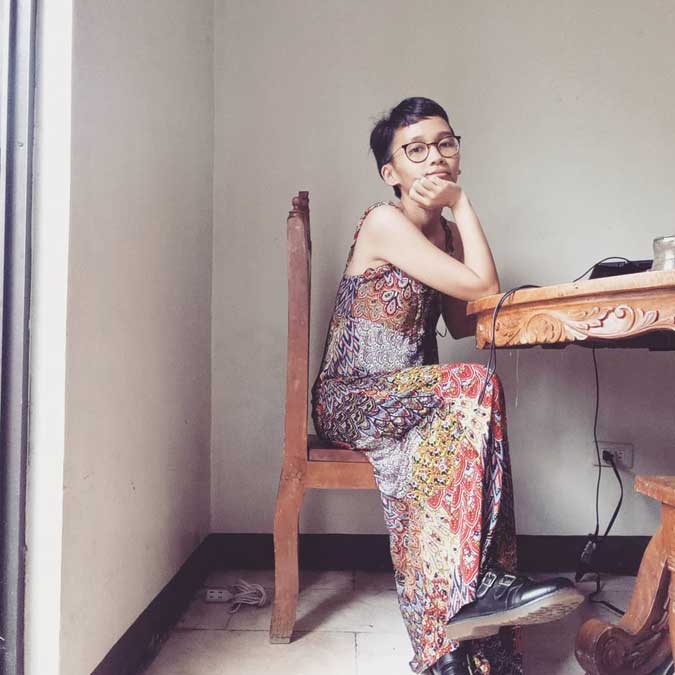
On the other hand, the creative nature of Ms. Carranza’s work, as well as her exposure to artistic circles, has influenced her bohemian style. “Colors would range from all black/white to solid powder blue with embroidered flowers, to ethnic/indigenous-inspired shirts of my husband that I borrow,” she said, describing her style in an e-mail. Her hands-on approach to parenthood also reflects in one of her accessories: a baby carrier. “Most of the time I use my black Ergobaby carrier because it’s convenient with the buckles… but when I feel fancy, the woven wraps do the talking.”

Asked about the differences between what they used to wear to work versus what they wear to work at home, both say that more expressive footwear has taken a backseat.

“Oh how I miss my four-inch stilettos!” quipped Ms. Joven-dela Merced. Ms. Carranza said, “The one thing I don’t wear now is footwear. You wouldn’t want to bring in shoes you used outside. Also, it’s impractical to wear [them] inside the house. If I wear footwear, it’s just bedroom slippers for now.”

CHANGING ROUTINES
Ms. Joven-dela Merced reflects on how she used to work before coronavirus disease 2019 (COVID-19).

“The most fun thing about my profession, pre-pandemic, is that no two days are ever the same. It’s such a dynamic field. I never had a normal routine, pre-pandemic,” she said. Describing her work routine now, she says, “I wake up early to work out as kids start school. I then attend to e-mails and correspondence, or have morning meetings if needed. Then I have lunch with the family, which is sacred. Then the afternoon is completely for work. Evenings are spent with the family — watching movies, playing board games, and so on, until they go to bed. After that, I go back to work until late through the night. Some alignment meetings and consultations I do late at night.

“What I wear changes depending on the activity obviously. So in one day, I’ll go from workout clothes, to work clothes, to lounge clothes, to pajamas,” she said.

Ms. Carranza says: “Sometimes I still help out in the kitchen and with the children — which I normally did pre-pandemic, working and studying with the children always in tow.” Ms. Carranza also says that for her, her house clothes have become work clothes, hosting music classes and sometimes even performances via Zoom. “Sometimes I throw in a random blazer for emergency meetings. [Fixing my eyebrows] would suffice, but then I discovered the Zoom filters for lips and eyebrows.”

Ms. Joven-dela Merced has added more color into her wardrobe during the beginning of the pandemic. “Before the pandemic, black was my color of choice. Black’s generally just more versatile. A black dress can take me from day to night. I can dress it down for meetings, then glam it up easily by accessorizing for evening events. But since the pandemic, I have consciously avoided black. In fact, I don’t recall ever wearing black since the lockdown. Not once. For over a year now, I’ve only worn rich, bright, happy colors. The realities of life in this pandemic are already very dimmed and bleak. So I purposely clad myself in color, if only to brighten my mood and those who I meet with online,” she said.

Ms. Carranza, meanwhile, has gotten into twinning, or wearing matchy outfits with her two daughters during special occasions. “I hated twinning because it seemed forced to try to look like your children. On the other hand, the children will grow up fast and they’ll soon find it awkward to wear matchy-matchy outfits,” she said in a mix of English and Filipino.

WORKING IN A PANDEMIC
Both reflect on how their work lives changed because of the pandemic.

“I actually enjoyed it at the onset. Pre-pandemic, we only really got to spend this much quality time whenever we traveled as a family in long stretches, like summer or Christmas breaks. So I relished it in the beginning. I’m used to working remotely (at home or whenever I was abroad) even before the lockdown so that wasn’t really a big shock. I love spending time with the family. We’re such a fun and funny foursome. We poke fun and prank each other often. It’s such a hilarious dynamic. My husband and I are like big kids sometimes, childish and immature at times. We genuinely enjoy time with each other,” said Ms. Joven-dela Merced. “But to have them in your face day in and day out inescapably, that can also be somewhat claustrophobic after a while. Of course, there’s cabin fever.”

Ms. Carranza says, “It’s not new to me. I used to bring the kids to their school before I work/study. People wouldn’t know me if I don’t have my kids with me (at least that’s how I perceive it). The only difference is, we don’t go out. I’m introverted and I like the solitude of not talking to other people.”

Due to the new work-from-home setups both employ, they have had to set the lines to separate work from family life, in the absence of the chore (or escape) found in the office.

“We all just agreed on our ground rules. We assigned spaces for each other and made door signs so as not to interrupt one another, unless urgent: ‘Class ongoing’ or ‘Silence please, recording.’ We dedicate specified hours for each other. We’ve also established our respective patterns and cycles. After over a year of this, I think we’ve learned to accept and embrace this way of life. More importantly, we’ve learned to be happy despite the immobility,” said Ms. Joven-dela Merced.

“It was my hope that for this year, I would be working full-time; my husband part-time. We had an agreement to switch when I finished my master’s and get my full time job, it’s my turn to be the career woman I wanted to be,” said Ms. Carranza. But due to the pandemic, she says she lies low, and rests. “Maybe this is the rest I needed in the four years of being a ‘super mama,’ as some have said,” she said.

Changing times also mean changing goals, and being in constant close quarters with family certainly influenced that. “I saw my children grow. Before, I didn’t mind it so much, because I wanted to rest in between. Now, I have no choice — well actually, we made the choice. I also stopped blogging about motherhood for a while to evaluate how I want to portray motherhood to others,” said Ms. Carranza. “I’m not really a super woman! And neither do other women have to be — because we have to acknowledge our limits and that society has to step up in the way with how it treats women and mothers by actually giving them concrete ways and means on how to be the best versions of themselves and not glorify the resiliency and sacrifice of mothers.”

She adds, “I realized that I needed to wait for things to happen and not always chase after them because I will become very tired. I learned to value myself and give myself the rest I deserve.”

“My professional and personal goals were always very realistic and achievable,” said Ms. Joven-dela Merced. “Sure, when I was younger and more aggressive, my goals were more ambitious and ideal. But as I matured, I learned to temper them. Even before the pandemic, I already had a very appreciative outlook and level-headed mentality. I don’t beat myself up anymore for things I can’t control. I just do the best I can under the parameters I’m given,” she said. “Professionally, I just want to ensure the company is able to assist its employees the best way it can, given the company’s limitations. Personally, I just want to provide a healthy and happy environment for the family.”

WHAT IS ESSENTIAL
The pandemic is a constant season of loss, and last year made it necessary to deem what was truly essential. Both women reflected on things they have learned to let go, and things to hold closer. For Ms. Carranza, she gladly loses one thing: “I can do without a bra!” she says with laughter. “Other than that, it turns out I can do with so little clothes. No need to buy again.”

She decided to let go of anger (and also a bit of social media): “Ang hirap magalit palagi (It’s hard to always be angry). You read about the billions of debt on Facebook. I deactivated FB for a while because all the fake news is there! But it’s so hard to always be complacent, contened, or ‘blessed.’ We should always choose to live truthfully and responsibly in all the ways we can do. Start with the little things you do with your children.”

As for Ms. Joven-dela Merced, “My heart aches every time I hear of someone’s passing, someone’s business suffering, someone losing a job, or someone’s mental state spiraling [down]. It’s heartbreaking to witness the hardships and the pain people undergo because of the situation we’re in. I just channel my emotions to doing something to help, even in my own little way. I involve the kids in these little donation-drive projects to help displaced individuals. It’s a tiny drop, what we do. Hopefully though it helps nonetheless.

“We just have to keep the faith and maintain optimism. After all, hope is such a powerful thing.” —  Joseph L. Garcia

Live and let Leaf

The author poses after driving a Nissan Leaf in Japan in 2017. — PHOTO FROM ANGEL RIVERO

At long last, Nissan PHL formally welcomes the brand’s best-selling EV

THE LONG-AWAITED Nissan Leaf has finally arrived in the Philippines — and it’s high time that the world’s best-selling, mass-produced electric vehicle got here for the Filipino public to experience. Being a five-door compact hatchback, it’s small in size but big on innovation. And that’s because — in case you didn’t realize it — Nissan has always been at the forefront of affordable production electric vehicles in the world. And the Nissan Leaf is the icon of the brand’s precious Intelligent Mobility Suite.

Nissan Intelligent Mobility expresses the Japanese company’s vision to transform the way people drive and live. I’ve witnessed several milestones in its evolution, as I’ve been able to join Nissan’s contingent to every Tokyo Motor Show since 2015.

Basically, Nissan likes to break down its Intelligent Mobility concept into three major areas, namely: Intelligent Power, Intelligent Driving and Intelligent Integration. Intelligent Power includes its zero-emission electric vehicles and its e-Power products; while Intelligent Driving refers to the suite of technologies under ProPilot, such as ProPilot Park (a self-parking feature) and emergency braking. Meanwhile, Intelligent Integration refers to what Nissan likes to call “SAM” or Seamless Autonomous Mobility.

The latest Nissan Leaf is a torchbearer of Intelligent Mobility as it is an attractive, fully electric vehicle armed with a power output of 110kW and 320Nm of torque; a roomy, high-tech interior; a driving range that can go up to the 300km to 400km territory depending on road conditions and driving style; and futuristic features such as: ProPilot Park and Nissan’s proprietary e-pedal.

The e-pedal feature allows drivers to start, accelerate, decelerate, stop, and hold the car with the use of the accelerator pedal alone (yes, without using the brake pedal). And yes, it incorporates an auto-hold function. It represents an entirely new driving experience — allowing people to move around with greater confidence, exhilaration, and connection with the rest of the world. Although I admit that I found the feeling quite weird at first — not having to use an actual brake pedal reminded me of the times I would drive bump cars as a child — but it only takes some getting used to. Frankly, the Japanese market absolutely loved the feature when it first came out.

Moreover, the Nissan Leaf has always showcased the world’s first bi-directional charging capabilities. This means that owners can use the electric charge in their car to power their home or to simply return electricity to the grid. Therefore, the electric vehicle can also be tapped for some backup power during a blackout, or for use as a large, home storage device for captured renewable energy (in green homes). Furthermore, as the Leaf may also be exploited for some “energy balancing” within buildings and grids. Owners can choose to charge and store energy while electricity is cheap during off-peak hours, and then later use the car as a generator to utilize that stored energy once the more expensive grid rates take effect during peak hours. This is of course because, unlike in the Philippines, countries like Japan have different electricity rates depending on the time of the day (peak vs off-peak rates).

But having said that, imagine this: The Nissan Leaf could potentially help out with supplying energy during power outages when there are disasters.

The new Leaf is sold in over 60 markets around the world, and has already undergone rigorous flood tests, cold tests and heat tests to endure varying environments. It also performed very well in aerodynamic tests and other dynamic assessments, making it a high-output vehicle that is capable of being fully connected and fully integrated with its ecosystem.

In 2019, the Nissan Leaf was named the Canadian Green Car of the Year by the Automobile Journalists Association of Canada at the Vancouver International Auto Show. It also became Norway’s best-selling car overall after it was introduced in 2019. It is also a top-selling EV in the whole of Europe. Now that it is in the Philippines, I wonder how the country will embrace it.

For those who are worried about our atrocious Metro Manila traffic, the good news is that with electric vehicles, very little energy is used when at a standstill (say, only the minimum amount required to run the air-conditioning and electronics, etc.), so it shouldn’t be alarming to imagine driving an EV in heavy congestion.

Furthermore, fewer moving parts mean fewer parts to replace over time. And after over 400,000 units sold globally (and these units are usually being charged through conventional wall sockets), there have so far been zero reported incidents concerning any harm or threats to safety. The use of electric vehicles also reduces air pollution in congested city centers (such as Manila) and promotes renewable energy integration into that society.

There is also good news that Nissan has begun to develop systems to reuse and recycle old EV batteries. A Nissan affiliate called 4R Energy opened a plant in the town of Namie, Futaba District, within the Fukushima Prefecture of Japan, to focus specifically on the reuse of lithium-ion batteries from electric vehicles.

At the end of the day, it appears that in environmentally progressive countries such as Denmark, Norway, and the Netherlands, government incentives for EVs were always crucial for their success in their respective markets. Will the Philippines follow suit to match this kind of enthusiasm? Heck, our Asian neighbors such as Malaysia, Korea, and Thailand have already been way ahead of us in terms of government policy. Let’s cross our fingers and hope for the best.

Rates of Treasury bills likely to decline ahead of Q1 GDP data

BW FILE PHOTO

THE RATES of Treasury bills (T-bills) on offer on Monday could decline further as investors await the release of first-quarter gross domestic product (GDP) data.

The Bureau of the Treasury (BTr) is looking to raise P25 billion via its offering of T-bills on Monday, broken down into P5 billion from 91-day debt, P8 billion via the 182-day papers and P12 billion from the 364-day securities.

T-bill yields could decline by 5 to 10 basis points (bps) from their week-ago levels, analysts said.

“Expect bond yields to drift lower as expectations for GDP growth and inflation become more subdued with the lockdown taking its toll on business recovery forecasts,” Noel S. Reyes, first vice-president and chief investment officer at Security Bank Corp., said via Viber on Friday.

The bond trader shared this view, adding last month’s slower-than-expected inflation print will continue to affect yields.

At the secondary market on Friday, the 91-, 182- and 364-day papers were quoted at 1.328%, 1.569%, and 1.884%, respectively, based on the PHL Bloomberg Valuation Reference Rates published on the Philippine Dealing System’s website.

Headline inflation rose 4.5% year on year in April, steady from the March pace but faster than the 2.2% print logged in April 2020. This marked the fourth consecutive month that inflation exceeded the annual 2-4% target of the central bank.

Last month’s inflation rate was lower than the median 4.7% in a BusinessWorld poll and settled within the 4.2-5% estimate of the Bangko Sentral ng Pilipinas. The central bank sees inflation averaging at 4.2% this year.

Meanwhile, the Philippine Statistics Authority will report official GDP data for the first quarter on Tuesday.

A BusinessWorld poll of 18 analysts yielded a median estimate of a 2.6% GDP contraction in the first three months of the year as the lockdown in March amid a fresh surge in infections continued to weigh on the country’s economic prospects.

If realized, this would be the fifth consecutive quarter of a GDP decline, albeit better than the 8.3% contraction seen in the fourth quarter of 2020.

The government upsized the volume of T-bills it awarded on Monday last week and also opened its tap facility as rates dropped ahead of the release of April inflation data.

The BTr raised P28.2 billion via the T-bills last week, more than the programmed P25 billion. Total tenders reached P93.9 billion or nearly four times as much as the initial offer. It also opened its tap facility to raise P7 billion more via the one-year securities.

Broken down, the Treasury made a full P5-billion award of the 91-day debt papers it offered from P18.1 billion in bids. The three-month papers fetched an average rate of 1.306%, down by 6.3 bps from 1.369% previously.

Meanwhile, it raised P11.2 billion from the 182-day T-bills, higher than the programmed P8 billion, after the tenor attracted bids worth P38.075 billion. The average yield of the six-month debt also dropped by 8.5 bps to 1.629% from 1.714% previously.

Lastly, the BTr borrowed P12 billion as planned via the 364-day instruments as total tenders hit P37.865 billion. The one-year IOUs were quoted at 1.863%, down 1.7 bps from 1.88% previously.

The Treasury plans to raise P170 billion from the local bond market this month: P100 billion via the weekly offering of T-bills and P70 billion in Treasury bonds to be auctioned off fortnightly.

The government is looking to borrow P3 trillion this year from domestic and external sources to help fund a budget deficit seen to hit 8.9% of GDP. — B.M. Laforga