Home Blog Page 762

One dead, over 75,000 evacuated as typhoon Tino batters Visayas

DOST-PAGASA FB PAGE

One death and thousands of evacuees were reported as Typhoon Kalmaegi, locally known as Tino, continues to batter large parts of the Visayas, according to the National Disaster Risk Reduction and Management Council (NDRRMC).

The reported death was a barangay tanod (barangay public safety officer) from Barangay Danao in Panglao, Bohol, who was struck by a falling coconut tree while trying to cut it down for safety. The incident was confirmed by Diego A. Mariano, deputy spokesperson of the Office of Civil Defense (OCD), the operating arm of the NDRRMC.

Meanwhile, more than 75,000 individuals were pre-emptively evacuated in anticipation of the effects of typhoon Kalmaegi, NDRRMC said in a 6:00 a.m. situational report.

The evacuees were mainly from Regions VI, VII, VIII, MIMAROPA, and CARAGA.

The typhoon, which made its first landfall over Silago, Southern Leyte, has already affected nearly 60,000 individuals, or more than 17,000 families, the report also said.

Of the affected individuals, about 32,000 are being served inside 362 evacuation centers, while more than 10,600 are being assisted outside.

To provide relief, the NDRRMC report said that more than P6 million worth of food and non-food items have been distributed by the Department of Social Welfare and Development (DSWD) and various local government units.

The NDRRMC has not confirmed any estimated cost of damage to both agriculture and infrastructure. — Edg Adrian A. Eva

Zobel de Ayala, Aragon-GoBio among Forbes Asia’s 2025 Power Businesswomen

Photo Credit | BPI.COM

Two Filipinas have been named to Forbes Asia’s 2025 Power Businesswomen list, which recognizes 20 female leaders reshaping the region’s corporate landscape.

Ayala Corp. Managing Director Mariana Beatriz E. Zobel de Ayala, an eighth-generation member of one of the Philippines’ oldest business families, was cited for her leadership in the leasing and hospitality units of Ayala Land, Inc. She also serves as president of Ayala Malls, one of the country’s largest retail chains.

Joining her on the list is Mybelle V. Aragon-GoBio, president and chief executive officer of Robinsons Land Corp. She is the first woman and nonfamily executive to head the Gokongwei-led property arm of JG Summit Holdings, Inc.

Ms. Aragon-GoBio is steering Robinsons’ P125-billion expansion over the next five years, including a push to “premiumize” its brands.

“The women on this year’s Forbes Asia’s Power Businesswomen list are not just adapting to change but actively shaping the future of the region’s business landscape,” Forbes Asia Editorial Director Rana Wehbe Watson said in a statement.

“Some are forging paths in hot sectors like data centers, semiconductors and rare earths, while others are guiding their family businesses to new heights,” she added. — Beatriz Marie D. Cruz

US manufacturing mired in weakness as tariff gloom spreads

Robotic arms move material through the assembly process at the Magna Electric Vehicle Structures Facility, the manufacturing facility that builds battery enclosures for electric (EV) vehicles, in St. Clair, Michigan, US, March 31, 2025. REUTERS /REBECCA COOK

WASHINGTON – US manufacturing contracted for an eighth straight month in October as new orders remained subdued, and suppliers were taking longer to deliver materials to factories against the backdrop of tariffs on imported goods.

Accounts from manufacturers in the Institute for Supply Management survey on Monday painted a dire picture of the factory sector, which ironically President Donald Trump’s sweeping duties are intended to stimulate. Economists have long argued it was impossible to restore manufacturing to its former glory because of structural issues, including worker shortages.

Some makers of computer and electronic products agreed, and noted last month that “the cost to import in many cases is still more attractive than sourcing within the US” The ISM added to the gloom from other advanced nations’ factory surveys.

“Tariffs have been roiling the sector for much of this year,” said Stephen Stanley, chief US economist at Santander US Capital Markets. “The comments from individual respondents suggest that firms are exhausted by all of the back and forth on tariffs since the beginning of April and are suffering mightily as their customers have pulled back significantly.”

The ISM said its manufacturing PMI fell to 48.7 last month from 49.1 in September. A reading below 50 indicates contraction in manufacturing, which accounts for 10.1% of the economy.

The PMI remained above 42.3, a level that the ISM said over time was consistent with an expansion of the overall economy.

Economists polled by Reuters had forecast the PMI rising to 49.5. Six industries including primary metals, transportation equipment and fabricated metal products reported growth. Among the 12 industries that contracted were textile mills, wood and chemical products as well as electrical equipment, appliances and components, machinery, and computer and electronic products.

Some makers of chemical products said business remained “difficult as customers are cancelling and reducing orders due to uncertainty in the global economic environment and regarding the ever-changing tariff landscape.” Others said “wonder has turned to concern regarding how the tariff threats are affecting our business,” adding that “orders are down across most divisions.”

Machinery manufacturers complained about tariffs, noting “the products we import are not readily manufactured in the US, so attempts to reshore have been unsuccessful.”

Others said the Trump administration’s trade war had hurt agricultural exports, and impacted farmers’ finances and their ability to buy new equipment.

China stopped buying American soybeans amid Washington’s trade war with Beijing. Last week, Treasury Secretary Scott Bessent said China had committed to purchase 12 million metric tons during the current season through January, down from 22.5 million tons in the prior season.

TARIFFS ARE CONSTRAINING PRODUCTION AT FACTORIES
The US Supreme Court on Wednesday will hear arguments on the legality of Trump’s import duties. Trump has defended the tariffs as necessary to protect domestic manufacturing.

The ISM survey’s forward-looking new orders sub-index rose to a still-depressed 49.4 last month from 48.9 in September. This measure has contracted in eight of the last nine months.

“For every positive comment about new orders, there were 1.7 comments expressing concern about near-term demand, driven primarily by tariff costs and uncertainty,” said Susan Spence, chair of the ISM manufacturing business survey committee.

A month-long shutdown of the US government is making it difficult to get a good read of the economy. The shutdown, on track to be the longest on record, has caused a government economic data blackout.

Prior to the shutdown, the economy appeared to be on solid footing for much of the third quarter, spurred by consumer spending and to some extent business investment in artificial intelligence. But the shutdown could undercut consumer spending as food aid for nearly 42 million people lapsed on Saturday.

Consumer spending is mostly being driven by high-income households, who are the biggest beneficiaries of a stock market rally, economists said.

Backlog orders remained subdued last month as did export orders. Production was weak after briefly rebounding in September. Tariffs are gumming up supply chains, resulting in longer delivery times to factories. The ISM survey’s supplier deliveries index increased to 54.2 from 52.6 in September. A reading above 50 indicates slower deliveries.

Manufacturers of transportation equipment said “US trade policy and reciprocal actions by China in the form of export controls on rare earths and semiconductors, as well as ocean freight carrier restrictions, have once again caused a lot of stress in supply lines.”

Factories continued to pay more for inputs, though the pace of price increases moderated. The survey’s prices paid measure eased to a still-high 58.0 from 61.9 in the prior month. That would support some economists’ views that the hit to inflation from tariffs could be a one-time boost to the price level.

Factory employment remained weak, with the ISM noting that manufacturers continued to lay off workers and leave open positions unfilled to manage headcount.

“There have been a lot of deals made with countries committing hundreds of billions of investment in the US, but these plants can take several years to get set up,” said Christopher Rupkey, chief economist at FWDBONDS. “Workers will have to wait a while longer to join the assembly line, because there are no good jobs out there yet.” — Reuters

Metrobank posts record nine-month net profit

METROPOLITAN Bank & Trust Co. (Metrobank) booked a record nine-month net income, backed by strong loan growth that drove its net interest earnings.

The bank’s attributable net profit climbed by 4.34% to P37.28 billion in the first nine months of 2025 from P35.73 billion a year ago, it said in a disclosure to the stock exchange on Tuesday, which it attributed to “solid loan growth, improving margin trend, healthy trading income alongside well-managed cost growth.”

For the third quarter alone, its earnings rose by 2.56% year on year to P12.43 billion from P12.12 billion.

“Our prudent approach in expanding our core businesses continued to support our performance in the first nine months. We’re confident that the Philippines’ long-term growth story remains strong,” Metrobank President Fabian S. Dee said.

“We continue to be committed in helping our clients seize opportunities for growth as we navigate together any challenges and uncertainties on our journey ahead.”

The bank’s net interest income grew by 7.1% to P91.8 billion in the nine months through September, supported by a 10.8% increase in its gross loans to P1.9 trillion.

Non-interest income increased by 5.3% to P25.4 billion.

Meanwhile, its operating expenses increased by 1.7% year on year, with its cost-to-income ratio declining to 49.8% from 52.2%. — Bettina V. Roc

Typhoon Tino lashes Visayas; Signal No. 4 remains up in several areas

DOST-PAGASA FB PAGE

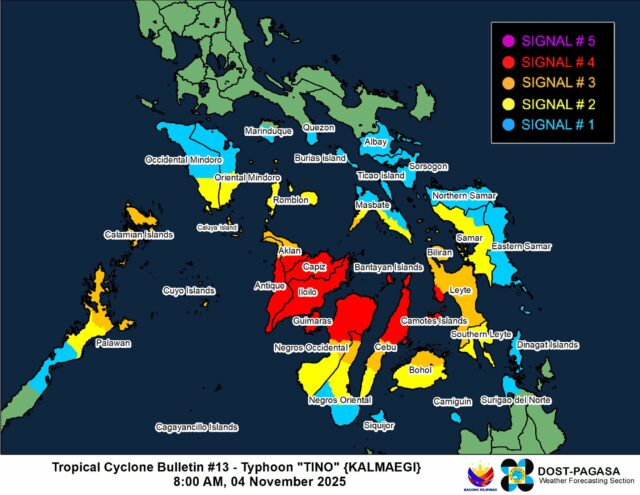
Typhoon Kalmaegi, locally known as Tino, is expected to continue battering the Visayas after making its first landfall over Southern Leyte on Tuesday. Tropical Cyclone Wind Signal No. 4 remains hoisted in various areas, according to the state weather bureau.

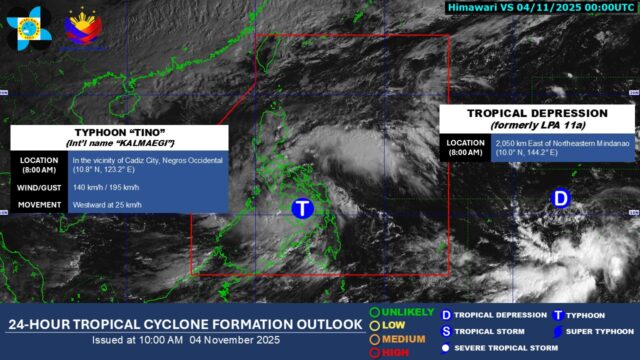
Kalmaegi has already made three landfalls — first in Silago, Leyte at 12:00 a.m., then in Borbon, Cebu at 5:10 a.m., and third in Sagay City, Negros Occidental at 6:40 a.m., the Philippine Atmospheric, Geophysical and Astronomical Services Administration (PAGASA) said in an 8:00 a.m. advisory.

The cyclone maintains its typhoon category level despite multiple landfalls, packing 150 kilometers per hour (kph) of sustained winds and 205 kph of gustiness.

Kalmaegi was recently located in the vicinity of Sagay City Negros Occidental, moving west-northwestward at 25 kph.

“In terms of intensity, even after making landfall, it has only slightly weakened and still remains within the typhoon category,” PAGASA’s weather specialist Grace Castañeda said during an 8:00 a.m. press briefing in both English and Filipino.

“It continues to bring strong to destructive winds, so once again, we urge our fellow citizens to exercise extra caution and remain alert.”

Signal No. 4, with expected typhoon-force winds, remains in effect in many parts of the Visayas, including western Leyte, northern Cebu, northern Negros Oriental, northern Negros Occidental, Guimaras, Iloilo, Capiz, southern Aklan, and central to southern Antique.

Signal No. 3 is up over portions of the Visayas and Luzon that may experience storm-force winds. These include the rest of Leyte, Biliran, northern Bohol, central Cebu, northern Negros Oriental, central Negros Occidental, the remaining parts of Aklan and Antique, as well as the southwestern portion of Masbate and northern Palawan, including the Calamian and Cuyo Islands.

Meanwhile, Signal No. 2 is in effect over areas likely to experience gale-force winds, including Romblon, the southern portions of Oriental and Occidental Mindoro, northern Palawan, southern Leyte, the rest of Bohol, Cebu, Negros Island, and western and southern Samar.

Signal No. 1 is hoisted over areas that may experience strong winds, such as Sorsogon, Albay, the rest of Masbate including Ticao and Burias Islands, Oriental Mindoro, northern and central Occidental Mindoro, southern Quezon, southern Marinduque, central Palawan including Cagayancillo Islands, Northern Samar, Eastern Samar, the rest of Samar, Siquijor, Dinagat Islands, northern Surigao del Norte, and Camiguin.

PAGASA said Kalmaegi is expected to continue moving across the landmass of Visayas and northern Palawan before emerging over the West Philippine Sea by Wednesday. The typhoon is forecast to exit the Philippine Area of Responsibility by Wednesday evening or early Thursday. — Edg Adrian A. Eva

Typhoon Kalmaegi brings ‘life-threatening’ conditions to central Philippines

DOST-PAGASA FB PAGE

MANILA — Typhoon Kalmaegi intensified as it made landfall in the central Philippines on Tuesday, with the state weather bureau warning of “life-threatening” conditions as it placed large parts of the Visayas region under the second-highest storm warning.

With sustained winds of 150 kilometers per hour (kph) and gusts of up to 205 kph, Kalmaegi, locally named Tino, is forecast to move across the Visayas and emerge over the South China Sea by Wednesday.

Weather agency PAGASA said the combined effects of Kalmaegi and a shear line brought heavy rains and strong winds over the Visayas island group and nearby areas.

“Due to interaction with the terrain, Tino may slightly weaken while crossing Visayas. However, it is expected to remain at typhoon intensity throughout its passage over the country,” PAGASA said in a morning bulletin.

More than 160 flights to and from affected areas have been cancelled, while those at sea were advised to head to the nearest safe harbor immediately and to stay in port.

In Southern Leyte, disaster officials evacuated residents from low-lying and coastal areas, the Philippine Coast Guard said.

PAGASA warned of a high risk of “life-threatening and damaging storm surges” that could reach over 3 meters high along coastal and low-lying communities in the central Philippines, including parts of Mindanao.

Kalmaegi comes as the Philippines, which is hit by an average of 20 tropical storms each year, is recovering from a run of disasters including earthquakes and severe weather events in recent months.

In September, Super Typhoon Ragasa swept across northern Luzon, forcing government work and classes to shut down as it brought fierce winds and torrential rain.— Reuters

For first time in long US government shutdown, hints of progress toward reopening

A US flag is draped at Union Station with the US Capitol dome in the background in Washington, DC, US, June 28. — REUTERS/KEN CEDENO

WASHINGTON — The first glimmers toward ending a near-record long federal government shutdown were seen in the US Capitol on Monday, as leading Senate Republicans and Democrats talked of a possible “off-ramp” to the disruption.

For 34 days, a standoff between Congress and President Donald Trump has shuttered a range of federal programs including those that provide aid for low-income Americans, US soldiers’ paychecks and airport operations.

A new fiscal year began on October 1 with no legislation enacted to fund these activities. Thousands of federal workers have now been furloughed, and the battle has hung up around $1.7 trillion in discretionary funds that account for about one-third of total US spending annually.

“I’m optimistic,” Senate Majority Leader John Thune, a Republican, told reporters when asked about prospects for ending the government shutdown that has many federal employees performing their jobs without paychecks.

Asked if he was confident of ending the shutdown, Mr. Thune, of South Dakota, hedged, saying: “Don’t push it.”

The comment was a small but significant change in tone. Democrats have linked government funding to extending a US health insurance subsidy that is on the verge of expiring.

Low-income families are seeing their food stamp benefits expire or only partially funded.

“Based on, sort of, my gut of how these things operate, I think we’re getting close to an off-ramp here,” Mr. Thune said.

The No. 2 Senate Democrat, Dick Durbin of Illinois said, “I sense that, too.” But he quickly added: “We’re still stuck with this premise of what we’re going to do about healthcare costs.”

Senate Appropriations Committee Chair Susan Collins of Maine told reporters that progress was made with Democrats offering specific language to break the impasse and staffs from both parties laboring over the weekend. “It just feels better this week,” she said.

Nonetheless, Ms. Collins admonished: “It could all fall apart again. And I don’t mean to imply there’s an agreement.”

Meanwhile, a bipartisan handful of House of Representatives moderates floated a compromise plan.

Axios reported a group of four House centrists, three Republicans and one Democrat, offered a plan to extend the expanded Affordable Care Act tax credit for two years, but with new caps on people whose income is at the upper end of qualifying.

Since October 1, groups of Senate Republicans and Democrats have held sporadic private meetings to look at ways to resolve the gridlock that has consumed Washington but so far have been unable to get to the finish line.— Reuters

Worker trapped under collapsed medieval tower in Rome dies, media says

COMMONS.WIKIMEDIA.ORG

ROME — A Romanian worker trapped for hours under rubble in Rome on Monday following the partial collapse of a medieval tower near the Colosseum has died, local media said.

The man was rescued by emergency services late on Monday and taken to hospital in a serious condition, Rome police chief Lamberto Giannini had previously said.

Parts of the 29-meter Torre dei Conti crashed to the ground on at least two occasions, videos posted on social media and Reuters video showed. The first collapse took place at around 1030 GMT, the second about 90 minutes later.

Clouds of dust came billowing out of the windows, along with the sound of collapsing masonry. The second incident took place while firefighters were working on the structure with aerial ladders.

A second worker, also Romanian, was pulled out almost immediately and hospitalized with serious but not life-threatening head injuries, while two more workers suffered minor injuries and declined hospital treatment.

None of the firefighters were injured.

Authorities have seized the construction site, Italian daily Corriere della Sera reported.

TOWER BUILT BY 13TH CENTURY POPE
The tower, which was due to be converted into a museum and conference space, is located halfway along the Via dei Fori Imperiali, the broad avenue that leads from central Piazza Venezia to the Colosseum.

The building was still standing, but showing significant internal damage.

It once hosted city hall offices but has not been in use since 2006 and was being worked on as part of a four-year renovation project due to end next year, according to Rome city authorities.

Due to the EU-funded restoration work, the area around the tower was closed off to pedestrians.

The building was erected by Pope Innocent III for his family in the early 13th century, and was originally twice as high, but was scaled down after damage from earthquakes in the 14th and 17th centuries.— Reuters

Peru breaks off diplomatic relations with Mexico after ex-PM flees to Mexican embassy

FREEPIK

LIMA — Peru has decided to break off diplomatic relations with Mexico, the Andean nation’s foreign minister said on Monday, after Peru’s former prime minister holed up in the Mexican embassy in the country to request asylum.

Foreign Minister Hugo de Zela told journalists that Peruvian officials learned earlier in the day that former Prime Minister Betssy Chavez, who served under President Pedro Castillo, had fled to the embassy.

Mexico’s foreign ministry did not immediately respond to a request for comment.

“In response to this unfriendly act, and taking into account the repeated occasions in which the current and former presidents of that country have interfered in the internal affairs of Peru, the Peruvian government has decided today to break diplomatic relations with Mexico,” Mr. de Zela said.

Ms. Chavez was facing criminal charges for her alleged role in Mr. Castillo’s attempt to dissolve Congress in late 2022. Mr. Castillo was ousted and remains under arrest.

Ms. Chavez had been imprisoned since June 2023, but was released by a judge in September while her trial was underway.

Her lawyer, Raul Noblecilla, told local radio station RPP that he had not heard from his client in several days and was unaware of whether or not she had requested asylum.

Ms. Chavez’s driver previously testified that she requested he take her to the Mexican embassy as Mr. Castillo’s bid to break up Congress was underway, before returning to her office.

Ms. Chavez denied that she attempted to reach the embassy then, and has denied knowing about Mr. Castillo’s plan to dissolve the legislature. Prosecutors have requested a 25-year sentence. — Reuters

Poll: GDP growth likely slowed in Q3

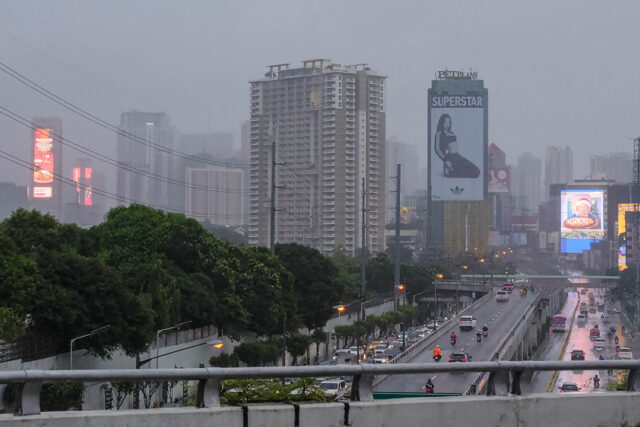
Vehicles are seen along EDSA on Sept. 23. Several typhoons may have also dragged Philippine economic activity during the third quarter, analysts said. Photo by RYAN BALDEMOR, THE PHILIPPINE STAR

By Heather Caitlin P. Mañago

THE PHILIPPINE ECONOMY likely cooled in the third quarter as soft government spending, typhoons and corruption scandals weighed on growth momentum, economists said.

However, resilient household spending supported by the central bank’s rate cuts may have helped anchor economic activity, they added.

Philippine gross domestic product (GDP) likely grew by 5.3% in the third quarter, based on a median forecast of 18 economists and analysts polled by BusinessWorld.

Q3 GDP growth forecast

This is slower than the 5.5% expansion in the second quarter, but a tad faster than the 5.2% expansion in the July-to-September period of 2024.

If realized, this would bring the average GDP growth to 5.4%, falling short of the government’s 5.5%-6.5% full-year target.

The Philippine Statistics Authority is scheduled to release third-quarter GDP data on Nov. 7.

In a research note, Chinabank Research said that government consumption may have declined due to the timing of disbursements and slower releases for some programs.

“Capital formation was likely weighed down by reduced public infrastructure spending due to the ongoing probe on infrastructure projects,” it said.

HSBC Global Investment Research economist for the Association of Southeast Asian Nations Aris D. Dacanay said that since public construction usually represents 5-6% of GDP, the 20% year-on-year drop in public infrastructure spending in July and August may have cut GDP growth by around one percentage point.

Public spending or government final consumption expenditure accounts for almost 18% of the country’s GDP.

Angelo B. Taningco, vice-president and Research Division head at Security Bank Corp., said sluggish capital formation and weak government spending may have dampened growth in the third quarter.

“[This is] hampered by tepid public infrastructure works tainted by corruption in flood control projects,” he said in an e-mail.

Data from the Bureau of the Treasury also showed the National Government disbursed P1.46 trillion in the third quarter, P141.73 billion less than its P1.6-trillion program for the period. This is mainly due to lower spending by the Department of Public Works and Highways, which is at the center of a corruption scandal involving flood control projects.

Ser Percival K. Peña-Reyes, director of the Ateneo Center for Economic Research and Development, said the corruption scandal involving infrastructure projects was the greatest domestic risk in the third quarter.

“Investor confidence has been shaken. Foreign investors are pulling back…, the scandal has created a toxic mix of political risk, fiscal uncertainty, and social unrest. It threatens our investment-grade rating and undermines our medium-term fiscal framework,” he said in an e-mail.

Mr. Peña-Reyes also noted that in the third quarter, the peso weakened past the P58-per-dollar mark, and the Philippine Stock Exchange index (PSEi) fell below the 6,000 psychological support level, reflecting political instability and capital flight.

BAD WEATHER
Several typhoons may have also dragged economic activity during the period, analysts said.

Bank of the Philippine Islands Lead Economist Emilio S. Neri, Jr. estimated GDP growth at 4.9%, largely due to the series of typhoons and disasters combined with significant decline in infrastructure spending.

In the third quarter, a total of 14 tropical cyclones formed or entered the Philippine Area of Responsibility as reported by the Philippine Atmospheric, Geophysical and Astronomical Services Administration.

According to the National Disaster Risk Reduction and Management Council, Typhoon Bising and the southwest monsoon caused P12 million in infrastructure damage in July. By August, the combined effects of the monsoon and tropical cyclones Crising, Dante, and Emong resulted in over P21 billion in agricultural and infrastructure losses nationwide.

“Furthermore, agricultural output also declined due to the typhoons. This may have also tempered household spending due to limited movement,” Reinielle Matt M. Erece, an economist at Oikonomia Advisory and Research, Inc., said in an e-mail.

The agriculture sector accounts for about a tenth of the country’s GDP and provides about a quarter of all jobs. Third-quarter agricultural output data will be released on Nov. 6.

HOUSEHOLD CONSUMPTION
Maybank Investment Bank economist Azril Rosli said that sustained private consumption continues to anchor economic activity, supported by the Bangko Sentral ng Pilipinas’ (BSP) rate cuts.

“The BSP’s monetary easing cycle, which began in mid-2024, is providing gradual relief to households and businesses, helping to sustain domestic demand momentum,” Mr. Rosli said.

He added that private consumption remains fundamentally sound, underpinned by steady wage growth and a relatively resilient labor market condition.

Household final consumption expenditure, which accounts for 68% of the economy, rose by 5.5% in the second quarter, faster than 4.8% in the same period last year.

The BSP has now slashed borrowing costs by a cumulative 175 basis points since it began its rate cut cycle in August 2024. This brought the policy rate to 4.75%, the lowest in over three years.

BSP Governor Eli M. Remolona, Jr. also signaled another rate cut is on the table at its next policy meeting in December.

Meanwhile, Moody’s Analytics economist Sarah Tan expects the economy to grow by 5.9%, faster than 5.5% in the previous quarter.

“The improvement reflects stronger household spending as monetary policy easing feeds through to lower borrowing costs and improved credit conditions,” she said in an e-mail.

She added that “softer inflation has improved households’ purchasing power and given the central bank space to maintain an accommodative stance.”

In September, inflation quickened to a six-month high of 1.7% in September from 1.5% in August. In the nine-month period, inflation averaged 1.7%, lower than the 3.4% in the same period in 2024.

For Nicholas Antonio T. Mapa, chief economist at the Metropolitan Bank & Trust Co., household consumption will likely deliver a sizable contribution to growth although the pace of expansion may be similar to the previous quarter.

“Despite slower inflation; price levels remain elevated while households rely more on credit,” he said in a Viber message.

Chinabank Research noted that household consumption remained the key driver of GDP growth, supported by low inflation.

“Additionally, the trade deficit narrowed during the quarter, helped by front-loading by US importers early in the period and resilient demand for semiconductors,” it added.

Moody Analytics’ Ms. Tan also noted that on the external side, exports have held up relatively well through July and August, which should support overall trade performance in the third quarter.

However, Mr. Erece said export growth may have slowed as front-loading tapered off with the 19% US tariff on Philippine goods taking effect on Aug. 7.

OUTLOOK
Meanwhile, economists expect Philippine GDP growth to accelerate in the remaining months of 2025.

“We expect growth to average 5.6% for the full year of 2025, settling within the government’s revised growth target range of 5.5% to 6.5%,” Moody’s Analytics’ Ms. Tan said.

She added that monetary easing, a strong labor market, and steady remittances will help sustain growth.

“These factors will sustain consumption, while external trade, on average across the year, should continue to contribute positively despite a softer global backdrop,” she said.

Ruben Carlo O. Asuncion, chief economist at Union Bank of the Philippines, said that modest improvement is expected in the fourth quarter as fiscal spending catches up and monetary easing gains traction.

For Miguel Chanco, chief emerging Asia economist at Pantheon Macroeconomics, “there should be something of a bounce in the fourth quarter.”

“For the most part, we’re sticking to our below-consensus view that 2025 full-year growth will come in at 5.3%, well below the government’s aspirations.”

Mr. Erece said that apart from tighter public spending, the recent corruption scandal may have negatively affected foreign investments, given its impact on trust.

Still, he expects holiday spending to drive fourth-quarter GDP growth.

“However, global trade jitters and public spending scrutiny may continue to drag down growth,” he said.

Maybank’s Mr. Rosli said he expects growth to remain solid at 5.5-5.9% in the fourth quarter, driven by year-end spending from both the government and private sector. The full impact of BSP’s monetary easing is also likely to support consumption and revive investment.

“Overall, our full-year 2025 GDP forecast of 5.6% represents solid and sustainable growth, underpinned by the economy’s fundamental strengths,” Mr. Rosli said.


Philippine manufacturing PMI bounces back to 50.1 in October

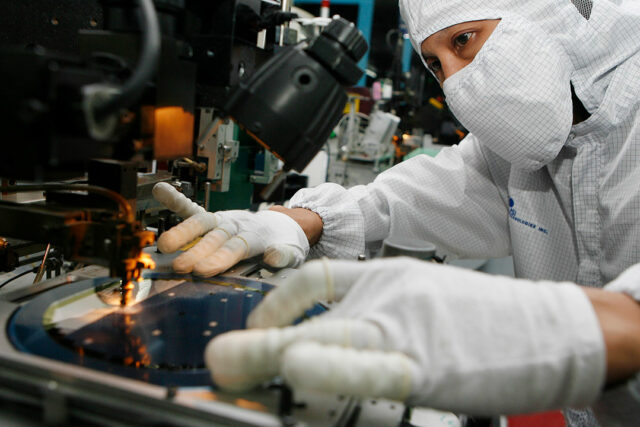
A WORKER adjusts a machine at a manufacturing facility in Manila, Dec. 10, 2008. — REUTERS

By Aubrey Rose A. Inosante, Reporter

PHILIPPINE MANUFACTURING activity rebounded in October, despite a further drop in new orders and output, according to S&P Global.

The S&P Global Philippines Manufacturing Purchasing Managers’ Index (PMI) improved to 50.1 in October, a turnaround from 49.9 in September.

A PMI reading above 50 denotes better operating conditions from the preceding month, while a reading below 50 shows a deterioration in operating conditions.

Philippines’ Manufacturing Purchasing Managers’ Index (PMI), October 2025

S&P Global noted that the latest PMI reading indicates “broadly stable” operating conditions.

Maryam Baluch, economist at S&P Global Market Intelligence, said the Philippine PMI reading in October reveals a “mixed picture.”

“The two largest segments, new orders and output, indicated further declines. Additionally, fresh contractions were observed in new export orders and purchasing activity, highlighting underlying demand conditions,” she said.

S&P Global noted that output and new orders “have now failed to record any growth for a second consecutive month, a trend not seen in over four years.”

“The decline in output was closely associated with falling new orders, which panelists linked to adverse weather conditions and the end-of-life status for certain products,” it said, adding that the pace of contraction slowed month on month.

S&P Global said new factory orders “fell at a stronger rate” in October, amid a “sluggish demand climate, with clients often putting orders on hold.”

“In addition, new export orders fell for the first time since May and at a solid pace which was the most pronounced for a year. Companies reported weaker demand from international clients,” it added.

S&P Global said the sharp drop in new orders led manufacturing firms to scale back their purchasing activity. This was the first decline in purchasing activity in nearly two years.

“However, according to anecdotal evidence, last-minute cancellations of orders meant that both pre- and post-production inventories recorded marginal increases. The latter registered a fresh uptick, marking the first expansion in three months,” it said.

Delivery times for inputs also lengthened in October, it said.

S&P Global said October marked a “further alleviation of underlying cost pressures.”

“The rate of input price inflation was modest and the weakest in three months. However, where goods producers reported higher prices, this was attributed to rising supplier and material costs,” it said.

Ms. Baluch said Filipino manufacturers also offered discounts in October to stimulate demand in a subdued market.

“Charges levied for Filipino manufactured goods fell for the first time in 19 months. The rate of decrease was marginal but the strongest since April 2020,” S&P Global said.

Business confidence also improved, nearing August levels, as manufacturers anticipated stronger output and strengthening demand trends” over the next 12 months.

“On a more positive note, manufacturers grew more optimistic about their growth prospects for output in the coming year. Companies also continued increasing their workforce numbers, with the latest rise in staffing numbers the strongest in three months,” Ms. Baluch said.

Ms. Baluch said the manufacturing sector remained in sluggish territory for most of the second half.

“Whether it can see a notable recovery in performance in the coming months will depend greatly on efforts to stimulate consumer demand,” she said.

S&P Global Marketing Intelligence Economics Associate Director Jingyu Pan said Philippine factory output in October showed that conditions are stabilizing.

“We have the output index falling at a less pronounced, in fact, very marginal pace. I think that’s a positive sign,” she said in an interview on Money Talks with Cathy Yang on One News on Monday.

However, Ms. Pan partly attributed the decline in output to a series of earthquakes in Cebu, a key electronics manufacturing hub, which damaged some business facilities.

Global trade tensions are expected to weigh on new export orders, with subdued demand already seen in October.

“I think, reflecting the kind of worries we had in terms of trade tensions coming through to actually impact the manufacturing economy in a more pronounced phase, especially now that as we enter the final quarter of the year with the tariffs settled in. I think that is something that we have to watch,” she said.

The US implemented the 19% tariff on Philippine-made goods on Aug. 7.

Better weather conditions may have also helped lift the Philippine manufacturing activity in October.

Rizal Commercial Banking Corp. Chief Economist Michael L. Ricafort said factory activity shifted to expansion mode partly due to better weather conditions followed by two months of adverse weather and earthquake disruptions.

“(This is) also partly due to the positive effects of the local policy rate cuts that reduced borrowing costs for some local manufacturers,” he said in a Viber message.

In the coming months, Mr. Ricafort warned that political noise could dampen manufacturing activity, especially among firms linked to infrastructure supply chains.

PHL industry ‘at its lowest point in recent years’ — Balisacan

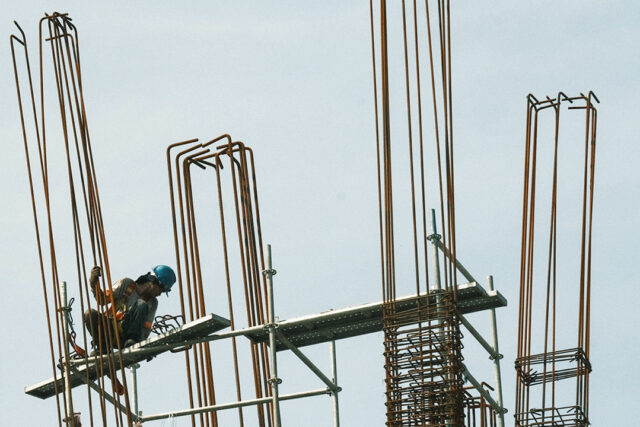
Workers are seen at a construction site in Navotas City. — PHILIPPINE STAR/RYAN BALDEMOR

THE PHILIPPINES’ INDUSTRY sector — including manufacturing and construction — may have slumped to its lowest level in recent years, dragging third-quarter economic growth, Economy Secretary Arsenio M. Balisacan said.

“I am not as optimistic (on growth) as I used to, given what the data that have been coming out in recent weeks, and particularly the performance of our industry,” he told reporters on the sidelines of an event on Monday.

“The industry is probably at its lowest point in recent years.”

He did not provide details on the gross domestic product (GDP)  data, which will be released by the Philippine Statistics Authority on Nov. 7.

Mr. Balisacan said the corruption scandal, weather-related disruptions and mounting global uncertainties may have weighed on GDP growth in the third quarter.

He said there was a slowdown in government spending and fixed-capital formation, as well as other areas like industry and services.

A crackdown on anomalous flood control projects alongside a corruption probe may have affected government disbursements.

The Marcos administration only disbursed P1.46 trillion in the third quarter, data from the Bureau of the Treasury showed, P141.73 billion less than its P1.6-trillion program for the period. This is mainly due to lower spending by the Department of Public Works and Highways, which is at the center of a corruption scandal involving flood control projects.

Mr. Balisacan also noted that adverse weather conditions that led to the suspension of work and classes may have contributed to slower growth in the July-to-September period.

However, he expects the impact on growth to be temporary, with a recovery likely in the next few quarters.

In the first six months of 2025, the economy grew by an average of 5.4%. The government is targeting 5.5-6.5% GDP growth this year.

“Our economic fundamentals have remained strong. The potentials have remained strong, our GDP growth potential is quite high, 6% and above. But reaching those potentials is another matter, and those are affected by instability, uncertainty, and we’ll see,” he said.

The country’s GDP likely grew by 5.3% in the third quarter, based on a median forecast of 18 economists and analysts polled by BusinessWorld. This is slower than the 5.5% expansion in the second quarter, but a tad faster than the 5.2% expansion in the July-to-September period of 2024.

RICE TARIFF REVIEW
Meanwhile, Mr. Balisacan said the Economic Development Council is scheduled to convene on Tuesday to tackle the proposal to raise rice tariffs to 35% from the current 15%.

The Department of Trade and Industry will present its recommendation on rice tariff adjustments during the meeting. This recommendation was endorsed to the Council by the Tariff-Related Matters Committee.

The Department Agriculture earlier recommended raising the rice import tariff to its original 35% rate from the current 15%.

Philippine President Ferdinand R. Marcos, Jr. on Sunday approved the extension of the country’s rice import ban until yearend.

Sought for comment, Mr. Balisacan said the government has “good enough supply” of rice to temper increases in retail prices.

“The overall goal of that is to protect farmgate prices from further falling, because in the past almost a year now, farmgate prices have dropped by more than 30%,” he said.

Farmer groups have blamed the current 15% tariff for keeping farmgate prices low by encouraging cheaper imports, undermining local producers.

However, Mr. Balisacan warned that tweaking the rice import tariff alone won’t fix the farmers’ problems.

“You have to use a combination of policy tools to address those problems, and that’s what we are going to present tomorrow,” he said noting that this approach will ensure the market will support medium-term and long-term development efforts.

Samahang Industriya ng Agrikultura spokesman Jayson H. Cainglet argued that the rice tariff cut to 15% has failed to benefit consumers, with importers and traders instead pocketing the savings.

He noted that palay production cost is P14.61 per kilo, but palay is only being bought at P8-12 per kilo, he told BusinessWorld in a Viber message on Monday.

He also noted that the reduced tariff has resulted in P25-billion foregone revenues from the imported rice as of end-August.

Separately, Mr. Balisacan led the opening of the Presidential Filipinnovation Awards that will select five winners out of 15 finalists which receive a cash grant and post-competition support package worth up to P3.5 million, including coaching and mentoring.

“Our goal here is that we can mainstream innovation in the private sector, that we can increase the success rate of our innovators,” he said during a briefing in Crowne Plaza Manila Galleria.

Economy Undersecretary Rosemarie G. Edillon said the government is targeting to raise the Philippines’ rank in the Global Innovation Index (GII) by 2028. The Philippines is currently at 50th place out of 139 economies in the 2025 GII. — Aubrey Rose A. Inosante