Home Blog Page 7580

Australian doctors warn of risks to hospitals once COVID-19 curbs ease

STOCK PHOTO

SYDNEY — Australian doctors on Thursday warned the country’s hospitals are not ready to cope with the government’s reopening plans, even with higher vaccination rates, as some states prepare to move from a virus suppression strategy to living with coronavirus disease 2019 (COVID-19).  

The Australian Medical Association (AMA) said the health system was in danger of being locked into a “permanent cycle of crisis” and has called for new modeling to check if staffing levels in hospitals can withstand an expected surge in cases when lockdown rules ease.  

“If you have opened up and you haven’t looked at the safety nets or the life rafts that we’ve got, we might end up actually trying to push more people on the life rafts and capsizing them,” AMA Vice President Chris Moy told broadcaster ABC.  

Australia in July unveiled a four-stage plan back to greater freedoms when the country reaches 70%–80% vaccination. But virus-free Queensland and Western Australia have said they may not stick to those plans as the agreement was finalised when cases in New South Wales were much lower.  

New South Wales on Thursday reported 1,288 new locally acquired cases, just below its pandemic high of 1,290 hit on Monday. Seven new deaths were recorded.  

A total of 957 people are in hospitals, up from 698 a week ago, while cases in intensive care units (ICU) jumped nearly 40% to 160, 64 of whom require ventilation.  

Authorities quadrupled the number of the state’s intensive care ventilators to 2,000 early last year, but the medical association’s Moy said governments need to focus on hospital staffing before relaxing lockdown rules.  

“It’s not just the number of ventilators, it’s not the number of IC units, it’s the number of staff and people that are going to have to man this when we open up,” he said.  

‘DON’T DELAY INEVITABLE’ 
Soaring cases forced Victoria on Wednesday to join New South Wales in abandoning a COVID-zero target, with both states now targeting rapid vaccinations as a pathway to freedom after failing to quell an outbreak of the Delta variant, even after a weeks-long lockdown.  

New cases in Victoria jumped to 176 on Thursday, the year’s biggest daily rise, from 120 a day earlier.  

Australia has largely lived in COVID-zero for much of the pandemic, recording 1,019 deaths in total and just over 56,500 cases. But a slow vaccination rollout has left it vulnerable to more infections and hospitalisations.  

So far, only about 36% of people above 16 have been fully vaccinated, well below most comparable countries.  

The federal government urged all states to stick to the national reopening plan, with Treasurer Josh Frydenberg saying the states can’t “delay the inevitable.”  

“You have to learn to live with COVID-19. COVID-19 may come to your state within a week, it might be a month, it might be a little bit after that. But the reality is we can’t eliminate the virus,” Mr. Frydenberg told Nine News on Thursday. — Renju Jose/Reuters 

Warnings as Southeast Asia’s biggest economies ease COVID-19 curbs

REUTERS

BANGKOK/JAKARTA — As Indonesia and Thailand start to ease coronavirus disease 2019 (COVID-19) curbs after seeing case numbers fall, health experts say cases of new infections could rise again with vaccination rates still low.  

After containing the coronavirus better than much of the world last year, Southeast Asia has turned into a global epicenter in recent months with the arrival of the virulent Delta variant.  

Although case numbers are still rising fast in most of the region, Indonesia and Thailand, which have its largest economies, have started to lift curbs on dine-in restaurants and shopping malls to ease the economic pain of their lockdowns.  

Indonesia reported 10,534 new cases on Tuesday, five times fewer than its peak in mid-July, while Thailand reported 14,802 new cases on Wednesday, down 37% from its mid-August peak.  

However, experts said relaxations carried dangers with a low level of vaccination and a shortage of testing, with rates of positive tests often above the 5% recommended by the World Health Organization (WHO).  

“We are definitely concerned around the reopening without meeting all the criteria proposed by the WHO,” Abhishek Rimal, Asia Pacific Emergency Health Coordinator at the International Federation of Red Cross and Red Crescent Societies, told Reuters.  

“Now with the Delta variant, which is highly transmissible, and the low vaccination rate, we could very well see a surge of COVID-19 in days to come.”  

Indonesia has recently had a positive test rate of 12% and Thailand 34%.  

“Surveillance is not that great, we still need to be careful,” said Tri Yunis Miko Wahyono, a University of Indonesia epidemiologist.  

Indonesia has recorded more than 4 million coronavirus cases in total and more than 133,000 deaths from COVID-19 since the start of the pandemic. Thailand has reported 11,841 deaths and 1.2 million cases.  

The two countries both have first vaccination rates at around 30% with Indonesia having fully vaccinated 17% and Thailand 11%. Their capitals, Jakarta and Bangkok, have much higher levels of vaccination.  

In Jakarta and some areas on the populous Java island, restaurants inside shopping malls could have a 50% dine-in capacity, and shopping malls could stay open until 9 p.m., while factories are permitted to operate at 100% capacity.  

Bangkok and 28 other provinces listed as having the most severe outbreaks can similarly reopen dine-in restaurants at a capacity between 50%–75%, with opening hours capped at 8 p.m., the same as shopping malls.  

“The situation is getting better because many people are getting vaccinated and they are being more cautious,” said restaurant customer Orrapin Peenanee, queuing in Bangkok.  

The economic benefits of easing lockdowns were understandable, said Dale Fisher, a senior infectious disease expert at the National University Hospital in Singapore, but he stressed that they also must vaccinate their citizens faster.  

“As you ease off the lockdowns, how much sort of punishment can you take before you have to bring a lockdown back in and be stronger? The answer’s in the vaccine,” he said. — Matthew Tostevin and Stanley Widianto/Reuters

Pollution likely to cut 9 years of life expectancy of 40% of Indians

Ninara/CC BY 2.0/Flickr

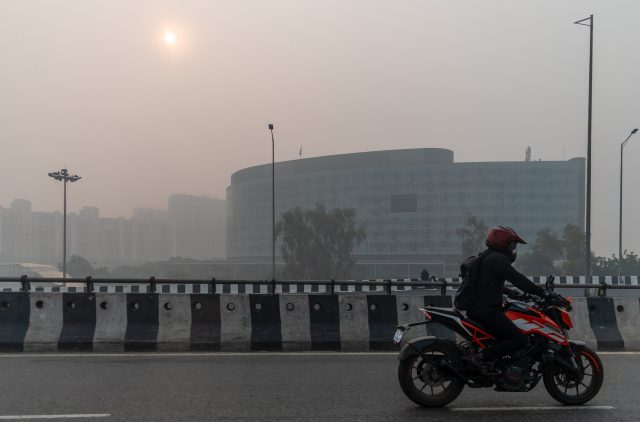
NEW DELHI — Air pollution is likely to reduce the life expectancy of about 40% of Indians by more than nine years, according to a report released by a US research group on Wednesday.  

More than 480 million people living in the vast swathes of central, eastern and northern India, including the capital, New Delhi, endure significantly high pollution levels, said the report prepared by the Energy Policy Institute at the University of Chicago (EPIC).  

“Alarmingly, India’s high levels of air pollution have expanded geographically over time,” the EPIC report said.  

For example, air quality has significantly worsened in the western state of Maharashtra and the central state of Madhya Pradesh, it said.  

Lauding India’s National Clean Air Program (NCAP), launched in 2019 to rein in dangerous pollution levels, the EPIC report said “achieving and sustaining” the NCAP goals would raise the country’s overall life expectancy by 1.7 years and that of New Delhi 3.1 years.  

The NCAP aims to reduce pollution in the 102 worst-affected cities by 20%–30% by 2024 by ensuring cuts in industrial emissions and vehicular exhaust, introducing stringent rules for transport fuels and biomass burning and reduce dust pollution. It will also entail better monitoring systems.  

New Delhi was the world’s most polluted capital for the third straight year in 2020, according to IQAir, a Swiss group that measures air quality levels based on the concentration of lung-damaging airborne particles known as PM2.5.  

Last year, New Delhi’s 20 million residents, who breathed some of the cleanest air on record in the summer because of coronavirus lockdown curbs, battled toxic air in winter following a sharp increase in farm residue burning in the nearby states of Punjab and Haryana.  

According to the EPIC’s findings, neighboring Bangladesh could raise average life expectancy by 5.4 years if the country improves air quality to levels recommended by the World Health Organization.  

To arrive at the life expectancy number, EPIC compared the health of people exposed to different levels of long-term air pollution and applied the results to various places in India and elsewhere. — Reuters

Duterte’s daughter says she has ‘running mate’ offers for Philippines 2022 election 

PRESIDENTIAL PHOTO/KING RODRIGUEZ

DAVAO City Mayor and presidential daughter Sara Duterte-Carpio said late Wednesday that politicians, including her father’s closest aide and preferred successor, have offered to run with her in next year’s election.  

Ms. Duterte-Carpio is leading opinion polls but has yet to disclose her political plans ahead of the deadline to file for candidacy in October.  

In her official Facebook account, Ms. Duterte-Carpio said lawmakers Sherwin T. Gatchalian and Christopher Lawrence “Bong” T. Go “personally expressed their offer to run as my vice president.”  

It was unclear when Mr. Go made the offer, but Ms. Duterte-Carpio’s post comes a few days after Mr. Go rejected the ruling party’s endorsement as presidential candidate.  

Ms. Duterte-Carpio said other possible running mates include former defense minister Gilberto “Gibo” C. Teodoro, who offered himself through common friends, and the son and namesake of late Philippine dictator Ferdinand Marcos.  

Mr. Go and the camp of Mr. Marcos did not respond to requests for comment. Other candidates have publicly disclosed their intent to run as Ms. Duterte-Carpio’s vice president.  

Ms. Duterte-Carpio, 43, has been quoted in media as saying she was open to running for president.  

“Whether or not she has already decided on her plans of running, there really is clamor from many sectors,” political analyst and professor Edmund Tayao told Reuters. “Many politicians think she will be a formidable presidential candidate.”  

Philippine leader Rodrigo R. Duterte, 76, is prohibited by the constitution from seeking a second term, but his opponents believe he could extend his grip on power through an election of an ally.  

Mr. Duterte has declared he will seek the vice presidency, if daughter Ms. Duterte-Carpio does not run for president.  

The elder Duterte remains popular despite his anti-narcotics campaign that has killed thousands of suspected drug dealers and users. But his administration is facing growing criticism over its handling of the pandemic, with the Philippines battling one of the worst coronavirus outbreaks in Asia.  — Reuters 

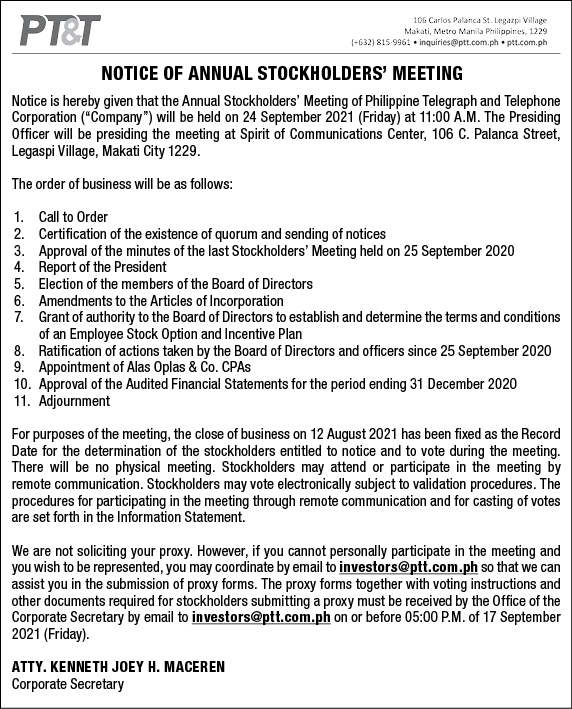
PT&T sets schedule of annual stockholders’ meeting

Spotlight is BusinessWorld’s sponsored section that allows advertisers to amplify their brand and connect with BusinessWorld’s audience by enabling them to publish their stories directly on the BusinessWorld Web site. For more information, send an email to online@bworldonline.com.

Join us on Viber to get more updates from BusinessWorld: https://bit.ly/3hv6bLA

Philippine factory activity plunges to 15-month low

REUTERS

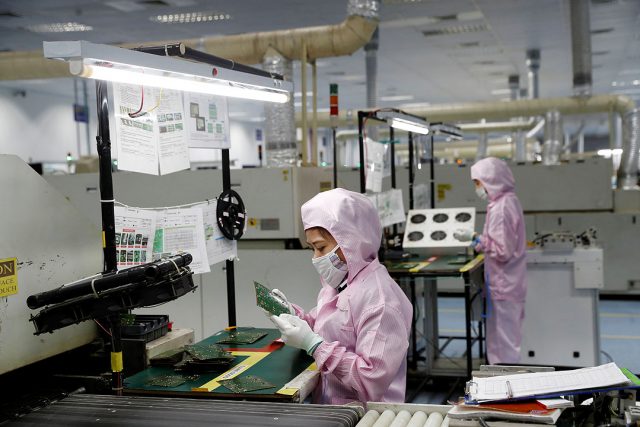
MANUFACTURING ACTIVITY sharply declined to a 15-month low in August as a fresh surge in coronavirus disease 2019 (COVID-19) infections led to another strict lockdown in the Philippine capital.

IHS Markit on Wednesday said the Philippines Manufacturing Purchasing Managers’ Index (PMI) fell to 46.4 last month from 50.4 in July, as factories and businesses were forced to close due to a two-week enhanced community quarantine in Metro Manila.

August saw factory activity ending two straight months of expansion and falling to its lowest level in 15 months or since the 40.1 reading in May 2020.

Manufacturing Purchasing Managers’ Index of select ASEAN economies (August 2021)

A reading above 50 indicates improving conditions for the sector versus the previous month, and below the threshold means deterioration.

“With the announcement of tightening ECQ measures in early August, the latest contraction in operating conditions in the Philippines manufacturing sector came as no surprise. Factories and their clients in the Metro Manila area once again paused their production lines in a bid to curb the spread of the new Delta variant,” Shreeya Patel, economist at IHS Markit, said in a statement.

Like the Philippines, the rest of Southeast Asia saw manufacturing conditions worsen in August due to a resurgence in COVID-19 cases and subsequent lockdowns. The regional average reading slipped to 44.5 in August from 44.6 the month earlier, marking the third straight month of deterioration.

The Philippines’ PMI reading was the second highest in the region, following Thailand’s 48.3. It was better than Indonesia (43.7), Malaysia (43.4), Vietnam (40.2) and Myanmar (36.5).

PMI is the weighted average of five sub-indices: new orders (30%), output (25%), employment (20%), suppliers’ delivery times (15%) and stocks of purchases (10%).

IHS Markit noted that all five of the PMI components worsened for the Philippines in August.

Production by local factories fell for the fifth month in a row in August, which was also the fourth steepest decline in the series history.

Customer demand likewise declined by the fourth quickest rate in the series history, as domestic sales slumped due to the closure of businesses and exports fell by the fastest pace since July 2020.

“Tighter restrictions on travel and the closure of businesses led clients to curb orders. Weak domestic sales were accompanied by a renewed contraction in foreign demand,” IHS Markit said.

Due to lower production, manufacturers bought less as they tried to restructure existing stocks and recover costs.

Supplier performance also deteriorated amid tighter restrictions, port congestion and supply shortage.

“Delivery times lengthened at the most marked rate since August 2020 and was among the lengthiest in the over five-and-a-half-year history of the survey,” IHS Markit said.

As factories temporarily shuttered operations, more workers either resigned or were laid off.

Raw material shortages from international suppliers and sustained delays in delivery pushed input costs higher in August, causing average cost burden to grow for the 16th consecutive month and inflation to remain high.

IHS Markit, however, noted price increases have slowed to its softest pace in seven months.

However, manufacturers still raised their selling prices to pass on these higher costs to customers.

“On a brighter note, firms’ expectations towards the outlook remained optimistic owing to hopes that the latest downturn is only temporary,” Ms. Patel said.

Companies are also hopeful that the vaccine rollout will help the country’s “return to normality,” although many are still worried about uncertainty over the pandemic.

The Philippines’ PMI may remain in contraction as prolonged quarantine restrictions and the elevated COVID-19 infections continue to hamper economic activities, Rizal Commercial Banking Corp. (RCBC) Chief Economist Michael L. Ricafort said in a note to journalists.

“Risk factors include the new coronavirus strains, especially the Delta variant, that are more contagious. [This] could slow down economic recovery prospects amid risks of lockdowns and travel restrictions locally and worldwide… [and lead] to slower recovery in manufacturing and imports,” he said.

Lockdown measures in Metro Manila and other provinces are under the second-most stringent lockdown until Sept. 7.

Health authorities reported 14,216 new COVID-19 cases on Wednesday, bringing the active caseload to 140,949.

“With PMI strongly associated with GDP (gross domestic product), we expect growth likely to soften in the third quarter further should the September reading remain in deeper contraction,” Security Bank Corp. Chief Economist Robert Dan J. Roces said via Viber on Wednesday.

Meanwhile, Mr. Roces said a fast turnaround from the August slump is possible given the easing price pressures and firms’ expectations that the PMI contraction will only be temporary.

“The biggest nudge will be a quickening of the vaccination pace and easing lockdowns,” he added. — B.M.Laforga

Bank lending slips for 8th straight month in July

BW FILE PHOTO

BANK LENDING slipped for an eighth consecutive month in July, although at a softer pace as borrowings for production activities increased amid looser quarantine restrictions.

Outstanding loans issued by big banks dipped 0.7% year on year to P9.137 trillion in July, based on preliminary data from the Bangko Sentral ng Pilipinas (BSP) released Tuesday evening.

The decline in July is softer than the 2% contraction in June, and matched the drop seen in December 2020. To recall, December saw bank lending fall for the first time since September 2006.

Inclusive of reverse repurchase agreements, outstanding loans disbursed by big banks slid by 0.5%.

Bank lending rose by 0.5% on a seasonally adjusted basis month on month, as July saw a further relaxation of restrictions in the capital region.

“Looking ahead, the BSP will continue to prioritize monetary policy support in order to ensure the continued momentum of economic recovery,” the central bank said in a statement.

“At the same time, the National Government’s targeted fiscal initiatives and health interventions will be crucial in boosting domestic demand and strengthening the recovery.”

The softer decline in bank lending reflects the lag in the effect of monetary policy, ING Bank N.V. Manila Senior Economist Nicholas Antonio T. Mapa said.

Policy rates are currently at a record low after the Monetary Board cut policy rates by a total of 200 basis points in 2020.

“BSP’s last follow-through rate cut in November appears to be finally helping lift lending somewhat with August bank lending expected to post a modest gain on a year-on-year basis,” Mr. Mapa said in an e-mail.

In July, lending for production activities rose 0.8%, a turnaround from the 0.6% contraction in June. The BSP attributed this to the higher borrowings for real estate activities (5.9%); information and communication (14%); electricity, gas steam and air-conditioning supply (2.1%); and transportation and storage (7%).

On the other hand, bank loans for other commercial activities dropped, including those for wholesale and retail trade and repair of motor vehicles and motorcycles (-4.5 %) and manufacturing (-2.6%).

Retail loans contracted by 8.2% in July, although softer than the 8.7% fall in June. Consumer loan segments continued to decline, led by motor vehicle loans (-15.4%), salary-based loans (-5.8%), and credit cards (-1.6%).

Even after a two-week strict lockdown was implemented in August, analysts are hopeful that credit growth will pick up in the coming months.

“I am expecting that the enhanced community quarantine (ECQ) of 2020 is not the same with the ECQ of 2021, and that the latter a lighter version of the other, in terms of the magnitude of restrictions. With this, I am hoping for a softer negative impact than that of 2020,” UnionBank of the Philippines, Inc. Chief Economist Ruben Carlo O. Asuncion said in an e-mail.

Banks’ risk appetite could improve once economic activities pick up in the next few months depending on the country’s pandemic management, Mr. Mapa said.

“We’ve noted the likely normalization of business activity if the country is better able to contain the virus and authorities must do all they can on the public health front to ensure an eventual smooth transition back to business operations,” he added.

M3 GROWTH SLOWS
The eighth straight month of lending decline coincided with continued growth in money supply, although slower than what was seen in June.

M3 — which is considered as the broadest measure of liquidity in an economy — rose by 5.9% in July, slower than the 6.5% growth in June, based on preliminary BSP data also released on Tuesday evening.

It rose by 0.1% month on month.

The slower M3 growth was likely due to base effect given the aggressive liquidity infusion measures done last year at the onset of the pandemic, Rizal Commercial Banking Corp. Chief Economist Michael L. Ricafort said.

Domestic claims increased 4.5%, easing from the 5.3% expansion in June. The BSP attributed this to the increase in net claims on the central government as well as the slight improvement in bank lending to the private sector.

“Going forward, the BSP will ensure that domestic liquidity remains adequate to support domestic economic activity, in line with the BSP’s price and financial stability objectives,” the central bank said.

The central bank has provided liquidity to the financial system through various easing measures. It has released some P2.2 trillion into the financial system, which is equivalent to about 12.1% of gross domestic product.

Despite this liquidity boost, banks remained risk-averse amid increased uncertainty as the pandemic continued.

In August, BSP Governor Benjamin E. Diokno said the central bank is not keen on raising rates or cutting banks’ reserve requirement ratio (RRR) while the country is still at the early stages of recovery.

He said there is still a lot of liquidity in the system, adding they might consider the need for further reduction in the RRR when there is strong loan demand.

The BSP kept the key policy rate unchanged at 2% in its Aug. 12 meeting. The Monetary Board will have its next policy-setting meeting on Sept. 23. — Luz Wendy T. Noble

Philippines’ ODA portfolio hits $30B

JAPAN INTERNATIONAL COOPERATION AGENCY
JAPAN remained the country’s top source of official development assistance (ODA) in 2020. The rehabilitation of the Porac-Gumain River Irrigation System is one of the projects funded by Japan ODA. — JAPAN INTERNATIONAL COOPERATION AGENCY

THE COUNTRY’S active official development assistance (ODA) portfolio jumped by 42% to $30.39 billion (P1.52 trillion) in 2020 as the government tapped more quick-disbursing loans to fund its pandemic response, the National Economic and Development Authority (NEDA) reported.

Preliminary data from NEDA obtained by BusinessWorld showed the foreign aid portfolio consisted of $29.004 billion in loans from development partners and $1.688 billion in grants.

The number of programs and projects supported by ODA went up 1.4% to 357 in 2020, comprised of 106 active loan agreements and 251 active grants.

The Philippines has ramped up its foreign borrowings to finance its pandemic response.

“The unprecedented challenges brought by the pandemic prompted a shift in sourcing and utilizing ODA financing in the new normal, from project-specific to quick-disbursing program loans,” NEDA said on Tuesday.

ODAs are concessional financing that multilateral banks and other institutions provide to poorer countries to promote economic development.

Japan remained the country’s top source of ODA in 2020, with a total portfolio of $11.18 billion, up 31% from the $8.5 billion as of end-2019. This comprised of $11.11 billion in loans and $74.67 million in grants.

Japan ODA accounted for 36.44% of the Philippines’ total foreign aid portfolio, but a tad lower than its 39.4% share in 2019.

The second-biggest lender was still the Asian Development Bank (ADB), after extending $8.75 billion in ODA in 2020, up 53.5% from $5.7 billion in 2019. This accounted for 28.5% of the total portfolio, improving from its 26.4% share previously.

The World Bank extended $6.44 billion in foreign aid, up 49% from its $4.31 billion total in 2019.

China-backed Asian Infrastructure Investment Bank (AIIB) jumped to fourth spot in 2020 from ninth place in 2019, after extending a $750-million loan for the government’s pandemic response.

AIIB’s total ODA more than quadrupled to $957.6 million in 2020 from $207.6 million in 2019.

South Korea extended $809.9 million in loans and grants, while China gave $620.7 million worth of foreign aid.

The United States was the seventh-biggest provider of ODA with $555.8 million in 2020, followed by France ($452.8 million); United Nations ($362.43 million); European Union ($233.7 million); and Australia ($176.8 million).

NEDA reported the government’s utilization of ODAs — or actual spending relative to target — went up to 66.69% in 2020 from 64.28% in 2019.

Total number of ongoing project loans also increased to 76 in 2020 from 67 the year before. — Beatrice M. Laforga

Customs beats collection goal in August

THE BUREAU of Customs (BoC) on Wednesday said it surpassed its collection target anew in August after generating P54.05 billion in duties and taxes on better valuation and higher volume of imports.

In a statement, BoC said it exceeded the P53.06-billion goal set for the month by 1.86%.

The BoC’s August collection fell by 7% month on month, but still 21.8% bigger than the P44.38-billion haul in August 2020.

The agency has been constantly beating its monthly collection targets since January.

In the first eight months of the year, Customs revenues grew by 19% to P412.96 billion from P347.29 billion a year ago.

The eight-month tally made up 67% of its P616.75-billion target for the entire year.

“The BoC’s positive revenue collection performance is attributed to the improved valuation and volume of importations, and the intensified collective efforts of all the ports to prevent revenue leakages and collect all lawful revenues,” Customs said in a statement.

The BoC has a P671.7-billion collection target for 2022, 9% higher than this year’s goal. — BML

SEC clears shares offer of hospital, sugar miller

THE Securities and Exchange Commission (SEC) cleared the maiden public offerings of Allied Care Experts (ACE) Medical Center-Cagayan de Oro, Inc. (CDO) and Central Azucarera de San Antonio, Inc. (CASA).

“In its meeting on Aug. 31, the commission en banc resolved to render effective the registration statements of ACE Medical Center-CDO and CASA covering 240,000 common shares and 1,850,000 common shares, respectively, subject to the companies’ compliance with certain remaining requirements,” the regulator said in a statement on Wednesday.

ACE Medical Center-CDO will be offering 3,600 blocks sold for P200,000 to P400,000 each, which will consist of 10 shares apiece.

The company expects to net P996,696,895 in proceeds for the offer, which will be used for the estimated P778.4-million construction expenses of its Cagayan de Oro hospital, to finance the acquisition of medical equipment, partial payment for a loan, and the hospital’s working capital requirement.

ACE Medical Center–CDO is building an eight-story healthcare facility that can accommodate 176 beds, spanning 21,198 square meters in Barangay Lapasan, Cagayan de Oro City.

The initial public offering (IPO) will be traded over the counter through the hospital’s internal staff, with medical practitioners, their relatives, and the public as their market.

Physicians and medical specialists who will avail of at least one block or 10 shares from the offer will be allowed to practice in the company’s hospital. They may be subjected to restrictions, limitations, and obligations that may be imposed by the company.

Those who wish to practice at ACE Medical Center–CDO are required to subscribe to the offer shares. Physicians who want to hold clinic at the hospital must have fully paid one block or 10 common shares and must have gone through the screening process and minimum requirements prescribed by the hospital.

Subscribers to ACE Medical Center–CDO’s IPO may also avail of benefits such as discounts on medical and dental services, which the stockholder and his dependents may avail of in other medical facilities with ACE Group of Hospitals affiliations.

CENTRAL AZUCARERA DE SAN ANTONIO
Meanwhile, CASA will be offering 277,500 common shares to the public, 214,551 of which will be sold by way of a primary offer and 62,949 will be offered by a selling shareholder.

Shares will be sold for up to P2,012.52 each and will be traded over the counter.

The company may net up to P422,043,000 from the primary offer, which will be used to upgrade its cogeneration facility, motor pool, and sugar factory. It will also be used for land acquisitions and farm mechanization, the SEC said.

Meanwhile, the company will not receive proceeds from the sale of secondary shares, which is expected to amount to P115,428,500.

The Chan-owned company primarily operates via its sugar milling business. However, it also dabbles in power generation through a biomass co-generation plant, which has an initial installed generation capacity of 15 megawatts.

CASA’s IPO is being conducted to comply with Republic Act No. 9136 or the Electric Power Industry Reform Act of 2001, which mandates power generation companies not publicly listed to offer and sell at least 15% of their common shares to the public within five years from the effectivity of the Energy Regulatory Commission Resolution No. 4-2019. — Keren Concepcion G. Valmonte

Regulator warns vs. entities posing as paramilitary groups

THE Securities and Exchange Commission (SEC) is warning the public of entities posing as paramilitary or pseudo-law enforcement and civic-oriented organizations or associations.

Some of these entities were “flaunting their SEC registration as a nonstock corporation to lend a color of legitimacy to their operations,” while some were not registered at all.

The SEC said it will not “tolerate the use of the corporate vehicle in proliferating these kinds of paramilitary activities/scheme.”

Without specific names, the regulator said these entities use names of the Philippine National Police (PNP), Armed Forces of the Philippines (AFP), Philippine Center on Transnational Crime – INTERPOL National Central Bureau Manila, the United Nations (UN), and other government agencies or international bodies to operate.

“Based on the investigation conducted by the department, these individuals or entities appear to have been using military affiliations/positions and appropriating military ranks to engage in activities or undertakings pertaining to the functions/mandates of the PNP, AFP, INTERPOL, the [UN] and its affiliates,” the commission said in an advisory, which also took note of the logos and emblems these entities used.

The commission said a certificate of registration as a corporation does not come with a license or authority to conduct paramilitary activities.

“These activities or functions are outside the scope that can be conferred by the Revised Corporation of the Philippines or by the Commission, nor can their paramilitary/law-enforcement activities be considered as incidental to or part of their express powers as corporations,” the SEC said.

The certificate issued by the commission also cannot give these entities rights or authority to use the names and logos of the United Nations, INTERPOL, and other international organizations.

As the act “blatantly constitutes misrepresentation” and may be used to promote fraudulent activities or “can be reasonably expected” to cause danger to public safety and welfare.

“The commission shall not hesitate to impose corresponding penalties under the Revised Corporation Code for violations committed by these corporations, without prejudice to liabilities individuals representing these corporations/entities may face for violations of the Revised Penal Code of the Philippines,” the SEC said. — Keren Concepcion G. Valmonte

SMC’s MRT-7 train cars to start arriving next week

COURTESY OF SMC

SAN Miguel Corp. (SMC) announced on Wednesday that the first batch of train cars for the Metro Rail Transit (MRT) Line-7 project, which is targeted for completion next year, will arrive in the Philippines next week.

“The trains, which consist of six cars, or two train sets procured from South Korea’s Hyundai ROTEM, have cleared inspections and factory acceptance testing,” the conglomerate said in an e-mailed statement.

“More trains are set to arrive in the following months up to next year… until all 108 cars or 36 train sets the company acquired are delivered,” it added.

The project, however, remains at “over 54%” completion rate.

In June, San Miguel Holdings Corp. Chief Finance Officer Raoul Eduardo C. Romulo said at an online forum: “As of April 2021, the MRT-7 project is halfway finished, with a total completion rate of 54.87%.”

ANG EXPLAINS PROJECT DELAY
“There are many causes of delay, from necessary pandemic restrictions to ROW (right-of-way) issues, but as with all SMC projects, we apply 110% effort to all the areas we can work on, so as to minimize delays,” SMC President Ramon S. Ang said.

“As we said before, the MRT-7 project is in many ways more difficult and complex than even our recently competed Skyway Stage 3, which in itself is an engineering feat. This is because MRT-7 has added complexities such as electric power systems, computer and communications systems, signaling systems, and automatic fare systems, among others,” he also said.

SMC said the first test run of the MRT-7 project is set for December next year.

The P63-billion project has three major components: a 24.7-kilometer mass rail transit system from North Avenue, Quezon City to San Jose del Monte, Bulacan, which is composed of 14 stations; an intermodal transportation terminal that will serve as a transportation hub catering to other types of public transportation; and a 19-kilometer highway from San Jose del Monte to Bocaue, Bulacan.

It is expected to accommodate up to 850,000 passengers daily and cut travel time between Quezon City and Bulacan from four hours to 34 minutes. — Arjay L. Balinbin