Home Blog Page 7547

IC allows insurers to invest in more offshore instruments, derivatives
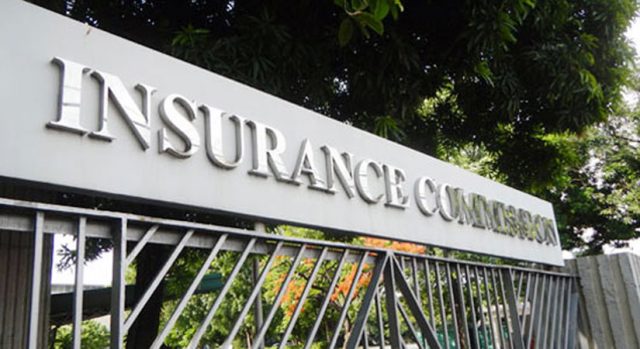
BW FILE PHOTO

THE INSURANCE Commission (IC) has opened more investment channels for local insurers to diversify their portfolio, allowing them to tap foreign currency-denominated instruments and derivatives.

Insurance Commissioner Dennis B. Funa issued Circular Letter No. 2021-53 providing guidelines on the foreign currency-denominated investments and additional derivative instruments that life and nonlife companies can put their money in.

“The guidelines on foreign currency denominated investments require expansion to recognize other investment products in the market not covered by current guidelines and to adopt with trends and development of the global financial market,” Mr. Funa said in the circular.

He said these new investment vehicles will help insurance companies in risk diversification, hedging and improving portfolio liquidity.

This will also allow life and nonlife insurers to sell foreign currency-denominated insurance products to their policyholders.

Investments in these assets are also subject to prior approval of the regulator.

The local insurance industry said these new rules are expected to help them expand their investment portfolio through offshore assets and allow them to hedge risks with derivatives, said Benedict C. Sison, president of Philippine Life Insurance Association.

“Given the low yields and scarcity of long-dated local assets, insurance companies can now consider investing in offshore USD-denominated assets to help improve portfolio yield and duration,” Mr. Sison, who is also the CEO and country head of Sun Life of Canada (Philippines), Inc., said in an e-mailed response.

“I believe most of the insurance companies will take advantage of this new development to be able to improve the returns and duration of their respective portfolios at the same time being able to diversity risk,” he added.

The new foreign currency-denominated investments local insurers can tap include debt and equity securities issued by the Philippine government and its state-run firms, as well as those sold by foreign governments and local and offshore companies that have a rating of at least “B” from international debt watchers.

Other allowed offshore investments include loans guaranteed by a local financial institution, equity investments in venture capital, investment unit instruments issued by special purpose vehicles, financial instruments with characteristics of both equity and debt securities with fixed income and variable income components, securities issued by local and foreign firms that have a fixed income component, and derivative instruments.

Unrated foreign currency-denominated financial instruments are also allowed if the papers or the issuer is guaranteed by a third-party entity that has at least an investment-grade rating.

The regulator said investments in these instruments will be considered as “reserve investments” if they are up to 20% of a life insurer’s total admitted assets or 20% of the net worth of a nonlife firm. Above this threshold, these will be considered as “surplus investments.”

“Below investment grade and unrated financial instruments not guaranteed by any third-party entity may be allowed, subject to the approval of the IC, provided that it shall not exceed 5% of the company’s latest verified total admitted assets for a life insurance company and 5% of the net worth for a nonlife insurance company,” the circular read.

If investments in unrated financial instruments and those with below investment-grade rating are included, the IC said overall investments should not exceed 50% of a life insurer’s total assets or a nonlife firm’s net worth.

For derivatives, aside from swaps and forwards, the IC has added options and futures as allowable instruments so local insurers can hedge risks from their foreign currency-denominated assets. — B.M. Laforga


HMOs Maxicare, Kaiser launch new health insurance products    

PIXABAY

HEALTH MAINTENANCE organizations (HMOs) Maxicare Healthcare Corporation and Kaiser International Health Group launched this month health insurance products for SMEs (small and medium enterprises) and individuals and their families, respectively.  

Maxicare unveiled its healthcare plans for small business owners:   

  • Maxicare Plus, for small enterprises with under 100 employees, with annual rates starting at P6,260 per employee.  
  • Maxicare Business Essential, for businesses with under 100 employees with annual rates starting at P5,301 per employee. The plan is for clinic-based outpatient care, with the option to get either outpatient care or outpatient care plus confinement.  
  • Maxicare Starter Plan, for micro-businesses with under 10 employees with annual rates starting at P4,651 per employee. The plan has limited pre-existing benefits, ward room confinement, and no access to major hospitals.  

All three plans include the basics (such as outpatient consultations and diagnostic procedures), include mental health coverage, and can be customized with riders such as annual check-ups and dental care.   

Maxicare Plus covers pandemic diseases and includes free flu vaccines for principal members.   

Companies that operate entirely digitally will benefit from the said plans, said Milky Gallegos, Maxicare’s assistant vice-president for Consumer Marketing.  

“Getting a plan is an investment for the business,” she told the participants at the Sept. 10 launch. “Even if your employees work from home, they can avail of our services such as our 24/7 telemedicine consultations.”  

TROO HEALTH
Meanwhile, Troo Health, a flagship product designed in cooperation with health group Kaiser, is geared toward families. 

“Our customers tell us that they are looking for an easy-to-understand, transparent, and affordable solution which provides them with life insurance protection and also takes care of their healthcare bills,” said Dominik Smeets, Troo president and chief executive officer, in a press statement.  

Troo is a lifetime partnership between EastWest Bank and insurance group Ageas.  

Among the benefits covered in the life and health insurance solution are health education and family planning, annual check-ups, coverage for up to 44 critical illnesses, emergency healthcare, a child critical illness benefit for children aged 30 days to 17 years, and support for hospital confinement.  

Hospitalization due to COVID-19 is likewise included.   

“To reward customers who add a Troo Health policy for eligible family members as part of a family cover, Troo offers a 10% discount on their life insurance premiums,” Mr. Smeets added. — Patricia B. Mirasol   


More information on Maxicare’s and Troo Health’s healthcare plans can be found at maxicare.com.ph and troo.life/troo-health

Gold armor for Lil Nas X, all black for Kim Kardashian at Met Gala

REUTERS

NEW YORK — Red, silver, and blue ruled the Metropolitan Museum of Art steps at a youth-driven Met Gala on Monday in a celebration of the best of American fashion.

There were show-stopping outfits from rapper Lil Nas X, wearing a Versace suit of gold armor and supermodel Iman in a stunning feathered gold and beige headdress and cage skirt as actors, singers, sports stars, and social media influencers embraced the theme of “American Independence.”

Kim Kardashian, wearing Balenciaga, turned heads by dressing entirely in black, with even her face covered in thick black fabric. Her companion, a man wearing a blackout hoodie, was initially thought to be her estranged husband Kanye West, but Vogue.com said later it was Balenciaga designer Demna Gvasalia.

Rihanna, one of the most anticipated Met Gala stars, arrived fashionably late about 45 minutes after the rest of the guests had gone inside. The “Diamonds” singer wore an oversized black coat dress, topped off with a beanie.

Chaired by four of the biggest Gen Z stars — actor Timothee Chalamet, singer Billie Eilish, poet Amanda Gorman, and tennis champion Naomi Osaka — the so-called Oscars of the East Coast annual fundraiser was intended to highlight young designers and celebrities.

Dune star Mr. Chalamet sported a white silk suit with black lapels, teamed with white high-top sneakers, while Ms. Eilish, 19, shed her trademark baggy clothes for a plunging Oscar de la Renta peach gown she said was inspired by Marilyn Monroe.

The invitation-only gala is a fundraising benefit for New York’s Metropolitan Museum of Art and also marks the opening of the Costume Institute’s annual fashion exhibition which this year is titled In America: A Lexicon of Fashion.

Some guests took the theme more seriously than others. Jennifer Lopez sported a Western black hat over a plunging bronze gown and fur jacket, singer Leon Bridges had a white cowboy hat and fringed suede jacket, Kim Petras wore the model of a horse’s head on her bust, Blondie singer Debbie Harry picked a gown inspired by the US flag, and Dear Evan Hansen star Ben Platt chose denim flares and 1970s platform shoes.

Ms. Gorman wore a blue Vera Wang gown and crystal laurel headpiece she said was intended to make her look like a reimagined Statue of Liberty, while red was the choice of multiple celebrities, including model Karlie Kloss, actress Jennifer Hudson, and Colombian singer Maluma.

Amid the glamor, some guests highlighted social issues.

Soccer player Megan Rapinoe carried a clutch bag with the words “In gay we trust,” while Schitt’s Creek actor Dan Levy opted for a bold, puff-sleeved creation featuring an artwork on the front that showed two men kissing.

Alexandria Ocasio-Cortez, the 31 year-old Democratic Congresswoman from New York, had “Tax the Rich” written in red across the back of her white gown.

“It’s time we bring all classes into the conversation about having a fairer country,” Ocasio-Cortez said about the slogan.

Like Ms. Ocasio-Cortez, many of the celebrities were first-timers at the Met Gala, including YouTuber Emma Chamberlain, Tik Tok star Addison Rae, musician Chance the Rapper, singer Olivia Rodrigo, and Game of Thrones actress Maisie Williams.

Last year’s Met Gala was canceled because of the coronavirus pandemic, and Monday’s gathering was about a third smaller than usual with about 300 guests, with proof of vaccination required, though they did not wear masks while posing upon their arrival.

Grimes, the musician girlfriend of Tesla entrepreneur Elon Musk, was among the exceptions. She sported a metallic face mask and carried a sword. — Reuters

Arthaland to offer 6 million preferred shares

Arthaland Corp. has filed for the registration of six million Series D preferred shares to raise up to P3 billion at most, which will be used to redeem Series B preferred shares and to fund the development of some of its projects.

The offer is comprised of four million preferred shares for the primary offer for P500 each, and an overallotment option of up to two-million preferred shares.

“The net proceeds of the offer will be used to redeem the Series B preferred shares,” the company said in its preliminary prospectus.

“In case the oversubscription option is exercised, [it will be used] to fund additional investments in SLDC (Savya Land Development Corp.) and CLLC (Cebu Lavana Land Corp.) to allow [Arthaland] to retain office and retail units that will allow it to increase its recurring income,” it added.

On Sept. 6, the company’s board of directors approved the public offering of up to six million Series D preferred shares. Arthaland said it filed for the registration of the shares with the Securities and Exchange Commission.

Arthaland has assigned BDO Capital & Investment Corp. as the sole issue manager, lead underwriter, and bookrunner for the transaction.

On Tuesday, shares of Arthaland at the stock market closed unchanged at 66 centavos apiece. — Keren Concepcion G. Valmonte

BSP backs bill on cooperative banks

BW FILE PHOTO

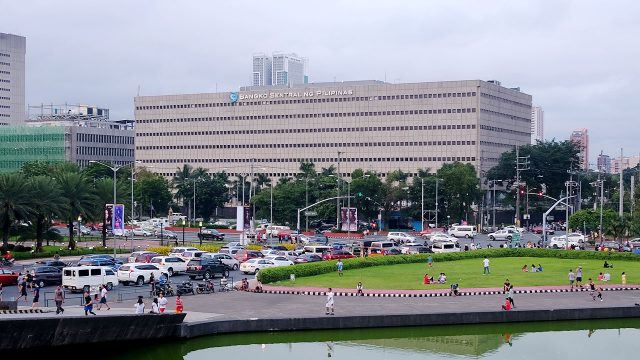
THE CENTRAL BANK is supporting a proposed measure that will improve the membership rules in the cooperatives industry and streamline conflicting regulations from the Bangko Sentral ng Pilipinas (BSP) and the Cooperative Development Authority (CDA).

House Bill 9541 streamlines the registration, regulation, and operation of cooperative banks. It is currently pending on second reading.

“Our primary objective in closely coordinating with the CDA and the cooperative banking industry is to streamline the regulatory requirements on cooperative banks while ensuring that they continue to operate in a safe and sound manner,” the BSP said in an e-mail.

Based on the BSP’s Manual of Regulations for Banks, a cooperative bank is meant to provide financial services to cooperatives and their members. These are set up by registered organizations in accordance with the Philippine Cooperative Code of 2008.

The BSP acknowledged that cooperative banks may find complying with rules set by the BSP and CDA “burdensome” as they are under the watch of two regulators.

“We proposed to include in the bill that cooperative banks shall be under the supervision of the BSP, but that the CDA shall still monitor the cooperative banks’ compliance with cooperative laws, rules, and regulations,” the BSP said.

“With respect to regulations on the governance of the cooperative banks, the provisions of the banking laws, rules, and regulations shall prevail,” it added.

The bill will likewise open up the membership of cooperative banks, which is currently limited to cooperative organizations and associations.

“Inasmuch as we understand the operational challenges faced by cooperative banks, we supported the move to include in the definition of regular members those individuals who are members of a cooperative, as well as foreign cooperatives,” the central bank said.

The draft bill includes the consolidated views and proposals of a working group that includes the BSP, CDA, and the Cooperative Bank Federation of the Philippines.

“Through our tripartite working group, we expect to work together to ensure that regulatory issuances will be mutually recognized by both the BSP and the CDA,” the central bank said.

The total assets of the country’s cooperative banking industry stood at P23.872 billion as of end-June, rising by 6.2% from P22.48 billion a year earlier. — Luz Wendy T. Noble

12 billion vaccine doses by the end of 2021 

About 12 billion vaccine doses will be produced by the end of 2021. And, if there are no major bottlenecks, total vaccine production will reach an estimated 24 billion by June 2022.  

By that time, the International Federation of Pharmaceutical Manufacturers & Associations (IFPMA) said that coronavirus disease 2019 (COVID-19) vaccine supplies will most likely outstrip global demand. 

COVID-19 vaccines dose production will reach 7.5 billion at the end of September at a rate of nearly 1.5 billion doses each month, a pace that is expected to pick up. This was made possible by a steady increase in production, supply chain, and voluntary technology transfer agreements with partners across the world. 

The British science information and analytics company Airfinity showed that even if vaccine advisory committees and governments in G7 countries (Canada, France, Germany, Italy, Japan, the United Kingdom, the United States, and the European Union) vaccinate teenagers and adults and decide to give boosters to at-risk populations, there would still be over 1.2 billion doses available for redistribution in 2021 alone. 

This May, the biopharmaceutical industry publicly committed to expend every effort to make additional uncommitted COVID-19 doses available to low- and lower-middle-income countries (LMICs).  

It also committed to support governments that have significant domestic supplies of COVID-19 vaccine doses to share a meaningful proportion of their doses with LMICs in a responsible and timely way through COVAX or other efficient established mechanisms. With the COVID-19 manufacturing scale-up, the appeal is to urgently shift attention to delivering vaccine equity and dose sharing. 

The latest Airfinity data also indicated that equitable redistribution of doses can be stepped up. With steady vaccine manufacturing output, projections showed it is possible to vaccinate the whole adult population by June 2022.  

However, this requires governments to strategically release doses so that vaccines leave the production lines and reach the people who need them most, especially healthcare workers and vulnerable groups. 

Coordinated action to remove delivery and administration bottlenecks is needed especially as mRNA vaccines might make up to 40% of the additional doses available. The Pfizer vaccine, for example, has to be shipped at temperatures between -80°C and -60°C while the Moderna vaccine must be shipped at -20°C, according to the vaccine alliance GAVI. 

Authorized COVID-19 vaccines demonstrate continued strong protection from infection and effectiveness against hospitalization and death even in the face of challenges posed by the highly transmissible Delta variant.  

Meanwhile, people who contract COVID-19 are managed with a handful of authorized treatments, which are becoming standard of care for those who have been hospitalized. Monoclonal antibody treatments are beginning to offer promise for outpatient treatment, as are novel antivirals. 

Authorized for emergency use in a number of countries are the antiviral remdesivir (Gilead Sciences), corticosteroid dexamethasone, anti-inflammatory baricitinib (Eli Lilly), monoclonal interleukin-6 blocker tocilizumab (Roche/Genentech), monoclonal casirivimab and imdevimab (Roche Regeneron), and monoclonal sotrovimab (GlaxoSmithKline). 

Under development are antiviral treatments from MSD (molnupiravir), Roche, Pfizer; and a monoclonal treatment from AstraZeneca. 

The biopharmaceutical industry is working on scaling up manufacturing capacity for both vaccines and therapeutics, but their effective rollout to all patients depends on strong collaboration with the government in the areas of allocation strategies for patients who will benefit most, testing, accurate demand and forecasting, and country readiness. 

At present, research-based companies that have local presence are working to make the Philippines a priority country to receive supplies of these highly needed therapies.  

The Pharmaceutical and Healthcare Association of the Philippines (PHAP) engages in weekly planning and inventory management with regional and global counterparts to monitor supplies, and if any become available, works on immediately redirecting these to the country. 


Teodoro B. Padilla is the executive director of Pharmaceutical and Healthcare Association of the Philippines (PHAP), which represents the biopharmaceutical medicines and vaccines industry in the country. Its members are at the forefront of research and development efforts for COVID-19 and other diseases that affect Filipinos.  

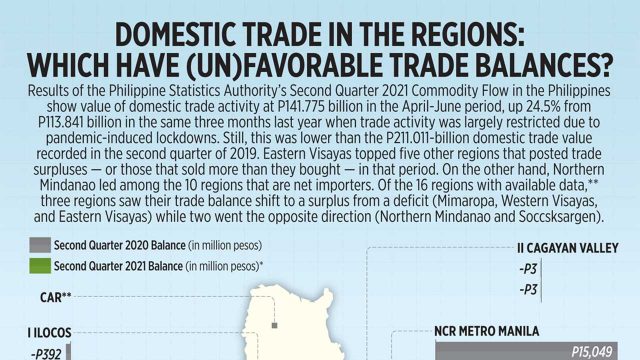
Domestic trade in the regions: Which have (un)favorable trade balances?

DOMESTIC TRADE ACTIVITY slightly bounced back in the second quarter from the previous year, albeit still lower compared with value of locally traded goods in 2019, data by the Philippine Statistics Authority (PSA) showed. Read the full story.

Domestic trade in the regions: Which have (un)favorable trade balances?

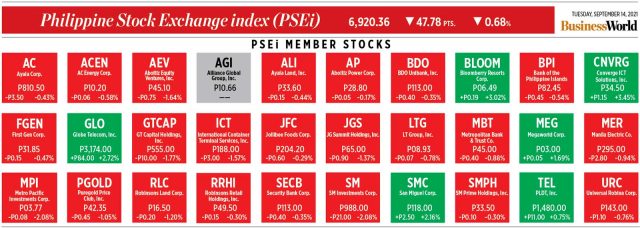
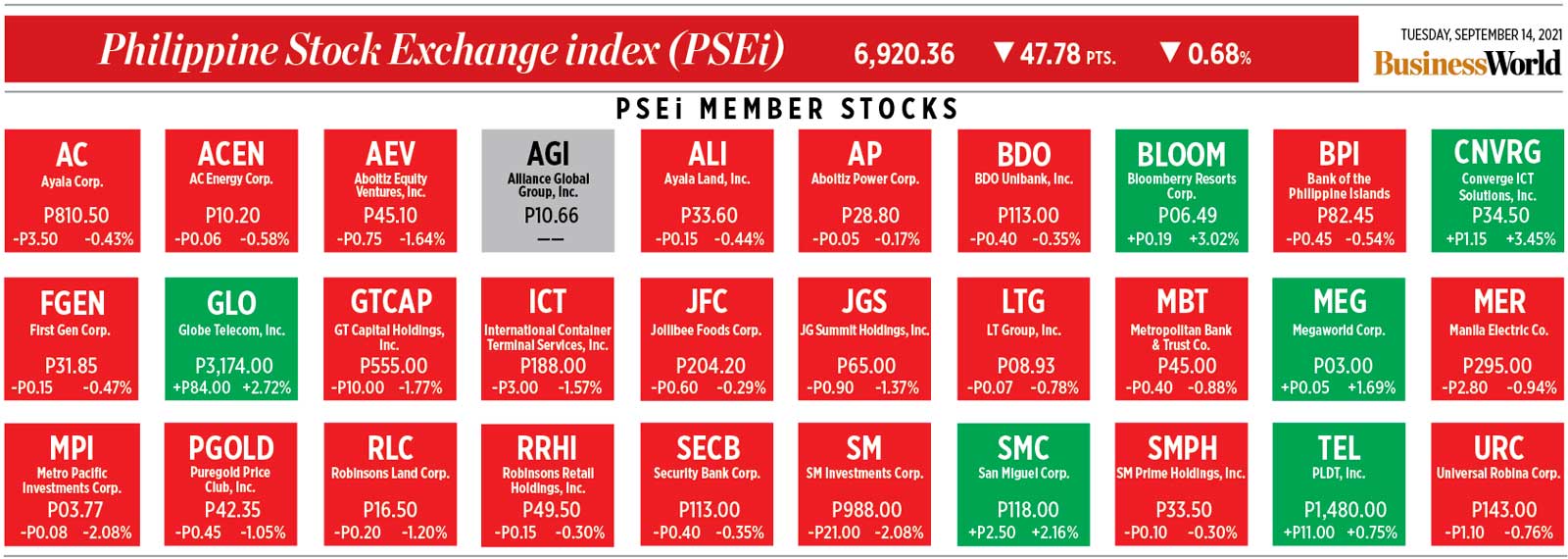
How PSEi member stocks performed — September 14, 2021

Here’s a quick glance at how PSEi stocks fared on Tuesday, September 14, 2021.


Building permit approvals more than double in second quarter

PHILSTAR FILE PHOTO

CONSTRUCTION starts as measured by building permit approvals rose 114.1% year on year to 38,389 in the second quarter, the Philippine Statistics Authority (PSA) said Tuesday.

This was the highest growth rate posted since at least 2006, according to initial data on the PSA’s OpenStat database.

The approved building permits cover 7.14 million square meters (sq.m.) of floor area valued at P84.36 billion. Floor area and value totals were up 148.2% and 194.3%, respectively, from a year earlier.

Permits for residential projects increased by 102.8% to 27,375. These projects were valued at P43.79 billion with a floor area of 4.21 million sq.m.

Single-detached homes accounted for 22,563 permits, followed by apartments at 4,457, duplexes and quadruplexes 287, condominiums 36, and other residential projects 32.

Non-residential project approvals rose 119.2% to 5,550, worth P32.83 billion and involving a floor area of 2.86 million sq.m.

The non-residential projects included 3,841 commercial buildings, 949 institutional buildings, 395 industrial buildings, 206 agricultural buildings, and 159 “other non-residential” buildings.

Permits for additions to existing structures numbered 1,174 in the second quarter, while those for alterations and repairs of existing structures numbered 4,290.

Region IV-A (Calabarzon) accounted for the largest number of approved building permits in the second quarter with 9,773, followed by Central Visayas with 5,608 and Ilocos Region with 4,659. Together, these three regions accounted for around 52.2% of total approved construction permits during the period.

By value, Calabarzon construction projects amounted to P20.09, followed by the National Capital Region (NCR) with P16.56 billion and Ilocos Region with P9.97 billion. These three accounted for 55.2% of construction value in the second quarter.

“The latest PSA data on building permits showing a stark pickup in growth was driven in large part by base effects as economic activity picked up relative to the extreme lockdowns experienced in 2020. This reflects pent-up (demand for) permits as construction activity was finally allowed to resume in some parts and on a staggered and limited basis,” ING Bank N.V. Manila Senior Economist Nicholas Antonio T. Mapa said in a statement.

Mr. Mapa also flagged the increase in permits granted in Calabarzon, which mirrored the developments noted in the Bangko Sentral ng Pilipinas’ (BSP) residential real estate price index (RREPI) report.

“The RREPI remains in contraction according to the central bank as the overall market was weighed down by the steep drop in condominium prices and prices in NCR in general. RREPI also shows that housing prices outside NCR and for single detached units have picked up, with is reflected in the permits data. This trend suggests that the Philippines is also experiencing the global phenomenon of migration from the urban centers to the areas outside the city with Filipinos in search of more space,” he said.

“Despite this development, signs of a real estate bubble have yet to manifest in a palpable manner. BSP’s RREPI remains negative and previously frothy condominium prices appear to have been deflated by the pandemic. Meanwhile, rental inflation has continued to slow and settled at 1.1% in August.”

Residential property prices declined in the first quarter, mainly dragged down by the lower cost of condominium units and duplexes due to weak demand. The RREPI was down 4.2% year on year in the three months to March, the steepest decline recorded since the index was launched in 2016.

In an e-mail, Asian Institute of Management Economist John Paolo R. Rivera said most companies have invested in the provinces where restrictions are fewer than in the NCR. “The dispersion of construction from NCR contributed to this,” he said.

Mr. Rivera is hopeful that the succeeding quarters for construction permits will continue to show improvement.

“This improvement may be driven by confidence in the economic environment both in the NCR and provincial areas. Of course, once herd immunity is achieved, the accelerator effect can fully manifest,” he said.

Meanwhile, Mr. Mapa, in a separate e-mail to BusinessWorld, said the prospects for recovery in building permits will be determined by how effective the government’s new measures and guidelines are in containing the virus.

“Should cases spike again, we could very well be returning to ECQ (enhanced community quarantine) levels, which would have a negative impact on construction activity and building permits as well,” he said, referring to the government’s strictest form of lockdown.

The Inter-Agency Task Force on Emerging Infectious Diseases on Monday released new guidelines for the pilot implementation of localized lockdowns and a new alert level system in Metro Manila beginning Thursday, the day after the modified ECQ in the Philippine capital ends.

Under the new guidelines, lockdowns will be localized at city level depending on the case transmission rates and healthcare utilization rates. The new alert system will consist of five levels, with level 5 equivalent to ECQ. — Bernadette Therese M. Gadon 

Some PPA board members not supportive of petitions to increase port charges

PHILSTAR

THE PHILIPPINE Ports Authority (PPA) said two petitions to increase port charges are currently awaiting a final decision, with some of its board members arguing that now is not the time to increase rates.

“As far as I know, one that’s pending is the tariff increase for North Harbor filed by Manila North Harbor Port, Inc. and another one is for the Port of Batangas, which was applied for by Asian Terminals, Inc. Both petitions for rate increases are still (being evaluated),” PPA General Manager Jay Daniel R. Santiago said at a virtual briefing Monday.

Asked if the decision is being delayed due to the pandemic crisis, Mr. Santiago said: “I will be transparent with you that there are some members of the board who are of the opinion that maybe now is not the time to consider the tariff increase.”

“But of course, there are contractual issues or considerations that have to be considered, kasi may concession tayong pinag-uusapan dyan (because concession agreements are involved). That is what we are weighing,” he added.

Mr. Santiago is vice-chairman of the PPA board, which is chaired by Transportation Secretary Arthur P. Tugade.

Board members include National Economic Development Authority Secretary Karl Kendrick T. Chua, Public Works and Highways Secretary Mark A. Villar, Finance Secretary Carlos G. Dominguez III, Environment and Natural Resources Secretary Roy A. Cimatu, and Trade Industry Secretary Ramon M. Lopez.

“The increase that was applied for ini-evaluate ’yan ng board at ng technical working group ng board (is being evaluated by the board and the technical working group) whether reasonable… and of course we try to input some considerations to temper it, so that it will not drastically hit our logistics sector even if you assume that we will approve the increase… later on,” Mr. Santiago said.

He added that the petition of Manila North Harbor was presented to the board in August, but was sent back to the board’s technical working group for further evaluation.

The Philippine Exporters Confederation, Inc. (Philexport) and the Export Development Council (EDC) said in July that the PPA needs to defer approval of a petition for an increase in cargo handling tariffs and passenger terminal fees at the Manila North Harbor.

The PPA should “suspend the mandatory weighing of export containers for the sake of small exporters and enterprises,” Philexport and EDC said in a statement.

Philexport said that “approving the rate hike now and allowing the mandatory weighing of export containers to continue will further add to the difficulties faced by micro, small, and medium enterprises and exporters.” — Arjay L. Balinbin

Bill seeks to make SIM card registration mandatory

STOCK PHOTO | Image by terimakasih0 from Pixabay

A SENATE BILL is seeking to make phone users register their identification details when applying for SIM cards, according to Senator Mary Grace Natividad S. Poe-Llamanzares.

On Monday, she sponsored a measure, Senate Bill (SB) No. 2395 or the proposed SIM Card Registration Act, which is intended to deter fraud.

If passed, the legislation will require all telecommunications companies make the registration of SIM cards a prerequisite to their sale.

Such a bill has the potential to expand consumer access to e-government services and develop mobile e-commerce, according to Senator Sherwin T. Gatchalian, who filed a similar bill in the 16th Congress.

He added that it will also provide new channels to access retail financial services such as remittances, payments, savings, credit, and insurance, among others.

The bill would require applicants to submit an electronic registration form and present a valid government-issued identification card (ID) or other documentation as a condition of sale.

“The privacy of consumers shall continue to be given the highest regard,” Ms. Poe said in the chamber Tuesday, adding that information may only be accessed by authorities acting on a court order.

Unregistered SIM cards have been a feature of crimes such as terrorism, bank hacks, the distribution of unsolicited obscene messages; and disinformation which could sow public disorder, she added.

Mr. Gatchalian said that the bill will seek to deter text scams, bomb threats, the transmission of ransom demands, and the use of phones to detonate bombs.

A total of 155 countries have adopted laws that require the registration of SIM cards — including countries with strong data privacy regimes such as Japan, South Korea, Australia, and much of the European Union, Ms. Poe said.

“This bill is not the be-all and end-all in our fight against any form of digital crime. It is only one of the measures that we need to put in place as Filipinos increasingly turn to digital banking and payment channels,” she said, noting that another bill regulating bank accounts, e-wallets and other financial accounts or SB 2380 was filed Monday.

“The bill that I filed seeks to penalize money mules — or those who electronically receive, acquire, or transfer money or proceeds derived from a cybercrime,” she added. — Alyssa Nicole O. Tan

NEDA’s Chua names infrastructure, innovation, climate change as priorities

KARL KENDRICK T. CHUA — PHILSTAR FILE PHOTO

SOCIOECONOMIC PLANNING Secretary Karl Kendrick T. Chua said he will focus on infrastructure, innovation and climate change before he steps down as head of the National Economic and Development Authority (NEDA).

Speaking at a forum arranged by the Philippine Institute for Development Studies, Mr. Chua said NEDA is also preparing for the country’s post-pandemic needs and putting the economy on a more solid footing for the next administration next year.

He called his priorities critical to sustaining the push towards upper-middle income status, which the Philippines hopes to attain by next year.

“As Secretary, my priority for the remainder of my term is to give the next administration a better foundation (with) more responsive infrastructure, innovation, which is the basis for sustaining our upper-middle income country status, regional equity in allocation of budget for infrastructure and social services, and most importantly, the threat of climate change,” he said in his speech.

Mr. Chua was named head of NEDA in April 2020, replacing Ernesto M. Pernia, who resigned.

His priorities at the start of his term were to fast-track registration for the national ID and prepare the economic recovery plan.

As the economy gears up for recovery, he said structural reforms in agriculture are needed, noting the distorting effect of current policy on the industry which have hampered its growth, creating a knock-on effect on manufacturing as well.

“A strong, productive agriculture sector provides the foundation for a competitive manufacturing sector, and eventually a high-skilled services sector,” he said.

He cited the Rice Tariffication Law as one of the much-needed reforms rolled out recently. Mr. Chua noted how the law loosened restrictions on imports of the staple grain, augmented supply and generated revenue from rice tariffs to modernize the industry.

“Moving forward, more are needed to improve the competitiveness of agriculture as well as other sectors through more cluster and value chain analysis,” he added.

At the same forum, Campden Hill Group, Inc. Chairman Antonio Jose U. Periquet said there is also a need to promote stronger competition across industries to bring down input costs and commodity prices, and eventually attract investment.

“There is a lack of competition in many sectors in our economy, which allows local firms to be price-setters, instead of price takers. Whereas in a situation of perfect competition, the consumer is king; here it is the producer who is king. This phenomenon explains why the only thing we seem to be able to export on a meaningful scale after decades of development, are people and coconuts. We simply cannot make things cheaply in this country,” he said.

To address this, Mr. Periquet said corporate behavior has to change to make both publicly-listed companies and private firms more responsible to society and shareholders, while stronger governments and institutions are needed to improve regulation and pave way to improve the business environment.

The structural reforms needed, he said, include an opening up to more foreign investment. — Beatrice M. Laforga

ADVERTISEMENT
ADVERTISEMENT