Home Blog Page 7515

NEA to electric co-ops: Adopt RE development plan

PHILSTAR FILE PHOTO

THE National Electrification Administration (NEA) ordered electric cooperatives (ECs) to follow the guidelines stated in its Renewable Energy Development Plan (REDP) to help the Energy department reach its goal of securing a 35% share of renewables in the power mix by 2030.

In a memorandum issued by NEA OIC-Administrator Sonia B. San Diego on Sept. 1, the agency told ECs to follow the REDP so they can “properly” schedule the sourcing of renewable energy (RE) to prevent the over-contracting of power supply while complying with regulations.

The general instructions of the plan read: “To avoid over contracting of PSA (power supply agreements), RECs (renewable energy certificates) shall only be purchased from RE Market and/or sourced from eligible RE plants including EC-Owned embedded Generation Facilities; (the) Green Energy Option Program (GEOP); and RE Facilities for own use.” 

The plan provides a template that guides ECs in sourcing and scheduling renewables for their power requirements.

NEA will be holding a virtual Zoom workshop on Sept. 10 at 10:00 a.m. on using the REDP’s template.

BusinessWorld reached out to NEA through its public affairs office for details of the development plan, but the agency has not replied as of deadline time.

A circular issued by the Department of Energy in 2017 said the department aspires to attain a 35% share of RE in the country’s generation mix by 2030. This is the same goal it has laid out in the current version of the National Renewable Energy Program (NREP), which covers the years 2011 to 2030.

In February, Senator Sherwin T. Gatchalian said that the latest draft of the NREP proposes higher RE targets of 37.3% by 2030 and 55.8% by 2040. — Angelica Y. Yang

Arts & Culture (09/08/21)

PETA offers new cycle online workshops

THE PHILIPPINE Educational Theater Association (PETA), will hold a new cycle of online theater workshops from September to October. Aimed at providing an avenue for learning and creative expression for starters and professionals, PETA’s exclusive online workshops are tailored to meet the demands of adults who are looking for personal artistic development in between their busy work-from-home schedules. Teachers for the upcoming workshop cycles include Meann Espinosa and Kiks Baento for Acting for Beginners (Batch 1 on Sept. 17, 19, 24, 26, Oct 1; Batch 2 on Oct. 8, 10, 15, 17, 22); Jeff Hernandez and Zoe Damag for Creative Musical Theater (Batch 1 on Sept. 17, 19, 24, 26, Oct 1; Batch 2 on Oct. 8, 10, 15, 17, 22); Phil Noble and Ian Segarra for Acting for Screen (Batch 1 on Sept. 17, 19, 24, 26, Oct 1; Batch 2 on Oct. 8, 10, 15, 17, 22); and J-Mee Katanyag for Writing for Performance (Oct. 8, 10, 15, 17, 22). For more information, visit bit.ly/PETAWorkshopOnline or contact Betita Sarmiento via cellphone at 0929-891-9538, or e-mail at betitasarmiento@petatheater.com.

Rep’s The Great Christmas Cookie Bake-off!

REPERTORY Philippines (Rep) will be bringing holiday cheer to every home with the musical The Great Christmas Cookie Bake-off! which marks many firsts. It is the first Rep Theater for Young Audiences (RTYA) offering in over a year. It is also the first-ever Filipino production to be available on streaming platform Broadway On Demand. The musical is also the first in the country that is purposely filmed for an international online streaming service. To be shown from Nov. 12 to Dec. 12, The Great Christmas Cookie Bake-off! combines the time-honored tradition of Christmas cookies with the ever-popular phenomenon of reality baking competitions. It features eight young cookie chefs from all over the country who will battle it out for first prize at the Cookie Coliseum. As the chefs are eliminated one by one by three celebrity judges, feelings of intense rivalry give way to virtues of charity, family, and forgiveness. The show is directed by RTYA Creative Director Joy Virata. The musical’s cast consists of Becca Coates, Tim Pavino, Jep Go, Jillian Itaas, Luigi Quesada, Rachel Coates, Justine Narciso, Steven Hotchkiss, Carla Guevara Laforteza, Jamie Wilson, Arnel Carrion, and Hans Eckstein. Treb Monteras helms the video production. Ticket prices are P700 (Regular) and P1,000 (Family/Household). Each ticket gives 24-hour access to the musical, which can be accessed via computer or mobile device through a web browser or via tablet or smartphone through the Broadway On Demand app on the App Store and Google Play. Broadway On Demand is also available on AppleTV and Roku.  For updates, visit www.repertoryphilippines.ph, like and follow Repertory Philippines on Facebook and Instagram. Educators and school representatives who are interested in the show can e-mail sales@repphil.org.

Fundacion Sansó raises funds for Museo Pambata

FUNDACION Sansó, in partnership with Museo Pambata, launched a fundraising event in aid of Manila’s temporarily closed museum — sold two limited-edition giclees by Sansó entitled Golden Bloom and Wandering Dream. Because of the limitations imposed by the ongoing coronavirus disease 2019 (COVID-19) pandemic, Museo Pambata, a top destination for field trips and school tours, became unable to accommodate visitors, resulting in its losing a large portion of its earnings. The fundraiser, Flowers for the Children, started in Nov. 2020. In June this year, Fundacion Sansó officially turned the proceeds over to Museo Pambata via streaming live on their Facebook page.

The Well-Appointed Life auction

SALCEDO Auctions’ annual The Well-Appointed Life auction highlights “Important Philippine Art” and a “Connoisseur Collection.” With the theme “The Worlds We Create,” the sale will take place simultaneously live and online on Sept. 18, 2 p.m., at the NEX Tower sale room. Up for bid are works by some of the country’s old masters and master artisans and rising contemporary artists and international designers. One highlight of the auction is a recently discovered 1900 seascape in oil by Félix Resurrección Hidalgo titled Marina. There is also a 1975 oil painting by National Artist H.R. Ocampo titled Excursion to Pinaglabanan — a tribute to Andres Bonifacio, Emilio Jacinto, and the Katipunan militia’s successful capture of a Spanish military base. Also in the auction is a 1966 oil on wood piece by National Artist Jose Joya titled Blue Harbor. The online catalogue as well as the bid registration and venue of the online auction can be accessed on salcedoauctions.com. For inquiries, e-mail info@salcedoauctions.com, call 8823-0956 or text 0917-107-5581.

Silverlens Art Basel show presents Pacita Abad

SILVERLENS will participate in Art Basel with a show called “Endless Blues” featuring works by the late Filipino-American artist Pacita Abad. There will be a VIP showing on Sept. 21 to 23, followed by a public viewing on Sept. 24 to 26. The presentation will focus on her Endless Blues series from the early 2000s. Produced towards the end of the artist’ s life, these works bring together Abad’s fascination with batik fabric, her love for blues music, and embed the color, energy, and vibrancy of a life on the road in diverse forms of abstraction. Three contemporary artists will be featured alongside the late artist through the Art Basel OVR, all of whom are connected to Abad: Pio Abad, Patricia Perez Eustaquio, and Nicole Coson. London-based Pio Abad, who is Pacita Abad’s nephew, will hold a walk-through of the exhibit Endless Blues on Sept. 23, at 11 a.m. in Basel, and 5 p.m. in Manila and Hong Kong. He will talk about his aunt’s life and share insights on her abstract pieces featured in the Art Basel exhibition. For details, visit www.silverlensgalleries.com, or call 8816-0044, or e-mail info@silverlensgalleries.com.

Alicdan exhibit at Shangri-La mall gallery

AN EXHIBIT of works by Wilfredo Alicdan called “Geometric Mode” is ongoing until Sept. 15 at The Artologist Gallery in Shangri-La Plaza.

Art workshop relieves pandemic stress

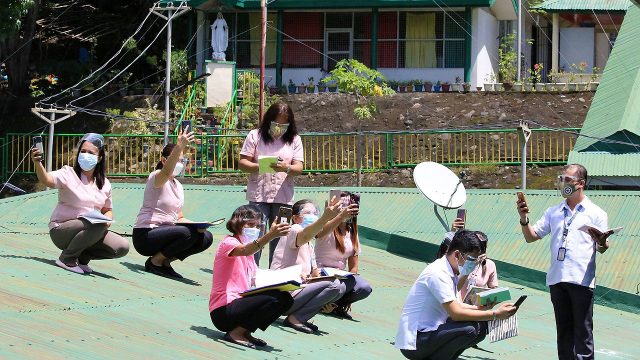
HEALTHCARE workers utilized the arts to break away from stress related to the pandemic, as the Tagum City Historical and Cultural Center organized its first Art in the Park, aimed at championing the arts to help deal with mental health concerns in these trying times. An ancillary event of the Center’s National Heroes Day celebration, Art in the Park gathered five nurses who had previously enlisted in the Center’s Art as a Tool for Therapy lecture by its resident artist Victor Augustus Dumaguing. Held at the Tagumpay Nature’s Park on Aug. 27, the one-day event featured a brief lecture and demo by Mr. Dumaguing on the many ways how to create art, specifically self-portraits. Healthcare workers were asked to paint their projection of themselves on the canvas, resulting in a colorful mixture of hues in one grand painting. Prior to the event, all of the participants had little or no background in painting, and their collective output surprised them. Their output will be one of the artworks included in the Center’s participation in the Mindanao Art Fair in October, the annual gathering of the best artists on the island.

PHL-Korea festival goes online

THE PHILIPPINES-KOREA Cultural Exchange Festival for 2021 will be an online event. A highlight of the festival is the We Stand Together Online Concert, which will be held on Sept. 25, 3 p.m. Organized by the Korean embassy and the Korean Cultural Center in the Philippines together with the United Korean Community Association (UKCA) and the National Commission for Culture and the Arts (NCCA), the concert will feature performances by Filipino and Korean artists and can be streamed for free via the Korean Cultural Center (KCC) in the Philippines Facebook and YouTube pages. The concert will also be streamed on the UKCA and NCCA Facebook pages. The festival’s Online Talent Competition is divided into Voice and Dance categories. Filipino participants (solo or group) may enter the voice competition by performing a Korean song, while Korean participants (solo and group) may join the voice category by singing a Filipino song. For the dance category, Filipino and Korean participants (solo or group) may perform any Korean pop, traditional, or cultural song. Submission of entries is until Sept. 11, after which a voting period shall commence from Sept. 13 to 17. The Grand Winner in the Online Talent Competition will take home P50,000, while the Vocal Category and Dance Category winners will get P30,000 each. Winners will be announced at the Online Concert. There will also be a special screening featuring Modern and Contemporary Art all Sundays of September via KCC social media.  Follow the KCC on Facebook (https://www.facebook.com/KoreanCulturalCenterPH/) and @kccphil on Instagram and Twitter for more updates about the Embassy and KCC’s events and activities.


Defense vs Delta, other variants  

Alexey Solodovnikov, Valeria Arkhipova/CC BY-SA 4.0/Wikimedia Commons

The Department of Health on Monday reported that five Delta cases were detected in the Bangsamoro Autonomous Region in Muslim Mindanao (BARMM) — meaning that the Delta variant is now all over the Philippines. 

On Aug. 31, a day before the Philippines’ coronavirus disease 2019 (COVID-19) cases total topped two million, the World Health Organization (WHO) confirmed that the highly transmissible Delta variant was the dominant SARS-CoV-2 variant in the country. SARS-CoV-2 is the virus that causes COVID-19.  

“The Delta variant is rapidly overtaking the Alpha variant as the dominant variant of concern globally,” said Dr. Cynthia P. Saloma, executive director of the Philippine Genome Center and professor at the National Institute of Molecular Biology and Biotechnology of the University of the Philippines-Diliman, in a health forum on Sept. 2.  

The earliest Delta variant sample was reported on Sept. 22, 2020, in India. As of this August, 146 countries have reported Delta variant cases, according to Dr. Saloma. 

Aside from Alpha (first reported in the UK) and Delta, the other variants of concern are Beta (first reported in South Africa) and Gamma (first reported in Japan and Brazil).  

She noted that since this April, there has been a rapid increase in the number of sequenced Delta variant cases worldwide. In all regions of the world except South America, the level of spread of the Delta variant is well over 90% — 98% in Africa, 92% in Asia and Europe, 99.9% in Oceania, and 98% in North America.  

The first Delta variant sample in the country was reported on April 24, with the first local Delta variant case reported the next month in Antique province.  

According to the US Centers for Disease Control and Prevention (CDC), the Delta variant causes more infections and spreads faster than earlier forms of SARS-CoV-2, and might cause more severe illness than previous strains in unvaccinated people. Experts believe that the Delta variant’s numerous spike protein mutations are responsible for its increased transmissibility and tendency to cause severe disease.  

“The Alpha variant is more transmissible than the original reference strain from Wuhan, China, but the Delta variant is 60% more transmissible than the Alpha variant. The Delta variant is associated with a different set of symptoms, and people infected with it are more likely to be hospitalized. Data from different countries, particularly the UK and Israel, indicate that one vaccine dose is less effective but two doses still provide strong protection,” Dr. Saloma said.  

She added that the proportion of variants of concern in the set of samples sequenced by the Philippine Genome Center since April has reached over 90%.  

June to July saw a steep 42% increase in the proportion of sequenced Delta variant cases in the country. The increase is even more pronounced in the National Capital Region: In June, sequenced Delta variants represented 10% of cases in NCR. By July, this had increased to 78% — a seven-fold increase.  

“We saw a much higher number of cases in August,” said Dr. Saloma, who also briefly discussed the Lambda variant, a variant of interest first detected in Peru in Dec. 2020.  

As of August, 33 countries reported Lambda variant cases, with the number of cases worldwide progressively declining. “Vaccines prevent severe disease and hospitalization among those infected with the Lambda variant,” said Dr. Saloma.  

She added that only one Lambda variant case has been detected in the country in July involving a 35-year-old female with no travel history. “Local transmission of the Lambda variant is not likely; this variant is not a concern at the moment.”  

Dr. Saloma warned that viral mutations and the emergence of new variants will likely continue. “Vaccination and the practice of minimum public health standards are our best defense against SARS-CoV-2 variants,” she said.  


Teodoro B. Padilla is the executive director of Pharmaceutical and Healthcare Association of the Philippines (PHAP), which represents the biopharmaceutical medicines and vaccines industry in the country. Its members are at the forefront of research and development efforts for COVID-19 and other diseases that affect Filipinos.  

Sun Life launches new fund

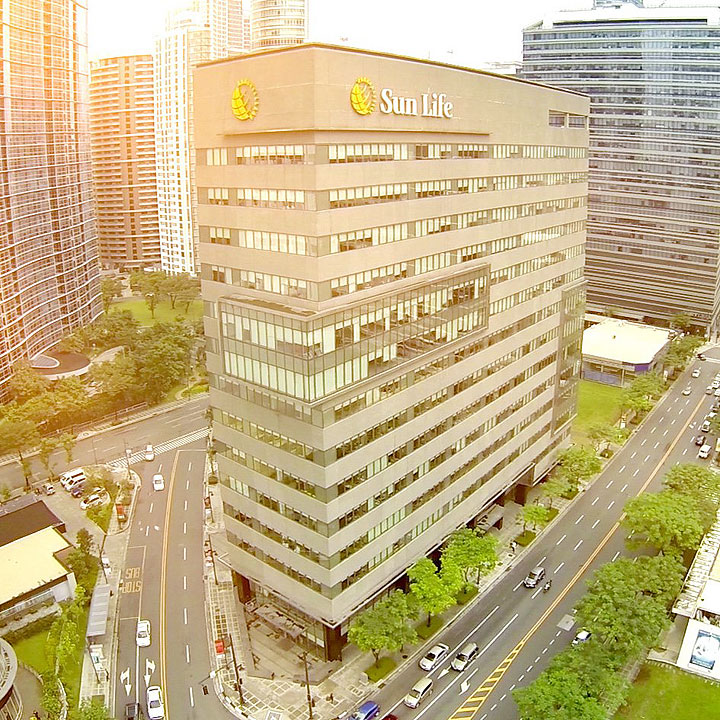
SUN LIFE of Canada (Philippines), Inc. launched a new offshore fund for its investment-linked life insurance products.

SUN LIFE of Canada (Philippines), Inc. launched a new offshore fund for its investment-linked life insurance products, tapping global financial markets for portfolio diversification and to generate long-term gains.

Sun Life Philippines said in a press release late Monday that the Global Opportunity Payout Fund will operate as a fund-of-funds and will invest mainly in a mix of foreign currency-denominated, income-generating, and capital-appreciating financial assets.

The fund can be availed for the following Sun Life investment-linked insurance products: Sun MaxiLink Dollar One, Sun FlexiDollar1, and Sun FlexiDollar, the insurer said.

“This new fund is suitable for clients with medium to long-term wealth accumulation goals such as preparing for retirement. They can stay financially secured with insurance and enjoy potential capital appreciation of their funds over time,” Sun Life Chief Marketing and Client Experience Officer Gilbert Simpao was quoted as saying in the statement. “The fund aims to provide regular cash payouts to our clients which will be given as long as the assets in the fund are able to support it.”

The cash payouts come from the gains generated via the income-paying assets of the fund.

Target assets of the fund include mutual funds and exchange-traded funds, as well as the bonds and other securities issued by the Philippines, the United States and other foreign governments and companies. It also targets investments in equity-linked securities.

“The Global Opportunity Payout Fund is a perfect complement to our existing roster of fund options for our investment-linked insurance products since it aims to provide an annual stream of cash flows and offers global diversification for clients,” Sun Life Philippines Investments Head Ivan Corcuera said.

Cebu Pacific says it passed IATA’s operational safety audit

CEBU PACIFIC

BUDGET carrier Cebu Pacific, operated by Cebu Air, Inc., announced on Tuesday that it recently passed the International Air Transport Association’s (IATA) operational safety audit.

“Cebu Pacific once again secure[d] the IATA’s Operational Safety Audit (IOSA) registration as it fully complies with its stringent global aviation safety standard,” the budget carrier said in an e-mailed statement.

The airline first joined the association in 2019.

“The IOSA audits the operator’s operational management and control systems covering organization management and control system, flight operations, dispatch, cabin, ground handling, cargo, maintenance and security,” Cebu Pacific said.

Cebu Air’s attributable net loss for the first half of the year was P13.8 billion, compared with a net loss of P9.1 billion in the same period in 2020.

Its first-half revenues dropped 65.9% to P5.9 billion from P17.3 billion previously.

Passenger revenue dropped 82.6% to P2 billion, while revenue from cargo grew 27.3% to P2.8 billion. Ancillary revenue for the period declined 69.4% to P1.1 billion. — Arjay L. Balinbin

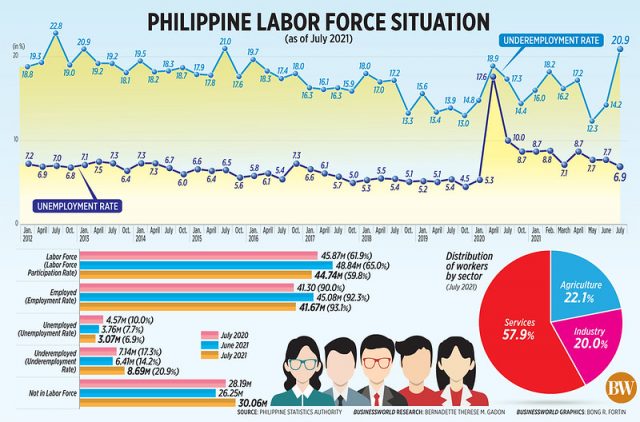
Philippine Labor Force Situation (July 2021)

THE NUMBER of jobless Filipinos declined to 3.073 million in July, but job quality remains a concern as more employed Filipinos are still seeking additional work, the Philippine Statistics Authority (PSA) reported on Tuesday. Read the full story.

Philippine Labor Force Situation (July 2021)

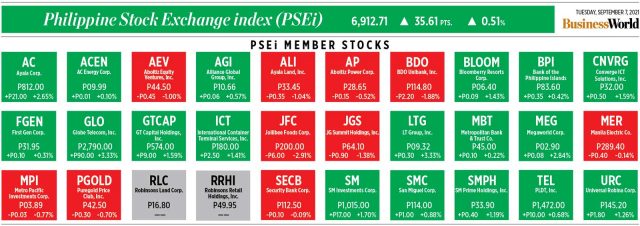
How PSEi member stocks performed — September 7, 2021

Here’s a quick glance at how PSEi stocks fared on Tuesday, September 7, 2021.


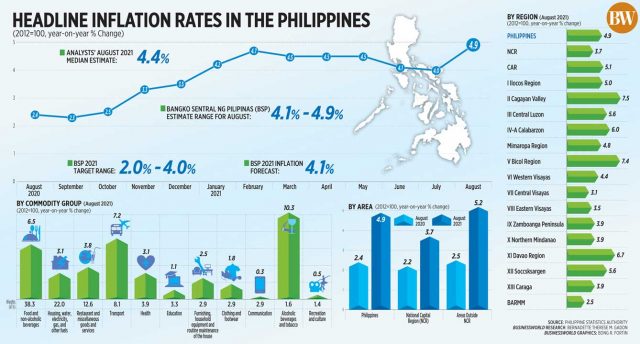
Headline inflation rates in the Philippines (August 2021)

THE OVERALL year-on-year increase in prices of widely used goods accelerated to its fastest pace in 32 months in August, driven by higher food and utility prices amid the stricter lockdown, the statistics agency said on Tuesday. Read the full story.

Headline inflation rates in the Philippines (August 2021)

Comelec public works ban for polls to start March 25

PHILIPPINE STAR/MICHAEL VARCAS

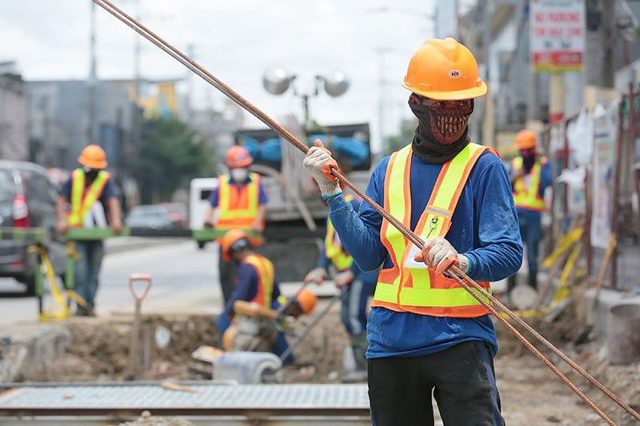
THE COMMISSION on Elections (Comelec) said the public works ban for the May national elections will run from March 25 to May 8, 2022.

The commission’s spokesman James B. Jimenez said the public works ban covers disbursement and spending as well as construction activity. Works are typically frozen around election season in order not to influence the outcome of the polls. The intent is to deny politicians access to resources that may be used to improperly aid their campaigns.

“For the 2022 elections, the period of prohibition is from March 25, 2022 to May 8, 2022 as per the Calendar of Activities,” Mr. Jimenez said in a Viber message Tuesday.

National elections take place in May, coinciding with the peak dry-season period where construction works can be carried out with minimal disruption. Building during the rainy season tends to be more irregular because concrete cannot be poured in wet conditions.

Mr. Jimenez said the Comelec has not yet released a formal resolution on the matter, “but it is expected that the same will be released in due time.”

The spending ban for the 2019 midterm elections was between March 29 and May 12, 2019. 

During the ban, spending activity is largely limited to emergency and maintenance works and salaries, with a few exceptions. The Comelec may be appealed to for other exceptions not listed. — Bianca Angelica D. Añago

Gaming regulator says ‘uncollected’ revenue disputed by POGOs

PHILSTAR FILE PHOTO

THE PHILIPPINE Amusement and Gaming Corp. (PAGCOR) said uncollected revenue flagged by government auditors worth P1.365 billion remains the subject of protest from Philippine Offshore Gaming Operators (POGOs).

In a statement Monday, PAGCOR said the uncollected revenue flagged by the Commission on Audit (CoA) is currently being disputed by the POGOs, who claim that other organizations had illicitly hijacked their gambling live feeds, leading the regulator to overestimate the fees they owe.

They said various websites are emulating the feeds of legal operators, a claim which is being validated to verify the actual amounts owed.

“As an initial remedial measure, the agency imposed assumed or estimated billings for these websites based on the average income performance of the original declared websites of its licensees… These billings were protested by its licensees, on the basis that the websites are actually websites of illegal operators, stealing their live streams and making it appear as the legal websites of our operators,” PAGCOR said.

In its 2020 audit report, CoA took note of PAGCOR’s P1.365 billion in uncollected receivables from 15 POGOs.  

Overall, CoA said P1.382 billion in receivables remain outstanding, depriving PAGCOR of funds for its operations.

Of the 15 POGOs listed, eight have had their licenses canceled by PAGCOR as of 2020 while three remain operational as of Jan. 12, 2021. Two of these three have entered into agreements to restructure their receivables.

In its comment on the audit findings, PAGCOR said that its board has approved the restructuring of P97.33 million worth of receivables, along with an adjustment for uncollected revenues worth P6.08 million.

PAGCOR Chair Andrea D. Domingo said in a House budget briefing on Aug. 27 that more than half of POGO operators have ceased operations and have moved to Cambodia, Vietnam, and Laos. — Russell Louis C. Ku

Japan in talks for P82-M organic vegetable project

FILE PHOTO - PIXABAY

THE DEPARTMENT of Agriculture (DA) said it met with representatives from the Japan Agricultural Exchange Council (JAEC) to discuss the latter’s proposal to improve vegetable production in the Philippines and set up cold storage facilities.

At a meeting on Sept. 6, Agriculture Secretary William D. Dar met with JAEC Senior Local Coordinator Toshiharo Sato and others to discuss their proposed “Safe Vegetable Production with Marketing Technology Improvement” project. 

The project, which has a funding of P82 million, aims to help Filipino farmers improve their production via the safe vegetable from rich soil technology which develops the soil using organic matter such as wood vinegar.

“The JAEC’s proposal also included the construction of a cold storage solar-powered facility in Buguias, Benguet, as well as the purchase of refrigerated cooling trucks, to improve post-harvest handling, storage, and delivery,” the DA said.

According to the DA, the JAEC project will be financed by Japan’s Ministry of Foreign Affairs and is currently being reviewed by the National Economic and Development Authority.

The project will also require the input of the Departments of Finance and Foreign Affairs, before approval by the Office of the President.

Upon approval, a memorandum of agreement will be drawn up between the DA and JAEC.

Mr. Dar expects the proposal to be approved before the current government steps down. — Revin Mikhael D. Ochave

Public investment seen needed in areas with low digital penetration

PHILSTAR

THE PHILIPPINE Institute for Development Studies (PIDS) said the government needs to focus its investment on communities underserved by digital infrastructure to fill in for gaps in private-sector coverage.

“Government investment in digital infrastructure must target network segments and areas where the market fails to deliver, as shown in NICTHS findings. The government may also consider investing in areas where the private sector has difficulty competing and making a profit,” PIDS said in a policy brief on Tuesday.

It was referring to the National Information and Communications Technology Household Survey (NICTHS) conducted by the Department of Information and Communications Technology (DICT) in 2019.

Most Filipinos still rely on cellular mobile services for their internet connections due to poor, inaccessible and expensive internet service, especially outside Metro Manila, PIDS said.

It said cost and availability remain the biggest barriers to internet connectivity while a number of rural areas remain unserved by the private sector.

The NICTHS estimates that only 18% of households have internet connections. The National Capital Region (NCR) was the most connected while the Bangsamoro Autonomous Region in Muslim Mindanao and the Eastern Visayas are least connected.

Non-users of broadband cited high costs, the expense of devices, and unavailable service.

The survey found that a quarter of households own a communal phone, while 75% of individuals said they have at least one mobile phone. Only 24% of households own a computer and 66% a laptop. Half of those that do not own such devices do not use computers at all.

One in five barangays has no internet service, including several barangays in the NCR, while providers in the regions are highly concentrated in urban areas.

“Income levels in some barangays are likely not sufficient for households to subscribe regularly to broadband services” to a degree required to make internet services viable for providers, PIDS said.

Cellular signal, meanwhile, reaches 92% of barangays, most commonly 3G.

To address the digital divide, PIDS said the government should also support passive infrastructure by granting all service providers access to operator-neutral utilities corridors.

It said outdated laws are holding back the growth of internet service providers, including the Radio Control Law, which only allows telecommunications companies with legislative franchises to use the radio spectrum and set up wireless internet. The Public Service Act prohibits foreign companies from fully owning telecommunication companies in the Philippines.

“Therefore, the government should remove regulatory barriers and expand market opportunities to allow players to invest, build, and innovate, regardless of size, ownership and technology,” it said.

The two laws need to be amended to ease entry restrictions, while House Bill 8910 or the proposed Open Access in Data Transmission Act should be passed to allow more investors to set up broadband networks via shared infrastructure. — Beatrice M. Laforga