Home Blog Page 749

Filipina cybersecurity expert honored by ACES Council for exemplary leadership in digital safety

The Asia Corporate Excellence and Sustainability (ACES) Council has recognized Filipina cybersecurity expert Mel Migriño, country head and general manager of Gogolook Philippines, for her outstanding leadership in advancing digital safety, cybersecurity awareness, and trust technology across Asia.

Ms. Migriño was cited for fusing cybersecurity, regulatory alliances, and social trust into a unified mission for digital protection.

Under her leadership, Gogolook’s local arm — developer of the Whoscall anti-scam application — has expanded its reach and strengthened partnerships that help Filipinos identify and block scam communications.

“Her accomplishments in scaling Gogolook’s national footprint, championing anti-scam campaigns, and advancing cyber literacy position her among Asia’s most inspiring executives,” the ACES Council said in a statement. “Her leadership continues to influence policy, public awareness, and corporate innovation with measurable societal benefit.”

In response to the recognition, Ms. Migriño thanked the ACES Council and said the award is a reminder of how much talent and passion Asia holds in shaping a safer digital world.

“I’m truly grateful to the ACES Council for this honor. It’s more than just an award — it’s a celebration of the incredible talent we have across Asia. This recognition inspires me to keep pushing for a future where technology builds trust, empowers people, and keeps communities safe.”

Beyond her corporate role, Ms. Migriño has also been recognized for promoting inclusivity and education in the cybersecurity field. She leads the Women in Security Alliance Philippines (WiSAP), which builds talent pipelines and conducts nationwide programs equipping communities with real-time protection tools and digital safety knowledge.  

Her work spans classrooms, hackathons, and national campaigns — demonstrating a blend of vision, execution, and empathy that continues to inspire both private and public sectors.

The Asia Corporate Excellence & Sustainability (ACES) Awards, established in 2014, is regarded as one of the region’s most prestigious platforms honoring leadership and sustainability.

It celebrates individuals and organizations that exemplify visionary governance, responsible growth, and impactful business practices contributing to the global sustainability agenda.

Through independent assessments and research-driven evaluation, the ACES Awards provides third-party validation of excellence — enhancing the reputation of winners and connecting Asia’s most influential leaders and brands with global opportunities.


Spotlight is BusinessWorld’s sponsored section that allows advertisers to amplify their brand and connect with BusinessWorld’s audience by publishing their stories on the BusinessWorld Web site. For more information, send an email to online@bworldonline.com.

Join us on Viber at https://bit.ly/3hv6bLA to get more updates and subscribe to BusinessWorld’s titles and get exclusive content through www.bworld-x.com.

AboitizPower to acquire 25% stake in Vietnam power plant

Van Phong 1 Power Plant Project — CPCL.VN

Aboitiz Power Corp. (AboitizPower) said on Thursday that it will acquire a 25% equity stake in Vietnam’s Van Phong Power Co. Ltd. (VPCL) from Japan’s Sumitomo Corp. for $220 million.

VPCL owns and operates a 1,320-megawatt (MW) high-efficiency, low-emission coal-fired power plant located in Khánh Hòa Province, Vietnam, AboitizPower said in a disclosure.

The power company said the investment marks its first major venture outside the Philippines.

The Van Phong 1 power plant, which began commercial operations in January 2024, operates under a 25-year power purchase agreement with Vietnam Electricity (EVN) and supplies about 8.5 billion kilowatt-hours (kWh) annually, or around 4% of Vietnam’s total power generation.

The completion of the transaction is subject to customary closing conditions, including regulatory approvals, AboitizPower said.—SJT

DOST signs partnership to bring digital learning to remote areas

DOST officials at the signing event at the Handa Pilipinas-Visayas leg in Bacolod City on October 29. — EDG ADRIAN A. EVA

The Department of Science and Technology (DOST) on Wednesday signed an agreement for the technology transfer of a digital learning solution aimed at helping students in disadvantaged areas gain access to the internet and learning materials.

The initiative, called the Resilient Education Information Infrastructure for the New Normal (REIINN), was developed by the DOST–Advanced Science and Technology Institute (DOST–ASTI), while its mass production and distribution will be led by Jassen Harris Industries Corp. (JHIC).

The agreement was formalized through a Limited Manufacturing Licensing Agreement signed during the Handa Pilipinas–Visayas leg held in Bacolod City.

REINN project leader Philip A. Martinez said the technology has two components: LokalFi, a community WiFi infrastructure that can be installed in last-mile communities to enhance signal strength, allowing facilities in need, such as schools, to gain access to the internet.

The other component is the RuralCasting (RCast), a technology that uses digital television signals to deliver educational content to remote communities with limited or no internet access.

RCast can come in the form of a digital television box or a dongle with embedded learning materials such as modules and videos, which can be projected onto a TV screen or a projector.

It also includes a built-in learning management system that lets teachers upload modules offline, deliver lessons to students, and manage activities such as quizzes and grading.

“The DepEd has been producing educational videos, but these do not reach schools in the last mile,” Mr. Martinez said during a press conference at the signing event.

“By creating an internet and internet-based solution for delivering educational content, we provide additional value to schools so they can compete with those in highly urbanized areas.”

Household internet access in the Philippines reached 48.8% in 2024, according to the National Information and Communications Technology Household Survey, marking a 31.1%‑point increase from 17.7% in 2019.

This figure refers to internet connections generally available for use by all members of the household, based on a nationwide survey of more than 44,000 households.

Meanwhile, the project leader said that RCAST’s learning materials cover Grades 1 to 12 and are aligned with the current MATATAG curriculum.

Since its initiation in 2021, REINN has served at least 20,000 students across twelve schools and one community center where the technology was installed, Mr. Martinez said.

Although the initiative is currently limited to Luzon due to logistical challenges, it is expected to expand to the Visayas and Mindanao by next year, he said. — Edg Adrian A. Eva

Melissa kills 25 in Haiti, nearly 30 total as hurricane batters Caribbean

PORT-AU-PRINCE/KINGSTON/HAVANA — Hurricane Melissa barreled through the northern Caribbean on Wednesday after thrashing Cuba’s second-biggest city, isolating hundreds of rural communities, unleashing devastation in Jamaica and drenching Haiti, where at least 25 were killed.

Melissa struck Jamaica on Tuesday as the strongest-ever hurricane to directly hit its shores, with sustained winds of 298 kilometers per hour (kph), well above the minimum strength for a Category 5, the strongest classification for hurricanes.

As of 8 p.m. (0000 GMT), Melissa was a Category 1 hurricane bringing wind, rain and storm surges as it moved north-east through the Bahamas archipelago, whose government earlier flew out nearly 1,500 people in what it called one of its largest evacuation operations.

Residents in the Bahamas and nearby Turks and Caicos hunkered down, while some 1,440 kilometers (km) north-east Bermudans prepared for hurricane conditions forecast from Thursday.

US forecaster AccuWeather said Melissa was the Caribbean’s third-most intense recorded hurricane, as well as its slowest-moving, which made it particularly destructive.

The storm did not directly hit Haiti, the Caribbean’s most populous nation, but lashed it with days of rain. Authorities reported at least 25 deaths, largely due to floods in Petit-Goave, a coastal town 64 km west of the capital where a river burst its banks.

At least 10 children were killed and 12 people remain missing there, Haiti’s disaster management agency said, adding that nationwide more than 1,000 homes have been flooded and nearly 12,000 people moved into emergency shelters.

An extended gang conflict has impoverished Haiti and displaced over 1.3 million. People living in makeshift camps said the flooding made it impossible to sit or sleep, and that the government and aid groups were slow to bring supplies.

Fortune Vital, a displaced man in Les Cayes, said he was separated from his family which already lacked sufficient food. “If the hurricane comes on top of all the problems we already have, we’ll simply die,” he said.

‘LIKE MISSILES BLOWING THROUGH THE GLASS’
In Jamaica, AccuWeather estimated Melissa could cost $22 billion in damages and economic loss and that rebuilding could take a decade or more.

The capital Kingston was spared the worst damage and its main airport was set to reopen Thursday, but as of Wednesday morning authorities said about 77% of Jamaica was without electricity.

Melissa made landfall in southwestern Jamaica on Tuesday, devastating areas already battered by last year’s Hurricane Beryl. Local authorities said flood waters had washed up four bodies in the agricultural hub of St. Elizabeth.

Prime Minister Andrew Holness visited Black River Hospital, the only public hospital in St. Elizabeth, where aerial footage showed the wrecks of buildings, roofs blown off, power cables knocked down and fields strewn with rubble.

Workers there told the prime minister they spent the night fearing for their own families while working by flashlight to care for patients.

“It was the most terrifying experience in all my life,” a hospital worker said. “It is beyond imagining. At one point it was as if missiles were blowing through the glass.”

Jamaica’s government gave an “all clear” to begin recovery efforts, but said it would keep emergency shelters open through the week as people kept coming in from devastated homes.

Local government minister Desmond McKenzie said over 25,000 people had been admitted. “No one must be turned back from the shelters,” he said.

MASS EVACUATIONS IN CUBA
Melissa was a still major Category 3 when it hit Cuba overnight with winds of 193 kph, landing in rural, mountainous Guama, some 40 km west of Santiago de Cuba, the island’s second-most populous city.

At least 241 communities remained isolated and without communications on Wednesday following the storm’s passage across Santiago province, according to preliminary media reports, affecting as many as 140,000 residents.

Across eastern Cuba, authorities evacuated around 735,000 people as the storm approached.

No deaths were reported on Wednesday but President Miguel Diaz-Canel said the island had suffered extensive damage and warned of vigilance as rains continue to lash the region.

“A major hurricane landfall in the dark is incredibly dangerous,” AccuWeather lead hurricane expert Alex DaSilva said.

“The storm lost wind intensity as it interacted with the mountains of southeast Cuba, but the forced upward motion of the air over the mountainous terrain is squeezing out tremendous amounts of rainfall.”

Cuban officials also warned of severe impact on crops ahead of the Northern Hemisphere’s winter growing season.

Cuba was already suffering from food, fuel, electricity and medicine shortages that have complicated life, prompting record-breaking emigration since 2021.

On Wednesday, the UN General Assembly again voted overwhelmingly for the US to end its Cold War-era economic embargo on the communist-run country.

LOSS AND DAMAGE
Scientists say hurricanes are intensifying faster with greater frequency as a result of warming ocean waters caused by greenhouse gas emissions. Many Caribbean leaders have called on wealthy, heavy-polluting nations to provide reparations in the form of aid or debt relief.

The Caribbean Community Climate Change Centre, a branch of regional bloc CARICOM, issued a statement in solidarity of those affected by Hurricane Melissa and called for stronger efforts to curb climate change.

It said Melissa’s rapid intensification, fueled by record-breaking Caribbean sea temperatures, underscored need for the U.’s “loss and damage” fund to be scaled up.

The fund was established in 2023 as a mechanism for developing nations to quickly and reliably access financing to recover from more frequent extreme weather events. However, donations from wealthy, polluting nations have fallen short of targets and the US withdrew from its board in March.

The devastation caused by Melissa drew an outpouring of support from across the world, with some countries pledging support in the form of cash, food aid and rescue teams.

In Montego Bay, a popular Jamaican tourist destination, a resident told Reuters the water reached her waist and rescuers had to break into her home to save her and her child.

“All the trees that my dad planted, all of them are gone,” she said.— Reuters

Trump seeks trade war truce with China’s Xi in South Korea talks

REUTERS/EVELYN HOCKSTEIN

US President Donald Trump and China’s leader Xi Jinping were set to hold talks in South Korea on Thursday morning, seeking a return to a fragile trade war truce between the world’s two largest economies.

The meeting, the first between the leaders since Mr. Trump returned to office in January, is due to begin at 11 a.m. local time (0200 GMT) in the southern port city of Busan, capping off the US president’s whirlwind trip around Asia.

Mr. Trump has repeatedly expressed optimism about reaching agreement with Xi during the summit, taking place on the sidelines of the Asia-Pacific Economic Cooperation (APEC) summit, buoyed by a breakthrough in trade talks with South Korea on Wednesday.

But with both countries increasingly willing to play hardball over areas of economic and geopolitical competition – which analysts see as a new Cold War – many questions remain about how long any trade detente may last.

The trade war reignited this month after Beijing proposed dramatically expanding curbs on exports of rare-earth minerals vital for high-tech applications, a sector China dominates.

Mr. Trump vowed to retaliate with additional 100% tariffs on Chinese exports, and with other steps including potential curbs on exports to China made with US software – moves that could have upended the global economy.

“THE G2 WILL BE CONVENING SHORTLY,” Mr. Trump posted on Truth Social shortly before landing in Busan to meet Xi.

In a separate post, he said the US would step-up testing of nuclear weapons immediately, noting China’s growing arsenal.

US EXPECTS BEIJING TO DELAY RARE EARTH CONTROLS
After a weekend scramble between top trade negotiators, US Treasury Secretary Scott Bessent said he expected Beijing to delay the rare earth controls for a year and revive purchases of US soybeans critical to American farmers, as part of a “substantial framework” to be agreed by the leaders.

Ahead of the summit, China bought its first cargoes of US soybeans in several months, Reuters reported exclusively on Wednesday.

The White House has signaled it hopes the summit will be the first of several between Mr. Trump and Xi in the coming year, including possible leader visits to each country, indicating a protracted negotiation process.

But Mr. Trump wants some quick progress, in talks being closely watched by businesses worldwide.

Mr. Trump said on Wednesday he expects to reduce US tariffs on Chinese goods in exchange for Beijing’s commitment to curb the flow of precursor chemicals to make fentanyl, a deadly synthetic opioid that is the leading cause of American overdose deaths.

Mr. Trump has also said he might sign a final deal with Xi on TikTok, the social media app that faces a US ban unless its Chinese owners divest its U.S. operations.

Beijing is willing to work together for “positive results”, foreign ministry spokesperson Guo Jiakun said on Wednesday.

PRIOR DEALS ON TARIFFS AND RARE EARTHS DUE TO EXPIRE
Previous deals, which brought down retaliatory tariffs sharply to about 55% on the US side and 10% on the Chinese side and restarted the flow of rare earth magnets from China, are due to expire on November 10.

Bessent said China had agreed to help curb the flow of fentanyl precursors, but did not say whether the US had made any concessions in return.

Beijing has sought the lifting of 20% tariffs over fentanyl, an easing of export controls on sensitive US technology, and a rollback of new US port fees on Chinese vessels aimed at combating China’s global dominance in shipbuilding, ocean freight, and logistics.

Mr. Trump’s meeting with Xi comes at the end of a five-day trip to Asia in which he signed pacts with Japan and Southeast Asian nations on rare earths, seeking to blunt China’s stranglehold on minerals used in everything from cars to fighter jets.

TENSIONS OVER TAIWAN
Regional strategic tensions, particularly over Beijing-claimed Taiwan, a US partner and high-tech powerhouse, are an ominous backdrop to the summit.

On Sunday, Chinese state media said Chinese H-6K bombers recently flew near Taiwan to practice “confrontation drills.”

US Secretary of State Marco Rubio said Taiwan should not be concerned about the US-China talks, despite some experts expressing fears that Mr. Trump might offer concessions over the island. Washington is required under US law to provide Taiwan with the means to defend itself.— Reuters

Fed lowers rates, but Powell suggests move may be the last of 2025

Fed Chairman Jerome Powell — FEDERAL RESERVE

WASHINGTON – A policy divide within the US central bank and a lack of federal government data may put another interest rate cut out of reach this year, Federal Reserve Chair Jerome Powell said on Wednesday, as he acknowledged the threats that officials see to the job market but also the risky nature of making further rate moves without a fuller picture of the economy.

The Fed on Wednesday cut interest rates by a quarter of a percentage point, as expected, as a way to temper any further weakening of the job market. But the central bank’s new policy statement included several references to the lack of official data during a federal government shutdown, and Powell told reporters later that policymakers are likely to become more cautious if it deprives them of further job and inflation reports.

“We’re going to collect every scrap of data we can find, evaluate it and think carefully about it. And that’s our job,” Powell said in a press conference after a two-day policy meeting, as he ticked off private data the Fed can use, along with its own in-house surveys of business executives and less formal interviews with a range of contacts around the country.

“If you asked me could it affect … the December meeting, I’m not saying it’s going to, but yeah, you could imagine that. You know, what do you do if you’re driving in the fog? You slow down.”

His comments show the developing dilemma for the Fed as a budget dispute between the Trump administration and Democrats in Congress extends into a second month, with the government unable to carry out surveys and produce reports that are key to central bankers’ policy decisions – in this case possibly delaying rate cuts that President Donald Trump himself wants.

Beyond the data issues, Powell said there were “strongly differing views” among his Fed colleagues about the appropriate path for monetary policy moving forward, with “a growing chorus now … feeling like maybe this is where we should at least wait a cycle” before cutting rates again.

Financial markets responded to Powell’s remarks by reducing bets on another rate cut at the Fed’s December 9-10 meeting, a prospect now given roughly two-to-one odds, with the S&P 500 ending the day largely flat after giving up earlier gains.

“Powell explicitly signaled a break between this and future meetings,” as he manages a policy-setting committee that agreed to consecutive rate cuts in September and October even as many of its members remain concerned that inflation is expected to rise through the remainder of 2025, said Michael Pearce, deputy chief US economist at Oxford Economics.

Even those who have emphasized the possible weakness in the job market agree the Fed should now move carefully.

The economy continues to throw off mixed signals, Powell said, with “bifurcated” consumers stressed at the low end of the income distribution but those at the upper end spending robustly, and economic growth buoyed by business investment even if that is not translating into strong job growth.

The latest rate cut drew dissents from two policymakers, with Fed Governor Stephen Miran again calling for a deeper reduction in borrowing costs and Kansas City Fed President Jeffrey Schmid favoring no cut at all given ongoing inflation.

It was only the third time since 1990, according to data from the St. Louis Fed, that policymakers had dissented in different policy directions, a sign of the split opinion at the central bank about where the economy is headed.

A ‘SOLID’ POLICY DECISION
Powell still called the Fed’s 10-2 vote in favor of lowering the benchmark interest rate to the 3.75%-4.00% range a “solid” endorsement of easing policy to help support a gradually cooling labor market.

But “there were strongly differing views about how to proceed in December,” Powell said, an unusually blunt comment about an upcoming meeting, something Fed chiefs usually shy away from.

“A further reduction in the policy rate at the December meeting is not a foregone conclusion. Far from it, policy is not on a preset course,” he said.

Powell said his own view is that the current policy rate remains “modestly restrictive” and is still putting some downward pressure on inflation, which he said as a base case will likely rise temporarily in coming months due to the Trump administration’s import tariffs, but then fall.

“I think it would not be appropriate to just ignore or assume away the inflation issue; at the same time I think the risk of higher, more persistent inflation has declined significantly since April,” Powell said, adding that the Fed would resume its rate cuts at some point. “I think we are trying to get to the end of this cycle with the labor market in a good place and with inflation on its way to 2% or at 2%.”

Fed policymakers acknowledged the limits in their decision-making process posed by the government shutdown, dating their view of the unemployment rate to August – the month of the last official jobs release – while noting that “available indicators suggest” the economy continued growing at a moderate pace.

Inflation has not risen as strongly as initially expected on the back of the White House’s new import taxes, but nevertheless has climbed from around 2.3% in April to about 2.7% in August, according to the last official estimate released for the Personal Consumption Expenditures Price Index before the shutdown. The Fed uses the PCE to set its 2% inflation target, and in projections issued in September policymakers expected it to rise to 3% by the end of this year.

The Fed also announced on Wednesday that it will restart limited purchases of Treasury securities after money markets showed signs that liquidity was becoming scarce, a condition it has pledged to avoid.

The decision to end the balance sheet drawdown will keep the total amount of the central bank’s roughly $6.61 trillion in holdings steady on a month-to-month basis as of December 1, but shift its portfolio by reinvesting the proceeds of maturing mortgage-backed securities into Treasury bills. — Reuters

Fuji-Haya Electric joins the 50th IIEE Annual National Convention, continuing its legacy of innovation and power protection

To celebrate the 50th year of the Institute of Integrated Electrical Engineers of the Philippines, Inc. (IIEE), Fuji-Haya Electric Corp. is set to join the 50th IIEE Annual National Convention and 3E XPO 2025, happening from Nov. 26 to 29, 2025, at the SMX Convention Center, Pasay City.

Marking a milestone year for both the IIEE and the electrical engineering community, the 50th convention highlights five decades of excellence, innovation, and collaboration in advancing the nation’s power and energy sector. As one of the country’s trusted names in power distribution and electrical systems, Fuji-Haya Electric is honored to take part once again in this momentous event carrying its theme “Beyond Expectations: Powering Progress, Expanding Horizons.”

Since 1979, Fuji-Haya Electric has been serving the country’s power protection and distribution needs, combining Japanese engineering standards and Korean emergence in technology to deliver world-class electrical solutions. The company has been a trusted partner in ensuring safe and reliable power systems guaranteeing continuous and stable electricity across its multitude of clients nationwide.

Fuji-Haya Electric takes pride in being the only company in the Philippines with its own certified Type-Tested Medium and Low-Voltage Switchgear designs, locally engineered and fully tested in internationally recognized third-party laboratories. These products have been proven to withstand the most demanding conditions in accordance with IEC standards and the Philippine Electrical Code.

This year, the company’s exhibit will highlight its Ring Main Unit (RMU), Low Voltage Switchgear (LVSG), Uninterruptible Power Supply (UPS), Capacitor Bank, and Automatic Transfer Switch (ATS) — all designed to deliver superior safety, efficiency, and reliability in modern power systems. Visitors can also explore the company’s Arc Relief Device Technology, a patented safety feature that enhances user protection; as well as its Super Capacitors with Self-Healing Metalized Electrodes, known for their durability, extended lifespan, and superior performance.

Fuji-Haya Electric Corp. is located at Booths 72-77 at the 50th IIEE Annual National Convention and 3E XPO 2025.


Spotlight is BusinessWorld’s sponsored section that allows advertisers to amplify their brand and connect with BusinessWorld’s audience by publishing their stories on the BusinessWorld Web site. For more information, send an email to online@bworldonline.com.

Join us on Viber at https://bit.ly/3hv6bLA to get more updates and subscribe to BusinessWorld’s titles and get exclusive content through www.bworld-x.com.

Peso slide to P60 per dollar ‘probable’

BW FILE PHOTO

By Aaron Michael C. Sy, Reporter

THE PESO could slide to the P60-per-dollar level amid a dovish central bank and market concerns over corruption issues, analysts said.

On Wednesday, the local unit closed at P58.69 versus the greenback, recovering by 44 centavos from the previous day’s record low of P59.13, Bankers Association of the Philippines data showed.

“P60 (per dollar) is probable, but not a done deal. The Bangko Sentral ng Pilipinas (BSP) has the firepower to defend the peso, and our core fundamentals are still solid. What’s weighing us down is uncertainty — especially from the floodgate scandal/tariff uncertainty which caused the dollar to strengthen,” Reyes Tacandong & Co. Senior Adviser Jonathan L. Ravelas said in a Viber message.

MUFG Global Markets Research said in a note on Wednesday that the peso’s depreciation has been more severe than expected.

“While we had already been anticipating some headwinds to PHP (Philippine peso) from a more dovish BSP, coupled with the corruption issues arising from flood control projects, the move in PHP has admittedly been weaker than we anticipated,” MUFG said.

“We were expecting other offsetting positives such as lower inflation, strong private investment including in renewable energy projects, an expected pickup in FDI (foreign direct investment) from the past surge in FDI approvals, coupled with seasonal inflows from remittances to boost the PHP. Admittedly, this has not happened yet,” it added.

Bank of the Philippine Islands Lead Economist Emilio S. Neri, Jr. said in a report that the peso depreciation has been driven by high crude oil prices, BSP’s dovish stance, net foreign selling in the stock market and the substantial current account deficit.

Mr. Neri said the BSP might continue to let the peso depreciate as inflation expectations remain below target.

“Also, allowing the peso to weaken might be a strategic move for them since a weaker peso could support growth and household spending through its impact on remittances. Recent statements from central bank officials indicate that supporting growth is a greater priority in the near term,” he said.

The BSP said in a statement on Tuesday that it would not intervene in the foreign market to offset day to day volatility, and will instead focus on minimizing the peso’s impact on inflation.

“Expect BSP to act decisively if global shocks worsen or volatility spikes,” Mr. Ravelas added.

The peso opened Wednesday’s session at P59.15 versus the dollar. Its intraday best was P58.65, while its worst showing was P59.26 — an all-time intraday low against the greenback.

Dollars exchanged rose to $2.01 billion on Wednesday from $1.75 billion on Tuesday.

“The peso appreciated as market participants took profit from (Tuesday’s) lows. This is also in anticipation of likely dovish policy signals from the US central bank overnight, which will continue to drive strength into the local currency (on Thursday),” a trader said in a Viber message on Wednesday.

The US Federal Reserve is widely expected to cut interest rates by a quarter of a percentage point to the 3.75%-4% level on Wednesday.

Rizal Commercial Banking Corp. Chief Economist Michael L. Ricafort said in a Viber message that the peso was also supported by remittances sent by overseas Filipino workers (OFWs) to their families ahead of the long holiday weekend.

“This is followed by the start of Christmas holiday-related spending, thereby making it more attractive for some OFWs and other US dollar earners to convert their US dollars for pesos near the record high,” he added.

For Thursday, Mr. Ricafort sees the peso moving between P58.45 and P58.80 per dollar, while the trader sees it ranging from P58.60 to P58.85.

Meanwhile, Regina Capital Development Corp. Head of Sales Luis A. Limlingan said in a Viber message that the peso’s prolonged depreciation could prompt the BSP to be more cautious due to its potential inflationary impact.

“Imported fuel, food, and materials get pricier, and those costs tend to feed into consumer inflation after a few months. It’s not an instant hit, but a sustained weak peso could make the BSP more cautious if inflation expectations rise,” he said.

Monetary Board member and former BSP Governor Benjamin E. Diokno has said the central bank may cut its key interest rate again in December and further in 2026 to offset a possible drag on growth caused by the corruption scandal and trade uncertainties.

The BSP earlier this month lowered interest rates by 25 basis points (bps) to 4.75%. It has cut rates by 175 bps since it began its easing cycle in August 2024.

Mr. Limlingan said the US dollar’s persistent strength due to a strong US economy could keep the peso under pressure despite easing trade tensions.

“Unless US data soften, the peso might stay under pressure,” he said.

Mr. Limlingan said the seasonal increase in remittances in the last two months of the year may slow the peso’s slide but the dollar is likely to remain strong.

“Import-heavy industries, manufacturing, retail, and firms that have foreign-denominated debt exposure would feel the squeeze since everything they bring in costs more in peso terms,” he said.

Meanwhile, export-related industries, BPOs (business process outsourcing), and OFWs will benefit from the peso depreciation.

Another trader said in an e-mail that consumer-heavy companies could be hit, as well as companies that import oil and have high exposure to dollar-denominated debt.

The trader said banks could see improved trading gains if they are able to take advantage of the foreign exchange volatility.

A weak peso is also beneficial for the property sector as this would lower property prices for foreign buyers, the trader said.

ADB ready to extend financing to support PHL grid system

NGCP.PH

SINGAPORE — The Asian Development Bank (ADB) is looking to extend up to a billion-dollar financing to strengthen the Philippine grid system in anticipation of the entry of new capacity coming from renewables, especially offshore wind.

“We are looking at strengthening your national grid,” ADB Senior Director for Energy Priyantha Wijayatunga told reporters on the sidelines of the Asian Clean Energy Summit here on Wednesday.

Mr. Wijayatunga said that a request was sent to ADB to support the country’s grid, adding that the transmission system “has not been adequately strengthened in recent times to absorb renewable energy from offshore wind.”

The ADB official said that the loan may be extended in a form of sovereign or non-sovereign financing.

“Maybe even up to about a billion dollars. It can be. It’s a lot of money, not small money, because you need a lot of money when it comes to these large investments,” he said when asked on the amount the loan may entail.

While finalizing the loan may take a while, Mr. Wijayatunga said that grid investments are necessary to allow the capacity intake from new renewable energy projects, particularly the upcoming huge load from offshore wind.

The government is gearing up to conduct the fifth round of green energy auction this year, focusing exclusively on fixed-bottom offshore wind technology with an installation target of 3,300 megawatts (MW).

As of April, the Department of Energy has awarded 1,392 renewable energy service contracts, which is equivalent to a potential capacity of 151.53 gigawatts.

At present, the country’s nationwide transmission system is being operated by the National Grid Corp. of the Philippines (NGCP) through a 25-year concession and a 50-year congressionally granted franchise.

NGCP officially started operations as power transmission service provider in 2009, having the right to operate and maintain the transmission system and related facilities, and to exercise the right of eminent domain as needed to construct, expand, maintain, and operate the transmission system.

Prior to the proposed financing support in grid system, the ADB previously approved a loan package that will help establish the $190-million Geothermal Resource De-risking Facility to stimulate geothermal investment in the Philippines.

The government plans to launch the geothermal de-risking facility by the second half of 2026 to help address exploration risks.

The facility is designed to share the cost of exploration and drilling, covering up to 50% of expenses through loans convertible to grants if drilling fails.

The Philippines’ geothermal energy capacity is 1,952 MW, making it the world’s third-biggest geothermal producer. — Sheldeen Joy Talavera

Generation Alpha to make up 27% of Philippine population in 2030

Students enter the classroom at Rafael Palma Elementary School in San Andres Bukid, Manila, June 16. — PHILIPPINE STAR/RYAN BALDEMOR

GENERATION ALPHA, or those born between 2010 and 2024, will make up 27% of the Philippine population in 2030, positioning it to become a major consumer market, Fitch Solutions unit BMI said. 

In a report dated Oct. 27, BMI said the Philippines will have the highest population of Gen Alpha consumers in Asia in 2030.

The Philippines’ total population is 112.73 million as of July 1, 2024.

In India and Indonesia, the proportion of Gen Alphas to their population will hit 23% by 2030.

Gen Alphas will account for 21% of the populations of Malaysia and Vietnam in 2030.

In Mainland China, Gen Alphas will account for 16% of the population in 2030.

On the other hand, Japan and South Korea, which are facing low birth rates and aging population, will have the smallest proportion of Gen Alphas with 12% and 11%, respectively, of their population.

“Asia will have the biggest population of Gen Alphas across all years, naturally driven by its already large population. Over 2030, Asia will have a Gen Alpha population of around 935.7 million, making up almost 50% of the global Gen Alpha population,” BMI said.

By 2050, the Gen Alpha population in Asia is projected to dip to 912.2 million as China, South Korea and other major markets continue to see a decline in birth rates, it added.

Gen Alpha refers to the population’s demographic born between 2010 and 2024. In 2026, their ages will range from one to 16 years old.

BMI said Gen Alpha will reach two billion by yearend, constituting nearly a quarter or 24.2% of the 8.3 billion global population.

“Generation Alpha is already a quarter of the world’s total population and as this generation is increasingly integrated into the consumer market, consumer trends will align with the preferences of this population,” it said.

Gen Alphas are pegged as the “digital natives” because they were born in a highly technologically advanced era and were exposed to technology from a young age, BMI said.

“Parents of Gen Alphas are predominantly Millennials and older Gen Zs, whose spending habits and attitudes will set the foundation of how Gen Alphas evolve into the market,” it added.

BMI said that by 2050, Gen Alpha will drop to around 20% of the global population, mainly because of the growing Generation Beta (2025-2039) and Gamma (2040-2054) proportional population.

Reinielle Matt M. Erece, an economist at Oikonomia Advisory and Research, Inc., said in a Viber message that the expected Philippine population growth could be the country’s asset “if cared for properly.”

“A continued replenishment for the workforce would mean lower dependency ratio, higher productivity, and faster growth,” he added.

However, Mr. Erece noted that current institutions might struggle to adequately address the needs of the growing population if the government will not improve essential sectors such as healthcare and education.   

“Apart from these areas, access to opportunity and income equality remains an issue. These areas must be solved first to turn population growth from risk to strength,” he added. — Katherine K. Chan

Mid-income condos to drive property market recovery — Colliers

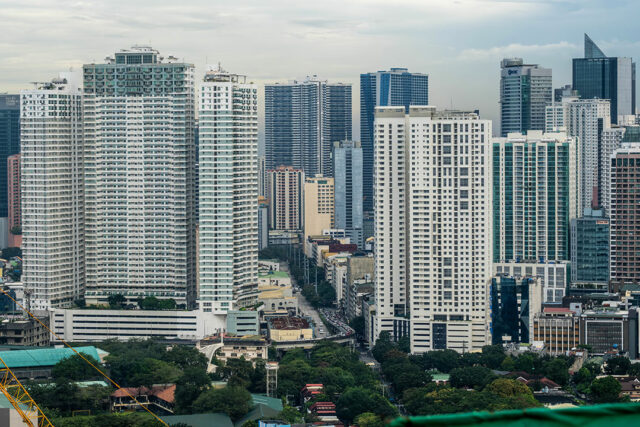
High-rise buildings dominate the skyline of Makati City’s central business district on Tuesday. — PHILIPPINE STAR/RYAN BALDEMOR

By Beatriz Marie D. Cruz, Reporter

RESIDENTIAL VACANCY in Metro Manila is expected to decline steadily by 2027, driven by renewed demand for middle-income condominium, according to real estate consultancy firm Colliers Philippines.

In its Third Quarter Property Market Report, Colliers expects residential vacancy rates to reach 26.5% this year, before falling to 26% in 2026 and to 24.9% in 2027.

“What stands out is that the mid-income residential segment continues to perform well,” Colliers Philippines Director and Head of Research Joey Roi H. Bondoc said at a briefing on Wednesday.

“Hopefully, we see a greater take-up for the affordable, lower mid-income, and upper mid-income condominium units by the end of this year, the fourth quarter, and towards 2026,” he added.

In the third quarter, residential take-up surged by 108% to 5,900 units from 2,800 units in the second quarter. This was also the highest in nine quarters or since the 8,500 units in the second quarter of 2023.

“When you look at the take-up for the first nine months of 2025, more than 90% of these projects are coming from the affordable to mid-income segment,” Mr. Bondoc said, noting that these units are typically priced between P2.5 million and P12 million.

Backout rates, where buyers cancel their purchases, also fell by 26% to 2,700 units in the third quarter from 3,600 units in the second quarter. This marked two consecutive quarters of a decline in backouts.

The improved residential vacancy rate can also be attributed to the lower completions in Metro Manila, Mr. Bondoc said.

“We call it developers turning off the supply tap and really recalibrating and just catering to what the market organically requires at this point,” he noted.

Colliers data showed that residential completions between 2026 and 2028 will average just 3,600 units, an 87% drop from the 13,000 units completed on average from 2017 to 2019.

“If you have limited supply right now, then you have a stable or even growing demand,” Mr. Bondoc said. “Intersect those two factors, we’re projecting a much lower vacancy moving forward.”

Colliers noted that residential vacancy rate is expected to inch up to 26.5% by end-2025 from 25% as of the third quarter due to additional units in the Bay Area, Alabang, and Makati Central Business District scheduled for turnover by yearend.

By submarket, the Bay Area is projected to have the highest residential vacancy at 58.6% by end-2025, followed by Fort Bonifacio (20.2%) and Makati central business district (13.2%).

As of the third quarter, about 30,400 units remain unsold in Metro Manila.

Of the total, 47% of unsold inventory in Metro Manila comes from the mid-income segments, falling from the 59% share of mid-income condominiums to unsold inventory in 2024.

Colliers added that 35% of unsold units come from the affordable segment, which is valued at P2.5 million to P3.19 million, 35% from lower mid-income (P3.2 million to P6.99 million), and 12% from the upper mid-income segment (P7 million to P11.99 million).

Mr. Bondoc noted that promos for ready-for-occupancy (RFO) units have been attracting buyers, thus improving residential take-up.

“This only indicates that the ready-for-occupancy promos being offered by developers right now, which continue to abound, have really been doing wonders for the residential sector here in Metro Manila,” he said.

In the previous quarters, Colliers said developers have offered attractive promos for RFO units, including discounts of up to 60% for spot cash payment, free parking, and rent-to-own promos.

Developers must be creative in their RFO promos to sustain buyer demand, Mr. Bondoc said.

Ayala Land raises P15 billion in ESG-linked bonds

Evo City is Ayala Land’s 207-hectare mixed-use estate in Kawit, Cavite. — AYALALAND.COM

LISTED Ayala Land, Inc. (ALI) said it has raised P15 billion through sustainability-linked bonds (SLBs) to fund green initiatives.

In a disclosure on Wednesday, ALI said the offering includes five-year Series C SLB due 2030 and 10-year Series D SLB due 2035.

The Series C and Series D bonds have fixed rates of 6.0671% and 6.3192% per annum, respectively.

“The inclusion of sustainability-linked performance targets further underscores Ayala Land’s alignment with global ESG (environmental, social, and governance) investment standards, appealing to institutional investors seeking responsible and future-oriented capital placements,” Globalinks Securities and Stocks, Inc. Head of Sales Trading Toby Allan C. Arce said in a Viber message.

“The fact that it could attract strong demand for a sustainability-linked bond at this scale suggests investors view its ESG commitments as genuine, not symbolic — a critical differentiator in the post-pandemic capital market landscape,” he added.

Philippine Rating Services Corp. (PhilRatings) assigned the bonds a PRS Aaa rating with a stable outlook, the developer said. A PRS Aaa rating indicates that the issuer has a “very strong capacity” to meet financial obligations and that credit risk is low.

“The bond’s linkage to sustainability targets also reflects a growing trust in the company’s commitment to ESG principles and its long-term strategic direction,” Regina Capital Development Corp. Head of Sales Luis A. Limlingan said in a Viber message.

The offering also marks the fourth tranche under ALI’s P50-billion debt securities program.

“We have raised a total of P56 billion or approximately $1 billion — a milestone that reflects our collective progress in integrating sustainability into the way we fund growth,” ALI Chief Finance Officer Jose Eduardo A. Quimpo II said.

With the latest issuance completing the developer’s debt funding plan for this year, Mr. Arce noted that ALI has secured sufficient liquidity to support expansion, refinance existing obligations, and maintain development momentum in its residential, commercial, and estate projects.

Around 60% of the SLB proceeds will be allocated to refinance existing debt, while the remaining 40% will fund major projects, including the redevelopment of the BPI Headquarters and Greenbelt 1 in Makati City, and the development of Ayala Malls Evo City in Cavite.

The redevelopment of the BPI Headquarters features a 45-storey energy-efficient tower integrated with the new Dela Rosa Gardens. Greenbelt 1 is also slated to become a modern lifestyle destination with sustainability features like skylights and rainwater collection systems.

ALI linked its SLBs to the 42% reduction in greenhouse gas emissions across its malls, offices, and hotels by 2030, and EDGE Zero Carbon certification for 1.5 million square meters of office space by end-2025.

For the first half, ALI’s net income rose by 8% to P14.2 billion on the back of higher contributions from its property development, leasing, and hospitality businesses.

ALI shares on Wednesday were down by 2.66% or 55 centavos to close at P20.15 each. — Beatriz Marie D. Cruz