Home Blog Page 7475

Bohol selected for trial devolution of DA functions post-Mandanas ruling 

PHILSTAR

BOHOL has been selected as a site to trial the local takeover of services formerly carried out by the National Government in preparation for the implementation of the Supreme Court’s Mandanas ruling, which ordered an increase in local governments’ share of the National Government’s revenue starting next year.

Agriculture Secretary William D. Dar said the initial devolution of services will come in the form of Province-led Agriculture and Fisheries Extension Systems (PAFES) program, for which Bohol was chosen as a “model.”

The National Government is shedding services in response to the Mandanas ruling, and is hoping that newly cashed-up local government units (LGUs) pick up the slack.

Mr. Dar said in a statement Tuesday: “We would like to see more LGUs investing in agriculture and fishery projects that would produce traditional as well as emerging products that enjoy comparative advantage.”

The DA, citing the Department of Budget and Management, said the Internal Revenue Allotment (IRA) of LGUs, representing their share of National Government revenue, is set to increase by P234.4 billion to P1.8 trillion in 2022.

Mr. Dar also confirmed that the DA has sent Malacañang a draft executive order to institutionalize PAFES next year for all provinces. 

“With the additional IRA, LGUs could implement the PAFES in partnership with the DA, to significantly boost the delivery of devolved functions and better perform their role as the country’s food security czars,” Mr. Dar said.

He said Bohol was selected because Governor Arthur C. Yap has aligned the province’s priority agriculture and fishery programs with the DA’s own plans.

“If all provinces are like Bohol, the improvement of the agriculture sector in every province would be quicker,” Mr. Dar said.

According to Mr. Yap, P588.8 million has been allotted for programs that cover rice, corn, root crops, coconut, milkfish, tilapia, seaweeds, dairy, native chicken, swine, and farm-to-market roads.

Mr. Dar said the DA will act favorably towards Mr. Yap’s request for an additional P976 million for farm and fishery projects, and P1.4 billion for farm-to-market roads.

“Agriculture is too important to be left alone with the DA. The DA must only do the steering. LGUs must do the rowing so that the provinces will be food secure. There must be a sense of partnership that must be nurtured between DA and the LGUs,” Mr. Dar said.  

“Several provinces are also taking the initiative by investing much of their budgets on agriculture. These include Isabela, Ilocos Norte, Ilocos Sur, Pangasinan, Quirino, Pampanga, Bulacan, Nueva Ecija, Batangas, Cebu, and Marinduque, among others,” he added. — Revin Mikhael D. Ochave

US, PHL complete five-year animal disease program

THE US and the Philippines have finished the final phase of a five-year biological threat capacity-building program worth around, aimed mainly at addressing the Philippines’ ability to handle animal diseases.

The US Embassy in the Philippines said the US Defense Threat Reduction Agency – Biological Threat Reduction Program (DTRA-BTRP) was conducted alongside the Department of Agriculture (DA) starting September 2016 to establish or improve seven regional animal disease diagnostic laboratories in Luzon, the Visayas, and Mindanao.

“The program also included the provision for Philippine counterparts to participate in 15 bio-safety and security courses, 26 quality management courses, four table-top exercises, 27 laboratory staff workshops, and support to the Regional Institute of Tropical Medicine through equipment fielding and training,” the US embassy said in a statement.

Agriculture Undersecretary William C. Medrano said the partnership helped modernize laboratories and institutionalize quality management.

“I can safely say that the desired outcome of the bio-safety and security project was fulfilled,” Mr. Medrano said.

The US embassy said the program also helped address emerging diseases in the Philippines such as avian influenza (bird flu) and African Swine Fever.

It added that the partnership also included disease surveillance and laboratory security and safety training.

Ada A. Bacetty, head of the DTRA-BTRP, said the partnership allowed the Philippines to improve its capacity to detect, diagnose, and report dangerous pathogens.

“These labs are a central line of defense against dangerous pathogens affecting agriculture, including those with potential to affect humans.  The capabilities developed through the BTRP-DA partnership strengthened the Philippines’ ability to detect and respond to emergent threats,” Ms. Bacetty said.

“Now that the Philippine government is operating these labs at full capacity, we look forward to the next opportunity to work with our critical Philippine friends, partners, and allies,” she added.

The US embassy said future partnerships between the BTRP and the Philippines will expand to include the human health sector. — Revin Mikhael D. Ochave  

Threat to arrest anti-vaxxers has no legal basis

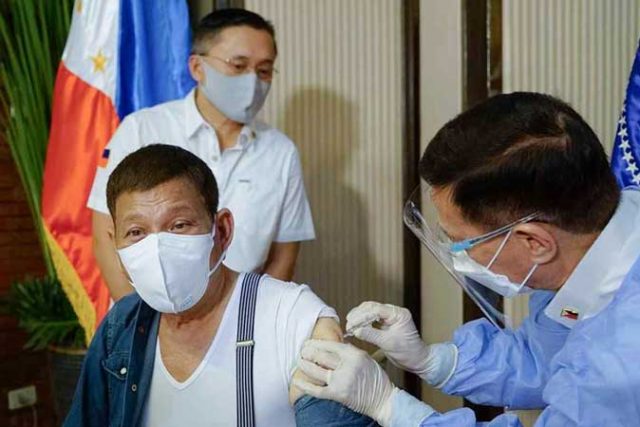
PRESIDENT Rodrigo R. Duterte receives his first shot of a Sinopharm COVID-19 vaccine on May 3, 2021. — PCOO

PRESIDENT Rodrigo R. Duterte’s threat to order the arrest of people who refuse to be vaccinated against the coronavirus has no legal basis, the country’s Justice chief said. 

“As a lawyer, he (Mr. Duterte) knows that not getting vaccinated is a legal choice; there is no law as yet that compels vaccination against COVID-19 (coronavirus disease 2019), much less criminalizes it, as presently available vaccines are still in their trial phases,” Justice Secretary Menardo I. Guevarra told reporters on Tuesday via Viber.

“I believe that the President merely used strong words to drive home the need for us to get vaccinated and reach herd immunity as soon as possible,” he added. 

He explained that not getting vaccinated and not following health protocols are “two entirely different things.”

“Getting vaccinated is not mandatory but complying with health protocols is mandatory,” he said.

Presidential Spokesperson Herminio L. Roque, Jr., however, insists that the state has the power to make COVID-19 vaccination mandatory.

Mr. Duterte, during his public address on Monday night, said he will order the arrest of those who refuse to take part in the vaccination program. He also threatened to require village officials to prepare a list of those who decline to be vaccinated.

The President also said those who do not want to be vaccinated may leave the country. “For as long as you are here and you are a human being who can carry the virus, magpa-bakuna ka (get vaccinated),” he said.

The President’s statement “emphasized what the state can do,” Mr. Roque told a televised news briefing on Tuesday.

“This is part of what we call the police power of the state,” Mr. Roque said, reiterating that the government can use police power to deter potential threats to public health.

He did acknowledge that implementing compulsory vaccination would require legal basis, either under a national law or a local government ordinance.

The spokesman said it would be easy for the executive branch to ask Congress to pass a law that would make vaccination mandatory.

LAWMAKERS
Several lawmakers, on the other hand, questioned the President’s threat.

Senator Francis N. Pangilinan said the solution to encourage Filipinos to get vaccinated is through “science-based” interventions, not by intimidation.

“Threatening or arresting are not the solutions. The solution is science-based interventions, contact tracing, testing information dissemination and an effective vaccine rollout,” he said, partly in Filipino, in an online briefing Tuesday.

Senator Risa N. Hontiveros-Baraquel, in a statement in Filipino, said there is no need to threaten Filipinos.

“There is no need to threaten the public if there is a sufficient and continuous supply of vaccines that are safe, effective, and appropriate to their conditions; credible health information and education in the communities; and an organized vaccination system,” she said.

Meanwhile, Senator Maria Lourdes Nancy S. Binay noted that vaccine hesitancy is not the problem.

“Vaccine supply is the biggest problem, so we need to arrest that. But at the same time, vaccine hesitancy is there, but for me, the urgent need right now is you need to have more supply of the vaccine,” she said in an interview with ABS-CBN News Channel.

A Social Weather Station survey released on May 20, conducted among 1,200 respondents from April 28 to May 2, found that 32% of Filipinos were willing to get vaccinated, 35% were uncertain, and 33% were unwilling to get their shots.

Around 8.4 million coronavirus vaccines doses were administered as of June 20, with around 2.15 million people who were fully vaccinated, according to the Health department.

Philippine authorities and medical experts have been urging the public to get vaccinated to reduce the number of critical cases and achieve herd immunity by the end of the year. — Bianca Angelica D. Añago, Kyle Aristophere T. Atienza, and Vann Marlo M. Villegas

US to donate 1M more coronavirus vaccines to PHL

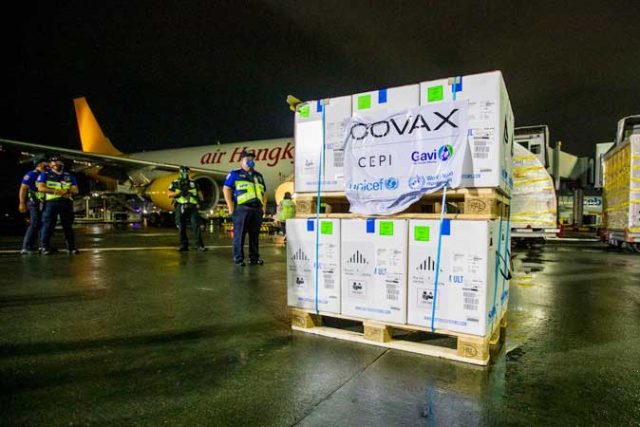
US EMBASSY PHOTO RELEASE

THE UNITED States is set to donate as many as one million doses of coronavirus vaccines to the Philippines, Manila’s envoy to Washington said on Thursday.

The 800,000 to one million doses are part of the 18 million vaccine vials that the US will give to various countries, Ambassador Jose Manuel D. Romualdez said at a televised interview with Palace spokesman Herminio L. Roque, Jr.

The vaccines would be either from Moderna, Inc. or AstraZeneca Plc, Mr. Romualdez said. The vaccines would probably arrive next month.

Mr. Romualdez said Manila would also get “a substantial amount of doses” from the 500 million vaccine vials donated by America “to the world.”

The US government would donate about 80 million vaccine vials globally, according to a White House statement on June 3. Of the total, at least 75% will be shared through a global initiative for equal access, which will allocate roughly seven million doses to Asian countries, including the Philippines.

The Philippines earlier negotiated for the purchase of about 20 million doses of Moderna vaccines. The first batch of which will arrive before the end of the month, Mr. Romualdez said.

The Philippines has so far received about 10.8 million doses of coronavirus vaccines. About 8.4 million doses have been administered as of June 20.

On Tuesday, the Department of Health reported 3,666 new coronavirus infections, bringing the country’s total to 1.37 million.

The death toll rose by 60 to 23,809, while recoveries increased by 6,810 to 1.29 million, it said in a bulletin.

There were 52,696 active cases, 1.4% of which were critical, 91% were mild, 4.2% did not show symptoms, 2% were severe and 1.40% were moderate.

The agency said 11 duplicates had been removed from the tally, eight of which were tagged as recoveries.

A total of 56 cases previously tagged as recoveries were reclassified as deaths. Twelve laboratories failed to submit data on June 20, the agency said.

About 13.6 million Filipinos have been tested for the coronavirus as of June 19, according to DoH’s tracker website.

The coronavirus has sickened about 179.6 million and killed 3.9 million people worldwide, according to the Worldometers website, citing various sources including data from the World Health Organization. — Kyle Aristophere T. Atienza and Vann Marlo M. Villegas

Military gets P183M worth of weapons, equipment with US assistance

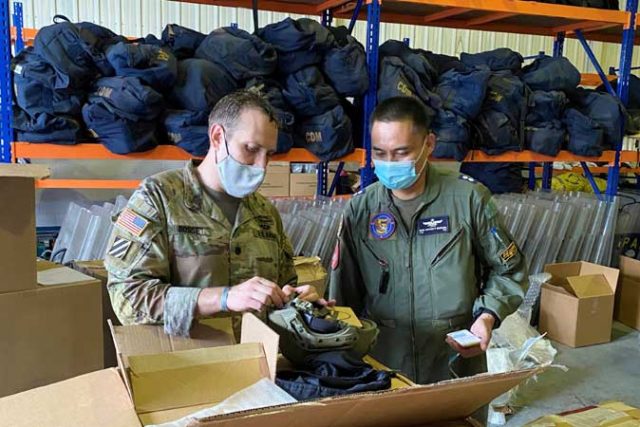
US EMBASSY PHOTO RELEASE

THE ARMED Forces of the Philippines on Monday took delivery of weapons and equipment worth P183 million from the Joint United States Military Assistance Group-Philippines (JUSMAG-Philippines) at the Clark Air Base.

The delivery, which aims to boost the military’s counterterrorism and maritime security capabilities, was paid for by the Philippine government with grant assistance from the US, the American Embassy in the Philippines said in a statement on Tuesday.

The shipment included nine M3P .50 caliber heavy machine guns, 10 mortar tubes and other equipment.

Col. Stephen C. Ma, JUSMAG-Philippines chief and senior defense official, said the US will continue supporting the Philippine military’s capacity-building efforts through training and key military training equipment transfers.

“Our mutual security collaboration remains a cornerstone of a free and open Indo-Pacific,” he said in the statement.

The Philippines is the largest recipient of military assistance from the US in the Indo-Pacific region, according to the US Embassy. Since 2015, the country has received more than P48.6 billion in US security assistance.

President Rodrigo R. Duterte last week extended, for the third time, for another six months the suspension of the termination of the country’s visiting forces agreement with the US, a pact that allows the entry of foreign military troops in the country for joint drills.

In February last year, he said he would terminate the agreement after the US Embassy cancelled the visa of his ally Senator Ronald M. dela Rosa.

Mr. Duterte suspended the termination for six months in June 2020, citing the heightened tensions in the region and that it was a distraction to the countries’ anti-coronavirus efforts. He suspended it again for another six months in December. — Vann Marlo M. Villegas

Opposition party exploring alliance with 3 senators, Manila mayor

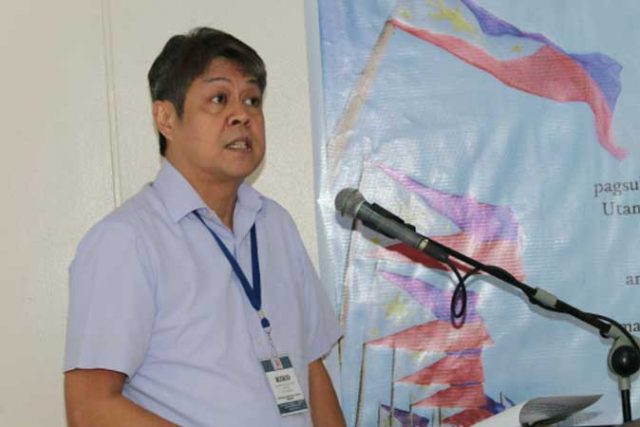
LIBERAL.PH

THE OPPOSITION party has initiated exploratory talks with four prospective candidates seeking to form a coalition for the 2022 elections, a senator said on Tuesday.

Senator Francis N. Pangilinan, president of the Liberal Party, said there were “efforts to reach out” to Senators Panfilo M. Lacson, Maria Lourdes Nancy S. Binay, and Emmanuel Joel M. Villanueva, and Manila Mayor Francisco “Isko” M. Domagoso.

Nandiyan si (There is) Senator Lacson, Senator Villanueva, nandiyan si Senator Binay, di ba. Nandiyan si Isko Moreno, of course si vice president (Maria Leonor G. Robredo),” he told an online briefing.

The vice president is the current Liberal Party chair.

“Can you imagine if everyone of those would be united in saying we want a better direction for our country,” he said in Filipino.

The party leader said there is a need for “broader unity” in the upcoming elections, noting that differences should be set aside to build the “broadest coalition possible.”

“We are working towards a broader unity which is critical,” he said.

There is nothing set though, he said, as they only had informal discussions. — Vann Marlo M. Villegas

Private schools appeal to BIR again to repeal higher tax

PHILIPPINE STAR/ MIGUEL DE GUZMAN

A GROUP of private schools asked the Bureau of Internal Revenue (BIR) to officially revoke its issuance that increased the income tax of non-profit educational institutions to 25%, the Coordinating Council for Private Educational Associations (COCOPEA) said in a press release on Tuesday.

COCOPEA, composed of the five biggest education associations representing around 2,500 private schools, said the 25% tax rate is still being implemented since BIR’s Revenue Memorandum Circular (RMC) 76-2021 on June 11 only clarified computation errors under Revenue Regulations (RR) No. 5-2021, but does not rectify the “onerous 150% tax hike” on private schools.

The BIR issued RR 5-2021 to implement the lowered one-percent corporate income tax under the Corporate Recovery and Tax Incentives for Enterprises (CREATE) law for non-profit educational institutions.

The tax agency stood firm in its interpretation that only private schools that are “non-profit” will enjoy the lowered tax rate, while the rest will have to pay the regular 25% rate — a decision that COCOPEA is questioning.

The group petitioned Malacañang for an intervention from President R. Duterte to reverse the issuance while a separate bill was filed in Congress to clarify the tax treatment of private educational institutions under the National Internal Revenue Code.

“Unless there is an official clarification from the BIR that removes the “non-profit” qualification in RR 5-2021 for proprietary educational institutions to enjoy the preferential tax rate of 10% under the Tax Code which is further lowered to 1% under the CREATE Act, we do not see any change at all in the existing tax policy that we are appealing to be corrected,” COCOPEA Managing Director Joseph Noel M. Estrada said in the statement. — Beatrice M. Laforga

Solon urges DoTr to release remaining P4.6B under transport service contracting program

PHILSTAR FILE PHOTO

A LEGISLATOR on Tuesday asked the Transport department to release about P4.6 billion allocated to transport workers under the service contracting program funded by an expiring stimulus law.

“The service has already been obligated. Filipino workers are clearly in need of more public transport options. The funds are available, although expiring soon. We have to release these funds without delay,” House Ways and Means Chair Jose Maria Clemente S. Salceda said in a statement.

Citing the Land Transportation, Franchising and Regulatory Board, Mr. Salceda said only P1 billion of the P5.5-billion program has been distributed to service contractors more than nine months since Republic Act No. 11494 or the Bayanihan To Recover As One Act (Bayanihan II) was signed. The law expires on June 30.

Mr. Salceda said paying service contractors might become more complicated “due to the expiry of Bayanihan II.”

“Bayanihan II is expiring on June 30. We have to reauthorize the appropriations under the package, or else, we won’t be authorized by any law to pay the service contractors,” the Albay representative said.

Mr. Salceda earlier called for an extension of Bayanihan II through a memorandum sent to the House leadership.

Palace spokesman Herminio L. Roque, Jr. earlier said over P18 billion from the second stimulus law remains unused. — Kyle Aristophere T. Atienza

Culture, calamansi and more to see and do in Pangasinan

TOURISM Secretary Bernadette Romulo-Puyat harvests Philippine lime at the Calamansian ed Lekep-Butao in San Fabian, Pangasinan. The agri-tourism site, owned by farmers in the community, also sells juice, cake and other dessert products. — @PANGASINAN.TOURISM

PANGASINAN, among the first provinces north of Manila to resume tourism operations, formally unveiled on Monday another attraction, the Casa Real as a National Historical Landmark.

Casa Real, located in the capital town of Lingayen, is a mid-19th century building that served as the province’s first government center during the Spanish era.

Officials of the National Historical Commission of the Philippines, Department of Tourism, and the provincial government led Monday’s inauguration ceremony for the restored landmark.

Prior to the Casa Real event, Tourism Secretary Bernadette Romulo-Puyat arrived in the province Sunday and visited some popular as well as newly-developed tourism sites.

Among her stops were: prayer park in Bayambang town, which holds a Guinness World Records for its statue of St. Vincent as the tallest bamboo structure in the world; Bella’s Puto Calasiao Factory, one of the pioneers in the town’s well-known rice cake delicacy; and the agri-tourism site Calamansian ed Lekep-Butao in San Fabian, a two-hectare calamansi plantation owned and managed by farmers in the community, which also sells calamansi juice and various dessert products.

Visitors coming to the province may check out the requirements and guidelines at the Pangasinan Provincial Tourism & Cultural Affairs Office’s official site www.seepangasinan.com or Facebook page @pangasinan.tourism.

ILOCOS REGION
Going further north, Ms. Puyat said the Tourism department is looking at developing cycling and motorbike trails that traverse Pangasinan and the other provinces in the Ilocos Region — La Union, Ilocos Sur, and Ilocos Norte.

“Region 1 holds so much potential to appeal to tourists under the new normal, given its abundance in nature sites. That is why we are very excited to launch the tourism recovery plan that will introduce new and exciting activities that will provide additional opportunities for the micro, small, and medium enterprises in the region,” Ms. Puyat said in a statement.

Other tourism recovery initiatives in the region include: the Marian Pilgrimage Tour; specialized training for Inabel textile weavers in Ilocos Sur; the Eastern, Western and Central Pangasinan Tourism Circuit; Bird Watching Tourism Circuit in Ilocos Norte; and the development of eco/nature trails in La Union. — Marifi S. Jara

VP office, Manila team up for drive-thru vaccination for transport workers

VP LENI ROBREDO FB PAGE

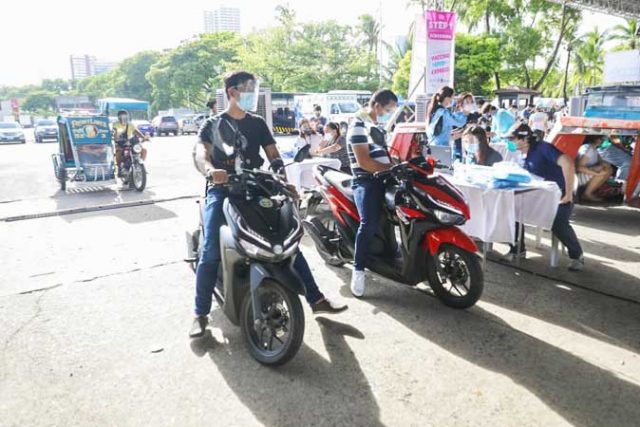
THE OFFICE of the Vice President and the city government of Manila have tied up for a drive-thru coronavirus vaccination for transport workers.

The two-day initiative called “vaccine express” was rolled out on Tuesday with a target to inoculate 5,000 pedicab drivers and delivery riders in the Philippine capital.

Vice President Maria Leonor G. Robredo, who launched the project together with Manila City Mayor Francisco Domagoso, said drivers and riders were given P500 gas cards as an incentive.

About 900 vaccines have been given out as of Tuesday noon, Ms. Robredo said in a Tweet.

The mayor, meanwhile, said the city is grateful for being chosen as one of the beneficiaries of the vaccination on wheels program.

Manila had 1,135 active coronavirus cases as of June 22. — Kyle Aristophere T. Atienza

The convergence of society, science, and technology towards climate resiliency

FREEPIK

Recently, the Philippine Atmospheric, Geophysical, and Astronomical Services Administration (PAGASA) warned of the high probability of near to above normal rainfall conditions in the following months. At the same time, PAGASA also said that up to 19 tropical cyclones may enter the country until November of this year.

Climate risks are not uncommon in the Philippines. In fact, the Germanwatch Global Climate Risk Index ranks the Philippines as the fourth most affected country by extreme weather events from 1999 to 2019. The World Bank (WB) International Disaster Database also shows that a total of 72 storms entered the Philippine Area of Responsibility (PAR) from 2011 to 2018, affecting some 68 million Filipinos. Each year, the country incurs $3.5 billion in estimated total damage to private and publicly owned assets.

According to Dr. CP David, who spoke at the Stratbase ADR Institute and Philippine Business for Environmental Stewardship’s (PBEST) virtual event on the need for our communities to adopt best practices for a proactive approach to climate resilience, despite our generation occupying the majority of the leadership roles today, climate risks are still “not a top-of-mind issue.” The reality is, due to other pressing problems such as the COVID-19 pandemic and because of its slow onset effect on humanity, climate issues are downplayed. The lack of understanding and proper communication is another reason for the lack of awareness of the climate risks.

The damaging impacts of climate risks to our communities will grow every year if we fail to keep pace with the warming and fast-changing world and waste the shrinking window of opportunity we have to address climate change.

However, not all opportunities are lost as Philippine communities’ can still build up their climate resilience if they adopt best practices now and not when these risks present themselves in full force. Because of the climate risks’ complex and long-standing nature that often affects every Filipino, solving it will require a collective effort from all stakeholders across all levels of our society.

For instance, Governor Dax Cua shared best practices from the province of Quirino where the local government there utilizes data gathered from its Community-Based Monitoring System (CBMS) to inform its citizens and plan ahead for possible calamities. The province also uses the Advanced Geographical Information System (GIS) to aid the local government in making accurate science- and evidence-based decisions and actions.

Collaboration among stakeholders is key to achieving sustainability and climate resilience, he added. Under the Union of Local Authorities of the Philippines (ULAP) dialogue series with private and community development partners, the province has been able to explore climate-resilient pathways to economic growth and inclusive development through the introduction of modern technologies and innovative solutions to reduce carbon emissions while promoting resilient economies, ecosystems, and communities.

Dr. Mahar Lagmay of Project NOAH also stressed that responses should be people-centered and data-driven. To save more lives and livelihood, warnings should be hazard- and area-specific, and time-bound. This can be done through openly available real-time monitoring applications or data platforms and other technologies which have advanced to such a degree that it helps people make better decisions.

Meanwhile, as creating sustainable and climate-resilient communities is too crucial to be left to the responsibility of the government, the private sector plays an active role in strengthening disaster resilience through its expertise, financial capabilities, resources, and technological know-how.

Among private-sector groups that lead in this undertaking is the Philippine Disaster Resilience Foundation (PDRF). Through its strategic partnerships with companies, government agencies, civil society organizations, and other stakeholders, the companies can nimbly mobilize efforts towards building disaster-resilient businesses in communities across the nation.

PDRF President Butch Meily shared their flagship project, the Emergency Operations Center (EOC) in Clark, Pampanga, the world’s first ever in the region that runs on a national basis. The center tracks tropical weather patterns, storms, volcanic and earthquake eruptions around the world. PDRF also uses the center to track the Philippine pandemic situation daily.

Another worthy example of multisectoral initiatives is the data-backed Liveable Cities Dashboard, a project of Globe Telecom, PDRF, the Liveable Cities Challenge, and the League of Cities. The dashboard aims to provide an interactive visual profile of the 146 cities in the country and aid the LGUs in utilizing data and innovation to enable local governments to quickly spot trends and correlations for effective decision-making and help them diagnose areas for improvement.

Jaime Augusto Zobel de Ayala, a co-chair of PDRF, summed up the importance of multisector collaboration: “Now, more than ever, everyone must play a role in building resilience and mitigating risks as more devastating calamities arise in the future. I think we should be contributors of resilience and help minimize the contributions we make in worsening the situation.” He added that “climate change is an existential threat to everyone, whether you are a business, a government institution, or just an individual.”

The real problems in creating climate-resilient communities are in front of us, and we just have to acknowledge them.

Multi-sector engagements and best practices must be discussed and more widely adopted to address climate risks proactively before they even happen. With these, the vulnerability of communities to physical, social, and economic shocks will be minimized, and many lives saved.


Felix Vitangcol is a Fellow for Environment at the Stratbase ADR Institute, and Secretary-General of Philippine Business for Environmental Stewardship.

Addressing the Philippine education crisis

PCH.VECTOR-FREEPIK

(Part 1)

Among the 17 Sustainable Development Goals (SDGs) of the United Nations, quality education ranks fourth after: 1.) No poverty; 2.) Zero hunger; and, 3.) Good health and wellbeing. It is obvious, however, that the SDGs are highly interdependent and cannot be addressed in isolation. As we shall discuss in greater detail in this series of articles, quality education for all, for example, is unattainable if a large number of children are undernourished or malnourished in the first years of their lives. Lack of sufficient nutrients in early childhood does significant damage to the brain, making learning difficult in later years. The same thing can be said about unhealthy children (SDG 3). For that matter, at least the next three other SDGs are also closely intertwined with quality education. These are: 5.) gender equality; 6.) clean water and sanitation; and, 7.) affordable and clean energy.

Before we examine the ongoing education crisis the Philippines is facing, exacerbated by the pandemic during which some 2.7 million students were forced to drop out of school for economic reasons, let us fully understand the role of quality education in the attainment of integral human development, which is the goal of every society. Let us avoid the mistake of thinking of education as just a means of providing workers for the economy, especially a free market economy. Especially as an economist, I try hard not to think of education solely as a means of addressing the supply side of the labor market, considering human beings as mere factors of production. Especially after being traumatized by a TV series entitled North and South produced in the United Kingdom, which depicted the inhumanities of the industrial revolution in the late 18th century in England, I want to follow the lead of the Department of Economics and Social Affairs of the United Nations in the manner in which it explained the fourth SDG goal which is “quality education.”

It is heartening to know that the United Nations considers education as a human right of every individual, independently of his or her economic utility to society. Every human being has a right to education because of his or her inherent dignity. In introducing the fourth SDG, the mission-vision statement (to use business terminology) reads as follows: “Ensure inclusive and equitable quality education and promote lifelong learning opportunities for all…  Education liberates the intellect, unlocks the imagination and is fundamental for self-respect. It is the key to prosperity and opens a world of opportunities, making it possible for each of us to contribute to a progressive, healthy society. Learning benefits every human being and should be available to all.” As a strong advocate of liberal education, I am especially glad to read such phrases as “lifelong learning opportunities” and “education liberates the intellect.” A very practical consequence of these statements is that it is the responsibility of the State to provide free education to all at the K to 12 level, which is what the Philippine Constitute mandates. This free basic education for all is geared towards making every Filipino citizen capable of living a fully human life, whatever special skills he or she may decide to acquire through additional formal, informal, or non-formal education to earn a living.

In formulating the curriculum for the K to 12 phase of education, the responsible authorities must focus on equipping the students with the appropriate skills so that they will be enabled to engage in lifelong learning. That is why there is the emphasis on competences in reading, math, and science, which are the foundational skills that will make it possible for an individual to continue learning for the rest of his or her life. Especially during the junior and senior high school years (Grades 7 to 12), the core curricula should consist of what is known as the liberal arts, precisely consisting in those subjects that “liberate the intellect” such as the humanities, math, science, literature, philosophy, history, the social sciences, and languages, among others. What used to be covered in the first two years of college before the onset of the K to 12 curricula should be taught during the junior and high school years. As an economics educator for more than 50 years, my admittedly biased recommendation is that if economics is taught as part of an over-all social sciences subject during junior high school, every effort should be exerted to include Economics as a separate subject during the senior year level. Objectively, an introductory course to Economics as a separate academic discipline, is arguably the most effective means to help a young adult integrate the different disciplines such as math, science, history, philosophy, and the other social sciences as they are helped to analyze the complex economic problems faced by every nation and the entire globe. If the teaching materials used in this introductory course in economics are judiciously prepared and the teachers are trained properly to take a multidisciplinary approach in teaching Basic Economics, it is going to be more possible for the students to “contribute to a progressive, healthy society.”

The conditio sine qua non to providing quality education for all is “to ensure that all girls and boys complete free, equitable and quality primary and secondary education leading to relevant and effective learning outcomes.” This is easier said than done because of widespread poverty which has worsened because of the pandemic. During the first four years of the Duterte Administration, poverty incidence was cut down from 21% of the population to a little over 16%. Today, it is estimated that because of massive loss of jobs and business opportunities for micro and small enterprises (witness jeepney and taxi drivers turning to begging on the streets), the poverty incidence is back to the 20% level. In fact, some 2.7 million students have dropped out of school because of the lack of employment and income of their parents. More than ever, our government has to devote funds for the Social Amelioration Program (SAP) or the four Ps to make sure that as many of the children possible are able to continue with schooling, no matter how imperfect under the blended learning system. This will be possible only if the parents are given cash assistance to provide for the most basic necessities, especially food. As a condition for the cash transfer, the parents will ensure that their children will continue to attend classes in whatever form possible. In this regard, because of the paucity of digital devices and internet connections among the poor households, it is imperative that physical classes be resumed as early as possible once herd immunity is reached. Blended learning will not work for the vast majority of C, D, and E households (which constitute as much as 60% of the population) because of lack of internet connections and inadequate digital devices. Only the children of the upper-middle income and high-income classes can continue with blended learning (three days attending physical classes and two days working from home).

I am pessimistic about the UN target of providing equal access to quality pre-primary education which ensures that all girls and boys have access to quality early childhood development, care, and pre-primary education so that they are ready for primary education. This is supposed to happen by the year 2030. We have to keep in mind that 75% of those who fall below the poverty line are in the rural areas where decades of neglect of agricultural and rural development have forced many parents to look for employment opportunities either in the urban areas or overseas. Parents have an indispensable role in quality early childhood development, care, and pre-primary education. Although there are signs that our government officials have finally realized how important it is to improve rural and agricultural incomes, especially under the present leadership in the Department of Agriculture, increase in agricultural productivity will be a slow process. At least for the next decade or so, we will continue to see massive migration of parents and other adults, especially to countries in Europe and Northeast Asia that are suffering from a serious demographic crisis. It will not be easy to give equal access to quality pre-primary education to the girls and boys in economically depressed areas.

What should be given a high priority is the goal of giving equal access to affordable technical and vocational education. This is the biggest gap in our pool of human resources. It is paradoxical that, despite our having a young and growing population, certain technical skills — especially in the construction industry which is booming because of the Build, Build, Build program of both the public and private sectors — are getting scarcer. There must be greater efforts by both the government and the business sectors to convince many young Filipinos to take up technical courses in TESDA-type of schools instead of being obsessed with acquiring college diplomas that are no guarantee to employment. I have discussed this issue many times in the past and am now reiterating that this is one of the most serious challenges to our educational sector: how to convince both parents and the youth that even before being overly concerned about being ready for Industrial Revolution 4.0, at least in the next 10 years, our greatest need for human resources will still be those related to Industrial Revolution 1.0 (people with mechanical skills); Industrial Revolution 2.0 (those related to the electricity industry); and Industrial Revolution 3.0 (those that have electro-mechanical skills such as those being produced by leading technical schools like Dualtech, CITE, and MFI Training Institute. These are the skills that are going to be in greatest demand as we transition from a low-middle income to an upper-middle income economy which has to provide more job opportunities for the marginalized sectors of society.

Because of the greater role of technical education in combatting mass poverty and attaining a more equitable distribution of income, I would recommend that we reduce the number of low-quality state universities and colleges and instead put up more state-sponsored technical and vocational schools, including schools that produce agribusiness technicians needed in modernizing our agricultural sector. These technicians will not only be employed in the farming sector but in the whole value chain of agribusiness including post-harvest, cold storage, logistics, food processing, and retailing. Since it is the private universities that account for the larger percentage of students enrolled in tertiary education, the State can just subsidize the costs of tuition and other education-related expenses of poor but deserving students in the best private universities in addition to supporting scholars to the various campuses of the leading state university, the University of the Philippines.

As we shall discuss in a future article, instead of taxing private schools that are established for profit, the State should consider them as valuable partners in delivering quality education to more and more post-secondary graduates.

To be continued.


Bernardo M. Villegas has a Ph.D. in Economics from Harvard, is Professor Emeritus at the University of Asia and the Pacific, and a Visiting Professor at the IESE Business School in Barcelona, Spain. He was a  member of the 1986 Constitutional Commission.

bernardo.villegas@uap.asia