Home Blog Page 7471

LANDBANK looking to sell soured loans, assets via FIST Law

BW FILE PHOTO

STATE-RUN Land Bank of the Philippines (LANDBANK) may sell its bad assets through the provisions of the Financial Institutions Strategic Transfer (FIST) Law as it seeks to improve its asset quality and boost lending to sectors affected by the pandemic.

“LANDBANK is considering selling nonperforming assets (NPAs) through FIST corporations to avail of the benefits such as tax exemptions and other privileges afforded by the law,” the bank said in an e-mail to BusinessWorld.

“Ultimately, the disposal of nonperforming assets via FIST will expectedly improve LANDBANK’s asset quality, thereby putting the bank in a better position to carry out its expanded role as a partner in the National Government’s efforts to rebuild the economy,” LANDBANK added.

Republic Act 11523 signed in February allows financial institutions to sell their nonperforming assets to FIST corporations, which will be given tax perks for the transactions performed to complete the process.

Under the law, assets that will be recognized as nonperforming until end-2022 will be qualified to be offloaded to FIST corporations.

The government hopes that through the law, lenders would be less cautious about granting new loans as they can improve their balance sheets, which have been affected by the coronavirus pandemic’s economic impact.

LANDBANK said they have started identifying eligible NPAs under the law. It said it will ensure the concerned borrowers of the loan they will sell to FIST corporations will be notified or given the chance to restructure their debt.

“As the pandemic adversely affected most, if not all, sectors of society, LANDBANK will most likely prepare a balanced nonperforming loan portfolio mix composed of large corporates and MSMEs (micro-, small- and medium-sized enterprises) for disposal,” it said.

The state-run lender said the benefits of the FIST Law will enable them to lend more to sectors in need of financing.

“LANDBANK’s main thrust is to intensify financial and technical support to its mandated sectors, and further pursue an agri-value chain approach to promote financial inclusiveness,” it said.

The bank said it will also prioritize extending credit to local government units and small businesses to help them rebound from the impact of the pandemic.

However, even as it seeks to boost lending to these sectors, LANDBANK said it will remain “prudent” as risks to the outlook linger.

“As banks continue to face an uncertain credit outlook, LANDBANK will adopt a more prudent stance in lending while striking a balance in pursuing loan growth. We will also ensure that all actions are proactive, timely, reasonable, and consistent with safe and sound lending practices to avoid an escalation in nonperforming loans,” the state-run lender said.

LANDBANK’s net income inched up by 1.67% to P5.48 billion in the first quarter. Its assets rose by 16.13%. — Luz Wendy T. Noble

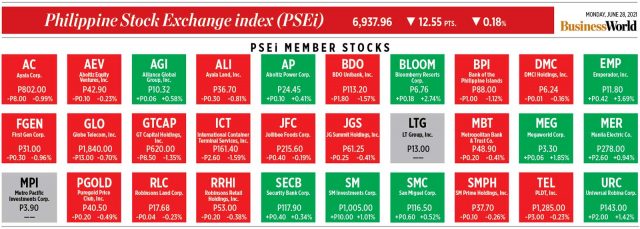
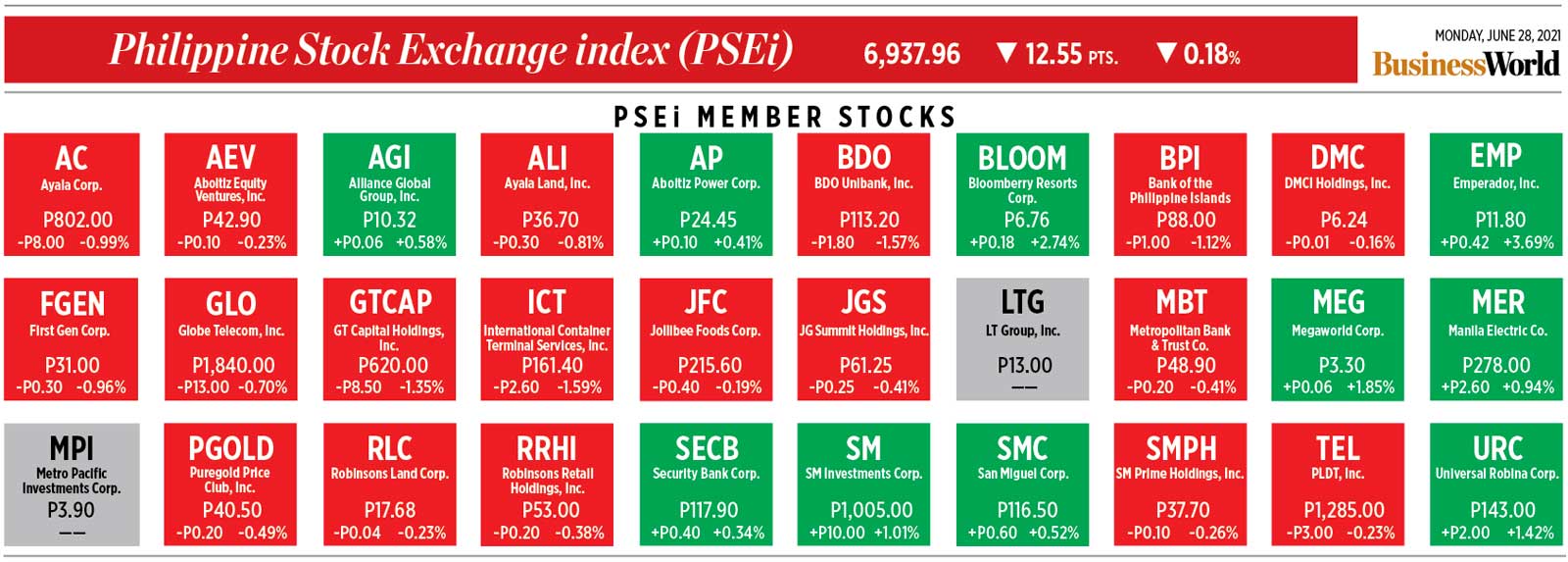
How PSEi member stocks performed — June 28, 2021

Here’s a quick glance at how PSEi stocks fared on Monday, June 28, 2021.


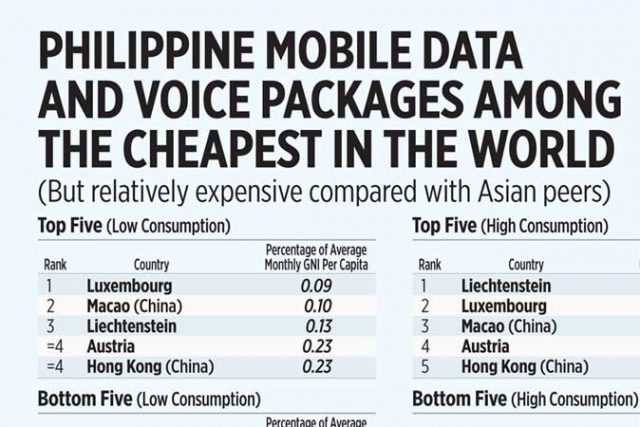
Philippine mobile data and voice packages among the cheapest in the world

Philippine mobile data and voice packages among the cheapest in the world

Index declines on window dressing, virus fears

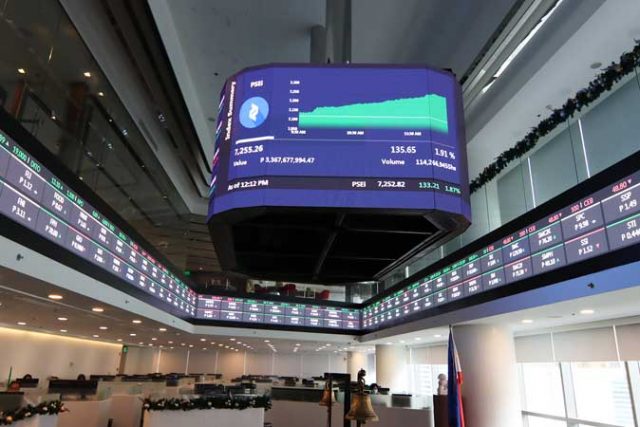
COURTESY OF PHILIPPINE STOCK EXCHANGE, INC.

THE Philippine Stock Exchange index (PSEi) started the week in the red as investors rebalanced their portfolios ahead of the month’s close and as the market was concerned over a new coronavirus disease 2019 (COVID-19) variant.

The 30-member PSEi declined by 12.55 points or 0.18% to close at 6,937.96 on Monday. Meanwhile, the broader all shares index gained 15.03 points or 0.35% to 4,244.61.

“Philippine shares traded sideways as investors prepare for window dressing by rebalancing portfolios ahead of the close of the semester,” Regina Capital Development Corp. Head of Sales Luis A. Limlingan said in a Viber message.

“Moreover, many are turning their attention to the release of ISM manufacturing data, unemployment rate, and trade balance among others,” he added.

Meanwhile, Philstocks Financial, Inc. Senior Research Analyst Japhet Louis O. Tantiangco said investors went profit taking on Monday following the market’s climb last week, but trading volume remained weak.

Value turnover decreased to P5.35 billion on Monday with 1.59 shares switching hands, from the P6.55 billion with 2.54 billion issues traded on Friday.

“Market sentiment was also weighed by renewed COVID-19 concerns amid the risks brought by the Delta variant,” Mr. Tantiangco said in a Viber message.

The Delta variant, which was first detected in India, is said to be a more transmissible form of COVID-19 by 50% to 60%.

The country has so far reported 17 cases of the Delta variant, which includes one death. The Health department said the infections were detected from incoming international travelers and there have been no reports of community transmission yet.

Sectoral indices were split on Monday. Mining and oil climbed by 128.55 points or 1.37% to 9,450.94; industrials improved by 95.11 points or 0.99% to 9,637.51; and holding firms went up by 12.08 points or 0.17% to close at 6,943.37.

Meanwhile, financials shed 11.26 points or 0.75% to end at 1,489.11; services lost 6.10 points or 0.38% to close at 1,577.45; and property went down by 11.50 points or 0.33% to 3,404.11.

Decliners outperformed advancers, 107 versus 96, while 43 names remained unchanged.

Foreigners turned buyers with P336.82 million in net purchases, a reversal of the P228.39 million in net outflows logged on Friday.

Philstocks Financial’s Mr. Tantiangco said investors are expected to remain cautious on Tuesday as they wait for the government’s announcement on new quarantine classifications.

Metro Manila and Bulacan were placed under general community quarantine (GCQ) “with some restrictions,” while Rizal, Laguna, and Cavite are under GCQ “with heightened restrictions” until June 30.

“Investors may weigh the improving COVID-19 situation in the NCR which is the top contributing region of our economy, against worries over the Delta variant. The local bourse may also take cues from Wall Street’s performance tonight,” Mr. Tantiangco said. — Keren Concepcion G. Valmonte

Peso weakens vs dollar as FATF adds the Philippines to ‘gray list’

THE PESO weakened versus the greenback on Monday as the Philippines was included in the list of countries that will be subjected to increased monitoring to prove its progress against money laundering and terrorist financing.

The local unit ended trading at P48.645 per dollar on Monday, shedding 16.4 centavos from its P48.481 close on Friday, based on data from the Bankers Association of the Philippines.

The peso opened Monday’s session at P48.50 versus the dollar, which was also its intraday best. Meanwhile, its weakest showing was at P48.685 against the greenback.

Dollars exchanged increased to $999.3 million on Monday from $985.2 million on Friday.

The peso depreciated after the Financial Action Task Force (FATF) announced that the Philippines will be under increased monitoring to prove its effective implementation of anti-money laundering (AML) and counter-terrorism (CTF) financing measures, Rizal Commercial Banking Corp. Chief Economist Michael L. Ricafort said in a text message.

The Philippines, together with South Sudan, Haiti, and Malta were added to the FATF’s “gray list” and will be required to submit progress reports every year to prove their progress in implementing AML/CTF measures.

Anti-Money Laundering Council (AMLC) Executive Director said the country will submit its first progress report on September. Gray-listed countries are expected to file their reports to the FATF every January, May, and September.

Meanwhile, a trader attributed the peso’s weakness to faster inflation in the United States.

The US Commerce department reported on Friday that the core personal consumption expenditures price index rose 3.4% in May, the fastest since the early 1990s. The index is a key inflation indicator used by the US Federal Reserve when setting monetary policy.

For Tuesday, both Mr. Ricafort and the trader gave a forecast range of P48.50 to P48.70 per dollar. — LWTN

PHL solar, wind investments projected at $11.9 billion by 2030

ACENERGY.COM.PH

By Angelica Y. Yang, Reporter

THE PHILIPPINES will attract an estimated $11.9 billion worth of wind and solar power investment by 2030, with renewables financing expected to double in the Asia Pacific this decade, an energy research and consultancy firm said.

“For the Philippines, wind and solar will attract $11.9 billion for 2021 to 2030. So that’s around 1% of APAC total wind and solar investments. Southeast Asia (SEA) contributes to around 6% for reference,” Wood Mackenzie Senior Analyst Rishab Shrestha told BusinessWorld in an e-mail.

He expects the region’s solar capacity to ramp up by 2030.

“Southeast Asia is one of the hottest solar market regions in the world, with installed capacity more than doubling every year since 2018. There will be a momentary slowdown with subsidies pulled back, but the region will add over 100 GW of solar in the next 10 years,” Mr. Shrestha said separately in a statement on June 22.

Wood Mackenzie’s Research Director Alex Whitworth said that power investment in the Asia Pacific region is projected at $2.4 trillion in the current decade, with renewables accounting for $1.3 trillion.

He added that Wood Mackenzie expects coal to account for 30% of fossil fuel investment in the decade, declining due to the emergence of gas.

“Fossil fuel power investments are expected to decline by around 25% to $54 billion a year,” Mr. Whitworth said.

Meanwhile, fossil fuel investment in the Philippines is projected at $6.1 billion for the remainder of the decade, averaging 31% of power investment each year, according to Mr. Shrestha.

Along with the growth of renewables investment, carbon emissions from the APAC’s power sector will peak at 7.3 billion tons (BT) in 2025, or 1.8 tons per person, which is less than half the level of most developed countries, based on Wood Mackenzie estimates.

“Although we expect a 47% drop in carbon emissions from the power sector from its peak of 7.3 BT in 2025, inertia in the coal power fleet will prevent Asia Pacific from reaching carbon-free power by 2050,” Mr. Whitworth noted.

“Adapting new emission-reduction technologies such as carbon capture and storage and green fuels (hydrogen, ammonia, biomass, etc.) into coal and gas generation will be key in reducing power sector emissions,” he added.

Next BSP rate hike seen in late 2022 — Fitch

BW FILE PHOTO

THE CENTRAL BANK is expected to keep the policy rates at record lows before tightening by the second half of 2022, when risks to economic recovery are likely to have significantly subsided and credit activity picks up, Fitch Solutions Country Risk & Industry Research said.

“We at Fitch Solutions believe the BSP will only begin to hike once the Philippine economy is on a sustained economic recovery and domestic demand-side price pressures become stronger, which we expect in second half of 2022. Accordingly, we forecast 50 basis points of key policy rate hikes by end-2022,” it said in a note Monday.

The Monetary Board on Thursday maintained the key policy rate at 2% in order to continue providing support to an economy that has seen early signs of improvement but with growth momentum still clouded by uncertainty due to the persistence of high daily infection levels. Lending and deposit rates were also kept at 2.5% and 1.5%, respectively.

Central bank officials have said they will maintain an accommodative policy stance “for as long as necessary” to support economic recovery. They have, however, assured that the BSP will be gauge the need for policy adjustments when risks to inflation and the growth outlook emerge.

BSP Governor Benjamin E. Diokno has said that monetary authorities will only consider policy adjustments when the economy shows more signs of sustainable growth, which he expects to happen by the second half of 2022.

The government expects 6-7% economic growth this year following the record 9.6% contraction in 2020. The economy remained in recession for a fifth straight quarter with gross domestic product declining by 4.2% in the three months to March.

Fitch Solutions said it expects inflation to ease in the next quarter as a result of the measures taken to respond to the shortage of pork, which was the trigger for higher inflation in recent months.

In May, the government temporarily lowered tariffs for pork imports and raised the minimum access volume for the commodity for a year.

“Food price inflation will prove temporary as the effects of the African Swine Fever (ASF) outbreak on pork prices recedes over the coming quarters. We believe domestic demand-side price pressures will remain subdued in 2021 before rising through 2022 as the Philippine economy undertakes a more sustained recovery,” it said.

Inflation stood at 4.5% for a third straight month in May, falling from 4.7% in February but still above the 2-4% target range set by the central bank. The BSP on Thursday raised its inflation forecast for the year to 4% from 3.9% previously, factoring in the continued recovery in global oil prices and the more favorable global growth outlook.

Fitch Solutions also believes muted credit activity will also strengthen the case for the BSP to keep interest rates at record lows.

“We expect that the BSP will refrain from tightening monetary policy until loan growth returns to trend and we cannot rule out further cuts to the reserve requirement rate to bolster credit supply as economic growth accelerates in 2022,” it said.

Lending by big banks dropped 5% in April, marking the fifth straight month of declining credit activity. Loan demand remained subdued as borrowers shy away from tapping financing amid muted economic activity and expansion plans shelved. Lenders have also imposed stricter loan standards to protect against bad loans. The non-performing loan ratio was at 4.21% at the end of April. — Luz Wendy T. Noble 

Creative industries touted as post-pandemic growth driver

CREATIVE INDUSTRIES, which accounted for 4.8 million jobs before the pandemic, are expected to help drive the Philippines’ economic growth in the post-pandemic era, the Trade department said Monday.

“Overall, the country is in a strong position in terms of our creative industries as evidenced by our performance in the 2020 Global Innovation Index (or GII). The Philippines ranked 57th in creative outputs and we are at a competitive position in terms of our creative good exports at 10th place,” Trade Secretary Ramon M. Lopez said at the Creative Futures 2021 online forum.

“That’s why we believe that our creative industries can help drive our country’s economic growth in the post-pandemic future,” he added.

He also noted that the creative sector can “very well be the next service industry-winner,” next to the business process outsourcing.

Before the pandemic hit in 2020, the creative industries provided 4.8 million jobs, equivalent to more than 11% of total employment as of 2019, Mr. Lopez said.

“In that same year, total creative exports amounted to $6.8 billion or 6% of total exports, while industry investments amounted to P281 million of total approved investment from investment promotions agencies,” he added.

“We’d like to point out that in 2018, we were ranked first in ASEAN for creative services exports and fifth in total creative exports. Within that same year, our total creative exports amounted to $4.1 billion in the Asia-Pacific region.”

Also Monday, Mr. Lopez said at the APEC Global MSME Forum 2021 that the Asia-Pacific Economic Cooperation (APEC) should tap the potential in micro, small and medium enterprises (MSMEs), which he said account for only 35% or less of the region’s direct exports.

“They contribute significantly to economic growth, with their share of GDP (gross domestic product) ranging from 40% to 60% in most APEC economies,” Mr. Lopez said at the forum.

He said APEC economies should “encourage” MSME development “to build their capacity to engage in international trade, whether as direct exporters or as part of regional and global value chains.”

“While MSMEs have been a core agenda (item) of APEC, the unparalleled effects on businesses of the COVID-19 crisis calls for stronger measures among APEC economies to support, strengthen and foster an enabling environment for MSMEs. Through the appropriate policies and measures, we need to assist them amidst the pandemic and beyond,” Mr. Lopez said. — Arjay L. Balinbin

USAID project seeking to boost PHL energy competitiveness

PHILIPPINE STAR/ MICHAEL VARCAS

THE US Agency for International Development (USAID) said Monday that it launched a $34-million project to improve the efficiency, security and resilience of the Philippine energy industry.

“Through the Energy Secure Philippines (ESP) Project, the US will work with Philippine government and private sector partners to improve the performance and efficiency of energy utilities, deploy renewable energy systems, enhance competition in the power sector, and address energy sector cybersecurity,” the US Embassy in the Philippines said in a statement.

Energy Secretary Alfonso Cusi, US Embassy Chargé d’Affaires John C. Law and USAID Philippines Acting Mission Director Sean E. Callahan signed a memorandum of understanding in a virtual event.

“The ESP will provide a wealth of opportunities for the (Philippine Department of Energy), as we re-evaluate the appropriateness of our current policies (vis-à-vis) our country’s energy goals,” Mr. Cusi said.

Also Monday, the US Embassy said Washington is also looking at “mobilizing” over $740 million in private-sector investment to help develop 500 megawatts of clean energy generation capacity in the Philippines.

According to its website, USAID has provided over $4.5 billion to help the Philippines achieve its development goals over the past 20 years. — Angelica Y. Yang

Industry counting on vaccines for improved economy by December

PHILIPPINE STAR/ MICHAEL VARCAS

SOLID PROGRESS on vaccination will be required if industry is to enjoy a healthy Christmas season, Presidential Adviser for Entrepreneurship Jose Ma. A. Concepcion said Monday.

In a Senate hearing, Mr. Concepcion said the lockdown “has caused a lot of pain” for many micro enterprises.

“The only solution really here is to solve the health problem,” he said in a Senate trade committee hearing on the effects of the pandemic on business.

He said the private sector is working with the government on a plan to improve the economy’s performance by Christmas and in 2022, which will hinge on inoculating more of the population.

“What we’re trying to do is how do we get to open the economy with 50% of the population already vaccinated. In September, October that should happen,” adding that it should be done as quickly as possible.

However, Mr. Concepcion flagged the possible spread of the more transmissible Delta variant which was first detected in India.

“What we have to look at is the issue on Delta variant this is the most serious variant that I think can really draw a curve ball and destroy our entire plan. We have to be careful in opening up especially our borders,” he said.

“In countries that have high level of Delta variant, because if that penetrates the Philippines then we will not be able to achieve a merry Christmas,” he added.

He said that hopefully, they can come up with recommendations when there is no Delta variant and 50% of the population vaccinated to the government for various industries.

Mr. Concepcion added that the banking community “will not lend if they don’t see the light at the end of the tunnel,” noting that the performance of service businesses such as restaurants, gyms, spas and retail is going to turn on any government decisions regarding capacity limits.

They will also be asking the government to allow greater mobility for the vaccinated “to spur the economy” and also allow establishment to create safe spaces to ensure the protection of both vaccinated and non-vaccinated customers.

“I think it’s a total plan, it hinges basically on the ability of both the private sector and the public sector, the LGUs especially to inoculate as fast as possible and achieve population protection; the ultimate goal is herd immunity for NCR plus. This we have to win in this year,” he said.

Mr. Concepcion also said that they are creating a roadmap detailing which industries can be opened assuming the arrival of a more transmissible variant.

He said there is a “good chance” of reviving the economy and opening up more by the end of this year.

Around 10 million doses have been administered as of June 27, according to the Health department, with over 2.5 million fully vaccinated individuals.

The government hopes to inoculate at least 500,000 people daily in Metro Manila, Rizal, Bulacan, Cavite, Laguna, Metro Cebu and Metro Davao to achieve herd immunity by Nov. 27. — Vann Marlo M. Villegas

Legislator presses for resolution to Hedcor hydro dispute with indigenous peoples

HEDCOR.COM

SHERWIN T. Gatchalian who chairs the Senate energy committee, said the National Commission on Indigenous Peoples (NCIP) and Department of Energy (DoE) need to help resolve the shutdown of three Benguet hydro plants operated by an Aboitiz Power Corp. subsidiary following the withdrawal of consent from the traditional owners of ancestral land.

The affected facilities in the town of Bakun are the 2.4-megawatt (MW) Lower Labay, 3.6-MW Lon-oy, and 5.9-MW FLS hydro facilities, which the NCIP Cordillera Administrative Region wants Aboitiz unit Hedcor to shut down within five days of receipt of its cease-and-desist order (CDO).

“While the issue confronting Hedcor and the indigenous communities is legal in nature, I implore the NCIP and DoE to work out a possible solution,” Mr. Gatchalian said in a statement Monday, adding that it was important that the facilities continue to operate during the pandemic.

“At a time when there’s a threat of yellow and red alerts in the power supply, we have to make sure that all plants are up and running especially now that we’re in the middle of a global health crisis,” he said.

DoE Renewable Energy Bureau Director Mylene C. Capongcol confirmed that the department is helping resolve the shutdown of Hedcor’s three hydro plants.

“We are helping,” she told BusinessWorld in an e-mail Monday. “The DoE helps in the earliest resolution of the issue or concerns, explaining the importance of ensuring power supply adequacy in the grid,” Ms. Capongcol said.

Hedcor has said it is exerting efforts to start a dialogue with the indigenous peoples in the area.

According to the CDO issued by the NCIP, indigenous groups issued a resolution of non-consent in April, citing “highly disadvantageous conditions in their memorandum of agreement (MoA) with Hedcor” and the “firm’s alleged use of the (MoA) as a tool to unduly exert pressure on the Bakun local government unit officials to yield to (the company’s) demands.”

Hedcor said it followed all the requirements while obtaining free prior informed consent (FPIC), a requirement for building on ancestral domains.

“We believe that we have been compliant with all the requirements during the course of the FPIC application process, and have been waiting for the issuance of the Certificate Precondition (CP) since the FPIC-MoA was signed,” Hedcor’s Vice-President for Corporate Services Noreen Marie N. Vicencio told the bourse in a June 23 disclosure.

Under the Indigenous People’s Rights Act of 1997, project developers can only acquire permits and licenses after receiving the CP from the NCIP, manifesting consent from the indigenous community hosting the project.

Hedcor currently operates 21 hydropower plants supplying 258 MW of renewable energy. — Angelica Y. Yang

New VAT rules on sale of goods to exporters, PEZA, other ecozones

The Bureau of Internal Revenue (BIR) recently issued Revenue Regulations (RR) No. 9-2021 which imposed 12% Value-Added Tax (VAT) on certain transactions that were previously taxed at 0%. The RR took effect on June 27, 2021, 15 days from its publication.

RR No. 9-2021 was issued to implement the provisions of Republic Act (RA) No. 10963 or the Tax Reform and Acceleration and Inclusion Act (TRAIN) which provide that certain transactions previously considered zero-rated shall be subject to 12% VAT upon satisfaction of two conditions: (1) the successful establishment and implementation of an enhanced VAT refund system, and that (2) all pending VAT refund claims as of Dec. 31, 2017 shall be fully paid in cash by Dec. 31, 2019. RR 9-2021 declared that the conditions set forth by the TRAIN Law have been fully satisfied. As such, the following sales of goods or properties are now subject to 12% VAT:

1. Sale of raw materials or packaging materials to a non-resident buyer for delivery to a local export-oriented enterprise;

2. Sale of raw materials or packaging materials to export-oriented enterprise whose export sales exceed 70% of total annual production; and

3. Those considered export sales under Executive Order (EO) No. 226, or the Omnibus Investment Code of 1987, and other special laws (Section 106 (A) (2) (a) (5) of the Tax Code, as amended).

From the foregoing, the sale of goods or properties by local suppliers to exporters IS now subject to 12% VAT.

A big concern, however, has been raised by taxpayers whose exemptions emanate from special laws, such as those with exemptions granted by the Philippine Economic Zone Authority (PEZA), Board of Investments (BoI), Subic Bay Metropolitan Authority (SBMA), and the Clark Development Authority (CDA), among others, on the VAT treatment of their local purchases of goods or properties.

RR 9-2021 provides that those considered export sales under EO 226 and other special laws are now subject to 12% VAT. Section 3 of the same RR, on the other hand, also provides the VAT zero rating of sales to persons or entities whose exemption under special laws or international agreements, to which the Philippines is a signatory, effectively subject such sales to a zero rate. This is also found in Section 106 (A) (2) (b) of the Tax Code, as amended. Thus, there is confusion on whether RR 9-2021 removed the zero rating of goods sold to entities exempt under special laws such as PEZA registered entities.

In the 2004 case of Contex Corporation vs. Commissioner of Internal Revenue, the Supreme Court (SC) considered that sales transactions with SMBA, CDA, and PEZA entities, being governed by special laws, are effectively subject to zero rate. In another case (CIR vs. Seagate, 2005), the SC held that sales made by a VAT-registered person in the customs territory to a PEZA-registered entity are considered exports to a foreign country. The SC anchored its ruling on the fiction that an ecozone is a foreign territory. The SC considered that sales to ecozones are export sales and thus, subject to a zero-rate pursuant to Section 106 (A)(2)(a)(5) of the Tax Code.

The Philippine VAT system adheres to the Cross-Border Doctrine which provides that no VAT shall be imposed to form part of the cost of goods destined for consumption outside of the territorial border of the taxing authority. Hence, actual export of goods and services from the Philippines to a foreign country must be free of VAT; while, those destined for use or consumption within the Philippines are subject to 12% VAT.

In RR No. 4-07, it was clarified that the sale of goods to special economic zones and freeport zones is considered export sales under Section 106 (A)(2)(a)(5) the Tax Code.

Thus, prior to the passage of TRAIN, these transactions were subject to zero VAT. With the enactment of the TRAIN Law and the fulfillment of conditions outlined under this law, these transactions are now subject to 12% VAT.

It is worthy to note that the President vetoed the provision under the TRAIN Law which treats the sale of goods to registered enterprises within a separate custom territory as provided under special laws and those registered enterprises within tourism economic zones as export sales subject to the zero rate. With this veto, we see the clear intent of the Executive to remove the zero-rating on the local purchases of goods of PEZA-registered entities and those entities enjoying similar incentives.

In view of the above discussions, it can be gleaned that local purchases of goods or properties of PEZA-registered entities and those entities having similar exemptions under special laws are now subject to 12% VAT.

However, there is an issue on the retention of VAT zero-rating in relation to the recently passed Corporate Recovery and Tax Incentives for Enterprises (CREATE) Law. Section 5 of Rule 18 of the recently-signed Implementing Rules and Regulations (IRR) for fiscal incentives under the CREATE Law provides that VAT zero-rating on local purchases of registered business enterprises (RBEs) may still apply provided such locally-purchased goods and services are directly and exclusively used in the registered project or activity of the RBE during the period of registration of the registered project/activity of the enterprise.

The direct and exclusive use in the registered project or activity refers to raw materials, inventory, supplies, equipment, goods, services and other expenditures necessary for the registered project or activity without which the registered project or activity cannot be carried out.

Considering that the TRAIN Law, through RR 9-2021, effectively removed the zero-rating of goods sold to PEZA-registered entities, and that the IRR of the CREATE Law provides that the VAT zero-rating may still apply, it is now deemed necessary for the BIR to issue clarifications or guidelines on the proper VAT treatment of the transactions mentioned. A clarification that will harmonize the provisions on VAT zero-rating under the TRAIN Law and CREATE Law will be much appreciated by taxpayers.

After all, the Philippines adheres to the principles of sound taxation, particularly in terms of administrative feasibility, which means that tax laws and regulations must be capable of being effectively enforced with the least inconvenience to the taxpayer.

Let’s Talk Tax is a weekly newspaper column of P&A Grant Thornton that aims to keep the public informed of various developments in taxation. This article is not intended to be a substitute for competent professional advice.


Neptali G. Maroto is an associate of Tax Advisory & Compliance division of P&A Grant Thornton, the Philippine member firm of Grant Thornton International Ltd.

pagrantthornton@ph.gt.com