Home Blog Page 743

Debt-to-GDP ratio grows to 63.1% at end of June
BW FILE PHOTO

THE National Government’s (NG) debt as a share of gross domestic product (GDP) rose to 63.1% at the end of June, the highest ratio since 2005, the Bureau of the Treasury reported on Thursday.

The ratio at the end of June represented a gain on the previous quarter’s 62% and the 60.9% posted a year earlier. It is also above the 60% debt-to-GDP threshold considered by multilateral lenders to be manageable for developing economies.

The government is aiming to bring down the ratio to 60.4% by the end of 2025, and to 56.9% by 2028.

End-June 2025 Gov’t Debt-to-GDP Ratio climbs to 63.1%, highest since 2005

Rizal Commercial Banking Corp. Chief Economist Michael L. Ricafort said the higher debt-to-GDP was likely due to the wider budget deficit.

In the first six months, the NG budget deficit widened 24.69% to P765.5 billion.

“As well, the relatively slower GDP growth mathematically slowed the growth in the GDP denominator,” he added.

The Philippine Statistics Authority on Thursday reported GDP grew 5.5% in the three months to June, against 5.4% a quarter earlier and 6.5% a year earlier.

Mr. Ricafort cited the need for “more tax and other fiscal reform measures to increase the recurring sources of government tax revenue, ensure more disciplined government spending in an effort to narrow the budget deficit and further bring down the NG debt-to-GDP ratio.”

Palace Press Officer Clarissa A. Castro said the Department of Finance (DoF) considers 70% of GDP to be the international threshold for sustainable borrowing, as opposed to the 60% rule-of-thumb that multilateral banks often hold developing countries to.

According to the Treasury, outstanding debt jumped to a record P17.27 trillion at the end of June.

Some 69.2% of the total debt was owed to domestic creditors, while the rest was owed to foreign creditors.

Domestic debt increased 13% year on year to P11.95 trillion at the end of June.

On the other hand, external debt rose 8.3% to P5.32 trillion. The NG’s outstanding debt is projected to hit P17.35 trillion by the end of 2025.

NG gross borrowing rose 78.16% year on year to P263.99 billion in June.

Until 2027, the NG plans to source at least 80% of its borrowing program from domestic sources and 20% from foreign. — Aubrey Rose A. Inosante

Chip industry association warns of ‘devastating’ Trump tariff impact

REUTERS

By Justine Irish D. Tabile, Reporter

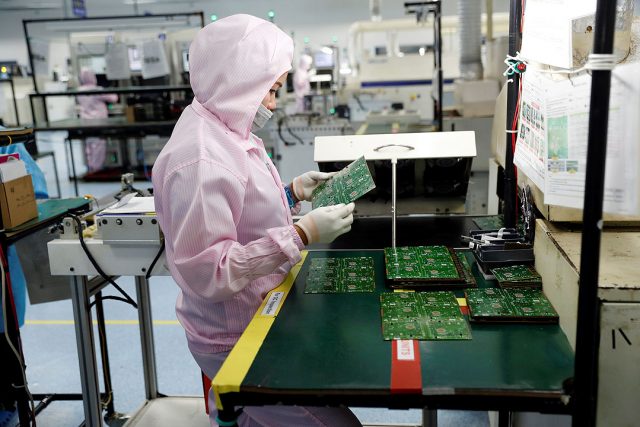
THE Semiconductor and Electronics Industries in the Philippines, Inc. (SEIPI) said the proposed 100% tariff on semiconductors entering the US market would be “devastating” to Philippine exporters.

“The 100% tariff would be devastating,” SEIPI President Danilo C. Lachica said via Viber.

US President Donald J. Trump announced plans to impose tariffs on semiconductors shipped to the US, but offered to exempt companies manufacturing in the US or those that commit to do so, Reuters reported.

Mr. Trump’s broader reciprocal tariffs on major trading partners were set to take effect starting Aug. 7.

In the updated annex, five members of the Association of Southeast Asian Nations (ASEAN), including the Philippines, will be charged 19%. The other countries are Cambodia, Malaysia, Thailand, and Indonesia.

Even prior to the announcement of a 100% tariff on semiconductors, SEIPI had expected the US tariff to temper the industry’s export projections.

“70% of Philippine exports are semiconductors, or about $30 billion last year, and 15%, or about $6 billion, of semiconductor exports are US-bound,” Mr. Lachica said.

Meanwhile, Electronics Industry Association of the Philippines President Earl Lawrence S. Qua noted that “most of the larger semiconductor packaging houses already have operations in the US.” 

“These are the multinationals that have a multi-region footprint, which include the US. So I’m not sure how the tariffs will affect them; they could be insulated like Apple,” he said.

“Having said that, it will force locally owned players to think about expanding or at least investing in the US. But it could be very damaging in the short term,” he added.

Economy Secretary Arsenio M. Balisacan said that he does not expect the semiconductor tariffs to have an “adverse” impact, as the value added of semiconductors and electronics is not that high compared to other manufacturing exports.

“The second consideration is that while our electronics and semiconductor exports are hit by such changes in tariffs, a big chunk, a lot of our exports go to other countries. Maybe 80-90% of that goes to countries like China,” he said.

BCDA approves P53.5B in investments in first 7 months

Filinvest New Clark City (Artist’s Perspective)

THE Bases Conversion and Development Authority (BCDA) said it approved P53.5 billion worth of proposed investments in the first seven months.

In a statement on Thursday, the BCDA said approvals during the period rose 63.82% from a year earlier.

These projects are expected to generate 7,000 jobs in New Clark City in Tarlac and Camp John Hay in Baguio. The year-earlier jobs-generation tally for approved proposals had been 6,544.

BCDA President and Chief Executive Officer Joshua M. Bingcang said the proposals reflect growing investor confidence in BCDA-managed economic zones.

“These numbers represent opportunities for thousands of Filipinos and signal the private sector’s trust in our vision of resilient, smart, and inclusive cities,” he added.

The approvals include projects of Science Park of the Philippines, Inc. which signed a 50-year contract to develop a 100-hectare industrial park in New Clark City worth P2.7 billion.

The BCDA also approved investments by the consortium of Sta. Clara International Corp., Saekyung Realty Corp., and Korea Overseas Infrastructure and Urban Development Corp., as well as by the Bangko Sentral ng Pilipinas, which is setting up a new complex in New Clark City.

Other investors include Ayala Land, Inc., Stern Real Estate, Top Taste and Trading, Inc., Amare La Cucina, and Prime Collective Corp. in Camp John Hay.

“As we drive progress in Central and Northern Luzon, we are proving that government-led development can attract private capital, unlock economic potential, and transform entire regions,” Mr. Bingcang said.

He said approval levels “underscore the growing momentum behind public-private partnerships in transforming government-owned developments into engines of economic growth.”

Earlier this year, the BCDA said it expects investments in Camp John Hay to hit P10 billion after it took over the property in January. — Justine Irish D. Tabile

60-day rice import freeze not seen as inflationary

PHILSTAR FILE PHOTO

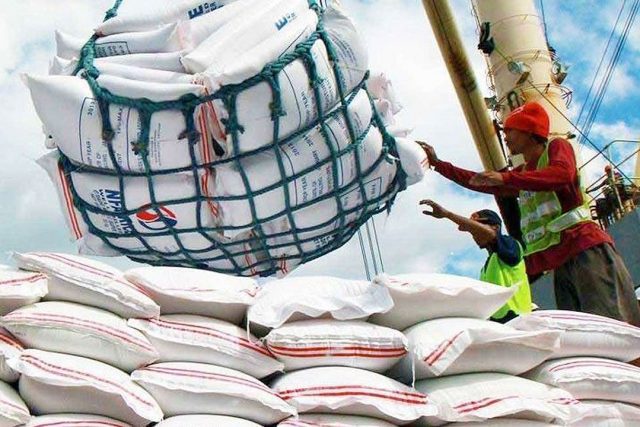
THE suspension of rice imports for 60 days is not likely to drive inflation due to ample supplies of the staple grain, the Department of Economy, Planning, and Development (DEPDev) said.

“Even if we suspend import during the harvest — that is, September and October — there will be enough supply. The availability of rice is close to what it is during normal times. It’s not likely going to cause increases in inflation,” Economy Secretary Arsenio M. Balisacan said at a briefing on Thursday.

On Wednesday, President Ferdinand R. Marcos, Jr. ordered a 60-day suspension of rice imports starting Sept. 1 to provide relief to farmers who have been offered low farmgate prices for their grain, and are counting on good prices for the harvest.

Inflation slowed to a near six-year low in July at 0.9% as utilities and food costs continued to ease. For the first seven months, inflation averaged 1.7%, running ahead of the Bangko Sentral ng Pilipinas forecast of 1.6% for 2025.

Mr. Balisacan cited estimates that supply will remain sufficient even if the government pauses imports for more than 40 days.

The Philippines is the world’s biggest rice importer, having brought in 2.44 million metric tons (MMT) at the end of July, according to the Bureau of Plant Industry.

In 2024, the Philippines imported 4.7 MMT, with volumes expected to exceed that level this year.

Asked if economic managers have reached a consensus on whether to raise the rice import tariff  to the original 35% level set by the Rice Tariffication Law of 2019, Mr. Balisacan said they are still studying “long term” measures.

“We want a permanent solution — one that is administratively affordable and predictable — so that farmers can be protected from sharp price swings. It’s okay to have some fluctuations; that’s expected due to seasonality,” he said.

Mr. Balisacan also cited circumstances that are different from when the government slashed the import tariff to 15% last year

“When the rice tariff was reduced from 35% to 15%, world prices were quite high, close to $600 per metric ton. Now it’s down to almost $450-$490 per metric ton. It’s a 31% drop in world prices,” he said.

“Of course, we have to keep watching and looking vigilant because world prices can change suddenly as well and we need to make sure that our policy is flexible enough to address all these changes in the marketplace,” he said. — Aubrey Rose A. Inosante

New ERC chairman sees rate review backlog cleared within four years

THE incoming chairman of the Energy Regulatory Commission (ERC) committed to clearing the backlog of rate reset applications within four years by streamlining the review process.

“Within four years, we will complete the rate reset of all private distribution utilities under the performance-based regulation,” ERC Chairperson and Chief Executive Officer Francis Saturnino C. Juan said during the turnover ceremony on Thursday.

Mr. Juan hopes to streamline the rate reset process by revising the rules for setting distribution wheeling rates.

Under the Electric Power Industry Reform Act (EPIRA) of 2001, the ERC is tasked with establishing the method for setting transmission and distribution wheeling rates. The rates must be set in a way that allows the recovery of “just and reasonable costs and a reasonable return on rate base,” enabling the entity to operate viably.

The rate reset process is typically a forward-looking exercise that requires the regulated entity to forecast expenditures and propose projects over a five-year regulatory period. The ERC assesses the actual performance of the entity and adjusts rates as needed.

Mr. Juan said that the process should be streamlined by proceeding directly to the release of the decision instead of undergoing draft consultations.

“If possible, once the hearings are done and all documents and evidence have been submitted, the ERC should go ahead and make a decision,” he said. “If the utility is not satisfied or wants something changed, it can still file a motion for reconsideration.”

Mr. Juan is set to take the helm of the ERC on Aug. 8, replacing the outgoing Monalisa C. Dimalanta, who submitted her irrevocable resignation in July.

Separately, in a notice, the ERC rejected the joint application of Province of Siquijor Electric Cooperative (Prosielco) and S.I. Power Corp. (Sipcor) to implement their supplemental agreement.

The ERC instead, directed the firms to comply with their obligations under the original power supply agreement, which was approved in 2012.

“Upon evaluation, the Commission determined that the supplemental agreement effectively amended the original agreement that was approved by the Commission, and there was already a commitment to supply what they wanted to cover in the supplemental agreement,” Ms. Dimalanta said.

“So, it seems the Commission no longer saw the necessity for that supplemental agreement if they comply with the original agreement,” she said.

Mr. Juan said that the power issue in Siquijor will be one of the first items the Commission will tackle during his term.

“We will study what the best course of action is to protect the interests of the consumers in Siquijor,” he said. — Sheldeen Joy Talavera

Deals with India seen unlocking economic ties, tourist exchanges

NOEL PABALATE/PPA POOL

DEALS signed between India and the Philippines are expected to accelerate the growth of business exchanges and leisure travel, officials said.

In a statement on Thursday, the Department of Tourism (DoT) said both countries agreed to the Implementation Program on Tourism Cooperation for 2025-2028 on Aug. 5.

Tourism Secretary Ma. Esperanza Christina G. Frasco said the deal signing will serve as a catalyst for raising Indian tourist numbers in the Philippines.

“We reaffirm our commitment to work together in unlocking the full potential of our tourism linkages — from policy exchange and capacity building to investment promotion and cultural tourism,” she said.

“Under the Marcos administration, we continue to advance our efforts toward strengthening global partnerships to bring more tourists to our shores while showcasing the best of Filipino hospitality, culture, and destinations to the world,” she added.

The Implementation Program is designed to facilitate mutual tourism growth and promote people-to-people exchanges.

It outlines joint initiatives between the Philippines and India, including the exchange of best practices and sustainable and responsible tourism.

“The program also highlights mutual efforts to encourage exchanges between tourism professionals and stakeholders, joint promotion and marketing, education and training, and tourism management and operations,” the DoT said.

According to the DoT, arrivals from India totaled 51,116 in the first seven months.

The DoT expects this to increase “with the easing of visa restrictions and establishment of direct flights between Delhi and Manila.”

Meanwhile, the Department of Trade and Industry (DTI) said a memorandum of understanding (MoU)  was signed by the Federation of Indian Chambers of Commerce and Industry and a Philippine-based Indian business association.

“This partnership is a strong symbol of the growing economic ties between the Philippines and India,” Trade Secretary Ma. Cristina A. Roque said in a statement.

“It reflects our shared commitment to advancing trade, promoting investment, and creating more opportunities for collaboration between our business communities,” she added.

The MoU aims to strengthen cooperation on trade promotion and information exchange and facilitate partnerships between Philippine and Indian businesses.

“The MoU builds on a similar agreement first signed in 2019 and expands cooperation to include information-sharing on trade regulations, support for policy advocacy, and coordinated efforts to host delegations and business forums,” the DTI said.

“By formalizing these channels, Filipino and Indian companies are expected to gain faster access to each other’s markets and benefit from simplified procedures for trade and investment activities,” it added.

The DTI said the MoU complements ongoing initiatives to position the Philippines as a hub for manufacturing, services, and technology-driven enterprise.

“The renewed MoU comes as both nations explore opportunities in sectors ranging from pharmaceuticals and information technology to agribusiness and consumer goods, areas where synergies between Indian innovation and Philippine market potential are increasingly being recognized,” the DTI added. — Justine Irish D. Tabile

Port cargo volume up 5.48% in 2nd quarter

ICTSI

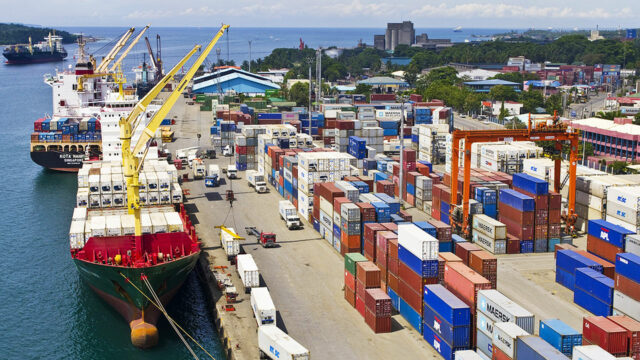
THE Philippine Ports Authority (PPA) said port cargo volume grew 5.48% in the second quarter, mainly driven by foreign shipments.

Citing preliminary data, the PPA said ports under its jurisdiction handled 83.30 million metric tons in the quarter.

Domestic cargo throughput totaled 29.54 million metric tons.

Foreign cargo throughput was 53.76 million metric tons, up 3.74% year on year.

PPA container ports serviced 2.14 million twenty-foot equivalent units (TEUs), up 10.31% from a year earlier.

Passenger traffic rose 13.74% to 26 million in the second quarter.

For the six months to June, cargo throughput rose 7.76% to 149.23 million metric tons.

Container traffic amounted to 4.18 million TEUs, up 11.8% from a year earlier.

In a separate statement, the PPA said it generated P14.68 billion in revenue in the first six months, up 13.70% from a year earlier due to higher vessel and cargo traffic. — Ashley Erika O. Jose

PCCI plans five more trade missions this year

THE Philippine Chamber of Commerce and Industry (PCCI) said it will be participating in five more foreign trade missions this year to help attract new investment to the Philippines.

“We are hoping to showcase the Philippines as the new investment hub,” PCCI President Enunina V. Mangio told reporters on the sidelines of the Metro Manila Business Conference at Seda Vertis North on Thursday.

She said that the PCCI will be taking part in trade missions to Vietnam, Australia, South Korea, Qatar, and Italy.

“We are hoping for further collaboration,” she added.

“In Korea, we’re looking at manufacturing. They are very much interested in our manufacturing,” she said. “They are also interested in digitalization and infrastructure.”

She also noted Korean interest in partnerships for road and bridge projects in Bohol.

Australia, meanwhile, will host a global summit for business chambers.

“We’re looking forward to meeting some business groups interested in expanding their businesses here in the Philippines,” she said.

She said a visit to Japan yielded an offer to train workers to make them hireable by Japanese companies.

In particular, she said Japanese companies will be sponsoring Filipinos for language studies.

“During our visit there, four companies expressed interest in expanding their business in the Philippines,” she added.

She said she expects Philippine exports to continue growing this year with exporters enhancing their product offerings.

“For this Christmas season, we’re trying to help exporters of Christmas decorations, furniture, and all that. I still believe, as far as our exporters are concerned, that our quality has improved a lot,” she said.

“I think our export market will expand … I can see that our exporters are working hard to improve their products,” she added.

She expects more handicrafts business towards the end of the year from the US and Europe. — Justine Irish D. Tabile

PHL stocks inch down on GDP report, tariff fears

PHILIPPINE STAR/KRIZ JOHN ROSALES

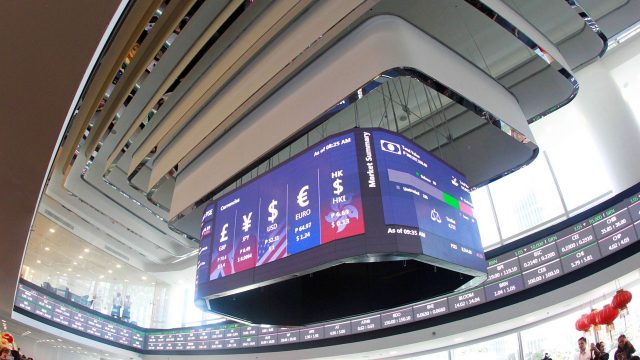
PHILIPPINE STOCKS edged lower on Thursday to end a four-day climb as the market reacted to second-quarter gross domestic product (GDP) data and amid renewed tariff concerns following fresh threats from US President Donald J. Trump.

The bellwether Philippine Stock Exchange index (PSEi) slipped by 0.09% or 5.96 points to close at 6,364.69, while the broader all shares index went down by 0.1% or 3.90 points to end the trading session at 3,776.06.

“The local market declined this Thursday… as investors digested our second quarter GDP data. Economic growth came in at 5.5%, posting a marginal improvement from the prior quarter’s 5.4% and slower than the same period last year’s 6.5%,” Philstocks Financial Inc. Research Manager Japhet Louis O. Tantiangco said in a Viber message.

“The PSEi closed at 6,364.69, down by 0.09%, as the market absorbs the recent GDP news. Some investors might have expected stronger results following the solid performance of the agriculture sector,” Regina Capital Development Corp. Head of Sales Luis A. Limlingan said in a Viber message.

The second-quarter GDP expansion matched the 5.5% median forecast in a BusinessWorld poll of 17 economists as well as the lower end of the government’s 5.5%-6.5% target for this year.

For the first half, Philippine economic growth averaged 5.4%, a tad below the government’s goal.

“US President Donald J. Trump’s plan to impose 100% tariffs on semiconductor and chip imports except for firms producing in the US also weighed on market sentiment,” Mr. Tantiangco added.

“Moreover, several companies released their earnings today, impacting both the index and the broader market,” Mr. Limlingan said.

Majority of sectoral indices closed lower on Thursday. Industrials sank by 1.52% or 139.68 points to 9,010,54; holding firms went down by 1.38% or 73.84 points to 5,277.65; property retreated by 0.24% or 5.83 points to 2,417.14; and mining and oil slipped by 0.53 point to 9,210.04.

Meanwhile, services climbed by 2.04% or 46.77 points to 2,329.05; and financials went up by 0.61% or 13.57 points to 2,204.3.

“International Container Terminal Services, Inc. was the top index gainer, climbing 2.7% to P494. Monde Nissin Corp. was the main index laggard, plunging 9.81% to P7.17,” Mr. Tantiangco said.

Value turnover went down to P6.27 billion on Thursday with 685.52 million shares traded from the P6.78 billion with 664.92 million issues exchanged on Wednesday.

Decliners outnumbered advancers, 124 versus 73, while 42 names were unchanged.

Net foreign buying decreased to P153.38 million on Thursday from P211.85 million on Wednesday. — Revin Mikhael D. Ochave

Marcos urges assertive global action amid tensions in Indo-Pacific region

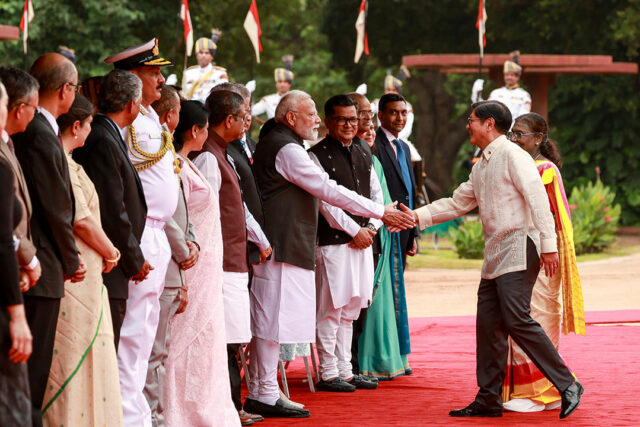
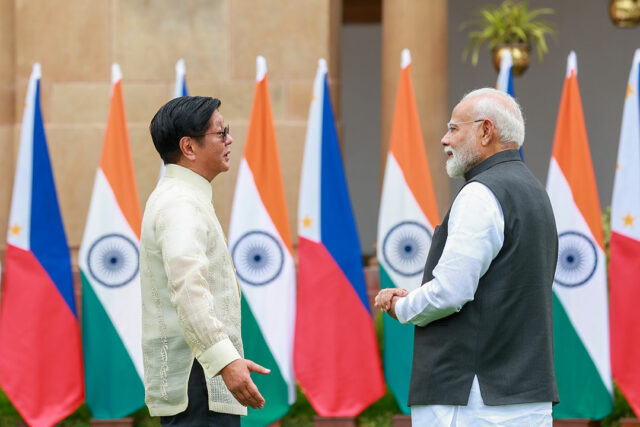
PRESIDENT Ferdinand R. Marcos, Jr. is welcomed by Indian Prime Minister Narendra Modi in New Delhi in this photo dated Aug. 5. — NOEL PABALATE/PPA POOL

PRESIDENT Ferdinand R. Marcos, Jr. on Wednesday called on like-minded nations to take a stronger, more assertive role in defending the rules-based international order, warning that rising global tensions and the erosion of multilateral norms are endangering the post-World War II system.

Speaking at the Observer Research Foundation’s Indo-Pacific Oration in New Delhi, Mr. Marcos said traditional powers are becoming increasingly inward-looking, creating space for provocations that threaten global stability — particularly in the Indo-Pacific region.

“There are those who sometimes justify such provocations under the pretext of geopolitics,” Mr. Marcos said, according to an official transcript released by Malacañang.

He took particular aim at how the international community has treated disputes in the South China Sea, where the Philippines has maritime tensions with China.

“The complex issue of competing claims in the South China Sea has, for years, been unfortunately and simplistically reduced to ‘the South China Sea disputes,’ as if claims were all equal. They are not,” he said.

Mr. Marcos cited the importance of international law, citing the 1982 United Nations Convention on the Law of the Sea (UNCLOS) and the 2016 arbitral ruling that rejected China’s expansive claims in the disputed waterway.

He reiterated Manila’s commitment to upholding these legal frameworks and urged other nations to do the same.

His remarks came as the Philippines and India elevated their bilateral relationship to a strategic partnership during his five-day state visit to India.

The visit, which comes at a time of intensifying power competition in the Indo-Pacific region, has focused on strengthening cooperation in defense, trade and maritime security.

Mr. Marcos said India’s foreign policy reflects the type of trust and responsible behavior the Philippines seeks in its partners, contrasting it with what he implied was China’s increasingly provocative posture.

The visit also coincided with another point of contention: the fallout from China’s Aug. 4 launch of a Long March 12 rocket, which reportedly resulted in debris falling into Philippine waters between Puerto Princesa and the Tubbataha Reefs in the Sulu Sea.

“The Philippines notes with concern China’s launch,” said Foreign Affairs Secretary Ma. Theresa P. Lazaro, as quoted in an earlier Palace briefing.

The government has since said it would examine the incident further for any possible violations, while the Philippine Space Agency confirmed the debris drop zone was near the country’s maritime territory.

Mr. Marcos’ call to action reflects the Philippines’ broader strategy of diversifying its alliances and encouraging a coalition of democracies to push back against coercive behavior in the region.

About $3.36 trillion worth of global trade passes through the South China Sea annually, underscoring the economic and strategic stakes.

The Philippine leader is in India for a five-day state visit at the invitation of Prime Minister Narendra Modi. He met earlier this week with both Mr. Modi and Indian President Droupadi Murmu to reaffirm defense and economic ties between the two democracies.

India remains one of the Philippines’ most significant trading partners, with bilateral trade reaching $3.53 billion in fiscal year 2023–2024, up from $3.05 billion the year before, based on data from the Indian Embassy in Manila.

India exports engineering goods, auto parts, electronics, petroleum, steel, medicines, chemicals, rice, and meat to the Philippines. In turn, the Philippines exports electrical machinery, semiconductors, copper, lead, plastics, precious stones and animal feed.

The Philippines also imports about 20% of India’s pharmaceutical exports to Southeast Asia, making it a key partner in the region’s healthcare supply chain.

The state visit comes amid the 75th anniversary of diplomatic relations between the Philippines and India. In June, the Philippines started granting visa-free entry to Indian nationals, which is expected to boost tourism and business travel and further strengthen bilateral ties. — Chloe Mari A. Hufana

PHL, India ink 18 business deals as Marcos pushes strategic economic ties

PRESIDENT Ferdinand R. Marcos, Jr. and the Philippine delegation at the Philippines-India Business Forum in Bengaluru, India on Aug. 7. — NOEL B. PABALATE/PPA POOL

THE PHILIPPINES and India signed 18 business agreements on Thursday, expanding economic cooperation across key sectors such as renewable energy, education, information technology, manufacturing and digital services.

“These agreements serve as tangible outcomes of our collaborative efforts and will serve as the foundation for ongoing and future business engagements between the Philippines and India,” Trade Secretary Maria Cristina Aldeguer-Roque told a business forum in Bangalore, India’s tech hub.

Her remarks were aired via a livestream on Radio Television Malacañang’s (RTVM) YouTube channel.

The agreements mark a significant development in Manila’s push to diversify trade partnerships as President Ferdinand R. Marcos, Jr. leads a Philippine delegation on a five-day state visit to India.

The two nations recently elevated ties to a strategic partnership and are working towards a preferential trade agreement.

Indian investment in the Philippines stands at about $5 billion, spanning industries such as pharmaceuticals, agriculture, information technology services, healthcare and textiles.

A trade deal with India will give the Philippines access to a market of more than 1.4 billion people and aligns with Mr. Marcos’ broader strategy to strengthen economic ties across the Indo-Pacific region.

“Our young, skilled, English-speaking workforce continues to attract global investment, making us a preferred destination for talent,” Mr. Marcos told Indian business leaders. “Our policy direction is very clear — to make the Philippines a trusted, connected, and competitive node in the Indo-Pacific economy.”

He highlighted key economic reforms aimed at improving the country’s investment climate, including the Corporate Recovery and Tax Incentives for Enterprises (CREATE) More Act, the Public-Private Partnership (PPP) Code and green lanes for strategic projects.

He also cited the newly enacted enterprise-based education and training law designed to align the workforce with industry needs.

The President cited the Philippines’ roadmap for long-term industrial cooperation in six priority areas — electric vehicles, advanced electronics, renewable energy, high-tech agriculture, healthcare and cybersecurity.

Mr. Marcos also highlighted the Philippines’ interest in joint ventures with Indian firms in smart manufacturing, mineral processing, shipbuilding and data center infrastructure.

“We see a strong alignment with Indian industries’ global footprint and a tremendous potential for shared success,” he added.

India remains one of the Philippines’ top trading partners, with bilateral trade reaching $3.53 billion in fiscal year 2023–2024, up from $3.05 billion a year earlier, according to the Indian Embassy in Manila.

India exports engineering goods, medicines, chemicals, rice, meat, and electronics to the Philippines, while the Philippines ships semiconductors, copper, plastics, and animal feed in return. — Chloe Mari A. Hufana

Marcos says Philippines open to joining BRICS bloc

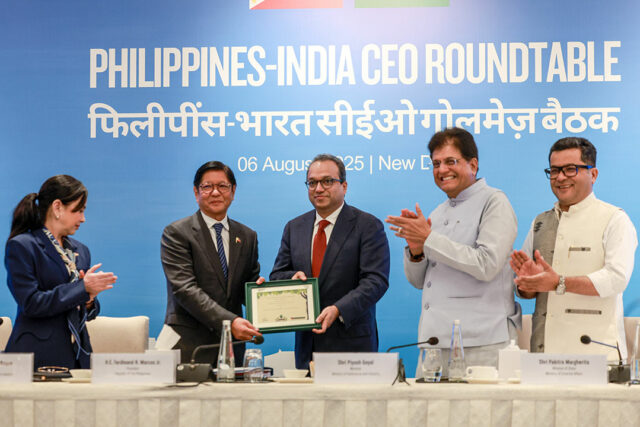
PRESIDENT Ferdinand R. Marcos, Jr. at the Philippines-India Chief Executive Officer (CEO) Roundtable in New Delhi on Aug. 6. — NOEL B. PABALATE/PPA POOL

By Chloe Mari A. Hufana, Reporter

PRESIDENT Ferdinand R. Marcos, Jr. said the Philippines is open to the possibility of joining the BRICS bloc, as Manila seeks to expand its global partnerships amid shifting geopolitical dynamics.

“I’ll certainly be open to it,” he told India-based news outlet Firstpost in an interview posted on its YouTube channel. “I haven’t given it a lot of thought… We’d have to certainly look into it, but it provides us more options.”

The President noted that while Manila is not “necessarily” planning to join the bloc now, the idea could be studied further with his Cabinet. “We’re too concerned looking internally — how to make the economy work, how to bring growth, how to create jobs… so well, it’s a thought,” he added.

His remarks come during a five-day state visit to India that ends on Aug. 8, during which he met with Indian President Droupadi Murmu and Prime Minister Narendra Modi to deepen diplomatic and economic ties.

The trip coincides with growing interest in alternative platforms for trade and development among developing countries.

BRICS — originally comprising Brazil, Russia, India, China, and South Africa — expanded its membership to include Egypt, Ethiopia, Iran, Saudi Arabia, the United Arab Emirates, and briefly, Argentina.

Indonesia officially joined the bloc in January. BRICS nations now account for over 40% of the world’s population and about the same share of global economic output, according to International Monetary Fund (IMF) data.

The expansion highlights BRICS’ appeal to emerging economies seeking alternatives to Western-dominated institutions such as the Group of Seven (G7), especially amid global uncertainties driven by US President Donald J. Trump’s return to power.

Josue Raphael J. Cortez, a diplomacy lecturer at De La Salle-College of St. Benilde, said the Philippines’ possible interest in BRICS aligns with its foreign policy trajectory.

With Southeast Asian peers like Indonesia, Vietnam, Thailand and Malaysia already involved, BRICS offers a platform to engage in multipolar cooperation, he said.

“Undoubtedly, this may be viewed by its Western partners as a way of policy shifting,” he said in a Facebook Messenger chat, citing the US’ cautious stance toward the group. “However, in light of recent political and economic developments, there is nothing erroneous with such a move if ever.”

Mr. Marcos’ openness to BRICS comes just weeks after his meeting with Mr. Trump at the White House, where both sides reaffirmed defense cooperation.

The Philippines’ possible membership in a bloc with key American rivals Russia, China, and Iran may signal policy-shifting, as it has always been proactive in strengthening ties with existing alliances.

“But the times we are in call for us to expand our cooperation with groups, regardless of ideological and political nuances,” Mr. Cortez said.