Home Blog Page 7371

Fort Pilar assigns right to buy Malaya plant

FORT Pilar Energy, Inc. has transferred its right to buy the government’s 650-megawatt Malaya thermal power plant in Pililla, Rizal to its subsidiary Belgrove Power Corp.

In a statement issued on Monday, state-run Power Sector Assets and Liabilities Management Corp. (PSALM) said it had approved Fort Pilar’s request to assign the right to Belgrove.

“PSALM considered the request for assignment only after ascertaining the assignee’s juridical existence and financial capability through a rigorous evaluation process and upon obtaining Fort Pilar’s acceptance of the additional conditions that it will become…liable with Belgrove,” PSALM President and Chief Executive Officer Irene Besido-Garcia said.

The next step in Malaya plant’s privatization is the filing of the required documents with the Philippine Competition Commission (PCC), which will issue a certificate of non-coverage. PSALM will be the one to secure the certificate.

“Within two business days from the receipt of clearance from PCC, PSALM will proceed with the issuance of certificate of effectivity to Belgrove,” the company said.

A closing date will be set within 30 days from Belgrove’s receipt of the certificate of effectivity.

Last month, PSALM declared Fort Pilar as the winning bidder after it submitted the highest offer of P3.12 billion for the plant and its underlying land. The offer is higher than the minimum price set by the state firm at P1.84 billion.

Fort Pilar subsequently passed the post-qualification process on June 2.

Joseph Omar A. Castillo, the firm’s chief executive officer, earlier said that Fort Pilar would build a “modern” energy facility in the plant’s location. The project is aimed at boosting power supply in Luzon.

According to the Department of Energy, PSALM was shelling out P1.2 billion annually to maintain the Malaya plant. The firm previously sought approval to pursue a negotiated sale for the asset after years of failed auctions. — Angelica Y. Yang

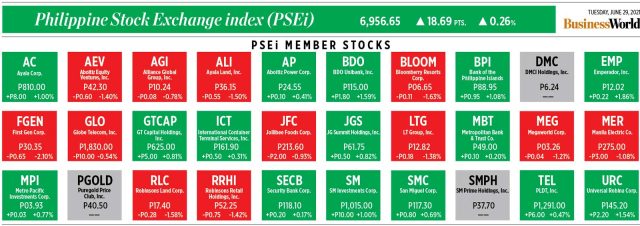
How PSEi member stocks performed — June 29, 2021

Here’s a quick glance at how PSEi stocks fared on Tuesday, June 29, 2021.


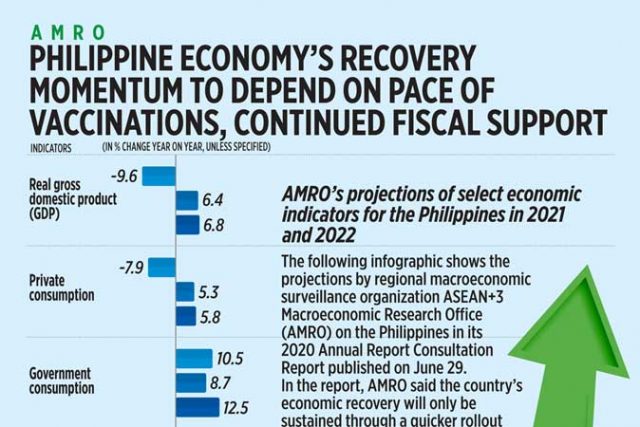
Philippine economy’s recovery momentum to depend on pace of vaccinations, continued fiscal support

THE ASEAN+3 Macroeconomic Research Office (AMRO) tempered its economic growth forecast for the Philippines this year due to a resurgence in coronavirus disease 2019 (COVID-19) infections coupled with a sluggish vaccine rollout, highlighting the need for the government to boost fiscal support to minimize economic scarring. Read the full story.

Philippine economy’s recovery momentum to depend on pace of vaccinations, continued fiscal support

Peso rises as Metro Manila remains under looser quarantine measures

BW FILE PHOTO

THE PESO strengthened versus the greenback on Tuesday after Malacañang announced that Metro Manila will remain under looser quarantine measures.

The local unit closed at P48.50 per dollar on Tuesday, gaining 14.5 centavos from its P48.645 finish on Monday, based on data from the Bankers Association of the Philippines.

The peso opened Tuesday’s session at P48.64 per dollar. Its weakest showing was at P48.67, while its intraday best was at P48.46 against the greenback.

Dollars exchanged decreased to $763.08 million on Tuesday from $993.3 million on Monday.

The peso rose after the government announced that Metro Manila will remain under looser restrictions until mid-July, boosting prospects of a further reopening of the economy, Rizal Commercial Banking Corp. Chief Economist Michael L. Ricafort said in a text message.

Coronavirus infections rose by 4,479 on Tuesday to bring the tally to 1.408 million, based on data from the Department of Health. Active cases stood at 50,037.

A trader meanwhile attributed the peso’s gains to preference for the local unit amid expectations of weaker US consumer confidence due to the impact of faster inflation on household spending.

For Wednesday, both Mr. Ricafort and the trader gave a forecast range of P48.40 to P48.60 per dollar. — LWTN

Shares inch higher as gov’t maintains restrictions

COURTESY OF PHILIPPINE STOCK EXCHANGE, INC.

PHILIPPINE shares inched up on Tuesday following the government’s decision to maintain quarantine restrictions in Metro Manila and nearby provinces.

The benchmark Philippine Stock Exchange index (PSEi) improved by 18.69 points or 0.26% to close at 6,956.65, while the broader all shares index gained 17.76 points or 0.41% to end at 4,262.37.

“The index traded slightly lower for most of the session as investors digested the government’s decision to keep the GCQ (general community quarantine) with some restrictions status for NCR (National Capital Region), and MECQ (modified enhanced community quarantine) for several areas such as Davao and Iloilo city from July 1 to July 15,” AB Capital Securities, Inc. Junior Equity Analyst Lance U. Soledad said in a Viber message.”

“The PSEi inched higher on another low-volume, sleepy, no-action trading session for blue chips. The government basically maintained current mobility restrictions for another month, which was no surprise, and drew no reaction from investors,” AAA Southeast Equities, Inc. Research Head Christopher John Mangun said in an e-mail.

“Most Asian stock markets ended with some losses on concerns of potential COVID-19 outbreaks because of the new Delta strain,” he added.

Malacañang announced on Tuesday that Metro Manila, Rizal, and Bulacan will remain under GCQ with “some restrictions” while Laguna and Cavite are still under GCQ with “heightened restrictions” until July 15.

Majority of sectoral indices closed in the green on Tuesday except for property, which lost 23.28 points or 0.68% to 3,380.83; and industrials, which declined by 10.51 points or 0.1% to end at 9,627.

Meanwhile, financials gained 22.35 points or 1.5% to close at 1,511.46; holding firms went up by 42.13 points or 0.6% to 6,985.50; services inched up by 5.49 points or 0.34% to 1,582.94; and mining and oil improved by 5.97 points or 0.06% to end at 9,456.91.

Value turnover decreased to P5.21 billion with 1.82 billion shares switching hands on Tuesday, from the P5.35 billion with 1.59 issues traded the previous day.

Decliners beat advancers, 113 against 96, while 41 names closed unchanged.

Foreigners turned sellers anew as they logged P379.35 million in net outflows on Tuesday versus the P336.82 million in net purchases seen on Monday.

Analysts expect the index to test the 7,000 resistance level in the coming days ahead of key data releases.

“We expect sideways trading for now… as investors await key economic data such as manufacturing PMI (purchasing managers’ index) and inflation,” AB Capital Securities’ Mr. Soledad said.

“The PSEi will continue to hover around the psychological 7,000 level until investors gain or lose confidence in the economy’s situation. In the meantime, investors will continue to look for opportunities in the broader market,” AAA Southeast Equities’ Mr. Mangun said. — Keren Concepcion G. Valmonte

Manila remains under lockdown until mid-July

PHILIPPINE STAR/ MICHAEL VARCAS

By Kyle Aristophere T. Atienza and Vann Marlo M. Villegas, Reporters

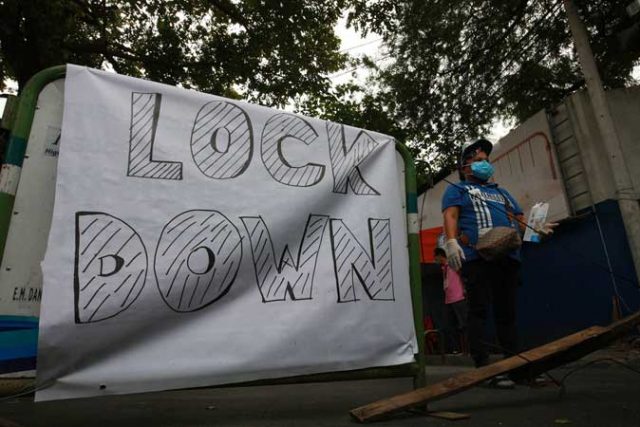
MANILA, the capital and nearby cities and provinces will remain under a general lockdown with fewer restrictions until July 15, according to the presidential palace, as it extended the travel ban on India and its neighbors until mid-July.

Also covered by the travel ban are Pakistan, Sri Lanka, Bangladesh, Nepal, Oman and the United Arab Emirates, presidential spokesman Herminio L. Roque, Jr. told a televised news briefing on Tuesday.

Coronavirus infections in the National Capital Region were decreasing, Health Undersecretary Leopoldo J. Vega told the same briefing. The Bicol region, Western Visayas, Caraga, Zamboanga Peninsula, Northern Mindanao and Davao region were experiencing surge, he added.

Aside from Metro Manila, the provinces of Bulacan and Rizal were also placed under a general community quarantine with some restrictions. Laguna and Cavite will remain under a general lockdown with tightened restrictions.

Fitness studios were allowed to operate at 40% of their capacity in areas under a general lockdown with some restrictions, Mr. Roque said. Indoor dining was also allowed at 40% capacity, while outdoor dining was allowed at 50% capacity.

The provinces of Ifugao, Isabela, Nueva Vizcaya, Quirino and the cities of Baguio and Santiago in northern Philippines were placed under a general lockdown.

Also under a general quarantine are the provinces of Batangas and Quezon and several areas in central Philippines such as Guimaras, Aklan, Bacolod City, Negros Occidental, Antique and Capiz, Mr. Roque said.

General Santos City, Sultan Kudarat, Sarangani, Cotabato, South Cotabato, Cotabato City, Zamboanga Sibugay, Zamboanga City, Agusan del Norte, Surigao del Norte and Agusan del Sur in southern Philippines would also be under a general quarantine.

Cagayan, Apayao, Bataan, Lucena City, Puerto Princesa and Naga City were placed under a modified enhanced community quarantine, Mr. Roque said. Twelve areas in coronavirus-hit Mindanao were also put under same lockdown level.

The rest of the country were placed under a modified general lockdown.

About 45% of intensive care unit (ICU) beds in the capital region had been used as of June 27. About 39% of isolation beds and about 23% of ward beds in the region were occupied.

About 57% of ICU beds in the country have been used, while about 47% of isolation beds and 44% of ward beds were occupied.

DAILY TALLY
The Department of Health (DoH) reported 4,479 coronavirus infections on Tuesday, bringing the total to 1.4 million.  The death toll rose by 101 to 24,557, while recoveries increase by 6,471 to 1.3 million, it said in a bulletin.

There were 50,037 active cases, 1.5% of which were critical, 90.4% were mild, 4.4% did not show symptoms, 2.1% were severe and 1.54% were moderate.

The agency said nine duplicates had been removed from the tally, seven of which were tagged as recoveries.

Twenty-eight recoveries were reclassified as active cases, while 75 cases tagged as recoveries were reclassified as deaths. Fourteen laboratories failed to submit data on June 27, the agency said.

About 13.9 million Filipinos have been tested for the coronavirus as of June 27, according to DoH’s tracker website.

The coronavirus has sickened about 182.2 million and killed 3.9 million people worldwide, according to the Worldometers website, citing various sources including data from the World Health Organization.

About 166.8 million people have recovered, it said.

Meanwhile, Health Undersecretary Maria Rosario S. Vergeire reminded the public to remain vigilant and not to be complacent in following the health protocols.

The situation in Metro Manila “is still very fragile,” she told a separate online news briefing. The daily infection average in the capital region was 666, still higher than the pre-surge level in January and February of about 300 cases, she pointed out.

The agency last week flagged increasing coronavirus infections in four regions in the Visayas and Mindanao.

The regions of Western Visayas, Caraga, Davao and Soccsksargen were at high risk, Health Director Alethea de Guzman told an onlne news briefing. Metro Manila and nearby provinces were now at low risk, she added.

Meanwhile, state insurer Philippine Health Insurance Corp. on said it would provide a compensation package to people who may get sick from vaccination.

Shirley B. Domingo, PhilHealth spokesperson and vice president for corporate affairs, said the benefits would cover hospitalization, permanent disability or death.

Under a PhilHealth circular, patients who get hospitalized are eligible to as much as P100,000 in benefits.

People who became permanently disabled or die will get a lump sum of P100,000. In case of death or permanent injury, their beneficiaries can claim the benefits on their behalf.

Ms. Vergeire said there had been no deaths due to coronavirus vaccines. No person who had been fully vaccinated has died of the coronavirus, she added.

About 10 million vaccine doses had been given out as of June 27, according to the Health department, more than 2.5 million of which were second doses.

The government targets to inoculate at least 500,000 people daily in Metro Manila, Rizal, Bulacan, Cavite, Laguna, Metro Cebu and Metro Davao to reach herd immunity by Nov. 27.


TV host acquitted of libel

THE Supreme Court (SC) has acquitted a radio and television host of libel, reversing an appellate court ruling in 2009.

In a Jan. 11 resolution published on Monday, the tribunal said prosecutors failed to prove that journalist Rafael “Raffy” T. Tulfo had acted with malice. Also cleared were the publisher and managing editor of Philippine tabloid Abante Tonite.

The libel case stemmed from a series of articles that Mr. Tulfo wrote for the tabloid in 1999 alleging illegal activities of a Bureau of Customs lawyer.

The court ruled the articles were about official functions of the lawyer that “refer to matters of public interest which the citizenry ought to know.” The written columns “fall within the purview of qualified privileged communications,” it said in the decision written by Justice Marvic M.V.F. Leonen.

The high court reminded journalists about ethics. “We regard the vital role that the media play in ensuring that the government and its officials remain true to their oath in carrying out their mandates in a manner prescribed by law,” it said.

“Nevertheless, the constitutionally protected freedoms enjoyed by the press cannot be used as a shield to advance the malicious propagation of false information carried out by unscrupulous entities to injure another’s reputation,” it added.

Meanwhile, a Manila trial court entered a not guilty plea for Rappler founder Maria Ressa and former reporter Rambo Talabong in their cyber-libel case after both refused to enter a plea during arraignment on Tuesday.

The complaint stemmed from a story written by Mr. Talabong and published on the news website in January 2020 about a scheme at De La Salle University-College of Saint Benilde where students allegedly paid P20,000 to pass their thesis subject.

Arrest warrants were issued against Ms. Ressa and Mr. Talabong based on a complaint file by a professor, but both posted bail worth P30,000 each. — Bianca Angelica D. Añago

Justice chief lukewarm to arming anti-crime civilian volunteers 

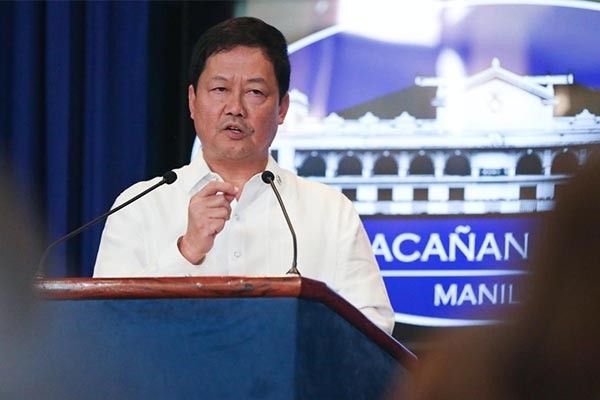
JUSTICE SECRETARY MENARDO I. GUEVARRA — PCOO.GOV.PH

JUSTICE Secretary Menardo I. Guevarra sees no need to arm civilian volunteer groups that will help in crime prevention, saying the police force is “strong enough to perform (its) duty” of protecting the people.

Mr. Guevarra made the statement to reporters Tuesday after President Rodrigo R. Duterte proposed the issuance of firearms to a new group of anti-crime volunteers that was launched Friday.

Police chief Guillermo Lorenzo T. Eleazar has expressed support to the recommendation.

The Justice chief, on the other hand, noted that gun ownership entails strict adherence to regulations.

“Except during the martial law period, civilians have always been free to arm themselves for their protection, provided they comply with all existing laws and regulations on the ownership, possession, and carrying of firearms outside residence, including the requirement to pass a neuro-psychiatric test,” Mr. Guevarra told reporters in a group message.

“Allowing them to band together and act like a vigilante group, however, is a totally different matter,” he said.

“Besides, except for a few high-profile incidents of violence, criminality on the streets is at an all-time low, due in part to the pandemic,” he added.

In a private mobile message, Mr. Guevarra explained that should anti-crime volunteers be given weapons, they “need to be properly screened, evaluated, and tested” as “there are existing laws on ownership and possession of firearms.”

Several lawmakers and human rights advocates have opposed Mr. Duterte’s suggestion saying it may lead to abuses and other crimes. — Bianca Angelica D. Añago 

DENR, NCIP start resolving indigenous peoples’ rights in protected areas

WIKIMEDIA COMMONS, ARIUS1998

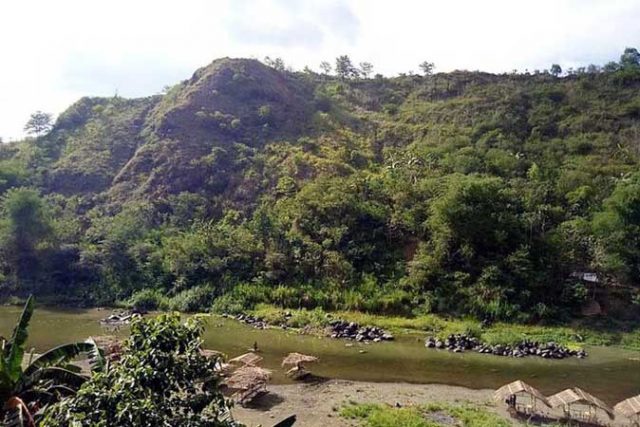
THE ENVIRONMENT department said on Tuesday that it has started a dialogue with the National Commission on Indigenous Peoples (NCIP) on addressing ancestral domain claims in protected areas, including the Upper Marikina River Basin Protected Landscape.

The talks aim to help the two government agencies resolve overlaps in implementing the National Integrated Protected Areas System (NIPAS) and the Indigenous People’s Rights Act (IPRA) of 1997.

“We really need to resolve with the NCIP what policy direction should be on the question of lands within protected areas that are subject to claims by our indigenous cultural communities,” Environment Undersecretary Jonas R. Leones said in an emailed statement.

A protected area is an identified portion of land or water “of physical and biological significance which must be protected against human exploitation.”

There are currently 244 declared protected areas across the country.

The Department of Environment and Natural Resources (DENR) estimates that these sites cover a total area of about 7.8 million hectares.

“The DENR and NCIP must work together to align our policies on conservation and protection measures in protected areas with the government’s program for the recognition, protection, and support of indigenous peoples’ rights in protected areas,” Mr. Leones said.

He explained that once a public land is awarded a certificate of ancestral domain title (CADT), it will be classified as private.

Indigenous communities that hold a CADT are not allowed to sell the land to private entities or non-tribe members.

MARIKINA WATERSHED
In the case of the upper Marikina River watershed, the Dumagat-Remontado indigenous group has a pending CADT application covering around half of the total land area.

“The DENR would effectively lose jurisdiction over half of (the area) should the NCIP decide that the claim is valid and issues a CADT,” he said.

The Environment department plans to strengthen over 800 hectares of the river bank through the planting of bamboos.

Last year, President Rodrigo R. Duterte ordered the Task Force Build Back Better, chaired by Environment Secretary Roy A. Cimatu, to oversee post-typhoon rehabilitation efforts in areas hit by typhoons Rolly and Ulysses, including the Marikina River. — Angelica Y. Yang

Grab PHL announces ‘Bayanihan’ program in support of vaccination drive

GRAB PHILIPPINES announced on Tuesday a program in support of the governments’ coronavirus vaccination drive wherein it will offer transport to jab sites with vaccinated GrabCar drivers.

The GrabCar Bayanihan aims to “provide safe mobility solutions for residents going to and from vaccination centers in Metro Manila,” Grab Philippines Country Head Grace Vera Cruz said at the Leading in Extraordinary Times 2021 online forum organized by the Makati Business Club.

In an e-mailed statement, Grab Philippines said the GrabCar Bayanihan was “initially beta-tested in Quezon City,” and it will pilot with “over a thousand vaccinated driver-partners.”

It will initially be available in Manila, Las Piñas, Taguig, Pasig, Makati, Quezon City, Pateros, and Marikina.

The company said it is also working with other local government units to extend GrabCar Bayanihan service to their residents.

GrabCar Bayanihan will provide livelihood opportunities for driver-partners within their respective cities of residence, the company noted.

“As we all work towards a safe and gradual recovery for our communities, Grab will continue to leverage its platform and technology to ensure that our kababayans (countrymen) have the means to get inoculated,” she added. — Arjay L. Balinbin

Addressing teenage pregnancies made a national priority

FREEPIK

PRESIDENT RODRIGO R. Duterte has signed an order recognizing the problem of teenage pregnancies in the country by making the implementation of “practicable” measures addressing its root causes as a national priority.

All government agencies, especially those involved in youth affairs, are directed to assist in finding solutions.

Under Executive Order No. 141, Mr. Duterte mandates all government agencies and instrumentalities to identify and implement “practicable” interventions to arrest adolescent pregnancies such as comprehensive sexuality education, education and employment opportunities for young people, and health promotion through media and communications.

Citing data from the Philippine Statistics Authority, the order said a total of 180,916 live births or 495 per day among adolescents aged 10-19 years were recorded in 2019.

Agencies should maximize the use of digital and online platforms in campaigning for responsible parenthood as well as raise awareness on the protection and promotion of reproductive health and rights, the order said.

Special focus should also be given to geographically isolated and depressed areas such as island towns, upland communities, and conflict-affected areas by empowering local offices and strengthening partnerships with civil society organizations and other stakeholders, the order said.

Among those that should be at the forefront of resolving teenage pregnancies are the Sangguniang Kabataan or local youth councils, National Youth Commission, and the Commission on Population and Development.

The order also tasks the Department of Budget and Management to ensure that the annual National Expenditure Program would “include initiatives for the prevention of adolescent pregnancies in the annual Budget Priorities Framework and its corresponding budget guidelines.” — Kyle Aristophere T. Atienza

NBI, IBP sign agreement to protect lawyers, judiciary members  

PHILSTAR FILE PHOTO

THE National Bureau of Investigation (NBI) and the Integrated Bar of the Philippines (IBP) signed a memorandum of agreement on June 25 to strengthen coordination and communication to prevent further attacks against lawyers and members of the judiciary.  

In a news release on Tuesday, the NBI said under the agreement, it committed to “provide timely assistance to lawyers, prosecutors, and magistrates in distress and extend appropriate security and protection in cases of threats or hazards in the performance of their duties and functions as may be allowed by law and regulations.”   

The IBP, meanwhile, “will provide legal assistance, through its legal aid program, to qualified NBI personnel who are unjustly harassed for doing their job and who do not have access to competent lawyers.”    

In addition, the lawyers’ group will provide a reward fund to encourage informants and witnesses in incidents of killing or attack against lawyers, prosecutors, and magistrates.   

The five-page document was signed by NBI Officer-in-Charge-Director Eric B. Distor and IBP President Domingo Egon Q. Cayosa. — Bianca Angelica D. Añago