Home Blog Page 7369

Jackson T. Ongsip named Pacific Online president, director

PACIFIC Online Systems Corp. has elected Jackson T. Ongsip as the company’s president and member of its board of directors to replace Willy N. Ocier and Ma. Virginia V. Abo-Hamda, respectively.

Mr. Ongsip will also take the place of Ms. Abo-Hamda at Pacific Online’s executive committee, joining Chairman Mr. Ocier and fellow member Armin Antonio B. Raquel Santos.

Pacific Online said in a disclosure to the exchange on Thursday that the corporate movements were implemented as the company “seeks to operationalize the good corporate governance principles that it has adopted for itself.” The move includes having different individuals holding the company’s chairmanship and presidency.

Changes are said to be effective immediately.

Mr. Ocier will be retaining his position as chairman of the company’s board of directors, while Ms. Abo-Hamda will remain the company’s chief financial officer.

Pacific Online’s new president and director, Mr. Ongsip, graduated from the University of Santo Tomas with a Bachelor of Science degree in Accountancy and is a Certified Public Accountant.

He has worked for several years in external audit with SyCip, Gorres, Velayo & Co., Globe Telecom, Inc. and the SM group of companies. He currently holds key positions in other listed companies.

Mr. Ongsip is currently the president and chief executive officer of holding company APC Group, Inc.; the executive vice-president, chief financial officer, and treasurer of Belle Corp.; vice-president for finance and chief financial officer and treasurer of Premium Leisure Corp.; and vice-president for portfolio investments of SM Investments Corp.

Pacific Online shares at the stock market closed unchanged on Thursday at two pesos apiece. — Keren Concepcion G. Valmonte

Stuff to do (10/08/21)

BGC Central Bark

BONIFACIO Global City (BGC), in partnership with Presidential Paws and PetMe, is opening BGC Central Bark, the newest off-leash dog park in Metro Manila. BGC Central Bark opened on Oct. 6. BGC and Taguig residents can enjoy free passes for a day in the park with their dogs. For more information and inquiries, visit the social media pages of BGC Central Bark on Facebook and on Instagram. Visit Bonifacio Global City’s Facebook page for the Central Bark FAQs.

Audience Choice films screening free

THE FIVE selected films for the Audience Choice Award at the Película-Spanish Film Festival will have a virtual screening on Oct. 10 at 6 p.m., through the festival’s platform www.pelikula.es. The film festival is ongoing until Oct. 10. The Audience Choice is an award given to the film that viewers have voted as the best of the festival, a tradition that began in 2004. Spectators of this year’s online festival can rate films after viewing them. The highest rated wins will be screened again on Oct. 10. The five selected films are: Fuera de Carta (Chef’s Special, 2008), about a chef who gets tangled in a love triangle with a maitre d’ and a handsome Argentinian soccer player; the Argentinian crime drama, El secreto de Sus Ojos (The Secret in their Eyes, 2009), which won the best foreign language film at the Academy Awards in 2009, tells the story of a judiciary employee and his boss as they investigate a rape and murder case; Tambien La Lluvia (Even the Rain, 2010), about a Mexican director and Spanish executive producer who travel to Bolivia and get tangled in the Cochamba Water War while shooting a film about Spanish conquest of the New World; Un Cuento Chino (2011) (Chinese Take-Away, 2011), is a comedy about a hardware shop owner and collector of strange stories, which he clips from newspapers, whose life turns upside down when a Chinese man comes to life from the backdoor of a taxi; Campeones (Champions, 2018), a dramedy about a basketball coach who, after a brawl, is forced to complete 90 days of social work, training a team of people with intellectual disabilities. Screening dates for Fuera de Carta are Oct. 8, 6 p.m. onwards, Oct. 9, whole day, and, Oct. 10, until 6 p.m.; for El secreto de Sus Ojos are Oct. 9, 4 p.m., Oct. 10, whole day, and Oct.11, until 4 p.m.; for Tambien La Lluvia are Oct. 9, 6 p.m., Oct.10, whole day, Oct. 11, until 6 p.m.; for Un Cuento Chino are Oct. 10, 4 p.m., Oct. 11, whole day, Oct. 12, until 4 p.m. Presented by the Instituto Cervantes de Manila and Sydney and the Spanish Embassies in the Philippines, Malaysia, Thailand, and Australia, the Película Spanish Film Festival is streaming four short films and 16 contemporary Spanish and Latin American feature films. All films will be available for free streaming with English subtitles at www.pelikula.es within 48 hours from their scheduled release.

Bb. Pilipinas send-off today

AS A TRADITION of Binibining Pilipinas (BBP), there will be an official send-off BBP Intercontinental 2021 Cinderella Faye Obeñita and BBP Globe 2021 Maureen Montagne today, 3 p.m., via the official Binibining Pilipinas Facebook page and YouTube channel. Binibining Pilipinas Charities, Inc., the reigning Binibining Pilipinas queens, as well as family and friends of Ms. Obeñita and Ms. Montagne in giving them warm wishes as they embark on their quest to bring home their respective international crowns.

Giveaways at Shopee’s 10.10 Brands Festival

AT SHOPEE’S 10.10 Brands Festival, there will be deals and discounts from trusted brands, plus free shipping with no minimum spend, ₱1,000 off brand vouchers, and Big Brand Giveaways amounting to ₱430,000 worth of prizes. Leading up to Oct. 10, there will be daily free vouchers, bundles, newly launched items, and even a lifetime supply of products from electronics, personal care, health, fashion, and home brands. To win the prizes and more, just follow the featured brands of the day. Over 80 winners will be drawn randomly. Set reminders for the giveaway schedule and check out the prizes here: https://shopee.ph/m/big-brand-giveaways. Aside from brand giveaways, shoppers can also win ₱100 worth of free money in the form of ShopeePay credits at the 10.10 Brands Festival. For more exclusive perks at the 10.10 Brands Festival, go cashless with ShopeePay when buying load, paying bills, and scanning to pay at thousands of merchants nationwide. Get up to 50% discount on load from Globe, Smart, TM, and TNT. Pay bills and get up to 50% cashback from Meralco, Maynilad, Globe, Smart, and a growing list of partner billers. Lastly, enjoy ShopeePay ₱1 Deals from Puregold, Potato Corner, Coffee Bean & Tea Leaf, Moonleaf, Seaoil, and other partner merchants. For more deals visit https://shopee.ph/m/10-10.

Global debt may hit 260% of GDP, but low rates to help, S&P says

GLOBAL DEBT LEVELS could reach about 260% of gross domestic product (GDP) by yearend, though low interest rates mean the ability to service it will be manageable, according to S&P Global Ratings.

The pile-on of debt was necessary given policy responses during the pandemic, Vera Chaplin, the credit ratings agency’s managing director and lead analytical manager, said on Thursday at the Asia Briefing Live forum co-hosted by Bloomberg and Asia Society Australia. Higher leverage and weakened credit metrics amid the recovery will probably trigger more defaults, she added. 

Ms. Chaplin said the recovery won’t be complete until vaccinations are widespread enough to make people more comfortable to move about, and that the pandemic hasn’t wrecked the “Asian century.”

Bruce Gosper, a vice-president at the Asian Development Bank and speaking on the same panel on Thursday, agreed the region’s recovery is underway and trade continues to rebound. Poverty reduction, however, has “more or less stalled across the region” and small businesses are still disproportionately struggling, he said.

“There is a new poor that’s emerging, mostly in urban areas” since agriculture has fared relatively better amid the crisis, he said. The ADB is focused on supporting informal workers who make up about two-thirds of the labor market in the economies they cover and are disproportionately women. — Bloomberg

Conducting an executive pay survey among friendly companies

We can’t afford to buy those expensive surveys by multinational consulting firms. Our hope was rekindled when I read your last column on the possibility that we could benchmark with some companies at least to compare the salaries and benefits of our executives. How is that possible? Could you give us more ideas? — Surprised Susan.

If you don’t ask, the answer is always no. The possibility of acceptance is possible if you ask more than 20 organizations to help you concretize your plan, not just for your company’s objectives but for all. Out of that number, there’s a better chance that two or three companies will respond favorably. That’s why it’s better to exhaust all possible options if you can’t afford to buy a salary report for $20,000.

As long as you understand the challenges, there’s always a big chance organizations will cooperate with you to gain a competitive advantage.

One caveat though. Some proponents of buying ready-made industry surveys say if you can’t afford to buy a $20,000 annual report, then how can you afford to increase the salary of people you care about? If you can’t afford it, then you can’t afford it. Period. You can’t make your compensation policy competitive the way you want it to be by starting on the wrong foot.

But I don’t want to disappoint you. To answer your question, I’m listing certain challenges that could make or break your plan to conduct a friendly benchmarking survey.

SIX CHALLENGES
First and foremost, how would you define a competitive pay package? Let’s take a sober look using this simple definition — anything within the general average of an industry standard. If most organizations are paying $150,000 a year to an executive, would you consider that as a standard? It’s not that simple. There are many factors to consider, including the basic ones listed below:

One, be honest and objective with your industry peers. Salaries are strictly confidential. HR people are prohibited from sharing their pay policies because of this commonly-accepted policy. But there’s a solution. Propose to do a kaliwaan or a handover of documents detailing pay structures (in sealed envelopes) with at least three organizations willing to do the same. Do this in one meeting with other participants.

Two, raise your profile in industry associations. It might be difficult to cold-call various companies. That’s why CEOs or their HR professionals join organizations like the People Management Association of the Philippines, the Employers Confederation of the Philippines, the Management Association of the Philippines and business associations within the same geographical area, in which they can nurture relationships with other executives.

Three, choose companies that are of similar size and structure. The priority is to compare notes with competitors. But this is impossible most of the time. Therefore, your next option is to identify companies within your geographical area with nearly the same number of workers and similar revenue, profits, assets, business longevity, and many other such characteristics.

Four, focus on key jobs that drive organizational success. Limit the survey only to positions occupied by people with “hot skills” or key executive jobs that are difficult to replace. My rule of thumb is not more than 10 key positions below the rank of President, Chief Executive Officer, Chief Operating Officer, Executive Vice-President, General Manager, and Senior Vice-President. This makes it easy for other companies to accept your proposal.

Five, define or redefine your compensation philosophy. Would you like your key people to receive the salary of those executives who are on top 90th percentile, 75th percentile, or 50th percentile or the median survey result? This is important to know before you think of conducting a focus group discussion with other organizations. Of course, you don’t have to divulge your intentions with those who are willing to participate in the survey.

Last, list down all related factors in the survey. This includes the education and seniority of the incumbents, how they ascended to high-end, their annual merit pay increase, and other related issues. This is to ensure an apples-to-apples comparison between and among target jobs. Sometimes, it’s also a good idea to talk about pay-for-performance as part of your pay philosophy.

OBJECTIVITY AND FAIRNESS
Some pundits say a person with six children is better satisfied with their salary than a childless person with six million dollars. Why is this so? That’s because money is not everything. If money is everything, then it’s only a matter of time before a dissatisfied person leaves for the highest bidder.

To avoid this, it’s important that an organization ensure the objectivity and fairness of its pay and perks policy. This can only happen if you buy an “expensive” industry study or by initiating a benchmarking survey with companies that are willing to participate.

Generally, people suffer from misconceptions about their earnings. It’s either they got their information from friends or people who know something about how organizations attract and retain their executives. The best way to put the issue to rest is by being professional with people.

And you can only do that if you’re armed with an annual survey.


Have a consulting chat with Rey Elbo on Facebook, LinkedIn, or Twitter or you can send anonymous questions to

elbonomics@gmail.com or via https://reyelbo.consulting

Nestlé Philippines commits to plant 3.5 million trees, bamboos in Mindanao

NESTLÉ Philippines, Inc. has pledged to plant a total of 3.5 million native trees and bamboos over the next three years in Mindanao, where the firm sources its coffee beans for its Nescafé brand.

In a virtual briefing on Thursday, Nestlé Philippines Chairman and Chief Executive Officer Kais Marzouki said that new initiative aims to plant 2.5 million bamboo clumps and one million native trees in the region.

“This reforestation effort supports Nestle’s global goal to plant 200 million trees by 2030, and it also forms part of the company’s plan to scale up actions in regenerative agriculture and deploy nature-based solutions to absorb greenhouse gases and therefore to help contribute to achieve our net zero targets by 2050,” he said.

The local unit of the global food and beverage company has teamed up with nonprofit One Tree Planted and private firm EcoPlanet Bamboo to implement the project, which aims to address deforestation in the Philippines.

Mr. Marzouki said the firm is targeting Mindanao because that is where it sources coffee beans for the Nestlé coffee brand.

“Nestlé’s reforestation initiative is also a pillar of the company’s ‘Forest Positive Strategy’ which looks beyond stopping deforestation to protecting and restoring forest over the long term. It aims to make a real positive impact on the critical agriculture areas where Nestlé sources its ingredients, and in this case, coffee,” he added.

Nestlé Global Climate Delivery Leader for Forests Emily Kunen said the first phase of planting activities will begin by August 2022.

Aside from native tree species, the initiative will also use tropical clumping bamboos or tree-like plants that are sturdy and can thrive on degraded soils, according to EcoPlanet Bamboo Co-Founder and Chief Operating Officer Camille Rebelo.

Nestlé Philippines’ announcement comes months after the firm promised to lessen virgin plastics consumption by a third and reduce 30% of its greenhouse gas emissions in local operations. This is in line with its goal of achieving net zero emissions not later than 2050. — Angelica Y. Yang

Entertainment News (10/08/21)

ABS-CBN gets 11 wins at creative arts awards

ABS-CBN got 11 national wins at the 2021 Asian Academy Creative Awards. iWantTFC’s original series He’s Into Her garnered three recognitions for ABS-CBN, including Best Original Program by a Streamer/OTT, Best Direction (Fiction) for director Chad Vidanes, and Best Theme Song for “He’s Into Her” by BGYO. The singing game show Everybody, Sing! also won as the nation’s Best Music/Dance Program, while Vice Ganda emerged as the Best Entertainment Program Host. The Best Single Drama/Anthology Episode went to Maalaala Mo Kaya (MMK) for its episode “Two Mothers” that starred Iza Calzado and Shamaine Buencamino. ABS-CBN stars also aced in the acting category: JM de Guzman was named Best Actor for Init sa Magdamag; Sylvia Sanchez and Nonie Buencamino won Best Supporting Actress and Best Supporting Actor respectively, for Huwag Kang Mangamba. In the news and current affairs category, the national winners include Karen Davila, who won as Best News Anchor for ANC’s Headstart, while Fedelina: A Stolen Life won the Best Documentary Program award. The country’s national winners will represent the Philippines in the regional awarding of the Asian Academy Awards that will be held in Singapore in December.

Pinoy films represent at 26th Busan Int’l Film Fest

TWO films, one project, and seven companies from the Philippines will take part in the 26th Busan International Film Festival in South Korea. This year’s film festival will be held in a hybrid live-online format from Oct. 6 to 15. Putting the spotlight on new or the most talked about films of the year by Asian filmmakers, this year’s “A Window on Asian Cinema” section features the new HBO Asia Original film Gensan Punch by Brillante Mendoza, and Erik Matti’s On the Job: The Missing 8. Gensan Punch is one of seven Asian films nominated for the Kim Jiseok Award. Participating in the Asian Project Market (APM), a co-production platform in Asia that offers emerging filmmakers the opportunity to meet leading international film professionals which runs from Oct. 12-14, are producer Armi Cacanindin and director Sigrid Andrea Bernardo with their project Happy Endings. The Film Development Council of the Philippines will host the online panel discussion “Co-Producing with the Philippines” and a virtual Philippine pavilion the 15th edition of Asian Contents & Film Market from Oct. 11-14. The seven participating companies are Sine Caboloan Ltd. Co., ABS-CBN (International Production & Co-Production), ABS-CBN Film Productions, Inc., Eichef Media\HFilms Co., Cignal Entertainment, The Producers Asia, and KT House Productions, Inc.

Kim Atienza joins GMA Network

HOST, triathlete, wellness and biodiversity advocate, and trivia buff Kim “Kuya Kim” Atienza has joined GMA Network. Mr. Atienza debuted on GMA’s flagship newscast 24 Oras on Oct. 4 as a segment host. Aside from 24 Oras, he will also be part of Mars Pa More and GTV’s upcoming news magazine show Dapat Alam Mo! With a career spanning 17 years in the broadcast industry, Atienza is known for the creative weather updates he presents and trivia he shares.

DC Fandome has special kids section

DC FANDOME, a global fan experience, will be held as a major streaming event, with talent from DC’s biggest movies, games, shows, and comics taking part in the second year of the free, virtual fan-first experience. At midnight SGT on Saturday night (Oct. 16), the youngest DC fans will kick off the day with DC Kids FanDome — a special standalone experience for kids and their parents to explore the DC Multiverse with Robin and the Teen Titans, including sneak peeks of upcoming DC animated shows and at-home digital activities in a safe, kid-friendly environment. It will be held over DCKidsFanDome.com and the DC Kids YouTube page and the event will be available throughout the day. It will be co-hosted by Cartoon Network’s Nandi Bushell. On Sunday, Oct. 17 at 1 a.m. SGT, the main show starts at DCFanDome.com and DC Asia Official YouTube. There will be news, reveals and surprises presented by stars, cast members, creators and crew from fan-favorite DC properties across the brand’s biggest films, live-action and animated TV series, games, comics and home entertainment. Special consumer products from Asia include a new range of Secretlab TITAN Evo 2022 chairs featuring DC Super Heroes Joker, Batman, The Flash and Superman (https://secretlab.co/dc). There are also limited-edition XM Studios DC statue collectibles, such as Batman On Bike (https://www.xm-studios.com). For updates from Asia, please follow the DC Asia Facebook page.

Over October releases EP

OVER October returns with a brand-new EP made during the pandemic. Maybe Today, Maybe Tomorrow is the band’s answer to the ongoing crisis: a collection of songs that reflect their feelings, frustrations, and hopes during a tumultuous period in their respective lives.  “At the same time, we wrote the songs during the well-known, often-cliche, but still heavy-hitting quarter life crisis happening in our personal lives,” vocalist and rhythm guitarist Josh Buizon said in a statement. The new EP’s songs are more introspective as compared to their other releases. Maybe Today, Maybe Tomorrow is out now on streaming platforms worldwide through Island Records Philippines and MCA Music, Inc.  Listen to the EP at https://overoctober.lnk.to/MTMT.

Critical traits of an innovative organization

While it has been proven in historical accounts that investing in innovation during crisis times (e.g., Asian financial crisis, dotcom crisis) pays off when economies bounce back, majority of companies are holding off innovation investments during this time of the pandemic.

Evidently, a 2020 study by McKinsey revealed that “commitment to innovation has decreased as companies work through the COVID-19 crisis and focus on short-term issues.” Furthermore, “executives have prioritized efficiency and keeping their core business secure and stable over innovation.” The study also noted that business leaders “reprioritize innovation when the crisis passes.”

But there are some companies that invest heavily in innovation during this time of the pandemic, which instead of holding off, decide to build their capabilities while everyone else are hibernating, so that when good times come, they will be ahead of the game. These highly innovative companies are referred to as “leapfroggers” in the recent study of Accenture.

Leapfroggers (18% of the entire sample) is a new category of companies that has emerged during these times. “This group stands out in their ability to quickly master the balance between systems strength and increased innovation,” according to the report. They “compressed their digital transformations into a shorter time frame through an aggressive and progressive technology strategy that converted the challenges of the past year into business opportunities and advantage.”

These innovative companies are “stepping up investments in cloud, artificial intelligence (AI) and other technologies,” and “are now growing revenue at five times the rate of ‘Laggards.’” Further to the study’s findings, “laggard companies just recently invested in newer technologies for the first time, largely to maintain business and technology operations during the pandemic,” which puts them “even further behind and in the position of playing catch-up.”

The leaders among the leapfrogger companies “focus not only on the implementation of modern technology, but the critical steps needed to ensure successful scaling across the enterprise, including new agile ways of working, making major changes to reinforce an innovation-led culture and upskilling their workforce.” In other words, innovative companies not only invest on the “hard” elements of innovation (resources, processes, and systems), but also on the “soft” elements, such as values, behaviors, and organizational climate.

Therefore, for companies to build an innovation culture, there are six building blocks to consider — resources, processes, values, behavior, climate, and success. This framework, propounded by Jay Rao and Joseph Weintraub, posits that innovative culture rests on a foundation of these six building blocks, which are dynamically linked. “For example, the values of the enterprise have an impact on people’s behaviors, on the climate of the workplace and on how success is defined and measured,” Rao and Weintraub said.

Values. Values drive priorities and decisions, which are reflected in how a company spends its time and money. Truly innovative enterprises spend generously on being entrepreneurial, promoting creativity and encouraging continuous learning. Values manifest themselves in how people behave and spend, more than in how they speak.

Behaviors. Behaviors describe how people act in the cause of innovation. For leaders, those acts include a willingness to kill off existing products with new and better ones to energize employees with a vivid description of the future and to cut through red tape. For employees, actions in support of innovation include doggedness in overcoming technical roadblocks, “scrounging” resources when budgets are thin, and listening to customers.

Climate. Climate is the tenor of workplace life. An innovative climate cultivates engagement and enthusiasm, challenges people to take risks within a safe environment, fosters learning, and encourages independent thinking.

Resources. Resources comprise three main factors: people, systems, and projects. Of these, people — especially “innovation champions” — are the most critical because they have a powerful impact on the organization’s values and climate.

Processes. Processes are the route that innovations follow as they are developed. These may include the familiar “innovation funnel” used to capture and sift through ideas or stage-gate systems for reviewing and prioritizing projects and prototyping.

Success. The success of an innovation can be captured at three levels: external, enterprise, and personal. External recognition shows how well a company is regarded as being innovative by its customers and competitors, and whether an innovation has paid off financially. More generally, success reinforces the enterprise’s values, behaviors, and processes, which in turn drive many subsequent actions and decisions: who will be rewarded, which people will be hired, and which projects will get the green light.

When we diagnose how innovative an organization’s culture is, we run a 54-question survey across the organization that rates the employees’ perceptions on a scale of 1 to 5 in these six building blocks of innovation. The resulting average rating is what we term as the organization’s innovation quotient, with five being the highest.

So far, we have evaluated the culture of several companies in manufacturing, energy, technology, and financial services in the Philippines. Highly innovative companies scored above 4 — way advanced in their transformation — while those in the early and middle stages hover between 3 and 3.9.

What is interesting is that in all the organizations we evaluated, the tangible tools-oriented building blocks — resources, processes, and success — scored lower relative to the people-oriented determinants of innovative culture — values, behaviors, and climate. The latter usually score higher in Western-world companies. Does this mean that employees in Philippine companies have the right mindset and behaviors toward innovation, but CEOs and boards are underinvesting in tools, technologies, and methods? Most likely.

That is why in our consulting work, we help organizations transform their resources-processes-success building blocks through planning, process audits, and innovation programs. More importantly, we align these with transforming employees’ mindsets, behaviors, and skills — the soft side of innovation — to ensure a sustainable and institutionalized culture change.


The author is the founder and CEO of Hungry Workhorse, a digital and culture transformation consulting firm. He is the chairman of the ICT Committee of the Financial Executives Institute of the Philippines (FINEX). He is a fellow at the US-based Institute for Digital Transformation. He teaches strategic management in the MBA Program of De La Salle University. The author may be e-mailed at rey.lugtu@hungryworkhorse.com.


Factory output expansion continues in August

INDUSTRIAL PRODUCTION rose for a fifth straight month in August, as many firms that produce essential goods continued to operate despite the two-week strict lockdown, the Philippine Statistics Authority (PSA) said on Thursday. Read the full story.

Factory output expansion continues in August

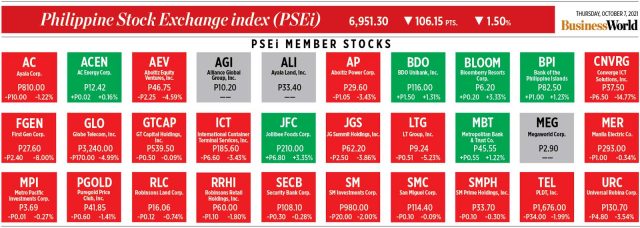
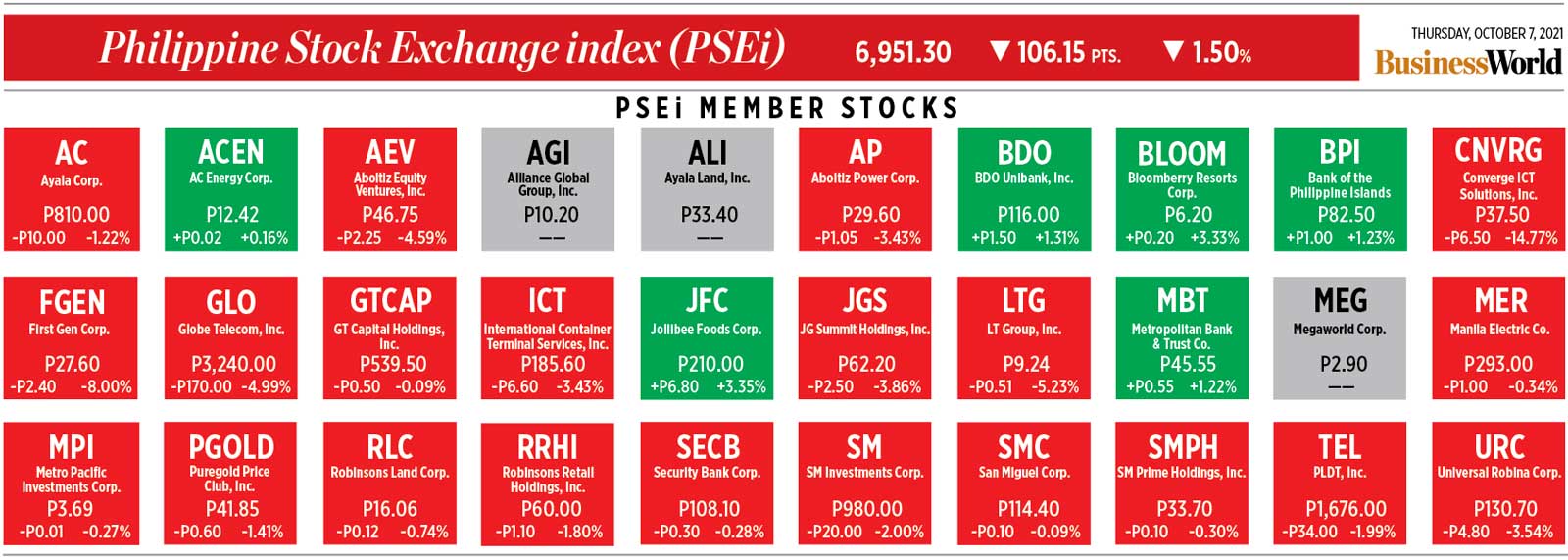
How PSEi member stocks performed — October 7, 2021

Here’s a quick glance at how PSEi stocks fared on Thursday, October 7, 2021.


Shares drop as investors pocket gains from rally

BW FILE PHOTO

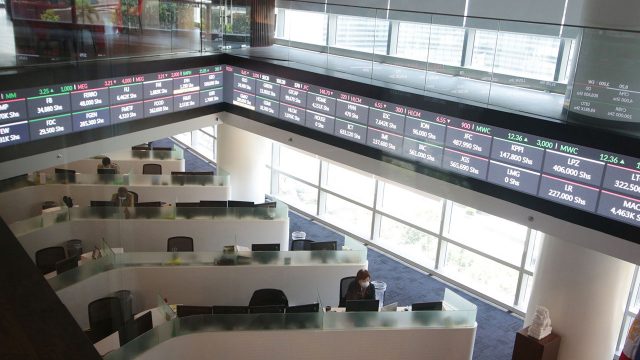
SHARES snapped their three-day rally on Thursday as investors pocketed gains and after Nikkei Asia’s coronavirus disease 2019 (COVID-19) recovery report put the Philippines in last place.

The Philippine Stock Exchange index (PSEi) declined by 106.15 points or 1.50% on Thursday to close at 6,951.30, while the all shares index shed 54.29 points or 1.23% to finish at 4,354.85.

“The index pulled back a day after breaking its 7,000 resistance and may have to redo this resistance challenge after closing back at 6,951,” COL Financial Group, Inc. Chief Technical Analyst Juanis G. Barredo said in a Viber message.

“The local bourse fell this Thursday… as investors took profits out of its preceding three-day rally,” Japhet Louis O. Tantiangco, senior research and engagement supervisor at Philstocks Financial, Inc., said in a separate Viber message.

“Nikkei Asia’s COVID-19 Recovery Index, in which the Philippines ranked last, also weighed on market sentiment,” he added.

The Philippines placed last in Nikkei Asia’s report, which ranked 121 countries based on their COVID-19 situation in terms of managing infections, vaccination programs, and social mobility. A higher ranking means the country is close to achieving recovery.

Majority of sectoral indices closed in the red on Thursday except for financials, which rose 13.28 points or 0.92% to 1,444.09. COL Financial’s Mr. Barredo noted that BDO Unibank, Inc., Metropolitan Bank & Trust Co., and Bank of the Philippine Islands were some of the issues that “saw some demand come their way.”

“[Wilcon Depot, Inc.], as [a] soon to be new index stock, seesawed, shooting up to P40 at one moment then faltering back to P34.00 closing with an 8% gain for the day. It would soon replace FGEN (First Gen Corp.) on the index roster,” Mr. Barredo said.

The PSE said on Wednesday that First Gen will be replaced by Wilcon in the 30-member PSEi following the former’s announcement about its tender offer. First Gen will also be excluded from the PSE’s Industrial index.

Meanwhile, services lost 63.10 points or 3.12 % to 1,954.03; holding firms shaved off 154.75 points or 2.20% to 6,872.98; mining and oil went down by 162.09 points or 1.66% to 9,601.65; industrials declined by 70.54 points or 0.67% to 10,371.44; and property inched down by 6.05 points or 0.19% to 3,067.33.

Value turnover increased to P13.17 billion with 1.40 billion shares switching hands on Thursday, up from the P9.55 billion with 2.71 billion issues traded the previous day.

Decliners beat advancers, 137 against 62, while 46 names closed unchanged.

Net foreign selling climbed to P1.47 billion on Thursday from the P356.05 million seen on Wednesday.

“We still think rotational action may continue and could cause ongoing choppy sways into the index and its attempt to regain fresh recent highs,” Mr. Barredo said. “Market resistance is pegged at 7,064 followed by 7,400, short-term support is seen between 6,925 to 6,840.” — Keren Concepcion G. Valmonte

Peso rebounds on strong US jobs data

BW FILE PHOTO
THE PESO strengthened on the back of improved US jobs data. — BW FILE PHOTO

THE PESO rebounded versus the dollar on Thursday following stronger US jobs data.

The local unit closed at P50.56 per dollar on Thursday, appreciating by 32 centavos from its 50.88 finish on Wednesday, based on data from the Bankers Association of the Philippines.

The peso opened Thursday’s session weaker at P50.80 per dollar. Its weakest showing was at P50.86, while its intraday best was at P50.55 against the greenback.

Dollars traded increased to $988.08 million on Thursday from $963 million on Wednesday.

The peso strengthened from its previous close on better risk appetite following improvements in the US job market, Rizal Commercial Banking Corp. Chief Economist Michael L. Ricafort said.

The ADP National Employment Report released on Wednesday showed private payrolls increased by 568,000 jobs in September, higher than the 428,000 estimate by economists in a Reuters poll.

This also surpassed the 340,000 jobs created in August.

Meanwhile, a trader said peso-dollar trading was also affected by developments in the US Congress’ discussions on the debt ceiling.

Reuters reported that Senator Mitch McConnell, a Republican, floated a plan for his party to allow an extension of the federal debt ceiling into December.

The White House has not yet received a formal offer for the said extension, spokeswoman Jen Psaki said.

Without legislative action to raise the $28.4-trillion debt limit, the Treasury department said it would run out of ways to meet all its obligations by Oct. 18.

For Friday, both Mr. Ricafort and the trader gave a forecast range of P50.45 to P50.65 per dollar. — LWTN with Reuters

Robredo to run for President as an independent

VP LENI OFFICIAL ROBREDO FB PAGE

By Kyle Aristophere T. Atienza, Reporter

VICE President Maria Leonor “Leni” G. Robredo on Thursday filed her certificate of candidacy for president, ending months of speculations about her political plans for next year.

The opposition leader, who heads the Liberal Party, will run as an independent candidate, the Commission on Elections tweeted.

Ms. Robredo, who has been endorsed by several civic groups, vowed to “defeat the old and rotten brand of politics.” “We will return the capacity to bring change to the hands of the ordinary Filipino,” she said in a speech streamed live on Facebook hours before her filing.

Former Senator Ferdinand “Bongbong” R. Marcos, Jr., who lost to her by a hair in the vice-presidential race in 2016, filed his candidacy certificate a day earlier.

Ms. Robredo earlier said that the candidacy of the late dictator’s only son and namesake would be a big factor in her decision.

Recent opinion polls showed that Mr. Marcos was among the top three choices for president.

Ms. Robredo had chosen Liberal Party President Francis N. Pangilinan as her vice-president, said two ranking party officials who asked not to be named.

She pledged to start changes in education, transportation, food security, health and social justice and make government accountable.

The vice-president, who has opposed the Duterte administration’s war on drugs and ties with China, said change won’t happen if the tough-talking leader’s allies win in the elections next year.

Ms. Robredo, who has not performed well in opinion polls, said it would be difficult to challenge the ruling party because her political machinery was not strong enough.

“The challenge now is how to expand her support base,” said Maria Ela L. Atienza, a political science professor from the University of the Philippines.

“She needs to highlight not just the anti-Duterte narratives but to actually present doable and concrete programs to deal with the pandemic and economic difficulties,” she said in a Viber message. “She has to make her programs relevant to the day-to-day lives of people.”

Earlier this month, opposition coalition 1Sambayan endorsed Ms. Robredo as its standard bearer for the 2022 elections. She did not immediately accept the endorsement, saying she had not decided to run.

The Supreme Court in February rejected Mr. Marcos’s election protest against Ms. Robredo after he failed to prove election fraud. He filed the protest in June 2016 after narrowly losing the face.

In the Philippines, the president and vice president are elected separately and can come from different political parties.

A group campaigning against the return of the Marcoses to the presidential palace this week said Mr. Marcos’s presidential run is “a brazen show of disregard and contempt” for the thousands of Filipinos who were killed and tortured under the martial rule of his late father, Ferdinand E. Marcos.

Mr. Marcos, who was among the first to return to the Philippines from exile in the United States in 1991, announced his presidential ambition hours after his transfer to a party that endorsed him for president.

His family was forced to flee the country in 1986 after a popular street uprising toppled his father’s two-decade rule, during which the family allegedly amassed billions of pesos in ill-gotten wealth.

The government has recovered P174 billion of the assets, according to the Presidential Commission on Good Government.

More than 70,000 people were jailed, about 34,000 were tortured and more than 3,000 people died under the dictator’s martial rule, according to Amnesty International.

Ms. Robredo was the fifth mainstream politician to announce a presidential run. She had been in talks with various political camps critical of the Duterte government.

Manila Mayor Francisco “Isko” M. Domagoso, Senator and boxing champion Emmanuel “Manny” D. Pacquiao and Senator Panfilo M. Lacson have filed their certificates of candidacy for president.

Ms. Robredo was thrust in the political limelight after the death of her husband and local government champion Jesse M. Robredo. She run for a House of Representatives seat in 2013 and won.

Before that, she lawyered for the poor and worked with the Public Attorney’s Office.

During her stint as Camariñes Sur representative, Ms. Robredo filed bills seeking to end political dynasties and mandating government offices to disclose financial transactions.

She also filed a bill that encouraged civic groups and the private sector to take part in local governance.