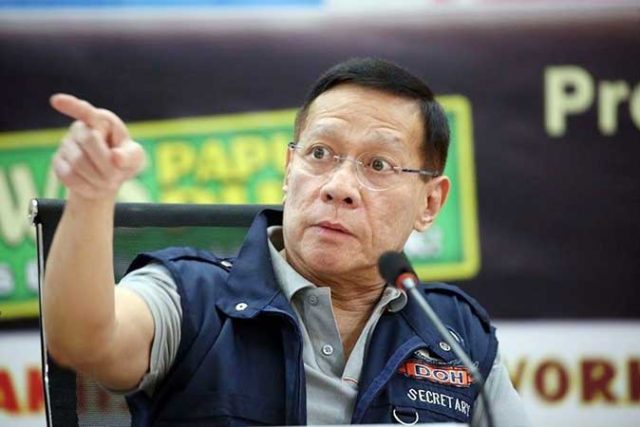
HEALTH SECRETARY Francisco T. Duque III on Thursday said he has submitted to Senator Emmanuel “Manny” D. Pacquiao the reports on the use of funds received by the department for the coronavirus response.
“Lahat po itong mga report na ito pinadala ko na kagabi kay (I have sent all these reports last night to) Senator Manny Pacquiao,” Mr. Duque told ABS-CBN News Channel.
Mr. Pacquiao, acting president of the ruling party PDP-Laban, has been in a squabble with a faction of their political group supported by President Rodrigo R. Duterte, the party chair.
The senator last week made allegations of corruption in government.
Mr. Duterte on Monday said he would campaign against Mr. Pacquiao in next year’s elections if he fails to identify the alleged corrupt officials.
The senator on Tuesday accepted the challenged and cited anomalies in the government’s purchase of rapid test kits, masks and other materials for the coronavirus pandemic. He also asked the Health department to account for expenditures.
Mr. Duque, in a statement on Tuesday, said the department was disheartened by the accusations and they are open to inquiries from legislators.
In Thursday’s interview, he said the procurement arm under the Budget department purchased the test kits, face masks and other supplies for the pandemic.
The Health chief also said that he talked on Wednesday to Budget Undersecretary Lloyd Christopher A. Lao, who said they are ready to show the budget utilization and transactions.
The funds for the vaccines coming from multilateral funding agencies go directly to the vaccine manufacturers, Mr. Duque added.
“If there is any hearing, we’ll be very glad to be there and show a full accounting of all the funds and budget that have been allocated to the DoH (Department of Health),” he said.
Palace Spokesperson Herminio L. Roque, Jr., meanwhile, said the administration complied with the reporting requirements provided under the Bayanihan laws.
“There was a regular reporting required by the law by itself which Malacañang complied with,” he told a news briefing Thursday. — Vann Marlo M. Villegas and Kyle Aristophere T. Atienza
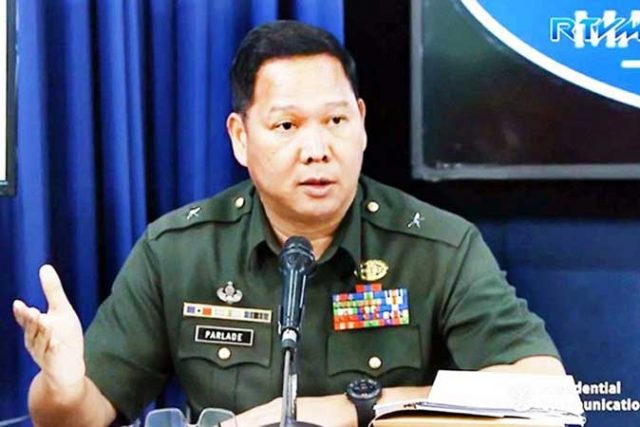
PRESIDENT R. Duterte has accepted the resignation of Lieutenant General Antonio G. Parlade, Jr. as spokesman for the country’s anti-communist task force, according to the presidential palace.
“The President has accepted the resignation of Gen. Parlade as spokesperson of NTF-ELCAC (National Task Force to End Local Communist Armed Conflict),” Palace Spokesperson Herminio L. Roque, Jr. told a televised news briefing, citing confirmation from Defense Secretary Delfin N. Lorenzana.
Mr. Parlade, in a statement, said his resignation was submitted almost a month ago “to ease the pressure on the NTF ELCAC principals who are being questioned” by legislators for designating him as an official of the civilian task force despite being an active military officer.
“I am happy that there are now six more civilian NTF spokespersons who shall carry on the fight passionately and with conviction,” he said.
The Senate earlier recommended the immediate relief of Mr. Parlade from his duty as spokesman of the task force, citing a provision in the 1987 Constitution barring an active military officer from holding a civilian position in the government.
Mr. Parlade has been controversial for tagging civic leaders and media personalities critical of the government as communist fronts.
“As spokesperson of NTF-ELCAC, Parlade used and abused his position to attack government critics, spread fake news, and red-tag activists and organizations, he should be held accountable for this,” Bayan Muna Party-list Rep. Ferdinand Gaite said in a statement.
Mr. Parlade, who is set to retire on July 26, heads the military’s Southern Luzon Command. — Kyle Aristophere T. Atienza
DAVAO CITY has started the vaccination of about 14,000 workers in tourism, one of the sectors hit hardest by the coronavirus pandemic.
Generose D. Tecson, officer-in-charge of the city tourism office, said the head count covers workers in all primary and secondary tourism establishments as well as allied services.
“It’s our way forward and will pave the way in reopening the tourism industry. This ensures the safety of our tourism workers,” she said in a statement.
During the first day of inoculation on June 30, held at the Waterfront Insular Hotel, an initial 500 workers received their first dose.
“The Waterfront is our lone vaccination site (for tourism workers) and they contributed snacks and stuff as part of their 60th anniversary. Our volunteers are from the Davao Tourism Association and other tourism associations,” she said.
Meanwhile, the Ayala group also rolled out its vaccination program on Wednesday for workers within the Abreeza complex, which includes a shopping mall, Seda Hotel, and condominiums.
The Ayala Malls Abreeza management said the vaccination drive, undertaken in partnership with the city and regional health authorities, “is in line with the shopping mall’s mission to safeguard the health and safety of mall employees… as well as to further ensure a safe shopping experience for its shoppers.”
An initial 350 employees out of the more than 1,600 target got their first jab on June 30.
Data from the Davao City Vaccination Cluster show 238,236 coronavirus vaccine doses have been administered as of June 28. Of the total, 196,886 were first doses while 41,350 have completed the two shots.
Majority of those inoculated are senior citizens at 70,952 with a first dose and 10,988 fully vaccinated. The city’s 26,361 healthcare workers are fully vaccinated. For persons with comorbidities, 80,859 have received their first jab while 3,976 are fully vaccinated.
City Health Office acting head Ashley G. Lopez said the local vaccination program has been covering an average of 10,000 recipients per day.
The city government of Davao, which has a population of over 1.8 million, is aiming to fully vaccinate at least 70% of residents. — MSJ
THE STATE volcanology agency on Thursday raised the alert level for Taal Volcano after it spewed a one kilometer-high plume, and called for the evacuation of two villages considered at high-risk.
At 3:16 p.m., the volcano’s main crater “generated a short-lived dark phreatomagmatic plume 1 kilometer-high with no accompanying volcanic earthquake,” the Philippine Institute of Volcanology and Seismology (Phivolcs) said in an advisory.
Under Phivolcs’ 5-level alert system, Taal’s status was raised to 3 or a “high level of volcanic unrest.”
“This means that there is magmatic intrusion at the Main Crater that may further drive succeeding eruptions,” Phivolcs said.
The high-risk barangays are Agoncillo and Laurel in Batangas.
“In addition, communities around the Taal Lake shore are advised to take precautionary measures and be vigilant of possible lakewater disturbances related to the ongoing unrest,” Phivolcs said.
The entire volcano island, located about 100 kilometers south of the capital region Metro Manila, has been declared a permanent danger zone.
ILOILO CITY Mayor Jerry P. Treñas said the local government has been administering up to 7,500 coronavirus vaccines daily and is ready to “at least double” that capacity once there is a steady supply from the national government.
“Once we have steady supply of vaccines, we can even increase the numbers or at the very least double it,” he said in a statement following the delivery of an additional 50,000 doses of the Sinovac brand on June 30.
The mayor noted that apart from workers in the medical sector, various sectors have been assisting in the inoculation program, including the police, city hall employees, and village officials.
The city, which has a population of nearly half a million and serves as a provincial and regional center, has seen a surge in coronavirus cases in the past weeks. Mr. Treñas has been appealing to the national government to give the city more vaccine allocation.
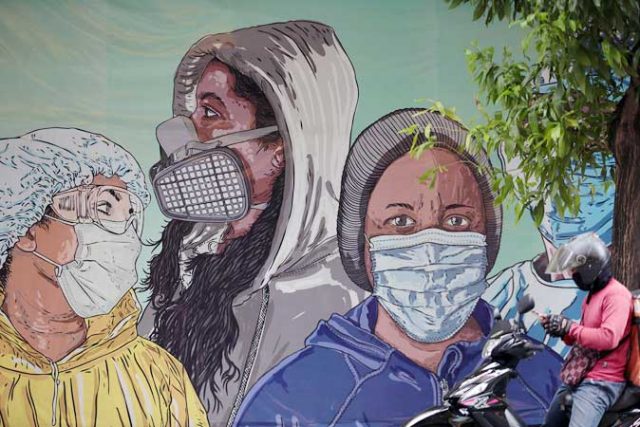
A DELIVERY RIDER checks his mobile phone in front of a mural of frontliners in Eastwood City, Libis, Quezon City. — PHILIPPINE STAR/ MICHAEL VARCAS
At the rate the Palace is unleashing its massive one-two punches against Senator Manny Pacquiao, and the defensive counter punches by the People’s Champ, are we seeing now the beginning of what Senator Koko Pimentel described as implosion of PDP-Laban?
It would be an unlamentable implosion if only its party mates would suffer in the collapse. But the people’s right to good governance and competent economic stewardship could be sacrificed in the strategic attempt to prolong the centrality of Davao in national politics.
Tactically, what is so wrong with our leaders is their inability to focus on the now. The now can define their common touch, their empathy with the people, their singular commitment to put an end to pandemic devastation and deep economic recession that are the scourge of our nation today.
In our previous columns, we commended the President for literally burning our ships to the ground by declaring the lockdowns would stay unless we defeated the virus through effective protocols and prompt administration of the jabs. We thought that would have been the marching order for those involved in testing, tracing, and treating system as well as in quarantine and vaccination activities to keep their eyes on the ball. Obviously, many dropped their balls so we ended up in a prolonged quarantine with enormous economic costs. Their failure to focus on today did, and will have, a great cost to our future.
A political squabble is the last thing we need today. If this is a game of golf, we have a very high handicap.
The pandemic threat does not appear to be receding. We have been told by the Octa Research Group that we must prepare for potential variant surge early this week. Cases are expected to multiply with the arrival of new variants. The Delta variant is supposed to be the most “concerning” of all the variants so far, even surpassing the UK variant which was previously the most dreaded. It is 50%-60% more infectious and more potentially fatal. The Delta factor could upset the Government’s target of herd immunity by Christmas 2021. When this happens, our growth target might be compromised. Jobs and income are on the line.
Our credibility in public policy execution is under question. Recent media reports from the Asian Infrastructure Investment Bank (AIIB) are disturbing. One broadsheet, for instance, reported that “despite having spent all of the $750-million loan extended … last year, the Philippines failed to drastically reduce the spread of COVID-19 — one of the intended results of the Beijing-based lender’s financing.” Of course, one positive outcome was that there was prolonging of the period for the infection rates’ doubling to 30 days from last year’s three to four days.
Our authorities should address this failure to deliver on the goals of this large foreign borrowing, identify the gaps and do the appropriate rectification. Even if gradually, incrementalism of progress is more desirable than none at all. If we examine the media reports, the combined loans from AIIB and the ADB would have covered the budget requirements for the increase in testing capacity, conditional cash transfers and emergency subsidy, economic stimulus and support to highly affected and vulnerable sectors, wage subsidies and tax relief to small business. The World Bank, in fact, joined the co-financing to raise $1.2 billion for the procurement of vaccines.
For transparency’s sake, we need to clear the air and present an accounting of all the borrowed funds and how they were disposed — and whether in the process, the targets were met fully, partially, or not at all.
Our revenue base appears to be eroding. The other day, the broadsheets reported another sovereign borrowing of $3 billion, or around P146 billion, from a global bond sale. This is unequivocally for budget support. The third time the Philippines tapped the global markets after the $2.5-billion euro-denominated sale in April and the $500-million yen-denominated Samurai bonds in March, this fund-raising exercise indicated the strong bias towards the 25-year long-term offering. One way of looking at it is to believe Treasurer Lead De Leon’s take that Philippine credit remains attractive for investors despite the impact of the virus. “Investors see our economic revival is imminent, strong and long lasting.” It will be wise to avoid wasting such global confidence with political skirmishes in the highest level of leadership.
Based on the recent trend in our gross national savings, our prognosis of our external payments position is ominous. The Philippine Statistics Authority recently reported that the country’s gross savings dropped by nearly 28% in 2020 despite a similar decline in household spending following a contraction in disposable income. Given the ambitious 6-7% growth target for 2021, the Philippines could only hope to deliver through increased reliance on foreign savings. This means we might have to spend more on imports of raw materials, capital goods and intermediate products, and even consumer goods like rice, oil, and passenger cars that would translate into higher productivity and efficiency to produce more. With limited revenues on account of the recession, the only option is to borrow more.
While external debt sustainability measures remain manageable, prolonged inability to put our economic house in order could equally prolong the weakness of our public revenues and reliance on borrowed funds abroad. With increasing external debt level and modest economic recovery, the metrics over time are bound to be breached.
Exactly one year from last Wednesday, this Administration, by the Constitution and the law, will vacate the Palace and leave a legacy of its choice. So far, it has in many ways upped the ante in economic management through its growth-sustaining initiatives on fiscal reforms, universal health coverage, capital market reforms, and infrastructure program. The pandemic might end up emasculating those milestones. Already, various international financial institutions, including the IMF, World Bank, ADB, and, recently, the Singapore-based ASEAN+3 Macroeconomic Research Office, have downgraded their forecasts of Philippine output performance for this year and the next.
If these forecasts come to pass, it will be tragic for all of us.
What we would like to see is another burning of whatever ships are left to keep our eyes firmly on our fight against the pandemic and its economic consequences. The illusion of attention requires us to face all iterations of scenarios, good and bad, economic, political or otherwise. We need to be attentive both to silence and noise. Political squabbles are big and visible, but some people may not find them big and visible enough to be seen.
This is where we are today.
Diwa C. Guinigundo is the former Deputy Governor for the Monetary and Economics Sector, the Bangko Sentral ng Pilipinas (BSP). He served the BSP for 41 years. In 2001-2003, he was Alternate Executive Director at the International Monetary Fund in Washington, DC. He is the senior pastor of the Fullness of Christ International Ministries in Mandaluyong.
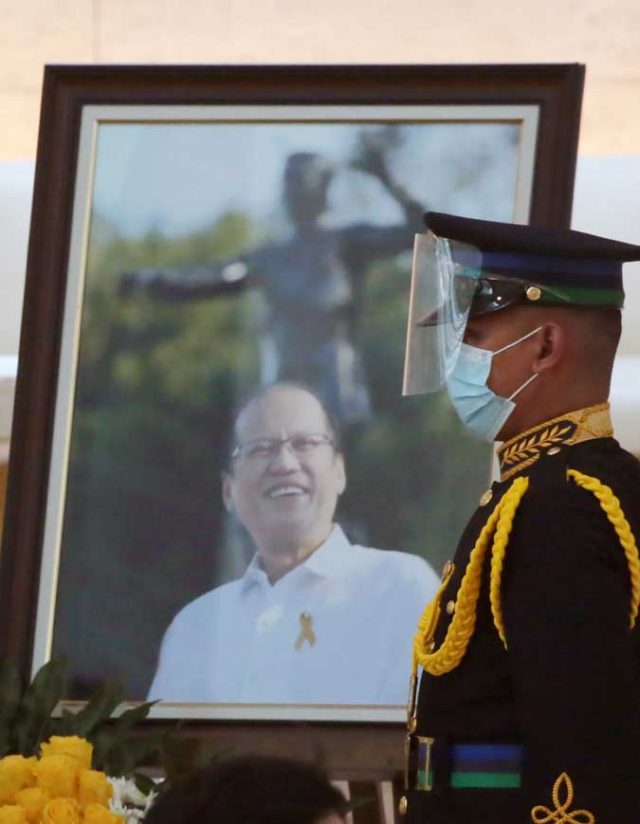
PUBLIC VIEWING of the remains of former President Benigno Simeon Aquino III was held at the Church of Gesu, Ateneo de Manila University in Quezon City. — PHILIPPINE STAR/MICHAEL VARCAS
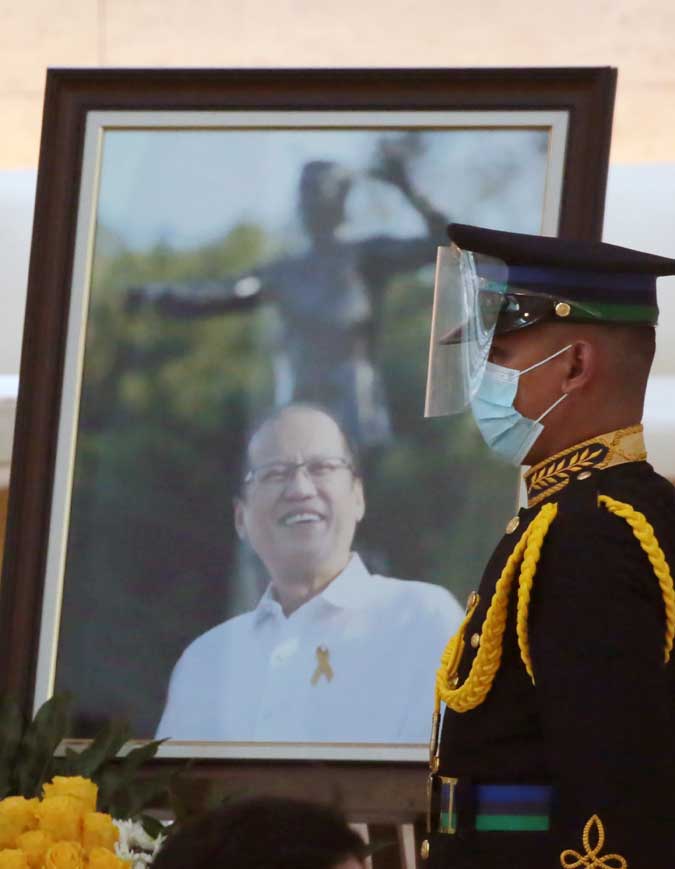
PUBLIC VIEWING of the remains of former President Benigno Simeon Aquino III was held at the Church of Gesu, Ateneo de Manila University in Quezon City. — PHILIPPINE STAR/MICHAEL VARCAS
The return of authoritarian rule is a constant threat, and progress an increasingly elusive goal in the Philippines. Democratization and development have too often foundered on the shoals of government indifference, incompetence, and antipathy.
A process that began during the reform and revolutionary periods of Philippine history, democratization has been interrupted, delayed, weakened, and sabotaged by foreign invasion, imperialism, and home-grown tyranny, with some post-martial law administrations paying only lip-service to it.
Development and “modernization” have also found their way in the vocabularies of a succession of regimes. But they have similarly proceeded glacially, if at all, and are continuing to elude this country, as evidenced by the poverty and the feudal relations that sustain it.
In these circumstances, the true measure of political leadership can only be how much it has contributed to either course — or, in this country of declining expectations, how little it has hampered both processes.
It need hardly be said that no one is perfect, and that no Philippine president has ever approached that exalted state.
Benigno Aquino III was no exception. But there are presidents and presidents, and some, despite their similarities, were nevertheless also better than others.
Aquino III’s death at the age of 61 last July 24 was predictably hailed by the fact-resistant hordes that infest both social and old media in behalf of a regime whose knowledge of statecraft is limited to harassing, threatening, imprisoning, and killing anyone who dares tell the truth about it. But his passing also reminded the civic-minded of the difference between presidents. Despite the political and social calamities that have befallen this country, they still believe that the true leaders it needs will save it. These citizens make it their business to carefully weigh who is worthy of their support for president, and in 2010 they chose Aquino. Today more than ever they believe that they chose wisely.
Like many of his countrymen, Benigno Simeon Cojuangco Aquino III was a child of the hierarchic and quasi-colonial political, social, and economic orders that have prevailed in the Philippines for decades. He shared with the rest of the political class the instinct to preserve, enhance, and protect one’s familial and class interests. The Hacienda Luisita issue was, for example, a constant challenge during his term, to which he hardly responded. Although far fewer in number than today’s, the extrajudicial killings that in most cases claim government critics as victims also continued during his watch.
He was no leftist or revolutionary, and he never claimed to be either. Only mildly reformist was his “walang mahirap kung walang corrupt” platform of government, corruption being just one of the many factors behind the persistence of poverty in these isles of want.
Like his predecessors, he also believed the United States to be a reliable friend and ally. To supplement the 1999 Visiting Forces Agreement (VFA), he signed with the US the 2014 Enhanced Defense Cooperation Agreement (EDCA) which gave visiting US troops access to Philippine military bases. He also thought the armed forces’ purely militarist approach to the so-called “insurgency” essentially valid, and supported the “modernization” of its weaponry.
But his father Benigno “Ninoy” Aquino, Jr.’s willingness in 1983 to sacrifice his liberty and even his own life in behalf of the anti-dictatorship resistance, and his mother Corazon’s presiding over the restoration of the Republic on whose ruins Ferdinand Marcos, Sr. had erected one-man rule, must surely have influenced and shaped his perceptions of Philippine society and governance.
Among his accomplishments as president was economic growth and the resulting decrease, so claimed government agencies, in poverty incidence. He also defended the country’s rights in the West Philippine Sea (WPS) by bringing the Philippine case to the UN Arbitral Tribunal, before which his designated petitioners succeeded in getting that body to strike down imperialist China’s absurd claims over some 80% of the WPS. But equally important was his remaining true to the Constitutional prohibition against abridging free expression and press freedom. What he did not do was, arguably, as significant as what he did. He never disparaged human rights, and neither did he vilify or threaten its defenders.
One of his first acts as president was to ban the practice of government vehicles’ wendingtheir way through traffic with lights ablaze and sirens blaring, a practice known as “wang wang,” that proclaims to ordinary folk how privileged and self-entitled the supposed servants of the people are.
He was his parents’ son, and was anti-dictatorship. He shepherded through Congress and signed into law the 2013 Human Rights Victims’ Reparation and Recognition Act, through which, rather than a Truth Commission, the Philippine government finally acknowledged that the Marcos regime had indeed committed such human rights violations as illegal arrests, detention and torture, involuntary disappearances, and extrajudicial killings, for which the survivors or their kin deserved indemnification. A landmark law, the Act, as he himself described it, was intended to “recognize the suffering of many during (Marcos’) martial law.”
Like his predecessors, he too was critical of the press. He complained about what he thought was its inordinate focus on his private life, and the bias against his administration by some broadcast and print practitioners identified with the regime prior to his. But he never threatened, insulted, or harassed journalists. He thought the numbers in the killing of journalists in the country’s rural communities that have been going on since 1986 exaggerated. But he did not justify the killings by blaming the victims and accusing them of corruption.
He answered the hardest questions even from his harshest press critics rationally, with civility, and, one must add, coherently. Although he did lose his temper at times, usually with his own officials, he never barred any journalist from covering his Office or his press conferences. Neither did he use the powers of the presidency to shut down any media organization the reporting of which he thought unfair and offensive.
Journalists were confident that they could report, monitor, and criticize his acts and policies and subject them to the closest scrutiny without fear of retaliation or petty vindictiveness. Without self-censorship and government hostility, the full exercise of press freedom and free expression was possible, although not always realized, during his six years in office due to reasons other than government intervention. He thereby convinced the nation and the world that he valued those rights as a necessary pillar of democratic governance.
Benigno Aquino III was a well-meaning, fairly competent product of this time and place. What he was not was a tyrant. Neither was he a brusquely anti-human rights, grossly incompetent and abusive poor excuse for a president and head of State.
Hounded as it was by such calamities as typhoon Yolanda and lapses in executive judgment like the Luneta hostage-taking crisis and the Mamasapano debacle, his term was far from perfect. It was neither an international embarrassment nor so bad as to deserve summary dismissal and total disparagement. But some of the worst enemies of the people are manufacturing misleading and totally false “information” about it for the meanest political reasons.
Every death diminishes us all, and Benigno Aquino III’s is no exception. But the Filipino people should mourn not only his passing but also the end of that less trying time when he was in office.
Comparisons, so the adage goes, are odious. But how can anyone with an iota of awareness of what his term was truly like avoid them in the context of the horrible present?
Luis V. Teodoro is on Facebook and Twitter (@luisteodoro).
A character flaw that seems to be prevalent among some accomplished, successful people is hubris. In Greek classical drama, it is the “overweening pride that leads to disaster… the refusal to accept the authority of the gods.” It can cause drowning in emotional quicksand.
Precious relationships fall apart when individuals commit mistakes but refuse to admit these and apologize.
Once upon a time, there was a story of friends who were “frenemies.” A misunderstanding caused a fissure that opened into a deep chasm. It was the result of a bad combination: A simple business deal and the passing of a close associate who had kept the delicate balance between the protagonists. There was a heavy dose of hidden envy and jealousy.
On the surface, they had a glaze of social niceties and civility. Underneath, there was a simmering irritation that deteriorated to a smoldering anger. It was one-sided.
Grief triggered a vicious verbal attack by one friend. The incident was witnessed by a few people at a private meeting. Then the nasty smear campaign began.
The innocent victim (who had been hurt) had to endure speculations by judgmental onlookers. The insidious whispering campaign spread. It was like a telenovela — the spectacle of one person being fed to the hungry lions in an arena.
Friends came to the rescue, to defend the bewildered victim. Instead of fighting back, he remained silent and did not fan the fire. Eventually, the people got tired and noticed that it was not true. The damage was done but it could have been worse if there had been a legal case. There had been another nasty incident that happened earlier. There was a report of theft, but the case remained in the police files. It would have been an entertaining, dramatic story for columnists because these characters were well-known in the community.
It took many years for the self-righteous person to realize that he had stained the reputation of a former friend. He was smart and established but there was a dark side. He was a Pharisee — arrogant, condescending and devious.
A former colleague described him as Dr. Jekyll.
In his old age, he abruptly cleared his conscience. He sent a note that might have been his version of a half-baked apology.
The word “peace” was mentioned. It was accepted. And the lingering ghostly haze vanished.
The psychiatrist Thomas Szasz once wrote in his book The Second Sin, “The stupid neither forgive nor forget; the naive forgive and forget; the wise forgive but do not forget.”
Closure, at last.
The Romantic period poet, painter, visionary William Blake wrote to bring a change in the social order and the minds of men. He wrote:
“The Poison Tree”
I was angry at my friend;
I told my wrath; my wrath did end.
I was angry at my foe;
I told it not, my wrath did grow.
And I watered it in fears,
Night & morning with my tears;
And I sunned it with smiles,
And with soft deceitful wiles.
And it grew both day and night.
Till it bore and apple bright,
And my foe beheld it shine,
And he knew that it was mine.
And into my garden stole,
When the night had veild the pole;
In the morning glad I see;
My foe outstretched beneath the tree.
In contrast, Blake also wrote the immortal verses about the glorious facets of nature and an open attitude to the Divine.
“Auguries of Innocence”
To see a World in a Grain of Sand
And a Heaven in a Wild Flower
Hold Infinity in the palm of your hand
And Eternity in an hour….
There is hope, a flickering light that guides us. Amidst the darkness and uncertainty, most people are undergoing trials, struggling to survive, coping with devastating losses, personal and financial.
Some individuals are thriving, finding new ways to overcome and live in a new normal. So many have sunk into depression. A few have emerged from the depths. What used to be their normal — isolation and sadness — is now the new normal.
During the past 15 months, they feel that they are no longer alone. They are becoming productive, creative.
With faith and patience, the transformation is slowly happening.
Maria Victoria Rufino is an artist, writer and businesswoman. She is president and executive producer of Maverick Productions.
ON JULY 4, 1946, President Manuel Roxas and US High Commissioner Paul McNutt signed the Treaty of Manila, establishing the independence of the Republic of the Philippines. The document touted “the unity of American and Philippine ideals,” and heralded a “new era of the two Governments and peoples… bound as closely as ever by ties of friendship and mutual trust.” In his Philippine Independence Day message last month, US President Joseph Biden reaffirmed this connection, saying, “Our people are forever connected through our deep bonds and shared sacrifices of valor, of family, and of friendship.”
These shared ideals were lyrically expressed 245 years ago in another Declaration, which proclaimed the inalienable rights, freedom, and equality of all persons. Our two democracies continue to be guided by this “unity of ideals” as we strive to fulfill those lofty goals and ensure prosperity, security, and opportunity for all. This Independence Day, I am heartened by the examples set by so many individuals in both countries whose efforts and accomplishments vividly embody those principles.
Both our nations celebrate and reward creativity, hard work, and entrepreneurial spirit. This is exemplified by the brilliance and ingenuity of tech executive Dr. Dan Lachica, who, after making his career in Silicon Valley, returned to the Philippines to help build a cutting-edge semiconductor industry back home. We see it in Fil-Am chef and Kora Bakery co-founder Kimberly Camara, whose desserts, inspired by Camara’s memories of cooking with her lola, now delight New Yorkers with Filipino flavors.
A further testament to our shared democratic principles are the growing ranks of Filipino-American leaders elected and appointed to public office in the United States. We are delighted when outstanding Filipinos find their experiences in the US of value to their endeavors here, such as Pasig Mayor Vico Sotto, who was recently recognized by the US State Department as one of 12 International Anticorruption Champions. Mayor Sotto was a 2018 Young Southeast Asian Leaders Initiative Professional Fellow, through which he completed a professional residency in the United States at the Iowa Public Information Board, helping inform his impressive anti-corruption initiatives.
Justifiably renowned are the histories of bravery and sacrifice of Filipinos and Americans who fought side by side for freedom eight decades ago. Yet our defense ties are no mere relic of history. Year after year, our armed forces grow stronger, closer, and more interoperable through joint training and exercises. The US military is further enriched by the contributions of Filipino-American service members such as Char McGinnis, recently promoted to Lieutenant Colonel in the United States Air Force. Her promotion ceremony was held aboard the USS Missouri, the site of the Japanese surrender that ended World War II, in honor of her Filipino grandfather, a veteran of that conflict.
Those profound historic roots are constantly nourished by robust ongoing educational and scientific cooperation — investments to ensure our relationship continues flourishing in the future. We are excited by the successes of talented young people like Filipino scholar Farrell Eldrian Wu, who recently graduated from the prestigious Massachusetts Institute of Technology with a perfect 5.0 GPA, and Fil-Am NASA engineer Gregorio Villar III, whose work helped ensure the safe landing of the NASA Perseverance rover on the surface of Mars. The more than four million Filipinos in the USA, and more than 350,000 Americans living in the Philippines, knit our countries ever closer together and show that our peoples, literally and figuratively, are one family.
The US-Philippine relationship is indeed “Thriving at 75.” These deep bonds and shared ideals give me confidence that, for generations to come, the United States and the Philippines will be “bound as closely as ever by ties of friendship and mutual trust.” Para sa mas matibay na samahan!
THOUGH Gerry Casida is on the priority list for a free coronavirus disease 2019 (COVID-19) vaccine in the Philippines because of his asthma, he’s isn’t planning to get the shot any time soon. A video he found on social media of a woman claiming vaccines are being used for genocide helps explain why.
“I’ve read a lot of posts on Facebook about how many died in other countries because of vaccines, and how that’s being concealed,” the construction worker, 43, from Manila said. “My mom also consulted a folk healer, who said the vaccines could affect my heart.”
Millions of people like Mr. Casida in some of the worst Covid hotspots in Southeast Asia are in no rush for inoculation or just saying no, swayed by disinformation on social media from both local sources as well anti-vaccination movements in the US. Those false claims are fueling vaccine hesitancy in some pockets of the region, undermining efforts to vaccinate some of the most vulnerable people in Asia and end a pandemic that has stalled the global economy.
Despite some of the highest rates of new cases in the world, recent surveys have shown vaccine resistance is prevalent in the region. In the Philippines, 68% of the people are either uncertain or unwilling to take the shots, according to polling company Social Weather Stations. A third of Thais have doubts or refuse to be vaccinated, according to the Suan Dusit Poll, while a separate survey in Indonesia showed nearly a fifth of the population hesitating.
Anti-vaccination propaganda is a big reason for that hesitancy, which has further slowed takeup in countries already struggling with limited supplies. Less than 10% of the population in Thailand and the Philippines have received even one shot.
“It is a polluted media landscape,” Melissa Fleming, the United Nations’ under-secretary-general for global communications, said at a virtual forum in May. “This infodemic has shifted now, and the focus is misinformation on vaccines. It’s about instilling fear in people.”
A heavily Catholic country, the Philippines has been vulnerable to falsehoods peddled online by US evangelical Christian groups, which then filter across through church and family networks. Among many Facebook discussion groups focused on anti-vaccination theories and trawled by Bloomberg News, one video in the local Filipino language said Covid shots will brand people with the “mark of the beast,” alluding to the Antichrist in Christian eschatology. It got more than a thousand views.
DISTANT PROTECTION An English language video with hundreds of views said the vaccine makes recipients magnetic. In Malaysia, misinformation ranging from exaggerated risks to life and body organs to genetic alteration are spreading on the Facebook, Inc.-owned messaging service WhatsApp. Many of them twist and amplify arguments made by US politicians and also Michael Yeadon, a former Pfizer, Inc. scientist and a COVID-vaccine skeptic who’s become an icon for anti-vaxxers.
Other popular conspiracy theories being peddled on social platforms across the region include one that says microchips in Covid-19 vaccines are used to collect biometric data.
The resistance is turning out to be a challenge for governments keen to get as much as 80% of their populations protected against the deadly pathogen. Almost all countries in Southeast Asia are struggling with a perfect storm: outbreaks driven by more transmissible variants; lagging inoculation because of shortages after rich nations snapped up stock; and, global isolation. In Bloomberg’s COVID Resilience Ranking, which tracks how well the world’s biggest 53 economies are handling the crisis, these countries are now in the bottom 10.
“Without some semblance of herd resiliency to the coronavirus, large countries and small will have difficulty in accommodating the free flow of international travelers, which is important not only for the travel and hospitality industries, but for business and international investment,” said Steve Cochrane, chief APAC economist at Moody’s Analytics.
In February, Malaysia’s Science Minister Khairy Jamaluddin had to reassure the public about the safety of vaccines, saying they don’t have microchips. He also rubbished claims that they are part of an Illuminati agenda to establish a new world order, according to a report by the Straits Times.
OPEN LETTER Even in Singapore, which has largely contained the spread of the virus, the young and educated succumb to fake news, said Leong Hoe Nam, an infectious disease physician at Singapore’s Mount Elizabeth Novena Hospital.
“Some of the stories get amplified more, but the reasons are pretty much the same,” he said.
In late May, an open letter by a dozen Singapore doctors questioning the safety of mRNA vaccines, including a claim that the shots would change one’s DNA, was circulated on WhatsApp. That elicited a swift rebuke from the city-state’s health ministry, which issued a press release saying all but one of the medical professionals “have since retracted their statement.”
Despite efforts by governments and companies to curb unsubstantiated information, the false claims in English often continue to spread in non-English speaking communities. Encrypted platforms, where there’s less moderation, also play a key role, said Ishaana Aiyanna, a researcher at Logically, a technology company that tracks misinformation and targeted disinformation campaigns.
“Western narratives that have previously been debunked are often circulated alongside hyper-localized narratives,” she said. “This is compounded by a lack of media literacy on the part of a vast majority who rely solely on these groups and online communities for information.”
There’s another major reason for hesitancy. With wealthier Western nations getting the lion’s share of the super-effective mRNA shots, poorer countries are having to contend with limited supplies and fewer available brands, exacerbating the problem. When a country offers a choice of only one vaccine, many people want to wait until they can get a higher-efficacy shot.
In Thailand, some are refusing vaccines from China’s Sinovac Biotech Ltd. and the UK’s AstraZeneca Plc. In the Philippines, nearly 50% in a survey earlier this year said they trust US-made shots the most, but the nation’s vaccine program has relied primarily on Sinovac. Philippine President Rodrigo Duterte has threatened to jail those who refuse vaccines.
Others are taking a quirkier approach to encourage vaccinations. A district in northern Thailand started raffling off cows in mid-June as an incentive. In rural Indonesia, vaccinated residents got free chickens, while a city in the Philippines is giving away a house.
Educating vaccine recipients and even medical practitioners is the best tool to fight hesitancy, said Leong.
“The biggest weapon the COVID-19 virus has against humans is one, vaccine hesitancy, and two, the lack of a coordinated worldwide response,” he said. “And in these two, human beings have failed miserably and the virus is winning incredibly.” — Bloomberg
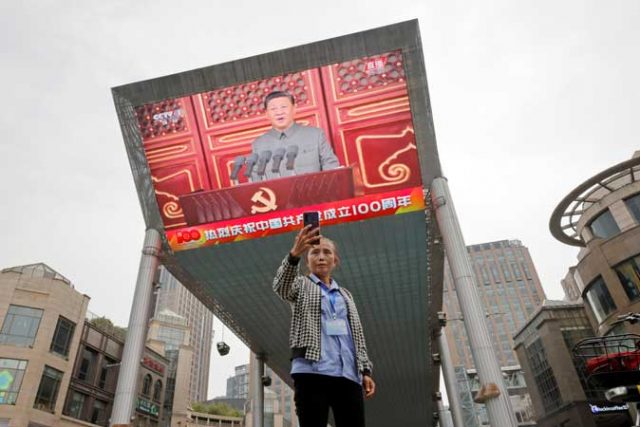
A WOMAN takes a selfie in front of a screen showing Chinese President Xi Jinping speaking during a celebration marking the 100th founding anniversary of the Communist Party of China, in Beijing, China, July 1. — REUTERS
BEIJING — China’s President Xi Jinping on Thursday warned that foreign forces attempting to bully the nation will “get their heads bashed,” and hailed a “new world” created by its people as the ruling Communist Party marked the centenary of its founding.
In an hour-long address from Tiananmen Square, Mr. Xi pledged to build up China’s military, committed to the “reunification” of Taiwan and said social stability would be ensured in Hong Kong while protecting China’s security and sovereignty.
“The people of China are not only good at destroying the old world, they have also created a new world,” said Mr. Xi, China’s most powerful leader since Mao Zedong, the founder of the People’s Republic. “Only socialism can save China.”
Mr. Xi and the party are riding high as China recovers briskly from the coronavirus disease 2019 (COVID-19) outbreak and takes a more assertive stance on the global stage. But Beijing faces external criticism over its clampdown in Hong Kong and treatment of ethnic minorities in Xinjiang, and is dealing with a worsening demographic outlook that imperils long-term economic growth.
A survey of 17 advanced economies released on Wednesday by the US-based Pew Research Center showed that views about China have remained broadly negative and confidence in Mr. Xi near historic lows.
On Thursday, Mr. Xi said that the people of China would never allow any foreign force to bully, oppress, or subjugate them.
“Anyone who dares try to do that will have their heads bashed bloody against the Great Wall of steel forged by over 1.4 billion Chinese people,” he said, sparking applause from an invited audience of 70,000 gathered in the massive square in central Beijing. The phrase became the top trending topic on China’s Twitter-like Weibo on Thursday morning.
Tang Renwu, a professor of public management at Beijing Normal University, said the tough talk was in response to US and western efforts to “contain” and “suppress” China.
“Xi’s stronger-than-usual response would have the effect of invoking even more patriotic and nationalistic sentiment among the Chinese people,” Tang said.
MILITARY MIGHT AND SOVEREIGNTY China, whose rapid military modernization has fueled growing worry among its neighbors and in the West, will build up its armed forces to safeguard its sovereignty, security and development, elevating them to world-class standards, Mr. Xi said.
“We must accelerate the modernization of national defense and the armed forces,” said Mr. Xi, who is also chairman of the Central Military Commission, which controls the country’s armed forces.
Resolving the Taiwan question and realizing China’s complete “reunification” is an “unswerving historical task” of the party, Mr. Xi said.
“All sons and daughters of China, including compatriots on both sides of the Taiwan Strait, must work together and move forward in solidarity, resolutely smashing any ‘Taiwan independence’ plots,” he said.
China, which considers democratically-ruled Taiwan its own, has stepped up efforts to assert its sovereignty claims, including sending fighter jets and bombers close to the island.
Regarding Hong Kong and Macau, Mr. Xi said China will “stay true to the letter and spirit of the principle of ‘One Country, Two Systems’,” under which the two are promised a high degree of autonomy.
However, a sweeping national security law imposed on Hong Kong a year ago has seen Beijing drastically tighten its grip on the once freewheeling financial hub. The traditional July 1 protests marking the anniversary of the city’s 1997 handover to Chinese rule were thwarted as police denied permission for a rally, citing coronavirus restrictions.
‘GREAT, GLORIOUS AND HEROIC’ Thursday’s celebrations began with a flyby of fighter jets and helicopters observed by the nation’s leaders, seated at the southern ramparts of the Forbidden City. A 3,000-strong chorus sang seven socialist songs during the event.
The Chinese Communist Party initially recruited peasants and workers but has evolved to embrace markets and entrepreneurship under “socialism with Chinese characteristics” while retaining a Leninist model of authoritarianism.
Party ranks swelled by 2.43 million in 2020, the largest annual gain since Mr. Xi became president in 2013, to 95.15 million members now, data released on Wednesday showed.
A 60-year-old teacher surnamed Wang who was photographing the overflying jets from a park on Thursday said he has much admiration for the party.
“Whether it’s chairman Mao, or Deng Xiaoping, or today’s leaders, it’s not easy for them — if you brought foreign leaders here and show how they manage 1.4 billion people, making sure they all have food to eat and a good life, it’s truly not easy.”
Mr. Xi closed his speech by leading two crowd-rousing cheers: “long live the CCP that is great, glorious and right,” and “long live the people who are great, glorious and heroic.” — Reuters
GILAS Pilipinas gave world number five Serbia a scare before losing, 83-76, in their FIBA Olympic Qualifying Tournament Group A match in Belgrade early on Thursday. — FIBA
By Michael Angelo S. Murillo, Senior Reporter
GILAS Pilipinas lost to Serbia, 83-76, in its opening match at the FIBA Olympic Qualifying Tournament in Belgrade early Thursday morning (Manila time) but not after making the host sweat.
The Philippine national team of young cadet players showed strong resolve in turning a game seen to be dominated by the world number five Serbians in the lead-up into a tightly fought contest.
Tab Baldwin-coached Gilas competed throughout the 40-minute Group A contest at the Aleksandar Nikolić Hall, even holding the lead, 74-73, with 3:50 left in the match.
Serbia’s National Basketball Association player Boban Marjanović and Dejan Davidovac led their team to a strong start as they raced to an early 11-2 lead in the opening three minutes of the first quarter.
But Filipino naturalized player Ange Kouame would help Gilas narrow the gap, 13-12, in the next four minutes.
The host eventually survived the Philippines’ spirited charge, holding a 22-16 advantage at the end of the opening frame.
In the second quarter, Gilas continued with its aggressive play but Serbia did a better job of holding it at bay en route to establishing a 45-34 cushion at the half time break.
The Philippines struggled early in the third canto which saw its deficit balloon to 16 points, 56-40, at the 6:35 mark.
Mr. Kouame, Kai Sotto, Jordan Heading and Justine Baltazar then led a 22-11 run for Gilas after to push their team to within striking distance, 67-62, entering the payoff quarter.
In the fourth, the Philippines tied the count at 67-all inside the opening minute with a triple from Carl Tamayo and a deuce by Mike Nieto.
Serbia managed to regain control thereafter and stay ahead for much of the time until a basket from Gilas guard RJ Abarrientos gave the Philippines the lead, 74-73, with 3:50 to go.
Dallas Maverick’s 7’4” center Marjanović then took over, scoring Serbia’s next eight points to hand his team an 81-76 advantage with 35 seconds remaining.
Two free throws from Danilo Andijusic sealed the victory for the Serbians.
Mr. Kouame led Gilas’ spirited performance with 17 points, seven rebounds and three blocks.
Filipino-Australian Heading finished with 13 points, going 4-of-5 from beyond the arc, while Mr. Sotto had 10 points, five rebounds and two assists.
Mr. Baltazar was the other Gilas player in double-digit scoring with 10.
Serbia, which is now through to the crossover semifinals, was led by Mr. Marjanović who had a double-double of 25 points and 11 rebounds.
He was backstopped by Ognjen Dobrić, who had 16 points, and former NBA campaigner Miloš Teodosić (13 points and six assists).
Mr. Baldwin after the game said he was proud with the way his team fought but admitted they missed out on completing a huge upset.
“I was very proud of the effort today. I want to play better than what we played and I know that we can be better,” the Gilas coach said. “We will play better.”
It will be a short turnaround for the Philippines as it plays the Dominican Republic early on Friday morning (2:30 a.m.) for a spot in the next round of the tournament.
The Gilas-Dominican Republic game can be seen over One Sports and One Sports+ as well as through online livestream by way of Smart Gigafest (gigafest.smart).