Home Blog Page 732

Peso may rebound as soft US inflation report bolsters Fed cut hopes

BW FILE PHOTO

THE PESO may rebound against the dollar this week following the release of softer US consumer inflation data, which would allow US Federal Reserve to continue its easing cycle.

On Friday, the local unit closed at P58.625 per dollar, slipping by 1.5 centavos from its P58.61 finish on Thursday, data from the Bankers Association of the Philippines showed. This was a fresh near nine-month low for the peso.

Week on week, the peso plunged by 46.5 centavos from its P58.16 close on Oct. 17.

A trader said the local unit mostly moved sideways against the dollar on Friday on cautious trading before the release of the much-awaited US consumer price index (CPI) report.

The dollar was also generally stronger as gold prices continued to rise, Rizal Commercial Banking Corp. Chief Economist Michael L. Ricafort said in a Viber message.

In the Asian session on Friday, the US dollar was steady as investors braced for delayed inflation data that showed US consumer prices increased less than expected in September, keeping the Federal Reserve on track to cut interest rates again this week, Reuters reported.

Trade war worries were also back on the agenda after US President Donald J. Trump said all trade talks with Canada were terminated following what he called a fraudulent advertisement by the province of Ontario in which former President Ronald Reagan spoke negatively about tariffs.

The US CPI rose 0.3% last month and 3% in the 12 months through September. Economists polled by Reuters had forecast the CPI increasing by 0.4% for the month and rising 3.1% year on year.

The CPI report was published despite an economic data blackout because of the government shutdown. The figure, used by the Social Security Administration to calculate its cost-of-living adjustment for millions of retirees and other benefits recipients, was initially due on Oct. 15.

Following the data release, the US dollar index was last down 0.021% at 98.934 after earlier falling as much as 0.2%.

The Fed is expected to reduce rates two more times this year, with a quarter-percentage-point cut baked in for the Oct. 28-29 meeting, according to LSEG calculations using rate futures.

With that rate move already factored into asset prices, markets are likely to be more sensitive to any forward-looking language from Fed Chair Jerome H. Powell, with the central bank expected to cut rates further at its next meeting in December.

Possibly clouding the Fed’s decision-making ability is the lack of data provided by the government since its shutdown began on Oct. 1, including delays in employment releases at a time of simmering worries about the health of the labor market.

For this week, the trader said the peso could rebound as the softer-than-expected US consumer inflation report strengthens the dovish Fed outlook.

The trader sees the peso moving between P58.20 and P58.60 per dollar this week, while Mr. Ricafort sees it ranging from P58.35 to P58.85. — A.M.C. Sy with Reuters

Missing Picasso painting found in Madrid weeks after vanishing

MADRID — Spanish police said on Friday they had recovered a 1919 Pablo Picasso painting that went missing earlier this month ahead of its planned display at a temporary exhibition in southern Spain.

The small framed Still Life with Guitar was part of a larger shipment of artworks moved from Madrid to Granada. The exhibit’s organizers filed a police complaint on Oct. 10 once they noticed it missing after the crates were unpacked.

In a post on X, police said the painting may not have been loaded onto the transport truck before the shipment left Madrid. The historical heritage brigade was continuing its investigation, the statement said, without indicating whether police believed any crime had been committed.

Police released pictures of forensic experts examining the painting while wearing full sterile bodysuits and masks.

The police had registered the painting, which is owned by a private collector, in Interpol’s global database of Stolen Works of Art containing nearly 57,000 items.

The CajaGranada Foundation holding the exhibition said its security camera footage showed only 57 works being unloaded from the vehicle when it arrived, instead of the 58 expected. — Reuters

Meralco shares rise as investors price in upgrade plans

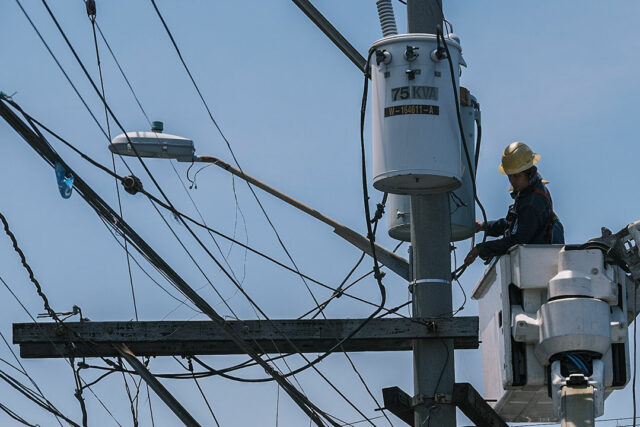
A Meralco worker examines a transformer in Navotas City. — PHILIPPINE STAR/RYAN BALDEMOR

SHARES in Manila Electric Co. (Meralco) climbed last week as investors responded to announcements on the company’s modernization initiatives, including a partnership with US-based Itron, Inc., aimed at strengthening its distribution network, analysts said.

Data from the Philippine Stock Exchange (PSE) showed Meralco was the seventh most actively traded stock for the week, with 1.98 million shares worth P1.15 billion changing hands. Its share price rose by 3.9% week on week to P579 on Friday from P557 the previous week, outperforming both the industrial index and the benchmark PSE index, which slipped by 0.4% and 1.7%, respectively.

Year to date, the stock has gained 18.6% from its closing price of P488 at end-2024.

The power distributor announced last week plans to install 1,500 kilometers of underground distribution cables in key areas and to deploy smart meters across Metro Manila through a partnership with Itron.

“These are certainly positive developments, which [showed] in Meralco’s stock performance as investors welcomed its push for smarter and more reliable power systems,” Regina Capital Development Corp. Head of Sales Luis A. Limlingan said in a Viber message.

Froilan J. Savet, Meralco’s first vice-president and head of networks, said the underground cable project will be implemented in the first regulatory period of the company’s multi-year capital expenditure plan. Meralco plans to file its application for the first period with the Energy Regulatory Commission by January 2026.

The utility giant said the undergrounding initiative will prioritize heavily trafficked areas such as business districts, heritage sites, tourist destinations, and typhoon-prone zones.

Diversified Securities, Inc. trader Aniceto K. Pangan said moving lines underground would reduce power losses and improve network resilience during storms.

Meanwhile, the Itron partnership will roll out advanced metering infrastructure allowing real-time monitoring of power use and faster outage response. The system is compatible with multiple meter brands, making it scalable across Meralco’s franchise area. About 73,000 meters in Metro Manila are set for installation in the first phase.

Mr. Limlingan noted that while sentiment was upbeat, investors also priced in the project’s “hefty capex and regulatory hurdles.”

He added that some investors were positioning for Meralco’s upcoming earnings report, which is expected to reflect “solid” third-quarter results.

In the first half, Meralco’s attributable net income grew by 5.3% year on year to P23.64 billion, while consolidated revenues rose by 3.3% to P245.22 billion.

Mr. Pangan said higher power rates in October may have also supported the stock’s performance. Meralco’s overall rate increased by P0.2331 per kilowatt-hour (kWh) to P13.3182 per kWh following a P0.831 per kWh reduction in September, mainly due to higher generation costs and peso depreciation.

For this week, Mr. Limlingan placed the stock’s support levels at P595-P600 and resistance at P570-P560, while Mr. Pangan pegged immediate support at P545 and resistance at P595.

Meralco’s controlling stakeholder, Beacon Electric Asset Holdings, Inc., is partly owned by PLDT Inc. Hastings Holdings, Inc., a unit of the PLDT Beneficial Trust Fund subsidiary MediaQuest Holdings, Inc., has an interest in BusinessWorld through the Philippine Star Group, which it controls. — Matthew Miguel L. Castillo

Honda Cars goes North

IMAGE FROM HONDA CARS PHILIPPINES

FOLLOWING ITS recent 35th anniversary, Honda Cars Philippines, Inc. (HCPI) is bringing its vehicle lineup closer to the north of Metro Manila. Until October 29, customers can check out the City 1.5 S CVT Honda Sensing and the BR-V 1.5 S CVT on display at the SM North EDSA’s The Block on the second floor between The Coffee Bean & Tea Leaf and Paul Le Café. Sales consultants will be present at the display to answer questions on financing, Honda technologies, and the latest models.

Meanwhile, until October 31, customers can select between a down payment as low as P35, availing up to five years of free periodic maintenance service (PMS), or as much as P100,000 cash discount when purchasing select City, BR-V or HR-V variants. Interested customers can see the City and the BR-V in the metal at the SM North EDSA display, while test drives will be available for all three models at the same venue.

This year, HCPI visited malls such as Ayala Malls Solenad Nuvali, The Podium, and Robinsons Magnolia. For areas that have not been covered yet, those interested in visiting may follow HCPI’s social media pages for announcements. Alternatively, customers may also visit any of the 39 Honda Cars Dealerships across the country (https://www.hondaphil.com/dealer-finder). Information on the latest models and technologies can be found at the Virtual Showroom https://www.hondaphil.com/virtual-honda.

USDA: No food aid benefits will be issued in November

DRAZEN ZIGIC-FREEPIK

WASHINGTON — The US Department of Agriculture (USDA) said food benefits under one of the country’s biggest social assistance programs will not be issued next month amid the ongoing federal government shutdown.

The shutdown is nearing its 30th day, with Republicans and Democrats in Congress remaining at an impasse over how to fund and reopen the federal government.

“Bottom line, the well has run dry,” the USDA said in a post on its website. “At this time, there will be no benefits issued Nov. 1.”

More than 41 million depend on the monthly payments, according to the USDA. In some states, like New Mexico, dependence on the program is as high as 21% of residents, it said.

The agency’s announcement came after Democrats in the US House of Representatives on Friday called on the USDA to draw on its emergency reserves to fund November food benefits.

However, according to a memo seen by Reuters, the department indicated that it would not do so.

Governors in Louisiana and Virginia declared states of emergencies this week to make funds available to help with hunger relief in anticipation of SNAP (Supplemental Nutrition Assistance Program) benefits not being issued next month. — Reuters

Dynasties and the flood of corruption

STOCK PHOTO | Image from Freepik

“The Philippines is the political dynasty capital of the world,” then-Senator Miriam Defensor Santiago declared in her explanatory note to The Anti-Political Dynasty Act, a bill “prohibiting the establishment of political dynasties,” submitted to the 15th Congress of the Republic of the Philippines in 2019.

A report by the United Nations Development Programme states that of the 77 Philippine provinces included in their study, 72 provinces or 94% had political families (ABS-CBN News, July 2).

The 1987 Constitution, Article 2, Section 26 provides: The State shall guarantee equal access to opportunities for public service and prohibit political dynasties as may be defined by law. “…As may be defined by law” has been the escape clause that allowed the political dynasty-dominated Philippine legislature to evade enacting the implementing law that will finally and truly establish the explicit prohibition in the constitution against political dynasties in our society. It has been 38 years since the Constitution was made. More than 30 anti-political dynasty bills have been filed in Congress, but none have become law.

Then-president Rodrigo Duterte openly jeered in a public speech in Batangas in April, 2022 that “Nothing will happen… as Congress won’t pass an enabling law to prohibit political dynasties because majority of its members are part of these dynasties and passing such law would spell doom for their political families” (factsfirstph-partners rappler.com).

The May 2025 mid-term election campaign confirmed Duterte’s painful taunt that political dynasties are determined to stay in power. The Philippine Center for Investigative Journalism (PCIJ) underscored the dominance of a system where power is frequently passed down within families, raising concerns about its impact on democratic representation and political diversity. In addition to the Marcos-Romualdez clans of Ilocos Norte and Leyte there were about two dozen political dynasties seeking to occupy at least five seats each after the May elections.

Cited were: the Singsons of Ilocos Sur; the Hataman-Sallimans of Basilan; the Ortegas of La Union; the Dys of Isabela; the Tulfos, Pacquiaos of South Cotabato and Sarangani; Dutertes of Davao City; the Villar family of Las Piñas; the Abaloses of Mandaluyong; the Revillas and Tolentinos of Cavite; the Ejercitos of Laguna and San Juan City; the Khos of Masbate; the Ynareses of Rizal; the Khonghuns of Zambales; the Duranos of Cebu; the Dimaporos of Lanao Del Norte; the Alonto-Adiongs of Lanao Del Sur; the Ampatuans and Masturas of Maguindanao; and the Tans of Sulu.

PCIJ subsequently posted the success of the political dynasties in the May elections: 71 out of 82 winning governors in the midterm elections were members of political families. About 58 ruling clans retained control of provincial leadership, while eight members of rival political clans lost. Four other governors-elect will replace sitting dynastic governors who either allied with them or did not field a family member to keep their post. Rival dynasties took down ruling clans in at least eight provinces.

The PCIJ counted at least 18 “obese” dynasties in the mid-term elections. A thin dynasty is one in which a political clan is able to manipulate one elected position over time; a fat dynasty is one in which a political clan holds multiple government positions simultaneously, as defined by the Center for Media Freedom and Responsibility (CMFR). A political dynasty with five or more clan members active in politics may be called an “obese” dynasty, as defined by the PCIJ.

Ateneo de Manila University (ADMU) School of Government Dean Ronald U. Mendoza said that over four decades of being voted into positions, political dynasties turned from largely “thin” to “fat” and “obese,” growing by at least 1% or about 170 positions every election period. The PCIJ warns how political dynasties perpetuate themselves in power and expand their influence by employing different tactics that are repeated in varying degrees in provinces, districts, cities, and municipalities. They sought higher positions and swapped roles with family members and allies. They established residency in new jurisdictions and got elected there. They joined the party-list race.

Political dynasties have been blamed for worsening corruption in the Philippines. According to the Catholic Bishops’ Conference of the Philippines (CBCP), “political dynasties breed corruption and ineptitude… because political power is monopolized by political dynasties” (Gulf News, Jan. 30, 2013). The dominance of powerful families has also allowed politicians facing corruption charges to get elected to public office. Plunder, bribery, unmerited government contracts, or misallocation of funds can be brazenly committed with impunity, because of the political dynasties’ control over the bureaucracy and the regulatory and justice system. The power and clout of the political dynasty is just too temptingly inherent not to be felt and taken to advantage by corrupt politicians.

And that is the reason why the people are now protesting about political dynasties — systemic corruption and blatant abuse of power by strongly entrenched politicians have literally flooded the collective consciousness leading to disillusionment with the “strong men” they have elected.

ELECTIONS, IMPEACHMENT, AND ARREST
The national elections on May 9, 2022 were “not free, honest, or fair by international standards,” according to the International Coalition for Human Rights in the Philippines (ICHRP). The Philippine Election 2022 International Observer Mission (IOM) commissioned by the ICHRP had over 60 observers from 11 countries on the ground, who meticulously documented the campaign, the vote, and the aftermath of the election. “The observers reported that the May elections showed a higher level of failure of the electronic voting system than ever before, along with a higher level of blatant vote-buying, a disturbing level of red-tagging of candidates and parties, as well as a number of incidents of deadly violence. A large number of voters did not get to cast their vote, and many had to trust that election officials would later put their marked ballot paper through a Vote Counting Machine, thus undermining the secrecy of the vote,” said Lee Rhiannon, former Australian Senator and Commissioner of the IOM.

On Nov. 3, 2022, former acting secretary of the Department of Information and Communications Technology Eliseo Rio, Jr., former Commission on Elections (Comelec) commissioner Gus Lagman, and ex-FINEX president Franklin Ysaac, filed a petition with the Supreme Court of the Philippines, wherein they alleged that in the May 9, 2022 presidential election, it was “highly improbable if not impossible” for Comelec to have been able to count over 20 million votes reported within one hour (7 to 8 p.m.) of the poll precincts’ closing. Nothing came of their petition, and electoral changes recommended to the Comelec have not been taken up.

And so, the Filipino people are not even sure, up to now, if the public officials the majority wanted to elect are indeed the ones sitting in offices of power and influence over life, liberty and pursuit of happiness.

On Feb. 5 this year, 215 members of the House of Representatives signed an impeachment complaint against Vice-President Sara Duterte on charges that include corruption, plotting to assassinate President Ferdinand “Bongbong” Marcos, involvement in extrajudicial killings, and incitement to insurrection and public disorder. House Secretary General Reginald Velasco said that an additional 25 law makers had signed documents, adding their names in support of the impeachment complaint, bringing the total number of signees to 240.

On June 9, minority senators Risa Hontiveros and Koko Pimentel attempted to formally start the senate impeachment trial of Ms. Duterte. The Senate delayed and decided after to archive the impeachment articles following the Supreme Court’s nullification of the complaint based on the “one year-bar rule” already covered by the first three impeachment cases, rendering the fourth one invalid. The complaint is remanded back to the House of Representatives, who have to wait until Feb. 6, 2026, one year after the original complaint, to impeach the vice-president.

But perhaps the ugliest blight and heaviest cross on the Duterte dynasty is the arrest of former president Rodrigo Duterte by the Philippine National Police and Interpol on March 11, under an International Criminal Court (ICC) warrant charging him with crimes against humanity related to the Philippine drug war. He is now in The Hague, Netherlands, detained and awaiting trial. It all started with a 77-page document to the ICC titled “The Situation of Mass Murder in the Philippines,” submitted by Filipino lawyer Jude Sabio in 2017, before Rodrigo Duterte unilaterally withdrew the Philippines from ICC in 2019.

The ICC mentions nine other co-perpetrators of Rodrigo Duterte whose names are redacted in a document. Lawyer Harry Roque said that former police chief Ronald dela Rosa could be among them, along with four other police heads, the Philippine Daily Inquirer reported on March 19. The Philippine government states it will serve future warrants for the ICC if such are conveyed through Interpol.

FLOOD CONTROL
In the rising heat of public disappointment and anger with corruption and crime in government, President Marcos, Jr. in his fourth State of the Nation Address (SONA) on July 28, vowed to improve flood control projects, to lessen the hazards to life and damage to property caused by the typhoons and monsoon rains of the season. He ordered the release of a complete list of flood control projects from the past three years for public scrutiny.

On Aug. 11, he revealed initial audit findings that P100 billion, or around 20% of the Marcos administration’s flood control project expenditures, went to only 15 contractors. News agencies exposed flagged projects collectively worth more than P350 billion which did not specify the exact flood control structure built or repaired, as well as several projects at different locations which disclosed identical designs and materials.

The Senate Blue Ribbon Committee launched a motu proprio investigation (shown live) into alleged irregularities in flood control projects. Ghost projects were revealed. Contractors rated triple-A or quadruple-A “leased” their license to smaller builders for a fee, a practice linked to substandard construction output. Senators alleged that a small group of contractors had cornered contracts worth around P100 billion, raising concerns over competition and transparency. Mr. Marcos revealed that only 15 out of 2,409 of the accredited contractors were awarded P100 billion, or 18% of the entire P545.6-billion flood mitigation budget allocated by his administration from July 2022 to May 2025.

Senator Erwin Tulfo, the vice-chairperson of the Blue Ribbon Committee, described the P545.6-billion flood control program as “a grand robbery,” claiming that kickbacks and commissions as high as 25% left only 30-40% of funds for actual construction. Greenpeace estimates are that up to P1.089 trillion was potentially lost to corruption since 2023, with P560 billion in 2025 alone, based on figures revealed at the Senate inquiries.

The saddest, and most angering revelations, or at least suspicions so far, are that people in government — senators, congressmen, local government officials, department secretaries and their staff — are complicit with, and personally benefit from this systemic corruption. Powerful political families, or dynasties, have been accused of manipulating government contracts for public works like flood control projects.

On July 18, Senator Francis “Kiko” Pangilinan filed a Senate bill seeking to prohibit political dynasties in the country — banning individuals related within the second degree of consanguinity or affinity from holding or running for public office simultaneously.


Amelia H. C. Ylagan is a doctor of Business Administration from the University of the Philippines.

ahcylagan@yahoo.com

Debt yields mixed before key US data

YIELDS on government securities (GS) traded at the secondary market ended mixed last week as the market looked ahead to the US consumer price index (CPI) data released late on Friday.

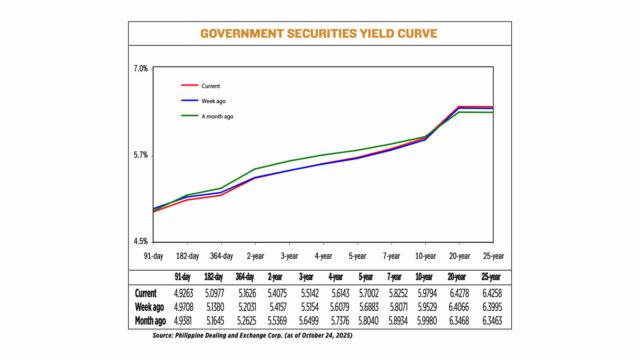
GS yields, which move opposite to prices, slipped by an average of 0.22 basis point (bp) week on week, based on the PHP Bloomberg Valuation Service Reference Rates as of Oct. 24 published on the Philippine Dealing System’s website.

At the short end of the curve, yields on the 91-, 182-, and 364-day Treasury bills (T-bills) went down by 4.45 bps (to 4.9263%), 4.03 bps (5.0977%), and 4.05 bps (5.1626%), respectively.

Meanwhile, at the belly, rates mostly went up. Yields on the four-, five-, and seven-year Treasury bonds (T-bonds) rose by 0.64 bp (5.6143%), 1.19 bps (5.7002%), and 1.81 bps (5.8252%), respectively. On the other hand, the two- and three-year papers saw their rates go down by 0.82 bp to 5.4075% and 0.12 bp to 5.5142%, respectively.

Lastly, at the long end of the curve, the 10-, 20-, and 25-year notes climbed by 2.65 bps, 2.12 bps and 2.63 bps to yield 5.9794%, 6.4278% and 6.4258%, respectively.

GS volume traded declined to P28.52 billion on Friday from P50.28 billion a week prior.

Yield movements were mixed as the market continued taking positions amid domestic and overseas developments, analysts said.

“The short end continues to reflect recent rate cuts, while the belly to the long end succumbed to profit taking,” a bond trader said in a Viber message.

The trader said players remained cautious before the release of key US inflation data on Friday evening as these could impact the Federal Reserve’s policy decision at its Oct. 28-29 meeting.

“Flush liquidity conditions and limited bond supply continued to support the front end, keeping yields anchored as investors are still positioning ahead of potential monetary policy easing amid emerging growth concerns,” Lodevico M. Ulpo, Jr., vice-president and head of fixed income strategies at ATRAM Trust Corp., said in a Viber message.

“In contrast, the uptick in the belly and long end reflected a more defensive stance consistent with movements in global bond markets, as participants priced in expectations of increased domestic bond supply on the belly to long end in the coming weeks and adjusted duration exposure accordingly.”

The Bangko Sentral ng Pilipinas (BSP) this month trimmed benchmark interest rates by 25 bps for a fourth consecutive meeting, bringing the policy rate to an over three-year low of 4.75%. It has now slashed borrowing costs by a cumulative 175 bps since it began its rate cut cycle in August 2024.

BSP Governor Eli M. Remolona, Jr. has left the door open to more reductions in the coming months to support the economy amid weakening prospects as governance concerns due to a graft scandal involving state infrastructure projects have affected investor sentiment.

The Monetary Board will next meet to discuss policy on Dec. 11.

Meanwhile, US consumer prices increased slightly less than expected in September as a surge in the cost of gasoline was partially offset by a sharp moderation in rents, keeping the Federal Reserve on track to cut interest rates again this week, Reuters reported.

The report was published despite an economic data blackout caused by the US government shutdown in order to help the Social Security Administration calculate its 2026 cost-of-living adjustment for millions of retirees and other benefits recipients, who will get a 2.8% increase.

It was initially due on Oct. 15 and the White House warned October’s inflation report might not be published for the first time ever because the shutdown had halted data collection.

The consumer price index rose 0.3% last month after climbing 0.4% in August, the Labor Department’s Bureau of Labor Statistics (BLS) said. The BLS said CPI data collection was completed before the shutdown. Still, the statistical agency used imputations to fill in missing information, with the share rising to 40% from 36% in August. A 4.1% jump in the price of gasoline was the main driver of the rise in the CPI.

In the 12 months through September, the CPI increased 3.0% after advancing 2.9% in August. Economists polled by Reuters had forecast a monthly increase in the CPI of 0.4% and a 3.1% rise on a year-over-year basis.

Excluding the volatile food and energy components, the CPI gained 0.2% after rising 0.3% in August. Slowing rent inflation accounted for the moderation in the so-called core CPI.

The Fed tracks the personal consumption expenditures (PCE) price indexes for its 2% inflation target. Based on the CPI data, economists estimated core PCE inflation rose 0.2% in September, translating to a 2.9% year-on-year gain.

The ongoing shutdown will, however, delay the release of that data. The second-longest shutdown in history is raising worries over the quality of future inflation reports, given the suspension of collection efforts.

Mr. Ulpo added that trading sentiment was “subdued” last week, as reflected in the results of the Bureau of the Treasury’s bond auction.

“The seven-year T-bond was awarded broadly in line with market expectations, while the 25-year tranche cleared roughly 10 bps above secondary market levels, underscoring the cautious stance of investors amid a lack of strong conviction,” he said. “Average daily traded volume declined sharply to P35 billion from P75 billion in the prior week, as market participants opted to stay on the sidelines ahead of major global data releases.”

“Externally, global macro uncertainty continued to weigh on local sentiment. The ongoing US government shutdown has delayed the release of key economic indicators, introducing an additional layer of uncertainty for investors. This information gap complicates the US Federal Reserve’s policy calibration. The resulting volatility and cautious global tone have spilled over into the local fixed-income space, further dampening risk appetite.”

For this week, the US inflation report released over the weekend could affect GS yield movements, both analysts said.

“Market direction will hinge on that report, but the bias remains for yields to trend lower given the absence of new supply and lingering growth concerns,” the trader said.

“We expect the local bond market to remain muted, with limited directional bias as investors await clearer catalysts. Domestic factors are likely to stay muted, and attention will turn to key US data releases,” Mr. Ulpo added.

He said the softer-than-expected September US consumer inflation print “could reinforce expectations of a more dovish Fed stance, providing support for global bond markets and possibly prompting renewed buying interest locally.” — Heather Caitlin P. Mañago with Reuters

German police bust gang that offered forged Picassos, Rembrandts

BERLIN — German police said they broke up a painting forgery ring that allegedly asked millions for canvases they claimed were by masters including Pablo Picasso and Rembrandt, including a painting that had hung in Amsterdam’s Rijksmuseum for decades.

Police last week arrested and then conditionally released the alleged ringleader, a 77-year-old from southwestern Germany, they said on Friday. He and 10 accomplices face charges of organized conspiracy to commit fraud with forged artworks.

In synchronized dawn raids on Wednesday, Oct. 15, police descended on premises across Germany and Switzerland and seized documents, mobile phones, and multiple suspected art forgeries, police in Bavaria, who led the operation, said in a statement.

Police first caught on to the group’s activities when the main suspect offered for sale two supposedly original Picassos, including one purporting to be of photographer and activist Dora Maar, Picasso’s long-time muse and partner.

Further investigations found he was also asking 120 million Swiss francs ($151 million) for a forged copy of Rembrandt’s 1662 De Staalmeesters, or The Sampling Officials, a stern collective portrait that has hung in the Rijksmuseum since 1885, according to police.

The painting was in the possession of an 84-year-old Swiss woman, who was also under investigation, police said. The suspected fraudsters claimed that the canvas hanging in Amsterdam was a copy.

The group had offered at least 19 other forgeries for sale, including works purportedly by Peter Paul Rubens, Anthony van Dyck, Joan Miro, Amedeo Modigliani and Frida Kahlo, for which they were asking prices between 400,000 and 14 million, police said.

Police said they did not yet know if any painting was actually sold. — Reuters

Sunlight Air to expand fleet, targets int’l routes by 2027

SUNLIGHTAIR.PH

BOUTIQUE CARRIER Sunlight Air plans to lease larger jets by 2027 to serve international routes as part of its fleet expansion program, according to its top executive.

“We are planning that for 2027. We are looking at some narrow-body jets,” Sunlight Air Chief Executive Officer Ryna C. Brito-Garcia told reporters on the sidelines of the airline’s aircraft launch last week.

The announcement came as the airline welcomed its newest aircraft — an ATR 72-600 — expanding its fleet to four.

The aircraft will be deployed on its existing domestic routes, including Clark-Siargao, Siargao-Cebu, Cebu-Busuanga, and Busuanga-Clark, and on the new Cebu-Siquijor route, which will operate four times weekly starting December.

Ms. Brito-Garcia said the modern ATR 72-600 complements Sunlight Air’s three ATR 72-500s, providing improved performance for short-haul regional operations.

“This new aircraft is one manifestation of the airline’s growth over the past few years. This fleet expansion aligns with our plans to continuously improve Sunlight Air’s services and eventually expand our route offerings,” she said.

For the short term, the airline aims to renew and upgrade its existing ATR 72-500 aircraft to ATR 72-600 units by next year.

Looking ahead, Sunlight Air is evaluating the acquisition or leasing of narrow-body regional jets to tap the foreign travel market.

“There are plans of acquiring or leasing regional jets. And when that happens, there’s definitely a plan of servicing foreign travelers coming into the Philippines,” Ms. Brito-Garcia said. “It’s very important for us that we bring more people to the different island destinations of our country.”

With its growing fleet, Sunlight Air is projecting 20% to 30% passenger growth in 2026.

Data from the Civil Aeronautics Board (CAB) showed that the airline, operated by Sunlight Express Airways Corp., carried 96,728 passengers in the first half of 2025.

“Currently, we are already at around 200,000 passengers for this year alone. The peak season is coming, so we are targeting to increase our passenger count by 20% to 30% next year,” Ms. Brito-Garcia said.

Sunlight Air operates from Clark, Cebu, and Manila, flying to domestic destinations such as Boracay, Coron (Busuanga), Siargao, and Cagayan de Oro, and also offers private charter services. — Ashley Erika O. Jose

Hyundai Trucks and Buses holds ‘Pasok sa Pasko’ promo

IMAGE FROM HARIPHIL ASIA RESOURCES, INC.

HARIPHIL ASIA RESOURCES, INC. (HARI), official distributor of Hyundai Trucks and Buses in the Philippines, holds its “Pasok sa Pasko” promo designed “to reward the hard work and entrepreneurial spirit of Filipinos nationwide.”

In a release, the company said it recognizes the vital role of reliable mobility in fueling economic progress. The “Pasok sa Pasko” Promo offers special discounts on two of Hyundai’s “most trusted” commercial vehicles, the Hyundai County New Breeze and the Hyundai Solati, to help Filipino entrepreneurs “scale their businesses efficiently and affordably.”

The Hyundai County New Breeze, engineered as a modern public utility vehicle, is available with a P300,000 discount. The New Breeze is said to be designed for power, comfort, and versatility.

On the other hand, the Hyundai Solati is available with a P250,000 discount. “Favored by executives, travel tours, and premium shuttling operation, the Solati combines elegant design with practical performance, delivering a first-class experience in every journey,” maintained HARI.

The “Pasok sa Pasko” Promo runs until December 31, 2025, and is available at Hyundai Trucks and Buses dealerships nationwide. Business owners and transport operators are invited to visit the nearest showroom to take advantage of these exclusive year-end offers.

“Launching the Pasok sa Pasko Promo is our way of giving back and sharing the joy of the season with hardworking Filipino entrepreneurs who keep our economy moving,” said HARI Vice-Chair, President and CEO Ma. Fe Perez-Agudo. “By making world-class Hyundai vehicles more accessible, we’re helping empower business owners with the reliable mobility solutions they need to drive success and uplift their communities.”

This year’s US corn crop could be the biggest ever

STOCK PHOTO | Image by Erik from Unsplash

FREDERICKSBURG, Iowa  — Kyle Wendland stepped away from his engineering degree two decades ago to follow his father — not just into farming corn, but into a world of debt, grit, and stubborn faith he could wrest a living from Iowa’s soil.

He calls his place Comeback Farms, after his family nearly lost the land in the w farm crisis.

This summer, with bills mounting and a farm economy in recession, he led a team through the sweltering Midwest, scouting fields and sizing up what President Donald Trump’s administration said would be the biggest corn crop in US history — a bounty that’s helped keep prices at multi-year lows.

Measuring ears of corn by hand may seem a relic in an age of satellites and artificial intelligence. Yet the annual survey by the Pro Farmer Crop Tour felt like a rural quest for signs that Washington was now wrong — that disease or something unseen would result in a lower forecast.

As Mr. Trump fired government statisticians, farmers and traders have questioned whether the quality of US Department of Agriculture (USDA) data, long a market backbone, would hold up, heightening interest in the crop tour.

More than 15,000 USDA employees, or about 15% of its workforce, have taken packages to leave the agency under Mr. Trump’s downsizing mandate.

The USDA has temporarily removed some climate data from its websites, delayed a key trade report and deleted language tying Mr. Trump’s tariffs to a widening trade deficit.

Agency staff shuttered research, and were obliged to correct export sales notices. It was a portent of more to come, with the federal government shutdown freezing the majority of USDA data or forcing it offline.

A USDA spokesperson told Reuters the workforce reductions prior to the government shutdown had “not had an impact on the Department’s ability to deliver timely, accurate, and useful data in service to American agriculture.”

USDA also said that it is reviewing all non-statutory surveys and reports “to ensure wise use of taxpayer dollars, improve efficiency, and eliminate unnecessary burdens.”

The White House directed questions about USDA reports and accuracy of its data to the agency.

In the heat of summer, Mr. Wendland’s mind turned to walking fields and seeing for himself how the Corn Belt’s crop was holding up. If conditions were good, it would mean big yields, low prices and farmers facing a third straight year of losses.

Wendland’s own farm was crowded with corn worth less than it cost him to grow.

If crop conditions had worsened since the USDA forecast though, tighter supplies could push prices higher.

“People are looking for hope out here,” he said.

Farm debt is set to hit a record high this year as global grain flows shift, deepening the downturn in an industry battered by trade policies set in motion under Mr. Trump, largely maintained under Democratic president Joe Biden, and broadened in Mr. Trump’s second term.

China, usually the top buyer of US soybeans, hasn’t purchased a bushel from this year’s crop. Last year, it bought 45% of US soybean exports.

Anticipating trouble, many farmers planted more corn. They bet exports to Mexico and Canada, ethanol production and livestock feed would keep prices afloat.

Instead, the season stayed mild. Fields flourished. Prices drifted lower. Farmers’ age-old fix — to boost yields and grow their way out of the problem — was no fix at all when the fields were this full and their bills so big.

Iowa corn farmers who rent land — a common practice _ need $4.58 a bushel this year to break even, according to Iowa State University Extension and Outreach. In August, the average cash price: $3.89.

Wall Street and rural America have long tracked the Pro Farmer Crop Tour. The boots-on-the-ground survey of more than 1,600 corn and soybean fields is conducted by farmers, traders, brokers and government researchers, and timed to when corn reveals its fate. In July, the plants typically pollinate, setting the crop’s potential; by August, that promise either fills out or fails.

The tour’s hand-written counts helped fill gaps in government data, too. USDA stopped collecting corn and soybean samples for its August crop production report after an agency audit during Mr. Trump’s first term. These days, the agency leans on satellites and farmer surveys, done in late July and early August. Just 14,900 farmers took part , nearly 27% fewer than the 20,300 producers surveyed .

On Aug. 12, USDA predicted the largest corn crop since 1866: 16.7 billion bushels, enough corn to fill every barn, bin, and crib in America and still feed the nation’s livestock for half a year. Corn prices dropped.

On social media, farmers insisted USDA had missed woes all too glaring in their backyards — plants with tassels wrapped too tight, hail and wind battering fields.

Five days later, Mr. Wendland and his fellow crop scouts — more than 50 farmers, grain brokers and commodity traders — rolled into Dublin, Ohio, in a caravan of pickups loaded with beer.

Another group pulled into South Dakota. Several USDA staff joined the tour, eager to check field conditions too.

Scouts like Mr. Wendland — on his 18th tour — said they believed USDA’s forecasts because they knew the people behind them. They’d tromped fields together, traded stories over drinks in parking lots.

Still, nature always changes, they said. What’s right one week can be wrong the next.

Launched by the Illinois Farm Bureau in the 1970s to gauge crop health, the tour expanded under news and marketing firm Pro Farmer to Ohio, Indiana, Iowa, Minnesota, South Dakota and Nebraska.

In Ohio, in a hotel meeting room, former Wall Street trader Peter Meyer outlined the rules: stop every 13 miles, sample and measure 30 feet of corn, count soybean pods longer than a quarter-inch. Randomness was the point — hundreds of imperfect samples stitched into a number that was a snapshot, not a guarantee.

Outside the tour, online anger spilled into real life. The chief commodities economist from StoneX Group, a financial services firm, was bombarded with online threats after the company pegged the US corn crop at 16.334 billion bushels on Aug. 4.

Some anger is rooted in fear. Farm debt is expected to hit nearly $600 billion this year, a record.

As credit conditions deteriorate, risk-wary bankers are tightening lending practices, according to the Federal Reserve Bank of Kansas City and farm lenders.

For debt-heavy growers, that can mean higher interest rates to cover spring planting or being denied by their existing lender, according to interviews with a dozen grain farmers.

As the scouts crisscrossed the Midwest, trouble was spreading that farmers may not have seen when talking to USDA in late July. Southern rust, a plant disease, freckled corn leaves, pustules black as pitch or bright as paprika. Spores clung to shirts and ballcaps.

Still, the crop was massive. Scout photos of heavy ears and dense rows spread online. Farmers grew testy, as the tone online turned from anxiety to derision.

One afternoon, Iowa cattleman Mike Berdo, a 6-foot-4 wall of good humor, pulled his yellow pickup onto a field driveway to take samples. A man from a nearby farmhouse blocked him in, accusing him of trespassing.

Mr. Berdo explained he was with the tour, offered a hat, tried to smooth things over. The man drove off in a huff.

While big agribusinesses can afford pricey private analytics, many farmers in the US and worldwide rely on government data to help guide planting and marketing decisions.

There are fewer people producing that information. At the USDA’s National Agricultural Statistics Service, roughly a third — 243 staff — left through the administration’s incentive programs as of May. The Economic Research Service lost 78 staff, or about 27%.

That was before the shutdown. About half of USDA’s 85,907 employees were slated for furlough when the government shuttered this month, according to the agency’s lapse-of-funding plan. At ERS, 94% of staff was furloughed; at NASS, 91%. How many USDA jobs might ultimately be eliminated remains unclear.

USDA data and research can swing commodity markets, raising or crushing crop values and triggering algorithmic trades. What matters most, traders said, isn’t precision so much as consistency: whether the agency’s data aligns with market expectations.

That’s why alarms went off in May when the USDA delayed a quarterly trade outlook and stripped out analysis linking a widening farm trade deficit to Mr. Trump’s tariffs. When it finally appeared, the tables were there; the analysis was gone.

Then came mistakes. In July, USDA announced a 135,000-ton corn sale to China — later corrected to South Korea. In September, it said China bought 68,000 tons of soybeans from this year’s crop.

The sale happened in January.

Some data sets are gone for good: USDA scrapped the Agricultural Labor Survey, used to help set H-2A guest worker wages, and the long-running Household Food Security Survey, a benchmark for hunger. Other reports halted by the Biden administration for budgetary reasons, such as the July Cattle Report, were revived.

On Aug. 22, Pro Farmer analyzed the data and released its estimate: 16.204 billion bushels, a tour record but smaller than USDA’s lofty outlook. Online, scouts were pilloried by analysts for bowing to farmer pressure to put out a lower forecast, and chastised by farmers for estimating too much.

“Our opinion about the crop has not changed,” said Pro Farmer economist Lane Akre. “The data speaks for itself.”

Three weeks later, USDA updated its corn prediction with crop-insurance data submitted by farmers. It showed farmers had sown the most corn acres since the Great Depression, even more than previously thought.

USDA forecast American farmers would indeed produce a record crop, and raised its 2025 US corn production estimate: 16.814 billion bushels. — Reuters


Partnerships to innovate access to medicines

STOCK PHOTO | Image by DC Studio from Freepik

In many low- and middle-income countries (LMICs), limited public health resources often push healthcare costs onto households already struggling with tight budgets. In the Philippines, household out-of-pocket payments account for about 45% of total health expenditures.

Making medicines more accessible can ease this financial strain, sparing families the difficult choice between medical treatment and other basic needs such as food, education, and shelter. When people can afford medicines, they are more likely to seek care promptly, adhere to treatment, and avoid complications that lead to higher costs later on.

COLLABORATION AS THE CORNERSTONE
Despite notable progress in health reforms, no single sector can achieve equitable access to essential medicines on its own. Sustained progress depends on robust multistakeholder partnerships that bring together government, the private sector, and civil society. These partnerships not only combine resources and expertise but also foster accountability, transparency, and long-term sustainability that are all essential for achieving health equity.

“Healthcare can indeed be accessible, but only if the private and public sectors work together, bound by common goals and grounded on a strong ethical code of conduct. The tragedy of a Filipino dying simply because they don’t have money must end,” said Dr. Diana Edralin, president of the Pharmaceutical and Healthcare Association of the Philippines (PHAP), during a recent healthcare forum.

Dr. Edralin emphasized that meaningful progress in access to medicines will depend on stronger partnerships between government and industry in three key areas.

First is in the area of accelerating Health Technology Assessment (HTA). Delays in HTA processes hinder patient access to innovative, life-saving medicines that are already standard of care globally. Without timely HTA reviews, these medicines are often excluded from the Philippine National Formulary, making them unavailable in public health facilities and forcing patients to shoulder the cost.

A practical solution is to establish a reliance or expedited review mechanism that allows the Philippine HTA to leverage trusted international regulatory bodies such as the US Food and Drug Authority (FDA) and the European Medicines Agency (EMA). Additionally, fostering structured and consultative discussions between industry experts and regulators can ensure that HTA evaluations remain timely, evidence-based, and transparent.

Second is in the area of implementing innovative access models. Innovative access models such as volume-based pricing and risk-sharing agreements can help reduce costs while expanding availability. Under these models, the government can purchase large quantities of medicines at lower unit prices and pay in full only for treatments that deliver verified patient outcomes.

Similarly, pooled procurement and multi-year contracts can stabilize supply chains and bring down costs. International experience demonstrates that when governments increase health spending and implement effective access programs, out-of-pocket payments for medicines drop significantly to 47% in Australia, 46% in Malaysia, 42% in South Korea, 41% in the United Kingdom, 32% in New Zealand, and just 9% in Thailand.

The third is in the area of strengthening partnerships with PhilHealth. While PhilHealth — the Philippine Health Insurance Corp. — has introduced programs aimed at improving medicine access, significant opportunities remain to expand its coverage. Limited formulary inclusion in benefit packages, particularly under the Z Benefits program, means that patients with catastrophic diseases still bear heavy out-of-pocket costs for essential medicines.

With this, Dr. Edralin proposed the co-creation of a joint review team with PhilHealth to regularly evaluate and update Z Benefit packages, prioritizing high-burden diseases. Partnerships could also fast-track the accreditation of private retail pharmacies as distribution points, bringing medicines closer to patients, especially in underserved areas.

During the same forum, stakeholders signed a “Manifesto of Commitment to Build a Stronger Nation through Improved Access to Medicines.” Signatories included Maria Blanca Kim Lokin, president and CEO of Philippine Pharma Procurement, Inc., and PhilHealth Vice-President Walter Bacareza.

Aligned with the Universal Health Care (UHC) Act, the signatories pledged to strengthen initiatives that promote the affordability, availability, and accessibility of quality medicines. These include the development of new distribution channels in remote communities. They also committed to cultivate partnerships, build stakeholder capacity, and adapt to evolving technologies and market dynamics to ensure the sustainability of the Philippine healthcare system.


Teodoro B. Padilla is the executive director of Pharmaceutical and Healthcare Association of the Philippines, which represents the biopharmaceutical medicines and vaccines industry in the country. Its members are at the forefront of developing, investing and delivering innovative medicines, vaccines, and diagnostics for Filipinos to live healthier and more productive lives.