The unemployment rate rose to 8.9% in September, the highest so far this year, even as lockdown restrictions were loosened in the Philippine capital.
The preliminary report of the Philippine Statistics Authority’s (PSA) September round of the labor force survey (LFS) put the unemployment rate at 8.9%, compared to the 8.1% in August. It was the highest so far for this year since the 8.8% rate recorded in January.
There were 4.25 million unemployed in September, up from 3.88 million in August. This was also the highest since the 4 million Filipinos without jobs in January.
In an online press conference on Thursday, National Statistician and PSA chief Dennis S. Mapa said the agriculture and forestry sector logged the biggest increase in unemployment due to bad weather conditions in September.
Around 862,000 jobs in agriculture and forestry were lost in September versus August, the PSA said. Severe Tropical Storm Jolina (Conson) and Tropical Storm Kiko (Chanthu) hit parts of the country in September, which coincided with the end of harvest season.
Meanwhile, the quality of jobs slightly improved as the underemployment rate, representing those under the labor force who are already working but are looking for more work or looking to work for longer hours, went down to 14.2% equivalent to 6.18 million Filipinos in September from 14.7% or 6.48 million in August. — BADA
WASHINGTON — The Federal Reserve threw its weight back behind the drive for a full US jobs recovery on Wednesday, restating its belief that current high inflation is “expected to be transitory” and, despite risks to that view, arguing that price pressures will ease and pave the way for stronger employment and economic growth in the months to come.
Even as the US central bank announced it was tucking away one of its main pandemic-fighting tools, by trimming its massive bond-buying program beginning this month, its latest policy statement and Fed Chair Jerome Powell’s remarks in a news conference signaled it would stay patient — and wait for more job growth — before raising interest rates.
“Supply and demand imbalances related to the pandemic and the reopening of the economy have contributed to sizeable price increases in some sectors,” the Fed said in its latest policy statement, adding that “an easing of supply constraints [is] expected to support continued gains in economic activity and employment as well as a reduction in inflation.”
Mr. Powell emphasized what he said is the Fed’s intent to push labor markets further with low interest rates, and to withhold judgment about the limits of job creation until further outbreaks of the coronavirus have been contained.
“Ideally, we would see further development of the labor market in a context where there isn’t another COVID spike. And then we would be able to see a lot. To see how does [labor] participation react in the post-COVID world,” he told reporters. “We are going to have to see some time post-COVID, or post-Delta anyway, to see what is possible,” Mr. Powell said in reference to the coronavirus variant that was largely responsible for a coronavirus disease 2019 (COVID-19) surge and economic slowdown over the last three months.
Yet inflation was uncomfortably high, Mr. Powell acknowledged, blaming it on “turmoil” in global supply chains that is likely to last until perhaps the second half of next year, posing a challenge in the meantime to families on fixed incomes or those earning lower wages.
Inflation for the last five months has been running at twice the Fed’s 2% target, and moving in a way Mr. Powell said could well satisfy the central bank’s benchmark for a rate increase — once maximum employment is reached.
But for now, he said, the Fed would be “patient” in deciding when to raise its benchmark overnight interest rate from the near-zero level, a counter to rising bets in financial markets that inflation would prompt the central bank to end its pandemic-era support for the economy sooner than later.
The Fed last year said it would allow higher inflation in hopes of encouraging more job growth, but as prices rose this year so did skepticism about the depth of the central bank’s commitment to that new approach.
“We don’t think it is time yet to raise interest rates. There is still ground to cover to reach maximum employment,” Mr. Powell said, adding that he thought that goal could perhaps be met late next year.
END OF ASSET PURCHASES
The Fed, as widely expected, announced on Wednesday that it would begin reducing its $120 billion in monthly purchases of Treasuries and mortgage-backed securities (MBS) at a pace of $15 billion per month, with a plan to end the purchases altogether in mid-2022.
That bond-buying “taper,” the source of market turbulence when the Fed plotted its exit from a similar asset-purchase program that was rolled out to fight the 2007-2009 recession, this time came off without a hitch
The central bank’s message of ongoing accommodative policy helped push the S&P 500 index and the Nasdaq Composite to record closing highs.
Treasury yields ended the day higher, but the move was more pronounced on longer-dated maturities that are more sensitive to inflation expectations. The yield on the benchmark 10-year Treasury note ended the session back above 1.60% for the first time in a week, while the yield on the 2-year Treasury note, a proxy for Fed interest rate expectations, ticked fractionally higher to about 0.46%.
Indeed, investors in recent weeks had focused less on the bond-buying taper and more on the Fed’s reaction to a surge in prices that promises to last much longer than anticipated when it first took root in the spring.
Mr. Powell’s response was to acknowledge the uncertainty, but argue that was part of the reason the Fed should not rush into a rate hike when it was still possible inflation would ease on its own and allow workers more time to navigate into jobs.
“As the pandemic subsides, supply-chain bottlenecks will abate and job growth will move back up,” he said. “And as that happens, inflation will decline from today’s elevated levels. Of course, the timing of that is highly uncertain.”
‘HEDGING THEIR BETS’
The Fed instructed its market agents at the New York Fed to begin executing the reduced bond purchases in the middle of this month, but only laid out that plan for November and December. Starting in mid-November, it will buy $70 billion of Treasuries and $35 billion of MBS per month, a pace that will drop to $60 billion of Treasuries and $30 billion of MBS per month in mid-December.
Policymakers, the Fed said, judge that “similar reductions in the pace of net asset purchases will likely be appropriate each month, but (are) prepared to adjust the pace of purchases if warranted by changes in the economic outlook.”
If the economy continues to progress as expected, the Fed could finish tapering those purchases by the middle of next year, Mr. Powell said. He stressed that officials have the flexibility to speed up, or slow down, the taper based on what happens in the economy.
“They’re hedging their bets, but that’s not anything new, because we’ve heard publicly they’re a little less confident that things are going to come down as quickly on the inflation side as they thought,” said Joseph LaVorgna, Americas chief economist at Natixis in New York.
“Along with supply disruptions, things just drag on a bit longer and the statement reflects those realities,” Mr. LaVorgna said. — Howard Schneider and Ann Saphir/Reuters
BTS danced its way through the United Nations — SCREENSHOT FROM YOUTUBE.COM/UNITEDNATIONS
Hybe Co., the agency managing K-pop sensation BTS, will team up with South Korea’s largest crypto exchange operator to sell non-fungible tokens related to the band, ahead of plans to also release a video game co-produced by BTS.
The agreement involves Hybe buying a 2.5% stake in Dunamu, which runs the Upbit crypto exchange, for 500 billion won ($423 million). Separately, Hybe will issue 700 billion won of new shares to Dunamu, the company disclosed in regulatory filings Thursday.
Photo cards of BTS members will be released as NFTs on Upbit, which would be available to share on virtual spaces. Physical photo cards are commonly released in limited quantities and collected and traded by fans who meet in person.
“We are working with Dunamu to create a way to expand the fan experience,” said Hybe founder Bang Si-hyuk in an online briefing. The goal is providing secure card ownership and “allowing them to be collected, exchanged, and displayed in a global fan community where instead of a single photo, it can be turned into a digital photo card with moving images and sound.”
Hybe shares were up as much as 7.5% in Seoul on Thursday.
Aside from the NFT announcement, Hybe also plans to launch original stories starring members of its K-pop boy bands from January, which will be released in web cartoon and web novel format via Naver Webtoon Co.’s platform. The company also said there’ll be a BTS game, developed with input from the band, in the first half of 2022.
NFTs have soared in popularity in recent months, with caricatures of monkeys and lions commanding prices that scale up into the millions of dollars and sports clubs and prestige automakers are among those getting into the business. BTS would be one of the biggest brands to join in the nascent trading business, which is based on blockchain technology to authenticate unique ownership tokens attached to otherwise easily reproducible digital goods. Music, photography and digital art are among the popularly traded genres of NFT.
Upbit is one of the four Korean exchanges that are allowed to offer won-based trading as well as crypto-to-crypto trading services after a regulatory clampdown in September. The country’s cryptocurrency market is dominated by the four biggest exchanges and Upbit accounted for about 88% of trading volume in the country as of September, according to data from ruling party lawmaker Noh Woong-rae. — Bloomberg
Digital technologies have become part of the numerous ways of doing business at present. As brands continue harnessing such innovations to build their future, they must know how to properly navigate the multidimensional digital space.
Providing insights to envision this digital future for brands, the Digicon POP 2021 gathered leaders, experts, and creators from various industries all over the world to discuss what a future further shaped by digital holds.
Organized by the Internet & Mobile Marketing Association of the Philippines (IMMAP), the five-day virtual conference — held on Oct. 11 to 15 — employed a framework of four programming tracks, namely Disruption, Expansion, Emerging, and Possibilities.
Day One: Rethinking ahead
The management of ABS-CBN, which now calls itself a “content company,” began the first day of Digicon by sharing how they disrupted the country’s largest entertainment and media conglomerate through digital channels.
Melissa Henson, vice-president and chief marketing officer of Manulife, followed the discussion by talking about resetting, restructuring, and revisiting priorities for the new normal to make every day better.
The Disruption track, which covered discussions to learn from innovators from different fields, gathered Pablo Gomez, head of Creative and Media Singapore and Regional Media Lead for APAC at Kantar; Michael Patent, founder of Culture Group; and Rushit Jhaveri, head of Content Solutions & Sponsorship (SEA) at Google. They talked about media and digital trends; the metaverse marketing ecosystem; and maximizing content reach, respectively.
Meanwhile, speakers at the Expansion expounded on the new growth areas and opportunities from digital technologies. The track’s first speaker on Day One was Nicholas Kontopoulos, head of Growth Market APAC at Adobe, who explored the future of customer experience. The next talk centered on rewriting the brand narrative with Wattpad, discussed by Twila Bergania, head of Fandom & Community Engagement at Culture Group, and Walter Demesa, senior account manager at Wattpad. The last session on Day One under the Expansion track was a panel discussion that answered the question of whether brands can go “Glocal.”
The Emerging leg, where speakers shared the emerging digital trends and tools, started its first day with Akshat Jain, country manager at Facebook, discussing “Making conversations deliver more for businesses;” followed by a panel discussion on the topic titled, “Your audience is listening. Are you missing out?;” and finally with Philip Tnee, country head for Global Business Service at TikTok, talking about “How Brands can Succeed in the Age of Participation.”
Recognizing new potential markets and underserved needs were the goal of Digicon’s last track, Possibilities. Its Day One speakers included Alasdair Gray, strategy director at BBH; Ash Mandhyan, former CEO of Quanta Digital; and Benjamin Burne, director of product strategy at Nielsen. Their respective talks dealt with learnings brands can get from games; the next step for retail with e-commerce; and transformation in audience measurement.
Adam Grant, an organizational psychologist and best-selling author
Adam Grant, an organizational psychologist and best-selling author, culminated the first day of Digicon with a reminder of the importance of rethinking or “thinking like a scientist” for businesses.
According to Mr. Grant, thinking like a scientist would free entrepreneurs from falling into the trap of escalation of commitment to a losing course of action where instead of rethinking a choice that did not go as hoped, they double down and invest more time, energy, and money on this failing claim.
“Rethinking does not always mean you have to change your mind. It means you’re open to reevaluating and reconsidering,” he said. “When you think more like a scientist, you take people who disagree with you not as a threat to your ego or image, but as people you can learn from.”
“The pandemic last year forced us to do a lot of rethinking, to question our assumptions or decisions,” he added. “I hope for 2021 and beyond, we do our rethinking more deliberately and proactively.”
Day Two: Meaningful connections and partnerships
The second day of Digicon POP was kicked off by Bretman Rock, sharing his thoughts about content creation and connecting with the audience as well as his advice for influencers.
The social media sensation shared that content creating is mentally draining at times, which some people do not talk about much. “Sometimes the pressure of content creating — the numbers, likes, views — could create so much problems,” he said. “This creator world is very taboo [and has] a lot of unspoken things.”
“If anyone out there struggling with their mental health, joining social media will not help them,” he added. “Having fame will not fix your mental health. Sometimes it’s better to not post today; it’s okay to not get as much likes on a post.”
He also expressed that he loved seeing “real” people on Philippine commercials today, also telling marketers that their audience and demographic now want real things. “I think that’s what the world is craving right now. That’s why I feel like the world loves me because I’m a real person.”
He also reminded his fellow and aspiring influencers about false self-entitlement. “Sometimes people want to have fame or start influencing to get the perks. But it should never be about that. People can see your intentions,” he said. “If you want to be an influencer for the perks of it, don’t.”
Laurent Ezekiel, chief marketing and growth officer at WPP, continued the second day of Digicon through a conversation with Gill Zhou, chief marketing officer of IBM APAC. They talked about IBM’s marketing transformation with agency partners.
Ms. Zhou shared that their needs and expectations evolved from their agency partners. First of which is they need “an agency partner that helps push the boundaries to find and test new and engaging formats across all channels.” Next is they need “a very diverse and inclusive talent pool to ensure the best work.” And lastly, they also need to “work seamlessly as one team driving one, shared outcome.”
“As the marketing transformation is ongoing at IBM, I think we will rely even more on the agency partners. If we elevate this relationship into business partner relationship, then I think that kind of mutual accountability and mutual reliance on each other for mutual success is just becoming inevitable,” Ms. Zhou said.
“I’m doing the work every day in my part of the world to get on this transformation journey with all my teams and agency partners over here to create that future that is quite foreseeable.”
Dhruv Vahra, Facebook’s director of Small and Medium Businesses in Southeast Asia, presented the digital adoption and consumption growth, among others, in the region. He also highlighted that Southeast Asia leads the digital transformation in the Asia-Pacific.
Day Two of Digicon’s Disruption track covered the key influencer marketing trends for 2022 in a panel discussion of the Content and Influencers Council of the Philippines. It was followed by Beia Latay, CEO of HealthNow, who shared what can be learned from the healthtech boom.
The Expansion track started with a discussion about mothers as consumers, led by Bela Gupta, founder of Edamama. Afterward, Jay Jenkins, tech strategist and evangelist for APAC at Google Cloud, talked about building a digital workforce.
Chris Schimkat, regional analytics director for APAC at Reprise, began the second day of Emerging with a talk about data science and getting the right data. Mehul Mandalia, co-founder of Moving Walls, followed with a topic on programmatic digital out-of-home.
The Possibilities track covered radio and podcasting. The Manila Broadcasting Corp. shared the story of radio amid the pandemic, including the innovations. Ron Baetiong, CEO and co-founder of Podcast Network Asia, then explained why podcasting is the new word of mouth.
Digicon’s second day ended with Ken Mandel, Grab’s regional marketing director for GrabAds and Brand Insights, talking about brand as a service.
Day Three: Striking balances
Starting Day Three of Digicon was a fireside chat on growth with Alex Tsering and Crystal Widjaja, Kumu’s respective chief growth officer and chief product officer. They were followed by Chandan Deep, head of Emerging Business for SEA at Twitter, discussing brand safety. Ragde Faicis, CEO of ChatGenie, subsequently talked about hyper-convenience in the time of the rising presence of super apps.
The third day of Disruption track opened with Bea Atienza, IBE Leader at Colgate Palmolive, speaking on the topic “Designing Customer Experiences that Pop.” Paula Abjelina, AdColony’s country manager for the Philippines and Thailand, and Memo Moreno, a managing partner at Mindshare, afterward talk over gaming as a new channel for marketing.
Esports was the central topic on the Expansion track, beginning with ONE Esports CEO Carlos Alimurung elucidating how this form of gaming builds fan engagement. The next topic dealt with esports going from the influencer to creator economy, a discussion led by Brian Dacanay, associate vice-president for Tier One’s Commercial Partnerships.
The first session on Day Three of Emerging was about “Marketing to Women,” discussed by Lucille McCart, comm’s director for APAC at Bumble. Marty Buaragay and Lian Capati, the respective country lead for Video and Head of Agencies at Facebook Philippines, then talked about “Rising in the era of social video.”
Gen Z, meanwhile, was the focus in Possibilities. Grace David, CEO of Edukasyon, and Isabelle Yap, special projects officer, SAVP at East West Bank, fulfilled the track’s third day by talking about exploring the said generation in the workforce and creating a banking solution for them, respectively.
The day ended with a discussion on balancing technological innovations with the human factor. “A great brand understands how to balance the automatic, the low friction, and the efficient with the human,” argued Rory Sutherland in his keynote talk at Digicon. “When you automate something, you also need to invest in the opposite.”
The vice-chair at Ogilvy UK underscored the issues with looking at technologies exclusively through the lens of efficiency, explaining it through the “doorman fallacy.” It is an idea in which one replaced a hotel doorman with an automatic door-opening, considering it to be cost-saving and efficient. “We get so excited by things that can be automated, that we tend to ignore the downside,” he commented.
Applying the concept to marketing, Mr. Sutherland thus encouraged to “start acknowledging that advertising works in multiple, different ways. And some of them are not best captured by the narrow-minded pursuit of accountability and efficiency.”
“It changes social context and meaning,” he added. “Sometimes it works at the individual level, sometimes at collective.”
Day Four: Potential pivots
Digicon Day Four commenced with “Starting Fires: An Ambition of our Post-Digital Education,” led by Peachy Pacquing, MA programme director at Hyper Island. SHAREit executives then shared how the platform can help accelerating user acquisition as well as monetizing and accepting payments.
The Disruption track was opened by Karl Mak, co-founder and CEO of Hepmil Media, with an exploration of this decentralized media age. Nina Dizon, CEO of Colourette Cosmetics, talked about building a beauty brand via digital means. The track’s fourth day ended with Shoppertainment Live sharing how to engage before, during, and after a livestream.
Edouard Leo, head of Performance and Ecommerce at Havas Media, led the first session of Expansion by showing the function of offline commerce in one’s e-commerce strategy. Anurag Gupta, Ada’s COC for APAC, afterward explained “Why Brands Need Partners and Not Agencies.” Patrick Gentry, CEO of Sprout, finished the track by elucidating how HR transformed for the future of work.
The Emerging track started its fourth day with Weldon Fung, social solutions director at MeltWater, discussing the topic “Experience Marketing 2.0: Moving at the Speed Culture with Social Data.” A panel discussion followed, focusing on “Brand Suitability: Striking the Right Balance for Your Brand.” Arshan Saha, APAC CEO of Xavis and Specialty Businesses, completed the track on the topic, “The Future You & I.”
Meanwhile, Daniel Hughes, chief data officer at Publicis Groupe APAC and MEA, opened Possibilities by discussing “Successful Pivots through Marketing Technology.” Brankas CEO Todd Schweitzer and Tonik CEO and founder Greg Kasnov followed with the topics on open banking and reinventing banking, respectively.
The fourth day of Digicon was wrapped up by Budjette Tan, the creator of Trese, and his words about storytelling.
Day Five: Profound opportunities
Digicon’s fifth and final day started with Scott Galloway, a marketing professor at New York University Stern School of Business. The best-selling author and entrepreneur shared four points during his keynote talk.
Mr. Galloway believed that COVID-19 will be seen as an accelerant more than a change agent.
He then talked about companies that he called “The Four” — Amazon, Apple, Facebook, and Google — and shared how their market capitalization soared in the last five years. Topping the four was Apple, which went from having $740 billion to $2.48 trillion. Amazon followed with $1.84 trillion, jumping from $221 billion. “These companies now have market capitalizations that are greater than the GDP of many G20 nations,” he noted.
“Amazon, Apple, Facebook, and Google are monopolies or duopolies and their unfettered markets creating tremendous negative externalities in our society in the United States and also globally,” he added.
Mr. Galloway’s next point was his projection that 2022 could be the best or the worst year for the world. “I think it’s up to us, what kind of investments do we want to make. Do we want to have more global cooperation or superpowers?”
He finished with the meaningful and profound opportunities that came from the pandemic. “There’s a meaningful opportunity professionally, and that is if your company provides you with the technology, the culture, and the support to work remotely and work through this pandemic at full tilt,” he explained. “The profound opportunity is more personal, [which] is for the repair and the cementing of key relationships.”
Following Mr. Galloway’s keynote talk was a discussion on “Collaboration for Impact” led by Margot Torres, managing director at McDonald’s Philippines.
The last day of Disruption started with the topic “Exploring TikTok Verticals,” explored by Alex Soon, a community operations manager at the social networking company. Melanie Norris, head of Planning at BBDO Knows, completed the track by discussing the emotional drivers that currently influence the market.
Yang Yang Zhang, managing director at Xendit, began the Expansion through “Regionalization through Localization.” IMMAP Advocacy on MIX (Meaningful Internet Experiences) finished the Expansion.
The Emerging track was started by Rain D. Balares, INCA Lead for the Philippines at GroupM, who talked about the “New rules of engagement for influencers.” Andrew Nicholls, co-founder and managing director at Carma Asia, subsequently shared how businesses can maximize data to unlock new opportunities.
Two panel discussions were held under the Possibilities track. The first was about “Escaping the Stereotype Trap” led by Investing in Women on Diversity & Inclusion. It was followed by the topic, “Planning for a Post-Cookie Future.”
Concluding the Digicon POP 2021 was a panel discussion that envisioned the future of digital skills.
Spotlight is BusinessWorld’s sponsored section that allows advertisers to amplify their brand and connect with BusinessWorld’s audience by enabling them to publish their stories directly on the BusinessWorld Web site. For more information, send an email to online@bworldonline.com.
The Philippines’ digital adoption journey has paved the way for more prevalent use of the internet, but along with its advancement is also the risk of abuse. An example of this is fake news, an issue that the country has been battling with for several years.
Among the difficult topics that are prone to fake news is the ongoing vaccination efforts of the national government. Fake news triggered hesitancy among a number of Filipinos and caused confusion to many regarding available vaccines in the country.
Some of the most alarming false claims being circulated are:
Microchips are inserted into those vaccinated by COVID-19, making them susceptible to 24/7 tracking
COVID-19 vaccines contain COVID-19 virus
COVID-19 vaccines will cause health hazards
These false claims are spread quickly through social media and other digital channels. Without discernment, the public can become easily scared to get vaccinated due to its supposed ill effects.
With its Truth In Action campaign, Globe is supporting the private sector’s INGAT ANGAT Bakuna Lahat program in an effort to educate the public on the safety of vaccines and encourage everyone to do their part in ending this pandemic. The campaign takes a different approach, using a series of videos illustrating the erroneous claims people have shared about the vaccines. It also includes a pledge that encourages the public to become responsible digital citizens and avoid spreading malicious and fake information online.
“As a digital solutions provider, we hope to educate the public on the hazards of fake news especially at a time of pandemic. We are calling for responsible digital citizenship among our fellow Filipinos, especially vital at this time where proper dissemination of information is crucial to achieve national recovery,” said Yoly C. Crisanto, Globe Chief Sustainability Officer and SVP for Corporate Communications.
In these times of uncertainty and confusion, Globe reiterates the importance of getting critical information only from credible news sources and how we as digital citizens must practice freedom of expression responsibly. Think, research, and think again before clicking and believing everything said online.
The Truth in Action campaign is part of Globe’s commitment to two United Nations Sustainable Development Goals. SDG No. 9 highlights the roles of infrastructure and innovation as crucial drivers of economic growth and development. SDG No. 17 aims to strengthen the means of implementation and revitalize global partnerships for sustainable development. Globe is committed to upholding the United Nations Global Compact principles and 10 UN SDGs.
Spotlight is BusinessWorld’s sponsored section that allows advertisers to amplify their brand and connect with BusinessWorld’s audience by enabling them to publish their stories directly on the BusinessWorld Web site. For more information, send an email to online@bworldonline.com.
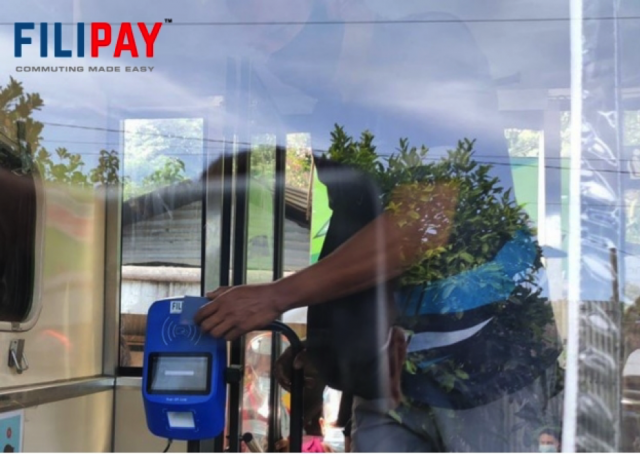
A commuter of PN Roa Canitoan Transport Cooperative in Canitoan, Cagayan De Oro taps in for fare payment via FILIPAY card
When the Omnibus Guidelines on the Planning and Identification of Public Road Transportation Services and Franchise Issuance, also the PUV Modernization Program (PUVMP), was first launched in Tacloban City, Leyte in 2018, the project has since emphasized new vehicle standards promoting improved regulation, environmental impact, employee benefits, safety, security, and convenience. The broad objectives comprising PUVMP is primarily based on, according to the Department of Transportation and its allied agencies, the varied concerns facing the Philippine public transport system—congested traffic situations, small-scale vehicles, fuel consumption and greenhouse gases emissions, and consolidation of the existing transport franchise holders.
FILIPAY Pioneered Tap In/Tap Out system
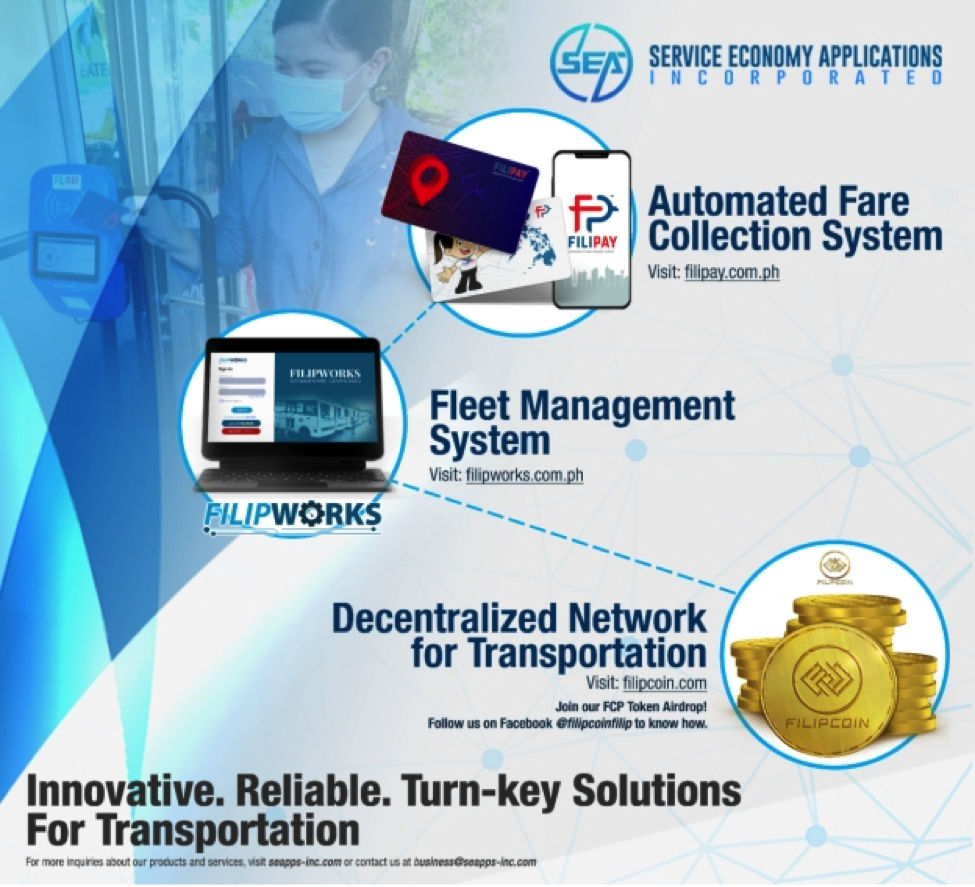
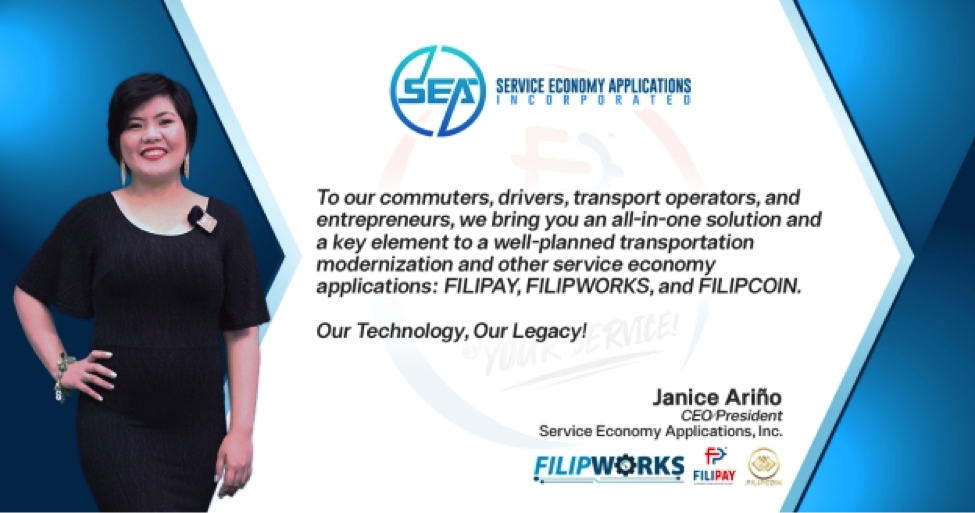
Service Economy Applications, Inc. (SEAi), through FILIPAY, its automated fare collection system (AFCS), is the first in the Philippines to implement the Tap In/Tap Out contactless fare payment system and is now operating in Canitoan, Cagayan De Oro, Dasmarinas City, Cavite to PITX, and Marikina City to Cubao, Quezon City.
This year, FILIPAY also started to roll out its interoperable devices in modern jeepneys following the Philippine National Standard for transportation while its team of developers and transport innovators led by Janice Arino, CEO and President of SEAi further develop the FILIPAY Mobile Application for fare payment via QR code.
Below are the current features of the FILIPAY Automated Fare Collection System:
Fare Collection via FILIPAY Card KM Distance-Traveled Fare Collection Temperature Screening Screen and Sound Notification Ticket Printing via Driver’s Monitor FILIPAY Credits Reloading via Distributor App Time Tracker Fire-proof, dust-proof, shock-proof, oil-proof, and anti-static material
For more information about FILIPAY, visit filipay.com.ph.
SEAi also provides partner transport cooperatives with a free fleet management system to further help transport cooperatives facilitate transparent, reliable, and real-time tracking of a multitude of transaction data and determine KPIs for decision-making and designing corporate objectives.
FILIPWORKS is complete with the eight ranges of Fleet Management:
Dispatch Management Tracking and Diagnostic Management Fuel Management Vehicle Management Financial Management Personnel Management Health and Safety Management The paper-less entrepreneurial solution aims to reduce costs and improved efficiency across the entire fleet operation.
From Automation to Decentralization in Transportation
AFCS and FMS in general, however, are not exempted from reviews following the PUVMP. For example, one of the early concerns when the Philippines started to restructure its public transportation system is the need for a unified fare collection system. For AFCS alone, the existence of several providers exposed the many concerns of both transport cooperatives and commuters on the use of varied cards and devices per route per transport service type.
The DOTr has proposed the formulation of the AFCS National Standards to ensure interoperability and EMVCo contactless payment specifications. Service Economy Applications, Inc., on one hand, also recognizes the need to address the concerns of its multi-sectoral stakeholders through the development of additional advances in transportation technology. Thus, in November 2020, the company relaunched FILIPCOIN, a decentralized network for transportation.
Decentralizing management of data delivers improved accessibility of data, less service failures, and lower transaction costs as compared to centralized and distributed systems. Such advantages will help aid automation and interoperability of payment systems. Additionally, the FILIPCOIN (FCP) token, powered by Ethereum and Binance Smart Chain, promotes the adoption of the digital currency trend for fare payment in most modes of transportation across the globe. It aims to develop its own blockchain ecosystem and further integration with already available services FILIPAY, FILIPWORKS, and other service economy applications to increase its demand and value.
There is still a need to reassess and standardize the existing policies of the PUVMP to ensure the public transport system in the country is geared towards higher operational efficiency. As for Service Economy Applications, Inc., the company is open to collaborate with the government, other AFCS providers, transport operators, drivers, and commuters to secure just implementation of the project specially during a lockdown prompted by a global pandemic.
Spotlight is BusinessWorld’s sponsored section that allows advertisers to amplify their brand and connect with BusinessWorld’s audience by enabling them to publish their stories directly on the BusinessWorld Web site. For more information, send an email to online@bworldonline.com.
Life is a journey filled with surprises. While a lot of these surprises bring happiness, a good number of them aren’t that much welcome.
But before you dive head-first into getting a life insurance, it’s best to be prepared. Here are some things to keep in mind when shopping around for the best plan for you and your family.
1. Do you really need it?
One of the first things you need to do before getting a life insurance is to ask yourself if you really need it. Some important points to ponder: Do you have people who depend on you financially? Will they be all right if something happened to you?
Corazon R. Aguada-Cruz, International Quality Award qualifier and longtime Sun Life employee, explains that we should think of life insurance as something we leave behind for our loved ones to protect them when we are no longer able to. “Filipinos should prioritize getting life insurance over other types of insurance. Death is the only thing that is certain to happen while other insurance policies cover things that are not certain.”
However, do you still need it even if you already have life insurance from your job? It actually depends on your needs. Group policies may provide a decent amount, but will it be enough and will you be allowed to take your coverage with you if you leave your job?
2. How much will you need?
A lot of people underestimate just how much they really need. Beyond having enough to pay off your debts, there are other long-term needs to consider, such as your loved ones’ future bills, or if you have children, their college tuition.
Aguada-Cruz adds, “Life insurance can help family members because the living benefit can be used to fund future needs such as education. In case of death, the family members get to maintain their standard of living because of the proceeds they get from the life insurance.”
Do you have an emergency fund or any other funds set aside? What financial resources will be available to your loved ones after? A common rule of thumb is to have a policy with a death benefit equal to 10 times your annual salary.
Term life policies last for only for a specific amount of time, usually around 10, 20, or 30 years. This type of policy is great if you only need life insurance for a period of time (like when your children are growing up or when you’re paying off your mortgage). It may also be a good fit if you’re on a budget.
On the other hand, lifetime policies are a good choice if you want to accumulate savings because some permanent life insurance policies can be used as savings as they have a cash value that is supposed to increase over time.
4. How much will it cost?
There’s a good reason why a lot of financial advisors will recommend getting a life insurance while young and it’s because the cost of life insurance will vary depending on your “risk.” The greater your risk of dying, the higher the cost; therefore, life insurance is generally more affordable to purchase when you are younger and healthier. “People should get insurance while they are physically healthy and financially capable to do so. The younger, the better,” says Aguada-Cruz. “It’s better to get a life insurance before one ‘crosses the bridge of uninsurability’ and it becomes too costly.”
Here’s another thing to consider is if you’re willing to pay your premiums annually or in installments. There’s often an additional charge for paying in smaller amounts, so a lot of people opt for the annual option. Something else you need to remember if you have a life insurance is to tell your beneficiaries about it. Make sure to tell your beneficiaries all the details they need to know, such as where you stored the documents, the company you got it from, the specifics of your plan, and any other instructions.
Now, being in your 20s might seem a bit too early to start thinking about life insurance, but the past two years have shown us how truly temporary life can be. Accidents can happen any time and it doesn’t hurt to be prepared to make sure our loved ones will be taken care of long after we’re gone.
Spotlight is BusinessWorld’s sponsored section that allows advertisers to amplify their brand and connect with BusinessWorld’s audience by enabling them to publish their stories directly on the BusinessWorld Web site. For more information, send an email to online@bworldonline.com.
THE PHILIPPINE banking industry may face rising risks from its exposure to the property market as real estate prices decline amid a sluggish economic recovery, Fitch Ratings said.
“Philippine banks face higher impairment risk amid a correction in property prices and a much weaker economy,” Fitch Ratings said in a report on Wednesday.
The debt watcher noted the local banking industry’s commercial and residential property exposures are at about 15% and 8% of its loan portfolio as of end-2020. Meanwhile, its buffers — which considers macroprudential measures, household assets, capital generation capability and capital buffers — were moderate.
The Philippines is among emerging markets in Asia-Pacific that have fewer property-related regulations, higher risk appetites, or lower absorption buffers, Fitch said. However, it noted some markets are partially supported by prudential factors including higher system common equity Tier 1 ratios.
Fitch also said the Philippines, like China, Thailand, Malaysia, and India have fewer historical data points to monitor.
“[This] means the sufficiency of prudential buffers in place will not be fully tested until the market faces a significant downturn,” it added.
The debt watcher said looser underwriting standards in recent years may have contributed to impairment charges for emerging markets in the region last year. This is reflected by the rising loan-to-value ratios, or the proportion of a loan to the purchased asset’s value.
Home prices in the second quarter slid by 9.4% year on year, the steepest rate since 2016, based on data from the Bangko Sentral ng Pilipinas. The central bank is also working on releasing a separate commercial real estate property index within the year.
Prices of condominium units have been hurt during the pandemic as demand from workers of Philippine offshore gaming operators faded, ING Bank N.V. Manila Senior Economist Nicholas Antonio T. Mapa said.
“Going forward, we expect housing prices to rebound as the economy recovers although the bounce back may be uneven and less pronounced across types of housing,” Mr. Mapa said in an e-mail.
“Subdued real estate prices translate to a commensurate fall in rental prices, which may constrain cash flows of home owners who had hoped to offset loan payments with rental income,” he added.
Mr. Mapa is hopeful that improvement in the economy could mean better cash flows and income for borrowers. This could in turn lessen potential for wide-scale defaults on property loans, he said.
Meanwhile, Tamma Febrian, Associate Director, Banks – APAC, Fitch Ratings, noted real estate loan growth — both in the commercial and residential sector — has slowed by less than overall banking loans.
“This is in part due to an uneven economic recovery where some economic segments continue to have surplus liquidity and could take advantage of a low interest rate environment to enter the market. We expect the central bank’s accommodative monetary policy posture to continue to underpin demand for property loans in the immediate term,” Mr. Febrian said.
Fitch in October lowered its growth forecast for the Philippine economy this year to 4.4% from 5% previously, pricing in the impact of the Delta outbreak and the sluggish vaccine rollout.
The debt watcher in July downgraded its rating outlook for the Philippines to “negative” from “stable,” which means its investment grade “BBB” could possibly be downgraded in the next 12 to 18 months. Fitch also revised its outlook on its rated Philippine banks to “negative.”
VILLAR GROUP Chairman Manuel B. Villar and Philippine Stock Exchange President and Chief Executive Officer Ramon S. Monzon rang the trading bell as AllDay Marts, Inc. listed on the stock exchange. Also in photo are AllDay Director Manuel Paolo A. Villar (far left), AllDay Vice Chairman Camille A. Villar (second from left) and former Public Works Secretary Mark A. Villar (far right).
By Keren Concepcion G. Valmonte, Reporter
SHARES of Villar-led AllDay Marts, Inc. surged in its debut on the stock market on Wednesday, as retail investors sought to grab a piece of the fast-growing supermarket chain.
AllDay shares opened at 90 centavos per share, hitting the 50% daily limit from its initial public offering (IPO) price of 60 centavos.
“Christmas came early for investors. AllDay’s rapid expansion in strategic areas triggered a lot of excitement,” AAA Southeast Equities, Inc. Research Head Christopher John Mangun said in a text message.
“This performance reminds us of [MerryMart Consumer Corp.]’s IPO and we may see more ‘jackpot’ trading days,” Mr. Mangun said. MerryMart also saw share prices surge by 50% on its first day of trading in June last year.
The supermarket operator raised P4.53 billion from its IPO, which will be used for debt repayment and store expansion.
Owned by tycoon and former Senate President Manuel B. Villar, AllDay currently has 33 supermarkets and aims to have 45 by 2022 and 100 by end-2026.
Claire T. Alviar, senior research and engagement officer at Philstocks Financial, Inc., said investors were attracted to the company’s trade proposition, with shares priced below one peso apiece and its P13-billion market capitalization.
“The positive outlook for the consumer retail industry also spurred optimism as this sector remains resilient amid the COVID-19 (coronavirus disease 2019) pandemic, especially that ALLDY (AllDay’s ticker symbol) is strengthening its online presence through digital innovation to meet the current needs of the consumers,” Ms. Alviar said in a Viber message.
Diversified Securities, Inc. Equity Trader Aniceto K. Pangan said the AllDay IPO also benefited from improved market sentiment driven by expectations of increased holiday spending.
“[AllDay’s IPO] was a recipient of the positive sentiment among investors as it moved up in price in anticipation of heavy consumer spending on Christmas holiday season,” Mr. Pangan said in a text message.
According to the PSE, AllDay set the record for the most number of local small investors (LSI) availing of the offer.
“They subscribed to more than 1.1 billion shares, exceeding the LSI allocation of 685.7 million shares by 1.62 times. I understand that the allotment for institutional investors was likewise 2.5 times oversubscribed,” PSE President and Chief Executive Officer Ramon S. Monzon said during the listing ceremony on Wednesday.
“This clearly demonstrates the trust and confidence investors have in the Villar family with their proven experience and success in their various businesses,” Mr. Monzon said.
AllDay is the Villar family’s fifth listed company, after Golden MV Holdings, Inc., Vista Land & Lifescapes, Inc., Vistamalls, Inc., and AllHome Corp.
The company is expecting a shift in market behavior in the Philippines because of the “growing middle class” segment. AllDay Vice-Chairman Camille A. Villar said the supermarket chain, which operates in the mid-premium segment, is “the local player that is best equipped to meet this challenge head-on.”
AllDay boasts of a premium in-store aesthetic, an e-commerce platform, the first self-checkout kiosks, and personal shopper service.
By the end of the trading session, AllDay saw P405.73 million with 450.81 million shares switch hands. Philstocks Financial’s Ms. Alviar said market demand may further mean more gains for the issue.
“Moving forward, we’re still expecting a further upside given the demand from the market. However, fundamental-wise, [AllDay] has already reached our target price,” Ms. Alviar said.
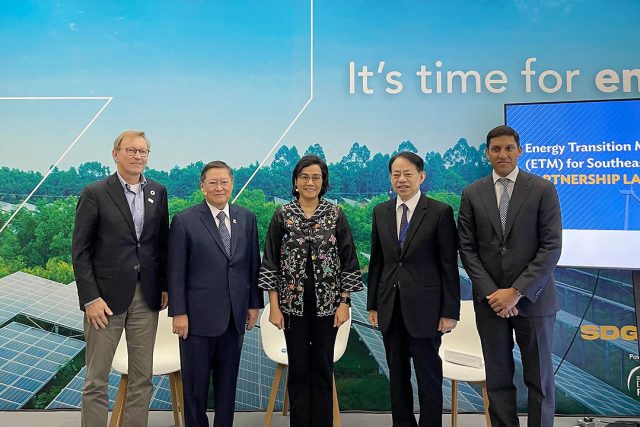
The Philippines, Indonesia and the Asian Development Bank (ADB) on Wednesday launched the Energy Transition Mechanism facility in Glasgow, Scotland. In photo, (from left to right) are Per Heggenes, CEO of IKEA Foundation; Philippine Finance Secretary Carlos G. Dominguez; Indonesian Finance Minister Sri Mulyani; ADB President Masatsugu Asakawa; and Dr. Raj Shah, President, The Rockefeller Foundation.
THE ASIAN Development Bank (ADB) partnered with the Philippines and Indonesia to launch an energy transition mechanism (ETM) which aims to fund the early retirement of coal-run power plants and replace them with renewable energy alternatives.
“The time for debate and merely discussing climate change theories is over. Today, we are focusing on applied solutions and workable programs to quickly reduce greenhouse gas emissions. We have a planet to save and we do not have much time to do it,” Finance Secretary Carlos G. Dominguez III said at the launch of the ETM Southeast Asia Partnership in Glasgow, Scotland.
Mr. Dominguez heads the Philippine delegation to the 26th United Nations Climate Change Conference of the Parties (COP26).
He said the Philippines has an opportunity to pilot the ETM facility in Mindanao, where the Agus-Pulangi hydropower plant is being rehabilitated. As Agus-Pulangi power plant increases its generating capacity, the government can gradually purchase coal-fired power plants in Mindanao and repurpose them through the ETM facility, the Finance chief said.
“Mindanao will showcase an Earth-friendly future that can be replicated in other areas in the Philippines — and even countries around the world… Together with the Asian Development Bank, the Philippines is pioneering an innovative model that will set a global standard in transitioning to a cleaner energy future,” Mr. Dominguez said.
The ETM is a public-private finance vehicle which has the potential of accelerating the retirement of coal plants by at least 10 to 15 years on average, he added.
The ETM’s pilot phase is expected to last for two to three years.
Throughout the pilot, ADB targets to raise enough funds to speed up the retirement of up to seven coal plants and channel investments in alternative clean energy options in both countries.
Under the partnership, the multilateral lender will work with government stakeholders to pilot the ETM in their respective countries.
The ETM is made up of two multibillion-dollar funds, with one focused on early plant retirement, while the other one devoted to new clean energy investments in power generation, storage, and grid upgrades.
“It is envisioned that multilateral banks, private institutional investors, philanthropic contributions, and long-term investors will provide capital for ETM,” ADB said.
According to the bank, the full implementation of the ETM in Indonesia, Philippines and possibly Vietnam, can prevent carbon dioxide emissions by 200 million tons per year. This translates to taking 61 million cars off the road.
“Indonesia and the Philippines have the potential to be pioneers in the process of removing coal from our region’s energy mix, making a substantial contribution to the reduction of global greenhouse gas emissions, and shifting their economies to a low-carbon growth path,” ADB President Masatsugu Asakawa was quoted as saying in a statement. — A.Y.Yang
BUSINESS GROUPS and foreign chambers on Wednesday urged lawmakers to approve the remaining economic reform measures, including the amendments to the Public Service Act (PSA), in the homestretch of the 18th Congress’ third regular session.
Thirteen business groups and foreign chambers sent letters to Congress leaders calling on them to pass 11 bills that they say would help drive the economy’s post-pandemic recovery.
One of the priority measures is the bill amending the PSA, which has been approved by the House of Representatives but is still pending at the Senate. It aims to reclassify “public utilities” such as telecommunications and transportation to “public services” and allow more foreign ownership in these industries.
“While supporting the amendments to the Public Service Act, the business groups and foreign chambers expressed opposition to the inclusion of any provision in the pending Senate version, Senate Bill 2094, that expands the legislative franchise requirement to public services beyond those provided under existing laws,” the statement read.
Also included in the business groups’ priority list are the last two tax reform packages being pushed by the Duterte administration — Property Valuation and Assessment Reform and Passive Income and Financial Intermediary Taxation.
Also identified as priorities are bills seeking to relax the Bank Secrecy Law, ease the payment of taxes, provide open access in data transmission, and promote digital payments.
Other bills include the Philippine Creative Industries Development Act, the creation of the Department of Water Resources Management, Freedom of Information Act, and Rural Agricultural and Fisheries Development Financing System Act.
“Most of these 11 reform bills have reached advanced stages in either chamber of Congress and only require counterpart action in the other chamber,” the statement read.
The business groups and foreign chambers also expressed hope for an “early ratification” by Congress of the reconciled versions of three bills, namely the Foreign Investment Act amendments, creation of the National Transportation Safety Board and the Electric Vehicles and Charging Stations Act.
Sought for comment, Senate President Vicente C. Sotto III told BusinessWorld via Viber message that most of the said bills being pushed by the business groups are already pending at the Senate plenary.
“We are on it. It is just a senator or two who still have some issues (on the bills),” Mr. Sotto said.
Sought for comment, House Speaker Lord Allan Jay Q. Velasco has not responded as of deadline time.
Congress is scheduled to resume session on Nov. 8, but the Senate is expected to focus on national budget deliberations.
It adjourns for the Christmas break from Dec. 18 – Jan. 16, 2022, and resume session from Jan. 17 to Feb. 4. After a three-month break for the elections, session resumes on May 23 and sine die adjournment on June 4.
The statement was backed by the Bankers Association of the Philippines, Financial Executives Institute of the Philippines, IT and Business Process Association of the Philippines, Makati Business Club, Management Association of the Philippines, Philippine Association of Multinational Companies Regional Headquarters, Inc., and Semiconductor and Electronics Industries in the Philippines Foundation, Inc.
Also supporting the statement are the American Chamber of Commerce of the Philippines, Australian-New Zealand Chamber of Commerce of the Philippines, Canadian Chamber of Commerce of the Philippines, European Chamber of Commerce of the Philippines, Japanese Chamber of Commerce and Industry of the Philippines, Inc., and Korean Chamber of Commerce of the Philippines, Inc. — Revin Mikhael D. Ochave with inputs from Russell Louis C. Ku
AYALA LAND, Inc. (ALI) reported a net income attributable worth P2.55 billion for the third quarter, up by 38% year on year from P1.85 billion, as its sales reflected “sustained demand” despite renewed quarantined restrictions.
In a disclosure to the stock exchange on Wednesday, the company said its sales reservations hit P21.8 billion in the July-to-September period. Its consolidated revenues grew by 7% to P23.65 billion from P22.12 billion a year ago.
For the first nine months of the year, ALI’s attributable net income grew by 35% to P8.59 billion from P6.37 billion, while consolidated revenues went up by 15% to P72.6 billion from P63.32 billion.
“Our business recovery was sustained despite the reimposition of stricter quarantine measures last August,” Bernard Vincent O. Dy, president and chief executive officer of ALI, said in a statement.
“We remain positive that with the reopening of the economy, business activity will gain momentum in the fourth quarter, especially for segments like our malls, hotels and resorts, which broadly rely on increased mobility,” he added.
The company’s property development revenues rose 27% to P51.5 billion in the period. Meanwhile, sales reservations for the first nine months went up by 15% to P70.1 billion, which was attributed to the company’s “strong sales performance” earlier in the year.
Office leasing revenues inched up by 5% to P7.47 billion from P7.12 billion. ALI said the growth was driven by the sustained operations of business process outsourcing and company headquarters.
Meanwhile, commercial leasing revenues for the period were at P14.23 billion, 18% lower than the P17.32 billion seen in the same period last year as quarantine restrictions were reimposed in August.
While the occupancy rate at Ayala Land’s malls stood at 80% to 85%, revenues from its shopping centers went down by 35% to P4.93 billion from P7.61 billion year on year due to limited operations, lower foot traffic, and the rental discounts offered to tenants.
Revenues from its hotels and resorts also declined by 29% to P1.85 billion from P2.6 billion due to renewed pandemic restrictions. Ayala Land said the average occupancy rate for its “stable hotels” was at 50% and 51%, while its “stable resorts” average occupancy rate stood at 12% and 13%.
ALI launched a total of 18 projects in the first nine months worth P59.1 billion, higher than the launches seen in full-year 2020 collectively worth P10.6 billion. The company said it “responded to stronger demand in the residential market.”
In the third quarter alone, Ayala Land launched projects collectively worth P13 billion in despite quarantine restrictions.
Under Ayala Land Premier, the company launched Ayala Greenfield Estates 4C Tranche 1 in Laguna and Lanewood Hills Phase 2 in Cavite. Meanwhile, it also opened Avida’s Centralis Towers in Pasay City and Amaia’s Steps Pasig Clara.
The company’s capital expenditures for the first nine months amounted to P44.7 billion, over half or 54% of which were spent on residential projects, 16% for estate development, 14% for commercial projects, and 13% were allocated for land acquisition.
Ayala Land has a land bank with over 12,000 hectares of property located across the country.
The company earlier listed its new P3-billion fixed-rate bonds at the Philippine Dealing and Exchange Corp. The issuance is meant to bring down the cost of its debt and lengthen maturities.
Ayala Land is also looking to achieve carbon neutrality by yearend through using clean energy sources, offsetting greenhouse gas emissions via carbon forests, and projects promoting the protection of forests, it said.
Shares of Ayala Land went up by 3.72% or P1.30 to close at P36.25 each on Wednesday. — Keren Concepcion G. Valmonte










 However, do you still need it even if you already have life insurance from your job? It actually depends on your needs. Group policies may provide a decent amount, but will it be enough and will you be allowed to take your coverage with you if you leave your job?
 4. How much will it cost?