Home Blog Page 7264

Amid underspending in first half: Budget deficit falls below ceiling
PHILIPPINE STAR/ MIGUEL DE GUZMAN

By Beatrice M. Laforga, Reporter

THE PHILIPPINES fell short of its budget deficit ceiling in the first half after missing its spending target by 10%, prompting analysts to warn that underspending could hamper the economy’s recovery.

Preliminary data from the Bureau of the Treasury (BTr) showed fiscal gap reached P716.1 billion for the January-June period or 30% lower than the P1.018 trillion programmed for the period.

However, the budget deficit was 28% larger than the P560.4-billion deficit seen in first six months of 2020.

The first-half fiscal deficit was below the program as the government fell short of its spending target by 10% but exceeded the six-month revenue goal by 5%.

In June, the budget balance swung to a P150-billion deficit from P1.8-billion surplus in the same month last year largely due to base effects. The Bureau of Internal Revenue (BIR) moved the April 15 deadline for income tax filing to June last year due to the lockdown.

Total spending increased by 13.2% year on year to P395.4 billion in June. Primary expenditures, or total spending minus interest payments, grew by 14% to P365.5 billion, while interest payments also increased by nine percent to P29.9 billion.

This pushed overall government spending for the six-month period to P2.206 trillion, up 9.6% from  P2.013 trillion a year ago. However, this was 9.56% short of the P2.44-trillion target for the first half.

“This is mainly due to the timing of subsidy releases awaiting requests from the concerned state-run firms, the pending enactment of the GUIDE (Government Financial Institutions Unified Initiatives to Distressed Enterprises for Economic Recovery) bill, outstanding checks as of end-June which are yet to be encashed by contractors or suppliers of line agencies, as well as interest savings,” the BTr said.

Primary spending totaled P2 trillion in the six-month period, up by 9.4% year on year, while interest payments jumped by 11% to P209 billion.

In June, overall revenues declined by 30% to P245.6 billion from P351 billion a year ago. The income tax filing deadline was moved to June 2020, hence the BIR’s unusually higher revenues for the month.

Tax revenues, which accounted for 90% of the total, dropped by 34.6% to P213.5 billion while non-tax income jumped by 31% to P32 billion.

BIR saw collections slide by 43.6% to P159 billion in June, while Customs posted 23% increase in revenues to P52.2 billion. Other tax-collecting offices generated P1.9 billion that month, up 49% year on year.

Non-tax revenues from the BTr surged by 84.2% year on year in June to P20.8 billion while other offices reported a 14% drop in income to P11.3 billion.

“The P12.2 billion year-on-year increase in dividend remittances as well as higher remittance of National Government share from PAGCOR (Philippine Amusement and Gaming Corp.) profit drove the growth for the month,” the Treasury said.

Despite the decline last month, total revenues still increased by 2.55% to P1.49 trillion in the first half, and surpassing the P1.421-trillion target by 4.82%.

This was largely due to the 10% increase in tax collections worth P1.344 trillion, but was slightly tempered by the 38% decline in non-tax revenues to P147 billion.

Taxes collected by the BIR rose by 8% to P1.032 trillion in the first half. Customs saw its revenues jump by 19% to P301.7 million, while other offices generated 21% higher collections at P10 billion.

For non-tax revenues, the BTr saw its income decline by 38% year on year to P81.6 billion, whereas other income from non-tax sources grew by 25% to P65.3 billion.

UNDERSPENDING
Analysts warned that the muted spending in the first half could derail the economy’s recovery.

State spending was only able to rise modestly last month, while the 2.55% increase in revenues showed collections remain constrained, ING Bank N.V. Manila Senior Economist Nicholas Antonio T. Mapa said via e-mail on Tuesday.

Mr. Mapa said the missed spending target could also signal softer a full-year gross domestic product (GDP).

“With the year-to-date deficit at approximately 8% of GDP, it’s getting more challenging to keep the debt to GDP level below 60% for the year. This could trigger a credit rating downgrade as early as the first quarter of 2022,” Mr. Mapa said.

“The economy had been counting on government spending to fill the void left by the private sector and with this development. We understand that authorities have struggled to get out badly needed expenditure to help support the economy, manifested in underspent Bayanihan funds, and we expect this trend to continue in the second half,” he added.

For University of Asia and the Pacific Senior Economist Cid L. Terosa, the government may have fallen short of its spending program due to delays in releasing and earmarking of funds for economic recovery programs.

“This may temporarily stall the government’s drive to fast track economic growth, but I believe spending in the second half will regain lost ground particularly because of last-ditch efforts by the current administration to set the economy on track to achieve economic recovery,” Mr. Terosa said via e-mail.

Economic mangers capped this year’s budget deficit at 9.3% of GDP.

They also set a 6-7% growth target for the year on expectations that the economy will bounce back strongly from last year’s 9.6% record slump.

National government fiscal performance (June 2021)

Infrastructure spending exceeds first-half target

PHILIPPINE STAR/ MICHAEL VARCAS

LOOSER quarantine restrictions that allowed construction activities to resume helped the government surpass its infrastructure spending target by nearly 2% in the first half of the year.

Data from the Department of Budget and Management (DBM) showed infrastructure and other capital outlays reached P426.6 billion between January and June, exceeding its P420-billion goal by 1.7%. Year on year, infrastructure spending surged 43% from P298 billion previously.

“Infrastructure and other capital outlays slightly exceeded the P419.6-billion program with the settlement of accounts payables and faster implementation of infrastructure activities of the DPWH (Department of Public Works and Highways) amid the looser community quarantine restrictions,” DBM said.

The government imposed stricter quarantine measures in Metro Manila and nearby provinces starting late March as coronavirus disease 2019 (COVID-19) cases spiked. Restrictions have gradually been eased since May, with more economic activities, including construction, allowed to resume as long as minimum health standards are observed.

In June alone, infrastructure spending rose by 50.4% to P94.4 billion from P62.8 billion a year ago, and by 20% from the P78.9 billion recorded in May.

DBM attributed the higher spending to DPWH’s infrastructure program to construct and repair roads, bridges and flood-control systems, as well as the Transportation department’s sustained rollout of various foreign-assisted projects.

Spending for the projects under the Armed Forces of the Philippines’ modernization program and the computerization program of the Education department also buoyed spending that month.

In the second quarter, infrastructure spending jumped by 63% to P231.4 billion from P142 billion in the same period last year. This also exceeded the P224.4-billion target by 3%.

Above-target spending on infrastructure should be a “good sign” for the economy as implementing agencies take advantage of good weather to fast-track construction works, UnionBank of the Philippines, Inc. Chief Economist Ruben Carlo O. Asuncion said via e-mail on Tuesday.

“We expect a faster rollout [moving forward] because of the coming election, the subsequent election bans on rollout of infrastructure projects, and the near end of this current administration. It is expected that all programmed spending may be pushed hard, and this will be favorable to economic growth for (the second half of 2021),” Mr. Asuncion said.

For the DBM, government spending should recover in the remaining months of 2021, since the slower disbursements in the first six months were only due to the pending request of subsidy release and outstanding checks.

“Disbursements will also be supported by the implementation of agency catch-up plans, particularly for those agencies which experienced implementation delays. The DBM is closely coordinating with the concerned departments/agencies for the submission and implementation of their catch-up plans,” it said.

The government has set a P1.02-trillion spending plan for infrastructure this year.

For the remaining months, it plans to spend P229.54 billion on infrastructure this quarter and another P221.6 billion in the fourth quarter. — Beatrice M. Laforga

Balance of payments deficit hits $312M

BW FILE PHOTO

THE OVERALL balance of payment (BoP) position swung to a deficit in June, as the National Government repaid some of its foreign debt obligations.

Data released by the Bangko Sentral ng Pilipinas (BSP) on Tuesday showed the BoP deficit stood at $312 million in June, a reversal from the $80-million surplus logged a year ago.

June also marked the second consecutive month that the BoP position was in deficit, although 78% slimmer than the $1.397-billion gap in May. It is the smallest shortfall since the $73 million in March.

“The BoP deficit in June 2021 reflected mainly the outflows arising from the foreign currency withdrawals of the National Government (NG) from its deposits with the BSP as the NG settled its foreign currency debt obligations and paid for various expenditures, and the BSP’s net foreign exchange operations,” the central bank said in a statement.

The outflows were partially offset by inflows from the central bank’s income from its investments abroad.

The BoP gives a glimpse of the country’s transactions with the rest of the world. A deficit means more funds left the country, while a surplus show that more money came in.

“Import performance has improved in the last months (low base effects), but we do expect import growth to continue to recover barring any impact from a disastrous Delta variant spread locally,” UnionBank of the Philippines, Inc. Chief Economist Ruben Carlo O. Asuncion said in a Viber message.

To recall, the BoP was mostly in surfeit last year, ending at $16.022-billion deficit as imports slipped amid the pandemic.

“With June recording another month of deficit, we are now anxious to see if the Philippines can still post a surplus this year given that expectations have now shifted to having a current account deficit as imports return,” ING Bank N.V. Manila Senior Economist Nicholas Antonio T. Mapa said.

Latest data from the Philippine Statistics Authority showed trade deficit stood at $2.76 billion in May, bigger than the $1.31 billion a year earlier although smaller than the $3.08-billion shortfall in April. This, as imports climbed 47.7% to $8.65 billion in May.

At its end-June position, the BoP reflects the country’s gross international reserves worth $105.76 billion, which is lower by 1.38% against the $107.25 billion seen as of end-May.

Still, the dollar reserves are enough to cover 12 months’ worth of imports of goods and payments of services and primary income, the central bank said. It is also equivalent to about 7.7 times the short-term external debt of the Philippines based on original maturity and 5.1 times based on residual maturity.

The country’s BoP position in the first semester stood at a deficit of $1.939 billion, a reversal from the $4.109-billion surfeit logged in the same period of 2020.

In the coming months, the BoP may continue to post deficit due to the expected rebound in global trade, analysts said.

“Aside from the further expected outflows due to the government’s debt payments and other expenditures, BoP is expected to likely slant towards more deficits in the coming months due to recovering trade environment,” Mr. Asuncion said.

For Mr. Mapa: “A BoP deficit will translate to a weaker (Philippine peso) and we will be factoring this in our round of forecast revisions as we now expect a more pronounced depreciation spell for the peso for the year.”

The peso has been trading around the P50-per-dollar range in recent weeks. Its Tuesday close of P50.42 is weaker by 4.99% from its P48.023-a-dollar finish on Dec. 29, which was the last trading day of 2020.

The BSP in June raised its BoP projection to a surplus of $7.1 billion from the $6.2-billion surfeit projection it previously gave. — L.W.T. Noble

PHL secures $400-million ADB loan to reduce youth unemployment

THE ASIAN Development Bank (ADB) approved a $400-million (P20.14-billion) loan to expand a Philippine government program aimed at helping unemployed youth find quality jobs.

The multilateral lender gave the green light for the policy-based loan that will fund the third phase of the government’s Facilitating Youth School-to-Work Transition Program.

Under the program, the Department of Labor and Employment (DoLE) will increase the job facilitation capacity of Public Employment Services Offices (PESOs) nationwide, as well as improve workplace skills development and labor market programs.

“The pandemic has led to job losses in many sectors, especially among young people. There is an urgent need to help young Filipinos find work through innovative labor market programs and skills development initiatives,” said Jose Antonio Tan III, ADB’s director for public management, financial sector and trade in Southeast Asia, in a statement.

The ADB loan will also finance the government’s unemployment insurance scheme, the P1-billion Tulong Trabaho Scholarship Fund of Technical Education and Skills Development Authority (TESDA), and First Time Jobseekers law, which waives the fees of public documents for first-time job applicants.

“This loan will help young jobseekers, especially women, access training opportunities and enhance their skills development. It will strengthen labor market policies and provide assistance to returning Filipino workers who lost jobs overseas because of the pandemic through group livelihood and entrepreneurship programs,” ADB Principal Financial Sector Specialist for Southeast Asia Stephen Schuster said.

The Philippines’ unemployment rate soared to 18.9% at the height of the strictest lockdown in April 2020, as nearly all economic activity was halted amid the coronavirus pandemic.

As of May 2021, the country’s unemployment rate stood 7.7%, but the youth jobless rate was at 14.5%. This means there were 1.12 million young Filipinos without jobs in May.

The ADB previously extended two loans for the youth employment program — a $400-million loan in 2019 and $300-million loan in 2017. These loans supported DoLE’s flagship JobStart Philippines program, which provided young Filipinos from poor families with job skills training.

The previous loans also helped establish PESOs, a facility by local government units installed across the country to assist job seekers and promote existing programs.

Moving forward, ADB said it is also working on another assistance package for the Philippine labor market next year, which includes a technical and vocational education and training project and a post-pandemic employment recovery program.

The bank is planning to lend the government $3.9 billion this year. — B.M.Laforga

Roxas and Co. sees output rebound

A SUBSIDIARY of Roxas and Co., Inc. (RCI) is set to boost production from its integrated coconut processing plant after the approval of a P100-million loan, the listed firm said in a stock exchange disclosure on Tuesday.

Edgar P. Arcos, RCI president and chief executive officer, said the loan is for the working capital of the processing plant for the rest of 2021. The plant is located in the town of Tupi, South Cotabato.

“The company expects a sharp production rebound in the second half of 2021 as demand for its coconut cream and milk, coconut water concentrate, and virgin coconut oil continues to rise,” Mr. Arcos said.

RCI unit Roxas Sigma Agriventures, Inc. (RSAI) secured the loan from the Development Bank of the Philippines.

RSAI is pushing the first phase of its expansion program to meet stronger demand from international business-to-business (B2B) customers in North America, Europe, and Asia-Pacific.

Based on its website, the company is a joint venture between RCI and Sigma Xynergies Corp. Founded in 2017, it manufactures coconut-based products such as coconut cream, coconut milk, virgin coconut oil, and coconut water concentrate.

Higher revenues allowed RCI to trim its net loss to P14.24 million in the first quarter from P167.46 million in the same period last year. Total revenues during the period rose 517% to P535.07 million against P86.79 million a year earlier.

On Tuesday, shares of RCI at the stock exchange dropped 2.86% or three centavos to finish at P1.02 apiece. — Revin Mikhael D. Ochave

Tech firm 1Export targets P500-million revenue

RAWPIXEL.COM/ FREEPIK.COM

By Jenina P. Ibañez, Reporter

TECH-ENABLED export platform 1Export is aiming to record P500 million in revenues by the end of 2022 as it links more local small businesses to global markets.

“We recently recorded about P25 million in revenue in 2020,” 1Export Chief Operating Officer (COO) Daniel Antonio S. Remo said in a press briefing on Tuesday.

“We want to be able to do half a billion by the end of 2022… We just recently got backed by several investment firms, and we intend to be able to scale our capabilities as well as our headcount,” he said.

Offering compliance, business matching and marketing services for exporters, the company plans to expand to around 60 destination markets from its current 23 by the end of next year. 1Export helps sell products to ethnic markets, mainstream stores, and wholesale markets overseas, including North America, the United Kingdom and the Middle East.

The firm works with 400 micro, small, and medium-sized enterprises (MSMEs), targeting expansion to 3,000 Southeast Asian MSMEs.

1Export will be launching offices in Indonesia, and the company plans to expand further across Southeast Asia.

Philippine merchandise exports in May went up by 29.8% year on year to $5.89 billion. In the first five months of 2021, exports grew 21.4% to $29.35 billion, data from the Philippine Statistics Authority showed.

Although exports rose from a low base in 2020, economists said that the data fell below expectations, with ING Bank NV Manila Senior Economist Nicholas Antonio T. Mapa saying that gains may have been hampered by limited shipment options amid industry bottlenecks.

Exporters have recently been facing logistics delays, reporting vessel space and container shortages that cause freight rate surges. Industries globally are reporting supply chain constraints and shortages as some economies bounce back amid the pandemic.

1Export works with various logistics companies, committing certain volumes to airlines and freight forwarders, to minimize shipping costs.

“Sea shipping currently is significantly high. We also do shipping via air — and that’s sort of where our volumes come in,” 1Export Chief Executive Officer Anna Melissa G. Nava said.

ICTSI’s South Pacific unit begins bulk coffee operations

LISTED port operator International Container Terminal Services, Inc. (ICTSI) announced on Tuesday that its unit South Pacific International Container Terminal (SPICT) in Papua New Guinea has started its bulk coffee operations.

“SPICT’s coffee bulking facility offers a 2,000-square-meter, fully equipped warehouse manned by a specialized team dedicated to coffee handling and storage operations,” ICTSI said in an e-mailed statement.

“SPICT assures customers of readily available containers from all shipping lines, as well as zero risk of missed sailings for shipments,” it added.

ICTSI noted that its unit recently took delivery of 320 bags of green coffee beans from Monpi Coffee Exports Ltd., a major coffee producer in Papua New Guinea (PNG). It said the shipment was bound for export to Melbourne, Australia.

Robert Maxwell, SPICT chief executive officer, said: “After almost a year of securing the necessary permits from state regulators and consultation with coffee experts across the country, we are now ready to provide the highest level of service to PNG’s coffee industry.”

“Opening the coffee bulking facility is one of our major accomplishments for this year. Having a young and capable team, along with ICTSI’s cargo-handling expertise, we look forward to helping PNG’s coffee industry grow by helping exporters capitalize on opportunities from the increasing global demand for coffee,” he added.

ICTSI saw a 51% increase in its attributable net income for the first three months of the year, owing to the improvements in its terminals and significant contributions from new shipping lines and services.

ICTSI’s net income attributable to equity holders for the first quarter reached $90.1 million, up from $59.6 million in the same period in 2020.

ICTSI shares closed 5.78% higher at P163 apiece on Tuesday. — Arjay L. Balinbin

SEC clears Aboitiz group for next tranche of P30-B bonds

ABOITIZ Equity Ventures, Inc. (AEV) on Tuesday said the Securities and Exchange Commission (SEC) has allowed the company to sell the third tranche of its P30-billion shelf-registered fixed-rate bonds.

In a disclosure to the exchange, AEV said it received its certificate of permit to offer securities for sale which was dated July 26.

The third tranche offer will consist of a principal amount of P5 billion, with an oversubscription option of up to P5 billion.

“AEV intends to list the Bonds with the Philippine Dealing & Exchange Corp.,” the company said.

The offer period began on Monday and will last until July 30. The bonds will be issued on Aug. 9.

AEV, in an earlier disclosure, said the proceeds from the third tranche of bonds will be used to finance the early redemption of some of its outstanding bonds, pay for the future funding requirements of Aboitiz InfraCapital, Inc., and for other general corporate purposes.

The Philippine Rating Services Corp. gave the bonds a “PRS Aaa” rating, which means that it has a minimal credit risk with the company having an “extremely strong” capacity to commit to its financial obligation.

Meanwhile, AEV shares at the stock exchange went up by 2.44% or 0.95 centavos to close at P39.95 each on Tuesday. — Keren Concepcion G. Valmonte

Filipino teens languish as pandemic drags on

PIXABAY

By Brontë H. Lacsamana 

OVERWHELMED by daily learning modules requiring focus in a household of eight people, 16-year-old Shaia found herself struggling with mental health issues made worse by Metro Manila’s lockdowns. 

“Around April this year, I had a mental breakdown to the point where I asked myself, what are all my efforts for? I felt like the ‘bright’ future I had was getting dimmer and dimmer, and I also kept wondering why our situation [with the pandemic] was just getting worse,” shared Shaia, who gave only her first name, in the vernacular via messaging platform Discord. 

Sixteen months into the worldwide spread of coronavirus disease 2019 (COVID-19), people are feeling the effects of spending most of their time online, where a lack of boundaries can mean seeing a lot of friends’ social media posts hinting at stress, depression, anxiety, or suicidal thoughts. Scrolling through these posts became part of Shaia’s routine, the main assurance that she was not alone and could rely on others as a support system. 

This feeling has become common not just among teens, but also people of various ages, according to Dr. Belle Erika R. Nubla-Gestuvo, head of outpatient services at The Medical City’s Department of Psychiatry, who spoke on the topic of teens’ mental health decline at a July webinar held by the Philippine Society for Child and Adolescent Psychiatry (PSCAP). 

Citing a widely circulated New York Times article published in April, Dr. Nubla-Gestuvo said that “languishing” was the best term to describe that feeling: “It’s a state of not being depressed but also not thriving. It’s not that you’re sick and not that you’re having a disorder, but also not that you’re feeling well. It’s a feeling of stagnation and emptiness.” 

Despite not being a clinical illness, languishing for extended periods of time may put one at risk of developing mental and anxiety disorders later in life, Dr. Nubla-Gestuvo warned. 

CYCLES OF DEPRESSION
In the Philippines, mental health problems have been reported in the workforce, from frontliners and business owners to pretty much everyone whose work involves greater levels of stress.  

Students’ mental health has been cited by pediatric experts as a compelling reason to gradually reopen in-person classes, starting with low-risk areas. 

However, the emergence of the Delta variant of COVID-19 has not only foiled any hope of such plans, but also disrupted natural cycles of mentally adapting or recovering, according to Dr. Cinderella Arellano-Sta. Cruz, program manager of the Clinical and Intervention Services Department at the Philippine Mental Health Association (PMHA), who spoke about students’ mental health on Radyo Veritas this July. 

Mas nakakataas sa anxiety ng isang tao ‘yung mga balita na ‘yan. Nasisira na naman momentum nila. Mafu-frustrate, maa-anxious, at made-depress na naman. Continuous cycle ‘yung nangyayari [Bad news can trigger a person’s anxiety. It can break their momentum, and they’ll feel frustrated, anxious, or depressed again. It becomes a continuous cycle],” she said. 

Missing out on once-in-a-lifetime experiences like prom and graduation also contributes to already-low morale. As an incoming Grade 10 student, Shaia lamented that it was “suffocating” having not much to do all year except stay inside and study, without any space to relax in a house of eight people, including her parents, aunt, uncle, cousin, and two siblings. 

Maria Mikaela “MM” P. Cabrera, an 18-year-old incoming college freshman, shared her similar struggles at the PSCAP webinar. Sharing an internet connection and space with several siblings can be hard yet manageable, but add on top that zero physical interaction with friends, disrupted sleeping patterns, and increased screentime and the situation takes a toll on you, she said. 

“Everyone is actually in one house or one home, but you don’t talk to each other because you’re all busy [with school or with work],” Dr. Arellano-Sta. Cruz of PMHA told Radyo Veritas, referring to how having a full household doesn’t equate to everyone talking. “You have to keep the communication lines open.” 

On equipping the youth with tools to take care of themselves, she added: “They have to be trained so that, while they’re at home, they have to do something to motivate themselves and plan their own schedules, with [parents and/or teachers’] guidance and support.” 

BUILDING RESILIENCE
Teens have devised their own coping mechanisms over time: Shaia watches movies and TV shows during the weekends, and bikes around her barangay when allowed; Ms. Cabrera plays video games and schedules video calls with friends.  

A 2020 study by Shuquan Chen and George A. Bonanno on psychological adjustment during the global COVID-19 outbreak found that “the vast majority of individuals are resilient, and that outcomes depend on a combination of resilience factors including exposure severity, individual differences, family context, and community characteristics.” 

In the Philippines there are hotlines and organizations that address the issue of mental health, including: 

  • Youth for Mental Health Coalition, a youth-led non-profit organization that campaigned for Republic Act No. 11036, or Philippine Mental Health Act, which passed in 2018. Their projects include information-sharing on social media, donation drives and fundraisers, procurement and delivery of medications, referrals for psychiatric consultation, online support groups, and podcasts on mental health.
  • The hotline HOPELINE, created by Globe and the Natasha Goulbourn Foundation in 2012 to reach out to people in need of immediate crisis intervention. The hotline is 2919 (free for Globe and TM subscribers), 804-HOPE (4673), or 0917-558HOPE (4673). This July, they partnered with telehealth service integrator HealthNow, making the service available on the HealthNow app.
  • The National Center for Mental Health, the country’s designated PhilHealth-accredited mental health institution, has a 24/7 crisis hotline reachable at 1553 (the free Luzon-wide landline), 0917-8998727, 0966-3514518, or (0908)-639-2672.

Webinars on mental health such as PSCAP’s are held almost every week as well, filling a demand for health services and information. Dr. Nubla-Gestuvo noted that it was important to maintain all these avenues of dialogue with the youth and with students, pandemic or no pandemic, to assist them in building their resilience. 

On helping teens like her cope, Shaia said that just having people to talk to already helps and that more concern should be directed toward the state of the Philippines: “Siguro ako kaya ko pang ma-manage. Ang kinakatakutan ko lang talaga ay baka dumating sa punto na abutin pa tayo ng ilang taon bago umayos ‘yung sitwasyon. [I guess I can still manage. What I’m really scared of is what if we reach the point where it will take years before this situation improves.]” 

Meanwhile, Ms. Cabrera and her friends have somewhat adjusted to remote learning organizing video-call study groups and trying time management methods like the Pomodoro technique to stay focused. She was recently accepted at her university of choice and is looking forward to being a college student, despite the fact that she will still be learning remotely.  

Again, citing Chen and Bonanno’s 2020 study on psychological adjustment, Dr. Nubla-Gestuvo put faith in teens’ resilience, guided by support systems: “People can bounce back. Human beings are not passive victims of change, but active stewards of our own well-being.” 

The stories behind faces

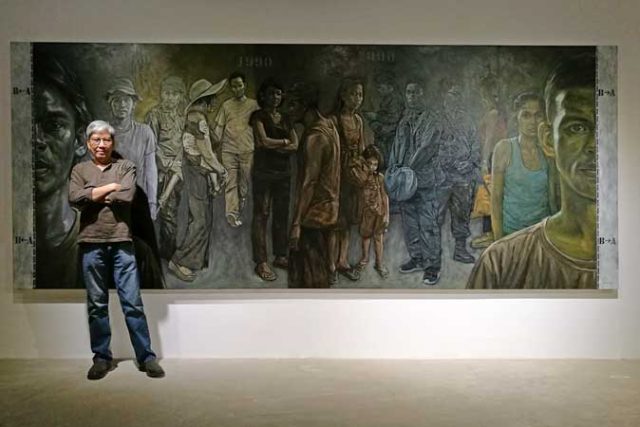
SOCIAL REALIST painter Antipas Delotavo

Art in the Park’s special exhibits

A CHRONICLING of the Filipino story, exploring self-portraits, and transforming new spaces are the focus of three featured artists in this year’s “Art in the Park Online 2021: Special Edition.”

For its 15th anniversary special edition, Art in the Park online (www.artinthepark.ph) is featuring over 10,000 artworks from 62 galleries, four special exhibits, and a variety of special online activities until Aug. 1.

A PEOPLE’S STORY
Throughout his long career — he has been making art since the 1970s — social realist painter Antipas Delotavo has been inspired by history and current events. Most of the images he creates are derived from photographs he has taken, videos and images on social media showing people’s daily lives, as well as his interactions with people in the streets.

“For an artist, everything in this world is fair game when it comes to choosing subjects. Some are moved to paint something they can relate to, be it aesthetic or philosophical, pleasant or unpleasant, to inspire them,” Mr. Delotavo said in an e-mail to BusinessWorld.

“In our country, the latter just overwhelms me. The artistic possibilities are also endless for a social realist; there are landscapes, human figures, still lives, abstract forms, etc. that I can incorporate in my work. The bottom-line is always art,” he added.

For this edition of “Art in the Park” online, Mr. Delotavo presents a special exhibit called Gridlock, depicting the Filipino and his societal burden through seven collages of nameless citizens who contribute to the nation.

“In art, a grid is a series of lines commonly used in drawing that form squares in a confined space. It seems our political, economic, social life is in a standstill. We are trapped in a grid. The pandemic just intensified it during the lockdowns,” Mr. Delotavo said.

“It’s important that you believe that you are the conscience and soul of society, that you are doing something noble other than what pleases the art market,” he added.

SELF-PORTRAITS IN THREADWORK
Eugenia “Ginny” Alcaide first ventured into using embroidery in her art during her third year as a student of  Fine Arts at the University of the Philippines.

“My class was given an interesting assignment: create a portrait with just one continuous, unbroken line,” Ms. Alcaide said in an e-mail. She knew that the work she wanted to make would be “difficult to achieve… with the physical limitations of paint.”

The granddaughter of a seamstress, Ms. Alcaide inherited her knowledge on stitching.

“My very first thread portrait was made for that class, and I have been trying to push the boundaries of this material and myself as an artist ever since,” she said.

After a stint as a graphic designer, Ms. Alcaide focused on fine arts full-time in 2010.

When she is working on a portrait, Ms. Alcaide noted that she works with reference photographs, with the subject evolving as her piece progresses, with the final image moving away from its reference and towards the faces of people around her.

“I do not stitch on cloth,” Ms. Alcaide clarified, preferring to work on silkscreen, adding that she seeks to explore “the idea of layers” which she described as “different and distinct, yet interconnected planes of design that just aren’t possible with opaque fabrics.”

“I stitch on silkscreen. I have found this material to not only possess the transparency required for the effect, but also a light-catching sheen that adds a mysterious brilliance to the finished pieces,” she said.

For the special edition of Art in the Park online, Ms. Alcaide focuses on self-portraits in the collection, “Adrift,” where she weaves “compositions of doubt, despair, and desolation” in striking colors of gold, orange, blue, and black.

“This is the only way I know to show the world how I see myself. And beyond the external image, I wanted to vivify how I feel,” she said.

The time in lockdown affected her creativity. “The feeling of isolation, and that unwavering, creeping sense of desperation affected me greatly… Relating this to my work, there is a definite and sudden exploration of color in the Art in the Park 2021 pieces that was not present before,” she said,

MELTING MIRRORS
Sculptor, painter, installation artist, and designer Leeroy New moves to the digital space with “Iris,” mirror sculptures which were constructed during the lockdown when he received requests to construct mirror sculptures with melting frames.

“These mirrors appeared as portals like openings to other worlds or dimensions and the melting frame was kind of like the dissolution the physical reality that we’re currently inhabiting,” Mr. New said in a press interview via Zoom.

Aside from holding the online exhibit of his mirror pieces, Mr. New also makes his first foray into augmented reality (AR) with Aliens of Manila, headpieces made of plastic containers that can be used as an Instagram filter for the duration of the online art fair.

“I’ve always been open to exploring how my works can translate into the virtual realm…,” Mr. New said. “So, it’s really just a natural progression for me to be able to harness technology for us to be able to give other forms to the work that we do and reach a different audience that would not be able to experience our work in the traditional ways.”

GODDESS IN THE PARK
The fourth exhibit is also by Mr. New — a scaled down installation of his work Mebuyan Vessel Polyp at Art in the Park’s home base, Jaime Velasquez Park in Makati, for the duration of the online fair. The public art installation serves as a sneak peek of the full installation which will be mounted in La Union later this year. The piece will be Mr. New’s entry for the online edition of Burning Man 2021 in August.

The installation is inspired from Mebuyan, the breast-covered goddess from Bagobo mythology, who is the mother who nourishes the infants and children in the underworld.

The original installation is likened to isolation pods or “a womb” constructed in varying sizes and connected by bridgeways.

In the future, Mr. New said that he would like to focus more on working in a sustainable manner.

“I realized from my collaboration with other people [that] they respond more positively to the fact that I focus on using discards,” Mr. New said, adding that he hopes to utilize at least 90% discarded materials in his future projects.

For more information, visit www.artinthepark.ph and follow www.facebook/artinthepark and @artintheparkph on Instagram. — Michelle Anne P. Soliman

Globe says 4G LTE network expands in 12 provinces

BW FILE PHOTO

GLOBE Telecom, Inc. announced on Tuesday that it had upgraded its third-generation (3G) network in 12 provinces to 4G Long-Term Evolution (LTE) with the completion and modernization of several sites.

“More customers in Batangas, Bohol, Bukidnon, Davao del Sur, Davao del Norte and seven other provinces will now have better access to Globe’s 4G LTE network,” Globe said in an e-mailed statement.

The Ayala-led telco said it upgraded at least 507 sites in Batangas from 3G to 4G LTE, the new standard of mobile data.

It also migrated 488 areas in Metro Manila and 450 in Cebu to 4G LTE.

“In Mindanao, 366 sites are now powered by 4G LTE in Davao del Sur. In Davao del Norte, 126 sites have been upgraded. In Bukidnon, 79 sites have been migrated to 4G LTE,” Globe said.

It also said 85 areas in Bohol are now 4G LTE-powered.

“Globe has also upgraded 111 sites in Cagayan; 88 in Rizal; 195 in Cavite; 328 in Laguna, and 358 in Pampanga,” the company noted.

Ookla, the company behind Speedtest, recently said the country’s speed rankings for both fixed broadband and mobile internet continued to improve in June.

The country’s average download speed for fixed broadband was 66.55 megabits per second (Mbps) in June, a 6.82 increase from the 59.73 Mbps speed recorded in May.

As for the mobile internet, the Philippines reached 32.84 Mbps, a 0.86 increase from 31.98 Mbps in May.

Globe Telecom shares closed 1.31% lower at P1,881 apiece on Tuesday. — Arjay L. Balinbin

Gov’t fully awards 7-year bonds at higher yield

BUREAU OF THE TREASURY FACEBOOK PAGE

THE GOVERNMENT made a full award of the reissued Treasury bonds (T-bonds) it offered on Tuesday at a higher rate amid strong demand for securities at the long of the yield curve.

The Bureau of the Treasury (BTr) on Tuesday raised P35 billion as planned via the reissued seven-year T-bonds with a remaining life of six years and eight months.

The offering was nearly twice oversubscribed, with tenders reaching P69.758 billion. This prompted the Treasury to open its tap facility and offer P10 billion more in the seven-year papers.

The demand seen for Tuesday’s offer was also more than the P61.175 billion in bids when this bond series was last auctioned off, which was on July 6. The government likewise made a full P35-billion award of the papers at that offering.

The notes fetched an average rate of 3.651% on Tuesday, up by 7.5 basis points from the 3.576% quoted for the tenor at the July 6 auction.

The yield fetched on Tuesday was also higher than the 3.491% quoted for the tenor at the secondary market prior to the auction, based on the PHL Bloomberg Valuation Reference Rates published on the Philippine Dealing System’s website.

National Treasurer Rosalia V. de Leon said the bond offer attracted strong demand from investors due to the abundant liquidity in the market and with the seven-year tenor serving as a “sweet spot” for investors.

A bond trader said via phone that the average rate quoted for the seven-year papers at the auction fell within market expectations and only tracked the rising trend of yields on government debt.

“This is actually closer to the market and is actually not bad as the demand was almost two times oversubscribed,” the trader said.

“Overall, it is indicative of the growing demand and the comfort level of the market, showing it is more comfortable extending the duration up to the seven-year level pending the August borrowing program of the BTr,” the trader added.

The BTr is expected to release its borrowing program for August this week.

Excluding the result of the tap facility offering on Tuesday, the Treasury raised P227.86 billion from the local market this month, lower than its P235-billion program after it made a partial award of the fresh 20-year bonds it offered on July 13.

Broken down, it borrowed P60 billion as programmed via Treasury bills but only raised P167.86 billion out of the P175-billion plan from T-bonds despite opening the tap facility thrice.

The government wants to borrow P3 trillion from domestic and external sources this year to help fund a budget deficit seen to hit 9.3% of gross domestic product. — B.M. Laforga