Home Blog Page 7233

Nets, Lakers ahead in 2022 NBA title odds

THE Milwaukee Bucks and Phoenix Suns are looking up at the favorites to win the 2021-22 NBA title according to early odds released by sportsbooks on Tuesday.

Leading the pack as the favorite for the Larry O’Brien Trophy next summer are the Brooklyn Nets at +210. The Nets lost a seven-game series to the eventual-champion Bucks in the Eastern Conference semifinals last month.

The Suns eliminated the Los Angeles Lakers in the first round of this year’s Western Conference playoffs, but it’s LeBron James’ team that has the best title odds in the West for next season, according to DraftKings.

PointsBet rates the top three in the same order — Nets (+250), Lakers (+650) and Bucks (+800) — and the Golden State Warriors are even with the Suns in a tie for fourth at +900.

At +475 via DraftKings, the Lakers are ahead of the Los Angeles Clippers (+800), Golden State Warriors (+1,200) and Suns (+1,400). Golden State missed the playoffs due to a loss to the Lakers and the Memphis Grizzlies in the play-in tournament, but the Warriors expect the return of shooting guard Klay Thompson and have the No. 7 pick in the 2021 draft.

The Suns eliminated the Clippers in the 2021 conference finals.

Philadelphia was the top seed in the Eastern Conference entering the 2021 playoffs, but the 76ers are just +1,600 at DraftKings to claim the championship with tumult on the roster and the future of 25-year-old point guard Ben Simmons unclear. The Sixers lost to the Atlanta Hawks in a second-round series last month.

Bringing up the rear on the DraftKings NBA title odds board, the Detroit Pistons own the No. 1 pick in next week’s draft and share +50,000 odds with the Orlando Magic, Cleveland Cavaliers, Oklahoma City Thunder and Houston Rockets. — Reuters

Giannis named NBA Finals MVP

MILWAUKEE Bucks forward Giannis Antetokounmpo (34) celebrates with the Bill Russell NBA Finals Most Valuable Player Award after game six of the 2021 NBA Finals against the Phoenix Suns at Fiserv Forum. — REUTERS

MILWAUKEE Bucks forward Giannis Antetokounmpo was named the NBA Finals Most Valuable Player (MVP) after leading his team to a 4-2 series victory over the visiting Phoenix Suns on Tuesday.

Antetokounmpo, who was born and raised in Athens to Nigerian parents, joins Dirk Nowitzki (2011), Tony Parker (2007), Tim Duncan (2005 and 2003) and Hakeem Olajuwon (1994 and 1995) as the only international players to be named NBA Finals MVP.

It was a remarkable NBA Finals debut for the 26-year-old Antetokounmpo, especially considering he missed the final two games of the previous series after suffering a gruesome-looking hyperextension of his left knee.

But Antetokounmpo managed to play in each game of the NBA Finals during which he averaged 35.2 points, 13.2 rebounds and five assists over six games.

Antetokounmpo saved his best for last as he recorded a playoff career-high 50 points in the championship-clinching game at home to go along with 14 rebounds and five blocks. — Reuters

Obiena has eyes on the prize in Tokyo

By Michael Angelo S. Murillo, Senior Reporter

POLE-VAULTER EJ Obiena holds the distinction as the first Filipino athlete to qualify for the Olympic Games in Tokyo and is looking to create more history as he competes in the rescheduled quadrennial Games.

“The Olympics is very near and no one can predict the results, but rest assured that the fighting spirit is very much alive. We will proudly not just represent the Philippines, but fight for its glory,” shared the 25-year-old Obiena on social media.

The Manila native is one of 19 Philippine bets out to hand the country its first-ever Olympic gold medal in almost a century of participation.

Mr. Obiena, who qualified for the Olympics in September 2019 in a tournament in Napoli, Italy, has spent majority of the past few years in Italy for his training; a situation that was not easy, especially with the pandemic, but something he had to do in the hopes of achieving his goals in Tokyo.

“When you’re out of the country and seeing what’s happening, it’s not easy… So hopefully, I can give back something to the country of some sort [in the Olympics during these times],” he told digital site PusoPilipinas.

And it has paid dividends for him as he steadily won a number of international competitions, including gold medals in meets in the Czech Republic, Germany and Italy.

He also struck gold in the Asian Championships, Southeast Asian Games and World University Games in 2019.

The solid run has him now ranked number six in the world in the men’s pole vault.

For the Olympics, the target for Mr. Obiena is to top his personal best and national records of 5.87 meters (outdoor) and 5.86 meters (indoor) to position himself for a podium finish, or even a gold.

To do that, he has to contend against a tough field which include world number one Armand Duplantis of Sweden, Americans Sam Kendricks and Christopher Nilsen, Polish Piotr Lisek and French Renaud Lavillenie.

Mr. Obiena begins his campaign on July 31 (qualification) with the pole-vault finals set for Aug. 3. He is due in Tokyo on Friday, July 23, hours before the Opening Ceremony.

The Tokyo Olympics will last until Aug. 8.

Team Philippines settling well in Athletes’ Village heading into start of Olympic Games

TAEKWONDO jin Kurt Barbosa is one of the Filipino athletes now in the Tokyo Olympics Athletes’ Village. — PHILIPPINE OLYMPIC COMMITTEE FB PAGE

MEMBERS of Team Philippines for the Tokyo Olympic Games are settling well in the Athletes’ Villages as they wait for the official start of the proceedings this weekend.

While Japan is in a state of emergency because of the pandemic, Philippine bets are managing to adjust to the situation and going about their affairs.

“The athletes approach each day as a regular one, but they don’t let their guards down,” Team Philippines’ physician Dr. Randy Molo of the Philippine Sports Commission’s Medical and Sports Science Science unit communicated to local sports media from Japan.

“They bring their chairs into the open, grass field and they soak up the sun. You see athletes jogging or cycling, but with the usual masks and social distancing,” he added.

The team physician also shared that the athletes’ needs are being taken care of, including extensive meals to choose from and massage treatment available upon request online.

Also, athletes, officials, and coaches numbering 6,700 inside the village undergo saliva testing for COVID-19 daily.

Dr. Molo said the village has had its share of positive cases already and it is something they are closely monitoring.

Majority of the Philippine bets are staying in the Athletes’ Village, including four-time Olympian Hidilyn Diaz (weightlifting) and debuting Margielyn Didal (skateboarding), Cris Nievarez (rowing), Caloy Yulo (gymnastics) and Kurt Barbosa (taekwondo).

The Philippines also has athletes seeing action in athletics, shooting, swimming, golf, judo and boxing. — Michael Angelo S. Murillo

Northport notches first win in rout of Phoenix

The Northport Batang Pier routed the Phoenix Super LPG Fuel Masters, 115-79, on Wednesday to book their first win in the PBA Philippine Cup. (PBA Images)   

By Michael Angelo S. Murillo, Senior Reporter

The Northport Batang Pier barged into the win column in the PBA Philippine Cup after routing the Phoenix Super LPG Fuel Masters, 115-79, on Wednesday at the Ynares Sports Arena in Pasig City.

Northport left Phoenix from the second quarter all the way to the fourth period, outscoring the latter, 93-61, to take their record to 1-1 early in the season-opening Philippine Basketball Association All-Filipino tournament.

Guard Robert Bolick, Kevin Ferrer and rookie big man Troy Rike each finished with 20 points apiece for the Batang Pier in the victory. Mr. Bolick also had 11 assists and seven rebounds while Mr. Ferrer grabbed nine boards. Mr. Rike, meanwhile, shot a high 85% (6-of-7) from three-point land.

Also finishing with double-digit points for Northport were Sidney Onwubere and rookie Jamie Malonzo with 15 points each, and Paolo Taha with 12.

The 36-point winning margin was the largest for the Batang Pier in franchise history, eclipsing their 34-point advantage, 124-90, against the Barangay Ginebra San Miguel Kings set in Game One of their 2019 Governors’ Cup best-of-five semifinal series.

Meanwhile, Phoenix, which dropped to its second defeat in as many outings, was led by the 26 points of Vic Manuel. Matthew Wright finished with 15 points.

Cignal tops Sta. Lucia in four sets

The Cignal HD Spikers were four-set winners over the Sta. Lucia Lady Realtors in PVL Open Conference action on Wednesday. (PVL Media Bureau)

The Cignal HD Spikers bounced back from their opening game loss in the Premier Volleyball League Open Conference, defeating the Sta. Lucia Lady Realtors in four sets, 25-22, 25-18, 13-25, 25-20, on Wednesday at the PCV Socio-Civic Cultural Center in Bacarra, Ilocos Norte.

Cignal came back stronger in the fourth set after it failed to complete a shutout of Sta. Lucia.

Janine Marciano and Roselyn Doria paced the HD Spikers with 14 points apiece with the former having 13 kills.

May Luna added 10 in the win while Rachel Anne Daquis and Norielle Ipac contributed eight points apiece.

The HD Spikers had a chance to close out the contest early but never got it going in the third frame where they fell behind and could not recover.

For Sta. Lucia, it was MJ Phillips who led with 20 points, 17 off kills. Aiza Maizo-Pontillas had 15 and Jovielyn Prado 11.

The loss sent the Lady Realtors to their second defeat in three matches. – Michael Angelo S. Murillo

In fashion and food, how to make more sustainable choices

PIXABAY

From recommerce in shopping to efforts on food waste reduction, consumers are placing an increasing importance on sustainability practices.  

Recommerce — or the buying and selling of pre-owned items — is accelerating in Southeast Asia because it intersects ethics and e-commerce, said Miranda Dimopoulos, regional chief executive officer of Interactive Advertising Bureau Southeast Asia and India, a non-profit advertising association that published a report this month on millennial buying behaviors. 

“Across all the local market research what was consistently obvious is that we are witnessing the explosive growth of recommerce as it feeds two key needs of consumers today: the demand for sustainability and the hunt for a good deal,” Ms. Dimopoulos said in a press statement. “[This] creates fertile ground for retail media because of the interplay among customer data, closed-loop reporting, and real-world results that generate more and better data.”   

The report, done with commerce marketing platform Carousell Media Group, found that almost all millennials (or 99%) in the Philippines find purchasing pre-owned items more sustainable. It also found that the country ranked higher (at 84%) than regional averages when it came to sustainability considerations being factored in by under 35s when they were selling an item. Respondents said they use web-based marketplaces like Carousell to sell products with the intent of upgrading, and because it is better for the environment to sell rather than dispose of an item. 

Across Carousell Group’s five markets in Singapore, Hong Kong, Malaysia, Singapore, and the Philippines, both the under 35s and over 35s were motivated to use its marketplace as the environmental impact when purchasing a pre-owned item was deemed lesser.  

The Carousell Group’s definition of millennials are individuals between 1835 years old. 

PERSONAL RESPONSIBILITY 
Turning to the secondhand market to inject new life into pre-loved goods is one of the environmentally-friendly practices that people enjoy doing, according to Dang U. Domingo, head of advertising of Carousell Philippines. 

“Supporting sustainability by buying unused or underused products that are still in good condition is a big draw, especially when these items are priced much lower, and are unique treasures not available in stores,” she told BusinessWorld in an e-mail interview. 

“We feel that this trend to purchase pre-owned items will continue post-pandemic,” Ms. Domingo added. “The younger generation… feels directly responsible in making choices that solve the problems inherited from previous generations.”  

The environmental impact of fashion is less obvious than that of other staples of modern life, such as single-use plastics. The industry, however, produces 10% of all humanity’s carbon emissions and is the second-largest consumer of the world’s water supply.  

Fast fashion, in particular, has come under fire for creating waste. Spanish apparel retailer Zara, noted the World Economic Forum in January 2020, puts out 24 collections per year, whereas Swedish multinational clothing-retail company H&M offers between 12 and 16. 

WASTE REDUCTION
In addition to fashion, food is another area where consumption has led to environmental degradation. Food accounts for over a quarter (or 26%) of global greenhouse gas emissions. Agriculture, moreover, accounts for 70% of global freshwater withdrawals and 78% of global ocean and freshwater eutrophication (or the pollution of waterways with nutrient-rich pollutants).  

A solution to this is efficient food production and consumption, which House Bill 7956, or the proposed Food Surplus Reduction Act, aims to address. It mandates a National Zero-Food Waste Campaign, even as it seeks to establish linkages between food businesses, food banks, and local government units to create a community-based food distribution system for the food-insecure. 

A private sector initiative with a similar objective is The Sustainable Diner Project of World Wildlife Fund-Philippines (WWF-Philippines).  The three-year project, which recently held its culminating event, collaborates with government agencies and food services to create an awareness on the environmental impacts of the food industry, as well as food and dining waste reduction schemes. 

This year, WWF-Philippines launched a sustainability guide for the food service and hospitality industry, which includes handouts and training videos to aid hotel and restaurant management and staff in integrating sustainability principles in their operations. The guide builds on a hotel kitchen kit based on the work of WWF US and the American Hotel and Lodging Association. The localized version of the toolkit rolled out in 2018 to address the Philippine food service industry’s food waste program. 

Among the other initiatives spearheaded in the project’s run are the creation of a food waste reduction ordinance in Cebu City, as well as the training of 24 restaurant and hotel partners to kickstart their sustainability journey. These partners include Kanin Club and Cravings in Quezon City, Zubuchon in Cebu City, and Taal Vista Hotel’s Taza Fresh Table and Bag of Beans in Tagaytay City. 

“Our food choices matter,” said Melody M. Rijk, project manager of WWF-Philippines’ Sustainable Consumption and Production, in a press statement. “Collectively, we can make this world a better place by simply choosing the right food, and the right way of making food.” — Patricia B. Mirasol 

Valuing sustainability

KATEMANGOSTAR-FREEPIK

There is a lot of confusion and debate on whether it even makes sense to put numbers and figures into sustainability. Many argue that sustainability should be a way of life, a norm. Is it okay to keep doing air travel and then simply plant a tree to offset this? Is it okay to label coffee as fair trade, and put figures onto how much meat consumption is acceptable? Many say that if you give standards and boxes to tick, people will find ways to circumvent and cheat the system. It is the same for companies. When you suddenly begin ranking firms based on sustainability criteria, then they will do the minimum required to comply and look good, perhaps neglecting the bigger picture of whether their practices really do have a positive impact, or at least reduce the negatives.

Even more difficult is the democratization and politization of rankings and assigning value. It is arguable that energy efficiency is high on the agenda of many nations whose gender balance, when it comes to people in leadership and pay scale, remain questionable. Many companies can be high on internal best practices and employee retention such as Apple, and yet still be criticized for demeaning labor standards in their outsourced operations or parts of their supply chain. And because of this, many companies are hesitant to join the bandwagon of reporting, case in point: Scandinavia. They have some of the most gender-balanced, social-protectionist, environmentally conscious operations in the world, and yet barely report on it. They do not feel the need to do so, with some of them even saying that the lengthy process of reporting takes away resources, time, and effort from simply doing the thing instead.

From a theoretical perspective, we must first go back to the definition of valuation, what matters to people, and what it means.

Valuation in the sociology of finance literatures is the process of bringing order to mere differences. A valuation process comprises two dimensions: first, determining that something is of worth and then, second, assessing that worth. From a sustainability standpoint it is to determine what should be measured, and then measuring it. The sociology of worth argues that individuals and organizations have “orders of worth,” a set of common values that they pursue and that evaluation criteria are attached to these values. For instance, market evaluation criteria, such as financial performance measures, are tied to the worth that individuals and/or organizations attach to the market, whereas family evaluation criteria such as standards of parental love are tied to the worth that individuals or society attach to the concept of family.

However, recent research in the sociology of valuation shows that the opposite relationship is also possible: the choice of evaluation tools might instead determine what is then of worth or valuable. Think of IT systems, web-based rating systems, appraisal systems: such evaluation tools can contribute to the reinforcement of particular value systems within an industry and affirm certain values over others. To wit, calculative devices, categorization, classification, standardization: all these can institutionalize sustainability and make it happen even if this was not de facto part of what was deemed of value. This happens in an accounting framework like what the UN PRI (Principles for Responsible Investment) is doing and the GRI (Global Reporting Initiative). In having to report about sustainability, companies are obliged to create sustainable practices to report on.

And so, what can be measured, gets done. For instance, one can argue that the fact that carbon emissions can now be measured contributes to making the environment (financially) valuable to organizations. In this way, sustainability accounting has been identified as a key lever for pushing practices towards sustainability and reinforcing its value. Finally, this process is iterative and requires the involvement of multiple actors and discussions often involving conflicts and power struggle. Such expression is key for the transformation of practices towards sustainable development.

And indeed, attention over the past decade has shifted from the dominance of quantitative economic value towards the commensuration of non-economic value. Unlike financial performance indicators, which over time have become more precise and standardized, to date there has been no convergence upon universally accepted environmental and social performance indicators, making such information questionable and difficult to measure, and unverifiable. Despite their limitations, these methodologies dominate since they are useful for assessing such a complex concept and they are effective in convincing actors to engage using their financial language. In fact, tools are performative; they shape practices independent of their validity, simply by their usage. Research shows that while established evaluation tools largely guide and frame action, reflexive agents actively take and transform the usage of existing tools to fit their own purposes, making the value of sustainability, not something to be proven but rather, something to be created.

Note: This article is based on a working paper entitled “Valuing Sustainability Without Financializing? The Case of the Reporting and Assessment Framework of the United Nations Principles for Responsible Investment (UN-PRI)” written by the author with Diane-Laure Arjalies of Ivey Business School, Western University (Canada) and Nicolas Mottis of the Ecole Polytechnique Paris. References are available upon request.


Daniela “Danie” Luz Laurel is a business journalist and anchor-producer of BusinessWorld Live on One News, formerly Bloomberg TV Philippines. Prior to this, she was a permanent professor of Finance at IÉSEG School of Management in Paris and maintains teaching affiliations at IÉSEG and the Ateneo School of Government. She has also worked as an investment banker in The Netherlands. Ms. Laurel holds a Ph.D. in Management Engineering with concentrations in Finance and Accounting from the Politecnico di Milano in Italy and an MBA from the Universidad Carlos III de Madrid.

Green mining and liquid ore

BRGFX-FREEPIK

Mining can be “green,” and ore can be “liquid.” Sounds too good to be true? Not according to a recent study by Oxford scientists. Just a matter of time, I believe, for this to happen. Given the necessity of mining in the digital age, coupled with the quick pace of technological advancement, green mining and liquid ore may yet become the standard in extraction by the next decade.

The shift from fossil fuel to electricity to power transportation is already driving the demand for metals like copper. The demand for batteries and other components for the production of energy from renewables like wind and solar is also pushing up demand for metallic and non-metallic minerals. There is correlation between mining output and renewable energy production.

So, with the shift to renewables to cut down on emissions, and the greater investment emphasis on ESG (environmental, social, and governance) issues, and how mining seems to be related to all this, then isn’t it just a matter of time when the industry will also need to turn “green” by sourcing ore and minerals from liquid and not solid earth?

President Rodrigo Duterte issued Executive Order No. 130 on April 14 to lift the nine-year moratorium on new mining contracts. He opted not to wait for new legislation that was supposed to set the terms for taxes and royalties, among others, for the mining industry. As we now review the rules for mining, we should already bear in mind the possibility of green mining in the future.

Opening up new mining sites is a step in the right direction, given that the economy is in trouble and the country is in dire need of new investments. But the government should go beyond “[maximizing] government revenues and share from production, including the possibility of declaring [mining] areas as mineral reservations to obtain appropriate royalties.”

Moving forward, I believe the government should also ban the export of raw ore, and require local processing prior to sale of minerals abroad. I also support sustainable development, and believe that we should strive to find a balance between environmental and economic interests by making sure that mining is done sustainably and responsibly.

And this is why the Oxford study matters. It points to the possibility of extracting from “brine mines,” and how this can become a reality in the next five to 15 years. Given this, existing rules should be reviewed in light of what we hope to achieve with the local mining industry in the next five to 10 years. Rules should pave the way for green mining by the medium term.

In a press announcement, the University of Oxford said that scientists from its Department of Earth Sciences have demonstrated how it was “possible to directly extract valuable metals from hot salty fluids (‘brines’) trapped in porous rocks at depths of around two kilometers below dormant volcanoes.” Calling this a “radical green-mining approach,” the University said the proposed process could “provide essential metals for a net zero future — copper, gold, zinc, silver and lithium — in a sustainable way.”

If this technology can be harnessed and developed for commercial use in the next five years, I believe it points to good prospects particularly for local mining. After all, the Philippines is in the Ring of Fire and has numerous active and dormant volcanoes all over the country. This sounds particularly promising if open pit mining can be abandoned altogether in favor of volcano mining.

“Magma beneath volcanoes releases gases that rise towards the surface. These gases are rich in metals. As the pressure drops, the gases separate into steam and brine. Most metals dissolved in the original magmatic gas become concentrated in the dense brine, which in turn gets trapped in porous rock. The less dense, and metal-depleted steam continues up to the surface, where it can form fumaroles, such as those seen at many active volcanoes,” the university explained.

“Oxford scientists reveal how this trapped, subterranean brine is a potential ‘liquid ore’ containing a slew of valuable metals, including gold, copper and lithium, that could be exploited by extracting the fluids to the surface via deep wells… Their models show that the brines potentially contain several million tons of copper,” it added.

Oxford scientists noted that “copper is a key metal for making the transition to net zero, due to its importance in electricity generation and transmission, and electric vehicles.” And, as stated by Oxford Professor Jon Blundy: “Getting to net zero will place unprecedented demand on natural metal resources, demand that recycling alone cannot meet. We need to be thinking of low-energy, sustainable ways to extract metals from the ground. Volcanoes are an obvious and ubiquitous target.”

Then there is the additional benefit of extracting geothermal power as a “significant by-product of a green-mining approach, meaning that operations at the well-head will be carbon-neutral,” the study noted. “The prospect of extracting metals in solution form from wells reduces the cost of mining and ore processing, plus exploits geothermal power to drive operations. This vastly reduces environmental impact of metal production.”

More important to the Philippines is the study finding that “geophysical surveys of volcanoes show that almost every active and dormant volcano hosts a potentially exploitable ‘lens’ of metal-rich brine. This means that metal exploration may not be limited to relatively few countries as it is currently, owing to the ubiquity of volcanoes around the world.”

While there are plenty of challenges to pursuing green mining, I believe that this early it should already form part of the considerations of policymakers in reviewing Philippine laws and guidelines on extraction. New guidelines and incentives may be made time-bound, and conditioned on the introduction and use of new technologies that are green and sustainable.

Rapid changes in technological advancement usually outpace the change in policy and regulation. This does not have to be the case, always. Access to data and studies and information on new developments already give us foresight, and allow for better visioning and planning. Policy changes must always be strategic and not just tactical, with the far future always in mind.


Marvin Tort is a former managing editor of BusinessWorld, and a former chairman of the Philippine Press Council

matort@yahoo.com

Citius, altius, fortius: Faster, higher, stronger

FREEPIK

The countdown to the 2021 Tokyo Olympics ends tomorrow, Friday, July 23, the day of the opening ceremonies and parade of athletes.

The 2021 Tokyo Olympics is going to be the most restrictive ever simply because it is being staged in the middle of a global health emergency. The fact that it will start tomorrow is in itself an achievement, added testimony to man’s resiliency. The fact that most of the 10,000 athletes competing have completed their long journeys is also a victory over adversity. It underscores the tremendous influence the Olympics have on governments and populations, despite the widespread and vocal objections to it in Japan itself.

Athletes and officials speak of the remarkable absence of demonstrations or public outcries or graffiti protesting the staging of the Earth’s biggest event. Obviously, restraint is a Japanese trait.

Edward Kho, communications and marketing director of the Philippine Athletics Track and Field Association (Patafa) is in Isahaya City, Nagasaki prefecture as the one-person advance party of the Patafa. The 55-year-old or so organization is a private, non-profit corporation that is the sole governing body of the sport of athletics in the country. Athletics covers the following events: track and field, race walking (walkathon), road running (marathon), and cross country. The sport, which is the foundation and centerpiece of any multi-sport Olympic-type festival, aptly breathes life into the Latin slogan, citius (faster), altius, (higher), fortius (stronger). The events in the sport include, running, jumping and throwing.

Edward was with me at Ishihaya in 2017 to lay the ground work for the pre-games, acclimatization, and athletics training camp. He noted the sparse crowd in the streets of Isahaya with a population of about 145,000. Edward said, “there are not too many people out walking in the streets, although quite a number of vehicles are running around. Our gracious hosts have politely informed us that, per National Government policy, our movements are limited to the hotel, to the track and back. No side trips anywhere.”

Isahaya is in the prefecture of Nagasaki, whose capital city of Nagasaki was one of two cities on which the United States dropped atomic bombs to speed up the cessation of World War II hostilities in the Pacific. Evidence of the devastation created by these two monstrous attacks are still very clear and memories are still fresh of Aug. 6 and 9, 1945 when Hiroshima and Nagasaki took those massive blows. Coincidentally, the Olympics end on Aug. 8, 2021 or 76 years later.

Aside from the atomic bomb attack, Nagasaki is known as being where Filipino missionaries like San Lorenzo Ruiz were executed. A marker has been erected in his memory with the help of Filipino clergy and laymen. There are about 50 Filipinos working and residing in Isahaya, and the commemoration of the martyrdom of Lorenzo Ruiz was milestone in the predominantly non-Christian area. Nagasaki was the only territory that the Japanese rulers back then opened up to the outside world during a period of isolation.

Typically, the Japanese were preparing early for the 2020 Olympics and had gotten the local governments like those in Nagasaki and Isahaya involved. The prefecture agreed to host the five-day pre-games training of foreign delegations and the Philippine athletics team was chosen by the officials of the two local governments. Hosting overseas athletes was simply a matter of getting the local officials and their constituents behind the games.

From our point of view, the matter was a no-brainer: Nagasaki and Isahaya offered the free use of the Transcosmos, an ultra-modern, 20,000-seat track stadium that compares very favorably with the larger New Clark City track oval built by the BCDA (Bases Conversion and Development Authority) for the 2019 SEA Games. It took Edward and I just one trip to Isahaya in August in the middle of the 2017 SEA Games at Kuala Lumpur to seal the deal. We could not help but wonder how a small city is able to own and maintain a multi-million-dollar modern track stadium. This scenario gives one an idea of the affluence of Japanese society and its economic dynamism.

The entire Philippine contingent to the 2021 Tokyo Olympics is comprised of 19 athletes – nine men and 10 women competing in athletics, aquatics, boxing, golf, gymnastics, weightlifting, and skateboarding. It’s the first time in the history of Philippine participation in the Olympics that women outnumber the men.

Ernest John (EJ) Obiena of athletics (listed by the Philippine Olympics Committee in its official publication as taking part in “pole vaulting,” which is an event in the athletics sport), will start competing in pole vault’s qualifying/preliminary round on July 31. He will be facing 31 vaulters, mostly from Europe, Scandinavia, and the Americas. The cast includes defending Olympic champion Thiago Braz of Brazil and world record holder Armand Duplantis. The American-born Duplantis opted to play for his mother’s homeland, Sweden. With a record of 6.17 meters, Duplantis is favored to win gold. EJ, however, is hardly daunted by this since he cleared 5.87 in early July to establish a new Philippine outdoor record. EJ was the first Filipino to qualify for the Tokyo Olympics. EJ needs to clear the height set by organizers to move into the final round on Aug. 3. According to Emerson Obiena, EJ’s father, based on the 2016 Rio Olympics, only the top 12 players may compete in the finals.

The Philippine entry in the 200 meter race, Kristina Knott, will run in a field of 40. That group is divided into to eight entries per heat. To advance to the semis, Kristina needs to finish in the top four of her heat or register among the fastest four losers from the remaining 20 other runners. After the semis, Kristina of course hopes to make it to the finals on Aug. 3.

Both EJ and Kristina have prepared long, hard, and smart. Physically, they’re in tip-top shape. At this point, with a few days to go, the mind and heart take over.


Philip Ella Juico’s areas of interest include the protection and promotion of democracy, free markets, sustainable development, social responsibility and sports as a tool for social development. He obtained his doctorate in business at De La Salle University. Dr. Juico served as Secretary of Agrarian Reform during the Corazon C. Aquino administration.

Showing up too early

DIANA.GRYTSKU-FREEPIK

AS A PEOPLE, we get a bad rap for treating time for appointments like suggestions for the retail price of goods. Is a 10:30 a.m. meeting really the equivalent of any time before lunch is served, but not after the soup? “Filipino time” has become an approximated time check, vague and suggestive.

Developed countries post their train or bus departure and arrival schedules to the minute like 6:07 a.m. Such precision implies a commitment to punctuality. Panting towards the pick-up point at 6:15 a.m., and you surely just missed your ride, not even seeing the back of the bus pulling away. Our own point-to-point bus service has emulated this departure precision by being parked at the terminal 15 minutes before time, pulling away on schedule.

Acceptable timeliness in our culture follows certain rules, based on venue, occasions, and habits.

A corporate launch of a new logo may state the time in the invitation as 5:30 p.m. The notation, “registration” is a wink to the cognoscenti that the actual event will take place half an hour later. Thus, the invitee routinely adds at least 30 minutes before showing up.

On the other hand, an office meeting called by the CEO to review the budget, set at 10:30 a.m., is expected to start on time, and woe to the straggler who pops in 30 minutes late with wet hair and a lame excuse about traffic during GCQ. The presenter will not even stop to recognize the latecomer. And if it’s the big boss who is late? Well, small talk fills up the gap. As soon as he walks in, the chatter stops — can we start now?

With this game of “reciprocal expectations,” it is impractical to take the designated time for an event literally. The host provides a time which is expected to be adjusted by the socially aware invitee so that an overly punctual arrival does not cause embarrassment. (Please water the plants, while I take a shower.)

Being too early (or even on the dot) is considered a social lapse of manners.

Even in virtual meetings which have become routine, there are always those who click the link 15 minutes before time — the host will let you in shortly. Why are you so early?

For in-person meetings which are now allowed a bit more after the proper vaccinations, early birds are the bane of event organizers. The commute time is estimated on the high side, even with the lower traffic volume and the opening of new overpasses. Mishaps are thrown into the calculation like the possibility of a flat tire or being in front of three ambulances with sirens blaring. Waiters putting tablecloths on the table in their undershirts give these eager beavers a pitying look — do you want a bread basket, sir?

The early guest is expected to kill time somewhere else. It is a challenge then depending on the venue (a mall is ideal for killing time) to find something to do for at least 30 minutes which may allow a browse through the bookstore without buying a book. No need for a shopping bag, if the shopper will just download the title as an e-book.

It’s fine to be too early for appointments with doctors, dentists, car repair shops, job interviews, and lunches. There are waiting areas to look busy in.

In this political season, announcing availability too early gives the trolls time for “opposition research.” This is an investigative effort to dig up dirt on a subject like fake diplomas, unexplained mansions in the provinces, and previous entanglements of a scandalous nature. This effort is akin to the canonization process where the “devil’s advocate” tries to prove the unworthiness of a possible saint. It can also be conducted by a candidate himself to test his vulnerabilities. Early announcements just give more time for the trolls to get to work.

The incumbent has already demonstrated the advantage of tardiness in filing candidacies, even using substitutes as a way in. Even after being in office, his lateness for appointments can extend to not even showing up for announcements of quarantine status for the next two weeks.

The overly punctual guest is seldom fussed over and dismissed as a favor seeker. Nobody looks for him when he leaves too early… unless he’s supposed to pay the bill.


Tony Samson is Chairman and CEO of TOUCH xda

ar.samson@yahoo.com

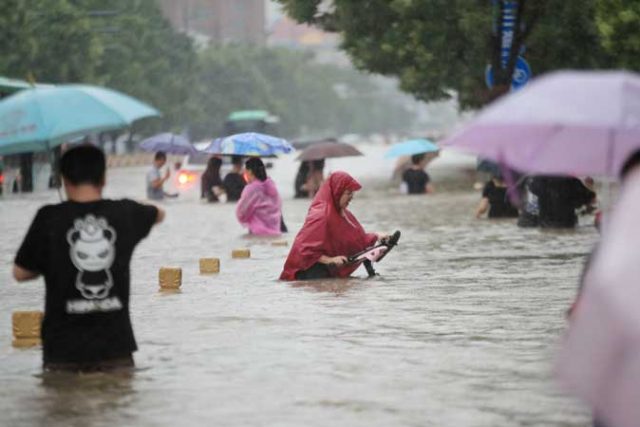
China’s ‘iPhone city’ relocates 100,000 after massive floods

Residents wade through floodwaters amid heavy rainfall in Zhengzhou, Henan province, China July 20, 2021. — CHINA DAILY VIA REUTERS
Residents wade through floodwaters amid heavy rainfall in Zhengzhou, Henan province, China July 20. — CHINA DAILY VIA REUTERS

AROUND 100,000 people have been evacuated from the central Chinese city of Zhengzhou, as record rainfall caused widespread flooding and economic disruptions to Henan province, home to the world’s biggest production base for iPhones and a major hub for food production and heavy industry.

Pictures published by state media showed large sections of roads submerged in Zhengzhou, a city of 10 million, while videos posted on social media showed passengers stuck inside flooded subway cars with water levels up to their shoulders and residents pulled to safety with ropes from fast moving floodwaters. State news agency Xinhua reported that 12 deaths had been confirmed so far.

The deluge has brought the equivalent of more than eight months’ worth of the city’s average rainfall since Tuesday, and has already interrupted the operations of at least one global company with manufacturing operations there. Nissan Motor Co Ltd. has temporarily halted production in Zhengzhou, according to a spokeswoman for the company. SAIC Motor Corp., China’s biggest automaker, said logistics around its factory in Zhengzhou have been impacted by the floods in the short term, but that the plant hasn’t been damaged.

Meanwhile Taiwan’s Hon Hai Precision Industry Co., which owns a massive iPhone production plant in Zhengzhou, said that it had activated an emergency response plan for flood control measures but that the flooding has had no direct impact on the facility.

Hon Hai’s plant receives components needed to assemble iPhones from global and domestic Chinese suppliers before shipping out the finished producers. The flooding struck just as the company prepares to ramp up output ahead of the launch of Apple, Inc.’s latest devices toward the end of the year.

The flooding in Henan may also impact China’s food supply. The province is the country’s second-largest food producer, accounts for about a quarter of the wheat harvest and is a major center for frozen food production. Henan is also the home of the world’s biggest pork processor WH Group Ltd., which acquired US meat production giant Smithfield Food, Inc. in 2013.

While China has already harvested its main wheat crop, earlier widespread rains impacted quality from areas including Henan. That is expected to drive up wheat imports by as much as 40% this year to the highest level since the mid-1990s, according to Bric Agriculture Group, a Beijing-based consulting firm. China has increased purchases from the US, Canada and Australia this year.

Other commodities have also been impacted by the flooding in Henan, which is a key hub for coal and metals. Some aluminum production and scrap-metal procurement has been halted or reduced, according to researcher Mysteel, citing its own survey.

On Wednesday, rescue workers and authorities continued to work to prevent dam breaches, restore lost power and pump out submerged gas stations. President Xi Jinping urged officials to step up disaster relief measures, state broadcaster CCTV reported. Inbound flights to Zhengzhou have also been suspended.

Zhengzhou saw 457.5 millimeters (18 inches) of rain fall in the 24 hours through 5 p.m. on Tuesday, the highest since records began for the city of more than 10 million people, Xinhua reported. That included a record 201.9 millimeters in a single hour, from 4 p.m. to 5 p.m, a record for mainland China. Zhengzhou typically receives average annual precipitation of about 640.8 millimeters.

The record rainfall came shortly after key Chinese cities warned that homes and factories face new power outages as historic demand and supply shortages strain energy grids. Eleven provinces including eastern manufacturing hubs and landlocked central China reported record demand and peak-load surges last week, amid hot weather. Henan already started banning exports of its coal supply to other areas last week amid concerns over energy supplies due to heavy rain.

Environmental nonprofit Greenpeace warned that the weather events in China fit the global pattern of extreme weather brought on by climate change. In the last few weeks, the US and Canada have experienced unprecedented heatwaves, Europe and India have suffered major floods, wildfires have spread across Siberia and drought has gripped parts of Africa and Brazil.

“Climate change has made extreme weather like heat waves and floods more frequent and more deadly in the past 20 years,” said the group’s East Asia climate and energy campaigner Liu Junyan. Recent events in Henan, along with North America and Europe “are all wake-up calls reminding people of the climate change crisis.” — Bloomberg