Home Blog Page 7167

Stocks rally as companies report higher profits

COURTESY OF PHILIPPINE STOCK EXCHANGE, INC.

PHILIPPINE shares continued to rally on Wednesday following positive earnings reports from companies, but analysts said the market could consolidate as the week comes to an end.

The Philippine Stock Exchange index (PSEi) gained 25.15 points or 0.38% on Wednesday to close at 6,585.21, while the all shares index went up by 18.77 points or 0.46% to end at 4,059.59.

“Philippine shares traded slightly up after the new string of positive corporate earnings results overshadowed investor concerns over the coronavirus and Chinese regulatory action against technology stocks,” Regina Capital Development Corp. Head of Sales Luis A. Limlingan said in a Viber message.

Property firm Megaworld Corp. said it recorded a net attributable income worth P2.6 billion in the second quarter, up by 39% from last year’s P1.9 billion.

SM Investments Corp. also saw its net income surge to P20.1 billion in the first semester, nearly a threefold improvement from the P7.1-billion profit booked in the same period last year.

Meanwhile, Metro Pacific Investments Corp. recorded an 82% growth in core net income for the quarter to P3.5 billion from P1.9 billion year on year.

On the other hand, shares in US and European-listed gaming companies fell on Tuesday after a steep sell-off in China’s social media and video games group Tencent driven by fears the sector could be next in regulators’ crosshairs, Reuters reported.

The slide in European and US gaming stocks followed a tumble in Tencent, down more than 10% at one point in Hong Kong in a decline that wiped off almost $60 billion from its market capitalization, after a Chinese state media outlet branded online video games “spiritual opium.”

“[A] follow-through buying on attractive valuation lifted the market but gains are losing steam and likely set to go on consolidation mode tomorrow and until [the] weekend,” First Metro Investment Corp. Head of Research Cristina S. Ulang said in a separate Viber message.

Majority of sectoral indices posted gains on Wednesday except for property, which inched down by 3.36 points or 0.1% to finish at 3,078.05.

Meanwhile, services climbed 29.10 points or 1.85% to 1,595.29; mining and oil rose 84.21 points or 0.86% to 9,840.62; financials increased by 10.98 points or 0.76% to 1,438.99; industrials went up 34.44 points or 0.37% to close at 9,262.94; and holding firms inched up by 3.70 points or 0.05% to 6,555.32.

Value turnover inched down to P4.64 billion with 1.10 billion issues traded on Wednesday, from the P4.89 billion with 799.68 million issues switched hands the previous day.

Advancers beat decliners, 115 against 73, while 46 names closed unchanged.

Net foreign buying decreased to P83.72 million yesterday from the P108.49 million logged on Tuesday. — K.C.G. Valmonte with Reuters

Airlines to seek fresh government aid next week

REUTERS

AIRLINES are hoping to meet with the government’s transport agencies next week to seek an extension of the waiver of airport fees as the aviation industry continues to struggle due to the pandemic and lockdowns, the Air Carriers Association of the Philippines (ACAP) said Wednesday.

“The government-backed guarantees were discussed as early as Bayanihan I, but (the matter remains) pending,” ACAP Chairman and Philippines AirAsia, Inc. Chief Executive Officer Ricardo P. Isla said at an online briefing. He was referring to the first Bayanihan stimulus package passed last year.

“However, what we are now asking for is an extension of the waived airport fees and parking fees. That alone will be a big help to the airline companies,” he added.

Mr. Isla also said ACAP is due to meet by next week with the Civil Aviation Authority of the Philippines, the Civil Aeronautics Board, and the Manila International Airport Authority.

He noted that some airport tenants are also asking for rent relief. 

“The parking and runway fees that we pay the airports — I think these are the basics that we can ask for right now,” he added.

Philippines AirAsia officials presented during the briefing the results of its survey conducted on July 23, 24, 27 and 28 involving 1,600 guests flying out of Ninoy Aquino International Airport Terminal 3 to destinations like Bohol, Bacolod, Cagayan de Oro, Cebu and Davao.

The low-cost carrier said 91.4% of the respondents agreed that having a fully vaccinated crew gives them confidence to travel by air. 

“As of August 2, 2021, 67% of the 1,500 Filipino (AirAsia employees) have received their COVID-19 shots. With the threat of the Delta variant, AirAsia Philippines is proactively campaigning to inoculate its entire workforce within the year,” the company said in a statement.

“Meanwhile, 729 guests or 45.5% claimed to have been vaccinated; 410 of whom were fully vaccinated or were traveling two weeks after receiving their second dose; 190 received their first dose; and 120 claimed to have gotten their second dose,” it added. — Arjay L. Balinbin

Emerging COVID-19 variants seen threatening PHL economic recovery

PHILIPPINE STAR/ MICHAEL VARCAS

AN ECONOMIC recovery for the Philippines could come “sooner than later,” though the main downside will come from the emergence of more infectious variants of the coronavirus, First Metro Investment Corp. (FMIC) and University of Asia and the Pacific (UA&P) said in a joint report Wednesday.

“The emergence of coronavirus disease 2019 (COVID-19) variants and possible draconian response still pose threats to a rapid economic reboot,” FMIC and UA&P said in their July market call.

The analysis noted that indicators in May including employment, manufacturing output, and government spending are helping to raise optimism that the economy is on the mend.

“The likelihood of continued improvement will largely depend on the roll-out of vaccines, the control of the spread of the COVID-19 and the relaxation of mobility restrictions. Employment gains should translate to higher aggregate spending, which will hopefully create more jobs in the second half,” according to the market call.

The May unemployment rate was 7.7%, equivalent to 3.73 million jobless, declining from 8.7% or 4.138 million in April, according to the Philippine Statistics Authority.

The June Labor Force Survey released Tuesday also came in at 7.7%, but estimated unemployment numbers at 3.764 million.

FMIC and UA&P are bullish that higher employment in sectors such as manufacturing and construction will help to propel a recovery in those sectors.

Factory activity continued to expand thought at a slower pace last month even as neighboring countries saw contractions due to the infection surge, according to IHS Markit. The Philippine Manufacturing Purchasing Managers’ Index was at 50.4 in July, slipping from a 50.8 reading in June, although still above the 50 neutral mark that separates contraction from expansion.

Another important factor that could help boost growth is the pickup in government spending, according to the market call.

“We expect National Government spending to accelerate further for the rest of the year as the May 2022 Presidential elections draw closer,” the two institutions said. 

Government spending in June rose 13.2% from a year earlier to P395.4 billion, according to the Bureau of the Treasury. Government spending in the first half of the year was P2.206 trillion, up 9.6% from a year earlier but still 9.56% short of the P2.44-trillion target for the January to June period.

In July, FMIC trimmed its GDP (gross domestic product) growth forecast for the year to 5-6% from the 5.5-6.5% estimate it issued in January. The official government target is 6-7%.

The economy contracted by 4.2% in the first quarter following the record 9.6% contraction in 2020. — Luz Wendy T. Noble

Schools seek prompt passage of tax relief bill

PHILSTAR

PRIVATE SCHOOLS said they are hoping a bill granting them eligibility for a lower tax rate is signed this month or in September, to remove the distraction of the dispute with the Bureau of Internal Revenue (BIR) and allow them to focus on their core teaching mission.

“We are hopeful that the bill can be signed into law before the new school year starts in earnest this August and September, so that our schools can fully focus on dealing with the Learning Crisis and the COVID (coronavirus disease) pandemic that our country is currently grappling with,” Coordinating Council of Private Educational Associations (COCOPEA) Managing Director Joseph Noel M. Estrada said in a statement Wednesday. 

Mr. Estrada also urged private educators to join COCOPEA in appealing to Congress to swiftly pass the bill “to extend a lifeline to our struggling schools during this pandemic, to ensure the continuity of learning for our students, to secure the jobs of our teachers and personnel, and to provide livelihoods for the many small businesses… who are dependent on our schools.

The House of Representatives’ Committee on Ways and Means passed the bill on second reading Monday.

House Bill 9913 amends Section 27 (B) of the National Internal Revenue Code of 1997 to explicitly allow all proprietary educational institutions and non-profit hospitals to avail of a 10% preferential tax rate for a limited period to allow them to recover from the economic crisis. 

Under the bill, the tax rate of private schools will further be reduced to 1% from July 1, 2020 to June 30, 2023, as authorized by Republic Act 11534 or the Corporate Recovery and Tax Incentives for Enterprises (CREATE) law. 

The BIR’s view on eligibility for tax relief was that it only applied to non-profit institutions, leaving for-profit schools to pay the regular corporate tax rate, currently at 25%. 

The BIR has since withdrawn its interpretation of the tax treatment for private schools. — Bianca Angelica D. Añago

Hedcor resumes hydro operations in Benguet after deal with IP groups

HEDCOR.COM

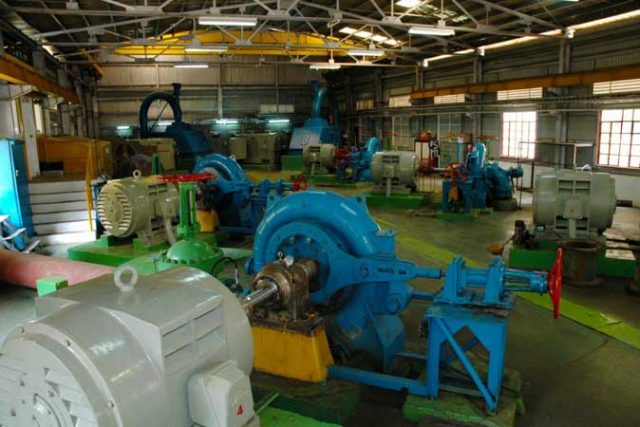
ABOITIZPOWER Corp. unit Hedcor, Inc. has resumed the operations of its three hydroelectric facilities in Bakun, Benguet, after reaching a deal with indigenous groups, which earlier withdrew their consent for the power plants over a royalty dispute.

The hydro plants are the 2.4-megawatt (MW) Lower Labay, 3.6-MW Lon-oy, and 5.9-MW FLS hydro facilities.

“Hedcor’s (plants) resumed operations on July 28, 2021 and synchronized to the Luzon grid. This is following the successful conduct of a negotiation participated in by Hedcor, the Bakun Indigenous Tribe Organization (BITO), together with the local government officials of Bakun last July 27-28,” AboitizPower said in a regulatory filing Wednesday.

“The Bakun community will collectively receive about 14 centavos per kWh (kilowatt hour) of the generation of the Bakun Plants which is an aggregation of mandatory shares, voluntary benefits, and projects,” the firm said.

Under the Energy department’s Energy Regulation 1-94 program, power generating firms are required to give one centavo for every kilowatt-hour of sales to their host communities to finance electrification, livelihood and development projects.

In June, the National Commission on Indigenous Peoples-Cordillera Administrative Region (NCIP-CAR) served a halt order on Hedcor due to alleged issues in securing consent from the tribes. The Bakun groups requested a cease-and-desist order in April, which the NCIP’s regional office issued “as a legal and necessary consequence of a resolution of non-consent.”

NCIP-CAR Concurrent Director IV Marlon P. Bosantog has said that one of the main disagreements stems from royalty issues following the expiry of an initial deal signed in 1991.

On Wednesday, Hedcor President and Chief Operating Officer Rolando G. Pacquiao said the company will continue its partnership with the Bakun tribes for another 25 years.

“We are very grateful that the (community) expressed their support over the resumption of our operations in Bakun. We are equally thankful for the support of the NCIP-CAR in opening the doors to dialogue, and to the community for the opportunity to sit down and talk so that we can work on a resolution,” he said.

With the new agreement, Hedcor hopes to complete its FPIC (free prior informed consent) application and secure a certificate of precondition (CP), which will both be issued by the NCIP.

According to the Indigenous Peoples’ (IP) Rights Act of 1997, developers may secure permits and licenses only after receiving the CP, which expresses consent from the indigenous community hosting the project.

Hedcor, a wholly owned subsidiary of AboitizPower, operates 22 hydropower plants supplying the country with over 277 MW of renewable energy. — Angelica Y. Yang

NIA settles dispute with SN Aboitiz over irrigation water used in Magat power operations

SN ABOITIZ

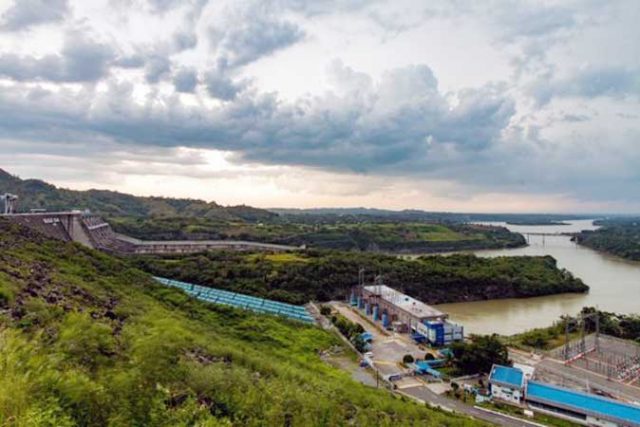
THE NATIONAL Irrigation Administration (NIA) and SN Aboitiz Power-Magat, Inc. (SNAP-MI) agreed to a P19.99-million settlement in relation to the use of irrigation water in power operations.

The NIA said in a statement Wednesday that the deal is structured as a compensation settlement.

The agreement was signed by NIA Administrator Ricardo R. Visaya and SNAP-MI President and Chief Executive Officer Joseph S. Yu on Aug. 3.

On Dec. 13, 2006, the NIA signed an operations and maintenance agreement with SNAP-MI for the non-power components of Magat Dam, owned and operated by NIA. The dam is primarily used for irrigation with a secondary role in power generation.

The agreement follows on from SNAP-MI’s acquisition of the 360-megawatt Magat Hydroelectric Power Plant (MHEPP) from the National Power Corp. in an auction conducted by the Power Sector Assets and Liabilities Management Corp.

“On June 18, 2008, in order to resolve the then pending issue on the pricing of water for the volume used in excess of the Irrigation Diversion Requirement (IDR) during times that the actual reservoir elevation is above the rule curve elevation, the MHEPP Oversight Committee issued Resolution No. 1, series of 2008 providing the unit of price of water to be adopted in computing the water service fee for MHEPP,” the NIA said.

During the November 2010-February 2011 period, NIA claimed P9.27 million from SNAP-MI, citing opportunity loss as a result of SNAP-MI’s non-use of the full IDR for electricity generation, while the latter is operating for ancillary services.

SNAP-MI argued that service fees should be computed based on the volume of water used for power generation as provided in the operations and maintenance agreement.

In the May-September 2009 period, the NIA claimed P10.72 million from SNAP-MI for the water consumed above the IDR during spilling conditions, per the rate of P0.062 as prescribed under the oversight committee resolution.

SNAP-MI argued that the regular rate of P0.031 should be applied in case of surplus flows that would be spilled if not used for power generation under exceptions that were provided in the operations and maintenance agreement.

The parties were also in dispute on the service fee adjustment under the operations and maintenance agreement, particularly on the frequency, rate, increase/decrease, and conditions.

Apart from the settlement, the NIA and SNAP-MI also decided to revise the operations and maintenance agreement in order for the service fee payable by SNAP-MI to NIA to be computed based on the allocated IDR, whether or not the IDR was utilized for electricity generation. — Revin Mikhael D. Ochave

Relief for foreign nationals with expired visas

To address numerous pleas and requests for reconsideration from foreign nationals, the Bureau of Immigration (BI) recently issued an Advisory, allowing a six-month non-extendible grace period to file applications for renewal/extension of their working, student, or resident visas, which expired from March 16, 2020 up to July 4, 2021. The filing period of the extension applications is until Nov. 30; otherwise, those illegally staying in the country will be subject to deportation proceedings. This Advisory does not, however, apply to expired tourist visas without an extension request.

This new Advisory is a welcome development to foreign nationals, who were stranded, or opted to stay in the country to continue their assignment or work but, for one reason or another, failed to get an extension of their visas.

THE PARADOX OF AN EXPIRED VISA
Prior to this BI Advisory, a foreign national who failed to apply for an extension of his working, student, or permanent resident visa before its expiry would need to request for its downgrading or cancellation to be able to apply for a new one. Paradoxically, the foreign national, who has been holding this visa for five years or more, may find himself in a Catch-22 situation. He may be required to leave the country after the downgrading order is released pursuant to the provisions of BI Administrative Order No. RAGE-2016-004. Under this Administrative Order, non-immigrant visa holders (e.g., 9[g] visa holders) who have held their non-immigrant visas for a total or cumulative period of five years, will be ordered to leave due to the downgrading application. In compliance, the foreign national must either depart the Philippines, or alternatively, file a letter seeking reconsideration from the order to leave.

Prior to March 19, 2020, or before the issuance by the Department of Foreign Affairs (DFA) of Foreign Service Circular No. 29-2020, which suspended visa-free privileges to non-restricted nationals, complying with the Administrative Order was simple. A foreign national could easily book a flight to his home country or any nearby country with a return ticket to the Philippines. Then, a new entry stamp will be issued to the foreign national, who may then proceed to apply for a new working or student visa.

WEATHERING THE PANDEMIC
However, with the pandemic, some borders remain closed for travelers coming from the Philippines. Here, the problem sets in as travel restrictions imposed by various countries make it more difficult for foreign nationals stranded in the Philippines to return to their home countries. While the opening of global borders may be in the offing, the BI’s current mandate to leave the country is, however, time-bound and pressing. More often than not, a foreign national has only 30 days (now extended to 60 days) to comply with the order to leave.

In recourse, a foreign national may opt to travel to other neighboring Asian countries that remain open for travelers coming from the Philippines. As part of health protocols, other Asian countries may admit foreign nationals from the Philippines on tourist status, subject to compliance with quarantine arrival requirements.  For re-entry into the country, the foreign national must apply for an entry exemption document (EED) and an entry visa from our Philippine Embassies overseas. Currently, with the pandemic, foreign nationals are still prohibited entry into the Philippines, except for those that fall under the specified categories of exemption (i.e., diplomats, Filipino-dual citizenship, holders of valid 9[c]/long term visa, those under the Balikbayan Program, and those with Filipino spouses/minor children). Only those who qualify may request an EED. For other foreign nationals seeking an entry exemption, a request for an EED should show the essentiality or necessity of the return by the foreign national to the Philippines. In other words, the EED is issued if the travel is for emergency or meritorious situations; otherwise, traveling as a tourist to the country is still not allowed.

The request for an EED and its supporting requirements shall be pre-evaluated by a government agency with which the local employer is registered (e.g., Philippine Economic Zone Authority, Board of Investments, etc.) for issuance of an endorsement. The endorsement will be forwarded for subsequent approval by the DFA in Manila. Once the EED is approved, the embassy can then issue an entry visa. However, one concern to date is that not all Philippine embassies will issue a visa if a foreign national cannot show proof of residency in that foreign country where the applicant is currently at. It’s a situation that needs to be addressed by the DFA, given the extraordinary circumstances of the pandemic.

Whether it’s the country’s low cost of living, warm climate, tropical scenery, hospitality, or English-speaking locals that attracted foreigners to this country, a number have chosen to settle here, if even just temporarily. Pre-pandemic statistics show that there were over 10,000 overseas students enrolled in undergraduate and postgraduate courses in the country (Bureau of Immigration, 2018), 148,000 resident foreigners in 2019 (ABS-CBN News, 2019), and 54,241 foreign workers in 2018 (Ople, 2019). By providing a grace period for the renewal/extension of expired visas, we commiserate with foreign nationals in these uncertain times, recognizing their valuable contribution to our economy and our development in the global community.

The views or opinions expressed in this article are solely those of the author and do not necessarily represent those of Isla Lipana & Co. The content is for general information purposes only, and should not be used as a substitute for specific advice.


Larissa C. Dalistan-Levosada is a senior manager at the Tax Services Department of Isla Lipana & Co., the Philippine member firm of the PwC network.

larissa.c.dalistan@pwc.com

Agencies to keep skeletal force amid lockdown

PHILIPPINE STAR/ MICHAEL VARCAS

By Kyle Aristophere T. Atienza, Reporter

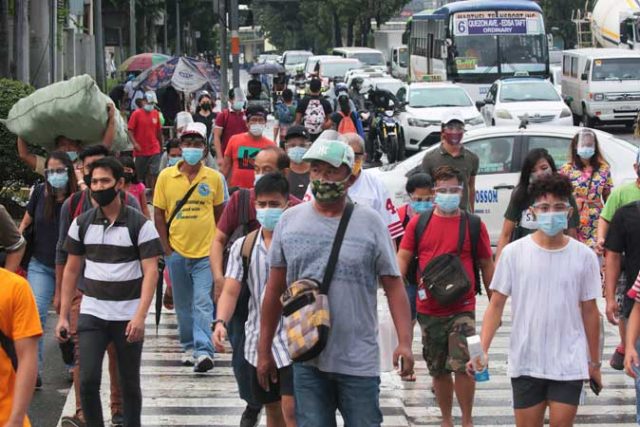
THE PRESIDENTIAL palace on Wednesday ordered agencies in the Philippine capital and nearby cities to reduce their on-site workers to 20% during the two-week enhanced lockdown meant to contain a more contagious Delta coronavirus variant.

Only agencies that provide health and emergency, laboratory and testing, border control and other critical services can fully operate, according to a copy of an Aug. 3 memo signed by Executive Secretary Salvador S. Medialdea.

“To ensure continuity of government service, the skeleton workforce shall not be less than 20% of on-site capacity at any given time, with the remainder being under work-from-home arrangements,” he said.

Department heads may change on-site capacity and related arrangements “as health considerations and the exigencies of the service may require.”

The palace urged offices under Congress, the Judiciary, independent constitutional commissions and bodies, and local governments in the capital region to adopt the executive memo.

Metro Manila will be under a hard lockdown from Aug. 6 to 20 to contain a fresh surge in coronavirus infections believed to have been triggered by the Delta coronavirus variant from India.

The Department of Health (DoH) reported 7,342 coronavirus infections on Wednesday, bringing the total to 1.61 million.

The death toll rose to 28,231 after 90 more patients died, while recoveries increased by 7,285 to 1.52 million, it said in a bulletin.

There were 63,171 active cases, 94.1% of which were mild, 1.3% did not show symptoms, 2% were severe, 1.42% were moderate and 1.2% were critical.

The agency said 59 duplicates had been removed from the tally, 52 of which were recoveries. Twenty-three recoveries were reclassified as active cases and 51 as deaths.

CIVIC BAN
Meanwhile, civic leaders said poor people were likely to suffer more amid a state ban on humanitarian works during the two-week enhanced lockdown.

Community-based initiatives that fill state void are vital to ease poverty, they said.

“Humanitarian work is essential especially during this pandemic,” former Social Welfare Secretary Judy M. Taguiwalo said in a Facebook Messenger chat. “To prohibit it at a time when millions are jobless and hungry is inhumane.”

“Our experience during this pandemic has exposed the inadequacy and inefficiency of the pandemic response of the National Government, which has the mandate and the resources,” she added.

Philippine authorities said unauthorized humanitarian activities, including donation drives and distribution of goods would be barred during the two-week lockdown in Metro Manila that starts on Aug. 6.

“Guidelines like this may hamper the delivery of humanitarian assistance in areas under an enhanced community quarantine,” said Sherlene Cruz, executive director of the Citizens’ Disaster Response Center. 

The order might also be used to discriminate against humanitarian organizations “that they deem unauthorized,” she said in a Facebook Messenger chat. “It may also put humanitarian workers at risk of harassment.”

Metro Manila Development Authority Chairman Benjamin Abalos, Jr. on Tuesday said community pantries would probably be prohibited during the lockdown to avoid so-called super spreader events.

Thousands of carts carrying donated food have sprouted across the Philippines in the past months, which critics said exposed government failure to help the poor amid one of the world’s strictest and longest coronavirus lockdowns.

Some government officials labeled Ana Patricia Non, a millennial entrepreneur who started the movement, and other pantry organizers as communists.

“Humanitarian work should be encouraged, while following health and safety protocols,” said Terry L. Ridon, former chairman of the Presidential Commission on the Urban Poor.

“The police have no power issuing these orders, as no authority is needed to conduct humanitarian work and good deeds for our marginalized communities,” he added.

Banning humanitarian work is illegal since the Constitution mandates the state to encourage “nongovernmental, community-based or sectoral organizations that promote the welfare of the nation,” said Michael Henry Ll. Yusingco, a senior research fellow at the Ateneo de Manila University Policy Center.

“Issuing a blanket prohibition that covers groups helping Filipinos cope with the effects of the lockdown does not help and is both unreasonable and inhumane,” he said in Facebook Messenger chat.

Feeding the poor is a state obligation and civic work is a critique of government failure, said Katrina S. Santiago, founder of the People for Accountable Governance and Sustainable Action.

“We like to romanticize serving the people in need, but I think what we should actually do is to stand in solidarity with them,” she said by telephone.

The Philippine economy could lose more than P200 billion during the two-week enhanced community quarantine, the National Economic and Development Authority has said.

The lockdown would also increase the number of poor people by as many as 177,000 and 444,000 Filipinos could become jobless, it added.

Families needing relief will increase “exponentially with these renewed lockdowns especially because so many have already been driven into deeper distress since March last year,” said Sonny A. Africa, executive director at think tank Ibon Foundation.

In the National Capital Region, seven out of 10 families or 2.3 million households don’t have savings and are trying to survive on a day-to-day basis, he added.

“This includes the millions of informal and irregular workers whose livelihood will be disrupted by the renewed enhanced community quarantine,” he said.

Economists earlier said the government should enact a bigger stimulus measure to address supply and demand shocks from lockdowns.

“A substantial National Government effort to give aid to at least the poorest 70% of NCR families is absolutely essential to ensure that no one falls through the cracks,” Mr. Africa said.

The House of Representatives in June approved a third stimulus measure that seeks to provide P401 billion to pandemic-hit sectors. President Rodrigo R. Duterte did not push the bill, which is pending in a Senate committee, in his last address to Congress this month.

Marikina Rep. Stella Luz A. Quimbo, one of the authors of the stimulus bill, said meager and delayed cash to poor families could force them to leave their homes, defeating the purpose of a strict lockdown.

“Aid is not enough,” she said at a House hearing in Filipino, noting that the promised cash aid would likely reach households after the lockdown.

“Unless aid is provided in a timely manner, these workers might leave their homes anyway if only to find ways to feed their families,” Ms. Quimbo said separately in a Viber message.

The lawmaker urged authorities to tweak the Aug. 6-20 lockdown by allowing businesses in nonessential sectors whose workers have been fully vaccinated and willing to do routine testing to continue operating.

“This is one way to mitigate the substantial economic losses worth P15 billion per day,” she said. “I also continue to push for Bayanihan III, which will provide aid that is urgently needed during an enhanced community quarantine.”


Gov’t urged to stop hospitalization surge and COVID deaths

PHILIPPINE STAR/ MICHAEL VARCAS

AN EPIDEMIOLOGIST on Wednesday urged the government to vaccinate all Filipinos aged 50 years and above to avoid a surge in hospitalizations and deaths.

Local government units should also make vaccination more accessible, and business groups should help the government improve the vaccination process during the strict lockdown, EpiMetrics Philippines President John Q. Wong told an online forum.

“Because of your experience in working with customers, help local government units understand your customers,” he told companies. He added that these should help convince people to get vaccinated, while helping gather feedback to improve the vaccination experience.

Interior Secretary Eduardo M. Año asked businesses to keep observing health rules at workplaces.

“We also encourage you to actively engage our local government units in the fight against COVID-19, especially in the procurement of vaccine doses,” he said.

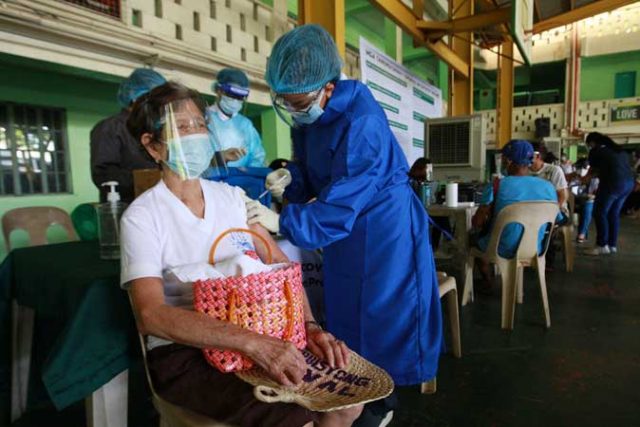
The government seeks to give out 4 million more coronavirus vaccines during the two-week enhanced quarantine in Metro Manila that starts on Aug. 6 to raise the vaccination coverage to 45% and bring the region closer to achieving so-called population protection, Metro Manila Development Authority (MMDA) Chairman Benjamin de Castro Abalos told the forum.

About 8.35 million shots had been given out as of Aug. 2 and almost a million more people would get vaccinated from Aug. 3 to 5, he said.

By the end of the strict lockdown, 12.6 million vaccine shots would have been given out, he said.

“We’re calling for additional sites because of the stormy weather,” Mr. Abalos said. He also asked the private sector to deploy mobile vaccination teams that could be assigned to local governments.

Metro Manila will be under an enhanced community quarantine, the strictest lockdown level, for two weeks starting Aug. 6. Residents may still go out to get vaccinated. — JPI

ASEAN should push unified response to China, says senator

THE PHILIPPINES should push its regional peers to come up with a coordinated position against China’s incursions in the South China Sea, according to a senator.

The Department of Foreign Affairs (DFA) should lead the push, Senator Ana Theresia Hontiveros-Baraquel said in a statement on Wednesday, as foreign ministers of the Association of Southeast Asian Nations (ASEAN) meet on August 2 to 6.

“ASEAN should stand as one,” she said. “When it comes to China’s belligerent actions in the West Philippine Sea, ASEAN’s principle of noninterference does not apply,” she added, referring to parts of the South China Sea within the country’s exclusive economic zone.

“Should China impede freedom of navigation in the entire South China Sea, it is not only the Philippines that will be gravely affected, but also the whole region,” Ms. Hontiveros said. “If the Philippines loses this diplomatic battle against China, the ASEAN loses too.”

Other ASEAN claiming parts of the disputed waterway have also been pushing back against China. Malaysia this year filed a diplomatic protest against China after Chinese aircraft were spotted over the South China Sea, off Borneo.

Last year, Vietnam was reported to have been exploring raising an international arbitration case against China.

“The ASEAN must actively exhaust all legal and diplomatic means to resist China’s excessive claims,” Ms. Hontiveros said. “Being passive does not help our case, especially in the face of an aggressor. China deliberately targets weaker states unable to effectively resist, thus the need for unified and concerted action.”

She said the region is home to some of the best and brightest minds in international law and diplomacy, “so let’s pool these talents together and put China in her place.” 

DFA has filed more than 100 diplomatic protests against China since 2016 because of its “incessant deployment, prolonged presence and illegal activities” in the South China Sea,” the lawmaker said. “Even then, Chinese fishing vessels and maritime militia vessels continue to increase.”

China has denied having deployed militia vessels at sea, saying these were fishing vessels.

Ms. Hontiveros said China’s presence in the waterway had destroyed marine life.

The Philippines loses P33.1 billion yearly or more than P200 billion in the past seven years, according to the University of the Philippines Marine Science Institute.

Foreign Affairs Secretary Teodoro L. Locsin, Jr. on Tuesday said a 2016 landmark arbitral ruling against China could help settle the sea dispute, which can be resolved peacefully by following international law.

The ruling should be followed by all since it was based on the United Nations Convention on the Law of the Sea, he said in a speech at the ASEAN post-ministerial conference session with China. — Alyssa Nicole O. Tan

Nationwide oxygen supply, prices stable — DTI 

PHILSTAR/THE FREEMAN

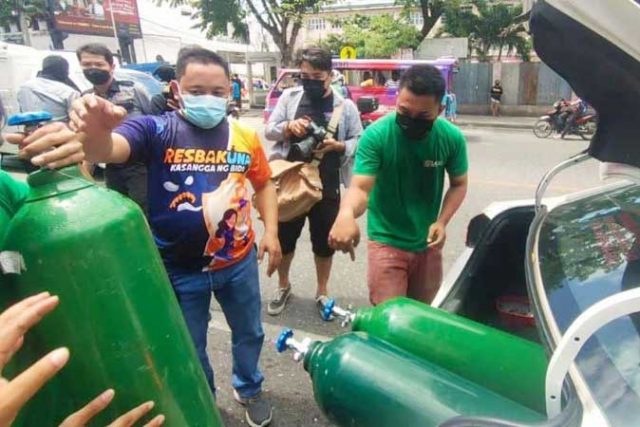
OXYGEN prices and supply have remained stable amid growing household demand for cylinder tanks, Trade Secretary Ramon M. Lopez said.  

“Based on report from industry, for now, the increase in demand for cylinder tanks is coming more from the households trying to buy for their personal need, either current or potential emergency need,” he told reporters in a Viber message on Wednesday.  

The industry capacity is three times more than the current demand, he said, noting a surplus in both medical and industrial capacity.  

“There is a surplus on the production side of oxygen, per se. And the producers have not increased their prices.”   

The government has issued suggested retail prices for medical devices, including oxygen tanks, in response to the coronavirus pandemic.  

Demand for oxygen has increased in Cebu City, the most populated urban hub in central Philippines, amid a spike in cases.  

“The queueing happens when there’s a sudden increase in demand for cylinder tanks in specific areas; and cylinder tanks deployment should eventually follow where the demand is,” Mr. Lopez said. 

“Hoarding especially at this time is a crime and our economic intelligence team will run after erring distributors or refillers.”   

REGULATION
In Cebu, Governor Gwendolyn F. Garcia has issued an order regulating the sale of medical oxygen starting Aug. 4 to halt the ongoing “panic buying” and ensure sufficient supply in healthcare facilities across the province. 

The order does not cover the independent city of Cebu, which serves as the provincial center where there has recently been a significant increase in hospitalizations for coronavirus patients.   

Cebu City is currently under the strictest quarantine level while the province is under the most relaxed category. However, in line with the “one island” policy of the provincial government, movement across the city’s borders are not restricted.  

“There is a need to immediately regulate the sale by manufacturers and dealers of Medical Oxygen so that the same may only be sold to hospitals and/or persons who are in real need of them,” reads part of Executive Order No. 36-2021 issued Tuesday night.   

“If the sale and purchase of Medical Oxygen will not be regulated, the panic buying… might cause a shortage,” it said. 

Ms. Garcia said in her order that medical oxygen manufacturers and suppliers in the province have given assurance that “there is sufficient supply” and they can convert industrial oxygen supply for medical use should the need arise.  

The provincial government, in a statement, said the regulation would prevent “people who would take advantage by reselling it at a higher price that could affect the supply of medical oxygen supply for hospitals.”  

Under the regulation, individuals purchasing medical oxygen will have to present a doctor’s prescription and will be limited to 20-pound tanks at a maximum of five tanks.   

As of Aug. 3, Cebu province had 3,187 active coronavirus cases while Cebu City had 3,054, based on date from the Department of Health-Central Visayas regional office. The two other independent cities in the province, Lapu-Lapu and Mandaue, had 1,286 and 1,139, respectively. 

CAPACITY
Mr. Lopez also said he has asked the Health department to procure and stockpile oxygen cylinder tanks and encouraged oxygen manufacturers to expand capacity in case of a surge caused by the more transmissible Delta variant.  

Department of Trade and Industry (DTI) data shows that four oxygen producers in the country have a combined capacity of 603 tons per day. While just 205 tons of this is for medical use, industrial oxygen capacity can be shifted to medical use in a worst-case scenario.  

To ensure continuous oxygen supply, the department recommended stockpiling the needed goods, exempt oxygen delivery from truck bans, ensure steady power supply for oxygen plants, exempt oxygen cargo from port load limits, and faster processing of new medical oxygen facilities.  

New producer Cryogenics Gases will start operations in Butuan City in southern Philippines by the end of the year, Mr. Lopez said earlier this year, noting that domestic suppliers should be preferred in government procurement.  

Meanwhile, national police chief Guillermo Lorenzo T. Eleazar said they will investigate the possible hoarding of oxygen tanks and other medical supplies in the country, especially in the capital region Metro Manila and Cebu City. 

“The PNP (Philippine National Police) and DTI will coordinate and work together to look into the reported hoarding of oxygen tanks, especially in Cebu City,” Mr. Eleazar said in Filipino in a news release on Wednesday. — Jenina P. Ibañez, Bianca Angelica D. Añago, and Marifi S. Jara

Labor dep’t to release P2B under cash-for-work program during lockdown  

PHILIPPINE STAR/ WALTERBOLLOZOS

THE LABOR department will distribute P2 billion in cash-for-work assistance to workers who will be affected by the two-week lockdown in the capital region and other areas while waiting for the Budget department’s decision on its request for another P2 billion for cash aid.    

In a news briefing on Wednesday, the Labor department’s Information and Publication Service director, Raul M. Francia, said the initial P2 billion will be sourced from its existing cash-for-work program, which still has a P4 billion ready fund.  

Mr. Francia said the Labor department is currently waiting for the list of affected workers from companies that will implement a temporary suspension of operations during the lockdown on Aug. 6 to 20 before it disburses the initial P2 billion. 

Beneficiaries will be chosen from the list and assigned temporary work in their communities.   

The request for fresh funds was submitted Tuesday, he said.  

Based on the request for an additional P2 billion, the distribution will be: P776 million for workers in Metro Manila, P298.5 million in Central Luzon, P179.1 million in CALABARZON (Cavite-Laguna-Batangas-Rizal-Quezon), P159.2 million in Western Visayas, P39.8 million in Northern Mindanao, and P537.3 million for other areas that may be put under the strictest quarantine level.   

Mr. Francia said the P2-billion budget, if approved, will benefit 398,000 workers with each to be given up to about P5,000. 

He added that cash assistance will also be allocated for displaced overseas Filipino workers. — Bianca Angelica D. Añago