Home Blog Page 7062

Disqualified party-list groups with Supreme Court appeal to be included in ballot

PARTY-LIST groups disqualified by the Commission on Elections (Comelec) but filed an appeal before the Supreme Court will be included in the tentative list of candidates for the May 2022 polls, an election official said.   

“To be prudent, inasmuch as they filed petitions in the (Supreme Court), we at Comelec will add the names of those party-list but no re-raffle of the ballot,” Comelec Commissioner Rowena V. Guanzon said on Twitter on Tuesday.  

The tentative list will be used in the ballots, with printing scheduled to start Jan. 15. A total of 166 party-lists are included in the updated tentative list of candidates. 

A raffle was held by Comelec on Dec. 14 to determine the order in which qualified groups will appear in the ballot, changing the practice in past elections of an alphabetical listing. 

In the last two weeks, the Philippine’s Highest Court issued temporary restraining orders against Comelec based on petitions filed by several party-lists whose applications were rejected by the poll body.   

The Comelec was also directed by the court to submit comments on the petitions within 10 days upon receipt of the orders.  

Among the petitioners given relief by the Supreme Court include the Igorot Warriors International, Ang Tinig ng Mga Senior, Alliance for Resilience, Sustainability and Empowerment, Mindanao Indigenous Peoples Conference for Peace and Development, Lingkud Bayanihan Party and Ugyon Mangunguma, Mangingisda Kag Mamumugon Nga Ilonggo (Uma Ilonggo).   

The Comelec denied the accreditation of over 100 party-list applicants. 

There will be 63 congressional seats allocated to party-list representatives in next year’s local and national elections.   

Under the law, each party that gets 2% of the national vote will be entitled to one seat, and an additional seat for every 2% of the vote thereafter, up to a maximum of three seats.     

The party-list system was created under the 1987 Constitution to give representation to marginalized sectors including labor, peasant, urban poor, indigenous, cultural, women and youth at the lower chamber. — Jaspearl Emerald G. Tan 

A strategic plan for the Philippine economy

VECTORJUICE-FREEPIK

(Part 1)

For over half a century, I have been closely involved in the preparation of strategic plans of large and small business enterprises in the Philippines. Not only do I usually provide the so-called environmental scanning as an economist, I also make it a point to give advice on the formulation of the mission and vision of the organization and the identification of strengths and weaknesses as part of the so-called SWOT analysis. In some special cases, I go all the way to help in strategy formulation because of my training as a business economist. Except in those companies in which I belong to the board of trustees as an Independent Director, I do not involve myself in project and operational planning.

As the new year of 2022 will be the start of the post-pandemic era for the Philippine economy as well as the beginning of another presidential term, I thought that I will use all the data, information and assumptions that appeared in my two previous series of articles, entitled “Aspiring for High-Income Status” and “2050 Take Me There,” to formulate a strategic plan for the entire Philippine Economy, not only for the next six years but also for the two presidential terms that will follow them. Those three terms will bring the country exactly to the year 2040 which has been a common target of Filipino professionals doing long-term planning. For example, our national economic planning agency, the National Economic and Development Authority (NEDA), came out with the publication “AmBisyon Natin 2040.” In addition to what is contained in that very valuable document, I will integrate into the strategic plan the views of leading economists, both domestic and international, that have appeared in their respective columns, blogs, and publications. As I have done in actual strategic planning exercises which I facilitated for many enterprises, I will draw out from these leading thinkers about the Philippine economy their expert views relevant to the various phases in the formulation of a strategic plan for the national economy.

Let me begin with the most important step in any strategic planning exercise, the statement of the Mission and Vision of the organization. I propose that we state the Mission of the Philippine economy as providing every Filipino citizen a standard of living that will enable her or him to attain full integral human development. This means achieving economic growth that is both sustainable and inclusive. To those who are not familiar with the expression “integral human development,” it may be necessary to explain that the economy should provide not only for the physical needs of human beings but must take into account that every person is an economic, political, social, cultural, moral, and spiritual being. All these dimensions must be addressed by the income that the national economy should provide for each and every Filipino. This has to be stated because there are regimes that are designed, at least partially, according to Marxist ideologies that believe that only matter exists and there is no such thing as spirit. This leads to a way of governing that completely ignores the non-material dimensions of a human person. Such regimes which are still at least partially influenced by Marxist thought are oftentimes guilty of violating some inviolable human rights as those of freedom of religion, free speech and self-determination, not to mention the right to life.

Now that we have a proposed Mission statement, let us address the Vision statement. Thanks to the NEDA we have a perfect Vision statement in what is called AmBisyon Natin 2040, which is the result of a long-term process that began in 2015 (the last full year of the Noynoy Aquino Administration). More than 300 citizens participated in focus group discussions and close to 10,000 answered the national survey. Technical studies were prepared to identify strategic options for realizing the vision articulated by the citizens. All the important sectors of society, i.e., government, the business sector, academe, and civil society were consulted. AmBisyon Natin 2040 represents the collective long-term vision and aspirations of the Filipino people for themselves and for the country by the year 2040 which is the terminal year for the next three successive Administrations that will start in 2022. We strongly recommend that our political leaders who will be elected in May 2022 take very seriously these aspirations of the Filipino people and formulate strategies that will effectively achieve the goals envisioned by the Vision. These strategies could be both those that have already been proven effective by previous administrations (continuity) or new ones still untried or better fitted to the new realities that the next 18 years will unfold.

Let us now state the exact words that express the Vision of the Filipino people for the year 2040: “By 2040, Filipinos enjoy a strongly rooted, comfortable, and secure life. In 2040, we will enjoy a stable and comfortable lifestyle, secure in the knowledge that we have enough for our daily needs and unexpected expenses, that we can plan and prepare for our own and our children’s future. Our family live together in a place of our own, and we have the freedom to go where we desire, protected and enabled by a clean, efficient, and fair government.”

This Vision Statement is succinct, as all Vision Statements should be. Fortunately, those officials of NEDA who facilitated the tedious process of arriving at the Vision statement (I remember the hours and hours I spent helping business enterprises and nongovernmental organizations to arrive at their respective Vision Statement) did us a great favor by fleshing out the Vision Statement enshrined in the AmBisyon Natin 2040. To help us in the subsequent steps of strategy formulation, it would be useful to know how some of the key phrases in the Mission Statement should be understood.

What is meant by Filipinos being “strongly rooted”? Using a Filipino word “matatag,” a more detailed explanation of this aspiration states that Filipino families live together; there is work-life balance so that there is time to spend with family, even for members who work. On weekends, families and friends enjoy time together in parks and recreational centers. It is a high-trust society with a strong sense of community. There are volunteer opportunities and Filipinos spend time to serve the community, help others who are in need, and contribute to various causes.

The second key word in Filipino is “maginhawa.” This means that no one is poor, no one is hungry. Filipino families live in comfortable homes with the desired amenities and secure tenure. Families and friends are within reach because transport is convenient and affordable, and they can take a vacation together within the country and abroad. Children receive quality education so that they are able to realize their full potentials and become productive members of society. Decent jobs that bring sustainable income are available, including opportunities for entrepreneurship.

Finally, the third condition is described by the Filipino word “panatag.” This means that Filipinos feel secure about their entire lifetime. They expect to live long and enjoy a comfortable life after retirement. They have access to resources that cover unexpected expenses, especially in the form of savings. They feel safe where ever they go in the Philippines. Filipinos trust their government because it is free of corruption and provides services to all citizens without discrimination.

(To be continued.)


Bernardo M. Villegas has a Ph.D. in Economics from Harvard, is professor emeritus at the University of Asia and the Pacific, and a visiting professor at the IESE Business School in Barcelona, Spain. He was a member of the 1986 Constitutional Commission.

bernardo.villegas@uap.asia

A holistic approach to disaster resiliency

VECTORJUICE-FREEPIK

Natural disasters come and go, and it is the communities that are left to deal with the consequences. We know all too well that the worst of these calamities leave a trail of casualties, render the survivors homeless, destroy key infrastructure, and disrupt the delivery of goods and services.

We saw this again with Typhoon Odette, which tragically struck our country a few days before Christmas this year.

Every time a disaster befalls us, we see the valiant efforts of Filipinos to rebuild their communities and economy. In a statement entitled “Disaster resilience is key to building back better,” the Philippine Business for Environmental Stewardship (PBEST) expressed that “We have always somehow managed to pull through — but we would have done better if we had necessary protection and preparedness in place.”

Mitigating climate change and implementing climate action are thus not isolated efforts. It requires a holistic effort involving government, the private sector, civil society, and the communities.

Government should be able to enable seamless coordination among national and local agencies and units. This is where the whole-of-government approach is best applicable. The Departments of Public Works and Highways (DPWH), Environment and Natural Resources (DENR), Social Welfare and Development (DSWD), Agriculture (DA), and Interior and Local Government (DILG), among others, should perform the role of first responders on different fronts.

For instance, should roads and bridges become impassable, the DPWH must be able to mobilize immediately to repair and clear transportation routes and provide alternative passages if such are heavily obstructed. For DILG and DSWD, constant coordination and communication should be established with LGUs in terms of evacuation, relief provision, and rescue operations.

Case in point is when power and telecommunications services were put out of service by Odette’s destructive force — two closely linked services that are indispensable in our lives and more so for disaster response and relief operations — the response teams of these utilities are themselves confronted with daunting mobility obstacles in the wake of the devastation.

The role of national agencies as the first responder is equally shared by the local government units (LGUs). Grounded in the communities, LGUs are directly concerned in providing the immediate preparation and precaution for typhoons. Emergency evacuation and the readiness of relief provision should always be ensured for the communities and targeted populations.

LGUs, in particular, should also be at the frontline of clearing operations for power and telecommunications lines that are critical to the dissemination of information and news, provision of relief services, and the availability of electricity. Another aspect where LGUs perform a decisive role in times of calamities refers to the establishment of early warning systems, strict implementation of evacuation protocols, and building resilient evacuation centers that are complete with supplies and able to withstand super typhoons. Hence, the role of the National Government is to empower LGUs by investing in their capacity building and disaster readiness.

In this sense, local and national synergy that demonstrates a strong collaboration among government units, agencies, the private sector, and civil society is essential in mitigating the adverse effects of climate change.

With regard to the delivery of public goods during and after a ravaging typhoon, we are reminded of the intricate relationship between two sectors — power and telecommunication. As PBEST aptly puts it, “One of the many lessons that can be learned is that power and telecommunication are intimately related, and the disruption of one — or both — of these services could deal a serious blow to recovery, relief, and rehabilitation efforts.”

PBEST adds: “At the ground level, government policies should be geared to strengthening our electric cooperatives who are nearest to the ordinary Filipinos in the communities and are familiar with their daily needs and demands. The private sector can complement this effort by providing the expertise and investments needed for their efficient and effective operations.”

As to the national effort of addressing the adverse impact of climate change, the country’s commitment to climate action is demonstrated by the following: 1.) ratification of the Doha Amendment to the Kyoto Protocol in 2016 and the Paris Agreement in 2017 by the Philippine Senate; 2.) the Climate Change Act of 2009 or R.A. 9729 and its amendment in 2012 under R.A. 10174; 3.) the National Framework Strategy on Climate Change; 4.) the Philippine Agenda 21 for Sustainable Development; 5.) the National Climate Change Action Plan, and, 6.) the Philippine Development Plan 2017-2022.

Noteworthy in the said commitments are the emphasis on resilient communities and the framework for climate action, and the annual provision of funds, i.e., the People’s Survival Fund (PSF) amounting to P1 billion.

First and foremost, the anchor of any climate advocacy or action should be the establishment of resilient communities because the effectiveness of climate adaptation and mitigation actions are dependent on them. Second, the PSF should be reviewed in order to determine its utilization and continuation. And third, environmental stewardship, green economy, and waste management are the components of a sustainable society.

These numerous commitments to climate action highlight the importance of private sector interventions in relief, rebuilding, and recovery operations. Civil society groups, philanthropic organizations and international aid also assume a distinct role in the said interventions.

The holistic effort to build resilient communities and government, galvanized by an active private sector and civil society, is the country’s first line of defense against climate change adversity.


Victor Andres “Dindo” C. Manhit is the president of the Stratbase ADR Institute.

What will 2022 bring in the way of misinformation on social media? Three experts weigh in

VECTORJUICE-FREEPIK

At the end of 2020, it seemed hard to imagine a worse year for misinformation on social media, given the intensity of the US presidential election and the trauma of the COVID-19 pandemic. But 2021 proved up to the task, starting with the Jan. 6 insurrection and continuing with copious amounts of falsehoods and distortions about COVID-19 vaccines.

To get a sense of what 2022 could hold, we asked three researchers about the evolution of misinformation on social media.

ABSENT REGULATION, MISINFORMATION WILL GET WORSE
Anjana Susarla
Professor of Information Systems
Michigan State University

While misinformation has always existed in media — think of the Great Moon Hoax of 1835 that claimed life was discovered on the moon — the advent of social media has significantly increased the scope, spread, and reach of misinformation. Social media platforms have morphed into public information utilities that control how most people view the world, which makes misinformation they facilitate a fundamental problem for society.

There are two primary challenges in addressing misinformation. The first is the dearth of regulatory mechanisms that address it. Mandating transparency and giving users greater access to and control over their data might go a long way in addressing the challenges of misinformation. But there’s also a need for independent audits, including tools that assess social media algorithms. These can establish how the social media platforms’ choices in curating news feeds and presenting content affect how people see information.

The second challenge is that racial and gender biases in algorithms used by social media platforms exacerbate the misinformation problem. While social media companies have introduced mechanisms to highlight authoritative sources of information, solutions such as labeling posts as misinformation don’t solve racial and gender biases in accessing information. Highlighting relevant sources of, for example, health information may only help users with greater health literacy and not people with low health literacy, who tend to be disproportionately minorities.

Another problem is the need to look systematically at where users are finding misinformation. TikTok, for example, has largely escaped government scrutiny. What’s more, misinformation targeting minorities, particularly Spanish-language content, may be far worse than misinformation targeting majority communities.

I believe the lack of independent audits, lack of transparency in fact checking and the racial and gender biases underlying algorithms used by social media platforms suggest that the need for regulatory action in 2022 is urgent and immediate.

GROWING DIVISIONS AND CYNICISM
Dam Hee Kim
Assistant Professor of Communication
University of Arizona

“Fake news” is hardly a new phenomenon, yet its costs have reached another level in recent years. Misinformation concerning COVID-19 has cost countless lives all over the world. False and misleading information about elections can shake the foundation of democracy, for instance, by making citizens lose confidence in the political system. Research I conducted with S Mo Jones-Jang and Kate Kenski on misinformation during elections, some published and some in progress, has turned up three key findings.

The first is that the use of social media, originally designed to connect people, can facilitate social disconnection. Social media has become rife with misinformation. This leads citizens who consume news on social media to become cynical not only toward established institutions such as politicians and the media, but also toward fellow voters.

Second, politicians, the media, and voters have become scapegoats for the harms of “fake news.” Few of them actually produce misinformation. Most misinformation is produced by foreign entities and political fringe groups who create “fake news” for financial or ideological purposes. Yet citizens who consume misinformation on social media tend to blame politicians, the media, and other voters.

The third finding is that people who care about being properly informed are not immune to misinformation. People who prefer to process, structure, and understand information in a coherent and meaningful way become more politically cynical after being exposed to perceived “fake news” than people who are less politically sophisticated. These critical thinkers become frustrated by having to process so much false and misleading information. This is troubling because democracy depends on the participation of engaged and thoughtful citizens.

Looking ahead to 2022, it’s important to address this cynicism. There has been much talk about media literacy interventions, primarily to help the less politically sophisticated. In addition, it’s important to find ways to explain the status of “fake news” on social media, specifically who produces “fake news,” why some entities and groups produce it, and which Americans fall for it. This could help keep people from growing more politically cynical.

Rather than blaming each other for the harms of “fake news” produced by foreign entities and fringe groups, people need to find a way to restore confidence in each other. Blunting the effects of misinformation will help with the larger goal of overcoming societal divisions.

PROPAGANDA BY ANOTHER NAME
Ethan Zuckerman
Associate Professor of Public Policy
Communication, and Information,
UMass Amherst

I expect the idea of misinformation will shift into an idea of propaganda in 2022, as suggested by sociologist and media scholar Francesca Tripodi in her forthcoming book, The Propagandist’s Playbook. Most misinformation is not the result of innocent misunderstanding. It’s the product of specific campaigns to advance a political or ideological agenda.

Once you understand that Facebook and other platforms are the battlegrounds on which contemporary political campaigns are fought, you can let go of the idea that all you need are facts to correct people’s misapprehensions. What’s going on is a more complex mix of persuasion, tribal affiliation and signaling, which plays out in venues from social media to search results.

As the 2022 elections heat up, I expect platforms like Facebook will reach a breaking point on misinformation because certain lies have become political speech central to party affiliation. How do social media platforms manage when false speech is also political speech?


Anjana Susarla is a professor of Information Systems at Michigan State University. She receives funding from the Omura-Saxena Professorship in Responsible AI at Michigan State University and from the National Institute of Health.

Dam Hee Kim is an assistant professor of Communication at the University of Arizona. Dam Hee Kim received a research gift from South Korea’s NAVER Corp. and funding from Arizona’s Social & Behavioral Science Research Institute.

Ethan Zuckerman is an associate professor of Public Policy, Communication, and Information at UMass Amherst. He receives funding from the MacArthur Foundation, the Knight Foundation, and the Ford Foundation. He is affiliated with the Danielle Allen for Governor (MA) campaign.

Expect more turbulent years ahead for the oil producers

MACROVECTOR-FREEPIK
MACROVECTOR-FREEPIK

The OPEC+ group of oil producers celebrated their fifth birthday in early December. It’s been a turbulent time — more so than they could have imagined when they first came together to face the threat posed by the US shale boom back in 2016 — and the future doesn’t look much easier.

On the verge of collapse in 2020, OPEC+ was saved by the COVID-19 pandemic and the need for a coordinated response to oil-supply management in the face of an unprecedented slump in demand. They have risen to that challenge with remarkable cohesion. Their next one will be continuing to stick together as the world’s need for oil tests their production limits.

Faced with a slump in oil prices, which had fallen from $110 a barrel in mid-2014 to less than $30 by early 2016, and soaring oil stockpiles, the 13 members of the Organization of Petroleum Exporting Countries agreed in November 2016 to cut production by 1.2 million barrels a day and called on non-member countries to support them with additional reductions.

A group of 11 countries — including the three biggest former-Soviet producers, Russia, Kazakhstan, and Azerbaijan — agreed to reduce their collective output by almost 560,000 barrels a day from the start of 2017.

That initial production cut was meant to last until the end of June. But it was extended, not once, but twice. Then, at the end of 2018, it was made even deeper, and subsequently extended yet again. By March 2020, what had initially been a six-month program of output restraint had run for more than three years.

And then suddenly it all blew apart.

As the COVID-19 pandemic began to bite into demand, Saudi Arabia demanded that Russia share in a proposed supply reduction of a further 1.5 million barrels a day. Russia demurred. OPEC+, as the wider group had become known, fell apart.

The producers didn’t quietly go their separate ways. Instead, they launched the bitterest of post-break-up fights — opening the spigots and flooding the market with crude, just as lockdowns and international travel restrictions were slashing demand. Prices plummeted again. That was enough to get them around a (virtual) table in April 2020 to agree to the deepest-ever voluntary output cuts. Their performance since then has defied expectations, certainly mine and probably even their own.

The group has shown a great deal of flexibility in attempting to adjust their supply to evolving demand as the pandemic has ebbed and surged over the past two years — even if they haven’t always got it right. They delayed early plans to ease output cuts, while Saudi Arabia made additional reductions on its own when demand was slow to pick up. More recently, they introduced a program of easing supply back onto the market as the recovery gained pace.

Even more surprising than the flexibility has been the degree to which producers stuck to what they said they would do. Sure, there have been those that haven’t, but imperfect compliance has been helped by unilateral Saudi cuts, maintenance outages in countries such as Kazakhstan, and falling production capacity in countries including Angola and Malaysia. More importantly, expectations that the deal would fall apart as demand picked up have been confounded.

The outlook for 2022 remains just as uncertain as this year’s has been. The pandemic is still with us. The emergence of another new variant in November has sent oil prices tumbling again, as countries seek to contain its spread.

In the immediate future, the producer group faces the return of oversupply and a growing need to cut output once again. At the same time, it faces pressure from consuming countries, worried by soaring inflation, to keep the taps open.

But assuming demand continues to recover, it won’t be long until the main concern is the group’s ability to pump all the oil the world needs, even as we attempt to transition away from fossil fuels. Russia’s second-largest oil producer, Lukoil PJSC, says its spare capacity will be used up by April if OPEC+ keeps adding 400,000 barrels a day each month.

Saudi Energy Minister Prince Abdulaziz bin Salman warned that the world faces a 30 million-barrel a day supply shortfall by the end of the decade. He was right to do so. With several OPEC+ members already unable to meet their output targets and others — including Russia — rapidly approaching capacity, it may not be long before the group is struggling to add the production as it needs to balance the market.

The next five years may be no smoother for the oil producer group than its first five have been.

BLOOMBERG OPINION

Expect more shipping chaos as Omicron forces workers to quit

REUTERS

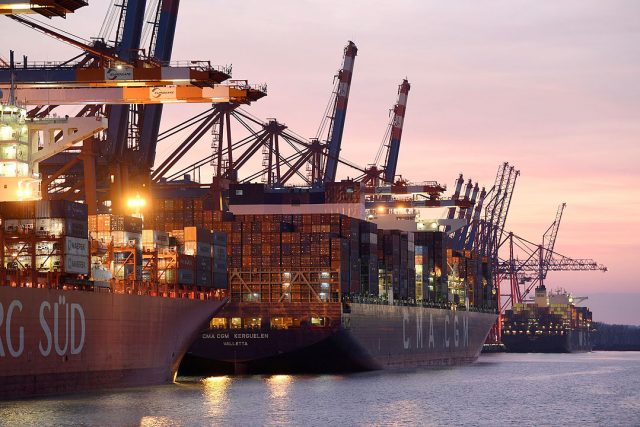
FROM SEAFARERS refusing to get back on ships to truck drivers whose concern over COVID-related border closures trumps the lure of higher pay, the transport industry is bracing for another roller coaster year of supply-chain disruptions.

As Omicron infections surge and governments tighten restrictions, logistics companies around the world, from global giants to small businesses, can’t find enough staff. According to the International Road Transport Union, around one-fifth of all professional truck driving jobs are unfilled, despite many employers offering increased wages. Some pockets of shipping are also sounding the warning bell about future hiring prospects.

“2022 is shaping up to be another year of severe disruption, under supply and extreme cost for cargo owners,” said Simon Heaney, an analyst at maritime research consultancy Drewry. “The virus is once again showing it’s in charge,” he said, predicting another 12 months of stretched labor and healthcare-related red tape.

As the mutated Omicron variant takes hold, workers who deliver goods on ships and trucks are shouldering the brunt of a supply chain infrastructure still mired in chaos. Faced with long weeks of quarantine combined with the precarious nature of crossing borders and fears of getting sick, some people are refusing contracts while others are looking for work elsewhere, companies say.

In Romania, many truck drivers don’t want to accept long-haul jobs into other parts of Europe, stung by last year’s 48-kilometer traffic jams and waits of up to 18 hours at EU borders. Countries where infections are surging are particularly problematic, according to Alex Constantinescu, CEO of Alex International Transport 94 SRL, which operates 130 trucks that deliver pharmaceutical and food products throughout the continent.

Already faced with a driver shortage before the pandemic, the trucking industry’s labor crisis has become more acute, he said. The company has had to raise wages by about 30% over the past three years.

QUARANTINE CONCERNS
“Long hours on the road, sleeping in the cab and now not knowing if the people you interact with have the virus — truck driving isn’t very attractive anymore,” said Mr. Constantinescu, who founded the company 27 years ago. “I look behind me and I can’t see any new generation of drivers. The pandemic has made this work very unattractive.”

In the UK, the ranks of heavy goods vehicle drivers slumped by 23%, or around 72,000 people, in the second quarter compared to 2019, data from Logistics UK show. In China, it’s the fear of draconian quarantines due to the government’s COVID-zero strategy keeping drivers away. Just last week the entire western city of Xi’an, population 13 million, went into a snap lockdown after 127 cases.

“China has very strict policy measures to control flare ups and that’s making truck drivers unwilling to go to some areas where they might be quarantined,” said Salmon Aidan Lee, head of polyesters at energy consultancy Wood Mackenzie. “These harsh measures have further contributed to supply chain issues, and some polyester factories have had to shut.”

The shipping industry is facing similar labor challenges.

While the crew-change crisis that prevented seafarers from getting home and being replaced with fresh mariners has mostly eased — fewer than 5% of seafarers were onboard ships beyond the expiry of their contracts in mid-November, a drop from 9% in mid-July, according to The Neptune Declaration Crew Change Indicator — now companies can’t entice them back.

Western Shipping Pte Ltd., a Singapore-based tanker operator, said about 20% of its some 1,000 mariners don’t want to get back onto ships. Around 5% of Anglo-Eastern Univan Group’s 30,000 mariners had indicated as of last month they aren’t interested in a new contract.

Western Shipping is having to hire seafarers from other companies and offer them good bonuses to boot, according to Managing Director Belal Ahmed, who also chairs the International Maritime Employers’ Council.

Some of those delaying going back to sea are senior crew members, such as officers with experience and tenure, said Bjorn Hojgaard, chief executive officer of ship manager Anglo-Eastern Univan.

“Even before COVID it was hard to get the right person with the right experience and training on a ship,” said Mr. Hojgaard, who is also chairman of the Hong Kong Shipowners Association. “Today, we have to compromise. That worries me we’re not doing anything good for the safety of ships.”

The shortage may worsen as shipowners and charterers request only vaccinated crew be hired. And with Omicron requiring more booster shots, the dearth is intensifying. Less than 30% of seafarers from India and the Philippines, among the top countries providing mariners, were fully inoculated as of mid-November, according to the Neptune Declaration indicator.

“We can’t dictate that seafarers take the vaccination but customers are stating they’ll only use fully vaccinated crew,” Columbia Shipmanagement Ltd. Chief Executive Officer Mark O’Neil said. “It’s been a challenge keeping these huge cargo ships moving.”

Wilhelmsen Ship Management, which manages a pool of around 10,000 mariners, is troubled by the trend of junior officers refusing contracts, even though it hasn’t affected the company’s overall crew-retention rate yet, CEO Carl Schou said. Still, the pipeline of future officers, who require years of training, could be disrupted.

“What happens then is you bring in people who aren’t qualified, you get them through a shorter training and promote them to roles that require more experience,” Ahmed said. “That could lead to more serious incidents and accidents on ships, groundings, even pollution. I‘m afraid we’re heading toward a disaster.” — Bloomberg


World hits record daily COVID cases as Omicron variant mars Christmas

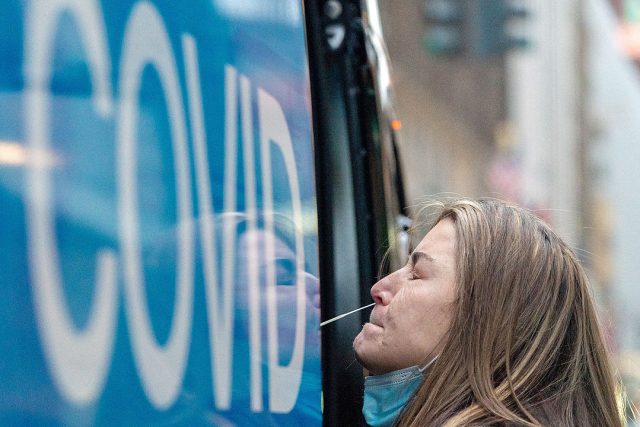
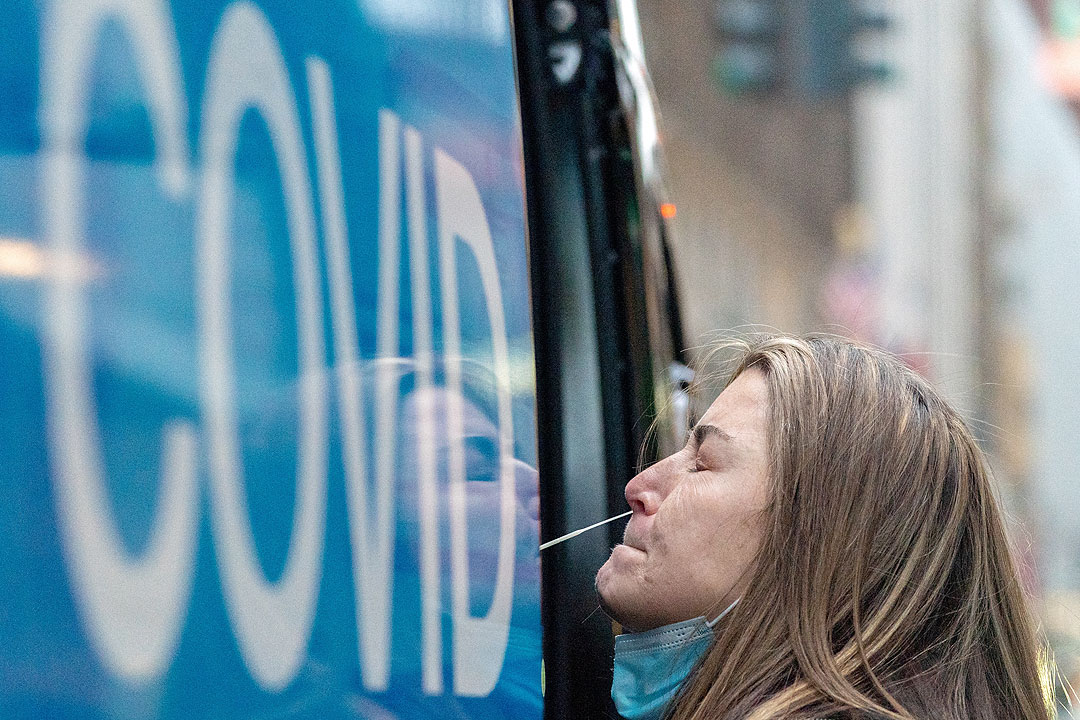
A woman takes a coronavirus disease test at a pop-up testing site as the Omicron coronavirus variant continues to spread in Manhattan, New York City, U.S., Dec. 27, 2021. — REUTERS
A woman takes a coronavirus disease test at a pop-up testing site as the Omicron coronavirus variant continues to spread in Manhattan, New York City, U.S., Dec. 27, 2021. — REUTERS/JEENAH MOON

GLOBAL COVID-19 cases hit a daily record on Monday, disrupting the holiday season a year after vaccines first started rolling out and two years after the emergence of the virus that many hoped would be fleeting.

The more than 1.44 million worldwide infections smashed the prior record after factoring out a day in Dec. 2020 when Turkey backdated a significant number of cases. A more conservative gauge — the seven-day rolling average that smooths out one-time fluctuations and holiday reporting irregularities — is also at a record level, thanks to a tidal wave of Omicron infections.

The highly-mutated and most transmissible variant yet, Omicron is fast becoming the dominant strain globally as it evades immunity normally provided by vaccines and previous infections. The seven-day rolling average of cases on Monday stood at about 841,000, a jump of 49% from a month ago when Omicron was first identified in southern Africa.

Studies suggest that although Omicron infects 70 times faster than previous strains, the illness it causes may not be as severe, especially for people who have been vaccinated and received a booster shot. The ease of transmission and soaring number of cases could still squeeze hospital capacity worldwide, leaving the unvaccinated and anyone who needs medical care for other conditions in the lurch.

Governments already are warning that infections and hospitalization may soar following the holidays, setting a grim tone as the world heads into the third year of the pandemic.

STEADY DEATHS
The silver lining is that daily Covid deaths haven’t significantly increased. The seven-day rolling average of deaths has hovered at about 7,000 since mid-October after falling from a delta-driven peak, despite the emergence of Omicron.

The outlook heading into 2022 depends on whether the death toll follows cases and surges higher in the days to come, or if the Omicron wave proves mild as more real-world data emerges. While deaths tend to lag infection rates by a few weeks, early indications from southern Africa and other locations where Omicron has been circulating suggest some decoupling of the measures.

Better pandemic tools may explain some of the rise in case counts. More infections are being found during this Omicron wave thanks to improved contact tracing and testing capabilities in the worldwide fight against the pathogen.

The record case counts are increasing pressure on public health officials to reassess their COVID control policies. The US cut the recommended isolation time for people who test positive for COVID-19, allowing them to return to work sooner and potentially helping reduce widespread disruptions that could close schools or snarl supply chains.

The arrival of Omicron broadly halted the march toward normalization that characterized much of 2021. A reluctance to return to pre-vaccine lockdowns and other COVID curbs may be allowing the virus to spread more widely, though it’s also giving some people a more traditional holiday season with family and friends after a dismal 2020 before vaccines were widely available. — Bloomberg

Bird flu kills thousands of cranes in Israel’s worst wildlife disaster

JERUSALEM — An outbreak of avian flu has killed more than 5,000 migratory cranes in Israel, prompting authorities to declare a popular nature reserve off-limits to visitors and warn of a possible egg shortage as local poultry are culled as a precaution.

“This is the worst blow to wildlife in the country’s history,” Environment Minister Tamar Zandberg tweeted as rangers in hazardous material suits collected carcasses of cranes from the lake of northern Hula Nature Reserve and outlying marshes.

Hundreds of thousands of chickens had been culled, she said.

Israeli media said children who had visited the reserve may have touched a stricken crane and thus contributed to the spread of the flu. Authorities were looking to import eggs from abroad and head off an egg shortage due to the cull, the reports said. — Reuters

Dolphins run winning streak to seven by dominating Saints

THE visiting Miami Dolphins — led by a dominant defense — won their seventh straight game, defeating the short-handed New Orleans Saints (20-3) on Monday night.

Miami (8-7) got a 28-yard pick-six from Nik Needham, a one-yard flip from Tua Tagovailoa to Jaylen Waddle and a pair of Jason Sanders field goals.

The Dolphins’ winning streak is the second-longest active run in the National Football League (NFL), trailing only the Kansas City Chiefs.

Miami’s defense had its first eight-sack game since 2012.

New Orleans (7-8) was without 22 players due to coronavirus disease 2019 (COVID-19) protocols. Quarterback Ian Book made his NFL debut and struggled against Miami’s blitzing defense. He threw two interceptions and completed 12-of-20 passes for 135 yards.

As has been the case all year, Tagovailoa threw mostly safe passes, going 19-of-26 for 198 yards with one interception and the one touchdown.

Waddle caught 10 passes for 92 yards. For the season, he has 96 catches for 941 yards, breaking Chris Chambers’ Dolphins rookie record for receiving yards. Chambers had 883 yards in 2001.

Book’s second career NFL pass resulted in a Dolphins touchdown. Andrew Van Ginkel deflected the pass at the line of scrimmage, and Needham turned it into an easy 28-yard interception return and a 7-0 Miami lead.

On its second possession, Miami extended its lead to 10-0 on Sanders’ 48-yard field goal. Miami was fortunate to get those three points because — on the previous play — Marcus Davenport strip-sacked Tagovailoa. However, Dolphins offensive lineman Liam Eichenberg recovered the fumble.

New Orleans got on the board with 2:45 left in the first half, mounting an eight-play, 55-yard drive that led to Brett Maher’s 38-yard field goal. Miami led 10-3 at half time.

With 5:10 left in the third quarter, Miami’s offense became the first to reach the end zone. It went down as a 1-yard scoring pass, but it was actually an end-around flip to Waddle, who cut back inside to increase Miami’s lead to 17-3.

That touchdown was set up by a huge third-and-nine play as Tagovailoa lofted a 40-yard pass to Mack Hollins, who made the catch despite apparent defensive interference. Later in the drive, the Dolphins converted a third-and-two due to a roughing-the-passer penalty.

Sanders’ 34-yard field goal with 12:05 left in the fourth gave Miami a 20-3 advantage. — Reuters

Ja Morant’s late basket helps Grizzlies edge Suns

MEMPHIS Grizzlies guard Ja Morant (12) shoots the ball over Phoenix Suns forward Mikal Bridges (25) during the second half at Footprint Center. — REUTERS

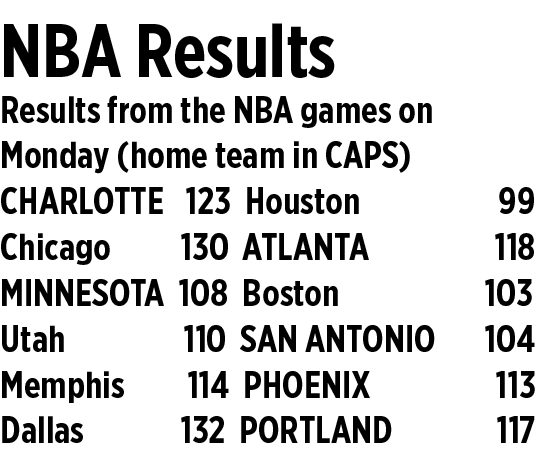
JA MORANT scored 33 points, including a layup with 0.5 second remaining, and Desmond Bane scored a career-high 32 points as the visiting Memphis Grizzlies withstood a fourth-quarter rally by the Phoenix Suns for a 114-113 win on Monday night.

Steven Adams had 13 points and 16 rebounds, and Jaren Jackson, Jr. added 11 points for the Grizzlies, who led by as many as 18 late in the third quarter before holding on for their second straight win.

Devin Booker scored 30 points and hit a 3-pointer to put the Suns ahead 113-112 with 5.1 seconds left. After Morant scored on a driving layup, Mikal Bridges missed a baseline jumper at the buzzer.

Cameron Johnson scored 19 points for the Suns while Cameron Payne added 15. Jalen Smith had a career-high 15 points, Chris Paul tallied 13 points and 13 assists, and Bridges scored 10 points.

Phoenix, whose 15-game home winning streak ended with Saturday’s 116-107 loss to the Golden State Warriors, dropped back-to-back games for just the second time this season.

The Suns were without starters Deandre Ayton and Jae Crowder, who are both in the league’s health and safety protocols.

Phoenix trailed 89-75 at the start of the fourth quarter before opening the final period on an 18-7 run.

Bane scored with 54 seconds left to put the Grizzlies ahead by five before Bridges scored with 32 seconds to play to pull the Suns within 112-110.

Memphis jumped to a 17-6 lead before Phoenix rallied to cut the deficit to 25-24 going into the second quarter.

Bane scored 19 points in the first half for Memphis, which took a 60-48 lead into the break after closing the period on a 19-8 run.

The Grizzlies shot 52.2% from the field in the first half and held Phoenix to 38.6%, including 3-of-14 on 3-pointers.

Morant scored 15 points in the third quarter for Memphis, which extended its lead to 18 with 1:44 left in the period. The Grizzlies played without De’Anthony Melton and Dillon Brooks, who are both in the league’s protocols.

Phoenix won 119-94 in the first meeting between the teams in Memphis on Nov. 12. — Reuters

Cavani salvages point for Man United at Newcastle

NEWCASTLE — Substitute Edinson Cavani scored in the second half to help Manchester United salvage a 1-1 draw at struggling Newcastle United in the Premier League on Monday.

The result stretched Manchester United interim manager Ralf Rangnick’s unbeaten start to four games in all competitions but the German will hardly be pleased by a toothless performance with goalkeeper David De Gea rescuing the visitors.

Cavani netted an opportunist 71st-minute equalizer after Allan Saint-Maximin gave the home side a seventh-minute lead with a fine individual effort, side-stepping two markers before he fired past De Gea.

The result left United seventh in the standings on 28 points from 17 games, behind sixth-placed West Ham on goal difference. Newcastle stayed 19th on 11 points from 19 matches.

Saint-Maximin, who tormented United’s shaky defense all evening, beat De Gea with an off-balance shot as he weaved his way into the penalty area.

The visiting goalkeeper kept a lethargic Manchester United afloat with an array of good saves as Newcastle always looked dangerous on the break, with home striker Callum Wilson having a goal ruled out for offside in the 38th minute.

Saint-Maximin spurned a sitter early in the second half with a scuffed shot from five meters and De Gea made two stops in quick succession, keeping out the Frenchman’s low drive before he blocked Jacob Murphy’s close-range effort.

The home side was punished for their misses as Cavani squeezed a snap shot past keeper Martin Dubravka at the second attempt after his initial shot was blocked following a Diogo Dalot cross from the right.

United barely survived a late Newcastle onslaught as Murphy hit the post and De Gea clawed Miguel Almiron’s shot on the rebound out of the top corner. — Reuters

Klopp pessimistic on Premier League clubs agreeing to five substitutions

LIVERPOOL manager Jürgen Klopp reiterated the need for five substitutions in the Premier League to protect players amid a demanding schedule and rising coronavirus disease 2019 (COVID-19) cases but conceded he did not see all clubs agreeing to make a change.

Top flight leagues in Europe adopted the rule to increase the number of substitutions per game to five to ease the workload on players amid the COVID-19 pandemic, but Premier League clubs voted against the motion.

Fifteen Premier League games have already been postponed this month due to coronavirus outbreaks leading to a fixture pile-up, while a lack of available players has forced those who recovered from COVID-19 to play more minutes.

The Premier League had a record 103 COVID-19 cases in the past week.

“You need 14 votes to change it — there’s something wrong. As an example, I’m not sure how many Burnley players play international football. When our players have three games, they have no game,” Klopp told reporters on Monday.

“We are talking about an issue that some clubs and some players definitely have, but it’s decided by other teams. Because we make a competition of it, they say no. That’s a real problem.

“The best league in the world, the most intense league in the world, is the only league with still three subs. That’s not right, we should change it (but) I don’t see a real chance to change it, to be honest.”

Brentford manager Thomas Frank also called for the introduction of five substitutions.

“I completely agree that we need five subs. I know I’m (part of) one of the clubs with the lowest budget and probably the thinnest squad, but I still think that will help all of us,” Frank said.

Watford manager Claudio Ranieri said on Monday he had his first “normal training session” since Dec. 10 and agreed five substitutions was the “right solution.”

“In Italy, I was the first to speak about five changes because it’s very important you don’t push the players’ fitness too much,” Ranieri said.

“If they don’t train and then they have to play — we are playing now every three days — how is it possible to keep players on the pitch for 90 minutes and I can change only three players?”

Both Manchester United interim manager Ralf Rangnick and Manchester City boss Pep Guardiola had called for five substitutions last week.

However, Tottenham Hotspur manager Antonio Conte said airing their views in a meeting with the league last week was like talking to a wall. — Reuters

ADVERTISEMENT
ADVERTISEMENT