Home Blog Page 7046

Why the drive-in motel is safe by design for quarantine
VICTORIA COURT

MOTELS have always been the go-to place for travelers who need somewhere to sleep for a night or anyone who seeks privacy in those very special cases, and the Philippines is no different. However, with the coronavirus disease 2019 (COVID-19) pandemic putting tourism and mobility in general on hold, motels and other types of accommodations moved to reorganize their operations.

In the Philippines, 78% of tourism-related businesses temporarily stopped offering a product or service due to restrictions in domestic and international travels, while 68% suspended operations due to the lack of demand. Many players in the accommodations subsector also mostly cut operations and employee headcount, slashed costs, and prepared a business continuity plan.

With accommodations mainly relying on tourism and travel, it became one of the hardest hit subsectors during the pandemic. But not all shut down or reduced operations and manpower; others moved to find a new purpose — they have proven useful as quarantine facilities.

Many, if not all, countries around the world have partnered with different public accommodations to house essential travelers. In the UK, people who have visited or passed “red list” locations are required to stay in government-approved quarantine hotels for 10 days. The same goes for South Korea, where the pandemic response has been deemed impressive over the past year, except asymptomatic travelers are required to stay in quarantine hotels for 14 days.

While these hotels serve their new purpose, they are still considered public spaces that pose risks to human health in the age of COVID-19. Since hotels have common areas such as the lobby, hallways, and elevators, people may likely run into others who are potentially infectious. Hotels also cater to more people in one building. The spread of highly infectious new COVID-19 strains now begs the question: Are hotels really appropriate places for quarantine?

For a safer and cleaner alternative, governments, organizations, and even individual travelers should look at drive-in motels, hopefully past their reputation as a place for a “quick” getaway. Of course, drive-in motels are structurally different compared to walk-up motels, which have more common areas like lobbies, corridors, and more. Here, guests can simply park their cars either in an open lot in front of the establishment or in designated garages and head straight to their rooms.

Since most drive-in motels have an average of two floors, guests can take the stairs when going to or leaving their units. Even health experts like Dr. John Carlo, CEO of Prism Health North Texas, believe that a motel room that exits directly outside, uses its own ventilation, and does not require the use of an elevator or common space pose lower risks than a multi-floor hotel full of other guests.

A number of drive-in motels in the Philippines have already been converted as quarantine facilities by the government. We, at Victoria Court, for instance, are already operating as such while still giving our guests five-star treatment.

Prior to staying in our rooms, guests are offered contactless methods for booking, payment, and room management. Once they’re set, they can simply drive to the motel and park their vehicle in the garage just below their designated room. This has been our structure even before the pandemic because we wouldn’t want our guests to run into people they know.

We have no common areas like the lobby or reception area, swimming pool, restaurants, and bars. Guests also have no need to use an elevator, where possible transmissions may occur.

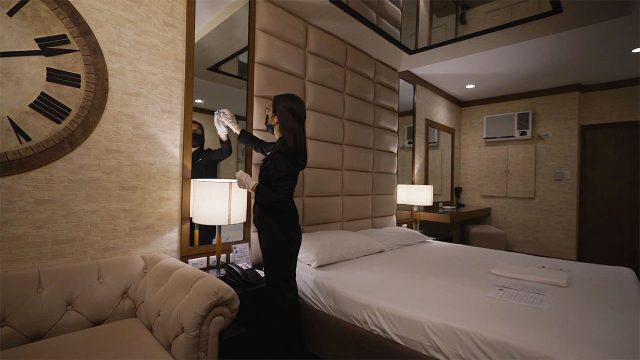
All of our units also each have an anteroom, which separates the primary rooms from areas that may be accessed by other people. If guests are worried about how they’ll get their food, our staff can leave their orders in the anteroom so they won’t have to interact with each other. If they’re also worried about the ventilation in their room, our units are each equipped with window-type aircons, eliminating the chances of particles to circulate in shared air vents.

The lack of common areas aligns with our goal of providing guests with complete privacy. By design, Victoria Court is built on people being able to come in, enjoy, and leave, all with the hush-hush implied by our logo. Many Filipinos are familiar with this discretion (though, of course, would shy away from admitting it). But it’s this respect for privacy today that fits well into requirements for isolation and safety. Our staff are also trained to minimize interaction with guests since privacy and discretion have been our core product since the 1980s.

Once guests leave, we then fulfill our promise of quality and safety by following stringent cleaning rules. Our staff have been retrained to use medical-grade cleaning solutions and UV-C disinfection systems to sanitize all our rooms. We also hired staff members who are equipped to conduct black light spot quality inspection — an extra step that some accommodations don’t always do — to detect traces of bacteria undetectable to the naked eye.

Duty managers prepare a room beforehand by marking frequently-touched surfaces with an invisible ink marker. Hotel stewards don’t know where these markings are placed so that they will tend to thoroughly clean the room, paying special attention to critical areas taught to them in training. Duty managers then check afterwards if the surfaces they marked have been cleaned. This step is important considering that COVID-19 is an invisible enemy we cannot fight in simple ways, so simulating it using black light helps us keep our rooms clean and virus-free.

We have been certified under ISO 9002 and 9001:2008 standards, assuring our guests that we are a world-class establishment that’s cleaner than most hotels. We’ve worked to achieve this perception of our brand since motels gained a certain reputation when it comes to sanitation.

As COVID-19 cases continue to increase in the country, hospitals will continue to feel the burden of the pandemic. The government should increase the number of drive-in motels that can serve as safer and cleaner quarantine facilities. Individuals seeking privacy during these times can also rely on drive-in motels to meet their needs without risking their health and comfort. As mental health can be an issue, at least here people can quarantine in themed rooms inspired by Greek islands, popular films, and even K-dramas, which is sure to bring a tongue-in-cheek smile to anyone’s face.

In the age of COVID-19, it definitely pays to take every precaution possible to assure our safety. As Filipinos, we should use our unique trait of resourcefulness or diskarte to look for solutions in unexpected places during the pandemic. In our case, it’s using drive-in motels as quarantine facilities past their pre-pandemic reputation. The structure of drive-in motels fulfills their promise of safety, cleanliness, and more importantly, privacy.

Being resourceful has helped every one of us get through our own problems before, and together, we can use that unique trait to save others today.


Atticus King is the owner and CEO of Victoria Court Group, a family-owned business that is a forerunner in the drive-in motel industry. Mr. King and his wife Kim also co-founded Kim King’s Kitchen, a pioneer in promoting the bone broth lifestyle in the Philippines. Finally, Mr. King is also a serial entrepreneur with investments in various industries.


Phoenix, Grab to reward cashless payments

PHOENIXFUELS.PH

INDEPENDENT oil firm Phoenix Petroleum Philippines, Inc. is partnering up with Grab’s mobile wallet service to launch a fuel cashback program for consumers and motorists who pay through cashless transactions.

In an emailed statement on Monday, the Dennis A. Uy-led firm said it will offer P50 worth of cashback credits for every P500 worth of Phoenix fuels paid via GrabPay.

“Apart from the cashback, Cebu and Davao motorists will also get an additional P130 Grab promo code for every P200 worth of Phoenix transaction paid using GrabPay. The promo code can be used to avail exciting discounts on GrabFood and other available Grab services in Cebu and Davao,” the firm said.

The campaign, which will last until Oct. 31, will cover 273 of the firm’s gas stations nationwide. The program includes 58 participating stations in Metro Manila, 124 for the rest of Luzon, 37 in Visayas and 54 in Mindanao.

Phoenix President and Chief Executive Officer Henry Albert R. Fadullon said Grabpay is one of the e-payment options accepted by the company’s gas stations.

“Since last year, we have been firm about our thrust for safer and secure transactions in our stations, hence we have been offering contactless options to our customers,” he added.

Meanwhile, Grab Financial Group Philippines said its partnership with Phoenix shows its commitment to provide consumers with a safe, convenient and rewarding payment solution.

“We hope that through this partnership, we continue to meaningfully grow an inclusive cashless society, and build a stronger and more resilient digital-first economy,” Grab Financial Group Country Head Martha A. Borja said.

In June 2020, Phoenix began offering contactless payment solutions in its stations to help curb the spread of the coronavirus disease infections.

Earlier, the oil firm reported that had it cornered a higher market share of 8.3% in the domestic petroleum market in the six months ending June, from its share of 7.1% as of end-2020, cementing its position as the third largest oil player in the Philippines.

Phoenix shares at the local bourse inched up 10 centavos or 0.84% to finish at P12.06 apiece on Monday. — Angelica Y. Yang

Entertainment News (09/28/21)

Coldplay and BTS single out

COLDPLAY has released the much-anticipated collaboration with BTS, “My Universe,” which was written by Coldplay and BTS and produced by Max Martin. The song is now available worldwide to stream or download. The song’s official lyric video features handwritten lyrics from both groups, in both English and Korean. Coldplay has also teased the song’s Dave Meyers-directed official music video, as “coming very soon.” “My Universe” follows Coldplay’s worldwide hit “Higher Power” as the second single to be taken from the band’s forthcoming album Music of The Spheres (to be released on Oct. 15).

Alessandra de Rossi launches AWOOO records

FRESH from the success of her directorial debut My Amanda in July, actress Alessandra de Rossi is now setting her sights on music, launching her record label AWOOO Records. “I think [Filipinos] really stand a chance in changing how the world looks and sounds,” Ms. De Rossi said in a statement. “All we need is to offer something pure, peculiar, and distinct. I think we can make it, too!” AWOOO, which stands for “a world of our own,” is a sublabel of Lilystars Records headed by Clem Castro who serves as partner and de facto adviser. AWOOO also launched its first two artists: Fil-German San Carlos City chanteuse Hya, and the SoCal-based singer-songwriter Alfa. The former was a talent-show champion who previously made the rounds at Rising Stars Philippines, Just Duet, and The Will to Win before landing a spot in Bangon Talentadong Pinoy where Ms. De Rossi was judge. Hya’s debut single, “Raindrops,” is arranged and co-produced with Nick Lazaro for La Balls Studio, has already been released. Meanwhile, Alfa will be releasing three albums and an EP soon.

To Have and to Hold premieres on GMA Telebabad

GMA Entertainment Group presents a story of marriage and love that know no bounds in To Have and to Hold, starring Carla Abellana, Rocco Nacino, Max Collins, and Rafael Rosell. Directed by Don Michael Perez, the series follows Dominique and Gavin, a long-married couple on the brink of separation. After an unexpected turn of events, Gavin finds himself unraveling a web of lies and deceit with a woman named Erica whose husband shares an untold connection with Dominique.  To Have and to Hold premieres on Sept. 27 after Legal Wives on GMA Telebabad.

Def Jam PHL releases single from new EP compilation

RECORD label Def Jam Philippines brings together top rap acts in “Puso at Diskarte,” the first single of the label’s second compilation EP, Rhapsodicity. In the track are veteran and rising Filipino hip-hop artists such as Astro of Owfuck, Zargon, Honcho of Ex-battalion, Dcoy (Wakin Burdado) of Madd Poets, Mike Kosa of 187 Mobstaz, and Pricetagg and Layzie Fu of 4 East Flava. Produced by Cursebox, the track delivers show-stopping verses and beats that blur the boundaries between gangsta rap and contemporary urban music. “Puso at Diskarte” is the first track off Def Jam Philippines’ collaborative EP, Rhapsodicity, which is touted as a “lyrical EP.” The upcoming compilation will also feature the tracks “Lahing Maangas,” “Diversity,” “Lakbay,” and “Epic.”  Puso at Diskarte” is available to stream on Spotify.   

Show tackles gay love triangle

LIMITED EDITION is a romantic drama about finding one’s elusive and everlasting love with a love triangle story arc between three gentlemen. It stars Jomari Angeles, Andrew Gan, and Ron Angeles. Director Jill Singson Urdaneta says: “The process of love and loving, of being loved and in love, everyone who will give us their time and support, they will witness it in… this drama about romantic connections and everlasting possibilities.” Also in the cast are Donna Cariaga, Michelle Jhoie Ferraris, Yayo Aguila, and Ruby Ruiz. Limited Edition starts airing on Oct. 2, 8 p.m., on online channel BRAGAIS TV.

Netflix fan event on YouTube

THOSE who missed the streaming of TUDUM, Netflix’s virtual Global Fan Event, can now watch the three-hour program on Netflix Philippines’ YouTube account. TUDUM included announcements about returning shows and previews of new titles coming up. For the hardcore animé fans, N-ko, Netflix’s official animé VTuber, showcased the upcoming lineup on Netflix. The shows include Bright: Samurai Soul, a fantasy adventure set in the time between the fall of the Shogunate and the rise of the Meiji era, which premieres on Oct. 12; Super Crooks, an animé adaptation from comic book legend Mark Millar, is heist story about eight super-villains told in 13 30-minute episodes, which premieres on Nov. 25; and Aggretsuko: Season 4, which premieres in December. Coming in 2022 are animé series Drifting Home and ULTRAMAN Season 2. Viewers will have a lot of fresh, new Korean content to look forward to including series, films, variety programs, and a dating reality show. These include the crime drama My Name (Oct. 15); supernatural series Hellbound which received acclaim at the 46th Toronto International Film Festival (November); and sci-fi show The Silent Sea (December). Coming next year are Juvenile Justice (January); zombie show All of Us Are Dead, based on the Korean webtoon Now at Our School (January); and the romantic film Moral Sense (February). There are also unscripted Korean reality shows including talk show Paik’s Spirit (Oct. 1), variety show New World (November), motorbike road trip adventure The Hungry and the Hairy (December); and dating show Single’s Inferno (December). Netflix also has a line-up of star-studded blockbusters including Army of Thieves, a prequel to Zack Snyder’s Army of the Dead (Oct. 29); the animated series Arcane, which brings the League of Legends franchise to television (Nov. 6); the Dwayne Johnson starrer Red Notice (Nov. 12); sci-fi-cowboy mashup Cowboy Bebop (Nov. 19); disaster film Don’t Look Up (Dec. 24); and The Sandman, a Netflix series based on the groundbreaking comic book series created for DC by Neil Gaiman (coming soon). Also coming soon are the Chris Hemsworth starrer Extraction 2 and the second season of Enola Holmes. The global hit Tiger King will return to Netflix for more madness and mayhem on Nov. 17. Coming soon is the documentary on Kanye West, Jeen-Yuhs. New seasons of fan favorite shows are also in the line-up: The Witcher (Dec. 17), season 2 of Emily in Paris (Dec. 22), and season 4 of Cobra Kai (Dec. 31). Coming soon are the prequel series The Witcher: Blood Origin, season 2 of Bridgerton, and season 4 of Stranger Things. For more information, visit tudum.com.

Gov’t upsizes T-bills volume as rates go down

BW FILE PHOTO
NATIONAL Treasurer Rosalia V. de Leon: “Liquidity [is] very much around, [coupled with] P22 billion in maturities this week. Placements remain in short tenor buckets.” — BW FILE PHOTO

THE GOVERNMENT upsized the volume of Treasury bills (T-bills) it awarded on Monday as rates declined across the board on high demand for the safe assets amid lingering inflationary concerns.

The Bureau of the Treasury (BTr) borrowed P17 billion via the T-bills on Monday, bigger than the initial plan to raise just P15 billion as total tenders reached P63.865 billion.

The auction was more than four times oversubscribed but the demand was smaller than the overall bids worth P72.5 billion seen in the previous offering last week.

Broken down, the BTr raised P5 billion as planned in 91-day debt papers from P17.24 billion in tenders. The average rate of the three-month debt went down by one basis point (bp) to 1.06% from 1.07%, previously.

It also raised P5 billion as planned in 182-day T-bills as the tenor attracted bids worth P21.505 billion. The six-month debt fetched an average rate of 1.385%, down by 0.4 bp from 1.389% a week ago.

Lastly, the government borrowed P7 billion via the 364-day securities, upsizing from the programmed P5 billion as tenders hit P25.12 billion. The average yield on the one-year bond also fell by 1.5 bps to 1.582% from 1.597 bps.

“Liquidity [is] very much around, [coupled with] P22 billion in maturities this week. Placements remain in short tenor buckets,” National Treasurer Rosalia V. de Leon told reporters in a Viber message on Monday.

A bond trader said rates fell within market expectations after the Bangko Sentral ng Pilipinas (BSP) maintained its key policy rates at the current record low.

The BSP kept benchmark interest rates unchanged at 2% during its policy meeting last Thursday as widely expected, citing the need to support a fragile economic recovery.

Rates fell as strong demand on the bills prevailed, according to the trader who said investors preferred safer short-term assets over long-dated bonds due to lingering inflationary concerns.

The BSP last week raised its inflation outlook for the year to 4.4% from 4.1% previously as supply issues continue to push food prices higher. This is beyond the 2-4% target of the central bank for 2021.

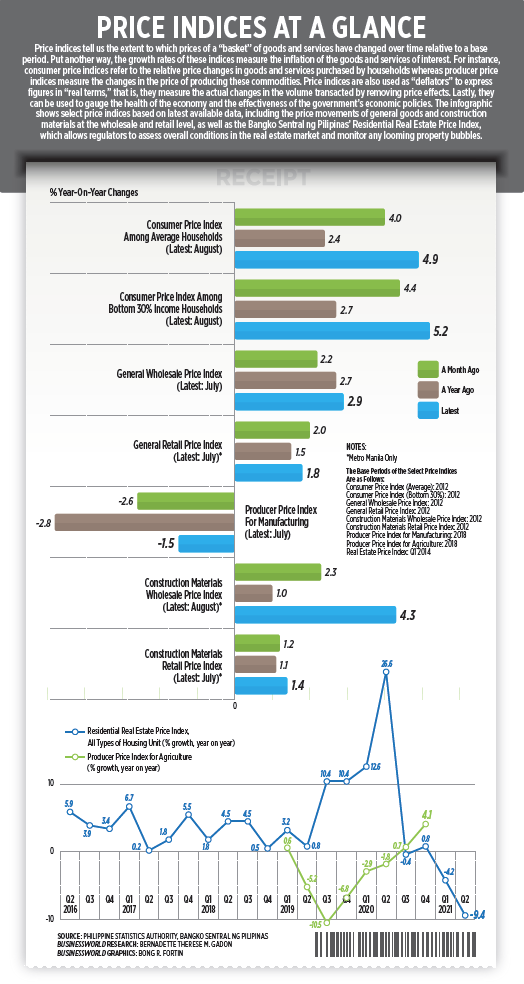
Headline inflation quickened to 4.9% in August from 4% in July, its fastest pace in more than two years, to bring the eight-month average to 4.4%, which is above the central bank’s target.

The BTr made a full award of the T-bills it offered last week as rates dipped across the board and total bids went up to P72.5 billion from P63.27 billion the week prior.

On Tuesday, the BTr will also auction off P35 billion in reissued 10-year Treasury bonds (T-bonds) with a remaining life of nine years and nine months.

The Treasury is looking to raise P250 billion from the local market this month: P75 billion via weekly offers of T-bills and P175 billion from weekly auctions of T-bonds.

The government wants to borrow P3 trillion from domestic and external sources this year to help fund a budget deficit seen to hit 9.3% of gross domestic product. — Beatrice M. Laforga

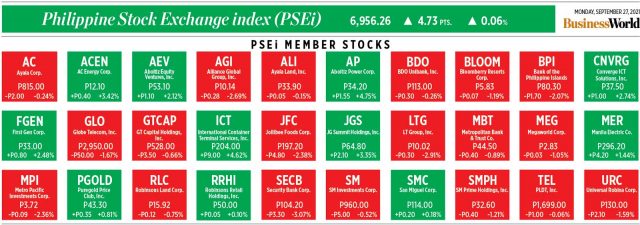
How PSEi member stocks performed — September 27, 2021

Here’s a quick glance at how PSEi stocks fared on Monday, September 27, 2021.


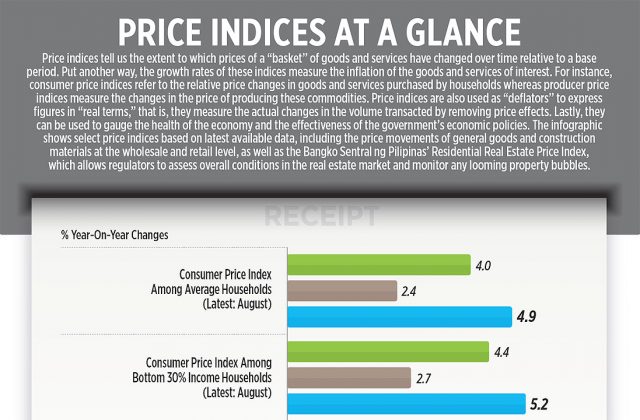
Price indices at a glance

Price indices at a glance

Philippines, Australia hold military exercises at sea

NIKITABUIDA-FREEPIK

PHILIPPINE Navy troops held sea drills with their Australian counterparts at the weekend supposedly to boost security in the Indo-Pacific region.

In a statement on Monday, the Philippine Navy said its missile-frigate and two royal Australian navy vessels had participated in the drills. It didn’t say where these took place.

The ships sailed together to Manila on Sunday morning after the Sept. 25 exercises, the Australian Embassy in Manila said in a separate statement.

“The exercise focused on high-end training and interoperability that will benefit both nations in increased maritime domain awareness and force generation,” it added.

The Aussie ships and a fleet replenishment vessel docked in Manila on Sunday for a three-day port visit as part of a regional activity that engages Southeast Asian countries.

The drills showed the “increasing mutual trust and cooperation between the Australian Defense Force and the Armed Forces of the Philippines,” Australian Ambassador to the Philippines Steven J. Robinson said in the statement.

“It is part of our robust and longstanding engagement with the Philippines to promote a secure, open, prosperous, and resilient region,” he added.

Last week, Foreign Affairs Secretary Teodoro L. Locsin, Jr. said the Philippines was backing a defense pact that allows Australia to build nuclear-powered submarines using technology that the US had only previously shared with Britain, saying it could keep the balance of power in the Indo-Pacific region.

His view differs from that of neighboring Indonesia and Malaysia, which warned that the alliance could provoke a nuclear arms race in the region. Singapore was more neutral, saying it hoped the deal “would contribute constructively to the peace and stability of the region and complement the regional architecture.”

China, the unspoken target of Washington’s latest effort to boost its influence in the region, criticized the agreement.

Chinese Foreign Ministry spokesman Zhao Lijian has said the pact seriously undermined regional peace and stability, exacerbated the arms race and undermined international nuclear nonproliferation efforts.

He also said any regional alliance “should not target or harm the interests of third parties.”

Mr. Locsin noted that without the actual presence of nuclear weapons, the military alliance does not violate a 1995 treaty to keep nuclear arms out of Southeast Asia.

But presidential spokesman Herminio L. Roque, Jr. said the Constitution “provides for a nuclear-free Philippines and we are also party to the ASEAN-Bangkok accord providing for a nuclear-free Southeast Asia.”

“The immediate concern of the Philippines is to ensure that… its treaty providing for a nuclear-free Southeast Asia will not be violated,” he told a televised news briefing on Monday.

The South China Sea is a prominent shipping passage with $5.3 trillion worth of trade cruising through its waters every year. That’s nearly a third of all global sea trade.

It remains a source of tension as the US, one of the Philippines’ oldest allies, and other Western countries hold so-called freedom of navigation operations to keep China, which claims more than 80% of the sea, at bay.

In July, China warned the UK Carrier Strike Group, led by the aircraft carrier HMS Queen Elizabeth, not to commit “improper acts” as it entered the South China Sea. China claims more than 80% of the waterway.

President Rodrigo R. Duterte, who has sought closer and investment ties with China since he became President in 2016, has said the Philippines could not afford war with China, adding that the sea dispute should be resolved peacefully.

Mr. Locsin said Australia’s ability to project power should restore and keep the balance of power rather than destabilize it.

He also noted that despite advances in military science, time, distance and water remain major constants in determining security capacity to respond to threats.

The trilateral military alliance had incensed France, which felt its Indo-Pacific interests had been torpedoed by the submarine deal. The pact brought its own 2016 deal to build submarines for Australia to an abrupt end.

Australian Prime Minister Scott Morrison has said that in spite of the hard feelings among rivals and allies, the deal with the US and Britain was an opportunity his country could not turn down. — Kyle Aristophere T. Atienza

Duterte threatens vaccine decliners with arrest

President Rodrigo R. Duterte on Monday night again threatened to get vaccine decliners arrested to protect public health.

“The police must go in and intervene in your private life so that you cannot be a danger to society,” he said in a televised address.

Philippine health authorities reported 18,449 coronavirus infections on Monday, bringing the total to 2.51  million.

The death toll rose to 37,494 after 93 more patients died, while recoveries increased by 21,811 to 2.31 million, the Department of Health (DoH) said in a bulletin.

There were 158,169 active cases,78.7% of which were mild, 15.3% did not show symptoms, 1.7% were severe, 3.42% were moderate and 0.8% were critical.

Of the 18,449 new infections, 17,953 (97%) occurred from Sept.14 to 27, the agency said.

The regions with most cases were the National Capital Region, Calabarzon and Central Luzon. — Kyle Aristophere T. Atienza

Risk from COVID-19 moderate, says Health department

PHILIPPINE STAR/ MICHAEL VARCAS

THE PHILIPPINES was now at moderate risk from the coronavirus after a decline in infections, the Health department said on Monday.

Virus cases fell by 4% in the past two weeks versus a 27% increase three to four weeks ago, Alethea de Guzman, director of the Health department’s Epidemiology bureau, told a televised news briefing.

For the past week alone, the average daily coronavirus infections fell by 11% to 17,783 from a week earlier, she said.

Daily infections for 100,000 people dropped to 17.12 from 17.80 recorded three to four weeks ago, she added.

Ms. de Guzman said 67.83% of hospital beds for coronavirus patients had been used, while 75.58% of intensive care unit beds were occupied.

The Cordillera, Cagayan Valley, Ilocos, Bicol, Mimaropa, Caraga, Soccsksargen, Zamboanga Peninsula and Western Visayas regions were at high-risk from the coronavirus.

Metro Manila was now under a moderate risk level, she said, noting that cases in the region were “starting to slow down.”

At the same briefing, presidential spokesman Herminio L. Roque, Jr. said 43.93 million coronavirus vaccines had been given out as of Sept 26. More than 20.3 million people or 26.33% of adult Filipinos had been fully vaccinated, he added.

Meanwhile, teachers and school personnel participating in the pilot run of face-to-face classes must have been fully vaccinated against the coronavirus, Roger Masapol, a director at the Education department, told a separate news briefing.

The agency earlier said teachers and other school staff would not be required to be fully vaccinated, raising questions about the safety of the pilot run.

At the same briefing, Health Undersecretary Maria Rosario S. Vergeire said the government had reversed the policy to ensure the safety of children.

The Education department earlier said 100 public schools and 20 private institutions in low-risk areas would participate in the pilot test.

Vaccine czar Carlito G. Galvez, Jr. earlier asked the government to start vaccinating children aged 12 to 17 by mid-October.

Seriously ill minors and children of health workers would be prioritized once President Rodrigo R. Duterte approves the proposal, he said.

The country’s drug regulator has approved the use of vaccines made by Pfizer, Inc. and Moderna, Inc. for children as young as 12 years. — Kyle Aristophere T. Atienza

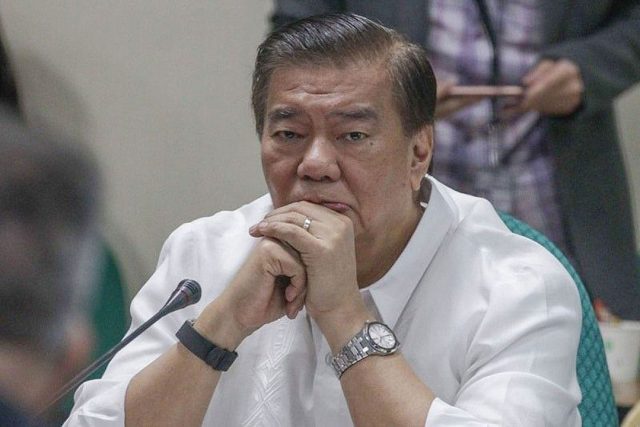
PTV4 hired contract workers in violation of memo — senator

THE STATE television hired more than 500 contract workers in violation of a Civil Service Commission memo, according to a senator.

Under the memo, contract workers may only be hired for special projects, Senator Franklin M. Drilon told a budget hearing on Monday.

The People’s Television Network (PTV 4) has hired 534 contract workers this year, General Manager Katherine C. de Castro told the hearing, adding that she was not aware of the government circular.

She also said the network needed technical assistants for its operations.

“You are not aware of it, that’s why you just keep on hiring contract of service personnel in total disregard of the circular,” Mr. Drilon said. He added that the circular seeks to limit the bureaucracy, which “can invent one thousand reasons why they need additional personnel.”

The Senate committee also questioned the alleged underpayment by the Presidential Communications Operations Office, which operates PTV, of its 1, 479 contract workers.

Senator Richard J. Gordon said he would not sponsor the agency’s budget on the floor unless officials come up with a satisfactory explanation. — Alyssa Nicole O. Tan

CoA authority to audit Pagcor has limits, says court 

PHILIPPINE STAR/MICHAEL VARCAS

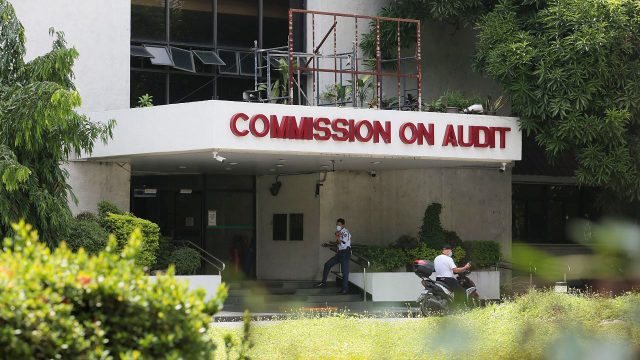
STATE AUDITORS’ power to review the books of the Philippine Amusement and Gaming Corp. (Pagcor) is limited to the state company’s franchise tax remittances and the government’s share in its gross earnings, the Supreme Court ruled. 

In a decision published on Sept. 24, the High Court reversed a Commission on Audit (CoA) ruling that disallowed Pagcor’s P2-million financial assistance to a homeowners’ association in Los Baños, Laguna in 2013. 

The tribunal noted that under the CoA charter, “the funds of the corporation to be covered by the audit shall be limited to the 5% franchise tax and 50% of the gross earnings pertaining to the government as its share.” 

“It is a cardinal rule in statutory construction that when the law is clear, there is no room for construction or interpretation,” the court said. “There is only room for application.” 

In 2010, the Pleasant Village Homeowners’ Association sought financial assistance worth P2 million from Pagcor so it could build a flood control and drainage system. The company’s board approved the request, the funding for which was taken from its marketing expenses. 

In 2017, state auditors said the Pagcor assistance did not cover a public property and did not serve a public purpose. 

CoA also said the subject roads and streets build under the project, while for public use, remained private property. 

The High Court did not pass upon the issue, saying the lawsuit only covered the fact that state auditors had “acted with grave abuse of discretion” in auditing Pagcor accounts beyond the law. — Bianca Angelica D. Añago 

Shares up on hopes over virus, consumer data

REUTERS

PHILIPPINE shares started the week in the green as hopeful investors in the country’s fight to contain the coronavirus disease 2019 (COVID-19) added to the positive sentiment driven by the release last week of the latest consumer and business confidence data.

The Philippine Stock Exchange index (PSEi) rose 4.73 points or 0.06% on Monday to close at 6,956.26, while the all shares index went up by 6.31 points or 0.14% to end at 4,329.95.

“With MMDA (Metropolitan Manila Development Authority) Chairman [Benjamin de Castro] Abalos, [Jr.] talking [about] the easing of restrictions by next month to Level 3 while reproduction number and growth rates of the pandemic virus on the downtrend by OCTA, this further [improved] the sentiment among investors, thus local market continued its uptrend on the third trading session,” Diversified Securities, Inc. Equity Trader Aniceto K. Pangan said in a text message.

Metro Manila’s quarantine classification is expected to be updated this week as the alert level 4 currently imposed under the government’s granular lockdown with alert level systems end on Sept. 30.

Mr. Abalos is hoping that the region’s alert level will be brought down to alert level 3 as the virus growth rate declines.

Philstocks Senior Research Analyst Japhet Louis O. Tantiangco said in a separate Viber message, “Investors remained hopeful that the COVID-19 situation in the country would continue to improve, leading to the easing of social restriction measures.”

On Sunday, the Health department reported 20,755 new COVID-19 infections, bringing the total active cases to 161,447. The national tally stands at over 2.49 million.

“The Bangko Sentral ng Pilipinas’ (BSP) latest confidence surveys which show that consumers and businesses are optimistic towards the upcoming quarter also gave a boost to sentiment,” Mr. Tantiangco said.

Last week, the BSP reported that the country’s consumer confidence index saw an improvement in the third quarter to –19.3% from the second quarter’s -30.9%.

However, the business confidence index went down to –5.6% after three consecutive quarters of optimism due to a surge in COVID-19 infections.

Meanwhile, consumer sentiment for the fourth quarter improved to 2.7% from 1.3% as the spending outlook also went up to 31.4% from 26.4%. The business confidence index for the fourth quarter was at 31.9%.

On Monday, sectoral indices were split.

Mining and oil dipped by 192.36 points or 2.03% to finish at 9,244.18; financials shed 15.26 points or 1.07% to 1,411.53; and property lost 25.35 points or 0.83% to 3,029.96.

Meanwhile, services climbed 24.74 points or 1.28% to 1,948.20 on Monday; holding firms improved by 15.44 points or 0.22% to 6,937.39; and industrials rose 12.71 points or 0.12% to end at 10,272.14.

Value turnover declined to P7.61 billion on Monday with 1.64 billion shares switching hands, down from the P8.95 billion with 2.11 billion issues traded on Friday.

Decliners beat advancers, 120 against 78, while 42 names closed unchanged.

Net foreign selling nearly doubled to P623.43 million on Monday from the P352.05 million logged in net outflows on Friday. — Keren Concepcion G. Valmonte