Home Blog Page 6953

Petro Gazz Angels upgrade roster, ink Fil-Am MJ Philips

FIL-AM MJ Philips — MJ PHILIPS FB

PETRO Gazz Angels revamped its roster with an aim of acquiring players with more experience and power.

They got what they asked for and more.

The Angels picked up a power-hitting Fil-American in MJ Philips and grizzled veterans Aiza Maizo-Pontillas and Bang Pineda that should beef their roster after letting go nine of their players from last season.

All three came from Sta. Lucia Realty, which took a leave early this month.

“Established names in the industry, all gassed up to give us exciting games ahead,” said the team in its social media account.

Ms. Philips, 26, should provide more scoring after emerging as one of the league’s best scorers in last year’s bubble in Bacarra, Ilocos Norte, while Ms. Maizo-Pontillas, an opposite hitter, and Ms. Pineda, a libero, should provide stability and leadership to a team seeking to improve on a third place finish a year back.

Petro Gazz also signed Nicole Tiamzon, Cienne Cruz, Djanel Cheng, Jonah Sabete and Yeye Gabarda the past week.

They will join the crisp-spiking troika of Myla Pablo, Gretchel Soltones and Remy Palma. — Joey Villar

A reset on hybrid work

LATE last year, organizations all over the word were ready and gearing up for a smooth rollout of hybrid work in 2022. Companies already crafted policies and procedures on who should report physically in the office and who will work remotely, the frequency of remote work, monitoring and reporting structures, and others. Human resource (HR) leaders were expecting a certain degree of stability in 2022, where employees just need to get vaccinated, follow health protocols, and go on with their daily lives amid the pandemic.

News about the new COVID-19 variant Omicron broke in November, but we all knew little about it. People considered it as another deadly Delta-like variant that the current vaccines can ward off. Economies and businesses continued opening in December, taking advantage of the merriment and spending sprees of the holiday season. People were intoxicated with the prospect of living normal lives in coexistence with the virus.

Then in January, news sites and the internet were littered with how the Omicron cases had been doubling every day. In the US, hospitalizations break record cases as Omicron surges. The Philippines broke the 30,000 mark on daily cases just recently. The infectivity rate of the new variant is unprecedented, acting more infectious than the common flu.

While the severity of the symptoms brought about by Omicron is not as grave, people infected were rendered bed ridden. HR leaders had to rethink and even reset their hybrid work plans.

In France, the Ministry of Labour updated its guidelines imposing on all companies operating in France “to ensure that each employee (whose role allows for remote working) works remotely at least 3 days per week, and up to 4 days per week whenever compatible with the organization of work and the employee’s situation for a three-week period starting on 03-01-2022 (i.e., until 24-01-2022).”

South Korea, the Netherlands, Germany, and Ireland were among countries to reimpose partial or full lockdowns, or other social distancing measures in recent days, impacting the implementation of hybrid work.

BBC News reported that “finding a ‘new normal’ in the workplace as impossible” and that “amid constantly shifting circumstances, it’s hard to pin down where we might find ourselves in 12 months’ time.” Further to the report, “a call for shorter workweeks and condensed hours has been gaining traction around the globe, with companies and entire governments alike already exploring this alternative.”

Another report from Forbes wrote that “there is increased speculation that some work may be shifting more permanently from offices to the home.”  Furthermore, “a large permanent shift would have major implications in many spheres, including the future of office work and downtown Central Business Districts (CBDs).”

The changing circumstance of the pandemic is now compelling business leaders to revisit, and even reset their hybrid work policies.

Luxury toilet maker Lixil Corp.’s chief people officer, Jin Montesano said that the company has deviated from Japan’s rigid work structure by dumping core working hours and morning meetings, and rethinking what the office should be, as reported by Reuters. “It’s no longer the place to work … wherever you get work done is where you work,” said Montesano as reported by Reuters. “What we want to do is reimagine the office.”

When some workers finally do return to the office in 2022 or down the road, many will find the layout and function to be completely different. Nicholas Bloom, a professor of economics at Stanford University, US, told BBC News that “companies will reconfigure spaces this year to meet the needs of a newly hybrid workforce, and accounting for how people actually want to work when they’re together in person: collaboratively.”

So how will hybrid work look like in this year and the years to come? There are many prognostications from experts. In the end, we don’t know what we don’t know. The virus may show other mutations that have differently.

But one thing is certain — the pre-pandemic office doesn’t work the way employees in 2022 need it to. Business and HR leaders need to configure the work set up with enough flexibility. Companies will need to implement a distributed enterprise strategy that mimics the central office operations to the homes and locations of workers. Constant adjustment is key.


Reynaldo C. Lugtu, Jr. is the founder and CEO of Hungry Workhorse, a digital and culture transformation consulting firm. He is the chairman of the Information and Communication Technology Committee of the Financial Executives Institute of the Philippines (FINEX). He is a fellow at the US-based Institute for Digital Transformation. He teaches strategic management in the MBA Program of De La Salle University. The author may be e-mailed at rey.lugtu@hungryworkhorse.com

HR’s role in reconciling different management styles

Some managers are friendly and empower and engage their people, while others are deeply attached to their dictatorial ways and are hated for their toxic behavior. What kind of intervention must human resources (HR) perform to keep workers from making comparisons of the two types? — Red Rose.

A motivational speaker was asked to speak by a charity institution. After the speech, the program director handed him his professional fee. “I’m sorry, I can’t accept this,” the speaker said. “I appreciate the honor of being asked to speak before your group. I suggest you use the money to support your programs.”

The director replied if he would mind if the money went to the institution’s special fund.

The speaker replied. “Of course not. But what’s the special fund for?”

The director replied: “It adds to our funding so we can get a better speaker next time.”

At times, we can’t help but compare people and what they can and cannot do. This happens all the time. Recall your first experience with a new boss early in your employment. Was it a good learning experience? Why or why not? If it was nightmare, then what made it a nightmare?

Whatever the answer, you may have endured the remaining months or years of your tenure feeling the pain until an opportunity knocked, allowing you to transfer elsewhere within the organization or move to another job, where your boss seemed a lot more friendly.

After a few months of working for the new boss, did you start getting a sense of déjà vu? Did your new boss transform into something like your former boss?

HR INTERVENTIONS
Consult your HR department and compare its ideas with what other companies are doing. Assuming that your HR department is led by professionals, they should be performing the following interventions, in a calibrated and objective manner:

One, conduct an annual employee morale survey. Also called as a climate survey, such an approach is advisable for any organization wishing to understand how the workers perceive the management style of all line supervisors and managers. It can also pinpoint a particular unit, section, or department where changes must be prioritized.

Two, explore using an established set of survey questions. Some organizations use the Gallup’s Employee Engagement Survey. This includes questions about how employees are being treated at work, how they’re recognized and rewarded, how they’re being coached on career development and how their opinions are solicited.

Three, identify the low-scoring units, sections or departments. There’s no need to identify the problem managers by name. It is enough that they must know how their style is perceived by workers, regardless of whether the perception is true or not. What is important is how they change their ways to correct the perception.

Four, consider whether the findings line up with the attrition rate. There’s no better way to validate the workers’ perceptions with the rate of voluntary resignation. If the rate has become alarming in a particular unit, one possible solution is to allow the line executive to reform, with a transfer in extreme cases.

Last, offer a leadership program for all line executives. This could take the form of a deep-dive workshop, as an indirect signal to the supervisor and manager roster to improve their poor management skills. The module may include reviewing their motivational levels and identifying their styles, for correction if necessary. 

WIN-WIN SOLUTION
If these recommendations are not feasible for whatever reason, as your problem supervisors and managers might claim, there could be another solution to consider: Turn the negative approach into positive. Learn from “The Adventures of Tom Sawyer,” which illustrates that even a bothersome task like painting a fence can be gainfully passed on to other people.

Likewise, challenge the toxic managers to make supervising their workers an enjoyable experience, day in and day out. It may involve rewarding model line executives for their management styles.

It could be a radical idea to some people and not easy to imagine, even for model executives who may be reluctant to offer their styles as a solution for management colleagues. Unless you try it, the result could be to bear the consequences of having a good number of demotivated and unproductive workers.


Have a chat with Rey Elbo via Facebook, LinkedIn or Twitter or send your workplace questions to elbonomics@gmail.com or via https://reyelbo.consulting.

AllHome opens 56th and 57th stores in Mandaluyong, Las Piñas

AllHome Corp., the home improvement store of the Villar group, announced on Thursday the launch of its 56th and 57th stores in Mandaluyong and Las Piñas, respectively.

In a press release, AllHome Chairman Manuel B. Villar, Jr. said the group is “excited” to continue pursuing its strategy of store expansion, especially in Metro Manila.

“We continue to anticipate the country’s return to normal, and all economic signs point to the brisk recovery of the retail industry. We believe that Mandaluyong City, especially our current location along Shaw is a prime location. This location is a prime example of a market ready for ‘revenge shopping’ and they are the people who stand to gain from our full-line home center offering, range of products, services and exceptional shopping experience,” he said.

The 56th store is in Worldwide Corporate Center along Shaw Boulevard, Mandaluyong.

“Our latest AllHome store in our Worldwide Corporate Center is part of our initiative to close 2021 on a strong note — one that expands AllHome presence in Metro Manila and takes advantage of the reopening economy and the increasing comfort level of shoppers to reexperience in-store shopping,” AllHome said.

“Mandaluyong shoppers will learn firsthand about our commitment to providing premium and affordably priced choices as well as unique value-added services when it comes to building and furnishing homes — in-store or online,” it added.

AllHome’s 57th store is located in Evia Lifestyle Center, Las Piñas and is positioned as a “niche specialty store for hardware products, catering to specific home needs.”

The home improvement company said its foot traffic improved, with November 2021 foot traffic showing an increase of 22% from October 2021.

At the stock exchange on Thursday, AllHome shares rose by seven centavos or 0.79% to close at P8.95 each. — Luisa Maria Jacinta C. Jocson

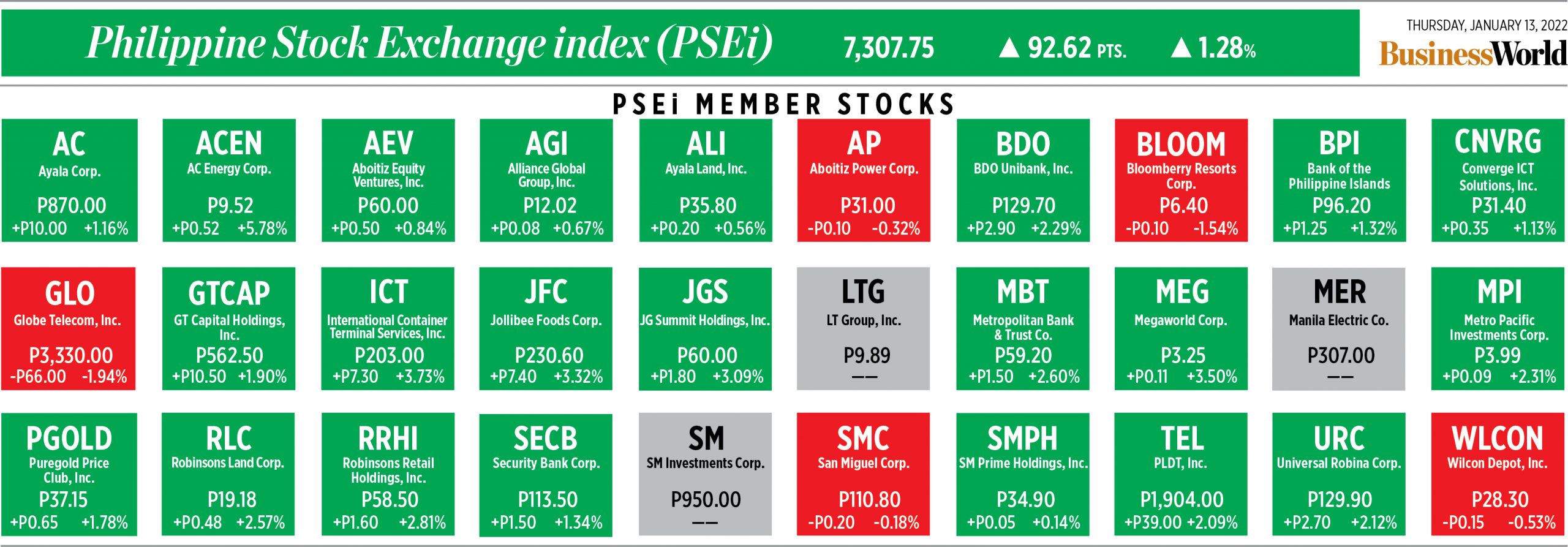
How PSEi member stocks performed — January 13, 2022

Here’s a quick glance at how PSEi stocks fared on Thursday, January 13, 2022.


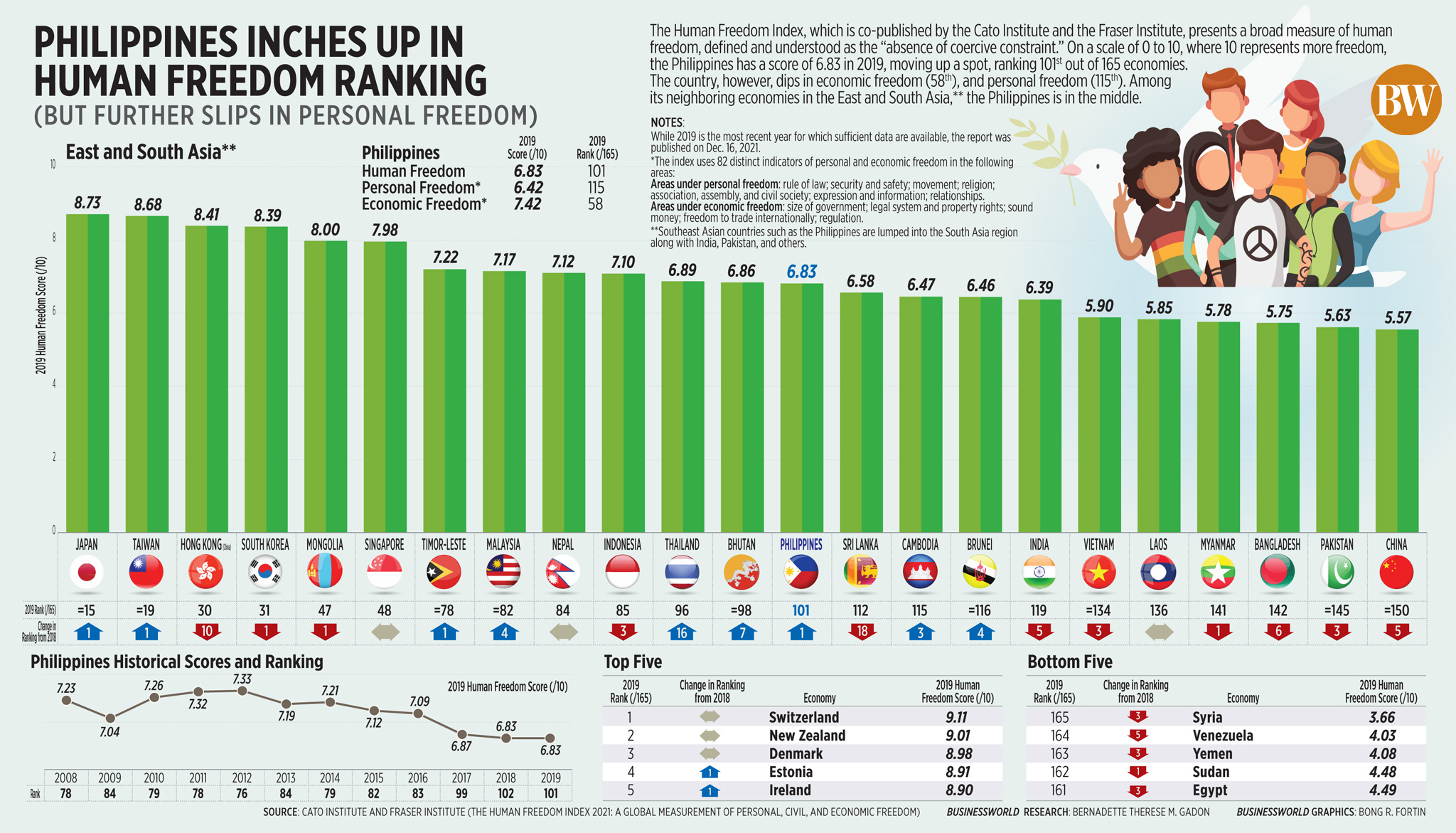
Philippines inches up in human freedom ranking

Philippines inches up in human freedom ranking

DoF blames pork for inflation blowout, backs more imports

PHILSTAR FILE PHOTO

THE Department of Finance (DoF) said meat prices pushed inflation beyond the government target range in 2021, and pressed for more pork imports and a drawdown of the pork inventory held in cold storage.

“The 16.8% meat price inflation last year accounted for 1.1 percentage points (of) the 4.4% overall inflation,” Finance Undersecretary Gil S. Beltran said in an economic bulletin on Thursday.

“Had meat price inflation been half as high, the upper level of the 2-4% inflation target range would not have been breached.”

Inflation in 2021 averaged 4.5%, against the 2.6% reading in 2020 and exceeding the central bank’s target band.

Mr. Beltran said meat price inflation in 2021 was the highest of any major food item since 2012.

The lingering effects of African Swine Fever (ASF) have drastically cut the hog population, pressuring pork prices higher, he said.

“The Department of Agriculture confirmed the outbreak of ASF in the country in the middle of 2019 but it was in 2021 that the country felt more fully the debilitating effects of the hog infection.”

Mr. Beltran said the Philippines will need to continue importing pork to meet demand and compensate for the supply shortfall.

Other interventions may include the regular release of pork held in cold storage and their continuous replenishment from local or imported supply, he said.

Finance Secretary Carlos G. Dominguez III supports the proposal by the National Economic and Development Authority to extend the validity of an executive order increasing import volumes until the end of 2022.

Executive Order No. 133 in May last year temporarily raised the pork import quota, known as the minimum access volume, to 254,210 metric tons from 54,210 to address increasing pork prices.

The hog and meat industry had opposed the proposed extension, asking the government to instead support local producers to improve supply. — Jenina P. Ibañez

Power plant coal stocks meet DoE standards for 30 days’ worth of supply

PHILSTAR FILE PHOTO

THE Department of Energy (DoE) said on Thursday that coal-fired power plants all have 30 days’ worth of coal reserves, with some having as much as 50, as the market tightened for thermal coal following Indonesia’s one-month coal export ban.

“All of them have met the 30-day requirement. In fact, some of them even have excess which can cover up to 45-50 days,” the director of the DoE’s Electric Power Industry Management Bureau, Mario C. Marasigan said at a virtual briefing on Thursday.

In a meeting with the companies on Tuesday, the Energy department required full reports on their coal requirements, the status of imports, and the schedule of deliveries in order to provide the authorities a better picture of the power situation.

“We have yet to receive full reports from the companies. Actually, we have assessed that we have coal inventories but the problem is what will happen (to) their expected schedule of deliveries,” he said.

Mr. Marasigan said one scenario that needs to be addressed is whether the ports can handle the delivery surge once Indonesia’s ban is lifted.

He said some companies’ imports were in the advanced stages of the Indonesian export process, having been loaded onto vessels awaiting final clearance, when the ban was imposed.

Indonesia, the world’s biggest thermal coal exporter, suspended exports on Jan. 1 after its state power utility reported dangerously low inventory levels at its domestic power stations, Reuters reported.

The DoE estimates that the Philippines imported 69.51% of its coal requirement of 42.476 million metric tons (MMT) in 2020.

Energy Secretary Alfonso G. Cusi has said that the Philippines imported 2.3 MMTs of coal monthly from Indonesia last year.

Mr. Cusi announced on Monday that he had written on Jan. 6 to his Indonesian counterpart, Minister of Energy and Mineral Resources Afirin Tasrif, appealing for the ban to be lifted, specifically for the Philippines.

Power companies operating coal-fired plants earlier told BusinessWorld that they are looking at tapping other sources of the fuel should the Indonesia ban be extended. — Marielle C. Lucenio

Ban on foreign state-owned firms seen as ‘discriminatory’

BW FILE PHOTO

BUSINESS LEADERS and a former Palace official said on Thursday that a ban on foreign state-owned companies is “discriminatory” and runs counter to the liberalizing intent of the proposed Public Service Act (PSA).

The President’s former Spokesman Herminio L. Roque, Jr., a Senate candidate, said at the Pandesal Forum in Quezon City:

“We are supposedly liberalizing the provision of public service, and yet here is an instance where we are expressly discriminating against foreign-owned enterprises.”

The forum was tackling Senate Bill (SB) 2094 or the proposed Public Service Act, which is currently being harmonized with its counterpart House measure in bicameral conference committee.

Under Section 16 of the measure, “an entity controlled by or acting on behalf of the foreign government or foreign state-owned enterprises shall be prohibited from owning capital in any public service classified as critical infrastructure.”

“I submit that this discriminatory provision against state-owned enterprises particularly from China is patently unconstitutional,” Mr. Roque said. “Although it is not mentioned that it is Chinese businesses or Chinese-owned businesses that are targeted, only Chinese enterprises have state-owned enterprises active in the public service industry, and therefore we can reasonably infer that it is directed against Chinese-owned enterprises.”

The purpose of the law is to allow more entrants into the sector, he added, which makes this provision contrary to the government’s objective of heightening competition to the benefit of consumers.

Philippines-Chinese Mutual Cooperation Society, Inc. Chairman and Asian Center for Comparative Governance President Peter T. Laviña said that as the country has one of the most restrictive investment policies in the region, and called for any liberalization not to be exclusionary.

In 2021, Philippine laws were judged to be the third most restrictive to foreign direct investment (FDI) in the world, according to the FDI Regulatory Restrictiveness Index. The index evaluates equity restrictions, restrictions on key foreign personnel, operational restrictions and discriminatory screening for approval mechanisms.

“We should not restrict, discriminate or exclude,” Mr. Laviña said during the forum, as this may stoke anti-Chinese sentiment in the Philippines. “Very clearly, it targets China companies, especially China state-owned companies.”

He called on legislators to clarify and correct any such restrictions in all three measures intended to attract foreign investment, the proposed PSA, the proposed Foreign Investments Act, and the proposed Retail Trade Liberalization Act.

“Let’s open up to everyone so that the Philippines will benefit in the same manner our neighbors have benefited from all the foreign investment that has come into their countries,” Mr. Laviña said.

Anvil Business Club Chairman George Siy said that “the considerations they put in, in principle, sound like there is sound reasoning behind them, but then the timing and the way that they have circumscribed the conditions” make it seem like they are targeting Chinese investments.

Amendments to the pending foreign investment laws should be consistent and non-discriminatory, he said, “and we should recognize that they can be changed over time, they are not fixed. We need to adjust it to new technologies, cultures, and definitions of security,” Mr. Siy said, noting that the laws and regulations should evolve with the times.

Flexibility in the law is vital, as is the execution, he added. Proper implementation can be done by building a culture that brings together talent pools of technocrats, allowing them to enter government by providing the right incentives.

This will allow new capital and technology inflows from abroad which will build new markets and capacities, accelerate recovery, and prepare the country for the fourth stage of industrial revolution, Mr. Siy said.

Federation of Filipino Chinese Chambers of Commerce and Industry, Inc. President Henry Lim Bon Liong, meanwhile, said his organization supports the government’s economic reform agenda to make the country more globally competitive and promote ease of doing business.

Mr. Lim Bon Liong also said he was for the amendments made in SB 2094 which establishes a rate setting mechanism that will result in fair and reasonable prices for commodities and services, improve technology, and modernize service. He also agreed with the updated penalties under the proposed measure.

“The passage of this legislation will stimulate the provision of better services by lifting the restrictions on ownership and operation of public services in the country,” Mr. Lim Bon Liong said. “This will eventually cascade to other parts of the economy since these are necessary for businesses to try to improve access and lower rates, which translates to a more conducive environment (for) doing business in the country.”

The entry of foreign investors, he said, will translate to more jobs, which are needed for the country to recover from the pandemic.

“The influx of foreign direct investment or the FDI has been on the upswing, and we believe that this legislation will be crucial to sustaining and further improving this favorable trend,” he added.

The Senate approved its version of the Public Services Act in December, while the House of Representatives passed the counterpart bill in March 2020.

Congress is hoping to pass the bill, certified as urgent by President Rodrigo R. Duterte, before the end of the Duterte administration. — Alyssa Nicole O. Tan


NCR retail price growth accelerates in November

BW FILE PHOTO

PRICE GROWTH of retail goods in the National Capital Region (NCR) accelerated to its highest level in more than two-and-a-half years in November, with consumer demand not dampened by the higher cost of goods.

Preliminary data from the Philippine Statistics Authority (PSA) indicate that the general retail price index (GRPI) rose 2.3% from a year earlier, against the 2.1% posted in October, and the year-earlier rate of 1.3%.

The November result matched the rise seen in May 2021 and was the highest increment since the 2.7% expansion in April 2019.

In the 11 months to November, Metro Manila’s retail price growth averaged 2%, against the year-earlier 1.2%.

The PSA attributed November’s uptick to a double-digit increase in mineral fuels, lubricants and related materials, whose prices rose 25% year on year from 22.1% in October.

Other commodities where prices accelerated included chemicals, including animal and vegetable oils and fats (1.3% in November from 0.8% in October); food (2.1% from 1.9%); machinery and transport equipment (0.4% from 0.3%); miscellaneous manufactured articles (0.3% from 0.2%); and manufactured goods classified chiefly by materials (1.2% from 1.1%).

Beverages and tobacco price growth slowed to 4.4% in November from 6% in October, while that of crude materials, inedible except fuels eased to 0.9% from 1%.

ING Bank N.V. Manila Senior Economist Nicholas Antonio T. Mapa said the rise in retail prices in November was due to higher production costs caused by supply chain bottlenecks as well as strong consumer demand.

“Looking at recent PMI (Purchasing Managers’ Index) figures, we’ve noted that increase material costs may have forced producers to pass on price increases to customers and finding its way to higher retail prices,” he said in an e-mail interview.

The country’s manufacturing PMI in November jumped to an eight-month high of 51.7 from 51 posted in October, as new orders increased that month.

A PMI reading of above 50 indicates that manufacturers are gearing up to increase production by placing more orders, making the statistic a leading indicator for future economic conditions; a reading below 50 signals a contraction.

Mr. Mapa also noted that the anticipation of the holiday buying rush also contributed to the increase in prices, which further improved as cases of coronavirus disease 2019 (COVID-19) continued to drop in November.

According to the Department of Health, 1,455 new COVID-19 cases were recorded at the start of November, which gradually decreased to 322 cases by Nov. 30.

However, a fresh surge brought by the highly mutated Omicron variant, which was first detected in South Africa, is currently surging through the Philippines.

“The ongoing wave of infections has just as quickly knocked down both business and consumer sentiment, which could sap inflationary pressures on retail prices in the near term,” Mr. Mapa said.

The monthly GRPI is also used as a deflator of the National Accounts, particularly on the retail trade sector, and serves as the basis of business forecasting in that sector. — Bernadette Therese M. Gadon

Locally manufactured COVID-19 drug awaiting FDA approval

LLOYD LABORATORIES, Inc. said it is awaiting approval from the Food and Drug Administration (FDA) to begin manufacturing Molnupiravir, an oral drug to treat coronavirus disease 2019 (COVID-19).

“Once cleared, within no time at all we can make the capsules available to people in the Philippines. We are ready for the manufacturing of the product immediately. If the FDA gives the clearance tomorrow, from five to seven days we can make it available to the market,” Vice-President for Research and Development Chandra Shekhara Reddy Nagareddy said in a briefing on Thursday.

On Monday, the Board of Investments approved the application lodged by Lloyd Laboratories to register the drug manufacturing operation for incentives.

The pharmaceutical company said it submitted all compliance documents and is waiting for emergency use authorization (EUA) from the FDA to begin manufacturing the drug.

“We will be able to serve all hospitals who require it, no limitations,” said Business Development Director Christopher M. Bamba. “We currently have a lot of inquiries from government hospitals. It will be fast for us to move forward once we get the EUA.”

Lloyd Laboratories obtained a Compassionate Special Permit to manufacture the drug for Recuenco General Hospital in Taguig, which it provided with 600 capsules.

The company said it has the capacity to manufacture 1 million capsules — either 200 mg or 400 mg —per batch, with each batch to take three or four days.

“We are not yet allowed to distribute to drugstores, only hospitals and local government units, as these are limited and controlled products,” Mr. Bamba added.

Lloyd Laboratories said that as affordability is a top concern, the drug will be 30 to 50% cheaper than imported drugs on the market.

“We are not paying any royalties to anyone. That is skipped from the equation. It will also be locally manufactured, so imports were limited to active pharmaceutical ingredients (API) or the raw materials,” said Mr. Bamba. “We are able to (adopt) a low-price strategy, being a local manufacturer and generic company.”

Lloyd Laboratories received technology transfer to produce the drug from India’s Optimus Pharma Pvt. Ltd.

Meanwhile, the company also said it is currently working on manufacturing a COVID-19 vaccine with Chinese pharmaceutical group Livzon Mavpharm, Inc.

The vaccine carries a provisional name of VO-1 and will be a recombinant vaccine that introduces a fusion protein to patients. Antonio D. Ligsay, medical consultant and head of the clinical trials, said facilities in the Philippines have the capacity to produce pre-filled syringes.

The first two phases of the vaccine project have been completed in China. The third phase of clinical studies is currently being administered in the Philippines, Indonesia, and Russia. The study involves 21,500 test subjects, of which the Philippines provided 12,000. — Luisa Maria Jacinta C. Jocson

Gov’t agencies told to draft energy efficiency plans

THE Department of Energy (DoE) on Thursday ordered all government agencies, including foreign service posts, to draft Energy Efficiency and Conservation Programs.

The DoE said the plans are a requirement of the Government Energy Management Program (GEMP).

In a resolution published on its website, the DoE, which heads the inter-agency committee on energy efficiency and conservation, ordered the implementation of the newly approved GEMP guidelines.

The Inter-Agency Energy Efficiency and Conservation Committee (IAEECC) Resolution No. 5 Series of 2022 covers all government entities including local governments, government-owned and -controlled corporations, government subsidiaries, state universities and colleges, and foreign service offices.

The government agencies are expected to outline their energy conservation measures, set energy cost reduction targets, and prepare similar measures for their motor vehicle fleets.

All government entities are encouraged to reduce electricity costs and fuel consumption by at least 10% from a base period set by the DoE.

Government entities have also been ordered to manage their electricity consumption by setting their office air conditioners to 24 degrees Celsius at the lowest setting, and for only six hours daily. The allowed operating period is eight hours during the dry season.

Air conditioning units should also be set to fan mode during lunch breaks, except in offices with no noon breaks.

Government agencies are also encouraged to purchase energy-efficient vehicles such as those using alternative fuels.

Agencies that reduce their electricity and fuel costs by 10% or more can apply their accumulated energy savings to upgrade their facilities, while those that fail to meet the norm can only use 50% of savings for such upgrades.

Philippine Energy Efficiency Alliance (PE2), an association of energy efficiency entities, welcomed the resolution.

“PE2 sees this as an enabling policy (allowing the) concerned national government agencies, especially those represented in IAEECC, to craft their respective implementing guidelines to finally allow private sector expertise and capital investments to be mobilized for energy efficiency projects in the public sector through the energy service companies (ESCO) performance contracting model,” PE2 President Alexander D. Ablaza told BusinessWorld in a Viber message.

Mr. Ablaza added that the alliance hopes that the GEMP guidelines trigger long-term policy measures which effectively remove the policy, procurement, financing and budgeting barriers which have prevented energy service companies in the last few decades to sign energy performance contracts with government entities.

The resolution sets guidelines for the evaluation, approval, procurement, implementation, and financing of government energy efficiency projects under the broader scope and objectives of GEMP. — Marielle C. Lucenio