Home Blog Page 6934

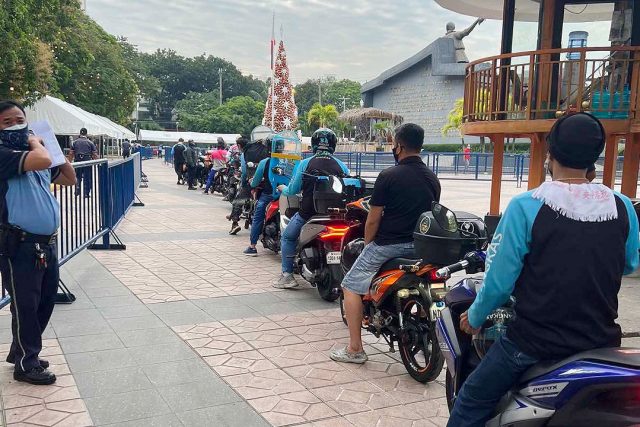
Manila provides booster shots to delivery riders

@ISKOMORENO TWITTER ACCOUNT

THE MANILA City government offered vaccine booster shots to delivery riders on Thursday as the Philippine capital and surrounding areas work to contain a fresh surge of coronavirus cases believed to be fueled by the more transmissible Omicron variant. 

“One of the challenges of a two-wheel worker is that they cannot go to malls to get vaccinated because it takes too long, it would take all day,” Manila Mayor Francisco “Isko” M. Domagoso said in Filipino.  “That is why we designed a drive-through vaccination especially for them.”

The mayor, who is running for president in the May elections, said the booster jab would help ensure their protection against the virus as they carry on with their work.

He noted that seven out of every 10 riders who were getting vaccinated at the site were not Manila City residents. 

Riders under various delivery firms — such as Grab, Angkas, Lalamove, Foodpanda and Mr. Speedy — lined up for the vaccine top-up.

Mr. Domagoso also announced that there will be a second round of vaccinations on Thursday evening for workers at the busy Divisoria Public Market, including employees, fish traders, market vendors, and drivers. 

He said that around 16,000 people were vaccinated in Manila on Wednesday night. — Jaspearl Emerald G. Tan 

Comelec removes another Marcos in presidential candidates list, but final roster still uncertain

THE COMMISSION on Elections (Comelec) updated the list of national candidates posted on its website on Thursday, removing four from the roster of presidential aspirants, including one with a Marcos family name.

This leaves Ferdinand R. Marcos, Jr., son and namesake of the late Philippine dictator, as the sole contender for the country’s top post with such a family name. 

From the previous 15 names as of Dec. 24, the list for presidential candidates is down to 11. Among those struck out were Maria Aurora Marcos, who has been declared a nuisance candidate.

Another Marcos with first name Tiburcio was earlier removed from the roster.

Marcos Jr., meanwhile, is facing several petitions for disqualification based mainly on his conviction for tax evasion, a crime that is penalized with perpetual disqualification from public office. The first hearing in three of the cases is set Friday.

The final list of election candidates was targeted to be released by Jan. 7, but Comelec Spokesperson James Jimenez said this could be delayed by a petition filed by a faction of the ruling PDP-Laban party. 

“Our expectation (on the final list) is on Jan. 7, hopefully,” Mr. Jimenez said in an interview with ABS-CBN on Thursday.

However, “If someone files something, and it’s properly filed, we need to address it before we can proceed,” he said in Filipino.

The petition calls for a reopening of the filing of certificates of candidacy, which was concluded in October. — Jaspearl Emerald G. Tan

Nomura: Why Leni is market-friendly

OVP

BusinessWorld bannered a very interesting news story that a Robredo win is “more market-friendly.” Based on the study by Nomura Global Research entitled “Philippines: No Holiday Cheer,” an incoming administration of Vice-President Leni Robredo is deemed more positive to the market than that of former Senator Ferdinand Marcos, Jr.

The team of Euben Paracuelles, chief ASEAN economist, and analysts Rangga Cipta, Craig Chan, and Wee Choon Teo based their assessment of the positive market implications of a Robredo win mainly on her experience “at the national level and articulating a strategy for the country to recover from the pandemic.”

The Nomura economists equated her experience and strategic approach with the ability to preside over a post-pandemic recovery. Her rightful focus on both healthcare and education which should be topmost in the agenda of the new president beginning July 1, 2022, counted for something significant. The pandemic has overwhelmed our health facilities in the last two years and unmasked decades of criminal neglect. With the lockdown, education was the immediate and most serious casualty. Young schoolchildren have to learn via Zoom, handicapped by inadequate supply of electronic gadgets and hopelessly weak internet signals. Even licensure examinations have to be compressed and shortened to get over them lest the virus totally scrap them for now.

As a team, Robredo and her running mate, Senator Francis Pangilinan, scored five out of five for national experience and business friendliness. They obtained four out of five in continuity/governance, infrastructure progress, and fiscal discipline. Robredo was especially cited for championing human rights causes and her declaration that transparency and accountability would be central to her presidency.

Transparency and accountability are considered crucial in preventing corruption that has characterized the Duterte government’s management of the pandemic. Based on the initial finding of the Philippine Senate, the Government in the middle of the pandemic squeezed dry its budget and borrowed inordinate amount of money for pandemic mitigation only to end up enriching some favored few.

Transparency and accountability are the building blocks of predictable governance which is considered important by the market. Without these elements, the government might not be inclined to address market failures including missing or weak markets, imperfect information and negative externalities. Government failure could lead to loss of market confidence, reversal or trickles of both domestic and foreign investments, and a credit crunch.

Robredo has committed that under her leadership, the Government will uplift the condition of the marginalized sectors of Philippine society. The broadsheets also reported her priority on food security through an intentional policy of doubling the agriculture budget.

Contrary to the fake videos going around social media, Robredo has provided civil society a glimpse of what to expect in terms of her political platform, something that Nomura must have had the benefit of examining when their report was prepared. First, the Vice-President, in a press conference in November, rolled out her comprehensive plan to mitigate the health pandemic and usher in the nation’s recovery. Second, in another press conference in early December, she zeroed in on the principal collateral damage of the pandemic which is the loss of millions of jobs.

Her health strategy was not taken from thin air. Robredo explained that “narating natin ang plano sa pagkokonsulta sa mga eksperto, mga sector, at higit sa lahat, sa harapang pagsaksi sa dinadaanan ng Pilipino (we came to the plan by consulting with experts, with the sectors, and, most of all, through our first-hand witnessing of what the Filipino is going through).” Nomura must have found this approach not only transparent and consultative but also evidence- and science-based.

Her immediate plan is to overhaul the current pandemic response which proved unequal to the health challenge. She was spot on when she declared the health sector needs a new leader supported by a team of experts, particularly organic staff of the health department. She believes the inter-agency task force on the pandemic should be streamlined for more nimble response.

Testing is to be stepped up, free and regular for healthcare workers and teachers alike. Benefits will be given to healthcare workers who will also be regularized and exempted from the Personnel Salary Cap. A centralized, integrated, and uniform contact tracing system will be institutionalized.

For the vaccines, P50 billion will be earmarked for distribution through a national vaccination distribution network of strengthened local health units for more systematic and monitored rollout. In areas with a high number of cases of COVID-19, free and safe mobile testing systems will be made available. Assistance will also be extended to families and small businesses in areas locked down on a granular basis to allow them to keep their workers employed.

In the medium term, she intends to double the health budget from the current P113 billion as recommended by the Philippine Health Facility Development Plan 2020-2040. More hospital beds, more healthcare workers, more medical equipment, and more systematic shifts of doctors and nurses are envisioned in her plan. With an inadequate number of hospital beds in the countryside, the Vice-President proposes to establish field hospitals, 2,400 rural health units and health centers in four years.

On the other hand, the Vice-President’s job recovery plan or “Hanapbuhay Para sa Lahat” (Work for All) can only be described as comprehensive. It was correct for her to focus on job recovery because as many as seven million jobs were lost at some point in 2020 when the pandemic-driven unemployment rate soared to 17.7 %.

Robredo’s plan is anchored on five pivotal themes: regaining trust in government, reviving Filipino industries, ending discrimination at work, supporting small businesses, and cushioning the effects of unemployment.

She was forceful when she declared that “Sa araw-araw mong pagkayod, dapat kakampi mo ang gobyerno (in your daily grind, government should be your ally).” For her, regaining the public’s trust in the Government should require the elimination of corruption and red tape. And this must be music to the ears of the market, “the playing field for businesses should be leveled.”

Robredo proposes plans to develop the maritime industry by including relevant courses in high school, modernizing docks and wharfs around the costal Philippines, and streamlining ship registration. The country is also up to be a “center of climate industry” by creating an e-transport industry, modernizing agricultural processes, investing in “climate smart” agricultural infrastructure and developing a clean energy policy framework.

For global competitiveness, the Vice-President is also proposing greater research and investment in modern technology and innovation. Manufacturing will be revived by an institutionalized industry roadmap, very suggestive of China and Vietnam’s successful efforts. To support job recovery, appropriate confidence-building measures will be undertaken including the strengthening of antitrust bodies, implementation of the Ease of Doing Business Act and accelerating the digital shift particularly in government operation.

These proposals could cost around P200 billion, or some 4% of the P5.024-trillion budget for 2022. The Vice-President is prepared to identify the possible sources including the budget for public works and highways, transportation, office of the President, and the police.

Finally, how she scored lower than five in continuity and governance as well as fiscal discipline is perplexing. With her budget cut to the bones, Robredo even managed to extend help to many victims of natural calamities by rallying private support. In three of her five years as vice-president, the Commission on Audit has given Robredo the highest audit ratings with an “unqualified opinion.” If this quality of governance and fiscal discipline has been shown to be possible, it could very well be replicated if Robredo is elected president of the Republic.

Infrastructure could be tricky as a metric of choice. Neither of the leading presidential candidates could claim credit, or lack of it, for the infrastructure program of the Duterte government. In the last five years, Robredo was not allowed to work with the cabinet while Marcos, Jr. remained a private individual who filed and lost an electoral protest against her.


Diwa C. Guinigundo is the former deputy governor for the Monetary and Economics Sector, the Bangko Sentral ng Pilipinas (BSP). He served the BSP for 41 years. In 2001-2003, he was alternate executive director at the International Monetary Fund in Washington, DC. He is the senior pastor of the Fullness of Christ International Ministries in Mandaluyong.


Feudal individualism

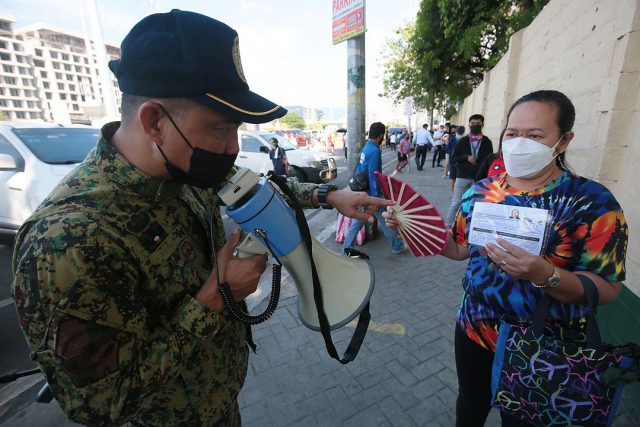
A DEVOTEE at the National Shrine of Our Mother of Perpetual Help in Baclaran shows her vaccination card prior to entering the church premises on Jan. 5. — PHILIPPINE STAR/MICHAEL VARCAS

It’s an oxymoron, a contradiction in terms. The feudal mindset values conformity with, and loyalty to, one’s collective, while individualism prizes the interests of the individual above everything else. But that paradox was evident in at least two instances as 2021 ended and a new year began.

Neither the injuries or even deaths, nor air pollution, the cost to public health, and the fires they often cause have deterred most Filipinos from meeting every new year with the explosives they aptly call paputok. Not even poverty or the pandemic has stopped them from buying up the entire inventories of the manufacturers of those incendiaries.

They have to have something to celebrate with, and only firecrackers, the more powerful the better, will do. But what is it they want to be happy about — is it the passing of the old year or the coming of the new, about which they’re always hopeful but which, once old, they’re glad to see go?

Or is the seriousness with which they pursue merry-making just one more indication of the live-for-today-forget-tomorrow mindset that momentarily provides some distraction from their desperate straits?

It doesn’t matter, one can almost hear them saying, it’s the fun of it that counts. And never mind the dozens of people, most of them minors, injured in firecracker-related incidents in the poorest communities in which, on New Year’s Eve, the loudest firecrackers were being set off. Forget those with asthma and other respiratory ailments for whom surviving the smog that blankets entire cities every December 31st has become an annual predicament. Never mind everyone else — the children, the neighbors, and the community. What matters is me, myself, what I want.

If no sense of community is evident in the yearly orgy of noise and mayhem that New Year’s Eve has always been in this archipelago, neither was it present in one balikbayan’s allegedly buying  her way out of mandatory quarantine in a Makati hotel so she could party.

The COVID-positive traveler from the United States —presumably one of the many who immigrate to that country yearly — described herself as “with connections,” and seems to have infected 15 of those she came in contact with. The latter could have spread the contagion to their own contacts, raising the possibility that she could be responsible for transmitting the disease to a hundred people or more.

As reprehensible as it was, hers could have been only one among many other cases. It raised the possibility that other travelers, of whatever nationality, entering the country could have also paid off the hotels where they were supposed to be quarantined for at least 10 days.

There was already anecdotal evidence in 2020 to suggest that that indeed was going on. But such returning and visiting Filipinos’ escapades are only among the various reasons for the spike in COVID cases, which from a low of 200 or so daily in the first weeks of December had surged to nearly 4,600 by the second day of 2022.

Equally party-loving Philippine-resident Filipinos are even more the cause as they ate out, visited resorts, flew to this or that local tourist destination, and, with the coming of the Christmas season, shopped in this or that mall or in markets such as those in Manila’s Divisoria, and made merry with kin and friends on Christmas Eve and the day itself.

But whether they’re driven by home-grown irresponsibility or by emigrant entitlement, the government response to these latest expressions of the individualism that co-exists with the values of feudal culture was to wash its hands of any responsibility and to put the blame entirely on the seeming offenders.

As usual, government agencies urged the citizenry, as the old year was ending, not to greet the new with firecrackers, even as the police released a list of those firecrackers allowed the public. That list did not prevent the usual injuries and the other harm firecrackers do from happening, underlining the imperative of totally banning citizen access to them, since, obviously, half-measures won’t do.

The same half-measures were evident as the case of the balikbayan party-goer who ignored quarantine protocols went public. Government filed charges against her after an investigation into whether the hotel where she was billeted (as well as others similarly designated as quarantine sites) indeed allowed her, and were allowing others, to come and go as they pleased.

Completely unnoticed and unmentioned were those belated measures’ being an indication that the compliance of both those quarantined as well as of the hotels where they’re billeted are either haphazardly monitored or not at all.

Government sources have hardly budged from their usual recourse of blaming the offenders against this or that policy whenever things go wrong. They lament that Filipinos are “undisciplined,” and “pasaway” (disobedient) rather than reviewing what in existing policies needs revising or even changing completely.

Not that the “undisciplined” and “pasaway” labels often flung at Filipinos are inaccurate. They are among the indicators of the complexities wrought on their psyche by the feudal relations dominant in the Philippine countryside and by the colonial and imperialist occupations of their homeland.

Both petty defiance and self-indulgence are indeed among the external expressions of Filipino psychology. They are as obviously evident as the sun at nine in the morning — and therefore should have been factored into any policy on issues of public concern, such as, for example, banning fireworks completely, seeing to it that the limits in the number of people in public transport and in places like malls and markets are observed, and closely monitoring whether the hotels designated as quarantine sites are in compliance with their mandated responsibilities as well as with health protocols.

The consequences of the failure to do so and of the half- measures in place are currently being demonstrated. More than 150 people, many of them minors, have been hurt by firecrackers and other fireworks that included both those banned and those allowed the citizens whom government spokespersons habitually describe as “irresponsible.” Meanwhile, on the pandemic front, a surge to 20,000 to 40,000 new cases daily by mid-January has been predicted.

But the worst of the consequences of the ineptitude that plagues the governance of this country is its running in place and going nowhere fast. The reason why should be as clear as crystal. No government has ever quite understood the particularities of their constituencies that’s vital to harnessing citizen energies in the making and implementation of the policies that can address this country’s needs.

Arriving at that understanding appears to be the first order of business for any administration committed to bringing about the changes that can lift this country out of the abyss of mass poverty, injustice, and despair to which it has been condemned for decades. There are many instances that validate the need for it: one is the case of President Rodrigo Duterte’s favorite country.

Its understanding of the aspirations, perspective, and psyche of the mass of its citizens was among the factors that enabled the leadership of China to begin that country’s transformation from the basket case of Asia in 1949 into what it is now: an economic power, and a contender for the United States title of global overlord.

Filipino hopes are far more modest than world domination. But as humble as they may be, realizing them will still depend on whether a half-way decent, competent, and incorruptible regime armed with the same level of understanding of its constituents can ever come to power in these troubled isles.


Luis V. Teodoro is on Facebook and Twitter (@luisteodoro).

www.luisteodoro.com

Grace and guts

FREEPIK

The world is rushing and spinning at a dizzying speed. Upheavals and natural disasters are happening almost simultaneously. People are overwhelmed by multiple issues such as health, food, income, housing. Survival in the prolonged pandemic is a priority. The political and economic scene is like a stormy sea. Unpredictable, tossing us off balance.

“Good breeding consists in concealing how much we think of ourselves and how little we think of the other person.” — Mark Twain

It is understandable that people may forget or overlook certain essential values. Respect for their elders, courtesy and gallantry, social responsibility, kindness, compassion, considerateness. Their interwoven qualities were taught by our grandparent, parents, teachers.

‘OTHERNESS’ VERSUS SELFISHNESS
One observes that some of these traits are sadly missing among the younger generation, “I, me, myself” — the sense of entitlement prevails.

Some self-centered children mistakenly think that the world is at their feet and that good fortune is meant only for their personal enjoyment. Others have been flaunting their new wealth — recently acquired by instant success, power, fame, and connections.

Some upstarts think that they know it all and disregard and defy strict rules that affect the safety of others. They ignore wise advice from more experienced elders. This happens frequently and shows their arrogance and lack of respect for the community.

Individuals, once quiet and obscure, who suddenly attain a degree of success and prominence begin to act pompously. They forget their manners and courtesy. They strut round and act condescendingly towards people who are more modest — the less important people (in their inflated opinion) — the service staff and the less fortunate, among others.

It is heartwarming to see a few young gentlemen being gallant escorts, opening doors and pulling chairs for the ladies — their grandmothers, mothers, and girlfriends. On a bus or train, it is rare but touching to see a young adult stand up to offer his/her seat to a woman who is carrying a baby or a heavy bag or to an old man.

The genteel era of courtliness and gallantry seems to have vanished in the past century with a few exceptions.

Guts is a quality that people equate with courage and confuse with toughness. To define it, writer Dorothy Parker once asked the celebrated author Ernest Hemingway what he meant by “guts.” His reply was simple, “grace under pressure.” We see this quality among our good leaders, in exceptional people who carry on during a crisis despite the odds.

An inspiring example of grace and compassion is the way the brave young women from privileged families in Manila have responded to the urgent need to help others in the typhoon-ravaged disasters areas. They chose to stay to help the affected communities. A rescue plane was sent but they courageously declined its use.

At Christmas time until the present, they have risked their own safety and comfort so that they could rehabilitate the families and the wrecked homes in Siargao. They did not celebrate noche buena with their families, but they celebrated life and love with the impoverished, marginalized and homeless.

It is truly a noble mission that exemplifies the values they have learned from their parents, grandparents, and the schools that formed their characters. They have the rare “guts” and grace as they continue give hope to thousands of people who are helpless. The value they show is “noblesse oblige” — nobility obliges.

“Those of high rank must be noble and responsible.” — Gaston Pierre Marc, Duc de Levis


Maria Victoria Rufino is an artist, writer and businesswoman. She is president and executive producer of Maverick Productions.

mavrufino@gmail.com

Discriminating against the unvaccinated is illegal and wrong

PIKISUPERSTAR-FREEPIK

Remember when the medical experts said two years ago that it would only take “two weeks to flatten the curve”? And when that didn’t happen, they told us that things will be back to normal when the vaccines arrive? Well, now with nearly 95% of the National Capital Region’s target population vaccinated (MMDA Chairman Benhur Abalos declared it at 100%; see GMA News, Dec. 9, 2021), we’re still nowhere back to normal.

OMICRON AND ITS DISCONTENT
So now many in the country are in a snit because of the so-called “Poblacion Girl,” who escaped quarantine and apparently spent the night out with her friends. Then it was reported that she was COVID-19 infected and so were a number of her friends. What the news media bafflingly refuses to report is her vaccination status. After all, she should have at least gotten one vaccine shot (otherwise she wouldn’t have been allowed to travel by air) and so were her friends (otherwise they wouldn’t be allowed inside the bars). In any event, these vaccinated people triggered an Omicron panic. And yet it’s the unvaccinated that are being discriminated against? How does this make any sense?

VACCINES, WHATEVER
It’s not as if current data is being inconsistent about the non-difference (infection transmission-wise) between the vaccinated and unvaccinated. St. Luke’s Medical Center reported (as of Jan. 3) that of their patients confined with COVID-19, 40% were unvaccinated, 40% vaccinated, and 10% already received booster shots, with two in the ICU. The Philippine General Hospital on the same day reported 60% of their COVID-19 patients as already vaccinated (with only 25% ICU occupancy). Mandaluyong then also reported that of their 67 COVID-19 patients, nine were unvaccinated and 58 vaccinated.

Apparently, vaccines aren’t that effective in protecting people from getting COVID-19. Even the hero of the pro-lockdown/ COVID-19 panic crowd, Dr. Anthony Fauci, declared that we are seeing people who are vaccinated and boosted who are getting breakthrough infections.” (“Fauci discourages fully vaccinated going to restaurants,” Jan. 2).

And most of those hospitalized for COVID-19, aside from perhaps the elderly or those with serious comorbidities, reported mild or moderate symptoms of runny noses, itchy throats, cough, low fever, and body aches.

Even then, one vaccine shot is reportedly ineffective against COVID-19 (hence why people are required to get second shots). So why the ban only against the unvaccinated? Why not also prohibit those with one vaccine shot from leaving their homes? But two vaccine shots without a booster are also said to be ineffective against Omicron. So why not prohibit those with two vaccine shots without booster from leaving their homes as well?

Why are the unvaccinated the only ones being discriminated against?

WHAT LAW? NONE
Hence why the Metro Manila local government executives’ measures against the unvaccinated (through MMDA Resolution No. 22-01) is utterly baffling. And it’s not as if they have any authority to do so in the first place.

The Resolution (released this week) needs individual city ordinances, which in turn need to be published. As the ordinances likely contain penal sanctions, they need a few weeks of publication before becoming effective. Unless that happens, there is no legal basis for malls, public transportation, etc., to deprive anyone of their rights.

However, even if such ordinances were enacted, they remain inherently questionable as no law authorizes local governments to discriminate against the healthy and unvaccinated. RA 11332 (referred to in MMDA Resolution No. 22-01) penalizes “non-cooperation of the person or entities identified as having the notifiable disease, or affected by the health event of public concern.” But if you’re healthy (and the legal presumption should be is that you are), then why should your movements be restricted?

FORCED VACCINATIONS IS WRONG
Other countries’ experiences show the futility of forced vaccination: “In the case of COVID-19 vaccines, the censorship aims to stamp out any questions about a universal vaccination program that, it is now clear, was based on the false premise that low-risk individuals must get vaccinated to halt the spread of COVID-19 and end the pandemic. Almost a year into the global vaccination campaign — and starting long before Omicron arrived — all the data stand in stark opposition to this belief.

“Rapidly waning vaccine efficacy and COVID-19 surges in countries and regions with high vaccination rates — including Israel, the United Kingdom, Singapore, and now Europe, as well as high-vaccination US states like Vermont — are evidence that vaccinated individuals can spread COVID-19 at rates comparable to the unvaccinated. Multiple studies have shown that viral loading vaccinated individuals with COVID-19 is the same as in the unvaccinated.” (“Forcing people into COVID vaccines ignores important scientific information,” The Federalist, Dec. 14, 2021)

The argument goes that depriving the unvaccinated of their rights is not discriminatory but merely done because “it’s for their protection” is simply inutile.

First of all, government has no right to deprive anyone of their rights, cannot intrude into one’s individual bodily autonomy, without due process and without equal protection, which are not present in this case.

As mentioned above, why target the unvaccinated for an Omicron variant whose symptoms are similar to the flu, where the aforementioned hospitals report that most of their COVID-19 patients either, a.) are already vaccinated and/or, b.) are merely having mild or moderate symptoms? Why target the unvaccinated when reportedly those with two vaccine shots are still not protected against Omicron if without boosters?

In fact, if the argument that the government is entitled to step in and deprive people of their rights for their own protection, then equitably the prohibitions should be imposed on those with underlying health conditions and senior citizens, vaccinated or not. Senior citizens (i.e., persons 60 years old and up), even after nearly a year of vaccinations, still comprise the substantial bulk of COVID-19 deaths in the country.

IATF UNAUTHORIZED
Even the IATF’s “resolutions” regarding “mandatory vaccination” for public and private employees (ref. IATF Resolutions 148b and 149, s.2021) and requiring bi-weekly tests on unvaccinated employees, are legally dubious. For exhortatory purposes, fine, but to impose a mandatory requirement? No. It’s just wrong. Notice as well the seeming lack of penalties therein for noncompliance.

Allowable intrusions into constitutional rights can (within certain conditions) be had but only through a congressional enactment. There is no law — not Bayanihan Acts I and II, not RA 11332, not RA 11469, not the Local Government Code — that authorizes the IATF to deprive citizens of their constitutional rights.

On the other hand, actual legal penalty is provided for under RA 11494 (Bayanihan II) for acts of discrimination done against any person in relation to COVID-19 measures. Any person (public or private) that so discriminates can be imprisoned for six months and fined P100,000.

RA 11525, Sec. 12, also makes clear that vaccination cards cannot be made a requirement for government or business transactions. More importantly, it also declares that vaccinated individuals shall “not be considered immune from COVID-19.”

The Executive Branch, of which the IATF is under, simply cannot demand mandatory vaccination. It goes against the Bill of Rights and the tripartite, equal branches of government principles of our Constitution.

RIGHTS MAKE RIGHT
Indeed, employers and employees, any citizen for that matter, that have been illegally or unduly or implicitly forced or coerced to be vaccinated just so they can exercise their inherent rights should take the appropriate legal measures.

The best and true checks and balance against undue government intrusion is not merely the words of the Constitution but the willingness of people to stand up for it.


Jemy Gatdula is a senior fellow of the Philippine Council for Foreign Relations and a Philippine Judicial Academy law lecturer for constitutional philosophy and jurisprudence

https://www.facebook.com/jigatdula/

Twitter @jemygatdula

South Africa’s Omicron excess deaths a fraction of other waves

REUTERS
SYRINGES with needles are seen in front of a displayed stock graph and words “Omicron SARS-CoV-2” in this illustration taken on Nov. 27, 2021. — REUTERS

SOUTH AFRICAN excess deaths, regarded as a true indication of the impact of coronavirus disease 2019 (COVID-19), have peaked during the Omicron-driven wave of infections at a fraction of the numbers seen in outbreaks caused by earlier variants.

The number of excess deaths, a measure of mortality against a historical average, in the week to Dec. 26 fell to 3,016 from 3,087 the week earlier, the South African Medical Research Council said in a report on Wednesday. Official deaths due to COVID-19 declined to 425 from 428. The excess death decline was the first in three weeks.

That compares with a peak of 16,115 in the week to Jan. 10, when the Beta variant was ripping through the country and South Africa had yet to start its vaccination drive. In July weekly excess deaths peaked at just over 10,000 during a wave of infections driven by the Delta variant while the initial outbreak, caused by the virus first identified in China, peaked at 6,674 in July 2020.

“The number of estimated excess deaths has begun to decrease, consistent with the trend in the number of confirmed COVID-19 deaths,” the council said. “This observation is strongly supportive that a significant proportion of the current excess mortality being observed in South Africa is likely to be attributable to COVID-19.”

South Africa, which on Nov. 25 was the first country announce the discovery of the highly infectious Omicron variant, has served as a harbinger of how the latest stage of the pandemic may play out globally. Hospitalizations have been lower than in previous waves and doctors have reported patients with milder symptoms. The wave of infections has also risen faster and then declined more rapidly than earlier outbreaks.

While official deaths from the coronavirus during the course of the pandemic in South Africa have been tallied at 91,561, the excess death figure is more than 286,000.

Excess deaths appear to have peaked in the province of Gauteng, where the Omicron variant was first identified, as well as in three of the country’s other eight provinces. — Bloomberg

Thailand raises COVID-19 alert level due to Omicron spread

REUTERS

BANGKOK — Thailand on Thursday raised its COVID-19 (coronavirus disease 2019) alert level following rising infections driven by the spread of the Omicron variant of the coronavirus, a senior health official said.

The change, from level three to four, sets a pretext for possible measures that could follow, such as closing high-risk areas and placing restrictions on domestic travel or public gatherings.

“Thailand has entered a new wave of infections, where new cases will be rising fast,” said Kiattiphum Wongrajit, permanent secretary of the health ministry.

“Level four means we may close high-risk places and announce more measures.”

The move comes amid a sharp rise in daily infections since the beginning of the year.

Thailand reported 5,775 new cases on Thursday, a 48% rise on the previous day and nearly double the number on Jan. 1.

The Southeast Asian country has vaccinated about 69.1% of an estimated 72 million people living in the country with two doses, but only 10.9% have received booster shots. — Reuters

Google Maps helps Italian police capture mafia fugitive

ROME — Italian police has caught a top mafia fugitive who had been on the run for nearly 20 years thanks to the help of the Google Maps app, an investigator told Reuters on Wednesday.

After a two-year investigation, Gioacchino Gammino, 61, was tracked down in Galapagar, Spain, where he lived under a fake name. The town is close to the capital Madrid.

A Google Maps street view picture portraying a man who looked like him in front of a fruit shop was key in triggering a deeper investigation.

“The photogram helped us to confirm the investigation we were developing in traditional ways,” Nicola Altiero, deputy director of the Italian anti-mafia police unit, said.

Gammino, a member of a Sicilian mafia group dubbed Stidda, had escaped Rome’s Rebibbia jail in 2002 and in 2003 had been sentenced to life imprisonment for a murder committed several years earlier.

Altiero said Gammino is currently under custody in Spain and they hope to bring him back to Italy by the end of February. Reuters was unable to locate a representative of Gammino to comment. — Reuters

Kyrie Irving returns to successful season debut vs Pacers, 129-121

BROOKLYN Nets guard Kyrie Irving (11) shoots the ball while Indiana Pacers guard Keifer Sykes (28) defends in the second half at Gainbridge Fieldhouse. — REUTERS

KYRIE Irving scored 10 of his 22 points in the fourth quarter as the Brooklyn Nets made his season debut a successful one by overcoming a 19-point deficit for a 129-121 victory over the host Indiana Pacers on Wednesday night.

Irving returned as a part-time player due to being unvaccinated against coronavirus disease 2019 (COVID-19) and the vaccine mandate in New York City, which prevents him from playing in home games. He was dominant in the fourth quarter as the Nets snapped a season-high three-game.

The Nets never trailed again after Patty Mills hit a 3-pointer for a 107-106 lead with 7:23 left. Irving hit consecutive jumpers to push the lead to 111-106 a little over a minute later and then hit consecutive jumpers and a free throw to extend the lead to 123-113 with 2:17 remaining.

With his father, Drederick, sitting courtside, Irving shot 9 of 17 from the field in 31:59 of play. It was his first action since Game 4 of the Eastern Conference semifinals in Milwaukee when he injured his ankle.

Kevin Durant led the Nets with 39 points, eight rebounds and seven assists as Brooklyn shot 56.3% and made 13 of 19 shots in the fourth. James Harden added 18 while LaMarcus Aldridge chipped in 13 and DeAndre’ Bembry and Nic Claxton contributed 12 apiece as the Nets outscored Indiana 35-20 in the fourth quarter.

The Pacers dropped their sixth straight and blew a double-digit lead to the Nets for the second time this season despite getting big games from Domantas Sabonis and Lance Stephenson.

Sabonis posted a triple-double of 32 points, 12 rebounds and 10 assists. Stephenson scored 30 points — three shy of his career high — with 20 of his points coming in the opening quarter.

Keifer Sykes added 18 and Myles Turner contributed 14 as the Pacers missed 13 of 18 shots in the fourth and took their ninth loss in 11 games.

Stephenson scored Indiana’s last 20 points and ended his impressive opening quarter with a 3-pointer at the buzzer to give the Pacers a 37-32 lead. Sabonis scored 11 points as the Pacers pulled away midway through the second quarter and held a 73-60 lead by half time.

Indiana opened an 81-62 lead less than two minutes into the third and held a 98-81 edge on Duane Washington, Jr.’s 3-pointer with 3:04 left. Brooklyn scored the last eight points of the third and were within 101-94 on Irving’s 21-footer at the buzzer. — Reuters

PSC receives disinfectant chemical donated by Interworld Enterprises

INTERWORLD Enterprises donated 400 liters of Nobac Urban disinfectant to the PSC which were officially received by PSC Engineering staff Daniel Espino (right) today at Rizal Memorial Sports Complex, Manila. — PSC

THE Philippine Sports Commission (PSC) received 400 liters of disinfection chemicals donation from the Interworld Enterprises today at Rizal Memorial Sports Complex in Manila.

The 20 containers of Nobac Urban organic-based deodorizer disinfectant with 20 liters each were officially received by PSC Engineering staff Daniel Espino to be used for the disinfection of PSC facilities specifically the main administrative building inside RMSC and in PhilSports Complex in Pasig.

PSC Executive Director Atty. Guillermo Iroy, Jr. said that the PSC is always grateful for the support from good friends and colleagues from the private sector. The donated disinfectants are especially helpful now as the agency doubles their disinfection schedule in light of the rise in coronavirus disease 2019 (COVID-19) cases in the country.

Since the pandemic started, the PSC management has regularly conducted disinfection activities after office hours every Monday, Wednesday, Friday and on weekends to prevent the spread of the virus and ensure the health and safety of their employees and staff.

Chelsea dominates Hotspurs in 2-0 league cup semifinal win

LONDON — Chelsea seized control of their league cup semifinal against Tottenham Hotspur, beating their London rival 2-0 in the first leg on Wednesday thanks to an early strike by Kai Havertz and an own goal by Spurs defender Ben Davies.

The Blues, who had enough chances to put the tie beyond doubt, swamped the visitors from the start as they sought to book their place in their third final under coach Thomas Tuchel who has yet to mark his first anniversary at Stamford Bridge.

After a mix-up in the Spurs defense in the fifth minute, Havertz fired an angled shot that was goal-bound before it went in off the foot of Davinson Sanchez.

Half an hour later, the dominant hosts got their second goal, albeit with a slice of luck, when Japhet Tanganga headed away a Hakim Ziyech free kick, only for the ball to rebound into the Spurs net off Davies’ shoulder.

The win, while not as thumping as it could have been, dented the hopes of Spurs, under former Chelsea coach Antonio Conte, of winning a first trophy since lifting the league cup in 2008. In that time, Chelsea has won 12 major trophies including three Premier League and two Champions League titles.

Tuchel restored record signing Romelu Lukaku to the team having dropped him for Sunday’s 2-2 draw with Liverpool as punishment for the Belgian saying in an interview that he was unhappy with his role at Stamford Bridge.

Lukaku went close with a first-half header, created a great chance for Ziyech after the break which the Moroccan wasted and hit an injury-time shot straight at Hugo Lloris. — Reuters