Home Blog Page 69

Job shortage tops worries of Philippine business leaders — WEF

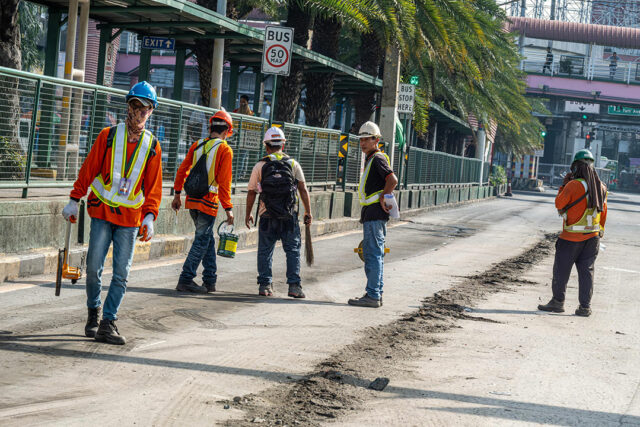
MEN are at work on a road project in Tondo, Manila, June 7, 2025. — PHILIPPINE STAR/NOEL B. PABALATE

A SHORTAGE of jobs is emerging as the biggest worry for Philippine business leaders, according to the World Economic Forum (WEF), a sign that economic growth risks falling short of what’s needed to absorb workers over the next two years.

Philippine executives ranked weak public services and social protection as their second concern in the WEF’s 2026 Global Risks Report, with respondents pointing to shortcomings in education, infrastructure and pension systems.

Business leaders also flagged the spread of misinformation and disinformation, unintended effects of artificial intelligence, and inflation as key threats to the economy.

Leonardo A. Lanzona, an economics professor at the Ateneo de Manila University, said the Philippine executives’ concern over jobs reflects the recent economic slowdown.

“As the economy screeches to a slowdown as a result of the decrease in government expenditures, aggregate demand decreases,” he said in a Messenger chat.

The lack of additional opportunities is also causing a number of businesses, particularly micro, small, and medium enterprises, to fail, Mr. Lanzona said.

“Consequently, this economic slowdown brings about significant unemployment,” he added.

In the first 11 months of 2025, the unemployment rate averaged 4.19% or equivalent to 2.25 million jobless Filipinos. This is higher than the 3.9% jobless rate, which is equivalent to 1.66 million in the same period in 2024.

“As most of the budget is eaten by debt, the situation is aggravated by lower social protection, political infighting, and a labor-saving technology such as AI (artificial intelligence) that can further reduce labor demand,” Mr. Lanzona said.

Meanwhile, the WEF report showed globally, the biggest risk over the next two years remained geoeconomic confrontation.

The WEF’s Global Risks Perception Survey captured insights from over 1,300 experts worldwide.

Other top risks cited by global business leaders included misinformation and disinformation, societal polarization, extreme weather events, and state-based armed conflict.

“Geoeconomic confrontation has emerged as the most severe risk over the next two years, while economic risks have experienced the sharpest rises among all risk categories over the two-year timeframe,” WEF Managing Director Saadia Zahidi said.

Rising inflation and potential asset worries rose as countries face high debt burdens and volatile markets amid growing concerns over an economic downturn, she said.

The WEF noted that 18% of surveyed participants identified geoeconomic confrontation as the top risk likely to trigger a material global crisis in 2026.

This was followed by state-based armed conflict (14%), extreme weather events (8%), societal polarization (7%), misinformation and disinformation (7%), and economic downturn (5%).

Meanwhile, over the next 10 years, survey participants expect extreme weather events to become even more severe. — Aubrey Rose A. Inosante

Gov’t partnerships with private sector seen to boost transparency in public works projects

Parts of Epifanio de los Santos Avenue (EDSA) in Pasay City are under rehabilitation in Pasay City on Thursday, Dec. 25, 2025, after the start of the EDSA rehabilitation project by the Department of Public Works and Highways-National Capital Region (DPWH-NCR). Heavy equipment is seen in the area as reblocking of damaged road sections and asphalt overlaying across the entire width of EDSA are being carried out from Dec. 24 to 27, 2025. — PHILIPPINE STAR/ RYAN BALDEMOR

By Aubrey Rose A. Inosante, Reporter

TAPPING PRIVATE and development partners for state infrastructure projects may help improve efficiency and transparency as the Philippine government continues to deal with the economic fallout from a corruption scandal linked to public works.

Public-Private Partnership (PPP) Center Executive Director and Undersecretary Rizza Blanco-Latorre, who took office on Dec. 11, said teaming up with private entities for infrastructure projects could be a “feasible” option for the government.

“(The) PPP option enables the public to harness private sector expertise while at the same time ensuring that project delivery is performance-based, has optimal risks allocation, and holds private partners accountable throughout the project lifecycle, she told BusinessWorld in a Viber message on Dec. 19.

The Marcos administration is facing governance concerns as a wide-scale controversy involving anomalous state flood control and infrastructure projects linked to Public Works officials, lawmakers, and contractors has highlighted the systemic corruption that continues to hamper the delivery of public services, weighing on the Philippines’ economic prospects.

In the third quarter of 2025, Philippine gross domestic product (GDP) growth slowed to a more than four-year low of 4% as the graft scandal stalled both public and consumer spending.

Analysts have said that minimizing the government’s monopoly over infrastructure projects could be a key to curbing corruption.

Under the PPP model, the government can grant subsidies, tax breaks, guaranteed revenues, or asset transfers to attract private sector partners to help fund, build, and operate projects.

“The PPP Center has established relevant project development and project management interventions, as well as capacity building support, to enable concerned implementing agencies to pursue the said PPP option,” Ms. Blanco-Latorre said.

The PPP Code enables projects usually funded by the national budget to be carried out through the model and also allows for both solicited and unsolicited proposals.

A solicited proposal refers to projects that are identified by the implementing agency from the list of their priority projects, for which bids are invited from the public, while an unsolicited proposal is submitted by private sector proponents without formal solicitation from the government.

“We reiterate, though, the critical need to diligently structure these projects as PPPs to ensure the viability of private sector participation, manage implementation risks, and truly secure the best deal for government and the public,” she said.

PPP Center data as of Dec. 19 showed that the project pipeline consists of 251 projects valued at P2.81 trillion, while 290 projects worth P3.61 trillion are under implementation.

Acting Budget Secretary Rolando U. Toledo said that both private and development partners could help the government plug infrastructure gaps, with public spending now undergoing greater scrutiny.

“Strategic use of PPPs and concessional financing can help restore credibility and accelerate delivery given the additional layer of review that is being undertaken here by the oversight agencies,” he said in a statement sent to BusinessWorld via Viber message on Dec. 20.

Proposed projects are reviewed through inter‑agency deliberations to assess viability, while ongoing projects are regularly monitored for performance, he said.

“Given the downturn in public infrastructure spending brought about by the flood control issues, it is important that private construction steps up to cover the gaps we are now facing in the infrastructure development.”

Mr. Toledo added that PPPs have “big potential” as private sector interest in undertaking projects has increased since the passage of the PPP Code. However, this also heightens the need for stronger preparation, transparency, and accountability mechanisms at all stages of project delivery.

GOVERNANCE RISKS
Infrastructure investment is a “critical” contributor to GDP as it directly contributes to output and has multiplier effects that can boost economic growth, Asian Development Bank (ADB) Country Director for the Philippines Andrew Jeffries said in an e-mailed statement on Dec. 18.

“There remains a need for public investment at scale to address critical infrastructure gaps — particularly in transport, energy, and digital connectivity — to strengthen the Philippines’ competitiveness as a destination for private investment,” he said.

“The greatest risk with a sustained reduction in public expenditure is if critical investment needs are not met, in turn depressing the country’s overall competitiveness and productivity. Regardless of the source of funds, execution and governance risks need to be managed to ensure the quality of infrastructure spending.”

Mr. Jeffries said the government should prioritize investments in social infrastructure where commercial returns are not attractive for private sector players.

“Private sector investment can increase efficiency and help in effective technology transfers. Multilateral development bank financing can be a source of long-term stable financing and best practices, and help deliver strong governance,” he added. “As the Philippines approaches upper middle-income country status, the private sector will need to play an increasingly significant role in driving innovation, job creation, and growth.”

The ADB is ready to support Philippine infrastructure development through both financing and policy support, Mr. Jeffries said.

“This support includes the ability to provide large-scale financing coupled with strong oversight of procurement, financial management, and project implementation. ADB’s support goes well beyond infrastructure project lending, however, and includes policy support and technical assistance to improve regulatory frameworks and the ease of doing business,” he said.

Improving the enabling environment for private investments and PPPs is also part of the ADB’s key support areas for the Philippines, he added.

“At the same time, recent issues also underscore that PPPs are not a substitute for strong public sector planning, governance, and oversight. In practice, the feasibility of an expanded PPP role will closely depend on sustained improvements in upstream project preparation, transparent and competitive procurement, and credible regulatory frameworks,” he said.

“Without these foundations, transferring more responsibility to private firms could shift — rather than reduce — project risks and costs.”

Nigel Paul C. Villarete, a senior adviser on PPPs at technical advisory group Libra Konsult Inc., said that it is necessary for a developing economy like the Philippines, whose spending requirements far exceed its capacity to generate revenues, to open the door for increased private sector participation in infrastructure projects while having the appropriate safeguards in place.

“While we do have a sizeable and increasing chunk of private sector investments, our annual development expenditures are still mostly public. But the possibility of boosting private investments in nation-building remains available and even necessary,” he said in a Viber message on Dec. 20. “We’re not placing or changing priority from one to the other — we’re just making use of available financing opportunities to support the main public fiscal spending, which should continue as the main source.”

However, the government must rebuild investor trust by implementing reforms, he said.

“As always investor confidence is key. No one will shell out money when uncertainties remain, more so when these include possible corruption issues. That’s why clear and proper rules and guidelines are necessary, [with] ambiguities minimized or even completely erased,” Mr. Villarete said.

“We also need to understand that private sector financing will be attractive when the private sector is allowed to generate an attractive rate of return. This is where the balance comes in. PPPs must be both attractive and safe for all sectors.”

Mr. Toledo also acknowledged that improving investor sentiment is key to ensuring the economy’s recovery amid the corruption mess.

“The main risk is if investors’ confidence remains low and therefore, it would not provide the needed boost to the GDP growth,” he said.

“Over the short term, growth outcomes will still depend on the government’s ability to instill confidence through its efficient spending and credible policies in addressing corruption.”


UAE-based G42 eyes up to $500-M investment in PHL data center — DICT

STOCK PHOTO | Image DC Studio from Freepik

THE PHILIPPINES is attracting renewed interest from global data center operators, with Abu Dhabi-based technology firm Group 42 Holding Ltd. (G42) planning to invest as much as $500 million (around P29.6 billion) in a new facility.

Department of Information and Communications Technology (DICT) Secretary Henry Rhoel R. Aguda said G42, which expressed interest toward the end of the Philippine delegation’s recent trip to Abu Dhabi, is considering an investment of $300 million to $500 million over three to five years.

“They still have a lot to do. They need to come to the Philippines and check the availability of land. With data centers, you also need power and water,” Mr. Aguda told a Palace briefing.

Combined with multiple international subsea cables linking the Philippines to global routes, the country is positioned as a potential data center hub in Southeast Asia.

Data center operators view the Philippines’ geography and connectivity as strategic, Mr. Aguda said, noting that strong digital infrastructure could allow the country to eventually export artificial intelligence (AI) services, treating AI computing like a utility delivered from local facilities.

“As for connectivity, they’re essentially already sold on that — it’s not a problem. The Philippines has many international subsea cables coming in from the north-south, northeast, and southwest routes,” he added.

Investors have also been encouraged by the near completion of the national fiber backbone, which runs from north to south, and the Luzon Bypass Infrastructure, which strengthens east-west connectivity.

Connectivity is no longer a constraint, Mr. Aguda said, with remaining considerations focused on securing suitable land with reliable power and adequate water access — key requirements for large-scale data centers.

President Ferdinand R. Marcos, Jr. was in the United Arab Emirates (UAE) earlier this week to witness the signing of a trade deal and a defense pact. During his trip, he and Mr. Aguda met with tech firm DAMAC Digital, which is exploring plans for what may become the country’s largest data center in Laguna.

The administration is offering priority support for the sector as part of its strategy to attract capital into high-value, tech-driven industries and position the Philippines as a regional hub for digital infrastructure amid rising demand from e-commerce, digital payments, and AI.

DAMAC Digital has committed over $3 billion to Southeast Asia and plans 250 megawatts of operational capacity in the region by 2026. — Chloe Mari A. Hufana

Meralco sees interest from top power firms for 200-MW RE supply

PHILIPPINE STAR/RYAN BALDEMOR

SUBSIDIARIES of ACEN Corp., First Gen Corp., San Miguel Global Holdings Corp. (SMGP), and Aboitiz Power Corp. (AboitizPower) are looking to bid for Manila Electric Co.’s (Meralco) 200-megawatt (MW) renewable energy (RE) supply requirements.

All 15 companies that expressed interest and attended Thursday’s pre-bid conference were major players in the country’s power sector.

Ayala-led ACEN Corp., along with its subsidiaries SanMar Solar, Negros Island Solar, and Sinocalan Solar Power, indicated interest in supplying Meralco’s renewable energy needs.

Lopez-led First Gen and its subsidiaries, including First Gen Hydro, Energy Development Corp., BacMan Geothermal, and Greencore Geothermal, also participated in the conference.

SMGP subsidiaries Mariveles Power Generation, and Sual Power expressed their interest in joining the bidding.

Aboitiz Power Corp.’s subsidiaries, including AP Renewable Energy, GNPower Mariveles Energy Center, Therma Luzon, and Therma Visayas, are also expected to participate. GNPower Kauswagan is owned by Power Partners, a partner of AboitizPower.

AboitizPower, SMGP, First Gen, and ACEN were the country’s leading power producers, dominating the national market share last year, according to the Energy Regulatory Commission (ERC).

Since the bid submission deadline on Feb. 16 is after the proposed effective date of Jan. 26, Meralco said the latter will be moved depending on when the ERC approves the resulting power supply contract.

The four-year agreement aims to help Meralco comply with the Renewable Portfolio Standards, which require distribution utilities to source a portion of their electricity from eligible renewable energy sources.

Suppliers, whether renewable, conventional, or a combination, can fulfill the supply requirements from their own plants or the spot market, provided that renewable energy certificates (RECs) are guaranteed. Each REC represents a megawatt-hour of electricity generated from eligible RE sources.

“As a highly regulated entity, Meralco remains fully committed to upholding the highest standards of transparency, fairness, and regulatory compliance throughout the CSP (competitive selection process),” said Lawrence S. Fernandez, chairman of Meralco’s bids and awards committee for power supply agreements.

Meralco’s controlling stakeholder, Beacon Electric Asset Holdings, Inc., is partly owned by PLDT Inc. Hastings Holdings, a unit of PLDT Beneficial Trust Fund subsidiary MediaQuest Holdings, has an interest in BusinessWorld through the Philippine Star Group, which it controls. — Sheldeen Joy Talavera

Basic Energy earmarks P1.9B for 43-MW solar project in Negros

STOCK PHOTO | Image from Pixabay

LISTED Basic Energy Corp. is allocating around P1.9 billion for the development of a 43.41-megawatt alternating current (MWac) solar power project in Cadiz City, Negros Occidental.

In a disclosure on Thursday, the company said it received a certificate of award from the Department of Energy (DoE) following its successful bid in the fourth round of the green energy auction (GEA-4).

GEA-4 projects cover technologies such as ground-mounted, roof-mounted, and floating solar; onshore wind; and integrated solar with energy storage systems.

“With the receipt of the certificate of award, the company is advancing the completion of the remaining project requirements, including the execution of the necessary agreements, in preparation for the development and delivery of the project to the Visayas grid,” Basic Energy said.

The solar project is slated to begin commercial operations on or before the end of the year.

Basic Energy Chief Executive Officer Oscar L. de Venecia, Jr. said construction has not yet started, as the company is completing remaining pre-development requirements. The start of construction will follow once these requirements are finalized, in line with the project’s overall development timeline. 

“The company is mindful of the project’s delivery commitment and is managing the development work accordingly. However, construction will only commence after the remaining pre-development requirements are completed,” he said.

Last year, he said the company allocated up to P300 million to finance pre-development activities for its renewable energy projects over the next two to three years.

Basic Energy is pursuing three solar projects with a combined potential capacity of around 150 MW and aims to build a 1-gigawatt renewable energy portfolio by 2030.

At the local bourse on Thursday, shares of the company rose 8.06% to close at P0.134 per share. — Sheldeen Joy Talavera

Peso slips to fresh record low on rate cut bets

BW FILE PHOTO

THE Philippine peso weakened to a new record low against the dollar on Thursday as markets priced in the possibility that the Bangko Sentral ng Pilipinas (BSP) could cut interest rates ahead of the US Federal Reserve.

The local currency closed at P59.46 a dollar, down two centavos from Wednesday’s record-low finish of P59.44, data from the Bankers Association of the Philippines showed.

The peso opened Thursday’s session slightly stronger at P59.43, touched an intraday high of P59.35, and weakened to as low as P59.47. Dollar trading volume rose to $1.079 billion, higher than the $951 million recorded the previous day.

“The dollar-peso closed higher on prospects of a narrowing interest rate differential, with the BSP expected to cut rates before the Fed,” a trader said by telephone.

Another trader said the peso continued to soften after recent US producer inflation and retail sales data underscored the resilience of the American economy, reinforcing expectations that the Fed will keep policy rates unchanged in the coming months.

Rizal Commercial Banking Corp. Chief Economist Michael L. Ricafort said market expectations of a BSP rate cut at its February policy meeting also weighed on the peso.

BSP Governor Eli M. Remolona, Jr. said last week that a rate cut at the Monetary Board’s Feb. 19 meeting “remains on the table” but is “unlikely,” as the central bank is nearing the end of its easing cycle.

The BSP has reduced its benchmark rate by a total of 200 basis points since August 2024, bringing the policy rate to a more than three-year low of 4.5%.

Despite the peso’s weakness, the BSP sees no need for immediate intervention. Palace Press Officer Clarissa A. Castro said the central bank continues to closely monitor exchange-rate movements and is prepared to act if necessary.

“The Bangko Sentral ng Pilipinas continues to monitor the peso-dollar exchange rate so it can take appropriate action if needed,” she told a news briefing in Filipino. “For now, the central bank is confident that intervention is not required.”

She said the peso’s depreciation reflects global developments, including the strength of the US dollar driven by expectations on Fed policy and geopolitical tensions abroad.

The government is working to mitigate the impact of a weaker peso by slowing price increases, supporting investments, and strengthening key economic sectors, she added.

MUFG Global Markets Research Senior Currency Analyst Michael Wan said the peso might remain more sensitive to oil price movements than some of its regional peers, although further oil price increases are not his base case scenario.

“Further oil price increases is not our base case, and we will look to see if the peso retraces some weakness on these recent oil price moves,” he said.

Traders said the peso could continue testing record lows until the BSP and Fed hold their respective policy meetings, unless the US central bank signals a shift toward rate cuts.

However, movements will remain data-dependent, particularly on US inflation and labor market indicators. 

For Friday, the first trader sees the peso trading from P59.20 to P59.50 a dollar, while the second trader expects a range of P59.25 to P59.50.

Mr. Ricafort said the local currency could move from P59.35 to P59.55, noting that strong foreign exchange reserves and continued net foreign buying in the local stock market might help cushion further depreciation. — Aaron Michael C. Sy

Fintech firms may drive IPO activity

BW FILE PHOTO

THE financial technology (fintech) sector is expected to drive initial public offering (IPO) activity in the Philippine stock market later this year through 2027, Citigroup Inc. (Citi) said, as investor interest gradually returns to the local equity market.

Rob Chan, head of Equity Capital Markets (ECM) Syndicate for Asia at Citi, said the Philippine equity market is likely to remain stable, with several companies — particularly fintech firms — seen lining up potential listings.

“We could see more (IPO activity) coming from the Philippines, but that’s, to my understanding, perhaps later in the year, or perhaps even slipping into 2027,” he told reporters.

“What we are excited to see is, to the extent there’s going to be growth in businesses, especially around fintech names that investors are expecting,” he added.

IPO activity in the Philippines has been muted in recent years. In 2025, only two companies completed their listings, falling short of the Philippine Stock Exchange’s (PSE) target of six IPOs.

Cebu-based fuel distributor and retailer Top Line Business Development Corp. listed in April, while Maynilad Water Services, Inc. completed its IPO in November.

Mr. Chan said the Philippine market has historically not been among the region’s most active in terms of equity capital market transactions, citing relatively low trading liquidity as a key concern for international investors.

“The lower trading liquidity is something investors are very focused on,” he said.

Still, he pointed to Maynilad’s $500-million IPO and its strong aftermarket performance as a positive signal for the local market.

To see a transaction of that size trade well is a “very positive sign,” he said, adding that such deals help build confidence in the Philippines as an investment destination.

The PSE is targeting four potential listings this year, including electronic wallet platform GCash and PNB Holdings Corp.’s planned listing by way of introduction.

GCash was initially slated to go public last year, but its operator, Globe Fintech Innovations, Inc., deferred the plan due to weak market conditions.

Mr. Chan said the successful execution of these offerings could help lift overall equity capital market activity compared with recent years and attract greater interest from global investors.

“As those IPOs actually happen, that could increase the overall level of global investor focus on the Philippines,” he said.

He added that while Singapore remains the dominant market for equity capital transactions in Southeast Asia, the Philippines has shown gradual year-on-year growth in capital market activity over the past three years, with annual deal values reaching about $1 billion.

Mr. Chan said international investors are likely to continue focusing on larger, well-established Philippine companies with clear growth narratives, particularly in sectors such as fintech.

The Philippine Stock Exchange index rose 1.52% or 97.72 points to close at 6,487.53, while the broader all-share index gained 0.68% or 24.76 points to 3,660.70. — Katherine K. Chan

JFC reports stable domestic sales, strong overseas growth in Q4 2025

BW FILE PHOTO

JOLLIBEE Foods Corp. (JFC) said it saw stable domestic demand and strong overseas growth in the fourth quarter (Q4) of 2025, led by Vietnam.

“Since our December update, the operating environment and business trends have remained broadly consistent with our prior disclosures,” JFC Chief Financial and Risk Officer Richard Shin said in a statement on Thursday.

“Customer demand has been stable across key markets, and network expansion continues to be supported by strong franchise engagement, reinforcing our asset light growth strategy,” he added.

The company said preliminary indicators showed solid system-wide and same-store sales growth in Q4 2025.

In the Philippines, Jollibee Group’s Champion Brands, including Jollibee, Chowking, and Mang Inasal, drove domestic system-wide and same-store sales growth through brand equity and consumer engagement, with fourth-quarter results showing improving demand amid a challenging operating environment.

Vietnam, Jollibee Group’s largest overseas market by store count, recorded high double-digit system-wide and same-store sales growth that outperformed peers, supported by strong market position and asset-light expansion, the company said.

“The Tim Ho Wan (THW) concept continues to emerge as a strategic growth engine for the Jollibee Group, highly complementary to the Group’s portfolio and well positioned for long-term global expansion,” it said.

In January 2025, JFC completed its takeover of Tim Ho Wan through its subsidiary Jollibee Worldwide Pte. Ltd., acquiring 166.46 million shares from Titan Dining Group Ltd. for $20.2 million under a share purchase agreement signed in November 2024.

“In Hong Kong, store operations have stabilized and returned to profitability, reinforcing confidence in the brand’s operating model and execution under the Jollibee Group’s stewardship, including the first THW location opened following the acquisition. In the US, early customer response to newly opened stores has been encouraging, supporting management’s conviction in the scalability and long-term growth potential of the THW brand across international markets,” it said.

Over the past four years, Jollibee Group achieved double-digit growth in system-wide sales, revenues, earnings before interest, taxes, depreciation, and amortization (EBITDA), operating profitability, and store network expansion, the company noted.

Its store network growth remained on track, supported by more franchises and its low-asset strategy, which aids scalability and efficiency across markets.

Jollibee recently inaugurated its fourth food commissary in Guinsay, Danao, Cebu, supporting regional expansion and job creation. The facility serves Jollibee and six of its 13 brands and aims to optimize logistics across the Visayas and Mindanao.

JFC plans to spin off its international business into a standalone company, which it will list on a US stock exchange by late 2027 to support its global expansion.

Jollibee Foods Corp. International (JFCI) would include all businesses outside the Philippines, while domestic operations will remain listed locally.

Shares of JFC jumped the most in over five years after the announcement.

In a media briefing, Mr. Shin said the proposed transaction seeks to unlock value by providing structural clarity, enabling investors to evaluate each business independently with greater transparency.

“Each entity will operate as a fully independent entity post-separation. They are independent companies now, they’re not subsidiaries anymore. Each entity will have its own board management team and operating model with clear accountability and decision-making authority,” he said.

Mr. Shin added that the setup would make capital allocation and strategy execution smoother, potentially driving sustainable returns and valuation re-rating over time. 

He noted that a US listing aligns JFCI with the largest capital market, provides liquidity access, and supports valuation discovery, making it preferable over other indices.

At the local bourse on Thursday, JFC shares rose 0.29% or 60 centavos, closing at P209 each. — Alexandria Grace C. Magno

Floating above Cappadocia

AERIAL VIEW of Cappadocia — CATHY ROSE A. GARCIA

By Cathy Rose A. Garcia, Editor-in-Chief

IMAGINE waking up at dawn, excited to finally check off one of the top experiences on your travel bucket list. But then you’re seized by the thought: “What if it’s just another tourist trap?”

Like many other people, my travel bucket list has always included “a hot air balloon ride over Cappadocia.”

After all, who has not seen the countless TikTok videos of dozens of hot air balloons floating as the sun rises over Cappadocia’s otherworldly rock formations? They are so picture-perfect that not a few have commented: “It looks AI!”

So, when I had a chance to visit Turkey in October, I wanted to see for myself if the hot air balloons of Cappadocia would live up to the hype.

To get to Cappadocia, we first had to take an over 12-hour flight from Manila to Istanbul, then a one-and-a-half-hour flight from Istanbul to Kayseri. Kayseri is in east central Anatolia and widely considered as the gateway to the Cappadocia region.

Cappadocia is known for its unique rock formations that were formed through volcanic activity and erosion over thousands, if not millions of years.

Our first stop was Love Valley, perhaps due to its phallic-shaped fairy chimneys. These fairy chimneys are tall spires made of soft volcanic rock that was easily eroded by natural elements over thousands of years.

Meanwhile, Pigeon Valley takes its name from the man-made pigeon houses that were carved into the volcanic rock. Red Valley is known for its rock formations that take on crimson hues during sunset.

After seeing countless TikToks and Instagram posts, I was convinced the best way to admire Cappadocia’s landscape was from a hot air balloon.

However, apprehension crept in. Hot air balloons are safe, right? Right?

I swallowed my fears and pushed through with it.

Since it was early October, our pick-up time from the hotel was at 5:30 a.m. The guide told us that the pick-up time depends on the season and can be as early as 4 a.m. during summer.

The launch sites for hot air balloon rides are usually around the Göreme area. But there’s no guarantee that the hot air balloon ride will push through, as operators must wait for the Turkish Civil Aviation Authority to give its clearance.

Another thing you need to know is there are no toilets in the area so do your business before getting there.

After a short car ride, we arrived at the launch site by 6:30 a.m. The large balloons lay on the ground still deflated. We watched as the crew set up and inflated the balloons using a gas-fired fan. Slowly, the balloons come alive.

Temperatures hovered around 10°C, making us glad we wore thick jackets.

Before long, the guide called us over to the balloon’s basket which was bigger than we expected and could hold up to 28 people. There was some confusion since there were different tour groups in the ride, so we scrambled to make sure that we were all in the same corner of the basket. 

The basket gently lifted off the ground, with burners on to heat the air inside the balloon.

Everyone held up their phones and cameras to capture the moment. The hot air balloon gently ascended into the sky. It was so smooth that we didn’t even notice we were already high up.

The sky was clear, with no wind. The sun peeked through the rugged mountain ranges, while rainbow-colored hot air balloons floated all around us.

I tried hard to just be in the moment — to enjoy the view as the sun slowly rose and a golden light bathed the white rock formations and fairy chimneys. From above, Cappadocia looked like an alien planet, something out of Dune or Star Wars. I remember looking down and pinching myself because it really felt like a dream.

Time flew by. I took dozens of photos and videos of the sunrise, the balloons, and the surreal landscape.

Soon our 60 minutes were up. The pilot made his descent, with everyone crouched in a landing position. While it was a bit bumpy, everyone was safe and sound when we landed.

Another thing that TikToks and Instagram posts don’t show you is how awkward it is to get out of the basket. We basically had to be carried over the side by the crew members. Ah, the indignity of it all!

Once on solid land, the crew brought out a bottle of sparkling juice to celebrate the successful flight. Again, social media posts make this into some sort of fancy experience, but the sparkling juice felt flat.

On the way back, I scrolled through dozens of photos on my phone. None truly captured the magic of floating over the Cappadocia’s otherworldly landscape. It was a reminder that some experiences live richer in memory than any phone or camera can hold.

It’s the corruption, sir

STOCK PHOTO | Image from Freepik

The numbers no longer whisper. They shout.

Last Wednesday’s broadsheets carried a grim headline: foreign direct investment (FDI) has slumped sharply, driven by a collapse of more than 50% in non-residents’ net investments in debt instruments such as intercompany loans and related financing. In normal circumstances, such a retreat could be blamed on global headwinds, tightening financial conditions, or deteriorating macroeconomic fundamentals. But this time, the explanation lies much closer to home, and it is deeply uncomfortable.

As we noted in our GlobalSource Partners commentary released the same day, the fall in FDI reflects “recent governance developments.” In plain terms, this is about corruption. The flood control scandal, together with long-standing concerns about weak public accountability and selective justice, has poisoned investor confidence. The October year-on-year plunge in FDI is not a statistical accident. It is a verdict.

The data reinforce what investors have been quietly signaling for months. Confidence in Philippine governance is eroding, and patience is running out.

This is not an isolated episode.

Even before the October collapse, FDI inflows had already weakened in August and September. That pattern points to a sustained deterioration in sentiment, not a temporary market overreaction. Modest gains in equity investments and reinvested earnings were simply not enough to offset the chilling effect of policy uncertainty, institutional fragility, and governance risks. Momentum now works against the country and once credibility is lost, it is extraordinarily difficult to recover.

To be clear, the Philippines is not devoid of talent or institutional foundations. There are competent and principled public servants. There are laws on the books, agencies with mandates, and policy frameworks that could function if insulated from politics and rent-seeking, particularly on the fiscal side. But these strengths are being overwhelmed by a far more powerful signal that accountability is optional for the powerful, and justice is negotiable.

Investors are not confused. They are responding rationally.

Weak governance is now intersecting with weak investment fundamentals. Despite a larger economy and a growing population, gross capital formation remains stubbornly low, reaching only about 23% of GDP. This places the Philippines at the bottom tier of investment performance in the region. Thailand, Malaysia, and Singapore occupy similar ranges today, but they posted much higher investment shares when they were growing at high single-digit rates. Meanwhile, Indonesia, Vietnam, and Cambodia consistently invest between the mid-20s and over 30% of GDP.

This gap matters.

Countries that invest more build faster, learn quicker, and compete better. Vietnam has already overtaken us. Cambodia, with investment ratios above 30%, is not far behind. An economy that fails to invest condemns itself to slower growth, weaker productivity, and declining relevance.

And yet, just as the country struggles with low physical investment, it faces an even more daunting challenge. This is preparing the people for an economy being reshaped by artificial intelligence (AI) and innovation.

IMF Managing Director Kristalina Georgieva has been unequivocal in saying that countries that fail to prepare workers and firms for the AI transition will fall behind, quickly and decisively. For the Philippines, this means equipping young people with cognitive, creative, and technical skills that complement AI rather than compete with it. It means reskilling displaced workers before they are pushed into permanent redundancy.

But the starting point is deeply troubling. Philippine students continue to perform poorly in reading, science, and mathematics. Creative thinking scores are alarmingly low. These are not abstract indicators — they are early warnings of a workforce ill-prepared for the demands of a high-productivity, innovation-driven modern economy.

The IMF’s new Skills Imbalance Index makes the global stakes even clearer. Countries that successfully align skills with future demand will enjoy labor mobility, adaptability, and growth. Those that fail will face stagnation, inequality, and social strain. This reality demands not only education reform but also stronger competition policy, easier entry for new firms, and robust social protection systems to support job transitions.

And this is precisely where corruption inflicts its deepest damage.

Every peso lost to graft is a peso stolen from classrooms, laboratories, digital infrastructure, and public health. With national budgets leaking and public trust evaporating, hopes for a decisive pivot toward human capital development remain just that. Hopes. Public discourse is still trapped in the language of minimum adequacy, while the future demands excellence.

Yes, the 2026 national budget emphasizes human capital, digital transformation, and infrastructure. Funding for science and technology, digital connectivity, education, and innovation has increased. These are welcome steps. But incremental progress will never be enough if systemic corruption continues to undermine execution. A bigger budget means little if governance remains broken.

Investors see the contradiction clearly. They value Filipinos’ English proficiency, work ethic, and adaptability. At the same time, they flag weak digital skills, narrow technical competencies, and low productivity. Domestic firms echo these concerns, pointing to persistent skills mismatches and the urgent need for education reform and more flexible labor policies. Unless these structural issues are addressed decisively, capital flows will remain volatile and increasingly scarce.

Some will argue that the Philippines is improving its competitiveness. The data supports modest progress. Rankings in global competitiveness and digital readiness have inched upward. But this is faint praise. Improvement from a low base does not change the fact that we remain well behind our ASEAN peers — and are falling further behind those moving decisively.

More damaging still, whatever gains we achieve are being wiped out by the perception, and reality, of bad governance. Transparency International’s 2024 Corruption Perceptions Index ranked the Philippines 114th out of 180 countries, with a score of 33. This places us far below the global and regional averages, and behind every major ASEAN competitor. Singapore, Malaysia, Vietnam, Indonesia, and Thailand all outperform us, for some, dramatically.

These rankings reflect what investors already believe: that transparency is weak, enforcement selective, and accountability uncertain. With the flood control scandal dominating headlines, there is every reason to expect further reputational damage.

It should be no puzzle, then, that October’s FDI inflows collapsed. One headline said it plainly: “Corruption puts investors on edge.” The country’s largest business group warned that investment sentiment will continue to deteriorate unless those implicated in the multibillion-peso scandal are held accountable even at the highest levels. The Philippine Chamber of Commerce and Industry was right to say that foreign investors’ patience is “razor-thin.”

This warning must not be ignored. While global shocks matter, corruption has become a decisive factor in the country’s investment decline. Calls to strengthen safeguards in the 2026 budget are necessary — but they are no substitute for credible enforcement and visible accountability.

The fiscal consequences are already severe. National Government debt has more than doubled in six years, rising from P7.7 trillion before the pandemic to an estimated P17.6 trillion, or over 63% of GDP. Debt servicing now absorbs roughly P2 trillion a year — resources that should have gone to infrastructure, education, and innovation. With revenues persistently low and expenditures high, borrowing pressures remain relentless.

Under these conditions, sustained growth is not just unlikely, it is implausible.

So if we ask why the economy refuses to lift off, we might recall James Carville’s blunt advice: “It’s the economy, stupid.” But in the Philippines today, the diagnosis is sharper and more uncomfortable.

It’s the corruption, sir.


Diwa C. Guinigundo is the former deputy governor for the Monetary and Economics Sector, the Bangko Sentral ng Pilipinas (BSP). He served the BSP for 41 years. In 2001-2003, he was alternate executive director at the International Monetary Fund in Washington, DC. He is the senior pastor of the Fullness of Christ International Ministries in Mandaluyong.

DoE reviews Semirara coal contract ahead of 2027 expiry

SEMIRARAMINING.COM

The Department of Energy (DoE) is weighing whether to extend the coal operating contract of Semirara Mining and Power Corp. (SMPC) or offer it to other mining firms as it approaches expiration in 2027.

Energy Secretary Sharon S. Garin said the 50-year contract gives the department two options: extend it or bid it out to other companies.

“We’re still under discussion together with our legal team on what to do because we have to assess if the claim of Semirara is correct. But we will decide within the quarter,” she told reporters on Tuesday.

The coal operating contract, which was originally set for 35 years, was issued in 1977, granting SMPC the exclusive right to explore, develop, and mine coal on Semirara Island. The DoE extended the term by 15 years, moving its expiration from 2012 to 2027.

Ms. Garin said the company is “asking for 13 years more” for the effective period of its contract.

Asked whether other firms had expressed interest, she said the DoE had received no official or unofficial notice.

“But I guess because it’s the biggest mining company or coal mining company in the country, it has the potential to mine for a few years more. So there might be some interest also,” she added.

SMPC, the power generation and coal-mining unit of the Consunji group, is the Philippines’ largest coal producer and the only power company in the country that owns and mines its own fuel source.

Last year, the company allocated a P6.9-billion capital expenditure budget to improve operational efficiencies in its coal and power segments.

For the first nine months of 2025, SMPC’s income fell 37% year on year to P9.9 billion, due to weaker coal and electricity prices. Revenues slipped 13% to P43.26 billion.

Despite this, the company’s total coal shipments reached a record 12.9 million metric tons (MT), driven by stronger exports and increased deliveries to its own power plants.

Coal production also hit an all-time high of 15.1 million MT, aided by improved access to coal seams at the Narra mine. — Sheldeen Joy Talavera

JuanHand: Double-digit loan growth likely ’til 2030

JUANHAND Lending Corp. expects the Philippine financial technology (fintech) industry to sustain high-double-digit loan growth through 2030, after a resilient performance last year despite weaker business sentiment.

“We’re in a great position for fintech  because it’s still growing on high double-digit, even for 2026 and beyond,” President and Chief Executive Officer Francisco “Coco” Mauricio told a news briefing on Wednesday.

“We expect the growth to be very high double-digit until at the very least 2030,” he added.

The fintech sector expanded 27% year on year in 2025, buoyed by strong demand for online lending despite a corruption scandal that dampened overall business confidence in the latter half of the year.

JuanHand itself recorded a compounded annual growth rate of 89% over the past five years, effectively doubling its business annually.

The company reported more than 100,000 transactions a day and P4 billion in loan disbursements each month last year. Its platform also surpassed 65 million downloads, 20 million registered users and 4 million active borrowers at any given time.

Mr. Mauricio credited the company’s robust anti-fraud systems for supporting growth.

He said their proprietary cybersecurity platform prevented almost all attempted fraud. Only 0.0001% of transactions initially bypassed the system, and those were eventually stopped, he added.

JuanHand also said it would comply with the Securities and Exchange Commission’s (SEC) interest rate and fee caps for small consumer loans, despite previously proposing a tiered approach.

“JuanHand is in support of regulation and the SEC. We have followed the previous 15%, and there is no reason for us again not to comply with the 12% limit coming April 2026,” said Francis Jasper Fulgar, head of external affairs.

The SEC in December capped nominal interest rates at 6% per month and effective interest rates at 12% per month for loans up to P10,000 with terms of up to four months.

Mr. Mauricio noted that these limits apply primarily to smaller loans, which make up more than 15% of the industry’s total loan book.

Despite regulatory changes, executives said the fintech sector is poised for long-term growth, with increasing adoption of digital lending platforms expected to drive further participation from households and small borrowers. — Aaron Michael C. Sy