Home Blog Page 6899

Sixers on Simmons

To be fair, Doc Rivers faced every question. He knew Media Day was going to be a circus, and loaded with speculation on the status of the Sixers’ frayed relationship with All-Star Ben Simmons. And yet he was only too willing to address anything and everything scribes threw at him. In fact, he proved so bent on explaining the situation that, at one point, he told a reporter, “I’m gonna finish. I’m in charge here.” He wasn’t necessarily being onion-skinned; he simply felt he needed to get his points across.

The bottom line, Rivers argued, is that the Sixers want Simmons back. That was never at issue, he said, not even in the aftermath of an embarrassing exit at the hands of the underdog Hawks in the second round of the 2021 Playoffs. At the time, scrutiny focused on the starting point guard’s paltry offensive output, especially in the crunch. And, with wounds still festering and the pain yet to subside, the head coach waffled. “I don’t know,” he disclosed in response to a query on whether the back-to-back All-Defensive First Team selection could be the point guard of a championship team.

The other day, Rivers didn’t so much as walk back on his comments as point out the erroneous context in which they were taken. And, depending on perspective, he came across as either persuasively sincere or protesting too much. In any case, Simmons has made clear that he isn’t biting; he even turned away a contingent of players who wanted to trek cross-country by jet to his California residence in order to make him change his mind. He wants out, and has no plans to report to training camp, the prospect of lost wages notwithstanding.

By all accounts, the Sixers haven’t stopped wooing Simmons. Media Day was filled with quotes of “We want him back” in varying degrees. Then again, they also haven’t stopped entertaining offers for him. And were they inclined to budge from their prohibitive asking price, he may well be plying his trade in a different jersey by now. It’s not exactly a good start for the 2021-2022 season, and they’re not without blame on the matter.


Anthony L. Cuaycong has been writing Courtside since BusinessWorld introduced a Sports section in 1994. He is a consultant on strategic planning, operations and Human Resources management, corporate communications, and business development.

Kim offers to reopen inter-Korean hotline

KCNA VIA REUTERS

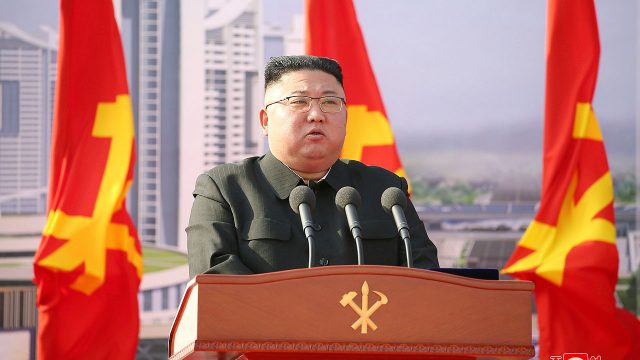
SEOUL — North Korean leader Kim Jong Un said he is willing to restore severed inter-Korean hotlines next month, but accused the United States of proposing talks without changing its “hostile policy” to the country, state media KCNA reported on Thursday.

Mr. Kim made the remarks at the reclusive country’s rubber-stamp parliament, the Supreme People’s Assembly, which gathered for a second day to discuss the government’s political, economic and social agenda.

North Korea this week test-fired a previously unseen hypersonic missile, joining a race for the advanced weapons system led by major military powers, and again demanded that Seoul and Washington scrap their “double standards” over weapon development.

Mr. Kim expressed his willingness to reconnect inter-Korean hotlines starting October, but criticized the South’s “delusion” over what it calls military provocations from the North.

North Korea severed the hotlines in early August in protest against joint South Korea-US military drills, just days after reopening them for the first time in a year.

The decision to reactivate the lines is to help “realize the expectations and desire of the entire Korean nation” for recovery and durable peace in cross-border relations, Mr. Kim said.

“We have neither aim nor reason to provoke South Korea and no idea to harm it,” he said, according to the official KCNA news agency.

South Korea’s Unification Ministry responsible for inter-Korean affairs welcomed Mr. Kim’s offer on the hotlines, but did not comment on his other remarks.

Mr. Kim took a tougher tone toward Washington, accusing President Joseph Biden’s new administration of “employing more cunning ways and methods” in pursuing military threats while still offering talks. “The US is touting ‘diplomatic engagement’ and ‘dialogue without preconditions’ but it is no more than a petty trick for deceiving the international community and hiding its hostile acts,” Mr. Kim said.

The Biden administration has said it reached out to Pyongyang to break an impasse over talks aimed at dismantling its nuclear and missile programs in return for US sanction relief.

It has criticized North Korea’s recent missile launches as “destabilizing” and “threats.”

The UN Security Council was set to meet behind closed-doors on Thursday over the North’s latest test following requests from the United States, Britain and France, diplomats said.

Analysts said the North’s carrot-and-stick approach is aimed at securing international recognition as a nuclear weapons state and driving a wedge between Seoul and Washington, taking advantage of South Korean President Moon Jae-in’s desire for a diplomatic legacy before his term ends in May.

“The North seems upset about the Biden administration having not made any concrete, tempting proposal to resume negotiations,” said Yang Moo-jin, a professor at the University of North Korean Studies in Seoul.

Pyongyang was attempting to foster a more positive mood towards North Korea in Seoul ahead of the upcoming presidential election and press Mr. Moon to help shift US attitudes, he said.

Mr. Kim did not refer to the North’s recent missile tests, but touted “ultra-modern weapons which are being developed at an extremely fast speed” and capable of containing “hostile forces.”

He also said that in order to formally end the 1950-53 Korean War, as suggested by Mr. Moon at the recent UN General Assembly, both Koreas should withdraw “unfair and double-dealing attitude and hostile viewpoint and policies” toward each other.

KCNA separately reported that Kim Yo Jong, the leader’s powerful sister, was named as a new member of the State Affairs Commission, a top governing body created in 2016 and chaired by Kim Jong Un, as part of a personnel reshuffle unveiled on the sidelines of the parliament meeting.

Kim Yo Jong, 32, has risen rapidly since her brother took power in 2011, becoming a senior official at the ruling Workers’ Party handling propaganda and ideological messaging in 2014.

She has taken on a more diplomatic role, especially on inter-Korean affairs since she visited the South for the 2018 Winter Olympics. — Reuters

China’s high-end military technology touted at biggest aviation show

ZHUHAI, China — China put on an extravagant display of once-secret high-end military technology at its largest air show this week, while broadcasting its growing ambitions in space exploration and for self-sufficiency in commercial aircraft.

Pandemic-related travel restrictions meant Airshow China in the southern city of Zhuhai was a largely domestic affair, but foreign observers kept a close eye on developments from afar as China builds its military strength.

“Key platforms in service with the PLAAF — having been operated in tight secrecy previously — being shown to the public for the first time have attracted considerable attention from the international audience,” said Kelvin Wong, a Singapore-based defense editor at Janes.

He pointed to WZ-7 Xianglong, a high-altitude long-endurance reconnaissance drone roughly analogous to the US-made Northrop Grumman RQ-4 Global Hawk but with inferior engines. The WZ-7 has been sighted operating out of airbases close to the Sino-Indian border, the North Korean border and the South China Sea, Mr. Wong said.

China has been working hard to improve the performance of its homegrown engines, which have lagged Western technology. At the show, it flew its J-20 fighter jets with Chinese engines rather than Russian ones for the first time.

Testing is also under way for two types of domestic engines for its Y-20 transport plane, the plane’s chief designer told the Global Times on Wednesday.

The J-16D electronic warfare fighter, its closest equivalent to the US-made EA-18G Growler, was on ground display, showcasing a capability that experts say could help it erode Taiwan’s anti-aircraft defenses in the event of conflict.

Mr. Wong said at least three types of jamming pods were hung on the plane, suggesting that each was designed to disrupt different parts of the electronic spectrum.

China also revealed it is pursuing a “loyal wingman” drone to help protect pricier crewed fighter jets, in line with rival projects in the United States, Britain, Australia, India and Russia.

The developer did not say whether that drone, the Feihong FH-97 concept, would be exported, but the presentation was attended by many foreign observers.

China also revealed it expected to launch its next generation of heavy-duty rockets, powerful enough to send a crewed spacecraft to the moon, in 2028 — two years earlier than previously expected.

In commercial aircraft, China is stepping up efforts to become more self-sufficient in key technologies amid trade tensions with the United States.

Aero Engine Corp of China displayed a rotating, full-size model of the CJ1000 engine under development for the C919 narrow body plane, which could eventually replace the imported CFM International LEAP-1C engines.

The C919 has found it harder to meet certification and production targets thanks to tough US export rules, Reuters reported on Monday, citing sources with knowledge of the situation.

“With an unrivalled domestic market and increasingly participation of private investment, it is only a matter of time for China to resolve external tech blockages,” Wang Yanan, chief editor of Beijing-based Aerospace Knowledge magazine, told the Global Times in response to the Reuters story.

Western plane makers are also finding it increasingly difficult to gain certification for new models that would compete against Chinese-made planes.

The Airbus A220, Embraer E-Jet E2 series and ATR 42-600 turboprop have not yet been approved by China’s aviation regulator despite being in service elsewhere for years, hindering the chances of local sales.

Boeing, however, said at the show it remained hopeful the 737 MAX would receive approvals for its return in China by the end of the year after being grounded for more than two years. — Reuters

Death toll in Ecuador prison riot increases to 116; six decapitated

QUITO — The death toll from a riot at one of Ecuador’s largest prisons rose to 116, President Guillermo Lasso said on Wednesday, adding that he would send additional security forces and free up funds to avoid a repeat.

Another 80 inmates were injured during the Tuesday night clashes at the Penitenciaria del Litoral in Guayas province, which has been the scene of bloody fights between gangs for control of the prison in recent months.

“It is unfortunate that criminal groups are attempting to convert prisons into a battleground for power disputes,” Mr. Lasso told reporters in Guayaquil, Ecuador’s largest city. “I ask God to bless Ecuador and that we can avoid more loss of human life.”

Tuesday’s clash was the deadliest act of violence ever reported in Ecuador’s penitentiary system. Similar clashes took place in Feb. and July 2021 in various prisons throughout the country. At least 79 people died in the February violence, and in July at least 22 lives were lost.

Dozens of people arrived at the jail to seek information about relatives and demand accountability from officials responsible for the inmates’ safety. The government bolstered military presence outside the facility. Mr. Lasso said the state would assist the families of dead and injured inmates.

The South American country’s prosecutor’s office said earlier on Wednesday that six of the slain prisoners at Penitenciaria del Litoral had been decapitated.

The Inter-American Commission on Human Rights (IACHR) has previously condemned the violence, and Human Rights Watch urged Ecuador’s government to fully investigate the prison violence and bring those responsible to justice. 

Mr. Lasso in August said the government would provide more funding for the overcrowded prison system to build new wards and install new equipment to improve security. Reuters

New Zealand outlaws terror attack planning after IS-linked stabbing

NEW ZEALAND passed a new security law on Thursday that outlaws preparations for terror attacks, closing a loophole exposed after seven people were stabbed and wounded this month in a supermarket in the most populous city of Auckland.

Amid heightened fears of “lone wolf” terror attacks, New Zealand has worked to beef up its laws, but rushed the new law through parliament after the Auckland attack, unleashed by an assailant whom authorities said had been inspired by Islamic State (IS).

“The nature of terrorism has changed,” Justice Minister Kris Faafoi said in an email. “Across the world there are more lone actors rather than larger organized groups.”

The measure pulls New Zealand’s security laws in line with most other countries, he added.

It gives police the power of entry, search and surveillance without warrants in their efforts to prevent planning and preparation of terroristic acts and criminalizes training in weapons or combat for such purposes.

The Auckland attacker was Aathil Mohamed Samsudeen, a 32-year-old Sri Lankan national, who was shot dead by police just moments afterwards. He had been released in July after spending about three years in jail.

Prime Minister Jacinda Ardern said Mr. Samsudeen had been inspired by militant group Islamic State to launch the attack.

In 2020, authorities unsuccessfully sought to charge him with terrorism offenses after he bought a hunting knife and was found in possession of Islamic State videos.

However, a judge ruled Mr. Samsudeen did not contravene New Zealand’s terror laws at the time. He was released and placed under 24-hour police surveillance. — Reuters

Innovation must be mandated for a strong corporate future, says study 

In order for the Philippines to see a transformative scenario in corporate innovation, there must be a mandate for innovation championed by top-level executives, whether nationwide or within a company, according to a study released in September by global innovation consulting agency Embiggen Consulting 

“The Future of Corporate Innovation in the Philippines,” which looked at signals of the future and drivers of change in the current business ecosystem, presented three different scenarios of how corporate innovation may look like in the country in the next 10 years. 

“Signals are not trends yet. Some of these are more advanced than others, but these are just nuggets or seeds of how we can imagine different scenarios using the generic foresight process,” said Rolan Marco U. Garcia, chief executive officer and managing partner at Embiggen as well as an author of the study. 

He also explained that, for all the scenarios, uncertainties such as regulations, political landscape, and corporations’ appetite for risk must be taken into account. 

INNOVATE TO SURVIVE
Republic Act No. 11337, or the Innovative Startup Act, was signed into law in 2019 to strengthen, promote, and develop an innovative and entrepreneurial ecosystem and culture in the Philippines. 

“The government has established policies like this Innovative Startup Act, which includes removing certain constraints so that startups can innovate more freely,” said Carlo Q. Lopa, research and development associate at Embiggen Consulting and another author of the study.   

However, without improvement and with relying simply on continuing the status quo, the state of corporate innovation in the country will only stay the same, he added.  

On the weaknesses of the current ecosystem, Embiggen CEO Mr. Garcia suggested that policies, including the aforementioned act, have to be implemented better. He also said that the labor market had to be more prepared to further the Philippines beyond innovating just to survive.  

STRIVE FOR CREATIVE DESTRUCTION
The second scenario is the transformative one that the study portrays as “a thriving Philippine economy through the improvement of innovation practices in the country,” competitive enough to go head-to-head with Silicon Valley. Here, the authors posit that the Philippines’ current place at 51st out of 132 economies in the 2021 Global Innovation Index could improve to 36th by 2030. 

To do this, Mr. Garcia explained: “[There’s a] need to invest in the labor market, a need to give importance to innovation, to also highlight how essential private-public partnerships are.” 

He highlights that the private sector, the government, and the academe are the three main actors in the Philippine innovation ecosystem that need to work together.  

R&D associate Mr. Lopa described the seed that must continue as a trend: “In the past years, start-ups in the Philippines have been getting increasing support through government policies, investments, incubators, and venture capitalists. This will improve the startup ecosystem as a whole.”  

STICK TO TRADITIONS
Finally, Embiggen’s study warned against the bleakest scenario, which is a collapse — if government and corporations “stick to traditions.”  

This is characterized by a lack of a skilled workforce and lengthy bureaucratic processes, both of which stifle innovation, according to Mr. Garcia.  

“We’ve observed a decreasing lifespan of corporations in the S&P (Standard & Poor) 500,” he said, citing the 2021 Corporate Longevity Forecast published by S. Patrick Viguerie, Ned Calder, and Brian Hindo. “In 1965, corporations stayed in the S&P 500 index for about 30 years. However, in the next four years corporations will only have a lifespan of 10-15 years in the index.”  

Attributing this to lack of innovation and wariness of start-ups, Mr. Garcia stressed: “Innovation doesn’t come from a specific department. Innovation lives with a CEO. A CEO must be committed to innovation.” — Brontë H. Lacsamana

This is disturbing

In 2014, seven years ago, the Philippines was acclaimed by the Washington-based Center for Global Development as the most resilient emerging market to external shocks. Some 21 countries were covered and the Philippines topped South Korea, China, Chile, Thailand and 16 other countries based on its robust macroeconomy.

Today, the pandemic apparently wreaked havoc on the country’s performance.

This September, Bloomberg’s COVID resilience ranking of 53 countries measured which of them were handling the pandemic most effectively, “with the least social and economic upheaval” on 12 data points relevant to pandemic handling, the economy and opening up. Of the 53 countries, the Philippines ranked the least resilient, followed by Vietnam, Malaysia, Thailand, and Indonesia, in ascending order. Southeast Asia is the most damaged region by the onslaught of the Delta variant aggravated by what Bloomberg termed “slow vaccination rollouts.” Over the course of 2021, health-wise, the Philippines has been going through viral wave after viral wave.

This is most disturbing.

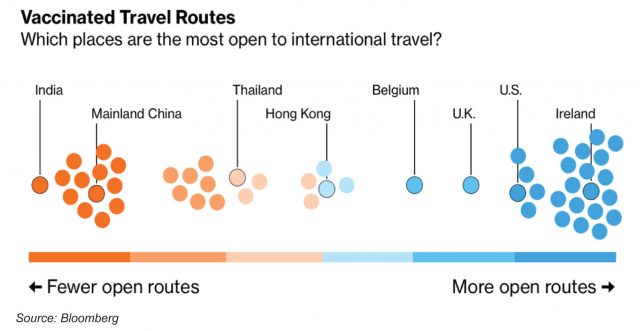
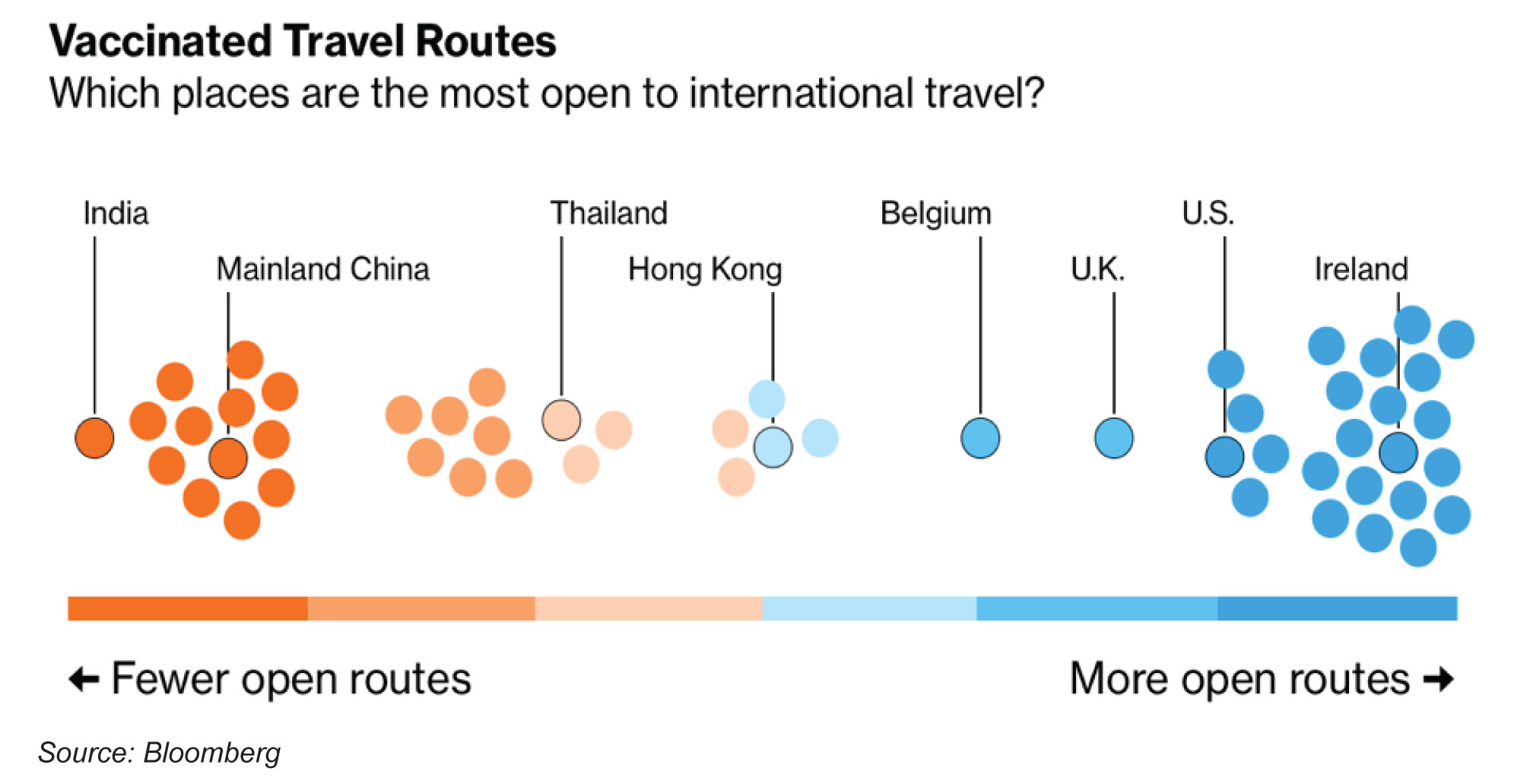
In contrast, what used to be the worst performing countries in pandemic management — Ireland, Spain, the Netherlands, and Finland — have vastly recovered because of one important Europe-wide strategy. This is the grant of quarantine-free entry to vaccinated travelers. With such an incentive to the inoculated, vaccination rollout skyrocketed, reaching as high as 90% for Ireland’s adult population. Social activities have also been resumed.

A very liberal approach to the Delta variant did not work for the US. Bloomberg described the US mode as “unfettered normalization,” that is, reopening the economy and resuming social activities without due regard to vaccination status. As a result, infections and deaths surged, and the US, an early vaccinating world power, found itself lagging behind the others at 28th place.

Assessing the US experience is how to appreciate the recent appeal of the business sector to place Metro Manila only at Alert Level 3 starting October, “to allow them to recover financial losses brought about by the COVID-19 pandemic.” We are all for normalizing business activities and social mobility; we have been hibernating in our homes for over a year and a half.

But the Task Force should also consider the Department of Health (DoH) advice of its Epidemiology Bureau Director Alethea de Guzman. She believes that Metro Manila may remain in Alert Level 4 even as daily caseloads appear to be on a downward spiral because of lower testing output by authorized laboratories. If true, we might be committing alpha error. Of course, it can be mitigated by more widespread vaccination, face masks, constant washing of hands, and observance of other key protocols.

The suggestion by the business community is close to the European solution that involves selective easing. This is to allow the vaccinated more room for social mobility including international travel, and shorter quarantine periods. Periodic and constant testing with RT-PCR is necessary. We can only hope an automated system would also be ready to enable granular lockdowns and easing.

With data coming from Johns Hopkins University, Bloomberg distilled a few lessons from this pandemic. High-ranked countries, for instance, enjoy trust in their government and compliance with established rules and protocols. Communication is important, as New Zealand and Singapore would vouch, especially on matters involving migration of alert system from one level to another. Everybody should be in the loop. Delayed response to the virus could also be costly as the US belatedly realized. Economic scars take time to heal and therefore, are more difficult to handle. Missed opportunities will never come back. Widespread and rapid rollout of vaccines does pay off.

Another obvious lesson in this pandemic is the importance of resources. The Bloomberg report highlighted that the developing world has only done nominal vaccination because the countries have little public money to support their procurement. WHO-backed COVAX efforts to enhance access of poor countries to vaccines enabled poor countries to administer them but only at the end of February 2021. Supplies are fast running out. Hence, booster shots are now being discouraged among the wealthier nations to help free up more vaccines for the first and second timers in smaller economies.

This latest COVID resiliency ranking resonates with the World Bank’s latest action on the Philippines’ economic outlook as contained in its “East Asia and the Pacific Regional Economic Update Report” released last Tuesday. No different from the IMF and other global financial institutions including the credit rating agencies, the World Bank downgraded its 2021 growth forecast for the Philippines from 5.5% in April and 4.7% in June down to 4.3% for September. For 2022, the downgrade was from 6.3% in April and 5.9% in June on to 5.8% for the September release.

Like for the other countries, these lower forecasts for the Philippines were driven by our weak containment of the pandemic. There is broad consistency between the ASEAN countries’ Bloomberg ranking and their growth prospects.

In fact, the World Bank is looking at an uneven economic recovery in the region. “While China, Indonesia, and Vietnam have already surpassed pre-pandemic levels of output, Cambodia, Malaysia, and Mongolia will only do so in 2022, and the Philippines, Thailand, and many Pacific Islands will remain below pre-pandemic levels of output even in 2023.”

What the Washington institution sees in terms of our pandemic management is a slow rollout of vaccines. Contrary to Philippine health authorities’ assurance that we would achieve 70% herd immunity by the end of 2021, the World Bank expects only 60% coverage by the second quarter of next year.

This is the same reason why Moody’s Analytics recently questioned the feasibility of our near-term economic recovery. Economists Katrina Ell and Dave Chia considered the risk of a more aggressive resurgence to be high due to the potent strain of the virus and the limited capacity of the health system.

No wonder, Moody’s Analytics was skeptical about the government’s recent decision to pivot away from city-wide restrictions and ease mobility restrictions although this move could also set the stage for higher domestic demand.

But there’s a catch.

Inflation is building up with the recent sharp rise in petroleum prices, expected adverse weather disturbances for the rest of 2021, and supply chain interruptions. The prolonged African Swine Fever could also be an upward risk. If the peso continues to depreciate beyond P51 to a dollar, import prices of oil and other key food commodities would begin rising. Our own Department of Trade and Industry issued increased suggested retail prices of key commodities in recognition of these factors.

Therefore, it would be difficult for the Central Bank to sustain its support of real sector activities in the face of higher inflation and much more difficult to help deliver on a pre-pandemic output performance as early as the second quarter next year. Policy rates are bound to move up sooner than later.

If monetary policy decides to do the lighter lifting, then fiscal policy should compensate. World Bank economists’ suggestions in their report are orthodox, something the Philippine Government has already included in their talking points either in the National Economic and Development Authority Board, the Development Budget Coordination Committee or even the Central Bank’s Monetary Board. With their observation about the significant reduction of the budget for social protection, the World Bank would like the government to pass bills easing restrictions on foreign investment, introducing tax reforms to strengthen the fiscal position, sustaining infra development, improving the educational sector, and adopting new technologies to enhance services and manufacturing.

There is no fundamental issue with such proposals. It is a matter of time before these agenda items are institutionalized and put on stream to produce results.

What is urgent is for the Philippine government to take both the pandemic containment and economic recovery to a higher plane of seriousness, greater thought, and trustworthy governance. Everything involves and revolves around the virus. It is also disturbing that the authorities continue to ignore the gorilla in the room.


Diwa C. Guinigundo is the former Deputy Governor for the Monetary and Economics Sector, the Bangko Sentral ng Pilipinas (BSP). He served the BSP for 41 years. In 2001-2003, he was Alternate Executive Director at the International Monetary Fund in Washington, DC. He is the senior pastor of the Fullness of Christ International Ministries in Mandaluyong.

Surviving 2022

September is the birth month of Ferdinand “Bong Bong” Marcos, Jr., as it is that of his father Ferdinand Senior. Forty-nine years ago, the latter placed the entire Philippines under martial law in the same month and extended his term in office beyond 1973 when, by Constitutional decree, it was supposed to end.

Despite a mountain of evidence to the contrary, the 14 years of Marcos’ one-man rule (1972-1986) are to this day still being described as a time of peace, progress, and prosperity compared to the terrible, supposedly “democratic” disasters of the decades that preceded and followed it. Implicit in that clueless view, and, in some instances, that deliberately misleading lie, is the dangerous notion that what this country needs is another tyranny.

As distressing as that patent absurdity already is, what should be of equal concern to pro-democracy forces is that the late dictator’s son, with the support of the oligarchy’s shrillest advocates of authoritarian rule, could end up in Malacañang Palace come July 2022. Once in power, he could quite possibly express in deeds the preference of the uninformed millions for the false glories of the martial law “golden age” that he has frequently celebrated in words.

As the month was ending this year, and after peddling in social media his bizarre version of his father’s martial rule, Marcos Junior announced his intention to run for President in 2022. It was not unexpected. He lost the Vice-Presidency to Maria Leonor “Leni” Robredo in 2016, but his running for that post could only have been the prelude to his eventually seeking the Presidency. Hence his futile, five-year attempt to replace Mrs. Robredo through his claims of electoral fraud before the Presidential Electoral Tribunal.

Now 64, either he goes for the Presidency next year or waits another six years until 2028. He would then be 71. However, it could be too late for his mother Imelda, who will then be 99 years old, to see realized her dream of the family’s recapturing Malacañang after they had to abandon it (and her shoe and perfume collection) to go into exile in Hawaii, USA when Marcos Senior was overthrown by the EDSA 1 “People Power” civilian-military mutiny.

It was not bad as exiles go. Marcos and family lived in luxury in the exclusive only-for-the-rich Makiki Heights district of Honolulu, the capital of that sub-tropical paradise. Their vast fortune was, after all, still intact and accessible in various bank accounts all over the planet, as were their art, jewelry and real estate collections.

Neither did their exile last for long. After five years and with their patriarch dead, then President Corazon Aquino allowed them to return to the Philippines in 1991 so Imelda Marcos could face charges of, among others, tax fraud and corruption.

That was a huge mistake. The family’s literal homecoming was the beginning of its eventual return to power, with Imelda Marcos’ election to the House of Representatives, and Marcos Junior’s and his older sister’s making it to the Senate.

But neither their vast fortunes nor the government posts they had snagged were enough, as neither power nor pelf had ever been enough for their late patriarch. By allying themselves with, and enabling the rise to the Presidency of, Rodrigo Duterte, they are today poised not only to seize control of the government of the very isles Marcos Senior had brought to near-irreparable ruin, but also to complete the rewriting of the history of his 14-year dictatorship via his son’s election in 2022.

That is not as distant a possibility as many optimists would hope. Marcos Junior could team up with Sara Duterte, whose popularity, if we are to believe the public opinion polls, makes her a shoo-in for either the Presidency or the Vice-Presidency in next year’s elections.

Philippine elections are decided mostly by money; alliances with local warlords and political kingpins; name recall; and the benefits of incumbent access to government resources, facilities and organization. A Marcos-Duterte team would have all those advantages. In addition, as Duterte regime candidates, they would also benefit from the surfeit of supposedly reformist, regime-critical candidates for both posts, among whom are likely administration operators fielded to confuse the electorate and divide opposition votes.

But would Sara Duterte still run for national office after declaring that she would instead be running again for mayor of Davao City because, with her father’s decision to run for the Vice-Presidency, her running for such a post would violate their agreement for them not to seek national office at the same time? And would she agree to run for Vice-President rather than for President?

The answer to the first is she could, if her father withdraws in her favor. Mr. Duterte made no secret of the totally private reason behind his decision to run for VP. It is to protect himself from prosecution for the offenses that apparently he himself thinks he has committed. If that is his only reason, his daughter’s winning the post could assure him of the same protection — and Marcos Junior’s as well.

Neither principle nor ideology shapes Philippine politics. Personal, familial, and class interests do. Marcos Junior has everything to gain by having Sara Duterte for running mate. In addition to the huge campaign funds the combination of his and her war chests would bring together, he would also share in her popularity, and add her name to his as an advocate of “strong government.”

As for Sara Duterte’s running as Marcos’ Vice-President, it would not be unlikely, because of what she could gain from giving way to one of her father’s favorite candidates, whom he has often named as his worthy successor. Those gains would essentially be the same as Marcos’: a combination of money and name recall, in addition to the support of the “solid North” — and her spending the next six years preparing for a Presidential run in 2028.

This portent of things to come — the distinct possibility of such a tandem’s winning in 2022 — demands that the real opposition, the pro-democracy and truly reformist forces, unify all those groups and formations that truly care for this country and its people, and to find its own team of competent and honest Presidential and Vice-Presidential candidates that could prevent the perpetuation of the tyrannies that have made this country the development laggard of Southeast Asia.

The electoral contest in 2022 is fundamentally between those who would prolong tyranny, and those who would end it in aid of democratizing Philippine governance and society. Delayed, sabotaged, and undermined by home-grown despotism and foreign intervention, the democratization process that began during the reform and revolutionary periods of Philippine history very briefly recovered in 1986 from its curtailment during the Marcos martial law period. It has since come to a veritable standstill during the current repression of the right to life, press freedom, and free expression. It has to be restarted for the sake of this country and its people’s survival and development.

It will not do for Philippine society to continue to wallow in the same pit of poverty, mass misery, and rank injustice to which dictatorship, incompetence and greed have condemned it. For that reason alone, the elections next year are among the most crucial in this country’s recent history whose outcome could very well decide the fate of this and future generations.


Luis V. Teodoro is on Facebook and Twitter (@luisteodoro).

www.luisteodoro.com

Whatever happened to Sweden?

LINUS MIMIETZ-UNSPLASH

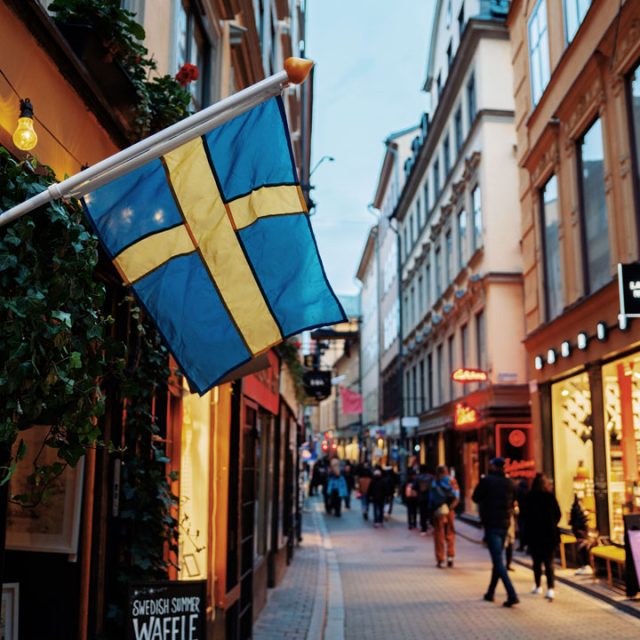
For some reason, people hate talking about Sweden. Bring it up in polite conversation or on social media and some crank is going to get triggered. And all Sweden did was to get it right in dealing with the pandemic.

Because Sweden avoided what incompetent governments did, which was to engage in prolonged, strict, and comprehensive lockdowns. It did not shut down schools, businesses (including restaurants) remained open, and masks (never mind face shields) while encouraged were not forced upon people. Instead, Sweden relied on reasoned common sense: proper hygiene, social distancing, stringent border control, and essentially did what good governments do — trust its people.

A great majority of Swedes believe that its government is doing the right thing (according to a survey conducted in March this year). And they’re likely right to do so.

What Sweden understood and which lockdown-minded policymakers forgot was the reality of tradeoffs: that doing one thing will lead to consequences in another area and more often than not the consequences are unforeseeable.

“Rational people understand this isn’t how the world works. Regardless of whether we acknowledge them, tradeoffs exist.” (“Sweden saw lower mortality rate than most of Europe in 2020, despite no lockdown,” Jonathan Miltimore, March 26, 2021).

In the end, Sweden was able to get away with an economy relatively unscathed.

Thus, while it “still experienced an economic contraction in the second quarter of the year, with its GDP shrinking by 8.6%, this was significantly less than the estimated average for the European Union as a whole, which saw a decline of approximately 11.9%. At the opposite end of the spectrum, meanwhile, those individual European nations that imposed particularly strict lockdowns were hit hard by the COVID-19 crunch, with Spain’s economy contracting by 18.5% after implementing arguably the harshest lockdown in the EU. By keeping society open throughout the pandemic — even with spending reduced as Swedes embraced voluntary social distancing — Sweden appears to have been able to soften the economic blow to small businesses and avoid the onslaught of job losses that is currently blighting countries across the EU.” (“The Swedish experiment: was it forward-thinking or not?”; Emily Cashen, World Finance, March 9, 2021).

The criticism hurled against Sweden is related to that inutile trope: “buhay bago negosyo (life before business).” Thus, it is argued, Sweden’s deaths were said to be the highest per population in Europe (and higher than its Nordic neighbors) and is more than four times larger than that of the Philippines.

But Sweden has circumstances different from its neighbors (e.g., it is more cosmopolitan, its borders more porous) and to compare it to the Philippines is inane considering differences in demographics and environment. The Philippines itself has a death count higher than its neighbors Malaysia, Vietnam, and Thailand.

And is Sweden’s death count really that bad compared to its fellow European countries? The answer is no.

“Preliminary data from EU statistics agency Eurostat compiled by Reuters showed Sweden had 7.7% more deaths in 2020 than its average for the preceding four years. Countries that opted for several periods of strict lockdowns, such as Spain and Belgium, had so-called excess mortality of 18.1% and 16.2% respectively. Twenty-one of the 30 countries with available statistics had higher excess mortality than Sweden.

“Many critics countered by comparing Sweden’s death rate to its Nordic counterparts Norway and Finland, which had some of the lowest mortality rates in Europe. Norway and Finland, however, embraced policies even less restrictive than Sweden’s for most of the pandemic.” (See Miltimor).

The lockdown crowd now offers another argument: that Sweden’s 63% vaccination rate (13th in Europe) is to be credited for Sweden’s relatively better condition. But that doesn’t hold water.

A recent study (“Indications that Stockholm has reached herd immunity, given limited restrictions, against several variants of SARS-CoV-2,” Marcus Carlsson, Cecilia Söderberg-Nauclér; July 13, 2021) points out that “the herd-immunity threshold appears to be much lower than previously thought.” The researchers were able to construct “a theoretical framework in which the cases in Stockholm County can be fully predicted without relying on neither oscillations in restrictions (and public compliance thereof) nor vaccination roll-out.” Doing so showed that it is “very difficult to match the data from Stockholm without including pre-immunity.”

As News Medical’s Sally Robertson reports: “herd immunity is not responsible for Sweden’s control of COVID-19.” Instead, what the researchers seem to suggest is that “‘pre-immunity’ or immunological ‘dark matter’ could underlie the unexpected trajectory of the COVID-19 pandemic” and that “what looks like pre-immunity on a population level, could in fact be a consequence of large variability in individual-level susceptibility. Furthermore, this susceptibility may depend on innate immunity and cross-reactive protective immunity initiated by another virus or other factors.”

All this to reiterate what this column has consistently pointed out since this insanity began: lockdowns don’t work.

Stanford’s Dr. Jay Bhattacharya puts it even better, lockdowns are simply the “biggest public health mistake we’ve ever made.


Jemy Gatdula is a Senior Fellow of the Philippine Council for Foreign Relations and a Philippine Judicial Academy law lecturer for constitutional philosophy and jurisprudence.

https://www.facebook.com/jigatdula/

Twitter @jemygatdula

Globe is PHL’s favorite telco – The Method Research

Globe has emerged as the favorite telecommunications provider among Filipinos based on a recent Philippine survey conducted by an international market research firm. This proves that the company was able to continue to touch the lives of its customers amid the challenges of the pandemic.

The results of The Method Research August 2021 pulse poll showed almost 4 out of 10 Filipinos, or 36.1% of the respondents chose Globe as their favorite telco nationwide. Globe led over Smart which scored 22.5%, TNT – 13.5%, PLDT – 12.6%, and Dito – 4.2%. It was also the preferred telco in Luzon – 38.4%, Visayas -36.9%, and Mindanao – 31.3%.[1]

The survey covered Filipinos 18 years old and above. About 65.4% of the respondents were female, and 34.6% were male. More than half or 51.1% of the respondents were from Luzon, 28.4% were from Mindanao, and 20.5% were from Visayas. The poll included the respondents’ favorite consumer brands, spending behavior, media consumption, and their perception of the country’s current situation.

The Method Research specializes in primary market research with a focus on digital surveys. It provides valuable insights to some of the world’s best brands and institutions.

“We are happy that customers are choosing us over competition. We have always placed superior customer service as a high priority in the way we do business. In addition, we make sure that we are grounded on our customers’ needs especially at this time. In everything that we bring to the market, we want to enhance our customers’ lives and empower them with digital solutions,” said Ernest Cu, Globe President and CEO.

Globe continuously improves its products and services and looks into new ventures and innovations to offer more than connectivity. It has moved beyond telco and provides fintech, healthtech, adtech, e-commerce, and other digital solutions that help people cope with social distancing measures.

Through its wholly-owned corporate venture builder 917Ventures, Globe continues to scale and accelerate eight companies as well as incubate six seed ventures and three angel ventures.

917 Ventures’ portfolio includes popular e-wallet service GCash, loyalty and e-commerce solutions provider RUSH, online grocery shopping platform PureGo, digital and mobile marketing solutions firm AdSpark, and telehealth service platforms KonsultaMD and HealthNow.

Globe strongly supports the United Nations Sustainable Development Goals, particularly UN SDG No. 9, which highlights the roles of infrastructure and innovation as crucial drivers of economic growth and development. Globe is committed to upholding the UN Global Compact principles and contributing to 10 UN SDGs.

To know more about Globe, visit www.globe.com.ph.

[1] Source: https://www.themethod-research.com/philippines-pulse-poll


Spotlight is BusinessWorld’s sponsored section that allows advertisers to amplify their brand and connect with BusinessWorld’s audience by enabling them to publish their stories directly on the BusinessWorld Web site. For more information, send an email to online@bworldonline.com.

Join us on Viber to get more updates from BusinessWorld: https://bit.ly/3hv6bLA.

YouTube helps brands reach non-TV watching audience 

By Patricia Mirasol 

Brands that utilize YouTube as a marketing platform are able to complement their reach in traditional media such as television (TV), according to data from the Philippines gathered by Google and YouTube.  

According to a Google cross-media reach report from January 2020 to May 2021, more than 50% of the 18- to 34-year-old audience reached on YouTube was incremental to TV. YouTube’s internal data, culled between 2017-2020, also reveal the platform’s effectiveness as 3.4 times greater than TV’s. 

“If you’re planning a video campaign for marketing, adding YouTube to TV equals more reach,” said Gabby Roxas, marketing head of Google Philippines, in a Sept. 29 event organized by YouTube. 

Incremental reach, as defined by Amazon Advertising, refers to the audience that a video campaign in OTT (direct-to-consumer streaming services) format engages that is in addition to a brand’s TV audience.  

In the aforementioned event, Dennis Perez, media director of Unilever Philippines, shared that the consumer goods company was able to reach 16 million music lovers and 9 million movie buffs between December 2020 to June 2021 by utilizing sponsorable activities on YouTube.  

“We’re entering an era where viewers are holding a hyper-remote control… and the choices are endless,” he said. He told the Sept. 29 audience that viewers consume content in line with what they need in their lives. 

“The challenge is how to integrate your brand in a meaningful way,” Mr. Perez said. “How do you weave your brand’s story in terms of it not interfering, especially since viewers choose [what to consume] based on their passion.”  

Unilever, he added, uses data to target different demographics and improve the quality of its reach.  

“When we did a marketing mix modeling [a technique that quantifies the impact of marketing] on YouTube, we realized we got an incremental reach of more than 10%,” Mr. Perez said. “We were able to tap other markets, like the Gen Zs, as well as non-users of our brands.”  

YouTube has reached over 45 million people in the Philippines aged 18 years old and above as of April. The video sharing website also saw a more than 25% rise in watch time from April 2020 to April 2021. Its creator ecosystem in the country is similarly thriving, with more than 3,000 creators and 250 channels having over 100,000 and one million subscribers, respectively.

China vaccine diplomacy wavers as nations seek Western shots

PHILIPPINE STAR/ MICHAEL VARCAS

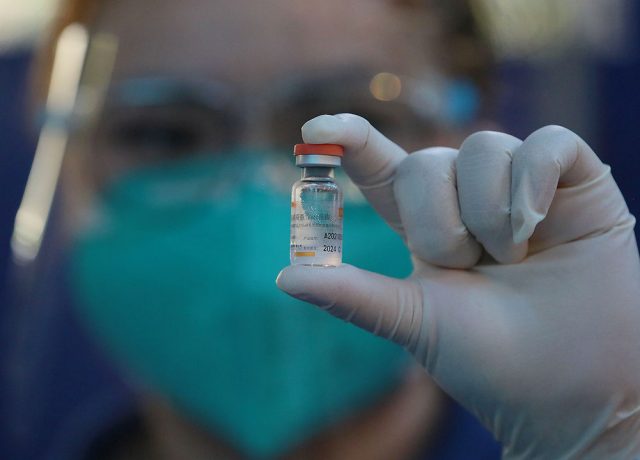
In the early days of the Covid-19 vaccine rollout, Chinese shots saved countless lives. They kick-started inoculation programs across Asia, Latin America and the Middle East, while richer countries hoarded scarce mRNA shots from Pfizer Inc. and Moderna Inc.

But many governments that once relied on vaccines from Sinovac Biotech Ltd. or Sinopharm Group Co Ltd. are now turning to options from the U.S. and Europe instead, as concerns mount about Chinese vaccines’ efficacy against the delta strain and the Western stranglehold on mRNA supplies grows looser. That preference may already be showing up in China’s customs data, where exports of human vaccines dropped 21% in August to $1.96 billion from $2.48 billion in July, after rising steadily since Dec. 2020.

Officials inspect shipment of the Sinovac and Sinopharm vaccines at Harare International Airport in Zimbabwe, in March 2021.

“Basically people took what they could get” when COVID vaccines first became available, said Nicholas Thomas, an associate professor at the City University of Hong Kong who has edited several books on foreign policy and public health.

“But as this has gone on, general populations — rather than just medical practitioners — have become more educated about the differences,” he said. “They have realized that not all vaccines are equal in terms of protection.”

SLOWING MOMENTUM
This shift played out during Thailand’s deadly outbreak earlier this year. As cases surged and Southeast Asia emerged as the new epicenter of the pandemic, the nation desperately tried to purchase vaccines. Only one supplier came through in time: China’s Sinovac.

The shots allowed the country of 70 million to begin its inoculation campaign earlier than hoped, but Thailand soon confronted a challenge now faced by lawmakers across the developing world.

The efficacy of China’s inactivated vaccines ranges from about 50% to 80% in clinical trials. But they are less potent than mRNA vaccines and questions are mounting about their effectiveness against the highly transmissible delta variant. As a result, the Thai government became the first in the world to offer an AstraZeneca Plc shot to people who had already received a jab or even two of Sinovac. While it is not an mRNA, Thai studies showed the Cambridge, U.K.-based company’s viral vector vaccine is potent as a booster to the Chinese shot, and that Pfizer’s dose was found to be even more effective.

But many Thais soon expressed a strong preference for Western shots — even protesting to demand them — and the country’s opposition began lambasting the government for its reliance on China. Thailand halted orders of Sinovac and began buying more Western vaccines.

“I’m not anti-Sinovac,” said Chaowat Sittisak, a 29-year-old teacher in northern Thailand who got a first dose of Sinovac but ordered a second Moderna shot from a private hospital. “If the world only had one vaccine and it’s Sinovac, I’d get it. But we have so many other choices. And I want whatever is best.”

Many governments that once relied on Chinese shots are now ordering or seeking donations of mRNA vaccines instead. The swing away from China is likely to accelerate as U.S. President Joe Biden promises to donate 1.1 billion mRNA shots, Europe pledges hundreds of millions of vaccines and India prepares to once again export AstraZeneca vaccines after curtailing shipments following its deadly second wave. In addition to availability and efficacy, freedom of movement may also be motivating the shift: Recipients of Chinese vaccines can’t travel to some locations, such as Singapore.

VACCINE EXPORTS
In a written reply to Bloomberg, Sinovac said its CoronaVac shot has been effective at preventing hospitalization, intensive care admissions and deaths throughout the pandemic. A spokesperson said some countries first rolled out Sinovac to the elderly, who are more likely to be hospitalized with Covid-19, while younger populations received different vaccines later, “and this should be factored in the evaluation of CoronaVac’s effectiveness.”

Many countries, including Thailand, have “purchased vaccines from multiple suppliers in order to maximize the number of doses available for their population,” the company said.

As things stand, the list of places shifting away from Chinese vaccines — or augmenting them with Western boosters — includes Singapore, Turkey and the United Arab Emirates. In China’s own territory of Hong Kong, which has long offered residents a choice between BioNTech and Sinovac, health officials are now testing whether the Chinese shot will perform better when paired with a western booster.

Even in Pakistan, an all-weather ally of Beijing that’s used Chinese shots for 84% of its vaccination drive, some are going out of their way to find Western jabs: Muhammad Kashif, a 41-year-old motorcycle delivery rider in Karachi, felt lucky to find a rare dose of the Moderna vaccine at a crowded inoculation center where later arrivals were forced to get Sinovac.

“I thought that this is American, they must have made it after a lot of high-level research,” Kashif said. “I feel delighted I was able to get it. I feel it’s much safer.”

While Sinovac allowed Thailand to start its rollout earlier than planned, the 6 million doses arriving in October will be the last shipment. In 2022, at least three quarters of the government’s orders will also come from Astra and Pfizer.

Moves like Thailand’s represent a blow to China’s vaccine diplomacy ambitions. Nevertheless, governments face a tricky balance between wanting to protect the public and maintaining good relations with China. The Thai Health Ministry has been careful to say that while it has no plans to order more Sinovac, it isn’t suggesting the shots aren’t effective.  

Chinese firms have exported some 884 million doses of its homegrown vaccines via mostly bilateral deals with places like Brazil and Indonesia. This week Chile started giving Sinovac shots to children as young as six, a strong endorsement of a shot that’s formed the backbone of their rollout. 

And there are still many parts of the world drastically short of vaccines. Some African nations, for instance, have barely started their inoculation drives after struggling to procure shots. Cote d’Ivoire, Burkina Faso and Kenya are all rolling out Chinese vacciness, and Beijing is a key supplier to the World Health Organization-backed Covax facility aimed at getting vaccines to the developing world. President Xi Jinping has pledged to export 2 billion doses this year, matching commitments by Group of Seven nations.

Various studies conducted around the world have shown the jabs to be effective at preventing serious illness and death. 

Yet China’s pharmaceutical firms — which were initially less forthcoming than western companies in releasing clinical trial data — have not released similarly conclusive studies that inactivated vaccines are effective against delta.

Over the coming year, policy makers may well continue turning away from the older technology of the inactivated Chinese vaccines, says Benjamin Cowling, a professor of epidemiology and biostatistics at the University of Hong Kong, who published a recent study in the Lancet showing the Pfizer vaccine generated 10 times more antibodies than Sinovac.

“If you’ve got some vaccines that are more effective than others, and the cost is roughly the same, then you’re going to get a better bang for the buck if you choose the more effective vaccines,” Cowling said. “But I still think that the supplies are limited, so it may not be as easy as saying, ‘We just want to order the Moderna vaccine,’ or whatever.”

‘BETTER ALTERNATIVES’
In Thailand, the opposition Move Forward party is now calling on the government to reveal the percentage of people who have only received the Sinovac shots.

“The government already knows that studies and research show inactivated virus vaccines are less effective against virus mutations when compared to mRNA-based vaccines,” said Wiroj Lakkhanaadisorn, an opposition lawmaker and a key critic of the government’s vaccine policies. “We should know the vaccination rate that excludes all two-dose Sinovac shots because the immunity may not be enough any more. Any regions that are ready can then reopen.”

Thailand’s health ministry didn’t respond to a request for comment.

Chaowat, the teacher, said he felt pressured to take the Sinovac shot because of his job but is hoping to get a Moderna shot in a month or two.

“The government is turning away from Sinovac because they have to push through with their reopening plan and they want to reduce vaccine hesitancy among people who don’t want Sinovac,” he said. “They’re turning to better alternatives.” — Bloomberg