Home Blog Page 6885

Cement tariff and the consumers
“Consumption is the sole end and purpose of all production; and the interest of the producer ought to be attended to, only so far as it may be necessary for promoting that of the consumer.”

—  Adam Smith,
The Wealth of Nations (1776),
Book IV Chapter VIII, v. ii.

ON Dec. 6, 2021, the Department of Trade and Industry (DTI) imposed an anti-dumping duty on Philippine cement imports from Vietnam at the following rates: Type 1 cement, $1.02 to $10.53 per metric ton (MT) or 2.7% to 31.9% of the export price; and Type 1P cement, $1.16 to $12.79 per MT or 3.8% to 29.2% of export price. DTI estimated that these provisional duties will add P2.01 to P25.08 per 40 kilo bag of cement to the import cost.

Then on Dec. 9, the Tariff Commission (TC) began a formal investigation after it received a request from the DTI and the complete case records. A preliminary conference was held on Dec. 20.

The policy of imposing anti-dumping duty is based on the complaint and lobby by some local cement manufacturers, especially subsidiaries of big multinationals like Lafarge Holcim (Switzerland), CEMEX (Mexico), and CRH (Ireland) that (a.) cement imports from Vietnam are sold here at artificially low, “dumped” prices, (b.) leading to business injuries to local cement manufacturers.

Do these two allegations have a basis? To analyze (a.), I requested data on Philippine cement imports from the Philippine Statistics Authority (PSA), and to analyze (b.), I checked data from the BusinessWorld Top 1,000 Corporations.

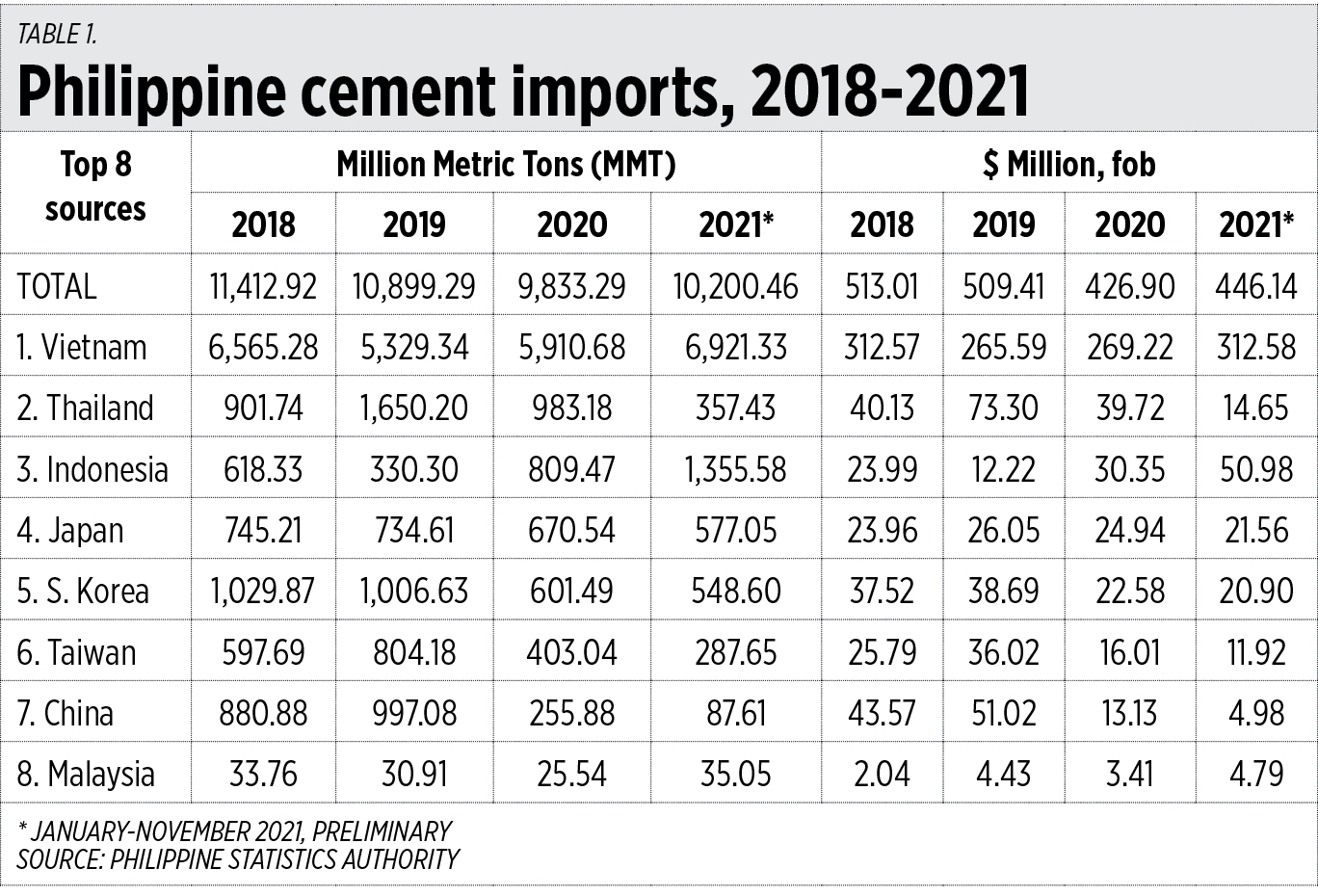
The Philippines’ domestic production of 24 to 26 million metric tons (MMT) of cement yearly is insufficient to supply domestic demand of up to 35 MMT. Hence, the Philippines imports 10 to 11 MMT yearly from many countries, some 5 to 7 MMT of which are from Vietnam, another 1.5-2 MMT from Thailand and Indonesia, another 1.2-1.7 MMT from Japan and South Korea.

In terms of value, the Philippines’ cement imports were $427 million to $513 million yearly, free on board (fob). Some $266-$313 million of which are from Vietnam, another $64-$85 million from Thailand and Indonesia (Table 1).
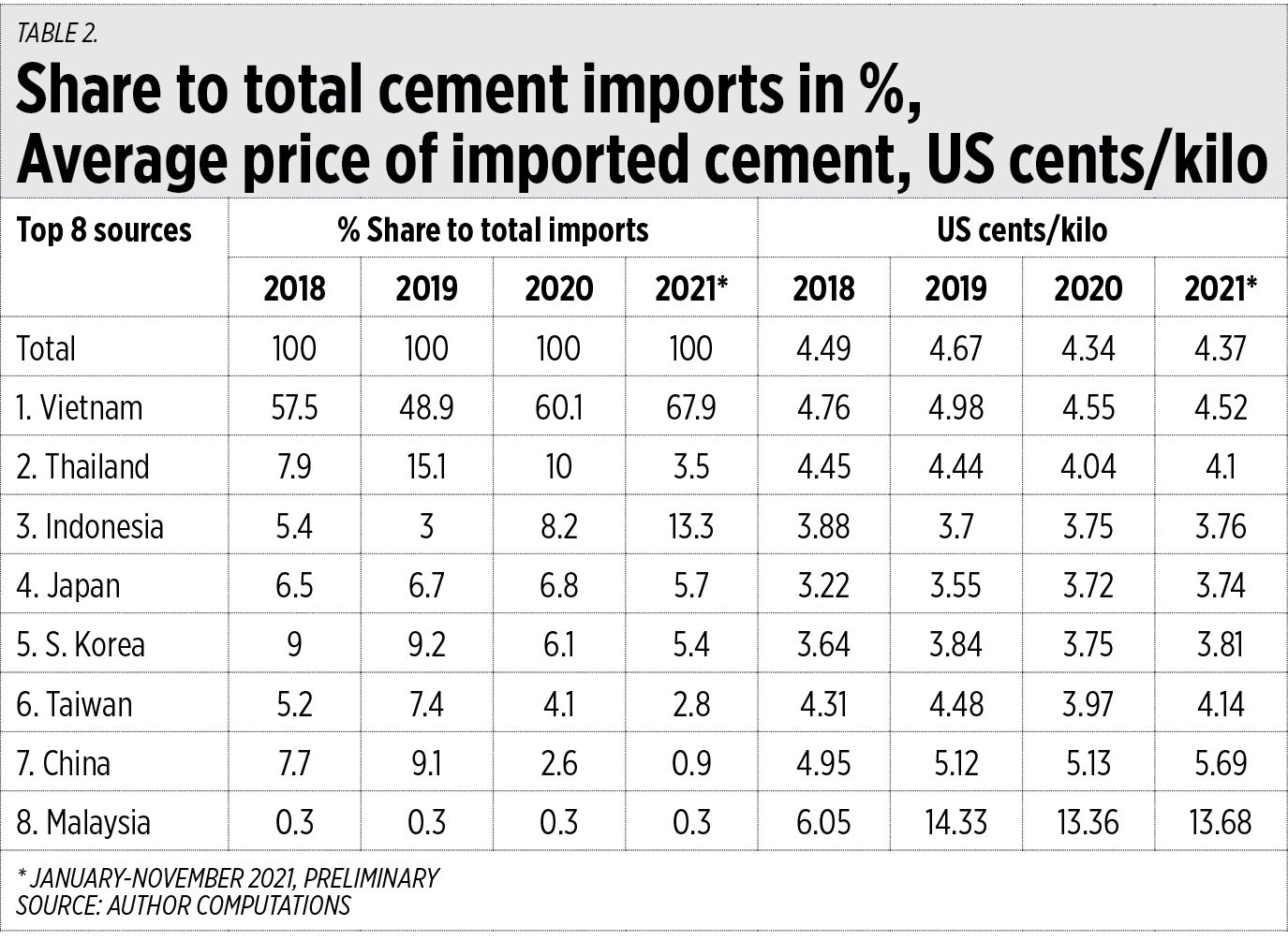
From these numbers, I computed the percent share of these country sources, then divided the value over quantity to get the average price per kilo. Vietnam’s share is 49% to 68% of total imports, followed by 13% to 18% from Thailand and Indonesia.

On imported prices, here is an interesting revelation: the average price is only 4.37 to 4.67 US cents per kilo. And the cheaper cement did not come from Vietnam but from Thailand, Indonesia, South Korea, Japan, and Taiwan (Table 2).
So, why did the local manufacturers, who lobbied for more expensive cement imports via the imposition of an anti-dumping duty, not complain about the much cheaper cement from these five Asian countries?

These prices are equivalent to P2.14 to P2.38 per kilo at P49 to P51 per $1 exchange rate, or P86 to P95 per 40-kilo bag — really cheap. But this is still free on board (fob) value, so there are additional costs to add — shipping, insurance, docking delays (if any), trucking, storage, others. Plus the importers’ and retailers’ profit margin. Perhaps retail prices of P170 to P190 per bag. If so, then consumers benefit if they can save at least P20/bag.

Next test, (b.) — did domestic cement producers really suffer business injuries due to cheap cement imports?

According to the BusinessWorld Top 1,000 Corporations, all these local manufacturers experienced an increase or flat gross revenues in 2019 compared to 2018 except Holcim. The decline in revenues in 2020 was mainly due to the lockdown and pandemic. Even then, some companies experienced increases in net income — Apo, Northern, Philcement. Eagle and Republic Building Materials, Republic Iligan/Mindanao have no data for 2020 (Table 3).
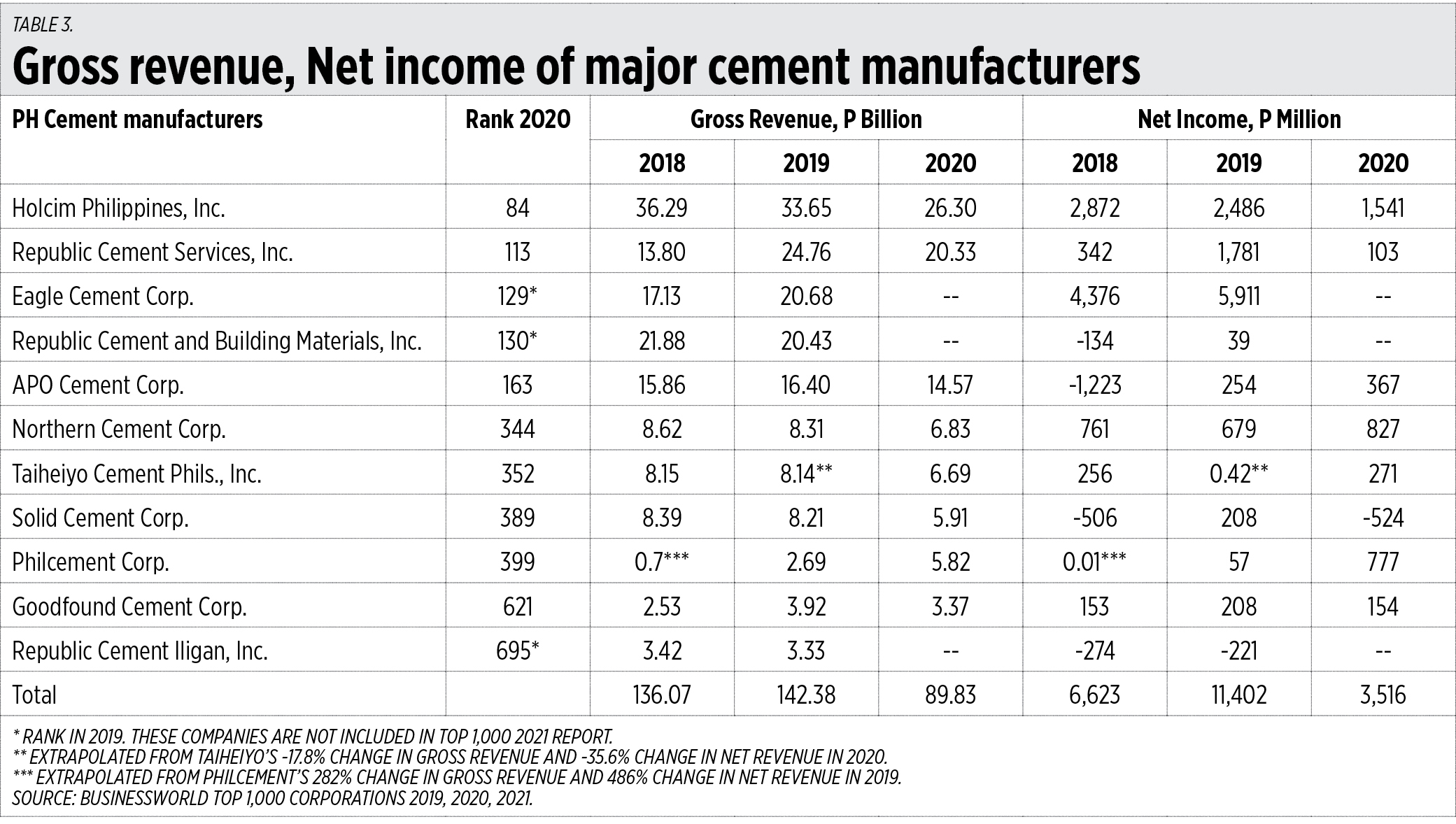
Usually companies drop out of the Top 1,000 in a given year not because they suffered a huge decline in revenues but because they had not yet submitted their financial statements to the Securities and Exchange Commission at the time that  the BusinessWorld research department was collating the data.

From the above discussions, we can conclude the following:

One, high cement imports from Vietnam imply their products are cheaper than domestic products, but Vietnam prices are more expensive than cement from Thailand, Indonesia, South Korea, Japan, and Taiwan. But imported cement from these countries were not targeted for anti-dumping duties by the local manufacturers, especially the multinationals.

Two, imposing duties against exports of fellow ASEAN country is not good as we are supposed to have a free trade, zero tariff ASEAN Economic Community (AEC). The lobby for expensive cement imports did not include cement from Thailand and Indonesia because it is not good to expand trade disputes.

Three, data on gross revenues and net income show that there are no clear business injuries for the local manufacturers except for Holcim and Republic Cement. One possible reason is that these two companies have high prices and many consumers have shifted to imported cement.

Four, “dumping” is actually pro-consumer. Households, and commercial and government consumers benefit when cement prices are low and supply is large. Domestic production should expand big time and prices should go down to levels similar to those of imported products.

Five, TC and DTI should not consider making the current provisional anti-dumping duty permanent. The duty should go back to zero. As Adam Smith pointed out, the main goal of production (and trade) is to satisfy the customers.

See also this column’s piece on cement tariffs three years ago, https://www.bworldonline.com/economic-prospects-2019-and-cement-tariff/ (Jan. 24, 2019).


Bienvenido S. Oplas, Jr. is the president of Minimal Government Thinkers.

minimalgovernment@gmail.com

Love and resilience in the time of Omicron

FREEPIK

Will 2022 be “2020 too”?

The December holidays felt like a return to a sense of normalcy and optimism. Finally, after more than one and a half years, we could hang out with our friends. Businesses were bouncing back. Cases were going down. But alas, the holidays were merely a reprieve; January saw a spike in COVID-19 cases presumably caused by the Omicron variant. Most likely, our loved ones and even we ourselves have contracted the virus. It is tempting to be pessimistic. Perhaps the social media pun is right — 2022 seems to be “2020 too”!

Two years in, we have accumulated personal anecdotes and formal research on how the pandemic has adversely affected multiple dimensions of our well-being: physical, economic, mental, social, and even spiritual health. The spread of Omicron has forced us to more intimately struggle against the apparent absurdity of life. With every breath that falls short, anxiety that intrudes, and the pain of isolation, it is tempting to give up and just let the virus leech our souls.

But wait! Wouldn’t it be such a tragedy to give up during the month of love? If there is any silver lining in this seemingly absurd situation, it is that testing positive for COVID-19 does not feel like a death sentence anymore, compared with the heartbreaking stories of 2020. My medical doctor friends have surmised that the advent of the Omicron variant, which is more transmissible but less lethal than the Delta variant, is the beginning of the end of this pandemic. We are at the climax of this pandemic story. We seem to be entering the final battle against this wretched virus.

Given this context, I offer two insights to reflect on: 1.) rather than being in denial, we are better off assuming that we will all be infected by the coronavirus (the Omicron variant seems to infect by the household); and 2.) outlasting the virus is a team-based marathon.

My wife and I thought that getting infected would just be a matter of time. The strategy that our medical doctor friends offered was simple: before getting infected, take the vaccines, and boost the immune system through vitamins and supplements. Thus, when we did test positive, we felt more prepared. My symptoms were worse than hers. The way she cared for me, supplemented by the generous care kits sent by our relatives, gave me a more profound appreciation of love within the context of suffering. To love is to not be in denial of impending suffering; to love is to suffer together yet still choose to care for each other. To love is to take advantage of all kinds of blessings brought about by both science and faith.

These insights apply to businesses and organizations, too. Now is the time to be more generous and flexible than ever. Work-from-home and hybrid arrangements are still optimal for social distancing and recovery. More than efficiency and productivity, however, we should aim to survive through empathy and creativity. Surviving means allowing our workforce and key partners to recover so that we can keep on covering each other’s weaknesses. The strategy is also clear: embrace digital business models and work setups. Digitalization is the vaccine for businesses and organizations against the pandemic. Although not a silver bullet, it allows us to better take advantage of opportunities.

Personal and business resilience means remaining virtuous despite the worst circumstances. In other words, choosing love is where resilience and romance intersect. With love, 2022 will not be “2020 too”!


Patrick “Patch” Adriel H. Aure, PhD is the vice-chair of, and an assistant professor at, the Department of Management and Organization, Ramon V. del Rosario College of Business, De La Salle University. He advocates social entrepreneurship, humanistic management, and integral human development as the head of the Social Enterprise Research Network of the Center for Business Research and Development (CBRD-SERN).

patrick.aure@dlsu.edu.ph

US seeks North Korea talks after biggest missile test in years

REUTERS

THE BIDEN administration reiterated that it’s ready to hold talks with North Korea without preconditions, a day after Kim Jong Un’s regime fired an intermediate-range ballistic missile for the first time since 2017.

Pyongyang’s official Korean Central News Agency on Monday “confirmed the accuracy, security and effectiveness of the operation of the Hwasong 12-type weapon system under production.” It said the launch was conducted at the highest angle “in consideration of the security of neighboring countries.”

A senior administration official described North Korea’s recent series of missile launches as destabilizing, a threat to North Korea’s neighbors and US forces in the region, and a breach of United Nations Security Council resolutions. Still, the US is committed to diplomacy with North Korea and hasn’t received a response from Pyongyang to an offer for dialogue, the official said.

Sunday’s test provided a reminder to the White House that Kim’s nuclear arsenal remains among the US’s biggest foreign policy challenges despite former President Donald Trump’s unprecedented face-to-face meetings with the North Korean leader. It also marks the end of a moratorium on tests of long-range missiles Mr. Kim announced in the run-up to the first Trump summit, signaling that Mr. Kim may soon test another intercontinental ballistic missile capable of striking the entire US homeland.

The US official declined to spell out how the US might take action if diplomacy fails. A solution will require direct engagement and diplomacy on denuclearization of the Korean peninsula, the official said, adding that the US has been seeking to have direct discussions and is ready to meet anytime at any place without preconditions.

Even so, the time isn’t right for a meeting between Mr. Kim and President Joseph R. Biden, who has said that it would have to have a clear purpose — a condition that’s nowhere close to being met, the official said.

The Hwasong-12 was last tested in 2017 and could be used to hit US military bases in Guam. The US Indo-Pacific Command said it was consulting with South Korea and Japan on the test. “The United States condemns these actions and calls on the DPRK to refrain from further destabilizing acts,” it said in a statement, referring to North Korea by its formal name.

This month, Mr. Kim’s regime has set off a record volley of missile tests designed to hit South Korea and Japan, which host the bulk of US troops in the region. These include hypersonic systems designed to use high speeds and maneuverability to evade US-operated interceptors. — Bloomberg

COVID-infected HIV patient developed 21 mutations

A SOUTH AFRICAN woman suffering from inadequately treated HIV, and who harbored COVID-19 for nine months saw the respiratory virus develop at least 21 mutations while in her body, according to a study.

Once the 22-year-old adhered to the anti-retroviral medication used to treat HIV and her immune system strengthened she was able to overcome the COVID-19 infection within six to nine weeks, the study, led by scientists from Stellenbosch and the University the University of KwaZulu-Natal showed. The research has not been peer reviewed.

The study adds to evidence that COVID-19 may mutate rapidly when harbored by immunosuppressed individuals, such as those not taking medication to treat HIV, and this may lead to the development of new variants. The beta variant, which the patient in the study was infected with, was discovered in South Africa, as was Omicron.

“This case, like others before, describes a potential pathway for the emergence of novel variants,” the scientists said, stressing that it was still a hypothesis. “Our experience reinforces previous reports that effective anti-retroviral treatment is the key to controlling such events.”

South Africa has the world’s biggest HIV epidemic with 8.2 million of its 60 million people infected with the virus, which weakens the immune system.

The coronavirus harbored by the patient in the study developed at least 10 mutations on the spike protein, which allows it to bind with cells, and 11 other mutations, the scientists said. Some of the changes were common to those seen in the Omicron and lambda variants while some were consistent with mutations that allow the virus to evade antibodies. — Bloomberg

Hong Kong has never been closer to losing its COVID-zero battle

REUTERS

AS RESIDENTS prepare for another Chinese New Year under COVID-19 restrictions, Omicron seems to have gotten the better of the city’s defenses, with a record number of new and untraceable infections.

Though the city has beaten back four previous waves of infection, returning to no COVID cases will be much harder this time, given it is facing Omicron, the most infectious and immune-evasive of variants.

“The horse has bolted, and I don’t think that the government is going to be able to get on top of this,” said David Owens, a family medicine specialist and honorary clinical assistant professor at the University of Hong Kong, where he has collaborated on COVID research. “This disease is just too transmissible.”

Chief Executive Carrie Lam is unlikely to give up completely on efforts to eradicate the virus while Chinese President Xi Jinping adheres to that policy in the mainland, but her government can’t deploy the blunt tools that China has used to lock down millions of people in cities like Xi’an and Tianjin.

The measures Hong Kong has deployed so far, including lockdowns of apartment buildings, closures of schools, restaurants, gyms and cinemas, and vaccine mandates, are already straining the limit of the city’s resources.

Without the ability to escalate measures, as China has done, or to back away from the COVID-Zero goal, as Singapore, Australia and others have, Hong Kong has no clear path forward.

“There is no way for a full-city lockdown to be sustained for any appreciable period to allow termination of transition links,” said Leung Chi-chiu, a former chairman of the Hong Kong Medical Association’s advisory committee on communicable diseases, adding that Hong Kong doesn’t have the testing capacity or community infrastructure for mainland-style lockdowns. “Without these, we will die faster than the virus,” he said.

HIDDEN CHAINS
While the city’s outbreak is minuscule by global standards, with fewer than 14,000 infections and just 213 deaths throughout the pandemic, Hong Kong on Jan. 27 set a record, with 164 new cases.

“It’s certainly not a situation that would give us the comfort or the assurance that it is under control,” Lam said at a briefing on Jan. 27. “We are expecting that, any time, we could have an exponential increase in cases and it could give rise to a massive community outbreak.”

Hong Kong has more than a dozen hidden chains of transmission silently spreading the pathogen, and government adviser David Hui estimated there are 90 untraceable cases.

Unlike former COVID-Zero stalwarts like Australia and Singapore, Hong Kong has resisted trying to get to some semblance of herd immunity through a combination of natural infection and vaccinations, since that would jeopardize Lam’s goal of reopening the border with mainland China.

Moreover, with just under half of people over 70 years old vaccinated, widespread infection would lead to soaring hospitalizations and deaths.

“We do not possess the prerequisites for living with the virus because the vaccination rate is not good, especially amongst the elderly,” Lam said. “I could not stand seeing a lot of old people dying in my hospitals.”

Officials instead are pursuing what they call “Dynamic Zero,” an approach that emerged from China and aims to work toward no new infections while acknowledging some may still occur.

A silver lining of the Omicron outbreak is that it’s giving Lam’s government the political backing to push much harder with vaccine mandates. The city will require vaccines for residents of nursing homes and from late February will ban most unvaccinated people from restaurants, gyms and bars.

“Zero-COVID is to buy time for boosting the vaccination rate, especially for high-risk groups,” said Lam Ching-choi, a doctor who is a member of the Hong Kong leader’s advisory Executive Council. “The recent trend is quite promising.”

There’s been a jump in pace since the Omicron outbreak, though Hong Kong’s vaccination levels especially among the elderly remain one of the worst of developed economies. About 80% of people 12 and above have received at least one shot, and officials have said the government won’t consider easing current restrictions until 90% of them are vaccinated.

The vaccination rate among people 80 and above is now at 31%, up from 19% in December.

The restrictions have battered Hong Kong’s reputation for openness and frustrated business lobby groups.

People returning from eight countries including the US, UK and Canada are banned until at least mid-February. Thousands of residents were locked inside their public housing apartments for days and officials have even euthanized several thousand hamsters after a Delta case in a pet store.

Hong Kong could make the decision to shift away from the zero-tolerance approach and accept some community spread, said microbiologist Siddharth Sridhar, an assistant professor at the University of Hong Kong. Unlike Singapore, which abandoned Covid Zero just before getting hit with the Delta wave, he said, Hong Kong could make the change when the less virulent omicron variant is dominant, which might ease pressure on the health-care system.

“We can potentially do this in quite a safe way,” he said. “It will take a lot of planning but it’s not a bad position to be in, honestly.”

However, after more than two years of focus on keeping daily cases at or near zero, officials haven’t communicated any clear exit plan for the pandemic, and it’s unlikely that Lam’s government can formulate one without Beijing’s sign-off.

With China firmly wedded to COVID Zero, the city’s health authorities will likely focus on more testing and lockdowns, said Nicholas Thomas, an associate professor at the City University of Hong Kong who has edited several books on pandemics and politics. He added that having a large number of people inoculated with the less-effective Sinovac Biotech Ltd. vaccine is an additional hurdle.

“The political decision to pursue zero-Covid above the realities on a globally-endemic virus leaves no room for any sort of policy innovation that would allow Hong Kong the space to live with the virus,” he said.  Bloomberg

Florida is so cold iguanas are falling out of trees

WIKIPEDIA/Ajoshi54

THE US National Weather Service Miami-South Florida warned the public on Sunday that immobilized iguanas could fall out of trees due to unusual cold temperatures across the region.

“Iguanas are cold-blooded. They slow down or become immobile when temps drop into the 40s (4-9 Celsius). They may fall from trees, but they are not dead,” the service said on Twitter.

Temperatures in South Florida reached a low of 25 degrees Fahrenheit on Sunday morning, according to the National Weather Service, and high temperatures on Sunday were expected to remain in the upper 50s to low 60s.

The nation’s Northeast was walloped on Saturday by a deadly winter storm that prompted several states to declare emergencies and forced the cancellation of more than 1,400 flights.

Zoologist Stacey Cohen, a reptile expert at Palm Beach Zoo in Florida, explained the iguana phenomenon to television station WPBF.

“Their bodies basically start to shut down where they lose their functions and so they are up in the trees on the branches sleeping and then because it gets so cold, they lose that ability to hang on and then they do fall out of trees a lot,” Ms. Cohen said.

Although most of the reptiles will likely survive this period of immobilization, Ms. Cohen said freezing temperatures were a threat to their survival and pointed to a cold snap in 2010 that wiped out a large number of the population.

“Cold is a very, very life-threatening thing for them because they are from parts of Central and South America close to the equator where it always stays very warm,” she said.

Green iguanas are not native to Florida, according to the Florida Fish and Wildlife Conservation Commission. They were accidentally introduced as stowaways in cargo ships and are considered an invasive species. They can weigh up to 17 pounds (7.5 kg) and measure over five feet (1.50 metres) in length.

These iguanas are not the first animals to suffer the cold this winter. Hundreds of thousands of farmed fish died from thermal shock in a lagoon in northwestern Greece after a heavy snowstorm crippled the country last week. — Reuters

Rafael Nadal pulls off comeback for the ages to claim Grand Slam record

REUTERS

MELBOURNE — Rafa Nadal roared back from two sets down to edge Daniil Medvedev in a classic Australian Open final and claim a record 21st Grand Slam title only months after fearing his glorious career might be over.

With Novak Djokovic forced out by deportation and Roger Federer recovering from knee surgery, the Spanish great is now one major title clear of his “Big Three” rivals after surviving the 2-6, 6-7(5), 6-4, 6-4, 7-5 thriller at Rod Laver Arena.

“It was one of the most emotional matches in my tennis career,” Nadal said after the five-hour 24-minute epic.

“It’s just amazing now (given) one month and a half ago, I didn’t know if I will be able to be back on the tour playing tennis again.

Riding a wave of raucous support from the crowd, a vintage Nadal pulled off his greatest escape to deny Medvedev again, less than three years after leaving the rangy Russian heartbroken in five sets at the 2019 US Open final.

In a match steeped in drama that stretched into the early hours of Monday morning, sixth seed Nadal was two points from the title but was broken as he served for the match at 5-4.

He held firm to break Medvedev again and served out the match to love, with a backhand volley the final coup de grace.

Dropping his racket, Nadal shook his head and grinned, then kicked a tennis ball away and pumped his fists in delight.

Tributes flew in from around the world, with Federer and Djokovic quick to congratulate him.

“A few months ago, we were joking about both being on crutches. Amazing. Never underestimate a great champion,” Federer wrote on social media.

“Amazing achievement,” said Serbian Djokovic. “Always impressive fighting spirit that prevailed another time.”

It was a triumph that defied time and logic, with the 35-year-old Nadal fighting back from a two-set deficit for the first time in 15 years — the last time against Mikhail Youzhny at Wimbledon in 2007.

It came 10 years after losing a five-set marathon to Djokovic in the 2012 Australian Open, which lasted nearly six hours. Having suffered three other final defeats in 2014, 2017 and 2019, Nadal can now savor a second crown at Melbourne Park, 13 years after beating Federer in another epic decider in 2009.

The long hair and pirate shorts of that era have fallen by the wayside, but the class and fighting spirit endure despite titanic battles with his body.

He missed Wimbledon due to fatigue and the US Open with a chronic foot condition, leaving him on the brink of quitting the sport in late-2021.

Just making the second week at Melbourne Park felt miraculous for the Spaniard, who joins Djokovic, Rod Laver and Roy Emerson as the only men to win all four Grand Slam titles at least twice each.

Thrashed by Djokovic in last year’s final, US Open champion Medvedev has now lost three out of his four major deciders.

Often booed and heckled by sections of the shamelessly pro-Nadal crowd, Medvedev admitted the frosty reception had hurt him, and he was still raw hours after the match.

After a lengthy monologue in his post-match media conference, Medvedev said he would gladly skip Wimbledon or the French Open if he could instead play in front of home fans in Russia.

The 25-year-old’s frustrations only grew as the match wore on and his court coverage waned. He frowned as a trainer worked on his left thigh but dragged himself out to make a game of it.

Nadal, however, was not to be denied. — Reuters

Last-quarter comeback sends LA Rams past Niners, into Super Bowl

LOS ANGELES Rams quarterback Matthew Stafford (9) throws a pass against the San Francisco 49ers in the first half during the NFC Championship Game at SoFi Stadium. — REUTERS

MATT Gay kicked a 30-yard field goal with 1:46 remaining and the Los Angeles Rams are headed to the Super Bowl for the second time in four seasons after notching a 20-17 victory over the San Francisco 49ers in the National Football Conference (NFC) Championship Game on Sunday night at Inglewood, CA.

Travin Howard recorded the game-clinching interception with 1:09 left as Los Angeles snapped a six-game losing streak against the 49ers. Cooper Kupp caught 11 passes for 142 yards and two touchdowns, and Matthew Stafford completed 31 of 45 passes for 337 yards, two touchdowns and one interception for the Rams.

Los Angeles will face the Cincinnati Bengals in the Super Bowl on Feb. 13 in its home stadium in Inglewood. The Bengals defeated the Kansas City Chiefs in the AFC title game earlier on Sunday.

The Super Bowl appearance will be the fifth in franchise history for the Rams — two coming when the franchise was located in St. Louis.

Jimmy Garoppolo completed 16 of 30 passes for 232 yards and two touchdowns for San Francisco, which blew a 10-point lead in the fourth quarter. Deebo Samuel and George Kittle caught scoring passes, and Jimmie Ward had an interception.

Gay’s game-winning boot was set up by Stafford’s 25-yard completion to Kupp to the 49ers’ 12-yard line.

After the score, San Francisco couldn’t move the ball, and Aaron Donald’s pressure forced Garoppolo to make a desperate underhanded toss that Howard picked off to seal the victory.

Odell Beckham, Jr. caught nine passes for 113 yards for Los Angeles, which outgained the 49ers in total yards 396 to 282 and had big edges in offensive plays (76 to 50) and first downs (25 to 16).

The 49ers led 17-7 after Garoppolo spotted a wide-open Kittle in the end zone and connected on a 16-yard scoring pass with 1:59 remaining in the third quarter.

Los Angeles responded with Stafford tossing an 11-yard scoring pass to Kupp to cut the deficit to three with 13:30 left in the game.

The Rams tied the score at 17 on their next possession when Gay booted a 40-yard field goal with 6:49 left in the game.

San Francisco led 10-7 at half time courtesy of Robbie Gould’s 38-yard field goal as time expired. Gould has converted 21 of 21 field goals in the postseason during his career.

The Rams struck first when Stafford hit Kupp for a 16-yard touchdown on third-and-13 with 8:46 left in the half. The score capped an 18-play, 97-yard drive that took 9:33 off the clock.

The 49ers knotted the score when Samuel caught a receiver screen from Garoppolo and shed four tackles along the way to a 44-yard touchdown with 6:10 remaining in the half. — Reuters

Bulls light up scoreboard in win over Trail Blazers

NIKOLA Vučević had 24 points and 14 rebounds to lead a balanced attack as the Chicago Bulls cruised to a 130-116 win over the visiting Portland Trail Blazers on Sunday.

DeMar DeRozan had 23 points and 10 assists, Zach LaVine scored 20 points, Coby White added 18 and Javonte Green scored a season-high 16 for Chicago, which led by as many as 19 in the third quarter. At 31-18, the Bulls matched their win total from last season.

CJ McCollum paced Portland with 29 points. Norman Powell scored 22 points and Anfernee Simons added 21, while Robert Covington and Jusuf Nurkic had 11 points apiece.

Ayo Dosunmu tallied a career-high 11 assists for Chicago, which carried a 104-92 lead into the fourth quarter.

Matt Thomas scored five straight points to put the Bulls ahead 117-99 with 8:09 remaining, and Portland struggled to mount a final charge down the stretch.The Blazers opened the contest with a 35-29 lead after shooting 66.7% from the field in the first quarter, including 7 of 11 from 3-point range.

Chicago outscored the Blazers 44-30 in the second quarter and held a 73-65 advantage at the half. Vučević, DeRozan and LaVine combined for 40 points in the first half for the Bulls.

Chicago extended its lead to 94-75 with 5:04 left in the third quarter before Portland responded with a 13-2 run and pulled within 96-88 on Ben McLemore’s 3-pointer.

Tony Bradley had a season-high 10 points for the Bulls, who have won three of their last four games.

Simons made 5 of 10 from beyond the arc and has made at least four 3-pointers in seven straight games, matching a Portland franchise record.

Chicago shot 55.6% from the field and outscored the Blazers 52-36 in the paint. — Reuters

Lydia Ko fends off Danielle Kang to win Gainbridge at Boca Raton

LYDIA Ko’s right-to-left birdie putt at the 15th hole put her ahead for good Sunday, as the New Zealander outlasted Danielle Kang to win the Gainbridge Ladies Professional Golf Association (LPGA) at Boca Raton, FL.

Ko held at least a share of the lead after every round at Boca Rio Golf Club en route to securing her 17th LPGA Tour victory. Ko’s final-round, 3-under-par 69 polished off a 14-under 274, one better than Kang, who was at her heels throughout the week.

Ko, 24, entered Sunday’s round with a two-shot advantage over Kang. But Kang took the solo lead with birdies at Nos. 11 and 12 before giving it back with a costly bogey at the par-3 13th. Kang fired a 4-under 68 to earn second place.

Japan’s Yuka Saso tied the low round of the day with a 67 that helped her place third at 12 under. England’s Charley Hull (68) and France’s Celine Boutier (69) tied for fourth at 11 under.

Kang, 29, was vying to win her second event in as many weeks. She was victorious at last week’s Tournament of Champions. — Reuters

Salah stars as Egypt comes from behind to reach semis

YAOUNDE — Mohamed Salah scored an equalizer and created the winner as Egypt came from behind to beat Morocco 2-1 after extra time in their Africa Cup of Nations quarterfinal on Sunday.

Morocco went ahead in the seventh minute from a penalty converted by Sofiane Boufal at the Ahmadou Ahidjo Stadium but Egypt came storming back as they dominated the game with Salah scoring in the 53rd minute.

The Liverpool forward then turned provider to set up Mahmoud Trezeguet for the winner 10 minutes into extra time.

Egypt now meet hosts Cameroon in the semifinal in Yaounde on Thursday after a much-improved performance following a slow start to the tournament.

Sunday’s victory kept Egypt on course to extend their record number of titles to eight and condemned Morocco to yet another failed campaign, having last made it to the semifinals at the Cup of Nations in 2004.

They had made a strong start as marauding right back Achraf Hakimi was brought down after five minutes by Ayman Ashraf and a penalty was awarded after referee Maguette Ndiaye had consulted with the VAR.

But Egypt clawed their way back into the game as they began to dominate possession and Salah equalised when he pounced on a rebound after Morocco goalkeeper Yassine Bounou had parried away a diving header from Mohamed Abdelmoneim.

Egypt continued to press for the winner although Nayef Aguerd was inches away from restoring Morocco’s lead with an 81st-minute header from a free kick that Egypt goalkeeper Mohamed Abougabal tipped onto the underside of the crossbar in a dramatic save.

Abougabal had come on for first choice Mohamed El Shenawy in Egypt’s previous match but hurt himself making the save and although he tried to stay on, was replaced in extra time by uncapped Mohamed Sobhi — Egypt’s third choice coming into the tournament.

Sobhi remained untested, however, by a tired Morocco team while Trezeguet then completed the turnaround in the 100th minute as he tapped in Salah’s pass at the back post.

“It was a great performance against a tough team that didn’t give us much,” said Salah. “But we played well and managed to win and that’s the most important thing.”

Senegal were playing giantkillers Equatorial Guinea later at the same stadium in the last of the quarterfinal clashes. — Reuters

Japan reaches semifinals; Australia crashes out of Women’s Asian Cup

TWO-TIME defending champion Japan booked their place in the semifinals of the Women’s Asian Cup with a 7-0 thrashing of Thailand on Sunday but joint-favorite Australia crashed out after a shock defeat by South Korea.

Chelsea midfielder Ji So-yun scored from distance with two minutes remaining to earn South Korea a 1-0 victory in Pune over the 2018 runners-up and set up a semifinal against the Philippines.

The Japanese, meanwhile, set up a last-four meeting with China despite seeing Mana Iwabuchi’s weak penalty saved by Thai goalkeeper Waraporn Boonsing 15 minutes into the last-eight encounter in Navi Mumbai.

Yuika Sugasawa, however, went on to score four for the champions with Hinata Miyazawa, Rin Sumida and Riko Ueki also on target.

Sugasawa put the Japanese ahead when she slid in to poke Miyazawa’s center into the roof of the net in the 27th minute while Miyazawa doubled the advantage two minutes into first-half injury time from inside the six-yard box.

From there, the Japanese went on the rampage. Sumida added the third three minutes after the start and Sugasawa hit her second from the spot.

Ueki scored the fifth with 15 minutes remaining before two more from Sugasawa in the final 10 minutes completed a comprehensive victory.

The victories meant China, South Korea, the Philippines and Japan also secured berths at next year’s Women’s World Cup in Australia and New Zealand.

Asia has five berths at the World Cup in addition to Australia’s direct qualification as co-hosts. Two other nations will be granted playoff places.

MATILDAS STUNNED BY KOREANS
Former champion Australia will not be in a position to reclaim the title they won in 2010 after they were eliminated by South Korea.

The Matildas were given a let-off five minutes from the end of the first half of their quarterfinal with the Koreans when Cho So-hyun fired her penalty over the bar.

A lengthy VAR check by referee Qin Liang after Caitlin Foord’s challenge on Lee Geum-min resulted in the Chinese official pointing to the spot, but Cho’s attempt was woefully off target.

Australia had dominated the opening 45 minutes, with Sam Kerr rattling the crossbar with a header and Korean goalkeeper Kim Jung-mi called upon to deny both the Chelsea striker and Mary Fowler.

The game looked headed for extra-time when, with two minutes remaining, Ji picked up possession 30 meters from goal and fired a right-footed shot into the top corner, giving Australian goalkeeper Lydia Williams little chance.

CHINA SEALs COMEBACK WIN
China fought back from a goal down to beat Vietnam 3-1 in Navi Mumbai, while the Philippines defeated Taiwan 4-3 on penalties after their match ended 1-1 after extra time in Pune.

Vietnam took a surprise lead in the 11th minute with a strike from Nguyen Thi Tuyet Dung after a defensive error from China but the eight-time champion equalized in the 25th minute as midfielder Wang Shuang scored from a Wang Shanshan cross.

China scored two quick goals after the break as Wang Shanshan finished off a brilliant team effort with a shot on the turn in the 52nd minute and Jiali Tang made it 3-1 the following minute with a stunning effort from the center of the box.

Vietnam’s Nguyen Thi Bich Thuy hit the crossbar from a penalty in the 89th minute, ending any hopes of a comeback. — Reuters