MEMBERS of the House of Representatives expressed support to a committee’s plan to hold hearings this week on several bills that seek to raise the minimum wage rate, but they are not too optimistic that a consolidated measure will be passed before the current Congress closes.
“We are happy that the Committee on Labor and Employment sees the importance of tackling House Bill (HB) 541 together with other similar measures,” Magsasaka Party-list Rep. Argel T. Cabatbat said in a Viber message.
“With the onslaught of the pandemic and the skyrocketing oil prices brought about by the Ukraine-Russian conflict, the government must take necessary actions to address the declining purchasing power of its citizens,” he said.
“We urge our Senate counterparts to see the same necessity,” he added.
DIWA Party-list Rep. Michael Edgar Y. Aglipay, however, said it is too late to go through the legislative process and get the bill ratified before the 18th Congress ends.
“Sadly, this was last tackled 1st quarter of 2020 and I have been fighting for this salary determination by one entity (the National Wages and Productivity Commission or NWPC) and correspondingly abolish regional wage boards because it has become inutile and anti-labor already,” Mr. Aglipay said in a separate Viber message.
“Two years have been wasted to pass this bill and I think there will be not enough time to pass this into law because Congress will be open for only two weeks after May 27,” he said.
1-PACMAN Party-list Rep. Enrico A. Pineda, who chairs the labor and employment committee, announced Friday that it will hold meetings this week on HB 246, 276, 541, 668, 2878, 668, 2878, 6752, which all relate to wages or amendments in the Philippine Labor Code.
“We will open deliberations once again also so that we can have some discussions on the feasibility of raising minimum wage through the National Wages and Productivity Commission (NWPC),” Mr. Pineda said in a statement.
He said “all stakeholders will be invited,” including representatives from the labor and management sectors.
Under the current wage system, minimum rates are set per region through a wage board and subject to approval by NWPC, an agency under the Department of Labor and Employment.
Among the proposed measures is implementing a nationwide minimum wage rate.
There are currently pending petitions for wage rate increases at the regional boards. — Jaspearl Emerald G. Tan
ONE SENATOR praised the President’s pronouncement of willingness to open Philippine military facilities to American forces should the Russia-Ukraine war spill over to Asia, but an opposition lawmaker pointed out that making such a statement is “irresponsible and premature.”
“The Philippine government should not be issuing statements that are counter-intuitive to conflict resolution and which almost amount to saber-rattling,” opposition Senator Leila M. de Lima said in a statement on Saturday.
The detained senator, known as one of the staunchest critics of President Rodrigo R. Duterte, noted that the United States and the North Atlantic Treaty Organization (NATO) continue to call for a peaceful resolution and withdrawal of Russian forces from Ukraine.
NATO is a political and military alliance with 30 member countries, including several neighbors of Ukraine, which has been under attack by Russian forces since Feb. 24.
Ukrainian authorities have said that the country’s plan to become a NATO member is among the main reasons for Russia’s unprovoked invasion.
Senator Panfilo M. Lacson, Sr., on the other hand, said it was only right for the country to be prepared for all scenarios.
“We signed the UN General Assembly resolution condemning the invasion of Ukraine by Russia. So, we should walk the talk. If our facilities are needed whether it be on land, sea, or air, it is only proper (to provide assistance),” he said in Filipino in a DZRH radio interview on Saturday.
Mr. Lacson, a former national police chief, is running for president in the May elections.
Mr. Duterte, who is ending his six-year term by June 30, on Friday said that “reality” pushes the country to take a side when it comes to the Russia-Ukraine crisis despite his preference for neutrality.
Philippine Ambassador to the United States Jose Manuel del Gallego Romualdez told reporters that the tough-talking leader has assured the US government that, “If push comes to shove, the Philippines will be ready to be part of the effort, especially if this Ukrainian crisis spills over to the Asian region.”
“He (Mr. Duterte) offered that the Philippines will be ready to open its doors, especially to our ally, the United States, in using our facilities, any facilities that they may need,” Mr. Romualdez said, citing the former US military bases in Clark and Subic.
Both Clark and Subic — which used to be an American air and naval base, respectively — have been developed into special economic zones with air and sea port facilities.
“If this spreads out into our part, the Asian region, for some reason or another, the President obviously sees the need for us to make a choice and our choices, obviously, since we have an MDT (Mutual Defense Treaty) with the United States, we have this special relationship, our military alliance,” Mr. Romualdez said.
Under the treaty, both sides must help each other in case of any external aggression. — Alyssa Nicole O. Tan
MICRO, small, medium enterprises (MSME) need more subsidies rather than financing, said Marikina Rep. Stella Luz A. Quimbo, citing the latest state auditor’s report showing low uptake of loans offered by the government to help the sector recover from the economic impact of the coronavirus pandemic.
“I hope that the economic managers seriously consider expanding the various subsidy programs for MSMEs, such as DTI’s (Department of Trade and Industry’s) Livelihood Seeding Program – Negosyo Serbisyo Sa Barangay,” Ms. Quimbo said in a statement released Friday.
“This is the way to get small businesses re-started, and eventually, for them to muster enough confidence to avail of the expanded loan programs. Subsidies are especially important today, with the series of oil price hikes,” she said.
The Commission on Audit’s report dated March 2 showed P4.9 billion or over half of the COVID-19 Assistance to Restart Enterprises (CARES) program loans remained untapped as of end-June 2021.
Ms. Quimbo said MSMEs generally have a loan risk aversion while many belong to the informal sector or are unbanked.
“Meanwhile, it would also make sense for the GFIs (government financial institutions) to further streamline the loan requirements and provide more effective credit mediation services. Small businesses need ‘handholding’ now, so they would have the courage to loan,” she said.
MSMEs comprise 99.5% of the 957,620 registered establishments in the country, based on 2020 data from the Philippine Statistics Authority. — Jaspearl Emerald G. Tan
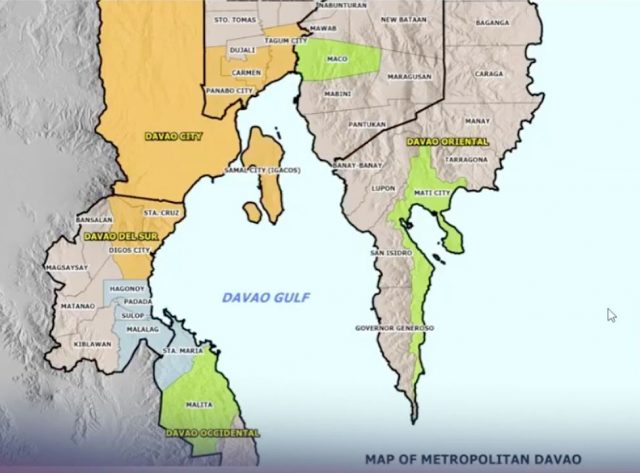
THE MINDANAO Development Authority (MinDA) welcomes the forthcoming establishment of the Metro Davao area, citing that its governing agency could help in the development of other urban centers in the country’s southern island.
“We are seeing this as aligning with our long-term assumption of how metropolis is going to evolve and emerge in Mindanao in the next few years,” Assistant Secretary and MinDA Deputy Executive Director Romeo M. Montenegro said in a virtual press briefing last week.
The Congress-ratified bill that will create Metro Davao and set up the Metropolitan Davao Development Authority (MDDA) has been transmitted to Malacañang for the President’s signature, according to Davao City Rep. Isidro T. Ungab, author of the measure’s version in the House of Representatives.
Mr. Montenegro said MDDA will aid other Mindanao stakeholders in terms of identifying specific strategies that should be pursued given the strengths and resources of the different regions.
“As we have always highlighted through the Mindanao Corridors (strategy), there is no ‘one size fits all’ strategies in Mindanao and everything is incumbent with the peculiarity of the area and the nuances of the localities,” Mr. Montenegro said.
“And therefore, if we are looking at specific development directions and planning for Metro Davao, it will have differences with the development direction that we should also be looking at (for example) the rural areas in Mindanao,” he added.
The Senate approved the consolidated bills on Metro Davao in mid-January.
It covers 15 towns and cities, with development programs and projects to be synchronized by the MDDA.
These are: Davao City; cities of Panabo, Tagum, and the Island Garden City of Samal in Davao del Norte; Digos City in Davao del Sur; Mati City in Davao Oriental; and the municipalities of Sta. Cruz, Hagonoy, Padada, Malalag, and Sulop in Davao del Sur; Carmen in Davao del Norte; Maco in Davao de Oro; and Malita and Sta. Maria in Davao Occidental. — Maya M. Padillo
A CHILD happily plays at the newly reopened Imus City playground on Sunday, March 13. With the lowering of the COVID-19 Alert Level to Level 1, the Local Government reopened the space for Imuseño children, following quarantine standards and the proper guidelines.
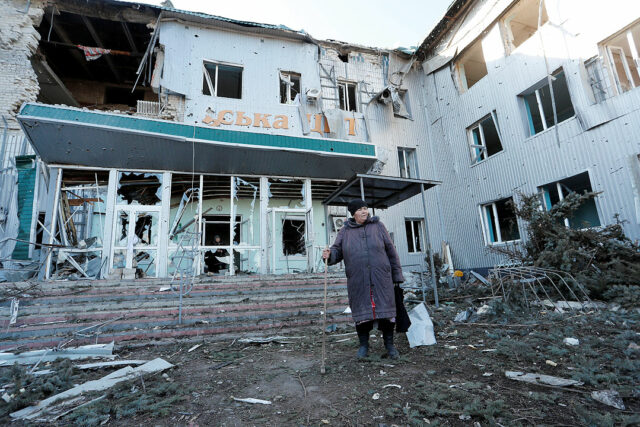
A WOMAN stands outside a local hospital, which was destroyed during Ukraine-Russia conflict in the separatist-controlled town of Volnovakha in the Donetsk region, Ukraine, March 12, 2022. — REUTERS
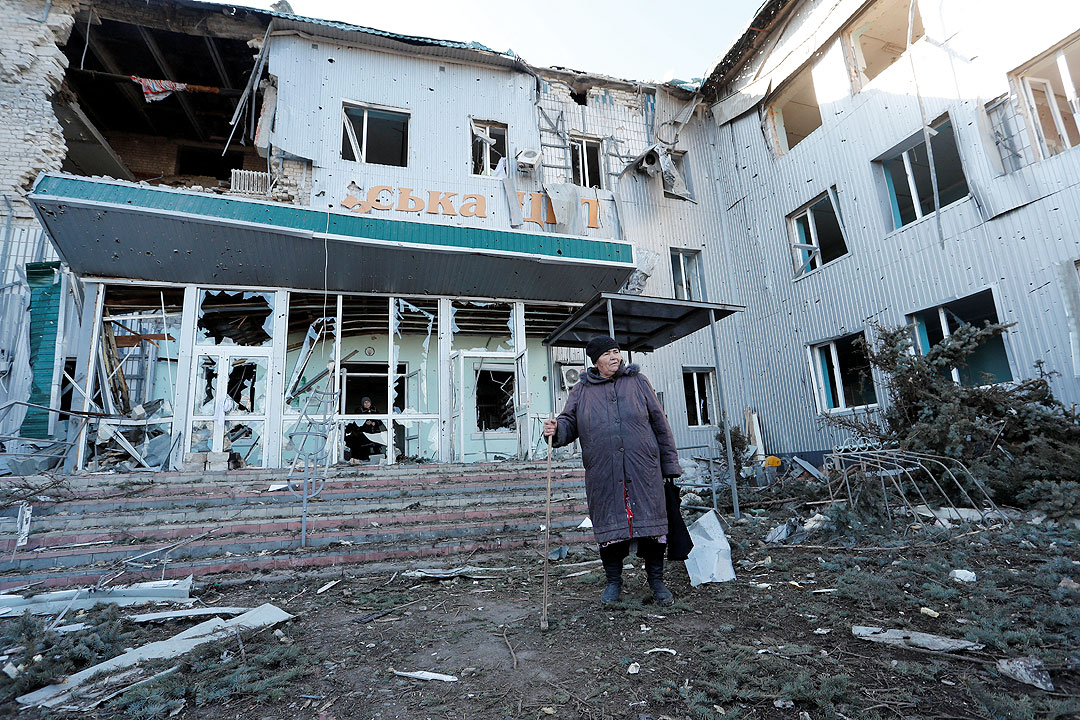
A WOMAN stands outside a local hospital, which was destroyed during Ukraine-Russia conflict in the separatist-controlled town of Volnovakha in the Donetsk region, Ukraine, March 12. — REUTERS
LVIV, Ukraine — Russian forces fired eight missiles at a Ukrainian military facility near the Polish border on Sunday, officials said, in what appeared to be the westernmost attack of the war, and air raid sirens again woke residents in the capital Kyiv.
“The occupiers launched an air strike on the International Center for Peacekeeping and Security” in Yavoriv, the Lviv regional military administration said in a statement. “According to preliminary data, they fired eight missiles.”
The administration did not say whether the training facility was hit or offer further details.
Ukrainian President Volodymyr Zelensky has warned Russian forces they face a fight to the death if they try to occupy the capital Kyiv, as air raid sirens again woke residents on Sunday morning.
“If they decide to carpet bomb and simply erase the history of this region … and destroy all of us, then they will enter Kyiv. If that’s their goal, let them come in, but they will have to live on this land by themselves,” Mr. Zelensky said on Saturday.
The president, who has repeatedly appeared on social media from the capital, said some small towns no longer existed in the third week of Russian attacks, the biggest assault on a European country since World War II.
Russian shelling has trapped thousands of people in besieged cities and sent 2.5 million Ukrainians fleeing to neighboring countries.
Ukraine accused Russian forces on Saturday of killing seven civilians in an attack on women and children trying to flee fighting near Kyiv. France said Russian President Vladimir Putin had shown no readiness to make peace.
The Ukrainian intelligence service said the seven, including one child, were killed as they fled the village of Peremoha and that “the occupiers forced the remnants of the column to turn back.”
Reuters was unable immediately to verify the report and Russia offered no immediate comment.
Moscow denies targeting civilians since invading Ukraine on Feb. 24. It blames Ukraine for failed attempts to evacuate civilians from encircled cities, an accusation Ukraine and its Western allies strongly reject.
Mr. Zelensky said Moscow was sending in new troops after Ukrainian forces put 31 of Russia’s battalion tactical groups out of action in what he called Russia’s largest army losses in decades. Reuters could not verify his statements.
“We still need to hold on. We still have to fight,” Mr. Zelensky said in a video address late on Saturday, his second of the day. Saying about 1,300 Ukrainian troops had been killed, he urged the West to get more involved in peace negotiations.
The United States said it would rush up to $200 million in additional small arms, anti-tank and anti-aircraft weapons to Ukraine, where officials have pleaded for more military aid.
The Kremlin describes its actions as a “special operation” to disarm Ukraine and unseat leaders it calls neo-Nazis. Ukraine and Western allies call this a baseless pretext for a war of choice that has raised fears of wider conflict in Europe.
Mr. Zelensky discussed the war with German Chancellor Olaf Scholz and French President Emmanuel Macron, who urged Mr. Putin to order an immediate ceasefire.
A Kremlin statement on their 75-minute call made no mention of a ceasefire. A French presidency official said: “We did not detect a willingness on Putin’s part to end the war.”
Russian Deputy Foreign Minister Sergei Ryabkov accused the United States of escalating tensions and said the situation had been complicated by convoys of Western arms shipments to Ukraine that Russian forces considered “legitimate targets”.
In comments reported by the Tass news agency, Mr. Ryabkov made no specific threat. Any attack on such convoys before they reached Ukraine would risk widening the war.
Crisis talks between Moscow and Kyiv have been continuing by video link, said Kremlin spokesperson Dmitry Peskov, according to Russia’s RIA news agency. He gave no details, but Ukrainian Foreign Minister Dmytro Kuleba said Kyiv would not surrender or accept any ultimatums.
HUMANITARIAN CORRIDORS Russian rocket attacks destroyed a Ukrainian airbase and hit an ammunition depot near Vasylkiv in the Kyiv region, Interfax Ukraine quoted its mayor as saying.
The exhausted-looking governor of Chernihiv, around 150 km (100 miles) northeast of Kyiv, gave a video update in front of the ruins of the city’s Ukraine Hotel.
“There is no such hotel anymore,” Viacheslav Chaus said, wiping tears from his eyes. “But Ukraine itself still exists, and it will prevail.”
Britain’s defense ministry has said Russian ground forces were massed 25 km (15 miles) from the center of Kyiv, while Kharkiv, Chernihiv, Sumy and the key Black Sea port of Mariupol remained encircled under heavy Russian shelling.
The general staff of the Ukraine armed forces said Russia had slowed its offensive and in many places its forces had been stopped. The military’s Facebook post did not give details.
Ukrainian officials had planned to use humanitarian corridors from Mariupol in the south as well as towns and villages in the regions of Kyiv, Sumy and some other areas on Saturday.
Around 13,000 people were evacuated from Ukrainian cities on Saturday, said Deputy Prime Minister Iryna Vereshchuk.
The Donetsk region’s governor said constant shelling was complicating bringing aid into Mariupol. Fires were burning in the western section of the city and dozens of apartment buildings heavily damaged, according to images taken on Saturday by private US satellite firm Maxar.
At least 1,582 civilians in Mariupol have been killed as a result of Russian shelling and a 12-day blockade, the city council said on Friday. Reuters could not verify casualty figures.
“There are reports of looting and violent confrontations among civilians over what little basic supplies remain in the city,” the U.N.’s Office for the Coordination of Humanitarian Affairs said.
People were boiling ground water for drinking, using wood to cook food and burying their dead near where they lay, a staff member for Medecins Sans Frontieres (Doctors without Borders) in Mariupol said. — Reuters
PARIS — France is to introduce a rebate of 0.15 euros ($0.16) per liter of transport fuel to help drivers cope with soaring pump prices, Prime Minister Jean Castex said in an interview with daily newspaper Le Parisien.
The measure, to apply for four months from April 1, is expected to cost the government just over 2 billion euros, he said.
Retail gasoline and diesel prices soared to record highs in many countries across the world this week as Russia’s invasion of Ukraine added to market tensions, after economies had begun recovering from the coronavirus pandemic.
A gesture of support for French motorists had been flagged by President Emmanuel Macron, who is campaigning for a second term in elections next month.
In the interview published on Saturday, Mr. Castex said the rebate would cover households as well as lorry transport and farmers.
The measure, which he said fuel distributors should reinforce with their own effort to cut retail prices, would save a motorist 9 euros on a 60 liter tank, Mr. Castex added.
Mr. Macron has said his government has already spent 20 billion euros a year to moderate gasoline and power costs. — Reuters
ERBIL, Iraq — A dozen ballistic missiles launched from outside Iraq struck the country’s northern Kurdish regional capital Erbil on Sunday, Kurdish officials said, adding there were no casualties.
The attack was launched from Iran, a US official told Reuters. The official, who spoke on condition of anonymity, did not provide further information.
There was no immediate claim of responsibility or further details available. A US State Department spokesperson called it an “outrageous attack” but said no Americans were hurt and there was no damage to US government facilities in Erbil.
Iraqi state TV quoted the Kurdistan region’s counter-terrorism force as saying 12 missiles launched from outside Iraq hit Erbil. It was not immediately clear where they landed.
US forces stationed at Erbil’s international airport complex have in the past come under fire from rocket and drone attacks that US officials blame on Iran-aligned militia groups, but no such attacks have occurred for several months.
The last time ballistic missiles were directed at US forces was in Jan. 2020 — an Iranian retaliation for the US killing earlier that month of its military commander Qassem Soleimani at Baghdad airport.
No US personnel were killed in the 2020 attack but many suffered head injuries.
Iraq and neighboring Syria are regularly the scene of violence between the United States and Iran. Iran-backed Shi’ite Islamist militias have attacked US forces in both countries and Washington has on occasion retaliated with air strikes.
An Israeli air strike in Syria on Monday killed two members of Iran’s Revolutionary Guards Corps (IRGC), Iranian state media said this week. The IRGC vowed to retaliate, it said.
Kurdish officials did not immediately say where the missiles struck. A spokesperson for the regional authorities said there were no flight interruptions at Erbil airport.
Residents of Erbil posted videos online showing several large explosions, and some said the blasts shook their homes. Reuters could not independently verify those videos.
Iraq has been rocked by chronic instability since the defeat of the Sunni Islamist group Islamic State in 2017 by a loose coalition of Iraqi, U.S.-led and Iran-backed forces.
Since then, Iran-aligned militias have regularly attacked US military and diplomatic sites in Iraq, US and many Iraqi officials say. Iran denies involvement in those attacks.
Domestic politics has also fueled violence.
Iraqi political parties, most of which have armed wings, are currently in tense talks over forming a government after an election in October. Shi’ite militia groups close to Iran warn in private that they will resort to violence if they are left out of any ruling coalition.
The chief political foes of those groups include their powerful Shi’ite rival, the populist cleric Moqtada al-Sadr, who has vowed to form a government that leaves out Iran’s allies and includes Kurds and Sunnis. — Reuters
NEW YORK—A Museum of Modern Art (MoMA) patron whose membership card was recently revoked for unruly behavior stabbed two MoMA employees on Saturday when they denied him admission to the famed midtown Manhattan site and then fled, police said.
The two victims, both women, were rushed to a local hospital for treatment of multiple stab wounds to their upper bodies, but “we’re told they’re going to be OK,” John Miller, deputy New York City police commissioner, told a news briefing afterward.
New York City Police Department (NYPD) officers launched a manhunt for the suspect, whom Mr. Miller said was familiar to MoMA staff as a museum “regular” and to police from previous “disorderly conduct” incidents, including at least one at MoMA, in recent days.
NYPD was not aware of any record of arrests or other brushes with the law, says Mr. Miller.
A letter revoking the man’s MoMA membership card was sent to him on Friday, and he showed up late on Saturday afternoon “with the stated intention” of seeing a film being screened at the museum, Mr. Miller said.
When he was told that his membership card had expired and was refused entrance, he became upset, jumped over the reception desk and stabbed the two employees, according to Miller. Surveillance video footage showed him fleeing the museum moments afterward on foot.
The New York Post posted photographs showing each of the two women being moved on gurneys to waiting ambulances outside the museum. The Post said the stabbings triggered a chaotic scene that sent visitors scurrying from the museum, renowned for one of the world’s largest and most influential collections of modern art. — Reuters
CEBU’S information technology and business process management (IT-BPM) industry is seeking an exemption from a government order to return to office work starting April 1, noting that the region continues to be affected by December’s Typhoon Odette.
“If they really want to implement it nationwide, maybe they can exempt Cebu because of the typhoon,” Cebu IT-BPM Organization (CIB.O) Executive Director Buddy R. Villasis told BusinessWorld in a phone interview last week.
The Fiscal Incentives Review Board (FIRB), which regulates industries eligible for incentives, particularly those that operate in economic zones, has declined to extend an old order allowing the industry to conduct the bulk of its work with home-based employees. The denial of the extension effectively means the industry’s workforce must revert to on-site work starting April 1.
Mr. Villasis said Cebu’s IT-BPM workforce of about 200,000 remains dispersed all over Mindanao, Samar, Leyte, Bohol, and Negros, to which employees with roots in those places returned during the pandemic.
Government policy has centered on increasing the proportion of on-site work in order to propel the recovery of the transport industry and small businesses that depend on spending by office workers.
“Is the city ready? Is the transport sector ready? Are all the telecommunications facilities fully restored? Are all the boarding houses ready to accommodate the thousands of people who will be coming back to Cebu? These should be considered,” Mr. Villasis said.
Cebu, he said, will need about two more months to get ready for the returning workers, with pending tasks including preparing offices and allowing their workers to look for accommodation.
Finance Secretary and FIRB Chairman Carlos G. Dominguez III said on Wednesday that the board, at a Feb. 21 meeting, rejected a petition by the Philippine Economic Zone Authority (PEZA) to extend work-from-home arrangements for workers in IT-BPM companies registered for incentives.
Mr. Dominguez said the increased vaccination rate wallows “safe measures for physical reporting of employees, including those working in the IT-BPM firms operating within economic zones (ecozones) and freeports.”
Work-from-home arrangements were only meant to be temporary in response to the pandemic, he said. The IT-BPM industry’s entitlement to incentives is tied to their use of premises located in economic zones.
Asked to provide comment, PEZA Director General Charito B. Plaza said in a phone message: “We’re negotiating” the FIRB ruling and preparing “a letter of reconsideration.”
“The companies are not against returning to sites fully but not that fast. It will take them some time to bring in everybody back to onsite,” Mr. Villasis said.
CIB.O members met with officials of the Inter-Agency Task Force for the Management of Emerging Infectious Diseases (IATF)-Cebu and other government officials on Thursday to “lobby… for Cebu to delay the full implementation of the return-to-office order, otherwise it will be problems,” he added.
“We got our power and telco (connections) back five days after the typhoon, but not all. Losses reached P500 million per day of no operations. So that’s a major headache,” Mr. Villasis noted.
POWER PLANTS endorsed to the regulatory commission for five-year operating permits included 12 diesel-powered facilities out of 17 overall, according to a list posted to the Department of Energy’s (DoE) website five years.
Of the other plants endorsed to the Energy Regulatory Commission (ERC), three are coal-fired, one hydro-powered and one using biomass as feedstock.
If issued a Certificate of Compliance by the ERC, the 17 plants are expected to add 1,495.41 megawatts (MW) of capacity to the power grid.
Mariveles Power Generation Corp.’s Mariveles Coal-fired Power Plant and SMC Consolidated Power Corp.’s new Kimay Circulating Fluidized Bed Coal-fired Power Plant had the largest capacity of any plant on the list at 600.1 MW each.
The DoE endorsement paves the way for the grid operator to conduct a system impact study, which will generate a finding that a plant is suitable for connection to the power grid.
Eleven of projects are being developed by the National Power Corp. and the remaining six by South Luzon Thermal Energy Corp.; DMCI Power Corp., Mindoro Grid Corp., SMC Consolidated Power Corp., Mariveles Power Corp.; and Cleangreen Energy Corp.
The DoE has said that the energy grid is expected to have 7,910.96 MW of additional capacity by 2027, with coal-fired plants accounting for 46.68%, natural gas 38.71%, renewable energy 11.39%, and oil-based facilities 6.67%. — Marielle C. Lucenio
THE critical role of natural gas as a “transition fuel” en route to achieving the world’s environmental objectives warrants a new pricing system decoupled from the volatility of most energy commodities, an energy department official said.
Energy Undersecretary Gerardo D. Erguiza called for a system of “fair pricing” for natural gas, demand for which has grown because of the Russian invasion of Ukraine. Fear of sanctions on Russia, a major gas supplier to Europe, has sent Europe scrambling for alternative sources of supply, making energy more expensive overall.
At a March 9 panel discussion for Cambridge Energy Research Associates Week (CERAWeek) in Houston, Mr. Erguiza argued for a pricing system that makes natural gas affordable in order to ensure a smooth transition to clean energy.
The Philippines “is currently in a transition stage from fossil fuel to clean energy and our transition fuel is natural gas. Along with other fuel prices, natural gas prices also unexpectedly rose,” Mr. Erguiza said separately via Viber.
Manila Electric Co., which sources most of its natural gas from the offshore Malampaya field, warned consumers on Thursday that the impact of the Russia-Ukraine crisis will be felt by power consumers in May.
Energy prices are set globally and tend to move in unison based on calculations of the equivalency of each form of fuel in generating a given amount of energy.
As of March 10, Dubai crude oil is at $114.13 per barrel, according to Bloomberg.
“Expensive natural gas doesn’t serve its purpose,” Mr. Erguiza added.
Separately, Atlantic Gulf & Pacific Company (AG&P) is set to open the Philippines’ first integrated liquefied natural gas (LNG) import terminal in Ilijan, Batangas, in July, marking the Philippines’ transition to gas importer after decades of tapping Malampaya, which is approaching commercial depletion by 2027.
Alexander P. Gamboa, managing director and global head of business development for AG&P Manila, Inc., said the terminal will help service the gas market that had been created by Malampaya.
Mr. Gamboa has said that high demand for LNG has exerted upward pressure on prices but has also created arbitrage opportunities as more sites store gas, effectively making prices less volatile overall.
“The ability of LNG to be moved through a growing network of terminals gives developing countries in Asia effective access to global arbitrage and (and the ability to diversify) supply. In turn, this reduces dependence on global gas reserves, not to mention coal, and mitigates geopolitical trading risk,” he said.
AG&P’s LNG terminal will store and deliver LNG to power plants. It is expected to have an initial annual capacity of 3 million tons of regasified LNG.
“Without the safety net of natural gas, renewable energy would struggle to establish itself as the backbone of stable energy systems,” Mr. Gamboa said. — Marielle C. Lucenio