Home Blog Page 6618

Cracks widen in euro zone economy as war in Ukraine rages on

REUTERS

FRANKFURT — Europe’s economy is increasingly strained by Russia’s war in Ukraine as growth stalls, confidence plummets and inflation soars, data and warnings from policymakers made clear on Wednesday. 

Sanctions on Russia following its invasion last month have pushed energy prices to record highs across the continent, sapping confidence and raising the risk of another recession, even before some states have recovered from a downturn fueled by coronavirus disease 2019 (COVID-19)

Germany, the bloc’s biggest economy and one of the most reliant on Russian energy, will be among the hardest hit and the government’s council of economic advisers on Wednesday more than halved their growth forecast for this year, to 1.8%. 

“The risk of a recession is substantial,” Volker Wieland, one of the panel’s members said, adding the economy would now take until the third quarter to return to its pre-pandemic size. 

The advisers, whose forecasts guide the government in setting fiscal policy, also predicted that German inflation would double to over 6%. 

As the government triggered an emergency plan for possible gas rationing should supplies from Russia be disrupted or stopped, Wieland said Germany should work to end its dependence on Russian energy, possibly through a longer-than-anticipated nuclear energy program. 

This would push up inflation for now but improve the long-term security of the country and the economy’s stability, he said. 

European Central Bank (ECB) President Christine Lagarde also warned that, as the conflict drags on, Europe’s economy could suffer more than feared just a few weeks ago. 

“The longer the war lasts, the higher the economic costs will be and the greater the likelihood we end up in more adverse scenarios,” she said in a speech. 

In Vienna, Austria’s central bank cut its growth forecast and sharply raised its inflation outlook for this year, saying its new predictions would worsen further if the war dragged on. 

STAGFLATION DILEMMA 

Ms. Lagarde said households were already becoming more pessimistic and businesses could soon be postponing investment. 

Her warning was underlined by a sentiment indicator that showed the war had sent consumer confidence in the euro zone plummeting and inflation expectations to record highs. 

The European Commission’s economic sentiment index dropped to 108.5 in March from a downwardly revised 113.9 in February, while consumer confidence plunged to -18.7 from -8.8. 

The biggest hit to confidence came from inflation, which is sapping consumer spending power, even as governments quickly roll out subsidies to ease some of the pain. 

In Spain, one of the bloc’s biggest economies, inflation accelerated to 9.8% in March, the fastest pace since May 1985, from 7.6% in February. 

German price growth meanwhile soared past expectations to hit 7.6%, a level not seen since the early 1980s, suggesting that the euro zone reading on Friday is almost certain to exceed economists’ 6.6% forecast. 

“Those inflation numbers were absolute whoppers, big big upside surprise to the numbers,” Chris Scicluna, head of research at Daiwa Capital Markets, said. 

Stagnating growth coupled with high inflation — stagflation in economic jargon — leaves Ms. Lagarde’s ECB in a dilemma. 

While the central bank would normally tighten policy to fight inflation, such a move could exacerbate a recession, hurting consumers even more. 

To mitigate the risk, Ms. Lagarde promised to move only by small increments, without making longer-term commitments. 

“Gradualism means that we will move carefully and adjust our policy as we receive feedback on our actions,” she said. 

This policy dilemma could in turn divide the ECB’s rate setting Governing Council even more, as conservatives are already calling for a hike to combat high inflation. 

“Unless … the war …becomes a global conflict, then I think that the first rise (of rates) could come towards the end of this year,” ECB policymaker Peter Kazimir said. — Balazs Koranyi/Reuters

Axie Infinity owner ‘fully committed’ to reimbursing players after hack

REUTERS

The company behind the popular Axie Infinity crypto game said it will reimburse online participants who lost funds after hackers stole about $600 million from a blockchain system underpinning the game.

“We are fully committed to reimbursing our players as soon as possible,” Aleksander Leonard Larsen, chief operating officer of the gaming studio Sky Mavis, said via text message. “We’re still working on a solution, that is an ongoing discussion.”

Hackers exploited a security weakness in a so-called bridge — software that lets people convert tokens into ones that can be used on another network — to drain it of 173,600 Ether and 25.5 million USDC tokens in two transactions. The breach happened on March 23, but was only discovered Tuesday, according to Ronin, the blockchain that supports Axie Infinity.

The funds swiped include the “deposits of players and speculators and the Axie Infinity Treasury revenue,” Larsen said. Of the Ether stolen, 56,000 belonged to the Axie Infinity treasury, he said. The company doesn’t suspect insider involvement in the heist, according to Larsen.

Axie Infinity is among the biggest of the so-called play-to-earn games, which allow participants to accumulate tradeable crypto coins. Daily active users swelled last year in developing countries hit hard by Covid, including the Philippines, Brazil and Venezuela. It continued to be played Wednesday.

The attack is the latest to show that bridges are often rife with problems. The computer code of many isn’t audited, allowing for hackers to exploit vulnerabilities. It’s often unclear who runs them and exactly how. Identities of validators, who are supposed to order transactions on bridges, are often shrouded in mystery. And yet there are thousands of bridges out there, and they move hundreds of million of dollars worth of crypto.

POSSIBLE SOLUTIONS

Among possible ways to raise funds, Sky Mavis could sell some of its Axie-related tokens in bulk at discount to major players, or sell the company’s equity to raise cash, said Sam Peurifoy, head of interactive at Hivemind Capital who also leads the play-to-earn guild Kapital DAO in Axie Infinity.

Alternatively, the Axie community could host a vote to approve liquidating enough funding from its “community treasury” — which currently has a total net worth of $1.6 billion — for reimbursements of the hack, Peurifoy said.

AXS, a token used in Axie Infinity, fell as much as 11% after the hack was announced before recouping some losses. It was down about 9% on Wednesday, according to CoinMarketCap data. Ron, a token used on the Ronin blockchain, was down about 20%.

“From our experience, the chances of recovery are low,” said Rishav Rai, lead investigator for Merkle Science, a blockchain data analysis company. “When we look at the biggest crypto hacks and heists out there, it’s very rare that the funds get returned.

Sky Mavis has said it keeps all its revenue from Axie Infinity — including fees for joining the game, breeding its nonfungible token creatures, and other in-game payments — in its treasury, and only uses outside investor money to maintain its real-world team’s operations. It generated $1.3 billion in revenue in the 12 months through February.

“The easiest way to look at this is like the bridge is the bank for the Ronin Network,” Larsen said. “The heist that happened took out all the ETH and USDC. So the ETH/USDC on Ronin Network is not currently backed by anything. But we are looking at other options.” — Bloomberg

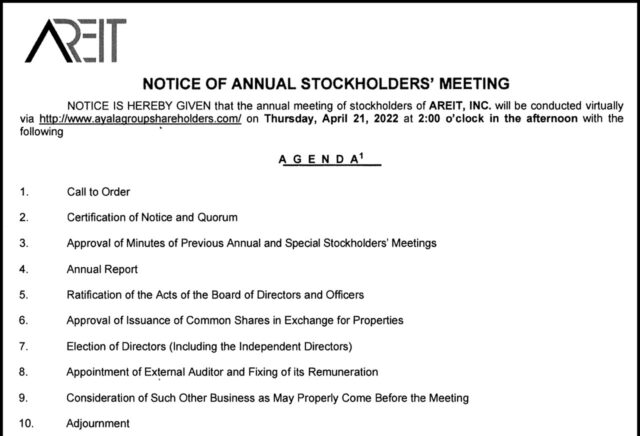
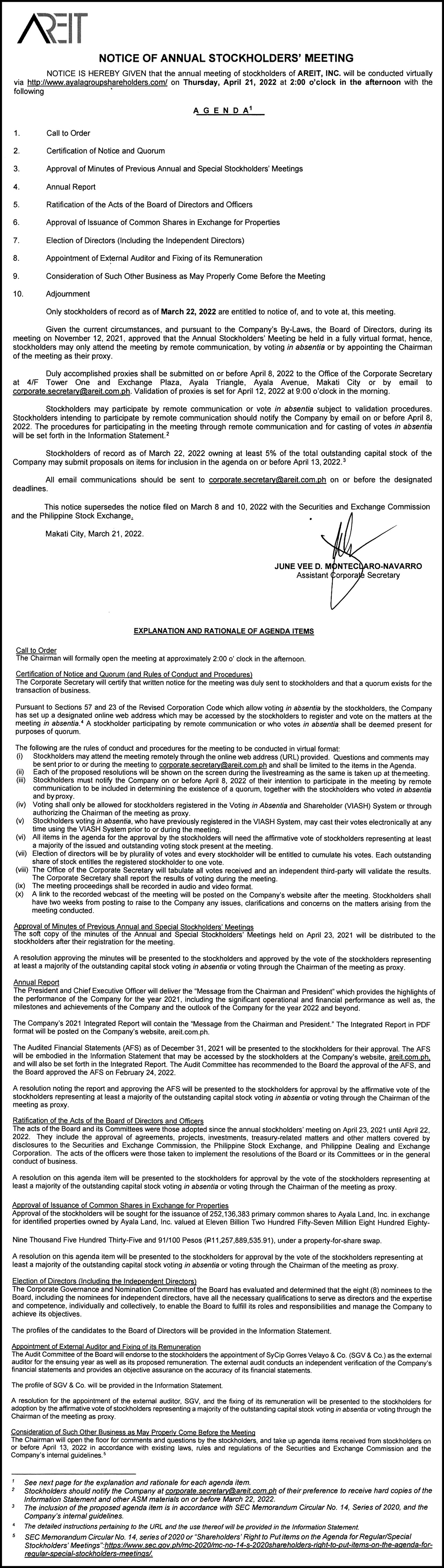
AREIT, Inc. announces schedule of annual stockholders’ meeting on April 21

Click to enlarge.

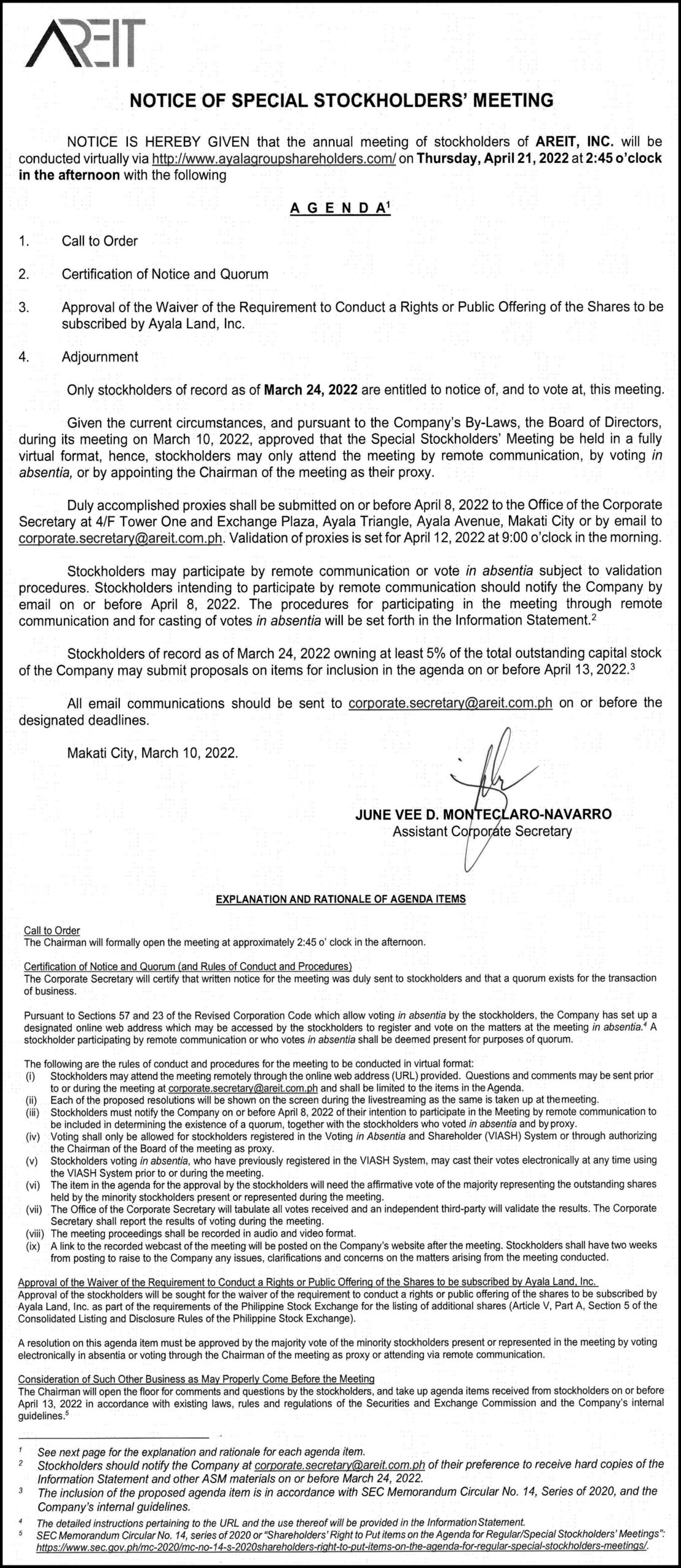
AREIT, Inc. announces schedule of special stockholders’ meeting

Click to enlarge

Smart delivers Best Mobile Video Experience, according to Ookla®

Following its back-to-back awards as the Philippines’ fastest 5G mobile network, PLDT mobile services arm Smart Communications Inc. (Smart) has been recognized anew for delivering the Best Mobile Video Experience across all mobile technologies, according Ookla®, the global leader in mobile and broadband network intelligence.        

Ookla declared Smart as the winner of the Best Mobile Video Experience award with a Video Score™ of 65.75 based on its analysis of Speedtest Intelligence® data covering Q3-Q4 2021 from 54,894 user-initiated tests. Its closest competitor registered a Video Score of 60.    

Measured on a scale of 0 to 100, Ookla’s Video Score considers the real-world experience of users while streaming videos, such as watching on a website or a streaming app.   

To score consumer video experience, Ookla evaluates five components, including the percentage of tests where users failed to play a video, the average waiting time of users to start a video, the quality of video, the percentage of tests where the video stalled, and the percentage of rebuffering among those who experienced a stalled video.  

Reinforcing Philippines’ Fastest 5G Mobile Network 

Smart’s latest recognition for Best Mobile Video Experience reinforces the provider’s feat of sweeping the Ookla Speedtest Awards™ in both the first and second half of 2021 as the Philippines’ fastest 5G mobile network amid its continuous 5G rollout and network improvement efforts across the country.

Market research firm Statista estimates that as of Q3 2021, over 98 percent of internet users in the Philippines watched any kind of online video content each week.           

“As Filipino online users have become accustomed to streaming online videos, our fastest mobile network enables us to deliver the best Video Experience to our subscribers across all mobile technologies – whether it’s on 3G, 4G, or 5G,” said Jane J. Basas, SVP and Head of Consumer Wireless Business at Smart.  

“The latest Ookla data reflects our unrelenting efforts to improve customer experience and stay ahead of their needs and demands so they may pursue their passions,” she added.  

Watch live and on-demand content on Smart GigaPlay app

As part of its push to provide the best Video Experience to Filipinos, Smart introduced the Smart GigaPlay app, which offers free access to specially curated live and on-demand sports and entertainment content exclusive to subscribers.  

Downloadable on the Apple App Store and Google Play Store, GigaPlay offers live and on-demand coverage of the biggest local and international sports leagues, including the FIBA World Cup Qualifiers, Japan B League, National Basketball Association (NBA), National Basketball League (NBL), Philippine Basketball Association (PBA), Premier Volleyball League (PVL), and the University Athletic Association of the Philippines (UAAP). 

Also included in GigaPlay’s expanding catalogue are international and K-Pop music award shows and concerts, Korean drama series, and Hallyu Hangouts sessions, among other awesome content attuned to the passions of Filipinos.  

Extensive network infrastructure nationwide  

Through its extensive network infrastructure nationwide, Smart is able to support the growing mobile needs of its 3G, 4G/LTE, and 5G subscribers from Batanes to Tawi-Tawi.   

As of end-2021, Smart has deployed around 7,200 5G base stations across the country. Supporting Smart’s mobile network is PLDT’s extensive fiber infrastructure, which is at 743,700 kilometers as of end-December. 

Disclaimer: Based on analysis by Ookla® of Speedtest Intelligence® data Q3–Q4 2021. Ookla trademarks used under license and reprinted with permission.  

ASC Ref No. S110P033022SS


Spotlight is BusinessWorld’s sponsored section that allows advertisers to amplify their brand and connect with BusinessWorld’s audience by enabling them to publish their stories directly on the BusinessWorld Web site. For more information, send an email to online@bworldonline.com.

Join us on Viber to get more updates from BusinessWorld: https://bit.ly/3hv6bLA.

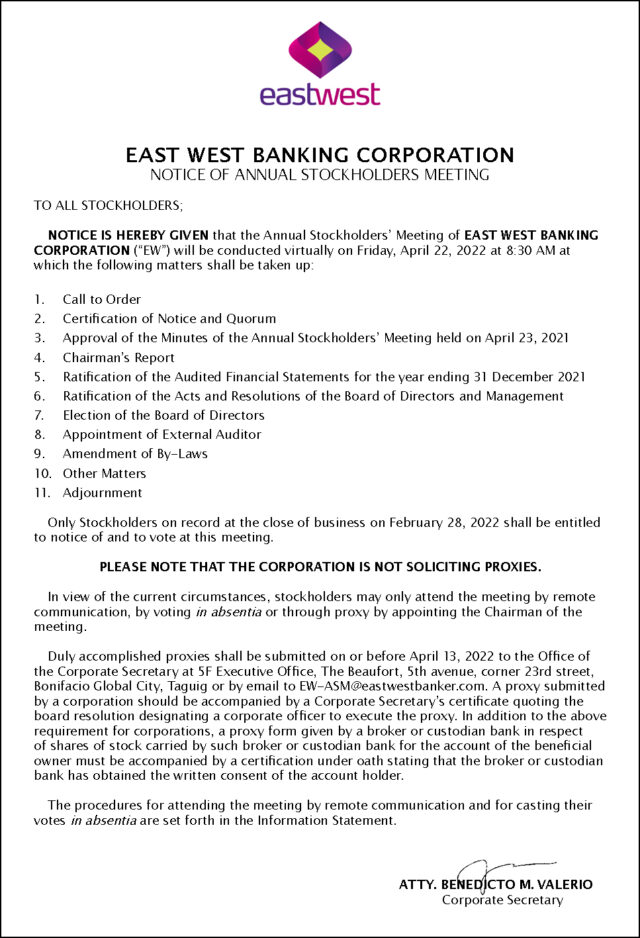
East West Banking Corp. to conduct annual stockholders’ meeting virtually on April 22


Spotlight is BusinessWorld’s sponsored section that allows advertisers to amplify their brand and connect with BusinessWorld’s audience by enabling them to publish their stories directly on the BusinessWorld Web site. For more information, send an email to online@bworldonline.com.

Join us on Viber to get more updates from BusinessWorld: https://bit.ly/3hv6bLA.

Shipping costs seen to drive inflation

REUTERS
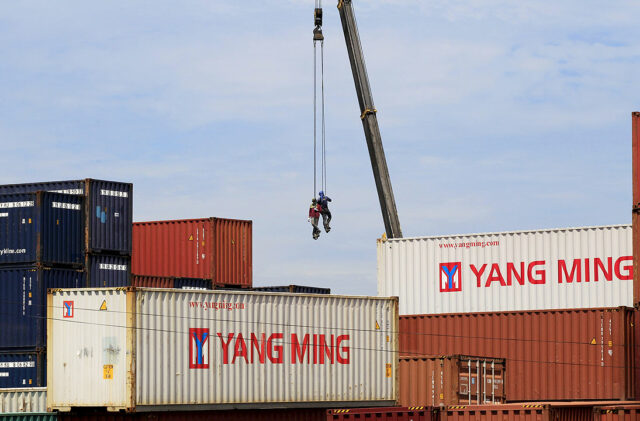
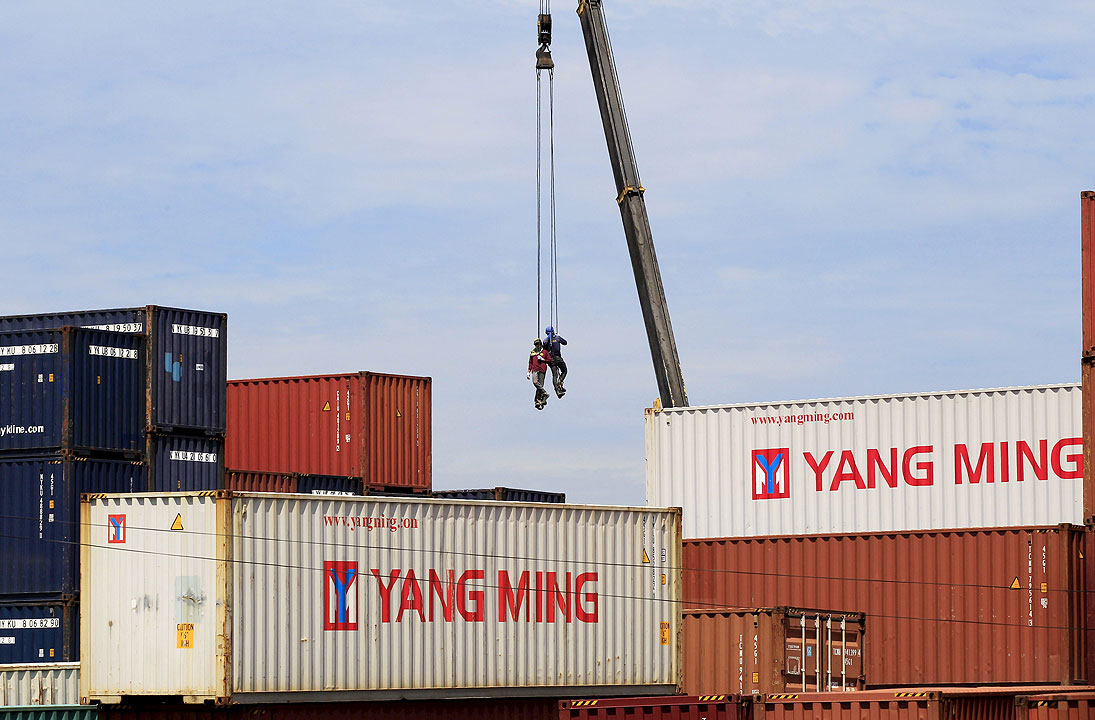
Cargo containers are seen at a shipping yard in Cavite, July 23, 2015. — REUTERS

By Luz Wendy T. Noble, Reporter

THE SURGE in global shipping costs will likely continue causing faster inflation in economies that are reliant on imports until the end of the year, according to the International Monetary Fund (IMF).

In a blog titled “How Soaring Shipping Costs Raise Prices Around the World,” IMF analysts Yan Carrière-Swallow, Pragyan Deb, Davide Furceri, Daniel Jiménez and Jonathan D. Ostry said global shipping costs that have soared during the pandemic due to supply chain disruptions are expected to remain elevated this year.

“Our results suggest the inflationary impact of shipping costs will continue to build through the end of 2022. This will create complicated trade-offs for many central bankers facing increasing inflation and still ample slack in economic activity. Moreover, the war in Ukraine is likely to cause further disruptions to supply chains, which could keep global shipping costs — and their inflationary effects —higher for longer,” they said.

Using data from 143 countries over the past 30 years, the IMF analysts found shipping costs are an important driver of inflation.

“When freight rates double, inflation picks up by about 0.7 percentage point. Most importantly, the effects are quite persistent, peaking after a year and lasting up to 18 months. This implies that the increase in shipping costs observed in 2021 could increase inflation by about 1.5 percentage points in 2022,” they said.

Countries that import more of what they consume will likely experience faster inflation, they said.

Philippine Chamber of Commerce and Industry President George T. Barcelon said supply chain issues, including soaring shipping costs, are expected to persist throughout 2022. He said this has affected the input cost for both exports and imports.

Mr. Barcelon noted the logistics issue began during the pandemic but is worsening due to the rising global oil prices. Firms are hopeful that the Russia-Ukraine conflict would be resolved soon, easing the pressure on crude oil prices.

“In the next two weeks, we hope fuel prices subside, but the problem on supply chain logistics and the shipping will not go away,” Mr. Barcelon said in a phone call.

Lockdowns in some major cities in China have also aggravated the situation, he said. Port congestion has worsened in cities such as Shenzhen and Hong Kong as Chinese authorities continue to pursue a COVID-zero strategy.

Mr. Barcelon said the supply chain issues and higher shipping costs are a big problem specifically for exporters of perishable goods like fruits.

The IMF study found the increase in shipping costs is reflected in the prices of imported goods at the dock within two months. “But the impact on the prices consumers pay at the cash register builds up more gradually, hitting its peak after 12 months,” IMF analysts said.

Last week, Philippine Liner Shipping Association President Mark Matthew F. Parco has said freight fees have already increased by 25% on average.

Shipping is crucial for an archipelago like the Philippines as about 90% of trade is transported via water, UnionBank of the Philippines, Inc. Chief Economist Ruben Carlo O. Asuncion said.

“This could then have a big impact on inflation, and could most likely hit the transport index,” Mr. Asuncion said in a Viber message.

ING Bank N.V. Manila Senior Economist Nicholas Antonio T. Mapa said the surge in shipping cost is a case which proves that inflation pressures are unlikely to be transitory.

“On top of expensive oil, the shortage of tankers is also playing a role in keeping freight costs expensive. This is likely to continue until we get more tankers plying shipping lanes and when we start to see global energy prices slide,” Mr. Mapa said in an e-mail.

The Bangko Sentral ng Pilipinas (BSP) last week raised its inflation forecast for the year to 4.3%, which is already beyond their 2-4% target range, reflecting the surge in oil and commodity prices due to the war in Ukraine.

Headline inflation was steady at 3% for the second straight month in February. March inflation data will be out on April 5.

Filipinos ride NFT gold rush before the predicted bust

A NON-FUNGIBLE TOKEN (NFT) is displayed on the website of NFT marketplace OpenSea in this illustration picture taken on Feb. 28, 2022. — REUTERS

By Brönte H. Lacsamana, Reporter

AJ DIMARUCOT, 46, is one of a slew of Filipinos who use so-called non-fungible tokens (NFTs) to collect and sell digital art on the internet.

The Philippines ranked first out of 20 countries in terms of ownership of NFTs, which represent real-world objects such as art, music, in-game items and videos that are traded online, usually with cryptocurrency.

About a third of Filipino internet users claim to own these tokens, according to a December online survey by Australian information service provider Finder.

“Whether you’re a small or big artist, you immediately have a way to monetize your efforts and work using NFTs,” he said via Zoom.

Mr. Dimarucot sees a future when people, instead of providing free content to companies such as Facebook and Instagram in exchange for likes and followers, can monetize their creativity by getting their audience to pay $.001 or a peso for every like.

One in three NFTs have ended up as a dead collection, with little or no trading activity after minting, blockchain analytics firm Nansen said in a March 26 report.

Another third of the tokens were trading below the price it cost issuers to mint the tokens, according to the firm, which analyzed 8,400 collections made up of more than 19 million NFTs on the Ethereum blockchain.

“Our analysis revealed that NFT minters’ behavior could be taken as a signal for the short-term market trend, just as how we observe miners’ behavior as a proxy for Bitcoin’s price,” Nansen said.

As failed projects pile up, long-time crypto observers are having flashbacks to the initial coin offering bust of 2018, when thousands of digital tokens quickly became worthless after regulators warned they’re probably unregistered securities, Bloomberg reported.

Gary Vaynerchuk, the entrepreneur and chief executive at VaynerMedia, has predicted that 98% of NFT projects will fail after the gold rush fades, according to CNBC.

Mr. Dimarucot’s son is also involved in NFTs through Axie Infinity, an online video game where one can collect and mint NFTs that represent creatures known as Axies.

“It’s probably through gaming that we onboard more people into the space, and they might not necessarily know what an NFT is,” Mr. Dimarucot, an artist and graphic designer, said.

Unlike cryptocurrency, non-fungible tokens are unique and can’t be exchanged for one another. While one Bitcoin is always equal to another Bitcoin, NFTs have a digital signature that makes it impossible to exchange them for another NFT (hence, non-fungible).

By trading art via blockchain technology, such items become “non-fungible,” or unique due to authentication by digital certificates that also track each asset’s movements.

In 2020, non-fungible tokens took the Philippines by storm, with many home-bound Filipinos playing games to earn amid a coronavirus pandemic.

Axie Infinity, the most popular of these games, allowed Filipino players to buy in-game pets called Axies to win battles and reap rewards. These were then traded or sold for the cryptocurrency Ethereum.  (Related story, “Hackers steal about $600 million in one of the biggest crypto heists”)

“I learned about Axie Infinity in July from a friend who was earning lots of money from it,” an anonymous collector who goes by the name Vector said via Discord. “He told me how to apply for a scholarship with Axie University.”

While he still doesn’t completely understand what NFTs are, he’s keen on improving his game to earn more.

Play-to-earn gamers like Vector spurred the rising popularity of the NFT gaming scene in early 2021, which led to an increase in the prices of in-game assets.

Yield Guild Games (YGG), which invests in blockchain games and NFT assets, loans out Axies to “scholars” who want to play and earn. Vector is one of these scholars.

“It’s not easy to earn, though,” he said. “You have to work hard to play really well.”

Aside from YGG, many other outfits have popped up to fill the so-called NFT supply chain to support the growing community since the play-to-earn boom.

BreederDAO, a Philippine-based blockchain startup, has raised $10 million in series A funding through a token sale co-led by Andreessen Horowitz and Delphi Digital.

“If you look at the space right now, it’s still very raw,” Renz Carlo Chong, chief executive officer and one of the co-founders of BreederDAO, told BusinessWorld in a video interview. “Nobody has a full grasp of how play-to-earn really works.”

Axie Infinity is struggling and a number of games that followed are also barely keeping up, he pointed out. “It’s really interesting because nobody knows where the space will head towards.”

Axie Infinity has been losing about 50,000 players a month since January, based on data from activeplayer.io, due to supply-and-demand imbalance and volatile crypto assets, which developers at Sky Mavis have been trying to fix.

Mr. Chong is optimistic because of new blockchain startups and traditional gaming companies see value in the NFT space and are moving into it.

“You get to own these assets and you get to sell them in a decentralized marketplace, so you can see all of these projects — YGG, for example, tackling the player liquidity sides, bringing on the demand for all of these play-and-earn games,” he said.

BreederDAO seeks to tackle the asset liquidity side by bringing in the technology, human resources, and share in the market to increase their asset base and production capacity.

‘SCAMS’
As a digital artist with a son earning from Axie Infinity, Mr. Dimarucot thinks more Filipinos would probably join the NFT space due to both art and gaming. “More people will understand that there’s utility, there’s community and there’s a lot of opportunities in the space, so I’m excited.”

A staggering $174 million has been spent on NFTs since November 2017. Their sales surged to $25 billion globally in 2021 alone, fueled by the rising interest of celebrities and tech evangelists, according to market data tracker DappRadar. But some experts believe NFTs are a bubble that could eventually pop.

There are also concerns about the token minting process consuming a huge amount of energy and carbon footprint as well as accusations of the entire space being a Ponzi scheme.

“Please take the time to study NFTs,” said Marvin Germo, a financial consultant and author of the Stock Smarts book series, in a YouTube video discussing whether they’re a fad or the future. “Similar to cryptocurrencies and the metaverse, they’re technology. They’re disrupting the way we’re seeing things.”

There are scams and schemes everywhere and NFTs can harm people in the wrong hands, so it’s best to do your homework, he said via Zoom.

“No matter how much celebrities talk about it, you don’t invest in it or buy it just because other people are buying it,” Mr. Germo, who collects NFTs, said. “You should study anything that requires you to put your money in it.”

Mr. Chong said learning about non-fungible tokens is important, especially because it’s a new thing. “It’s really the same with a lot of new innovations.”

Because the blockchain is decentralized without banks to run the economy, there are also no operating expenses. The NFT community is instead governed by a code of trust that gives value back to users.

This makes it prone to all sorts of exploits, scams and hacks, something all innovations have to go through and address as they mature, Mr. Chong said.

Platforms like YouTube have been looking into features for video creators to capitalize on NFTs. Twitter now has a paid service where users can integrate NFT profile pictures by connecting their account to their Metamask wallet.

But artists looking to mint their works on the blockchain struggle with the newness of it all, Mr. Dimarucot said.

The urgent need to earn on the part of gamers becomes a driver to learn about the process.

“It was difficult at first, but the opportunities motivated me to research NFTs,” said Vector, the Axie Infinity scholar. “So far, it’s been worth it.”

The rewards trump both the hassle and the risks, as anyone already in the space would say, but Mr. Chong thinks there’s a vision to work towards.

Mr. Dimarucot claims the future of digital ownership will benefit those slaving away under the current Web 2.0 system, where people provide free content to companies such as Facebook and Instagram in exchange for likes and followers.

In the Web 3.0 metaverse — an idea for a new iteration of the World Wide Web based on blockchain technology — a small artist can monetize their efforts and everyone can supposedly give value to a digital creation.

“I think we’ll reach the point where you’re naturally doing NFTs without necessarily knowing it, like buying a ticket to a concert or a plane ticket or renewing a passport or license or getting a birth certificate,” Mr. Dimarucot said.

“Everything will be NFTs and tokenized on the blockchain.”

Treasury sets P200-B borrowing plan for April

BW FILE PHOTO

By Tobias Jared Tomas

THE NATIONAL Government is planning to raise P200 billion from the domestic market in April, the Bureau of the Treasury (BTr) said on Wednesday.

In an advisory, the BTr said the April auction of Treasury bills (T-bills) is targeted to generate P60 billion, while auction of Treasury bonds (T-bonds) is targeted to bring in P140 billion.

The April borrowing plan is smaller than the P250-billion programmed domestic borrowing this month. However, the government only raised less than half of the program in March.

A trader said in a Viber message that next month’s borrowing plan is lower as March had five auction weeks, compared with April’s four.

The weekly borrowing volume remained the same, however, as P15 billion in T-bills and P35 billion in T-bonds will be auctioned off every week.

The Treasury will offer P15 billion in short-dated T-bills — P5 billion each in 91-, 182- and 364-day bills — on April 4, 11, 18, and 25.

For the longer-term T-bonds, the Treasury will auction off P35 billion in three-year securities on April 5, P35 billion in four-year papers on April 12, P35 billion in the seven-year instruments on April 19, and the 10-year papers on April 26.

“Despite numerous rejections this month, the government had a borrowing boost via the offshore dollar bond issuance which amounted to a total of $2.25 billion,” a second trader said in a Viber message.

The Treasury raised $2.25 billion from its first triple tranche, US dollar-denominated bond offering last week, which included its first-ever green bonds.

The government said it raised $1 billion from the inaugural 25-year green bond offer, as well as $500 million from five-year bonds, and $750 million from 10.5-year bonds.

The second trader added that the lowered borrowing program in April also serves as a “breather for market participants,” who have been on the defensive amid expectations of rate hikes by the central bank.

The Bangko Sentral ng Pilipinas (BSP) kept its key interest rate unchanged last Thursday, although BSP Governor Benjamin E. Diokno has signaled rate adjustments in the second half.

The government borrows from local and external sources to help fund a budget deficit seen to hit 7.7% of gross domestic product this year.

The National Government has a gross domestic borrowing program of P1.91 trillion this year. Of this amount, T-bills will generate P52 billion, while fixed-rate T-bonds will bring in P1.86 trillion.

Diokno sees rate rise to 2.5%-2.75% as reasonable

BANGKO SENTRAL NG PILIPINAS GOVERNOR BENJAMIN E. DIOKNO — PHILIPPINE STAR/ GEREMY PINTOLO

PHILIPPINE CENTRAL BANK Governor Benjamin E. Diokno said raising the key policy rate to between 2.5% and 2.75% as part of an exit from pandemic-era accommodation would be “reasonable and consistent” with the nation’s economic growth and inflation targets.

“We plan to start the normalization process in the second half of the year,” Mr. Diokno said in a mobile-phone message on Wednesday, when asked about the plan for rate hikes. “It is not date specific, but we will continue to be data dependent,” he said, adding that a 2.75% key policy rate “might be reached by next year.”

Bangko Sentral ng Pilipinas last week held interest rates steady at a record low 2%. While the authority sees inflation averaging above its 2%-4% target this year, it expects consumer-price increases to be within the goal next year. Economic planners forecast output to grow between 7% and 9% this year.

The Philippines is among many Asian nations that has so far refrained from the global rate-hiking cycle led by the US Federal Reserve, choosing to nurture economic recovery even as price pressures rise.

“This is as clear a signal as it gets that again BSP is in no rush to start hiking despite forecasting inflation already above target this year,” said Euben Paracuelles, economist at Nomura Holdings, Inc. in Singapore. It “suggests BSP will be quite gradual in the pace of normalization, in contrast to the US Fed.”

The peso rose as much as 0.3% to its strongest against the dollar since March 7 in early trading on Wednesday.

Mr. Diokno on March 26 said a rate increase isn’t the appropriate tool to address supply-driven price pressures, and suggested non-monetary moves to the government. BSP has kept interest rates on hold since November 2020, and is scheduled to set the benchmark rate next on May 19. — Bloomberg

Deadline for ITR filing moved to April 18 — BIR

PHILIPPINE STAR/KRIZ JOHN ROSALES

THE BUREAU of Internal Revenue (BIR) moved the deadline for filing income tax returns (ITRs) to April 18, as the annual April 15 deadline falls on Good Friday this year.

In a BIR bulletin, the tax collection agency also reminded authorized agent banks (AABs) to extend their banking hours until 5 p.m., from the original cut-off time of 3 p.m. for the April 1 to 18 period.

BIR Commissioner Caesar R. Dulay also asked banks to accept payments on April 2, as two Saturdays before the tax deadline were declared as regular holidays. Araw ng Kagitingan falls on April 9, while Black Saturday is on April 16.

In a separate bulletin, Mr. Dulay reiterated the responsibilities of banks in accepting annual ITRs and payments.

Banks should accept all tax payments made by taxpayers using BIR official printed forms or copies of system-generated filing reference numbers; photocopies of returns or electronically filled tax returns; and downloaded annual ITRs.

Banks should also stamp “Received” on attached forms of specific pages of the ITRs, and ensure portions of the ITR and deposit slips are machine validated.

They should also accept payments made through checks, provided that check tax payments are made payable to the BIR.

Banks are also reminded that they cannot impose penalties on violations committed by taxpayers, as this responsibility falls to the BIR, Mr. Dulay said.

The BIR is targeting to collect P2.4 trillion this year. For the month of April, the BIR’s collection target is P256.89 billion. — Tobias Jared Tomas

D&L Industries’ earnings up 31% on exports growth

D&L Industries, Inc. on Wednesday reported a net income of P2.6 billion last year, up 31% from a year earlier, driven by increased economic activity and growth in the food ingredient maker’s export business.

“Our business faced incredible challenges during the pandemic. Now emerging two years later on a better footing both operationally and financially, with our earnings already back to pre-COVID levels, we feel that the company has not only proven but also strengthened its resilience,” D&L President and Chief Executive Officer Alvin D. Lao said in a statement.

He added that while the company is cautiously optimistic about the pandemic’s tailend, “we remain focused on our core competencies, ready to ride another wave of volatility brought about by recent geopolitical uncertainties.”

In the fourth quarter, earnings fell 25% to P480 million from P637 million in 2020, as margins dropped due to the lag in pass-through prices.

In its disclosure, the company said the rapid increase in commodity prices during the quarter and the tailend effect of the surge of the Delta virus variant “tempered” D&L’s consecutive quarters of earnings growth.

“With a lower COVID alert level in place and continued decline in new cases in the country, the company sees a buildup in momentum and renewed business optimism for further recovery,” it added.

D&L reported that prices of some of its key raw materials, including coconut and palm oil, surged in the past couple of months.

Average year-to-date prices of coconut oil and palm oil were up 23%, coming from over 60% year-on-year increases for both commodities in 2021.

“While D&L is able to adjust its selling price regularly to reflect higher input prices, there is a time lag of 30-45 days before the company can fully pass on price changes. As such, in an environment of rapid price increases, temporary margin contraction is possible. However, management sees this as temporary and expects margins to recover once commodity prices start to stabilize,” it said.

Meanwhile, the volume of high-margin specialty products (HMSP) grew 13% in the fourth quarter due to the eased quarantine restrictions.

“Had it not been for the lower margins due to the sharp increase in commodity prices, higher HMSP volumes would have resulted in meaningful earnings growth in the fourth quarter. Looking ahead, while the soaring commodity prices may weigh on volume recovery, the company sees the continued reopening of the economy to help fuel demand and offset potential weakness,” D&L said.

Exports, which accounted for 33% of total revenues, jumped 62% to P10.2 billion in 2021 and were up 81% in the fourth quarter.

Of the exports, coconut-based products under food and oleochemicals were the main drivers behind the growth.

“Coconut oil continues to gain traction in the global market due to its perceived natural antiviral, antibacterial, and antifungal properties. In addition, coconut oil remains a valued, sustainable substitute for petroleum-based raw materials used in many applications such as personal hygiene and home cleaning products. Going forward, the company expects its foothold in coconut oil-based exports to strengthen, which should offset some of the weakness in the domestic market in the near term,” D&L said.

The holding company is currently expanding its Batangas facility, which is expected to begin commercial operations in January 2023.

To accommodate additions and upgrades to the original plan for the facility, D&L increased the budgeted capital expenditures (capex) to P9.1 billion from P8 billion. The company had spent around P6.2 billion for the project as of end-December.

In September, the company executed its maiden bond offering, raising P5 billion to help fund the remaining capex for the expansion.

The facility will cater to D&L’s growing export businesses in the food and oleochemicals segments, by allowing the company to manufacture downstream packaging,

“This means that D&L will have the ability to process the raw materials and package them closer to finished consumer-facing products. This will enable D&L to move a step closer to its customers by providing customized solutions and simplifying their supply chain, which is of high importance given ongoing logistical challenges,” the company said.

D&L said it is also ramping up its sustainability measures through research and development.

“In the global scene, D&L is seen as an advocate for sustainable products derived from sustainable materials such as coconut oil, given its extensive technical know-how and wide array of product offerings,” the company said.

Its Batangas plant will be designed with sustainable infrastructure and operations with sustainable products in mind.

The company offers various sustainable products such as plant-based replacements for dairy and animal-derived ingredients, biodiesel that is a more environment-friendly substitute for fossil fuels, coconut oil-based natural and organic raw materials for home and personal care products, organic fertilizers, and even sustainable packaging materials.

“As the world shifts toward a more sustainable consumption, D&L plans to continue to play on its strengths and develop more products designed to better lives while being kind to the planet. The company sees this trend as the next leg of growth and sees the next decade as transformational for the company,” the company said.

“Nonetheless, while 2022 won’t be without difficulties, we continue to pursue areas of opportunities that will bring the next leg of growth for the company. With coconut oil continuing to gain traction globally as a natural and sustainable substitute to many petroleum-based raw materials, we plan to further capitalize on this by entering more export markets and by using our research and development expertise to introduce more highly specialized, coconut-oil based products,” Mr. Lao said.

At the stock exchange, D&L shares went up by 0.77% or P0.06 to close at P7.85 apiece on Wednesday. — Luisa Maria Jacinta C. Jocson

ADVERTISEMENT
ADVERTISEMENT